Feeds:
Posts
Comments

Archive for the ‘Haida’ Category

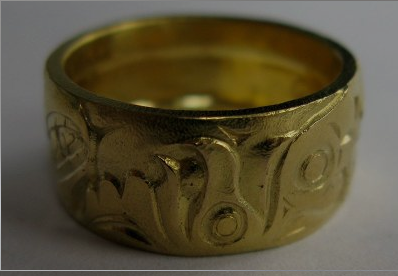
One way that you know an artist is talented is when other artists are eager for their work. Gwaai Edenshaw is in that enviable position among the Northwest Coast artists who live in Vancouver. A some-time botanist and Bill Reid’s last apprentice, he works largely in gold, although he has been known to sketch, carve wood, and even experiment with animation. Having admired his work since we first saw it, Trish and I recently celebrated our anniversary by buying two of his rings.

Mine is based on an episode in “Raven Traveling,” the Haida narrative of the Trickster’s wanderings near the beginning of time. On the beach, the raven encounters a group of crows. They begin to cook a salmon. The raven falls asleep, but the crows can’t wait for him to wake, and devour the salmon. Belatedly, they realize that the raven will be angry when he rouses, so they take the remaining crumbs of salmon, and wedge them between his teeth. When the raven wakes, hungry for his meal, they point out the crumbs and ask, “Don’t you remember? You ate it before you went to sleep.” Angry at the deception, Raven throws the crows into the fire, turning them forever from white to black.

I appreciate the story for its broad humor, as well as its extrapolation from nature; crows really do mob ravens, especially when their young are in the nest. If crows could play practical jokes on ravens, they undoubtedly would. Also, the story is not one of the ones that is generally depicted, like raven’s stealing of the light, or even his theft of the salmon from the beavers.

I suggested the subject to Edenshaw, and waited with all the patience that anticipation would allow for six months until he had time to get to it.

The result was more than worth the wait. Edenshaw chose a style that fits the humor of the story, showing the raven with his beak open and crows rollicking around him, pushing the crumbs of salmon into his mouth and their beaks open in excitement, no doubt chortling with glee at the thought of putting one over on their rival.

Since the raven has teeth in the story, and the Haida storytellers must have had plenty of chances to notice that birds have none, I assume that he must have been in human form when he met the crows. However, the fact that Edenshaw chose to show the raven as a bird with teeth in his beak does not detract, any more than the teeth in the beak of the parrot in Aladdin. It is a comic touch, and the result is reminiscent of the lively cartoons that you see in the margins of medieval manuscripts. I especially like the mischievous crow that is pushing a piece of salmon along the raven’s back (You can see the crow’s beak just behind the top of the raven’s head).

At the same time, I appreciate the economy and skill with which Edenshaw rendered the story. Like a business card (only more so), a ring provides a very limited space for depicting anything, yet Edenshaw manages to focus on the main event of the story, while selectively choosing details so that, while the feathers on raven’s head are not visible, the pieces of salmon clearly are. The detail is all the more amazing when you consider that the ring is cast, not engraved.

So far as I am concerned, Edenshaw produced a ring that is utterly unique, and wonderfully rich in humor and detail. After wearing it for several weeks, and having appreciated the small extra touches with which it was delivered (in a small wooden box, with the promise that the mold would be kept, in case the original was lost), I fully intend to buy more of Gwaai Edenshaw’s work. But if, as I suspect, his prices rise as he receives the recognition he deserves, at least we have a couple of samples of his work to console ourselves.
lm

Read Full Post »

For the past three Wednesday evenings, I’ve attended George Macdonald’s lectures on Haida villages at the Bill Reid Gallery. It was time well-spent, and I only regret that the lectures stopped with three. Nobody is boring when talking about an area of expertise, and Macdonald, Director of the Bill Reid Centre for Northwest Coast Art Studies at Simon Fraser University and the author of Haida Monumental Art, was certainly in his element. Just as importantly, he combined knowledge with an informal and lively manner, which made for an absorbing scholarly trio of evenings.

Macdonald divided his subject matter into the southern villages centering on Skidegate, the central villages around Masset, and the northern or Kaigani villages of southern Alaska. Unsurprisingly, the second lecture was the most popular, with many Haida living in Vancouver coming out for it, including artists like Gwaai Edenshaw and Dorothy Grant, but the third was also popular, perhaps because the arbitrary border has resulted in few Canadians knowing much about the Kaigani villages. And the entire series was attended by a core of regulars, including me.

The first surprise in the lecture is how much photographic evidence exists from the 19th and early 20th centuries. Because much of this evidence is not available to the general public, many people, I suspect, are like me and believe that it is very limited. However, Macdonald speaks in terms of thousands of photos (and I’m not sure that he didn’t talk of tens of thousands), to say nothing of sketches by anthropologists and navy officers, and works of art like Emily Carr’s. In fact, so much of this evidence exists that pieces can be cross-correlated, and the distinctive style of individual – if often anonymous – artists can be detected. Macdonald showed perhaps a few hundred slides of this evidence, but his lectures were enough to suggest the surprising wealth of material.

Another source of evidence is family tradition. In many Haida villages, memory or written records have preserved the names of many of the houses, as well as some of their history. For instance, at the third lecture, Dorothy Grant told her grandfather’s story of how his village was abandoned for a centralized, missionary-run new village of running water and electricity. During the burning of possessions that the missionaries insisted upon, her grandfather saved only the contents of the bentwood box in his hands.

Nearly four hours of lecture and audience participation is almost impossible to summarize. However, other topics in Macdonald’s lectures included the patterns of resettlement in the south as European diseases forced the survivors to regroup and, in many cases, regroup again; the use of palisades and hilltops during wars between lineages; the names and appearances of some of the great chiefs and carvers of a hundred and forty years ago; the question of whether Albert Edward Edenshaw was trying to bypass matrilineal inheritance by bestowing property on his son, and the characteristic designs of the graves of shamans. In many cases, too, the villages were illustrated by sketch maps or aerial photos.

Equally fascinating were Macdonald’s own stories of his experiences as an archaeologist in the field. They ranged from the careless destruction of one pole that survived into modern times in Prince Rupert, and the danger of bears while exploring villages. Macdonald also revealed in passing some of the professional issues and puzzles in the study of villages.

This was the first lecture series from the Bill Reid Gallery. The gallery is an ideal place for a small crowd, even if the monumental Mythic Messengers and the smell of cedar from Jim Hart’s work on his tribute pole to Bill Reid sometimes became distractions. But, on the whole, if it is an example of what these organizations plan to offer in the future, then future events deserve to be crowded. Like any good lectures, Macdonald’s have pushed back the boundaries of my ignorance a little while tantalizing me to find out more.

Read Full Post »

« Newer Posts