Feeds:
Posts
Comments

Archive for the ‘writing’ Category

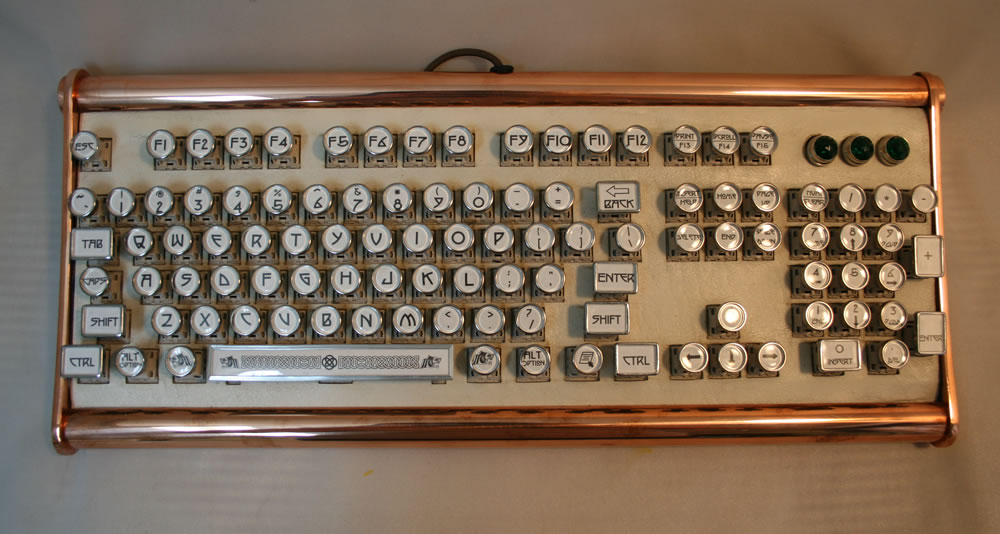
My long-awaited Arts and Crafts keyboard arrived yesterday from Datamancer Enterprises. Its copper and white leather, plus the Celtic knot-work design on the space bar is exactly what I envisioned. But what surprises me is the way the sound and feel of the mechanical action of its keys affects my writing.

It’s been years since I thought I needed special tools for writing. A professional writer, I maintain, ought to be able to work with whatever is at hand. So, while I have my preferences, over the years I have written on everything from a Palm pilot in its graffiti alphabet to the keyboard of a smart phone to a notebook. The point has never seemed the hardware, but preserving the content as quickly as it comes to me. Everything else has seemed pretension to me, like the various software tools that are supposed to help wannabes (Vim or a basic text editor is usually enough for me).

Still, I didn’t always feel that way. As a young adult with poetic aspirations, I was convinced that my writing was somehow tied to the muscular movements of a pen. The words I wrote by hand seemed to have a deeper, more thoughtful tone than things I attempted to write on a keyboard, and possibly a richer vocabulary as well. But somewhere in the first years of the millennium, I learned to do all my writing in front of a computer, and if my style suffered as a result, the damage was not enough to stop me from publishing regularly.

However, as soon as my fingertips connected with the new keyboard, I was aware of a change in how I was writing. It wasn’t that I had to press the keys slightly harder than I do on a cheap keyboard. Rather, I seemed to be paying more attention to what I was doing. What came next seemed to be blossoming in my mind earlier and quicker than with a cheap keyboard, and I was more likely to go back as I was writing and make changes in wording and structure, rather than leaving such changes for my revisions. The right word seemed to come morre easily. On the whole, I seemed to have a greater understanding about what the item I was composing needed.

At first, I thought the change was the result of the louder click alone. That surprised me, at first, because previously I would have imagined that I preferred a silent keyboard. But the sound of my new keyboard is the sound of progress being made – a sort of mechanical cheering to encourage me to keep going.

But that doesn’t seem to be whole of it. The action of the keys seems to be involved, too. The slight extra pressure on the keys seems to make a difference, and not just because at the end of yesterday my fingers felt like they had had an extra workout. Instead, it’s more like the connection between me and the words that I used to feel with a pen has been re-established.

After some thinking, I now wonder if the low-end keyboards I’ve used until now make typing too easy. Their keys are so sensitive that they require little effort on my part. That may sound like a desirable trait, but the lack of effort seems to severe my sense of connection. Now, entirely by accident, that connection has been restored in a way that I never thought possible (let alone necessary) with a keyboard.

Or, to put it another way, my new keyboard is like a bicycle: It extends my capabilities, but by supplementing the movement of my fingers instead of replacing them. By contrast, standard keyboards are a like a car, reducing my muscular actions to no more than a signal, and replacing them with its own actions. The slightly greater effort required by new keyboard is just enough to make me aware of what I was doing.

I’ll have to see how I feel as I’m settling down with the new keyboard. But, for now, I’m convinced that it is bring me closer to what I am doing, engaging me in a way that other keyboards do not.

It seems to me that this is what the best technology should do. Instead, many machines seem to reduce the need for human action. The result is that we are subtly alienated from our production, even when doing something like writing that is supposed to be creative.

All I know for sure is that I already I seem to detect a different cadence in my writing, and a tone that is closer to my speaking voice than most of what I create on the computer. I look forward to using the new keyboard, because it seems to be one the rare tools that really will help me to write more effectively.
copper2

Read Full Post »

George Orwell’s legacy includes dozens of memorable phrases. They include “Big Brother is watching you,” “All animals are equal, but some animals are more equal than others,” and “If you want a vision of the future, imagine a boot stamping on a human face—forever,” all of which are more chilling for seeming all too probable. But if anything, he is even better known for the words he coined, like “doublethink” and “thoughtcrime.” However, one Orwellian coining that I’ve always wished had become a part of English is “duckspeak.”

According to Orwell in Nineteen Eighty-Four, “duckspeak” means superficially different things depending to whom it is applied. When used of a speaker who follows the current orthodoxy, it is a word of approval. However, when applied to an enemy, it’s an insult;.

In its vividness, the word reminds me of some the great invective of the eighteenth century, including “toady,” “bootlicker” and “lickspittle.” And now I think, the eighteenth century developed a near-synonym for duckspeak, too – “cant.”

Both cant and duckspeak refer to a bland and unthinking expression of conventional ideas, often with enthusiasm and stubbornness. The difference is that cant was usually applied to statements that the speaker disagreed with. Duckspeak retains that application, but becomes a compliment when you agree with the statement, because speaking in cliches implies an unthinking loyalty. The implication is that a person who is a duckspeaker is unlikely to be disloyal, because they have no original thoughts.

Essentially, duckspeakers are those who break every rule for clear expression that George Orwell summarized in “Politics and the English Language.” They don’t use short, effective words; they use long, vague ones that obscure their meaning. They frown on original thought, and prefer instead to string cliches together into an approximation of meaning.

Rather than communication, their goals are inter-personal. They may hope that a flow of empty phrases will silence the opposition and impress bystanders into a silent admiration of their eloquence. However, their main purpose – quite unconsciously – is to show themselves orthodox followers of whatever line of thinking they happen to support.

The idea that speech or writing might be used to get things done is foreign to their actions, although when you point out the fact, they are likely to stare at you and wonder why you are stating the obvious – thereby proving that they are also engaged in what Orwell termed “doublethink,” the holding of two completely contradictory ideas at the same time.

Examples of duckspeak are everywhere. You might say that it is the dialect of modern industrial culture. But what got me thinking about duckspeak was the incident at PyCon that people call Donglegate. Hearing two men behind her joking about big dongles, Adria Richards posted a picture of them on Twitter to shame them, and complained to the conference organizers, who reprimanded the men. Richards later blogged about the incident with what can only be called a triumphant tone, suggesting she had struck a blow for women in technology. Soon after, others started giving their opinion of what happened. Richards and one of the jokers lost their jobs, and anti-feminists sent her death and rape threats.

Anybody with a claim to impartiality might have seen these events as evidence that feminism has come to high-tech, and that exactly how it will fit into that sub-culture needs to be discussed. However, with few exceptions, people on both sides could only respond with duckspeak.

The anti-feminists attacked Richards for the joker’s loss of his job, while openly rejoicing when she lost hers. They labeled her a stereotypical feminist – dictatorial, humorless, and erratic – and suggested that she deserved what happened to her. Rather than trying to analyze the memes that might have caused Donglegate, they used it as an excuse for the same old invective, ignoring the fact that many things need to change.

But to my dismay, the feminists – the women and men I support – responded as badly.. They excused Richards’ actions on the grounds that talking to the jokers one-on- one might be difficult for a woman, ignoring the fact Richards is articulate and capable. They petitioned for Richards’ employer to rehire her, while showing little sympathy for the fired joker, suggesting that he deserved what happened to him. They painted her as the victim of racism and misogyny (which she was), but made little mention of her arrogance and carelessness.

In other words, all nuance was lost in the discussion, and with it any hope for serious discussion. Both sides were too busy proving their orthodoxy to manage anything constructive.

Aside from a possible emotional catharsis, all that came out of the affair was the tendency of some anti-feminists to quote their opponents in squeaky voices. To a reader of Orwell like me, they seemed to have independently re-invented duckspeak in the most literal sense. But of course, what they never noticed is their verbal manifestos could have been lampooned in exactly the same. way.

Most people didn’t even get that much from the affair. We are all so used to public discussion degenerating in this way that most of us forget that it could be conducted in any other way.

That’s probably why duckspeak, like cant before it, has become obsolete. You don’t need a word for the norm. It’s just how people behave.

Still, watching episodes like Donglegate unfold, I conclude that a revival at least of duckspeak, with its ambiguous meanings, would be a useful way to improve public thought. Watching the anti-feminists and feminists demonstrate their separate orthodoxies, I couldn’t help thinking of the end of Animal Farm, in which humans and pigs are mingling, and the watching animals are having an increasingly hard time telling the two apart.

That’s where duckspeak leads. And if, by any chance I’m guilty of it here, then all I can say is – quack to you, too.

Read Full Post »

Say something controversial to me in person, and you usually don’t much of a response. I have to be unusually tired or fed up before I’ll do more than say something non-committal and make an excuse as soon as possible to leave. Often, my withdrawal will be to write about the outrageousness of what just happened, because, in print – having sold some 1400 articles and written some 665 blog entries – I’m not exactly known for my reticence. But occasionally, being silent even in print is forced on me by circumstance, although usually at the cost of biting my tongue hard enough that it needs a dozen stitches.

It doesn’t happen often. I have a naïve reverence for the power of dialog. Unlike my father, who learned in the army that giving your opinion could be dangerous if you were overheard by the brass, I believe in talking, no matter what the consequences. Despite countless examples to the contrary, I continue to believe, very simply and sincerely, that if I can just get a conversation started, I can improve things by pointing out previously overlooked nuances, working to keep people informed, and pointing out possible common ground or solutions that nobody else has raised.

The trouble is, the chance for dialog doesn’t always exist..

For example, once I had the kind of story that every writer dreams about. I had proof of some major financial inconsistencies that an organization had been making for several years running, up to and including a loan made to a former director. It was a rare case of black and white without nuance of gray, and I was practically cackling in anticipation of being a minor league Woodward or Bernstein.

The only trouble was, no reputable editor would touch it. Too controversial, they all said, even though I had evidence. Not the sort of thing we publish, one editor told me. So I fumed and stayed silent, and eventually the story sunk into irrelevancy.

Several times, too, some organization or person I had researched has done and said something rash, and I’ve been in the person in the best position to write a blistering op-ed in reply. And I wanted to, because their actions put one cause or another I believed in into disrepute. Sometimes, I even went so far as drafting a dissection of their actions and possible effects with all the verbal wit of a Dorothy Parker or the polemical skill of a Harlan Ellison (at least in my own imagination). But, in the end, I refrained from publishing.

In these cases, part of my restraint has been my deep-seated reluctance to join a lynch mob. I don’t care for the mob mentality, having been on its receiving end once or twice, and I won’t countenance it; it feels too much like being a bully, no matter how justified.

More importantly, while the organization or person may deserve to be called into account, the causes they represent may not. Yet it is not always easy to separate the organization or person from their causes. An attack on the organization of purpose may hurt the cause. So, once again, I shut up, fuming that I am letting someone get away with crassness or stupidity while seeing no other choice except to attack a worthwhile cause.

So what do I do while such events play out? I listen to favorite music. I go for harder than usual workouts. Sometimes, too, I write other things, including blog entries on the difficulty of silence.

Read Full Post »

I have been lucky enough to witness several social revolutions in my time. The most obvious is the personal computer; I only regret that it didn’t happen twenty years earlier. But the one that is most important to me personally is the acceptance of women into the literary canons.

Art being the record of human experience, this change did as much as any friendship or relationship to help me understand that women’s experiences were human experience, and therefore were something I needed to know.

When I started studying literature in Grade 12, women were severely under-represented in the works studied in academia. Except for those who might be hidden under the name of Anonymous, the first female writer mentioned was usually Jane Austen. She was too important a novelist to ignore, but for the rest of the nineteenth and twentieth century, women’s representation was limited. Charlotte Bronte was credited with having written one worthwhile novel. Elizabeth Barrett Browning had written a collection of soppy sonnets to her husband. Christina Rossetti had written a few children’s poems and minor lyrics. Emily Dickinson was a decided eccentric.

And so it went, with women consistently written out of the literary history whenever possible, and presented as minor if they had to be mentioned at all. Even George Eliot was known for only three novels, one of which, Silas Marner, was taught mainly because it had the virtue of being short enough for undergraduate’s attention spans.

The only exception was contemporary literature, especially science fiction. There, you could find female authors in something close to the percentages that you might expect from random chance, and I read writers like Ursula K. LeGuin and James Tiptree, Jr. (actually, Alice Sheldon) as eagerly as their male peers. But even these pioneers sometimes had little to say about women as women, as Le Guin would come to acknowledge later in her career.

Anyway, there was something daring about asserting the worth of writers who were still living. Somehow, they were not taken with quite the same seriousness as writers in the canon.

By contrast, by the time I finished my bachelor’s degree, the canon had been drastically revised. In those pre-Internet days, the main reason for this change was the feminist-inspired publication of more female writers, often by small, painfully non-profit imprints.

Suddenly, Charlotte Bronte, Christina Rossetti, and George Eliots were revealed to have had not just the occasional success, but entire writing careers. Other writers were suddenly being talked about – people like Aphra Behn, Mary Shelley, Ann Radcliffe, Zora Neale Hurston, and dozens of others.

I viewed this change with a mixture of enthusiasm and confusion. On the one hand, here was enough fresh reading to keep me busy for years (which it has). On the other hand, just what had I been taught?

More importantly, who were these women? As a science fiction reader, I already knew that all worthy works were not contained in the canon, and reading Robert Graves’ literary criticism had taught me that exercising my own judgment on the canon was not only permissible, but necessary for independence of thought.

Yet if these women were any good, then surely I would have been taught something about them. I suspected that the promotion of some of these writers was as much the result of academics creating careers for themselves as it was of negligence. And, aside from the occasional exception for historical reasons, why should I bother with mediocrity?

Gradually, though, I realized I was being unreasonable. How could I possibly learn who was worth reading unless a wide variety of works were available? Besides, while most of the work of Elizabeth Gaskell (for example) struck me as uninspired back then, so did that of accepted male members of the canon, such as Anthony Trollope or William Thackeray. If mediocre men were accepted, there was no reason not to accept mediocre women as well. If nothing else, tastes differ, not only between person and also occasions.

At any rate, the newly available work had enough masterpieces to justify the era of rediscovery in general. Without it, I might never have discovered the slippery mind of Aphra Behn, or learned as a non-Christian to appreciate the quirky thoughts of Christina Rossetti. I would have enjoyed Middlemarch and The Mill on the Floss, but not have had Eliot’s other books to put them into context.

Just as importantly, I found myself reading works by women differently once a critical mass of their work became easily available. Being a young man and as egocentric as most young men, I had always read Jane Austen’s novels about courtship and marriage or Jane Eyre‘s story of love and indendence as exceptions – interesting in their own way but somehow trivial compared to the concerns of male writers.

However, discovering dozens of female writers changed my perception. Newly able to place their subject matter in context, I realized that such topics were not exceptions. For a very long time, they were the concerns of half the human race. If I were to be fully human myself, I needed to understand these concerns, and appreciate them – and in a matter of months, I did.

I like to think that ordinary life was leading me to similar conclusions, and perhaps it was. But I think that, without the rewriting of the canon, the process would have taken me years, instead of months. I might not have even been ready for love and marriage when they came my way near the end of my readjustment.

People often talk about how feminism transforms women’s lives. But, if my personal example is any indication, its effect on men’s lives can be just as great. Throughout my life, my outlook has been broader – more mature – because of the simple fact that, when I was in my late teens, suddenly I could read about women’s lives and learn to appreciate them as the material of art.

The lesson remains one of the most valuable ones that I have ever had.

Read Full Post »

Parliamentary democracy is far from a perfect system of government. Its party system and first past the post elections are both serious flaws that seem increasingly unsuited to the modern world. However, it does include one concept that I find invaluable: that of the loyal opposition.

To anyone used to another system of government, the words “loyal opposition” may seem like an oxymoron. If someone was loyal, how could they oppose the government? If someone opposed the government, in what sense could they be loyal? Americans, with their system of confrontational politics, have a particularly hard time with the concept.

As a concept, the loyal opposition is reminiscent of the devil’s advocate. The assumption behind both is that questioning decisions and suggesting ways of modifying them makes for better decisions. It is also assumed that, in raising questions and making suggestions, the opposition is ultimately committed to making the government’s decisions better, and has a genuine allegiance to the country.

To someone trying to comprehend the idea, the loyal opposition sounds absurd at first. Since the opposition wants to form the government someday, surely its main motivation must be to discredit the government at every opportunity, rather than helping it to pass better laws or to take more useful actions. And today, to a large extent, people who think this way would be right.

All the same, the concept of the loyal opposition continues to exist. Especially in times of crisis, it allows a government and its opposition to act together. Yet, even in untroubled moments, it is not unusual to learn that the same people who exchange carefully restrained abuse in the House of Commons are in the habit of having a drink together in the evening.

I mention the concept because the loyal opposition is often the position I find myself in as a writer about free and open source software (FOSS). Despite the speed at which FOSS is growing, those involved in the community tend to be a small group. They know each other and, although feuds exist, they often support each other uncritically. They exchange praise easily, and rarely criticize each other – a situation that doesn’t always make for the best possible decisions.

Sometimes, users can correct this tendency by protesting clearly and repeatedly. However, users are not easily stirred up, and too much happens that would be better for a review.

That’s where people like me come in. I am all in favor of FOSS (if I wasn’t, I would be off doing something more lucrative), but there are frequently times when more feedback is useful, when a suggestion of alternatives is needed, or someone simply to say in public what everyone is saying in private emails and tweets. Nobody else is doing these things, so people like me write commentaries that do.

My criticism is rarely as harsh as it could be. In fact, you could probably get an accurate sense of my opinions by how diplomatically I phrase them. But, like the loyal opposition, I believe – perhaps arrogantly – that the community makes better decisions because someone says them at all.

Contrary to the knee-jerk cynicism of the Internet, it’s not because I am a paid troll, or set out to increase page hits by deliberately creating controversy. It’s because, like the loyal opposition, I am convinced that, frequently, voicing dissent is a greater sign of loyalty than unquestioning support.

Read Full Post »

Whenever someone claims they can tell if a piece of writing was written by a man or a woman, I have to suppress a knowing smile. They have only a fifty percent chance of being right, and a near certainty of embarrassing themselves with rationalizations if they are wrong. Writing, apparently, is a skill that has very little to do with gender.

I first became aware of this basic fact through the reactions to James Tiptree, Jr. As a young teen, I remember critics praising Tiptree for a supposedly masculine prose style. When rumors emerged that Tiptree might be a woman, many explained at great length why that could not possibly be so. Then it was revealed that Tiptree was actually a woman named Alice Sheldon – and in a perfect demonstration of double-think, many of the same critics began explaining how they knew that all along, and pointing out aspects of her prose as evidence for what was suddenly an obvious fact.

Something of the reversal happened a few years later with F. M. Busby, a writer of intelligent space opera. Because Rissa Kerguelen, one of Busby’s greatest successes, featured a female protagonist, dozens of people assumed that Busby was a woman. A man, they argued, couldn’t possibly write such a sympathetic female character. But Busby was a man – although one fond of saying that “An intelligent man who isn’t a feminist isn’t.” The reasons that he went by his initials were that he disliked his given names of Francis Marion, and that his publisher considered his nickname “Buz” too informal for a book cover.

Having these two counter-examples, I have always been skeptical about efforts to identify gender through writing samples. Like too much alleged social science, such efforts always assume that certain subject matter and stylistic choices are somehow innately masculine or feminine (gay, lesbian, transgendered, or queer are always left out). A male writer, for instance, might be supposed to use “I” and to write short, unqualified statements. By contrast, a woman might be said to be more tentative in offering an opinion, and write about emotions or domestic subjects. Needless to say, such divisions say more about the devisers of such studies than any actual differences.

In fact, I’ve always found such studies rather dismissive of writer’s abilities. Most writers I know would have no trouble imitating the so-called masculine or feminine prose styles of such studies. Once they knew the required mannerisms, all that would be needed is a few hundred words of practice.

Moreover, whenever I have tried any online versions of such studies, the results have been random. For example, this morning I ran samples of my writing through Gender Genie, an online adaptation of one such study. My journalistic articles registered consistently as male, and my personal blog entries as female. My fiction registered as both male or female, although neither very strongly. Similarly, two women writers of my acquaintance registered as male, and a male friend as female. I would have tried more samples, but at this point, it was obvious that the results had such a large margin of error as to be unreliable in any given case.

And apparently, my personal observations were correct. Recently, fantasy writer Teresa Frohock invited readers of her blog to identify the gender of the writers of ten different writing samples. Of 1,045 guesses, only 535 were correct – a number slightly above random chance, but well within statistical variation. As Frohock noted, despite all the elaborate rationalizations and the stereotyped ideas that men were more likely to write epic stories and women emotional-driven ones, people were unable to tell men from women based on how and what they wrote.

In other words, exactly what my experience would predict.  Excuse me while I cackle, “Told you so!”

But this subject goes far beyond a mildly diverting observation. The obvious conclusion is that, if writing samples don’t reveal who is male or female, then why are most people so quick to assume that supposed differences in male and female brains are significant? If the products of those brains are indistinguishable from one another, then the brain differences can’t matter much, either. As often happens when gender is discussed, too many people tell themselves comforting stories, then look for reason to believe the stories instead of examining the evidence.

Read Full Post »

Quoting is a delicate art. Depending on your preferences, you can clean up the grammar or elide a few words to make what remains pithier, but what you can never do – at least, not if you have any integrity – is present someone’s words in such a way that you misrepresent their opinions. However, recently I’ve noticed that the claim that a quote is taken out of context is becoming the last refuge of everyone from politicians to social media users trying to distance themselves from something they’ve said that happens to be inconvenient or embarrassing.

Probably, this defense has become popular because of the seriousness with which quoting out of context is viewed by academics and journalists. However, the distinction between legitimate and opportunistic users of the idea of context quickly becomes clear when you look at examples.

First, an example of someone actually quoting out of context. Five years ago, in an article on Linux.com, I wrote,”I’m not a great believer in the idea that women are less aggressive than or interact differently from men. Yet even I have to admit that most of the regulars on free software mailing lists for women are politer and more supportive than the average poster on general lists.”

In the comments, an anonymous poster wrote that he found himself “convinced that Bruce Byfield is single, has no daughters, and doesn’t have a close women friends. The fact of the matter is that (most) women interact differently both men do, in their interactions with both other women and men. If he doesn’t know this, he hasn’t spent much time around women.”

This comment, as another poster was quick to point out, focused entirely on the first sentence I wrote. Even then, he missed the nuance of “I’m not a great believer.” But, even more importantly, by stopping at the first sentence, he formed an entirely mistaken opinion of what I thought by ignoring the next sentence, which completed the thought I was expressing. Instead, he derided me for an opinion that I had never expressed, and made himself look like foolish rather than me.

By contrast, recently I wrote an article about how the priorities in GNOME, the free desktop used on Linux, appeared to have shifted. I quoted at length one member of the project who wrote during an online discussion that they were against allowing extensions that would alter the vision of the design team. I carefully mentioned that the discussion had taken place over a year ago, and went on to add that the member was now focusing on other matters, meaning to imply that they were no longer opposing the idea of extensions, and that their previous views no longer prevailed in the project.

The day after the article appeared, the person whose email I quote denounced me on Google+. I had quoted them out of context, they insisted. I should have asked them for their current view, and I was unprofessional because I didn’t. Yet when I asked them to explain exactly how I had misquoted them, they either would not or could not do so.

I never did get an explanation out of them. So far as they were concerned, I must have deliberately attacked them, and they were under no obligation to explain (although they were apparently quite willing to attack me, and to rant vaguely but ominously about the dangers of discussion on a public mailing list). I suspect that the person in question was now embarrassed by their former views, and was concerned about being associated with them. Perhaps their concern was that others might think they didn’t support the current policy.

My use of the quote had nothing out of context. It was clearly presented as a past view, contrasted with the present, and included several sentences in order to represent accurately the opinions expressed. But, whatever the exact reasons for the person’s reaction, the words “out of context” were a convenient form of denial. Never mind that they could not point to any misrepresentation – by savaging my reputation, they hoped to salvage theirs.

These two examples clearly show the difference between using the phrase “out of context” legitimately, and as a defense. In the first case, going to the original source quickly shows that the context has been misrepresented or misunderstood. In the second case, particulars are avoided for a generalized accusation, and the original discussion is deflected by a personal attack.

Fortunately, the response to cases like the second is exactly the same as for those like the first. In both circumstances, looking at the source immediately shows whether anything has been taken out of context or not. The real danger is when politicians and public figures claim that they were misquoted loudly enough that any methodical debunking of the claim is missed, and they are able to evade responsibility for their own words by launching a misleading counter-attack.

Read Full Post »

Writers are supposed to have a history of different jobs, and I’ve always done my best to keep that tradition alive – even before I started writing professionally. But looking back, I see that three turning points have brought me to where I am today, each of which was driven more by desperation than careful planning.

The first was my decision to return to university. I had finished my bachelor’s degree in English and Communications four years earlier, but I had done absolutely nothing with it. I was working part time in a book store, because, after five years of university, I was burned out. Just as importantly, I had no idea whatsoever how I wanted to make a living. But the two years off I had promised myself had turned to four, and I was feeling trapped, and more than a bit of a failure. Book stores, I had discovered to my surprise, were not about loving books at all, but selling them, and I might as well have been selling slabs of raw chicken breast in a butcher shop.

Not having a better idea, I listened to the common wisdom, and decided that what my double major amounted to was the first steps in the qualifications I needed to teach. That seemed plausible; I had given poetry seminars at my old high school, and they had gone over well. So I scraped up the recommendations I needed, and applied to both the faculties with which I had an association.

For a while, I considered studying parrots in the Communications Department, and even wrote to Irene Pepperberg, the recognized expert in the field. But my moment of desperation was in December, and the department only took new grad students in September.

By contrast, the English Department would let me start in January. I still wasn’t sure exactly how I would use a second degree, but I could be paid as a teaching assistant while getting it, and the pay and the responsibilities were much better than at the book store. So, for four years as a teaching assistant and seven as a lecturer, I taught, finding the job mostly satisfying, aside from the necessity of occasionally having to fail students.

Slowly, however, that became a dead end job, too. Unless I took my doctorate, the best I could hope for was a non-tenured position as Senior Lecturer, and even those jobs were rare unless my partner and I were prepared to move. We weren’t, and I realized that I was not only in another dead end, but one where my choices could be limited by the whim of the department chair.

Trying to ignore the despair and panic nibbling at the edges of my thoughts, I attended a Saturday afternoon seminar on technical writing at Simon Fraser University’s Harbour Centre campus. My partner picked me up so we could have dinner at her parents’, and, as we drove down the highway through Richmond, I summarized what I had learned about the profession to her.

A long silence fell as we considered the possibilities. Then suddenly, I turned to her and said, “You know, I can do this.”

So I did. I did it so well that I worked largely as a freelance. In four months,  I more than doubled my income, and, in nine months I was hiring sub-contractors. Unlike a surprisingly large amount of technical writers, I had realized that success required the ability to learn my subject – and if there was one thing that all those years of school had taught me, it was how to learn. I also discovered that being able to offer technical writing, marketing, and graphic design made me an all-in-one package that many employers found irresistible.

But that success made me an executive at a couple of startups. When they crashed, I found it hard to return to my base professions – I could see the mistakes that business owners were making, and I had just enough sense to realize that my opinions wouldn’t be welcome, particularly since I would have been correct more often than my employers.

I endured two particularly dreary jobs at companies that were being led into the ground. Then, one afternoon, walking along the Coal Harbour seawall in the autumn sunlight, I realized I could no longer be even conscientious about helping to prepare mediocre proprietary software.

I was already doing the occasional article for Linux.com. Now, in my desperation, I asked Robin (“roblimo”) Miller if he would take me on full-time. To my unending gratitude, he agreed to let me try. At first, I thought I would never manage the dozen stories he expected per month, but soon I was not only meeting my Linux.com quota, but writing another six to eight stories every month. Writing, I discovered, was like everything else, becoming easier with practice.

Looking back, I see that each of these turning points brought me a little closer to the work I did the best, even though I didn’t realize at the time what was happening.

More importantly, I realize that none were the rational, careful planned moves that the typical career advice suggest that you make. In fact, if I had followed that typical advice, I would probably still be at the book store. At each of these points, what motivated me was my unhappiness with my current position, and a realization that taking a leap into something new was no more chancy than staying where I was. It wasn’t ambition, or careful planning that made me move on – just a dim sense that I wasn’t where I wanted to be, and a growing awareness that I really had nothing left to lose.

This, I suspect is how most people make such decisions. These days, when someone comes to me asking for career advice (as happens two or three times a year), I don’t tell them to plan their career moves rationally. Instead, I ask them how they want to spend their lives, and what risks they are prepared to take to do it.

Read Full Post »

The older I get, the more I become convinced that most debates are a clash of half-truths. Instead of one point of view being right and the other wrong, almost always each has a limited validity. Necessity or pragmatism may mean that I need to choose a side, but my support is increasingly nuanced and qualified by context.

One of the latest examples of this perspective is my reaction to a discussion on the Geek Feminism Wiki. In response to a guest post, one commenter mentioned that they were put off by the amount of swearing in the post. A second commenter immediately said that the first was using a tone argument, and others quickly joined in.

A tone argument, for those who have never heard the phrase, is one that, rather than addressing what is said, focuses on how it is said. Feminists, for example, are frequently told that they might convince more people if they used a politer tone. Logically speaking, such an argument is irrelevant to a discussion, which means that, by invoking a tone argument, the second commenter was discrediting the first, condemning the objection to swearing as invalid.
.
What nobody in the ensuing discussion seemed to consider is that both positions might be true depending on context. Yes, by the highest standards of logic, a tone argument is a fallacy. How an idea is expressed does not alter how convincing or accurate it is, and complaining about the tone is basically an emotional appeal – often effective enough at swaying an audience, but unfair in any attempt to have a rational discussion of the issues.

Yet, at the same time, when you consider rhetoric as an art, the way the classical Greeks and Romans did, you would be rash to deny that tone is completely irrelevant. A writer or speaker who prides themselves on being ethical would avoid relying only on a tone argument, but no writer or speaker of any skill would refuse to think of tone as a useful support for whatever they were arguing. If nothing else, the chosen tone would vary depending on the audience. Usually, too, it would vary depending on exactly what response the writer hoped to encourage in the audience.

However, this does not mean you have to practice double-think and believe that both are simultaneously true. Instead, it means that you have a Schrodinger’s cat sort of situation, in which both perspectives are true, but only until you consider the context.

In the case of the argument about swearing and tone argument, the context depends on the motivation of the original comment. Was the disapproval of swearing meant to derail the discussion? Then it was a tone argument, and deserves not to be tolerated. But, if it was a meta-discussion, a discussion about the discussion, then it becomes a valid commentary, and bringing up tone arguments becomes an effort at derailment in itself.

What complicates this example is that, within the context, which is happening is difficult to determine. The written word is generally less subtle than the spoken word, and, unless I am mistaken, the first commenter is not well-known on the Geek Feminism Wiki, so anyone likely to read the exchange probably has no idea what their opinions might be.

Since the commenter writes that, “anyone with a strong point should be able to make it without swearing,” I suspect it is a meta-comment about technique. However, the comment is too short for me to have any strong confidence in that verdict.

Personally, that lack of certainty would have been enough for me to hesitate to mention tone arguments. However, choosing a side is always quicker than considering the possibilities of all sides.

The trouble is, once you support the idea that tone arguments are a fallacy that is particularly used against women, then your position can quickly degenerate in an either-or position in which any mention of tone is something to avoid, regardless of the circumstances. In the same way, insisting that mentioning tone is no more than a matter of technique, you can just as easily condemn the idea of a tone argument as being overly punctilious.

Even worse, taking either position as your own means that you can descend into an endless argument in which there is no right or wrong, not because they don’t exist, but because you are ignoring the circumstances that would determine them.

Increasingly, that is what I notice about many arguments – not just the utter impossibility of ever reaching a conclusion that might satisfy everyone, but, beyond that, the crushing futility of exchanging half-truths. After all, a half-truth is also half a lie.

Read Full Post »

Unlike most articles, an interview does not require multiple sources for legitimacy. By implication, the subject of an interview is either famous enough or interesting enough that readers will want to hear about them in detail. As the writer, your task is to present your subject’s opinions as accurately as possible, with a minimum of comment from you. Your ability to reach this goal will depend on how you conduct the interview, and how you structure it for publication.

This goal does not mean that you simply present your questions and the interviewee’s answers. That’s a transcript – and after you’ve made a few, you will understand why experienced writers say that the worst thing you can do to a person is quote them word for word. Even the most articulate are likely to have ums and ers and other hesitations, and to repeat themselves and forget to finish sentences. For this reason, very few people cannot be made to sound like rambling drunks when quoted verbatim.

Also, many readers react with dread to a long passage presented as a quote, and are likely to skip. Give them too many long passages of one person talking, and these readers are likely to stop reading your interview.

Instead, it is understood that your interview is an edited version of the transcript. As the writer you are expected not only to correct grammar and spelling, but to condense and reorganize to make the interviewee’s statements clearer. Similarly, you might edit your questions so that the context of what is being discussed is clearer.

What you must never do, however (assuming you want to be taken seriously), is edit the interviewee’s words so that they say something they would not to say, or edit your words so that you look clever at the interviewee’s expense. Both these practices are an abuse of your power as the writer.

Conducting the interview

To help you reach these basic goals, learn as much as possible about the interviewee and the topic of the interview before it takes place. Not only is preparation likely to give you better results, but you will be able to know if the interviewee is wrong or avoiding a topic and be able to ask more thorough questions.

Whenever possible, conduct your interview in person. At the very least, conduct it over the phone or video chat like Google+’s circles. These venues will help you to ask follow-up questions more easily.

They will also make the interviewee’s comments more natural-sounding. You want to do an email interview only as a last resource. Even chat gives more natural-sounding results than email. Some experienced interviewees may prefer email because they want to think about what they say, but you may be able to make them change their minds if you tell them that a live interview requires less of their time – which is generally true.

When you do a live interview, remember that it is about the subject, not you. While you should have some questions prepared, try to make sure, especially in the early stages, that your subject talks more than you. Start them out slow by asking easy, non-controversial questions such what their background is, then steer them gradually towards more detailed questions.

Try and talk yourself only when you need to focus the interview, or to ask for clarification. You’ll be surprised how often the interviewee will mention the points you wanted to cover without any prompting if you only wait a while. Cultivate the skills of a listener, including using body language to show your interest.

Occasionally, you may interview two or three people together. When you do, have each interviewee introduce themselves at the start, so you can identify their voices as you transcribe the interview. Ideally, you could have them name themselves each time they speak, but that can be awkward and is easily forgotten as the interview continues.

If you do have to do an email interview, see if your subject will consider several rounds of questions. The second and subsequent rounds will be shorter, but you may need them to get clarifications or details. These details may include the proper spelling of names, although you can sometimes use a web search instead.

Writing the interview

As you prepare to write, you will probably notice that the interviewee has some pet phrases and sentence structures. Use these quirks as a way of representing character, but not so much that the interviewee sound ridiculous or limited.

If you are preparing a transcript, you may also have to decide how to write down your interviewee’s favorite structures. For example, you may decide after a few examples to omit throwaway phrases like “I think.” Similarly, you may have to decide whether a dash or a semi-colon best represents how the interviewee joins two thoughts together

When you come to write your interview, resist the temptation to present it in simple question and answer form. The more interesting – and more difficult – choice is to use regular paragraphs, weaving the quotes into the grammar of your own sentences. Readers find this structure easier to read, and it has the advantage of making summaries and explanations easier.

But, regardless of this format, try to find a quote that will serve as a conclusion, even if you have to pick it out of an earlier point in the interview. Often, I find that ending an interview by talking about future plans, finishing with, “Is there anything we haven’t covered that you want to make sure gets said?” will provide that conclusion.

You will find that some editors dislike ending with a quote. If you ever write for someone with this preference, restating the last quote in different words will often be enough. Otherwise, a modest conclusion will usually do.

All these practices make an interview very different from the typical article. In a typical article, you may quote, but usually not at such length, and the effect on the structure is minimal. By contrast, in an interview, the content becomes the structure. Your goal is to discover the structure implicit in the content.

Read Full Post »

« Newer Posts - Older Posts »