Feeds:
Posts
Comments

Posts Tagged ‘Parrots’

In the two weeks since my parrot Ning died, many people have expressed their sympathies. Inevitably, they talk about the “unconditional love” of pets. Knowing that they mean well, I haven’t bothered correcting them, until yesterday I suddenly said to a friend, “Actually, the whole point about parrots is their love is conditional.”

When you stop to think, this statement is obvious. Although people have kept parrots for centuries, until a couple of decades ago, very few were born in captivity. Instead, each generation of parrots was taken from the wild.

As a result, at the very most, a parrot has only two or three generations of captivity. Unlike a dog, or even a cat, parrots haven’t been domesticated for thousands of years. They haven’t been bred to be docile, and they definitely haven’t been bred to be friendly towards humans. Other animals may stay loyal to the humans in their lives even when mistreated, but not a parrot.

If you want the loyalty of parrots, you have to earn it. You have to spend time with them, talking to them and feeding them and scratching the back of their necks. In other words, you have to convince them that you are trustworthy. Before they develop an affection for you, you have to earn it. Even if a parrot has been raised by hand, unless it is too young to have any sense of self or fear, it is going to take a while to accept you.

To some people, this behavior might be disappointing. If you expect a pet to take to you instantly, the fact that you may need to wait several weeks before your efforts are reciprocated may seem unreasonable.

Personally, though, I wouldn’t have it any other way. The flip side of all the patience needed to win over parrots is that when it happens – when they chirp happily to see you, or raise a tentative beak to preen your cheek – you feel that you have really earned something. Then, that moment is followed by the parrots gradually relaxing around you, and getting to know your quirks as you get to know theirs.
A human’s relationship with any pet is never going to be one of equals. If nothing else, you have teach parrots the limits of acceptable behavior, as much for their own safety as your own convenience.

All the same, your interactions with a parrot are likely to be far more like those with another human than any with a dog or a cat. Being social animals, parrots always want company, but they will be negotiating the relationship continually, not just responding to instinct. Just because they accept your dominance in some interactions doesn’t mean that they will accept it in everything. They will always be testing the limits, and at times they may challenge you.

A parrot’s friendship with you will always have an element of choice – and that is precisely what makes it worthwhile.

Read Full Post »

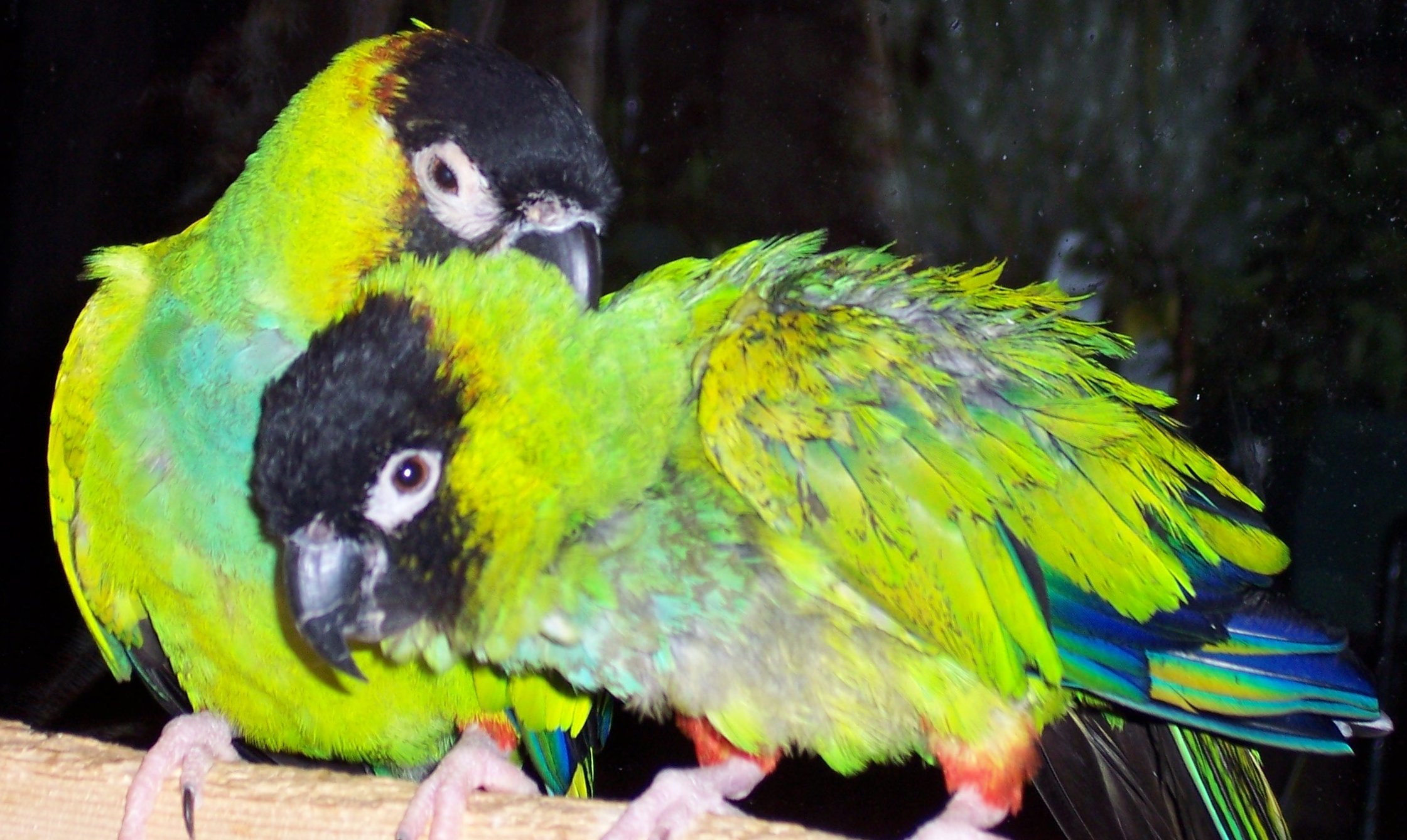
Today, my nanday conure Ninguable died, surviving his mate Sophie by just under thirteen months. He died in my hands. It was the last act in a relationship that had lasted twenty-eight years.

He had been listless for the past couple of days, but yesterday evening he had seemed to rally. However, the improvement didn’t last, and this morning he was lying on his back when I opened his cage. I thought him dead, and although he roused feebly, I knew he wouldn’t last out the day.

I had no means to euthanize him, and taking him to the vet would only make his last hours uncomfortable, so I sat with him through the day. He seemed to have suffered a stroke, because he struggled to move his left leg, growing testy at times.. Sometimes, he yawned with his beak tilted up. He didn’t show any signs of pain, just frustration. I was just putting him on to a towel in his cage bottom, so I could use the computer with one hand while stroking him with the other, when he collapsed beak first and twisted sideways.

For a moment, I swear I saw a light in his brown eyes. Then he was gone. I waited a few moments, but I knew what was left was no longer him. The time was shortly before 2PM.

Ning was our first parrot, and responsible for most of the others coming into our lives. We had been fascinated by a friend’s dwarf macaw, and had spent over a month looking for our own small parrot. We briefly considered a blue-crowned conure at the Lougheed Mall pet store, but debated if it was quite right. Then we saw Ning at the store in Kingsgate Mall, and immediately knew he was right for us.

Had we known what we knew a few years later, we probably wouldn’t have bought him. He was missing a nail on one foot, and part of a toe on another – a likely sign that he was wild caught, and had had his feet tangled in a net. Plus the store owner swore he was eighteen months old when by his markings he was under a year. Later, we realized he had probably been smuggled into the country, an abusive practice that we wouldn’t have wanted to support.

But he was so feisty among all the much larger birds in the room, hanging from the bars of his cage and trying to attract the attention of the red lory who was the only bird of his size. We put a deposit on him, and stopped on our way to the Vancouver Folk Festival to feed him cherries and grapes, all of which he greedily devoured.

On Trish’s birthday, we brought him home. We left him to acclimatize while we went out to dinner, but we were both so excited that we could hardly eat. We named him Ningauble, after the ever-curious wizard in Fritz Leiber’s Fafhrd and Gray Mouser series.

In the next few weeks, I worked with several times a day in the spare room, teaching him to climb up on a presented perch, then on a finger, feeding him and praising him loudly as a reward.

In the evenings, I would take him out and herd him on to my shoulder, where he would sit nervously before starting off. He couldn’t fly much, because we had clipped his wings, but that didn’t slow him much. He would glide as far as he could, and resolutely trudge along the floor and up the furniture until he reached his cage.

One evening, we were sitting reading when he reached over and gently preened my hair. Between my nervousness that he would bite my ear and my delight at this sign of trust, I hardly dared to move. But the next evening, he preened one side of my hair followed by the back, careful not to miss a spot, before giving up.

He seemed relieved to realize finally that he wasn’t responsible for all my hair, and after a few more evenings, settled down to a token preen in return for having his ear holes and neck scratched. He would sit and preen me for a couple of hours, then waddle down the couch to Trish to give her a couple of hours of attention.

I was in grad school at the time, and used to work in the spare room we had converted into a library. For a while, I used to take Ning into the library, since he would scream for me if I left him in the living room. Unfortunately, he would not only wander the shelves flinging books off, but also produce what our local used bookseller called parroted editions that had been thoroughly chewed to the point where they were unsellable.

After a couple of years, we decided he needed a mate, so we brought home Sophie, a malnourished, abused bird. Our plans to quarantine her for a month were immediately overturned when the only way to keep them from calling from room to room was to introduce them. Under our anxious eye, Ning jumped into Sophie’s cage and immediately started regurgitating to her.

If Sophie could talk, I swear she would have said, “Excuse me, sir? Have we been introduced?” but they immediately became inseparable, eventually going on to produce six chicks, one of whom is still with me, and one who returned to us before dying at a young age from the second hand smoke in a home where he briefly lived.

Ning wasn’t that skilled at feeding babies. But he kept Sophie fed while she was brooding, and delighted in teaching them the basics when they left the nest. At that point, Sophie was glad to pass along the responsibility, and Ning always pined when the babies went to other homes.

Because of the trouble and heartbreak of finding new homes for the babies, we eventually stopped allowing eggs to hatch. But Ning and Sophie didn’t seem unduly troubled. They continued in happy monogamy, with Ning in the adventurous lead and Sophie chirping nervously behind, but following him – on to the floor, or up on my shoulder, where they would sit preening each other and occasionally me while I worked on the computer.

In between, Ning would have territorial wars with the other male birds housed in the living room, always with the psychological edge. Although not particularly large for a nanday, his electric blue and green feathers showed he was the epitome of health. And, anyway, he was the cock with the hen.

He also showed an uncanny ability to find what unsettled his rivals the most at the least risk to him – for instance, sitting just inside another male’s territory on the floor, in a spot where he couldn’t be dive bombed.

And so things went on, the living room full of bird calls, affection and avian macho, until I got into the habit of thinking they might go on forever. But Trish sickened and died, and, five months later, Sophie died. Ning responded by a fit of macho, rampaging around the dining table until it was clear that this previously neutral ground was now his. He was also inclined to mope unless he spent as much time as possible with me – something I didn’t mind in the least, considering we were widowers together.

In the mornings, when I came to open the curtains, he would greet the sound of my voice with a liquid trill that would continue for up to a minute — one of the most beautiful sounds I ever heard, and one I wish now that I had got around to recording.

Despite his increasing age, Ning showed few signs of slowing down until the last four months of his life. One day, waddling over the carpet, he stopped and began biting furiously at his right wing. When I picked him up, I could find no damage, but he never flew far again. Instead, he would call anxiously to me, squirming until I picked him up and carried him to where he wanted to be. By this time, I could guess his destination with almost total accuracy.

I had seen similar signs in Sophie, but, considering Ning’s better health, I had hopes that his senior years would be prolonged. Until a few days ago, I even had hopes that with therapy he might fly freely again, since several times he managed short flights when frustrated.

As I write, it’s six hours after his death. I’ve taken his body to be cremated, and removed his cage from the living room – and I still keep looking for him as I type. He’s the one who taught me that parrots had sentience and limited planning abilities. He’s the one who kept me amused with his unabashed enthusiasm, and supported me with a preen and by hanging out when I was discouraged or grieving. He’s the one who taught me that parrots can purr.

Given all this, what could I do but sit with him in his final hours? I talked to him about our years together, sang him his favorite silly songs, and repeated my pet names for him. I cried over the inevitable before it happened and I hoped for a miracle, knowing I wouldn’t get one.

And you know what? I’m not ashamed of any of it. Because those are the sort of things you do for a friend. The only shame would have been to leave him to die alone, and my only comfort is that I did for him what I could.

Read Full Post »

Today is Ada Lovelace Day, when the tradition is to blog about a woman you admire in science, technology, engineering, or mathematics. I can think of dozens of women who are friends or acquaintances I could write about, but the first subject that comes to mind is Irene Pepperberg, who has quietly revolutionized the field of animal cognition with the help of her parrot colleagues Alex, Griffin, and Arthur (Wart).

Pepperberg and Alex especially are known to thousands from their public appearances. However, I sometimes wonder if many people in the audience appreciate that what they are seeing is not just an African Gray who has learned to respond on cues, but living proof that parrots’ intelligence overlaps with the lower edges of human intelligence. With the ability to use concepts such as difference, greater than, and absence, Pepperberg’s test subjects show the general intelligence of a two year old human child, and, in some cases, of a six year old. This discovery is a complete reversal of the traditional beliefs about avian intelligence – after all, “to parrot” is used as a synonym for “to repeat mindlessly.”

Pepperberg’s proof of avian intelligence is exciting, although to parrot owners, she is only repeating what they have long maintained. However, from a scientific viewpoint, Pepperberg’s proof of avian intelligence is the least of her accomplishments.

When Pepperberg began her studies over two decades ago, animal cognition had been thoroughly discredited by a long series of studies teaching chimpanzees and gorillas to communicate – usually through some form of sign language. These studies produced many touching anecdotes about the intelligence of the primates involved, but they were rightly criticized for poor experimental design and researcher bias. By the time Pepperberg began her first studies with Alex, it took a brave person to even approach the entire subject.

However, Pepperberg’s experimental design eventually gave the entire field of animal cognition greater respectability. As detailed in The Alex Studies, Pepperberg took special care to design studies that reduced the chance of unconscious cuing and was able to duplicate results with different researchers and even strangers. Just as importantly, the tasks that parrots have to perform in her studies are more complex than those solved by the earlier chimpanzees and gorillas, which reduced the possibility that her results were due to chance. As the number of her studies increased, gradually no one who read her work could deny her results.

An especially interesting part of Pepperberg’s designs is the Model-Rival learning method she developed. Unlike the usual stimulus-response model that is usually used to teach all sorts of animals rote behavior and responses, the Model-Rival technique begins with the obvious point that learning takes place in a social setting.

In the Model-Rival technique, experiments require two researchers, one of whom takes the traditional role, and one of whom plays a fellow student. The parrots being tested see the fellow student being praised for giving correct answers, and rewarded with food or the right to play with a toy, and, wanting the same attention and rewards, are motivated to learn. This setup not only serves as a serious challenge to classic behaviorism, but may also be of use in the teaching of humans with autism and other learning disabilities, although it is still not extensively studied.

What makes this new found respectability for animal cognition especially interesting is that you only have to look at Pepperberg interacting with her test subjects on video clips to realize that she adores them as much as the soppiest pet owner. When Alex died unexpectedly four years ago, Pepperberg was devastated, and wrote a memoir called Alex and Me that is one of the most moving true stories about an animal ever written. Yet to her credit, Pepperberg has never let her personal feelings undermine the integrity of her scientific work, beyond the obvious fact that she remains deeply committed to her studies. At times, such as when Alex died, the effort to keep the professional and the personal separate must have been almost impossible for her.

As a long time companion to parrots, I find Pepperberg’s work endlessly fascinating. At one point, I seriously weighed expanding on her work in graduate school, and corresponded with her briefly. Studying parrots proved to be a road not taken, but my admiration for her courage, scientific rigor, and passion remains. Far beyond her personal reputation in the media, Pepperberg remains a scientist’s scientist.

Read Full Post »

Four days ago, my Nanday conure Ning lost Sophy, his mate of 24 years, to old age. They had nested successfully four times, producing six chicks, and were a model of happy monogamy, constantly preening and never moving more than a few meters from each other. Ning had cared for her as though she were a chick in her final days, standing over her and preening and regurgitating to make sure she was fed. He was beside her when she died, and I have been able to observe first hand how he grieves. Being a widower myself, I feel a certain identification with what he is going through.

He knew at once when she died. Within a few seconds after she died, he nuzzled her once with her beak, and then moved twenty-five centimeters away, looking very small, with his feathers pressed tightly against his body, which is a sign of unhappiness in any parrot. He did not attack me when I placed her body in a shoe box to take to the vet (as I had half-expected), but went quietly up on my hand and into the cage.

When I returned from the vet, he was in the same position and had eaten little from his dish. But he screeched excitedly when I opened the door, and climbed up to my shoulder, pressing as tightly as he could against my neck and staying there for a couple of hours. I neglected the other birds to give him some time, stroking his back far more than he usually allows.

I was worrying that I might need to feed him and that, without his mate, he might no longer be able to hold his own against his arch-rival Beau, but my concerns proved needless.

As soon as I let the other birds out, Ning became manic. So much as 230 grams of bird can, he stamped around the table and the floor, trying to be everywhere at once. He seemed to have decided that he was going to prove his dominance once and for all by a frantic display. If so, it worked incredibly well – Beau is still reluctant to leave his cage when Ning is out. Now, as a result of Ning’s display, the dining room table is no longer a No-Go area for all the birds, but has been thoroughly annexed by Ning.

That evening, Ning preened me more than he had since the days after we brought him home, and he decided I was flock. But he would stop periodically to cheep for Sophy, and would occasionally fly off to the cage, and peer around it as though hoping she was somehow there. Later, when I put the cover on the cage, I could hear him cheeping for her again. I admit that went to bed early that night, because I could not stand to hear him.

The next morning was even harder. Ning went to Sophy’s convalescence cage, and seemed bewildered when neither she nor the towel I had arranged for her was there. After a moment, he moved down to the perch and started regurgitating. For a moment, it felt to me as though he was responding to Sophy’s ghost, and I was glad when he climbed to the top of the cage.

Fortunately, he started eating again on the second day, and his appetite is hearty. But he will take all the chew toys and attention that I tend to give him, and his efforts to preen me have a gentleness and a desperation that they never had before. He obviously needs the closeness – and, to be honest, so do I. At the same time, he regularly asserts his dominance by inspection tours of the area he claims.

It seems to me that the ability to mourn is a sign of sentience. After all, if a creature does not have a sense of itself, how can it feel loss? If it does not have a sense of others, then how can it mourn? If I did not already know from both personal experience and from Irene Pepperberg’s scientific studies that the intelligence of parrots overlaps with the lower levels of human intelligence, Ning’s behavior over the last few days would have proven his sentience ten times over. We’re supporting each other through our mutual loss – and I can only hope that I provide him with half the comfort that he gives me.

Read Full Post »

“In the West End of Derby lives a working man
He says, ‘I can’t fly but me pigeons can
And when I set them free
It’s just like part of me
Gets lifted up on shining wings’”
– “Charlie and the King of Rome”

This morning when I took the cover off the cage, my parrot Sophy was lying on one side, with her mate Ning hovering over her. She didn’t open her eyes, and her breathing was labored. I scooped her up and put her on the table, and she barely opened her eyes. I knew then that she was dying, so I decided that cleaning the cages would wait.

Sophy had been in a convalescence cage for the last few days after she slipped from a perch and started favoring her left leg. But her appetite was healthy and she was otherwise acting normally; the convalescence cage was just so she wouldn’t climb until her leg was better. Last night when I put her and Ning to bed, she was moving better, and I was cautiously optimistic that she was healing.

But she was thirty years old – old for her species — and had been growing quieter over the last year, so her condition this morning was not a total surprise. I debated taking her to the vet, and decided she was better at home, where she could be in the company of her flock when she died. Besides, the way she looked, I was not sure she would live long enough to arrive at the vet, or that the vet could do anything I couldn’t.

So I sat there as the sun rose, scratching her ear and trying to fed her corn. She refused the corn, and the loving regurgitation of Ning. In fact, she seemed to have trouble waking at all.

When the sun poured into the living room, I stood with her for a while so she could bask in the light, something she would do for hours, given a chance. The sun on her feathers roused her, but only a little. I placed her back on the table and continued waiting, scratching her neck feathers.

A few minutes later, she shifted her head awkwardly once or twice, as though trying to get comfortable. The eye that I could see grew misty. She seemed to stiffen, and all at once she had stopped breathing. Ning prodded her with his beak, and, when she did not respond, moved a body’s length away, preening himself with an air of apprehension.

That was the end of my twenty-four year relationship with Sophia J. (for Jabberwock) Bandersnatch. It was an end that I could hardly have predicted from the start.

When we bought Sophy from the bird-sitter, she had been neglected and abused for several years. She had no tail-feathers, and she had plucked her breast. Recognizing her as a nanday conure was so hard that we almost had to take the fact on faith.

We were told that she had locked in a cage for at least three years, and fed only on sunflower seeds. When she made a noise, a hand or a thrown boot hit the side of her cage. The only noise she could make was an outraged squawk.

Under these conditions, what could we do? If ever a bird needed rescuing, it was Sophy. When the bird-sitter reported back to her original owner that we found that she had a sweet personality, his reply was, “Sophy has a personality?” – more proof, if we had needed any, that he had no idea how to care for her.

When we brought her home, we placed her in the spare room, thinking to quarantine her for a month before introducing her to Ning. But the two birds started calling so excitedly that after a couple of hours, we brought Ning in for a visit.

We were ready to supervise, but there was no need. Ning leaped down off my shoulder and sidled up to her on the perch and immediately started regurgitating. Sophy made a stifled sound of surprise, as though to say, “Excuse me, sir, but have we been introduced?” but her objections could not have been too serious. Moments later, they were mating.

After that, Sophy and Ning were nearly inseparable, eating, bathing, playing with chew toys, climbing up on me. Always, in season and out, they mated, even on my shoulder. If one of them strayed more than the width of the living room, the other would start making anxious squawks. Ning was the more independent and aggressive of the two, but we soon noticed that anything Sophy wanted, she got. In anything she cared about, she was the dominant bird.

With Ning as her companion, Sophy blossomed and started to accept us. She would go everywhere with him, even occasionally down on the floor, which she obviously regarded as a dangerous place. I remember the two of them constantly worrying a small tin back and forth as though playing football.

One time, she crawled into one of Trish’s boots that was lying flat on the floor. She made an inquisitive cheep and, frightened by the echo, retreated squawking.

Over the next couple of years, her feathers grew in. But she remained an over-zealous preener, so that her feathers often looked ragged and you could see the gray of her down on her breast.

A few years later, she was healthy enough that she started laying eggs. The first one surprised her as much as it did us. She kept looking behind her at the egg, as if she could not quite believe that she had produced it.

Other eggs followed – so many at first, that she became egg-bound had to visit the vet just after Christmas. Ning moped around, and, early on New Years’ Day, we took him to pick her up. His rapturous purr as he started preening her in the examination room was as true a sign of devotion as you could see anywhere.

We bought a nest box, and watched her excavate the peat moss that lined it to her liking. Soon, eggs and hatchlings followed – Frumious (because what else should a Bandersnatch produce?), Jabberwock, and Rambunctious, Rogue and Rapscallion, and Madrigal, all born in the living room. Sophy would spend hours cooing over her hatchlings, over-preening them but caring for them fastidiously until they were weaned. Once they were eating for themselves, they were Ning’s concern for a few months so far as she was concerned, and she always seemed relieved when her offspring left for new homes.

A flock, a mate, and babies mellowed Sophy immensely. She never was much for hands after her previous experience, but she came to trust us enough that she would simply press her beak firmly around an encroaching finger, instead of drawing blood.

We knew that she trusted us, because every morning, she would lean from the top of the cage to preen our faces, more gently than any parrot I have ever met. She was the only bird I trusted to preen my eyes, because even a sudden noise would not excite her into nipping me. When I lowered a shoulder, she would scramble across the cage, careless of any obstacles, to climb up on me.

She would sit for hours on my shoulder, with or without Ning, as I worked at the computer. Sometimes, I would sing silly songs to her, and she would shake her tall and fluff out contentedly just at the corner of my vision.

I could go on and on – but I see that I already have. But I can hardly remember a time that her playful and loving presence was not part of my home life. All the birds were a comfort to me in the weeks after my wife died, but she was the one who sat with me the most, and seemed most sensitive to my grief. In return, remembering her sitting contentedly on one leg on the back of the cage, I like to think that we helped her put the years of abuse and neglect behind her.

As I type, Ning is restless, hopping from my shoulder to the table to the floor, and flying up to the cage. He keeps looking around as though expecting to see her, and is unable to keep still.

Without any anthropomorphizing whatsoever, I know exactly how he feels. Even after watching her die, I still can’t believe that gallant little Sophy is gone.

Read Full Post »

After four years, our parrot Beau has changed his behavior. In the last month, he’s started seeking us out to preen us.

If you know nothing about parrots, you probably don’t realize what a milestone that is. It’s not the same as a cat enjoying having its stomach scratched, or a dog licking your face. Cats and dogs can learn to enjoy interacting with humans in these ways, but these are not the behaviors of mature animals. They are the behaviors of very young animals that cats and dogs have kept because they are rewarded for them, and because they are pleasurable.

By contrast, parrots of all ages preen – not just their mates or their young, but other parrots in the flock as well. Partly, exchanging preens is a necessity, because, like many birds, parrots have places they just can’t reach themselves, such as behind the head and under the beak. Moreover, feather cases growing in can be uncomfortable.

But, just as importantly, preening is an important part of the complex, ever-shifting relationships in a flock. Who preens who (and in what order) can be a matter of status as well as trust. A parrot needs to preen and be preened almost as much as he or she needs water and varied food. For a parrot, preening is not just an indulgence; denied this social interaction, a parrot is unhappy and often despondent.

All this is true at any time, but it is even truer when a parrot chooses to preen a human. Parrots raised among humans may reach the necessary level of trust quicker than a wild parrot, but even a hand-fed one does not have the long history of domestication than a cat or a dog has. Even today, most domestic parrots are no more than a few generations removed from the wild. They are not creatures selected over centuries for subservience to humans.

Parrots that preen a human may be desperate for interaction, but they are still choosing to trust. Equal to equal, they are expressing friendship.

For these reasons, a preen by a parrot is not anything that you can take for granted. But it is especially touching in a neglected parrot like Beau, particularly since he has taken so long to reach this stage. We adopted Beau four years ago from the Greyhaven Exotic Bird Sanctuary, and he arrived in our house with baggage. He may have lost a mate, and he had apparently spent several years exiled to a laundry room, with only the sound of the washing machine and dryer for company. He may have been in mourning when he arrived in our house (parrots do mourn), and he was definitely seriously under-socialized.

When not crazed by his own hormones in the spring, in the past, Beau would accept a brief neck scratch, and sometimes a tickle under his wing, but, until now, he has not been much interested in returning the favor.

Now, he is preening with a persistence and enthusiasm that he never had before. If a hand is nearby, he will start preening between fingers or knuckles. If an arm is nearby, he will start on the arm hairs. But what he seems to like best is to scurry up a shoulder and preen hair and cheeks for minutes at a time.

As a veteran of decades of bird preens, I can tell he is tentative. But mostly he is eager, almost as though making up for lost time. His preening can be a little nerve-wracking, because ears tend to get him so excited that he bites, but gradually he is learning the rules, just as I am learning to relax under his ministrations.

Despite my nervousness, I feel honored by the change. I always do, but, in this case, I also take the preening as a sign that his rehabilitation is nearly complete. Like many parrots, Beau may never completely recover from being abused, but at least now we know for sure that he has made progress to a more normal life, and is comfortable in his new surroundings.

Read Full Post »

A story told to me this afternoon at the local parrot and exotic birds supply shop:

A customer comes into the store. She’s about fifty, well-dressed, and articulate enough that she’s probably well-educated.

She wants to buy a Moloccan cockatoo, so the woman who owns the store starts talking about the pros and cons of buying male and female birds.

“Of course you’ll need to know what to do when she starts laying eggs,” the owner says.

“I’m not going to buy a male,” the customer says. “So I won’t have that worry.”

“Umm – hens can lay eggs without a cock.”

“Nooo! No way!”

“Where do you think the eggs that you buy in a store comes from?”

“The hens need a rooster to lay eggs.”

“No they don’t.”

“Are you lying to me?” The woman seems to be trying to come to terms with a difficult concept.

The store owner tries to speak quietly. “You release eggs every month, or used to, depending on how old you are. Why would you assume that birds are any different?”

“I didn’t. You must think I’m stupid.”

Aware that several other customers are laughing in the background and not wanting to humiliate the woman, the owner tries to disengage from the conversation. But, convinced that she is right, the woman persists until the owner turns to help another customer. After a moment, the woman leaves, shaking her head and every bit as ignorant as when she entered.

Read Full Post »

If I want a day of bird-watching, I don’t have to leave the living room. With four Nanday conures – a type of small South American parrot – in residence, I can even do my bird-watching from the comfort of a chair. And, since three of the four Nandays are male, much of what I watch is territorial posturing.

The dominant cock is Ning. He has several advantages over the rest: He has been here the longest, he is the only one with a mate (Sophy), and he fathered one of the other males and has always lorded it over him. His disadvantage is that he is perhaps a little complacent and starting to get on in years, so he is no longer as aggressive as in his youth.

Of the other cocks, Ram is little competition. Not only is he Ning’s son, but he has a bad leg and is reluctant most of the time to compete – although he can surprise everyone at times with unexpected outbursts of ferocity.

Beau is the third cock, and the relative newcomer. However, he is younger, larger, and feistier than Ning, and probably the most cunning of the three. At first, Ning used to dive bomb him with impunity, threatening him without actually making contact. However, after about six months, he started dive bombing Ning in return, and now he gives as good as he gets.

This is how the living room is divided: Ning and Sophy have a cage on the right side of the room, and Beau’s cage is on the left. Ram’s cage is in the kitchen, but he uses the back of a chair and an arm of the couch by Beau’s cage with impunity, either because Beau doesn’t regard him as a threat, or on the principle that the enemy of my enemy is my friend. Occasionally, though, Beau will chase Ram away from his cage, especially if Ning isn’t there to vent his anger upon.

The dining room table between the two cages is contested ground. However, the futon by the window is definitely Ning’s, although Ram will brave it if Ning and Sophy are in their cage. Beau doesn’t quite dare, although he will pace to the end of the couch and sit as close to the futon as he can without actually being on it.

That is one of the main characteristics of the territorial posturing: Like kids in the backseat of a car who have been told to keep to their side of an imaginary line, Ning and Beau will come as close to the border of the other bird’s territory as they dare, apparently with the sole purpose of taunting each other. Just as Beau crowds the futon, so Ning will often see that his foraging on the carpet brings him close to Beau’s cage, apparently just to have the pleasure of disconcerting him. From their actions, the boundary couldn’t be clearer if it was painted on the carpet.

When not crowding each other, all the males will sometimes shriek at each other, so loudly that we have to pause the DVD we’re watching until we can hear it again. Sometimes, Beau will ambush Ning in mid-flight, too.
Apparently, the urge to defend his nest is strong in the typical Nanday cock. However, what is interesting is that the defense never seems to go beyond posturing, even in what must be the rather limited space in the living room. Not only is there never any real violence, but at times, as they call back and forth, the males seem almost friendly – as though their aggressiveness is only intramural, and, on some level, mutual identification as members of the same flock is as important as claiming territory.

And what does Sophy do in all of this? Mostly, she ignores it. Although sometimes she will loyally give one scream for every dozen of Ning’s, mostly she pretends it’s not going on. But, then, from Sophy’s frequent look of strained tolerance, I suspect she views the cocks — and the local humans as well – as slightly addled fledglings. Somehow, in the middle of all the male battles, she manages to look as though she is humoring all of us in the manner of a benevolent dictator. Her attitude suggests it would be beneath her dignity to notice the feuding in any way.

Read Full Post »

The other night, I was lying on the futon when I noticed our parrots going absolutely rigid. Unlike their usual habit, when they see a crow or a seagull, they were not calling out. They were making small, disturbed chirps, and their feathers were tight against their bodies – a sure sign of agitation.

Looking outside, I couldn’t see any reason for their disturbance at first. Then I noticed crows and smaller birds streaking low into the trees, and I realized a predator must be in the neighborhood. Sure enough, after a moment, I spotted a bald eagle perched atop tree about a hundred meters from the window.

Most of what I could see with my unaided eyes was a black silhouette, since it was less than twenty minutes before sunset. Still, there was no mistaking what I was seeing. Although I had nothing I could compare the silhouette with to be sure of its size, the general outline was nothing like the crows that usually sit on that perch. It was longer and thinner. It didn’t move like a crow, either. It kept peering this way and that with a jerk of the head that was most uncrow-like, and fanning and unfanning its tail.

Nor could the avian reactions, both outside or in leave me with any doubt that I was seeing a predator. Outside, I could see more silhouettes streaking low across the sky behind the eagle towards shelter. Nearby, the usual sounds as the birds go to roost were completely missing from the night. Inside, our parrots were tense and straining forward to keep an eye on the visitor, ignoring everything else.

What interested me about the parrots’ reaction was that they had no trouble recognizing a predator when they saw one. Of our four parrots, at least one was taken from the wild as a baby, and one was born in our living room, and neither of them could have had any personal experience of raptors, yet both reacted exactly the same as the other two. Of course, nanday conures are a flock species, and alarms and greetings spread quickly, even between parrots who don’t like each other. Yet it seems clear that, at some instinctual level, they knew a predator when they saw one.

At the same time, the two on the futon were not so alarmed that they panicked. On some level, they seemed to know that they were far enough away not to be a main target. Possibly, too, they were aware of the window between them and the eagle; one of the first bits of training we do with all our birds is introduce them to the window, so that they don’t fly into it by accident. Instead of backing slowly away, as I half-expected, they not only stayed where they were, but actually moved forward a bit, craning, to get a better view. In other words, they were on alert, but seemed aware that they were safe. Perhaps what I was seeing was instinct and intelligence fighting for control.

After about five minutes, the eagle stirred abruptly, seeming to fall rather than fly from its perch. I soon found out why: a half dozen crows were charging it. A predator can make short work of a single crow, but a determined flock of crows outhinks and outguns it, and this eagle was obviously experienced enough not to challenge its attackers. Now its turn had come to seek shelter, and the last I saw, it was flapping furiously, trying to outdistance the crows and not having much luck.

The crows, no doubt, had a strong incentive. This past ten days or so, the first of this year’s baby crows have been taking their first flying lessons, leaving many of them stranded permanently or temporarily on the ground, or on remote perches without being quite sure how to get back to the nest. I had been dive-bombed several times myself because of my curiosity, and no doubt the eagle, for whom the crow fledglings provide an easy meal, had raised the ire of the adults.

Given the timing, you can almost imagine the adult crows acting like a fighter squadron, scrambling to get a response into the air as soon as possible to confront the danger. When you consider crows’ intelligence and social organization, that metaphor might even be a reasonably literal description of what happened.

With the eagle gone, our parrots relaxed almost instantly – another sign, I suppose, that they know exactly what a predator is. As for me, I was left with both a gut-level awareness of the eagle as predator and our parrots as prey species that I had never had before. And, for all my fascination with observing the reactions, I found that I was relaxing too, along with the rest of my flock.

Read Full Post »

Parrots are such curious and lively creatures that you can easily forget that they are a prey species – until, at least, they are faced with something new. A cup or toy that they have seen before can often be replaced with one of the same shape, but add a new object to their environment, and their reaction is either a retreat with feathers held tight, or else aggressive posturing designed to intimidate (posturing that lasts only until the new object nears them). A case in point is the new cage we bought for Rambunctious, whom we hand-fed as a baby.

When Ram was pulled from the nest with a foot injury, he grew up in a glass aquarium with a heating pad underneath it. After he was weaned, he was put into the cage that he still occupies.

The cage is smaller that we’d give an unhandicapped bird, but Ram is a sturdy cripple, and could use more room. Besides, the plastic cage bottom is falling apart, and won’t last longer. For these reasons, we’ve been looking for a new cage for over a year. The quest isn’t easier, because most cages have bar spacing designed for much larger bird, which a Nanday conure like Ram could easily get his head stuck between.

Finally, last month, we found an ideal cage, about two-thirds larger than his present one, and with the right bar spacing. Last week, we outfitted it at the parrot supply shop, and deposited it on the counter near Ram’s cage.

His reaction was predictable. He retreated to the back of his cage, eying the new one warily. When we took him from his cage, he refused to come out; in fact, his good foot had to be pried loose from the perch it was gripping. I could feel his heart racing as I held him in my palm.

I sort of got the impression that we would not simply be dropping him in the cage. He was going to need to get used to it.

This past week, his reaction would be humorous, except that the matter was so obviously in deadly earnest to him. When his cage door was open, he sidles out as quickly as he can, climbing on the outside of his cage to a position on the top as far away from the new cage as he can manage. When I tried to place him on the cage, he flapped and scuttled up my arm with a piteous squawk and look of the utmost alarm and utmost betrayal in his eye. Only when we put the cage down on the floor would he manage to calm down.

After seven days, he has reached the point where, brought near the cage, he actually reached out to beak it. This is an encouraging sign, since it suggests that curiosity is starting to win out over fear for him. And when I started making some adjustment to the positions of the perches, toys and seedcups in his cage, he flew on to my shoulder, chirping with excitement and happiness as I worked.

The next step is to put him in the new cage for a while, with one of us close by to reassure him. If he eats while in the cage, or plays with a toy, then we can proceed with the move. But the whole operation is still going to take another one to three weeks. Parrots didn’t evolve by taking unnecessary chances, and, in changing Ram’s cage, we’re fighting instincts embedded by generations of natural selection. So we have to figure that it’s going to take a while.

Read Full Post »

« Newer Posts - Older Posts »