Feeds:
Posts
Comments

Archive for the ‘art appreciation’ Category

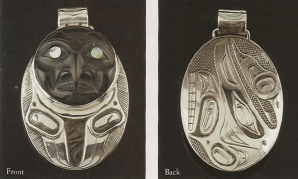
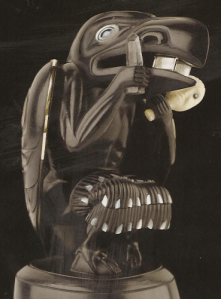
Northwest Coast art has a new medium. It’s called forton, and it’s a mixture of gypsum, fiberglass and plastics, and has the advantages of being non-toxic, lightweight, weather resistant, and capable of imitating anything from marble to plaster or bronze. So far, you can see the largest collection of sculptures in forton in Vancouver at the Douglas Reynolds Gallery, including one cast from James Hart’s Celebration of Bill Reid pole that was officially presented to the public on December 5.

The Celebration of Bill Reid pole is a permanent fixture at the Bill Reid Gallery in downtown Vancouver. Carved by James Hart with the help of Ernest Swanson, Tyson Brown, Carl Hart, and GwaLiga Hart, the pole is topped by a raven whose chest is a stylized version of Bill Reid’s face. Through the Douglas Reynolds Gallery, eighteen copies of the raven are being made in forton – six imitating plaster, and 12 bronze, including three artist proofs.

Hart spoke briefly at the launch, arriving after the crowd had already gathered and was well into the buffet and wine. A tall man with long gray hair, he wore a bright Guatemalan jacket and carried a string of trade beads in his hands that someone gave him as he came in the door. He walked with a stoop and a slight hesitation. As he stood halfway up the stairs in the gallery, he was surprisingly soft-spoken for a well-known artist who is also a chief.

Hart spoke briefly about the pole and its intent to honor Bill Reid. He explained that he not only learned carving from Reid, but how to survive in the city, including such details as how to use an elevator, something he had rarely encountered in his rural youth. Turning to the plaster raven in the corner, he emphasized that it was a white raven, a representation of the trickster before he stole the moon and was singed black in his effort to escape with it through the smoke hole.

Afterwards, I managed to talk briefly to him as he mingled with the crowd. He said that the project was his first effort to work in forton, and that he liked the way it could be carved and was resistant to weather. He also expressed his enthusiasm for the new medium and designs that younger artists from all the local first nations were developing the traditional art forms.

Until the new raven cast, most of the works in forton that I’ve seen were done by Don Yeoman at the Douglas Reynolds Gallery. However, Reynolds mentioned the side of a house in Whistler that recently had several dozen forton panels added to one side, and I suspect that any artists who encounter it are likely to be as interested in it as Hart seemed to be.

One look at the cast and you can understand why. Made from a mold of the cedar original, the pseudo-plaster cast picks up so much detail that you can actually see the wood grain and tool marks in it. With forton offering so many benefits and no drawbacks so far as I can discover, I strongly suspect that, just as local first nations artists adopted to argillite a century and half ago and glass in the last few decades, many are going to seize on forton as yet another medium for their work.

Read Full Post »

The stories of Raven stealing the light or Raven prying open a shell that contains the first people continue to inspire great art, and have the advantage of being no single family’s property. But they are only a fraction of the stories and themes that could be told in Northwest Coast art. That is why, when I buy art, I am always interested in less often heard subjects – the change is interesting to me, and, I hope, a change of pace for the artists as well.

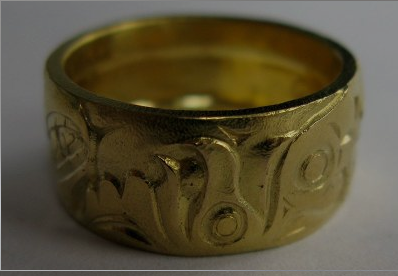
A case in point: “Healing Ring,” the second of the rings made for us by up and coming artist Gwaai Edenshaw (the other ring was “Raven and Crows,” which I blogged about earlier).

Here’s how Gwaai Edenshaw himself describes the ring. He was talking with us as he wrote and using a soft pencil, so I have had to guess here and there as I transcribed:

[The] centre of the ring is Fungus Man, made famous in the story of Raven and the First People. The only [one] of Raven’s helpers that was strong enough to face the feminine energy/sprit, and bring it to humanity. This character was likely Fomitopsis Officinalis. This is a shelf fungus that is analogous to a Chinese medicine (in fact one of Chinese Medicine’s most prized medicines). It was almost definitely used by Haida shamans. Samples of it have been found among shaman’s effects (this was thought to be wooden carvings until a recent test of the wood revealed it to be Fornitopsis. Fungus Man appears out of a bush of K’waay K’ia (Indian Hellebore), a very important medicine to us. Like many medicines it has potential for toxicity, but in the hands of the right practitioner it is a true marvel.

Also called Laricifomes officinalis, the fungus is almost extinct in Europe, but is found in old growth forests in the Pacific Northwest. In various locales, it has been used to treat tuberculosis, pneumonia, asthma, rheumatoid arthritis, infection, and smallpox, and to ensure long life.

I believe that the appearance of the fungus on the ring is one of the first instances in which Edenshaw has combined his interests in Haida botany and art. In fact, aside from what appears to be tobacco leaves and European-influenced floral designs in some argillite work, flora of any sort is rare in Haida art, although some mainland nations have floral crests, such as the Gitksan Fireweed clan.

Edenshaw continues:

On the reverse side is a pair of herons. These are the helper in a number of stories, notably the Gunarsiargit story where they play a small but critical role in the story’s namesake fulfilling his destiny.

More specifically, a heron often dwells on the edge of the village, some distance away from the inhabited houses. This locale reflects the heron’s often lone habits, but might also suggest a shaman, since shamans often lived and certainly were buried separately from everyone else.

For me, these are the kind of details that, when combined with artistic skill, can make Northwest Coast art so satisfying to me. They offer not only aesthetic pleasure, but, for a European ethnic like me a small window into the cultures that produce them. And Edenshaw, besides being a gold smith with a genuine feel for the metal, is also clearly someone deeply knowledgable about his culture as well.

Read Full Post »

One way that you know an artist is talented is when other artists are eager for their work. Gwaai Edenshaw is in that enviable position among the Northwest Coast artists who live in Vancouver. A some-time botanist and Bill Reid’s last apprentice, he works largely in gold, although he has been known to sketch, carve wood, and even experiment with animation. Having admired his work since we first saw it, Trish and I recently celebrated our anniversary by buying two of his rings.

Mine is based on an episode in “Raven Traveling,” the Haida narrative of the Trickster’s wanderings near the beginning of time. On the beach, the raven encounters a group of crows. They begin to cook a salmon. The raven falls asleep, but the crows can’t wait for him to wake, and devour the salmon. Belatedly, they realize that the raven will be angry when he rouses, so they take the remaining crumbs of salmon, and wedge them between his teeth. When the raven wakes, hungry for his meal, they point out the crumbs and ask, “Don’t you remember? You ate it before you went to sleep.” Angry at the deception, Raven throws the crows into the fire, turning them forever from white to black.

I appreciate the story for its broad humor, as well as its extrapolation from nature; crows really do mob ravens, especially when their young are in the nest. If crows could play practical jokes on ravens, they undoubtedly would. Also, the story is not one of the ones that is generally depicted, like raven’s stealing of the light, or even his theft of the salmon from the beavers.

I suggested the subject to Edenshaw, and waited with all the patience that anticipation would allow for six months until he had time to get to it.

The result was more than worth the wait. Edenshaw chose a style that fits the humor of the story, showing the raven with his beak open and crows rollicking around him, pushing the crumbs of salmon into his mouth and their beaks open in excitement, no doubt chortling with glee at the thought of putting one over on their rival.

Since the raven has teeth in the story, and the Haida storytellers must have had plenty of chances to notice that birds have none, I assume that he must have been in human form when he met the crows. However, the fact that Edenshaw chose to show the raven as a bird with teeth in his beak does not detract, any more than the teeth in the beak of the parrot in Aladdin. It is a comic touch, and the result is reminiscent of the lively cartoons that you see in the margins of medieval manuscripts. I especially like the mischievous crow that is pushing a piece of salmon along the raven’s back (You can see the crow’s beak just behind the top of the raven’s head).

At the same time, I appreciate the economy and skill with which Edenshaw rendered the story. Like a business card (only more so), a ring provides a very limited space for depicting anything, yet Edenshaw manages to focus on the main event of the story, while selectively choosing details so that, while the feathers on raven’s head are not visible, the pieces of salmon clearly are. The detail is all the more amazing when you consider that the ring is cast, not engraved.

So far as I am concerned, Edenshaw produced a ring that is utterly unique, and wonderfully rich in humor and detail. After wearing it for several weeks, and having appreciated the small extra touches with which it was delivered (in a small wooden box, with the promise that the mold would be kept, in case the original was lost), I fully intend to buy more of Gwaai Edenshaw’s work. But if, as I suspect, his prices rise as he receives the recognition he deserves, at least we have a couple of samples of his work to console ourselves.

lm

Read Full Post »

I appreciate Northwest Coast art for many reasons. It is semi-abstract, which always captures my imagination. It has a historical and sociological aspect, so I can combine intellectual and aesthetic interests. It is the art of my home, although not of my culture. But, sometimes, I think that my main reason for buying Northwest Coast art is that it is one of the few modern forms that remains largely unaffected by scholasticism.

By “scholasticism,” I refer to the modern trend in many of the arts for artists to be more interested in theories or concepts than in craft or any general audience. It is a trend that has occupied most of the twentieth century, and continues to prevail in the 21st. I’ve seen it first hand in poetry and literature, and it seems equally prevalent in music, painting, and dance. It is the approach that Tom Wolfe slammed, outrageously and a little unfairly in architecture when he wrote From Bauhaus to Our House.

Under scholasticism, what matters is the theory behind it. Before anything else, what interests the artists of scholasticism is demonstrating that they can put the theory into practice. Their work tends to be crammed with obscure references and in-jokes, and their talk is usually more about the theory than the work itself. It creates a vicious circle, with artists losing audiences because of their obscure practices, then retreating into even obscurer theory in reaction to the lack of audience.

While exceptions exist, Northwest Coast art seems largely free of such attitude. Beginners may be told to read Bill Holm to understand the mysteries of formline, but nobody reacts when someone breaks the alleged rules, or strikes out in a new direction, as the Salish artists have in the last few decades. Similarly, while many artists have experimented with the forms of modern art, few seem to become obsessed with the theories behind the forms.

Why Northwest Coast art has been spared this obsession is probably complex. But it is not because the art is in any way primitive, any more than Celtic knotwork is primitive. Such forms can be dismissed as primitive or romantic only to those who have not bothered to learn about them.

Nor is it naive. Many Northwest Coast artists are just as prone to in-jokes as any mainstream artists, but the difference is that the jokes are an extra layer of meaning, not the only one, nor even the most important one most of the time.

Nor does the reason has anything to do with the rigidity of change, or even the marketplace. For the last century and a half, Northwest Coast artists have seized on new media whenever they have had the chance. Argillite, glass, aluminum, canvas – each of these has been eagerly adopted as soon as it became available. The same is true of tools, from steel engraving tools to power tools. And, as often as not, the artists have begun work with new media and tools with only a few denouncements from their peers, people, or clients.

If anything, this versatility may have helped Northwest Coast artists take scholastic art in their stride. Although scholasticism is all about breaks with the past – often, the nosier the better – few Northwest Coast artists seem to consider new media, tools, or techniques a radical departure. This attitude has become very apparent in the Bill Reid Gallery’s current Continuum show, in which the curators’ efforts to start a dialog about the differences between traditional and contemporary first nations art has met with very limited success. Almost all the artists in the show make clear that they don’t see such an opposition.

Another reason for the freedom from scholasticism may be that, unlike modern mainstream artists, Northwest Coast artists tend not feel deracinated. Their art is not only an expression of their cultures, but a statement that their cultures are alive and thriving. Even those who did not grow up in their cultures generally feel an urge to know more about their origins as their art develops, and, for many in their communities, the success of Northwest Coast art is an obvious source of pride. Rediscovering and proclaiming their cultures, perhaps, is more than enough of an agenda to be going on with.
Not only that, but Northwest Coast art has genuine popularity, both among the first nations cultures of the coast and a small segment of the general art-buying public.

Admittedly, this popularity is not an unalloyed good. I have heard artists complain about being limited in their subject matter because something too esoteric won’t sell. Some artists, too, are tempted by the tourist trade, and start producing cheap curios rather than art. In addition, the popularity of the art form ties too many artists to the gallery system, and allows a handful of gallery owners far too much influence on what the public sees.

However, this popularity still gives Northwest Coast artists a huge advantage over their mainstream counterparts. Unlike mainstream artists, Northwest Coast artists know their work is appreciated – sometimes for the wrong reason, sometimes condescendingly, but appreciated all the same. Much of the public art in British Columbia is from the first nations, and, internationally, probably only art from the American Southwest is more eager sought after. In their own cultures, art is increasingly wanted for potlatches and ceremonial purposes.

Unlike many mainstream artists, Northwest Coast artists – even the most reclusive ones – have a dialogue with their audiences. They may not always like what they hear or agree with it, but they can still count on a degree of interest that mainstream artists can hardly imagine. So long as that interest remains, I suspect, it is hard to imagine scholasticism ever getting much of a hold in Northwest Coast art.

Why disengage and retreat into the cloisters when you have people who want to talk about your art? After all, that is what most artists want, even those who are most deeply into scholasticism – an audience that engages their work.

I used to wonder why mainstream art events so rarely included first nations artists in Vancouver. The communities seem very separate, even though a few people like Andrew Dexel or Sonny Assu seem to cross between them. The answer, I now believe, is that the two communities are so different that communication is difficult. Their approaches, attitudes, and perspectives are so much opposed to one another that the surprising thing is not that some Northwest Coast artists are exploring the mainstream. The surprising thing is that any have managed to do so at all. But, apparently, Northwest Coast Arti is in such a healthy state that it can even absorb attitudes that are opposite to its core assumptions without any real difficulty.

Read Full Post »

One of the pleasures of buying work from beginning artists is watching them fulfill their potential. Last January, I saw enough promise in John Wilson’s work to buy one of his masks. Now, in masks like “Shaman and His Helpers,” his work has reached its first maturity.

Compared to most of Wilson’s earlier works, “Shaman and His Helpers” is a busy piece, both in subject and execution. It benefits, too, from Wilson’s study of traditional masks through pictures, the most obvious benefit being the use of eye holes instead of painted irises and pupils.

The mask depicts a shaman and his spirit helpers. One of the spirit helpers sits in the shaman’s mouth, as though resting after a long climb up his esophagus. The other sits in the middle of his forehead like a frontlet. Both these positions suggest that the helpers are indicators of the shaman’s true nature.

The helpers look more or less human, but the one in the mouth is in a vaguely frog-like position, while the one on the forehead is round enough to be a moon. While the shaman’s eyes are narrowed as though he is entering a trance, both helpers have closed eyes, as if asleep or focusing inwardly.

One way or the other, you sense, the shaman’s and the helpers’ eyes are going to be in the same state shortly: Either the shaman is about to enter their world of perception or else the spirits will come into his. No matter which happens, the result is a mask of a half-realized transition.

Interestingly, too, the spirit on the forehead is painted similarly to the shaman, while the spirit at the mouth is left unpainted. That may be an artistic decision made because any paint would be overwhelmed by the red of the shaman’s lips. But the effect is to suggest that the spirits are in some ways opposite.
Are the spirits different aspects of the shaman’s nature? Or perhaps the helper in the mouth is unrevealed, a creature of the dark, and the moon-like one on the forehead is a creature of light? At the point portrayed in the mask, they do not seem at odds, so perhaps they are opposites needed for balance and insight. Whatever the case, a moment of magic and transition is depicted.

The awe of the moment is heightened by the design of the mask. Tall, thin masks are common in the northern tradition, but in this case, the physical dimensions suggest a lean asceticism that seems fitting for a shaman. This asceticism is heightened by the high cheekbones and the deepness of the eye sockets near the nose, which suggest that the shaman might have been fasting. The black eyebrows reinforce this sense of gauntness, especially in a bright light that emphasizes the cheekbones and eye sockets.

At the same time, the mask carries a hint of menace or pain. Especially from a distance, the hands of the spirit in the mouth suggest fangs. Similarly, the unusually bright red used in the mask leave a half-unconscious impression of blood, as though the shaman’s trance is accompanied by a nosebleed and his biting of his own lip. Or perhaps the redness of the lips suggests that the shaman is giving a sort of birth to the spirit clinging to his lips. The suggestions are understated – there are no blatant riverlets of blood trickling from the nostrils or down the chin – but they are only more effective for being subtle.

And always the grain, which Wilson has carefully matched to the contours of the face, stands out, suggesting a movement or fluidity just below the skin. Influenced by his teachers at the Fred Diesing School, Wilson has always shown an awareness of the grain as a finishing detail, but here that awareness is not just a reflection of technical skill, but also an addition to the design.

When this mask first went on the market, I missed the chance to buy it, and cursed my slowness to make a decision. Luckily for me, the first owner changed their mind, and I was able to buy it after all. The more I study “Shaman and His Helpers,” the more I think it is Wilson’s best mask to date. At the same time, knowing that he is a constant carver and likely to have decades to continue his learning of his craft, I can’t wait to see what levels he will reach next.

shaman-and-helpers

Read Full Post »

This afternoon, I heard Tlingit artist Nicholas Galanin speak at the Bill Reid Gallery. His talk was my first prolonged exposure to concept art applied to Northwest Coast art. I came away stimulated, but not particularly sympathetic to the effort.

Galanin is the latest of several generations of artists, and has done some jewelry in the traditional style. However, at least for the time being, he is not especially interested in traditional art or culture. He talked about traditional art as being confined by the stereotypes imposed by a romantic view of first nations, and – rather tellingly – could not tell where he obtained a traditional song he used in a video, even though in coast cultures, rights in songs and their performance can be important pieces of property. [Note: Both Galanin and Sonny Assu tell me that it was not the traditional song whose source Galanin didn’t know, but a hiphop song that was part of the same work. See the comments below. I apologize for the error].

Instead, Galanin is more interested in exploring the First Nations as another ethnic minority within the dominant culture – in particular, how coastal images are bastardized and exploited by cheap imitations made in Asia for the tourist trade in the Northwest Coast. He discussed, for example, a series of masks he made out of pages of the Bible, talking about how he found it appropriate that the holy book of Christians, who suppressed shamanism, should be converted into a shaman mask. Galanin also talked other paper masks he had made and how they were masks by a first nations person that showed no signs of first nations culture.

Other projects he discussed involved embedding tourist-trade masks in a wall covered with wallpaper that depicted idealized pictures of 19th century life and another in which the same type of masks were covered in Chinoserie. In a pair of videos, he had a traditional dancer (or an approximation of one) and a modern dancer moving to the same traditional song. In yet another series of work, he gave his version of the highly idealized photos of Edward Curtis: naked women with masks added in a graphics editor.

Meanwhile, ten meters from the podium where he stood was his contribution to the Bill Reid Gallery’s Continuum show: A version of Bill Reid’s “Raven and First Men” rendered by a chainsaw. Galanin was seeing his version of the famous sculpture for the first time, because he had outsourced the work – as he does much of his work.

The outsourcing is a commentary on commercialism, but I also had the sense that for Galanin what matters is not the actual work so much as the concept. Apparently, he sees his role as that of impresario, rather than as an artist who necessarily creates works with his own hand.

Having been a grad student in an English department of a major university, I am tolerably well-versed in such approaches to art. Nor do I find anything in Galanin’s social commentary with which I disagree.

But I wonder if I am missing something, because I have never found this kind of concept art very compelling.

For one thing, it seems to have little room for something that is central to my own appreciation of art – the enjoyment of craft, of sheer artistic excellence. Part of this lack may be that it does not delve deeply into tradition, so it has no standards to judge skill by. But the major reason for the lack seems to be that, when you are making a comment, craft becomes unimportant or perhaps a distraction.

Moreover, when you are commenting on commercialism, too much craft is probably out of place. If anything, your message is stronger if an object shows a lack of craft.

This situation helps create another problem: most concept art, including Galanin’s, is like a symphony of a single note. If your ideal is the “well-made object” of Bill Reid’s aesthetics, then viewers can return to it many times, and even discover something new after the first viewing. In comparison, concept art seems simple and to offer few reasons to return to it. Once you have grasped the message – which is often simple enough that you can reduce it to a single sentence, or at least a rather short paragraph – nothing is left to appreciate. Concept art seems to be unambiguous and unsubtle by nature, and, consequently, not very interesting.

In this respect, it is interesting to compare Galanin’s chainsaw Bill Reid knockoff with Mike Dangeli’s ridicule mask, which is also in the Continuum show. Where Galanin’s “Raven and the First Immigrants” seems one-dimensional, Dangeli has reached into his cultural history to bring an old concept into the future: just as the ridicule masks of the past were public announcements of a wrong, so Dangeli’s is a declaration of the wrongs suffered from the first nations. Dangeli’s mask is every bit as social or political as Galanin’s sculpture, but where Galanin’s sculpture seems facile, Dangeli’s mask is ambiguous and complex. And I doubt it is a coincidence that Dangeli is throughly involved in preserving and reviving his culture while Galanin sounds like a typical deracinated intellectual.

But such issues are a matter of taste. Regardless of what I think of Galanin’s work, I have to admit that the very fact that it takes the form that it does illustrates the diversity of Northwest Coast art and proves it a living tradition. And that by itself, I suspect, is something of value.

Read Full Post »

My revived interest in Northwest Coast art dates to nearly two years ago, when I commissioned a copper bracelet from Henry Green. So, naturally, I’ve kept an ongoing interest in what Green was doing – an interest that has been further reinforced by mutual acquaintances and by meeting Green when I was in Terrace for the Freda Diesing School graduation show last April. But, until this last week, I hadn’t bought anything else by Green.

The lack of purchases was definitely not a lack of interest. Although I didn’t realize the fact when I commissioned the bracelet, Green is one of the two leading Tsimshian artists working today (the other is Robert A. Boxley), and probably the premier jeweler. His engraving is exceptionally fine, and his invention is high, although it rarely strays far from tradition.

Moreover, his jewelry is exceptionally well-priced, perhaps because he doesn’t want to set too high a pricing standard for other artists, or perhaps because his income comes largely from poles and large commissions. He could easily get two or three times what he charges, which makes a silver pendant from him one of the best buys you can find in Northwest Coast art. The only real reason for not buying another of his pieces until now was simply that the artists whose work I want to buy far outstrip my income, especially in this last year of recession.

Several months ago at Alano Edzerza’s Gift of the Raven opening, I had seen and appreciated casts of combined pendants and broaches by Green representing some of the Tsimshian house crests. As is inescapable with casts, the pendants suffered from an obvious loss of detail, but I appreciated them all the same. When Morgan Green, Henry’s daughter, sold some to help finance her way through art school (presumably with permission, although I keep have visions of her sneaking into the family workshop at night), we bought a cast of the mosquito pendant from her.

But the cast we really wanted was the devilfish. Consequently, when I stumbled across the engraved original at Coastal People’s, I bought it as soon as I could afford it.

What first struck me about the pendant is its irregular shape. Distorting the design to fit its surface is common in Northwest Coast art, but, in this case (and several of the pendants from the same set), Green has chosen to distort the surface to fit the design. Rather than squeezing the devilfish into an oval or some other pendant shape, he decided instead to let the pendant take the shape of the devilfish instead.

At the same time, within the shape, Green has distorted the shape even though the shape does not require him to. I have seen a number of Northwest Coast designs for a squid or octopus, and almost always they are depicted in a flat, semi-realistic style. However, Green’s tangle of body and tentacles (which are reduced to three, just enough to give a suggestion), although more abstract, captures more of the feel of a devilfish’s irregular movements than a realistic portrayal.

Since the irregular movement is probably what most people see first when they encounter a live octopus or squid (even in a tide pool), the paradox is that Green’s abstraction is emotionally truer than a literal design. Moreover, because the irregular movements are apt to create uneasiness and fear, by capturing the movements, Green’s pendant suggests why a devilfish might become a household crest. With its outsized, eagle-like beak, Green’s devilfish seems a savage predator, powerful and potentially dangerous.

The large areas of cross-hatching and the parallel lines of dots or brief lines are straight from the traditional Tsimshian repertoire. However, in this pendant, Green adapts these elements for practical purposes, using an unusual filling around the eye to give it an unearthly look and turning the parallel lines into suckers on the tentacles.

At the same time, the placement of the tentacles seems to owe more to Celtic knotwork than traditional Tsimshian work. And, in fact, according to Morgan Green, this resemblance is deliberate, reflecting the fact that his first wife was Scottish, and his children are half-Scottish. However, while Don Yeoman and others have tried to combine Northwest Coast and Scottish design in the same piece, this pendant is one of the few that does so successfully. It does so, I think, by balancing the knotwork with the Tsimshian parallel lines and cross-hatched background, blending the two traditions so they work together.

This blending is worth noticing because I think it points to how Green can innovate within his main tradition. Unlike a beginning artist, Green is not restrained by the tradition, forced to alter his design to fit the tradition and therefore chafing at its limitations. Instead, Green is so utterly familiar with the tradition that he can use its elements for his own purposes. In this pendant, the result of his knowledge is a miniature masterpiece in silver.

henry-green-octopus-pendant

Read Full Post »

The Bill Reid Gallery kicked off a series of talks about artists from its Continuum exhibit with a slide show by Michael Dangeli, a Nisga’a artist who has started to receive recognition in the last few years. The choice was lucky or inspired, because Dangeli is more articulate about his work than most artists, and has clearly thought carefully about what he is doing.

The Continuum show is supposed to be about the conflict between traditional and contemporary influences in Northwest Coast art. And, in fact, Dangeli was introduced in terms of this conflict. However, he immediately made clear that he rejects such a dichotomy in his own work. Calling his work “traditionally contemporary,” Dangeli made clear that he considers his work a continuity of the past, both an attempt to reclaim it and to expand and to adopt it.

One reason why Dangeli is comfortable with the paradox of living with opposites is that he sees the rest of his life in such terms. Nisga’a by birth, he has lived in the United States and Vancouver, far from his nation’s territory. Deeply interested in his cultural past, he is also aware that he is a modern urbanite in his day to day life. Spiritually inclined, he is also a veteran of two tours of duty abroad in the American military. With such tensions, those between the traditional and contemporary must seem like just one more.

Another reason that Dangeli can have the attitudes he does is probably the fact that he is actively involved in the cultural revival of his people – something that seems especially unusual for an urbanite. During his discussion, Dangeli talked of pieces of art being given as payment for services, and at potlatches, as well as important events such as a betrothal. He talked, too, of being groomed to take over a chieftainship, and of his hesitation about taking on an even larger chieftainship recently. He talked about his dancing, and of acquiring songs and dances and inventing new ones, and of exploring the distinctions between male and female powers and responsibility with his finacee.

Unlike many First Nations artists, Dangeli seems either fortunate enough or determined enough to have lived with a sense of tradition from an early age. Consequently, it is easier for him than many artists to see a continuity rather than an opposition.

This continuity seems to affect his art very strongly. He talked of preferring that his gallery pieces not have eyes that would make them danceable, and of his relief when he managed to buy back an early exception to this preference. He talked, too, of making one of the first stone masks for well over a century, and having it danced.

But the strongest evidence of his artistic continuity came at the end of his talked, when he uncovered three pieces of his work that are reserved for ceremonial purposes: The mask he bought back and modified with a pieced of Ainu cloth; the stone mask, and a frontlet worn by his fiancee. He explained that he generally kept them covered, and treated them as living spirits, requesting that people look them over a few at a time so as not to overwhelm them. It was unclear to me whether any power in the objects was innate or resided in the respect shown to them, but his attitude was curiously moving.

Even if you didn’t share his cultural background or beliefs, they were obviously alive for him – either never having died or after being carefully revived, or some combination of the two. Clearly, he had fought hard to make them meaningful to himself and those around him, and I believe that he has largely succeeded. At the very least, he demonstrated to the audience that his cultures were still ongoing and hadn’t stopped developing with the European conquest.

All this says nothing directly about his work, which ranges from the traditional to the modern, with a variety of color palettes and a frequent emphasis on collaborations with other artists – or “brothers,” as he called them.

I have liked what I’ve seen of Dangeli’s work in the past, and, by the time he had finished talking, I had a much clearer sense of why, and an increased interest in what he might do in the future. And, really, what more can you ask of an artist’s talk? With several dozen slides and intelligent commentary, Dangeli sets a high standard for the next speakers in the series to match.

Read Full Post »

Haida art occupies a privileged place in Northwest Coast art. Because the revival of the art is associated closely with Bill Reid, who began with the Haida tradition, to many people, all Northwest Coast art is Haida, and Tsimshian, Nisga’a, Kwaguilth, Nu-chu-nualth, Salish and the others are not even names. Still, no one can deny that the Haida include many brilliant artists in every medium, so last night I went to the opening of Coastal People’s show, “Haida Masterworks” expecting to enjoy myself. Nor was I disappointed.

In fact, the show exceeded my expectations. Since it had been only lightly advertised, I expected a small show. Instead, what I saw was a showcase of leading Haida artists, with works ranging from the classic to the contemporary.

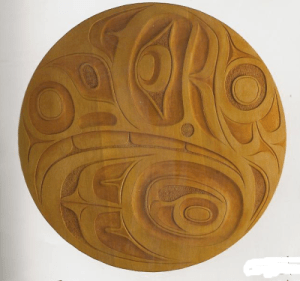
Several leading Haida artists featured prominently. Master carver Don Yeomans was represented by several circular panels and a mask well over a meter high –examples of what I think of as corporate art, since you need a large lobby, or at least an extremely long room with a high ceiling to display it in a setting that does it justice.

don-yeomans

April White, who paints in styles varying from traditional Haida designs on cedar bark to contemporary landscapes:

april-white

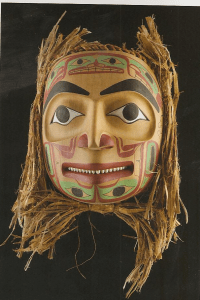
Also prominently displayed was the better part of two years work by Reg Davidson, who is probably the leading carver of masks that can be used for dances and ceremonies. This emphasis gives his masks a simplicity of line and color that is rarely seen, as well as a unique dramatic quality. I am sure, for instance, that the large eye-sockets that characterize his masks increase their theatrical effect when seen in the firelight of a night-time ceremony.

reg-davidson

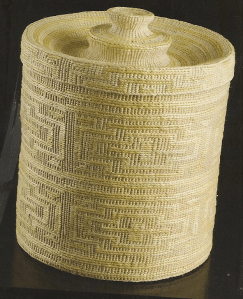
Yet another master artist who is well-represented is Isabel Rorick, a weaver who works largely with spruce roots and natural designs in traditional patterns collected from up and down the coast. I admit that I know little of basket weaving, and ordinarily think less of it. Yet even I could see that Rorick’s work was intricate and uniform. Despite the muted colors, the designs are clearly visible from ten meters away, and, up close, the evenness of her work make clear that she must spend hours upon hours in her craft.

isobel-rorick

Among such works by well-known artists, I almost missed some wood-carvings by newer artists. However, on my second or third round of the gallery, I took time to appreciate some panels by Kyran Yeoman, Don Yeoman’s son, and a mask by Robin Rorick. Also on display was one of the first masks I’ve seen by goldsmith Jesse Brillon.

Contemplating these works was a pleasant way to spend an evening. However, for me, the highlights of the show were the jewelry and small sculptures in the display cases. Jesse Brillon and Gwaai Edenshaw – so far as I’m concerned, the leading goldsmiths in Northwest Coast art – were unfortunately represented by only one work apiece, although both were standouts:

edenshaw-brillion

However, small displays of works by Derek White, Rick Adkins, and Gerry Marks were more than compensation.

I also took the time to appreciate the two-sided silver and argillite pendants by young artist Ernest Swanson. I had not given much attention to his work before the show, but I plan to correct that mistake in the future because of the fineness of detail in his engraving.

ernest-swanson

But for me, the highlight of the show was the work in argillite by cousins Christian and Darrell White. Christian White, of course, is one of the most-skilled argillite carvers working today, and pieces like “Raven’s Children and “Eagle and Salmon” are typical of the strong lines and sense of restraint that I associate with his work.

christian-white

By contrast, Darrell White has only been working seven years to his cousin’s three or four decades, but he is rapidly perfecting his work. His style is less serene than Christian’s White, reminding me a little of Ron Telek’s, and having the same attention to detail. Pieces like “Thunderbird Captures Killerwhale” and “Raven Dancer” (below) show an originality of design that leave me looking forward to what he will do next.

darrell-white

As usual at such events, appreciating the art was repeatedly sidetracked by the interesting conversations flowing around the gallery. Although I had only expected to stay an hour or so, I suddenly found that three hours had passed and I still hadn’t looked as closely as some works as I had wanted. But that just gives me an excuse to return, so I’m not complaining.

Read Full Post »

When I wandered into the Alcheringa Gallery in Victoria on a day off, I really wasn’t planning to buy another piece of art. My official excuse was to see the gallery’s “More Than Meets the Eye” show, which included a recent piece by John Wilson, and a twenty-five year old piece by Ron Telek. But when I saw an artist’s proof of Wayne Young’s “Wolf Clan,” a purchase was more or less inevitable.

For one thing, Wayne Young is an artist on my short list. Having learned his craft under Dempsey Bob and his uncles Robert and Norman Tait, like his cousin Ron Telek, Young displays in his work all the characteristics you would expect – imagination, a strong sense of line, and careful attention to finishing – while still managing to display a distinctive style of his own. One of his prints at the Alcheringa Gallery was one of the few renditions of Dogfish Woman that didn’t descend from Charles Edenshaw’s sketch via Bill Reid. Another print that I saw at the same time showed Raven and the First People without being dependent on Bill Reid’s monumental work; in fact, unless I miss my guess, it shows a mussel or a chiton rather than a clam shell.

Just as importantly, something that always fascinates me about Northwest Coast art is how the design is rearranged and constrained by the surface it is on. A flat design can be wrapped around the handle of a ladle, for instance, or rearranged to fit into a round panel. The challenge to the eye is to pick out the details of the design and identify it while enjoying the intricacy.

In the case of “Wolf Clan,” the shape of the design is reminiscent of an argillite pipe. The compressed space contains three wolves, two full sized and one small one, perhaps a cub. Of the small one, only the head can be identified for sure, although perhaps its body and legs are to the right of it or to the left across the two central S-curves. Possibly, it is a killer whale, representing a clan related to the wolves. The wolves on the end show few clear signs of their bodies, with most of the space given to their heads and tails, and, on the left, a single paw.

What is mildly unusual for Northwest Coast art is that it is asymmetrical, with all three heads both facing the same way, and the right side of the share by two of the heads. The two S-shaped areas in the middle – at least one of which is a tail, and possibly both – also create the optical illusion that one side is shorter than the other. However, which one seems shorter depends on which S-shaped area you focus on, and measurement proves that the two halves are about the same length.

Notice, too, the variation of repeated elements, such as the eyes and pupils of the heads, and the secondary elements that surround the head and eye. Even the teeth vary, with the wolf on the left sporting an incisor and the one on the right none. The small head, by contrast, actually seems to have incisors that curl up In much the same way, the stripes on the tail vary as well. Since contemporary design is asymmetrical, the overall impression is of a modern sensibility, even though all the elements, taken one at a time, are traditional.

Even more unusual is the extraordinary variation in the thickness of the formline, ranging from the thick lines of the wolf snouts and heads to the pen-thickness of the outline of the tail in the middle, and the extreme tapering of some of the secondary elements where they join another line. This variation gives “Wolf Clan” a certain angularity, despite the roundness and the sweeping curves throughout the design. The variety also makes a sense of constrained motion in the design, moving the eye along one line until it catches the next one.

“Wolf Clan” is a small piece but it shows all the strengths of Wayne Young’s work. I have noticed recently that we have a disproportionate amount of Nisga’a works among our purchases, probably because of the bold simplicity that features in that nation’s traditional designs. To that tradition, “Wolf Clan” adds an intricacy that I’m sure will intrigue me for years to come.

wolf-clan-lo-res

Read Full Post »

« Newer Posts - Older Posts »