Feeds:
Posts
Comments

Archive for the ‘British Columbia’ Category

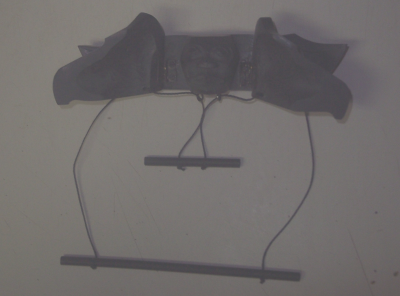
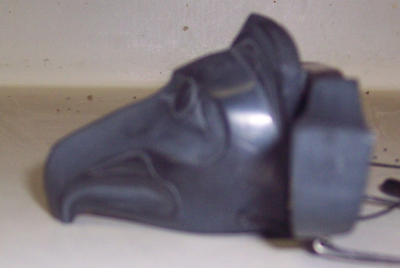
Ten years ago, Wayne Young was a promising journeyman in Northwest Coast art. Taught by such well-known figures as Dempsey Bob and Robert and Norman Tait, he had an enviable reputation for imaginative, often asymmetrical designs, and for fine finishing details on his carving. Now, however, illness keeps him from working. Since new works from him seem unlikely, when I first noticed this miniature argillite transformation mask of a raven and a human on the Alcheringa Gallery web site two years ago, I was immediately interested in buying it.

Not only was I interested in the artist, but I figured that the piece had to be one of a kind. I mean, a mask not only made of argillite, but with two faces? And one no more than fifteen centimeters long and six high? The thick hinges that the outer face swings upon and the fine screws drilled into the argillite are evidence of the difficulty in the construction – and also all the explanation necessary of why no one else is likely to try to imitate the piece.

However, obtaining the piece proved a challenge. When I visited the gallery fifteen months ago, none of the staff knew where it was. In fact, despite the fact it was still on the web site, they could never remember seeing it, and were sure it must be lost. However, three months ago, I queried again. This time, the gallery director answered, and could locate it.
Ordinarily, I don’t haggle over price. However, ten months previous, the mask had been part of an on-site auction, with a quick price that was two-thirds the listed price. Since the gallery had had the piece for seven years, I sensed it might be eager to sell it, so I offered the quick price. It was accepted, and I took a day trip to Victoria primarily to carry it safely home.

I declined the frame and beige and brown matting the gallery had added. I thought the frame did not do the mask justice; I am currently awaiting an argillite stand to display it properly.

Unfortunately, too, time has not been kind to the piece. Another artist who remembers seeing the piece when it was new remembers the outer mask closing evenly. Now, one hinge is slightly twisted, and one side of the mask is lower than the other when closed. A drop of glue on a couple of the screws might be useful, too, and perhaps a replacement of the black cord on the controls.

However, despite these imperfections, I consider the mask well worth having. The carving is simpler than most of Young’s work, but the lines need to be bold on a piece of such minute dimensions if they are to be discernible. Finer lines would be nearly invisible, and therefore wasted – nor would argillite lend itself to them. The fact that Young knew the restrictions of the size and the medium says a lot about his skill as an artist.

I could almost believe that Young deliberately set out to challenge himself by putting obstacles in his own path. If he didn’t, he must have soon discovered them. But, either way, he overcame the obstacles, not with inlays and other distractions, but with a well-designed, cleanly carved, understated bit of excellence. I consider myself lucky to have obtained it, and my only regret is that new pieces from Young are unlikely.
Read Full Post »

Yesterday, I had a date with a ghost.

You see, November 11 was the anniversary of Trish and I as a couple. It was not our wedding anniversary; that was for the public. November 11 was the private one, the day we kept for ourselves. Whenever we could, we took the day off, and at the very least we tried to go out to dinner, although once or twice in the last few years, she hadn’t been well enough for us to celebrate on the exact date.

This being the first anniversary since her death, I debated with myself all day if I would keep the date. Perhaps it was too sentimental? Too much giving in to grief? But in the end I decided I was observing the day in my own mind anyway, so I might as well indulge myself. I dressed in my best – a black Dorothy Grant shirt, my gold ring, my copper bracelet, and the Lyle Wilson pendant that Trish had won at a raffle at the West Vancouver Museum – and wore all black, one of the colors that Trish had liked best on me, and solemnly descended on the restaurant.

I had chosen La Rustica, an Italian restaurant we had known at its height when we were living in New Westminster. We hadn’t been there for years, but we had talked about returning there to see what it was like. Now, I would have to see for myself.

The restaurant had been extensively renovated at least once since we used to frequent it, so I couldn’t sit at the table in the back where a photographer had taken a picture of us on our fourth anniversary years ago. Instead, I was shown to a table for two on the edge of the vacant dance floor. On nights when the band played, I imagine it would have been a bad seat, the sort that single diners usually get unless they complain. But that night, I didn’t care; it was well away from the large party from the assisted living home who were the only other diners in the restaurant, so they wouldn’t notice my odd behavior.

My date, I imagined, was in a green turquoise dress with flowing sleeves, one of the few that I kept when I gave her clothes away. Her hair was long, and dyed auburn.

I ordered two glasses of white wine, and at first the server got it wrong, giving me two glasses of wine in a carafe. “If it’s not too odd, could I have another glass?” I asked. The server looked askance, but she did as I requested, not quite daring to ask what I was doing.

I poured our wine, then clinked the glasses together. Not daring to speak out loud because I knew I would end up sobbing in that horrible breathless way I have had during my mourning, I delivered the ritual Scottish toast and response that Trish had always loved since she first read it in George Macdonald Fraser’s The General Danced at Dawn:

“Here’s to us.”

“Wha’s like us?”

“Damn few, and they’re all deid.”

I followed that with the question that one or the other of us had always asked, “Has it really been __ years?”

“It doesn’t seem possible,” I whispered to myself, finishing the ritual. By then I was daubing at my eyes with the linen napkin.

My tastes have changed tremendously since I had last eaten at La Rustica, but I chose what had been my favorite meal: onion soup, followed by veal in a capers and wine sauce, and an amaretto gelato. The restaurant was dimly lit, but I knew my date was eating the shrimp, something I never prepare at home because it might trigger an allergic reaction for me, but which she always enjoyed when we ate out.

At the end of the meal, I asked if I could go into the back. But the years and the renovations defeated me, and I could not decide where our favorite table had been.

Maybe that was just as well. Wherever the table was, it would have sat hundreds since we had been at it, and we could have left no impression that would have remained.

The server was looking at me strangely, so I explained the occasion, and left a large tip before I left.

Ordinarily, I would have hardly felt two glasses of wine, but that night I did. I decided that I couldn’t bear the bus, so I walked down the hill to the Skytrain to sober myself up. By the time I boarded, the cold had cleared my head. I didn’t say goodbye to the ghost, of course; she followed me home.

People talk of melancholy although it were a form of depression, and should be avoided. If you believe that, you will never understand, but I enjoyed my company that night, although the encounter left me feeling drained.

I don’t know if I will be returning to La Rustica, which proved only adequate (the sauce had too much lemon, and the restaurant was no longer growing its own herbs on the roof). But I already know that my companion and I will be going out again on our wedding anniversary, as well as next next November 11th.

Read Full Post »

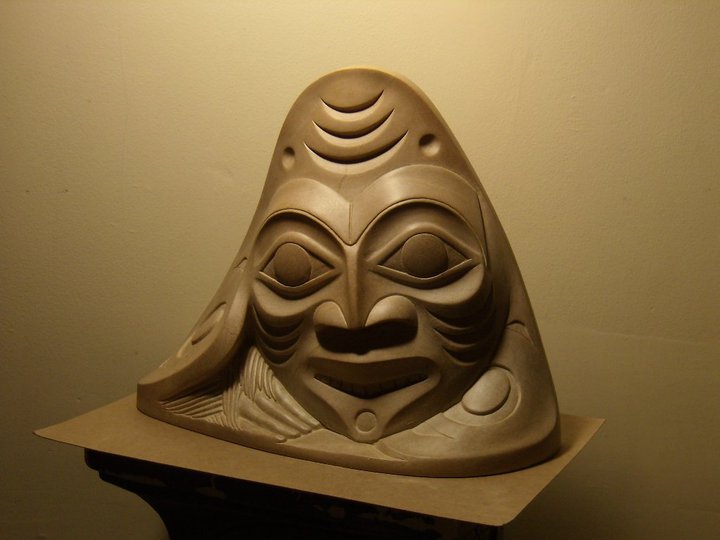
I never buy art unless it catches the eye or intrigues me in some other way. However, some purchases loom larger than others , and Gary Minaker Russ’ “Haida Sharkwoman” is one of them. I am not talking about price (although “Haida Sharkwoman” is one of the more expensive pieces that I’ve bought), nor size (although at fifty-three pounds, it is one of the heaviest), but about artistic integrity and excellence, both of which the piece has to spare.

Minaker is best-known as an argillite carver. Working with hand tools and preferring natural finishes, he has a tendency to go his his own way that some gallery owners think has hurt his career, but that keeps his work original. In the last few years, he has been resisting the pressure to carve for the market and produce copies of Bill Reid’s “Raven and First Men” or endless variations on Raven stealing the light. He has also been chafing at the growing tendency for inlays of precious and semi-precious stones and metals on argillite, which drives up the prices while rarely improving the actual lines of carvings.

Consequently, he has been branching out and trying to create a new market in Brazilian soapstone in the hopes of finding greater artistic freedom. He has had mixed success, he tells me: private collectors have no trouble accepting his new direction, but many galleries do. Still, he perseveres, partly because it is easier to find large pieces of soapstone than of argillite to produce such pieces as “Haida Sharkwoman.”

Forty-five centimeters long and thirty-five wide, “Haida Sharkwoman” is carved on one side and flat on the back. The asymmetrical curve on the right, Minaker says, was in the raw block, and only required refining.

Sharkwoman (not to be confused with Dogfish Woman, whom Charles Edenshaw and Bill Reid made famous) is a subject that Minaker has returned to many times in his work, just as Beau Dick keeps returning to the Bukwis and Tsonoqua. He suggests, only half-jokingly, that the subject reflects the difficulties he has had with the women in his life, adding that he tries to restrict himself to no more than one return to the subject each year.

The sculpture shows a woman half-way through a transformation into a shark. In modern northwest coast art, such a transformation is often depicted as a twisting of a person’s existing limbs, rather like the werewolf transformations seen in modern computer-generated special effects. That approach is unquestionably dramatic, but Minaker has chosen to depict the new shape as a blanket draped over the figure, as in the old stories. Here, you have the shark’s fins falling over the woman’s head like a hood, as her face, still showing her labret, is slowly transformed by the gills and flat snout of the shark.

The sculpture is dominated by the abstract carving style of the face and the fins. However, at the bottom right is a more realistic set of fingers half-covered by hair. This contrast emphasizes the transformation; it is only when your glance falls on the realistic hand that you realize that the transformation is taking place.

Notice, too, that the position of the hand suggests that the woman is propping herself up on her stomach against a rock, waiting for the transformation to complete so that she can begin to breathe the water.

The carving is further enhanced by one of the most sinuous and three-dimensional formlines that I have ever seen, beginning at the lower right of the fin, and twisting up to the eyebrows. From there, it continues around the face and jawbone to rejoin the right fin again, keeping the viewers’ eye in constant motion. And, should you detour down the nose or around the lip, the gills are on both cheeks to force your gaze back to the main formline. As a result, you soon tend to attribute the movement of your own eyes to the sculpture itself, and start imagining that its eyes are moving to watch you – not necessarily in a menacing way, but definitely an alert one.

I say “necessarily,” because the impression that “Haida Sharkwoman” makes can vary wildly. The combination of the formline and the reflective quality of the soapstone makes the sculpture look dramatically different in various lights. I have seen it a pale beige in bright sunlight, looking serene; golden in the reflected light of a flash, looking otherworldly, and dark in the shadows, looking sinister. The piece is so varied that I can get a different perspective on it simply by moving it to a different location.

One thing I’ve noticed, though, is that it tends to dominate a room, no matter where it’s put. After several experiments, I’ve given in and placed it on top of the TV cabinet, which most of the living room centers on anyway. As a major piece of art, it seems to belong there.

Read Full Post »

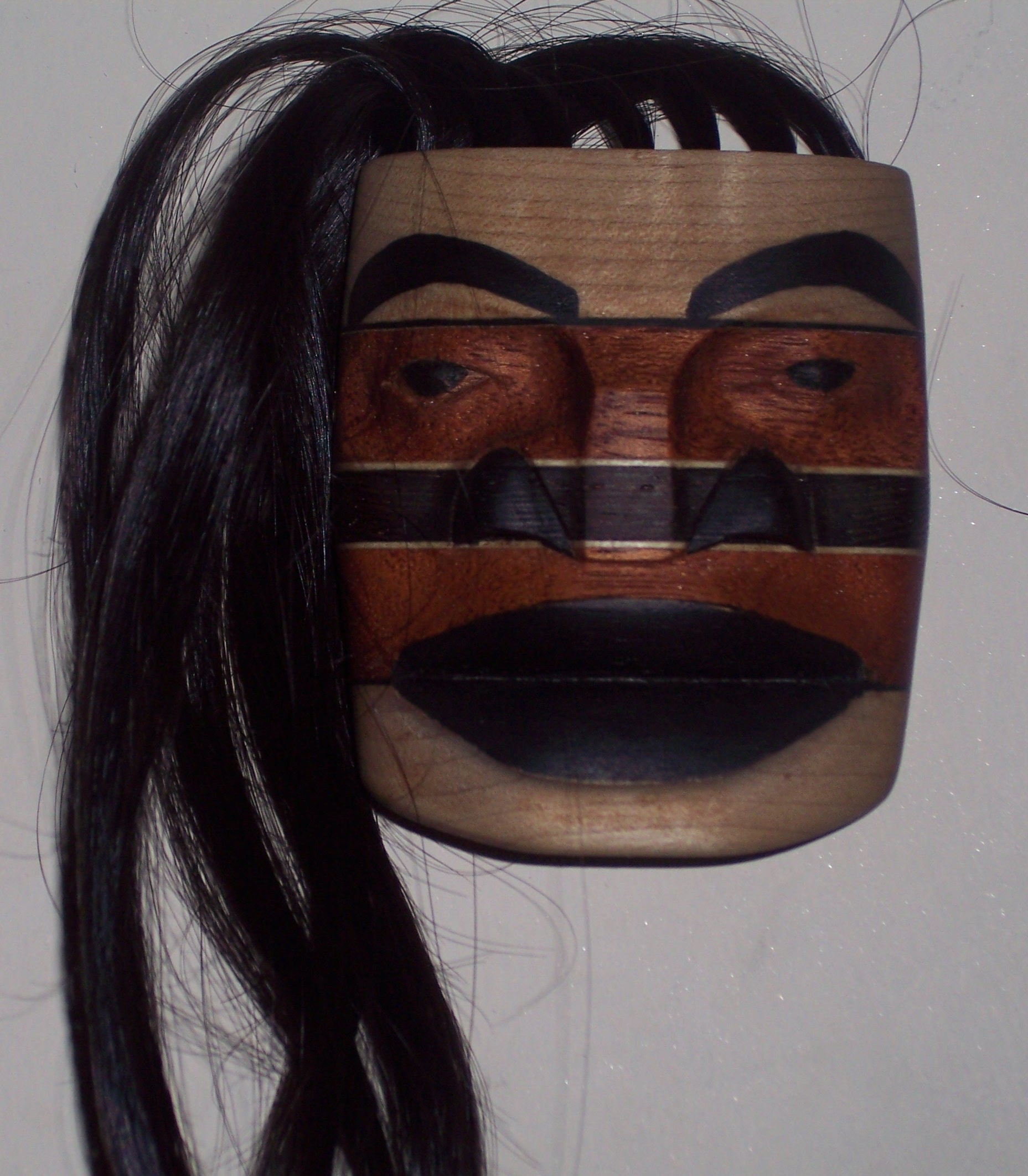
Miniature masks and sculpture are a test of an artist’s skill. They are merciless about showing who has a steady hand on the carving tool or the paint brush, and who cares about finishing details. Often, too, they demonstrate an artist’s ingenuity.  Tsimshian / Haida Mitch Adam’s “Peaceful Warrior” (shown below roughly full size) is an example of all these things, which is why I jumped to buy it when I learned it was available.

The mask is one of two that Adams carved from a block of laminated wood (the other is currently in the Spirit Wrestler Gallery). Except for a few pieces, such the eyebrows, the pupils, the lower lip, and part of the nostrils, what you see is not paint, but the natural colors of different layers of wood. From the outside working in, the layers are Swamp Ash, Ebony, Mahogany, Maple and Wenge. Adams has chosen to make so few additions to the block that you might call the result an example of minimalism.

Adams, who seems to be making miniatures one of his specialties, writes, “I enjoy carving this size of mask, to challenge my self and to see what level of detail and character I can get out of these woods. [I] try to carve and finish it as it would be done for a full size mask.”
Faced with such ingenious economy, what can I do except try to imitate it, and let the mask speak for itself?

Read Full Post »

If my late spouse Patricia Louise Williams had been an opera buff, I might have arranged a special performance in her name for charity. Had she loved walking in a particular park, I might have arranged for a bench with her name to be placed there. But, because three of her favorite things were needle art (embroidery, cross-stitch and other related techniques), our parrots,  and Northwest Coast art, I took an inspiration from Rande Cook’s “The Poet” and commissioned a limited edition of 20 prints and 5 artist proofs from Haisla artist John Wilson, one of our favorite artists.

The design process was interesting, because I had never been so heavily involved in it before. John and I chatted about what would go into the print a couple of times on Facebook before coming up with the final idea. I also talked with Mitch Adams, the artist-turned-printmaker as he was producing the prints and last minute changes were needed.

Essentially, the print is meant as a one to one transposition of her life into the cultures of the northern coast. The print shows a stylized woman (complete with labret) at a loom, which is a bit of wish fulfillment, because traditional weaving was something that Trish had dabbled in and always wanted to go more deeply into. Similarly, our four parrots become four ravens, their counterparts in the northern hemisphere, who also happen to be psychopomps – that is, conductors of the dead into the afterlife.

The print includes a number of reference and in-jokes, some public, and some private. The pattern on the loom is unfinished, reflecting the fact that Trish died relatively young, and with many things unfinished. Moreover, the pattern itself is Raven’s Tail, one of the oldest weaving patterns known on the coast, which ties in with Trish’s lifelong archaeological interests.

In the same way, the tongues of the ravens are touching, which traditionally indicates communication or the imparting of wisdom. If you have ever heard either parrots or ravens, you will know just how unlikely that sounds when applied to them.

To catch the other references, you would need to have known Trish. She was always holding needles in her mouth as she worked, which could make a kiss in passing a dangerous proposition. Also, like all needle art practitioners, she was always dropping needles – which one of us would eventually find by being stabbed in the foot. It’s all part of the gentle humor in the print which reflects Trish’s own.

I suppose some people might leap to accuse me of cultural expropriation. But if nineteenth century argillite carvers could depict Europeans in top hats, or Norman Tait could carve a mask that included a camera,  I think that “Needlewoman” is on safe grounds. People often forget the sense of humor in Northwest Coast art, and I make no apology for restoring some of it, especially when it’s appropriate to Trish.

Like all art, “Needle Woman is comforting to have – and so is sharing copies of it with those closest to Trish.

Thanks, John, for an original and moving piece of art.

Read Full Post »

(Morgan Green is currently trying to raise $5000 to pay the remainder of her tutition for goldsmithing. She is offering a number of pieces of her original art in return for donations. If you want to assist, please click this link)

http://www.indiegogo.com/project/widget/9083 )

Looking at the artistic career of twenty-six-year-old Morgan Green, the first thing that strikes most people is how varied it has been. But probably, that variety comes naturally. With an art teacher for a mother, and master carver Henry Green for a father, Green has been surrounded by a variety of art all her life.

However, for Green herself, the road to becoming an artist, “All started with clothing. “I’ve always loved making clothing since I was young. I used to handsew on the bus or wherever to pass time. I can still handsew and walk at the same time,” Green says, adding with a smile, “I can also read and walk, but it’s a bit of a dangerous occupation.”

In fact, Green’s first formal training after graduating from high school in Prince Rupert was fashion design. However, since then, she has also studied bronze casting, molding technique, clay sculpture and goldsmithing, as well as learning wood carving with her father and Salish carver Jordan Seward, and jewelry-making with Haida artist Richard Adkins.

With this background, Green is already making a living as an artist, although, like most artists, she has also had the usual array of odd jobs, ranging from commercial fishing to waitressing.

“The most important steps were just doing it,” Green says when asked about how she established her career. “I put myself out there, applied for grants, asked to apprentice, showed up, and applied for art jobs.”

However, Green also goes on to say that, “Formal training has helped me immensely to have cleaner, professional work. Usually, the teachers are an amazing resource.”

A tradition of her own

Of mixed Scottish and Tsimshian background, Green shows a similar diversity of influences.

In general, she says, “I admire artists who work hard.” However, asked to name artists she admires, the first one she mentions is Art Nouveau artist Alphonse Mucha.

“The visual flow of his work is enchanting,” she says. “I find it rather poignant how he influenced the whole Art Nouveau movement like that, then died alone in exile. Very sad. I like that much of his art was poster art, popular culture. He has been an influence because I have studied his work a lot and use his work often as a drawing reference.”

The next influences she acknowledges are “Tsimshian historical artists. Most of their names aren’t known, but I am the most fascinated with their work. Their variations on Mouse Woman are my favorite, but everything about their formline is amazing – the shapes, the flow, the connections.”

Some writers on Northwest Coast art would see a split between the modern and the traditional in these influences, but Green doesn’t see tings that way. “I think that tradition and innovation are the same, or, I should say that Northwest Coast historical designs and sculpture were extremely innovative. I think that it is important to study tradition, because, without that study, innovation can seem hollow.”

Unlike some First Nations artists, Green sees nothing wrong with choosing subjects that are not part of her family’s crests. “Technically, if I stayed within my hereditary right, I would only be able to make eagle things,” she says, “But even in history artists were definitely different from the general population. To my knowledge, the hereditary right is more important for who’s wearing the item. Artists have always created art for many different people, as well as for performances, and even neighboring villages. So I think that we can be given some artistic license.”

Diversity upon diversity

Since Green makes her living as an artist, she describes herself as “somewhere in mid-stage of my career. I feel like my artwork is still maturing, but the quality is good, and I’m happy with where I’m at. I’m not really one for major production or commercialism (I like to make things one of a kind, and I believe in locally made), so I’m lucky that I have supporters who believe in me.

Right now, Green thinks that “My career is at another jumping off point.” Continuing to work in a variety of media, she says “I see it all as connected. The processes are all different, but have similarities. A lot of [working with a new medium] is learning how to work best with the properties of the material.

“I am, of course, in love with a very traditional style of Tsimshian art myself.”

Besides art, Green also hopes to do more teaching in the future. “Teaching has probably been my biggest revelation: first figuring out I had skills to share, and then trying to formulate my knowledge and ideas into a communicable lesson plan. I think that teaching Northwest Coast art fills my need for altruism. I think it helps people, and at the very least makes kids happy.”

In addition, Green is also concerned with violence against women, and was Jordan Steward’s assistant a few years ago on the pole to commemorate missing women in Vancouver’s Downtown Eastside.

As Green thinks ahead, she adds “I want to teach art and prevent violence against women and make our children stronger and able to practice cultural arts. And I want to do a fashion show, sometime soon.”

An armchair psychologist might be tempted to speculate that Green is trying to combine the interests of both her parents in her own life. However, those who know her might be more tempted to say that her ambitions are just Morgan being Morgan, looking ahead to more of the diversity that has already characterized her career.

Read Full Post »

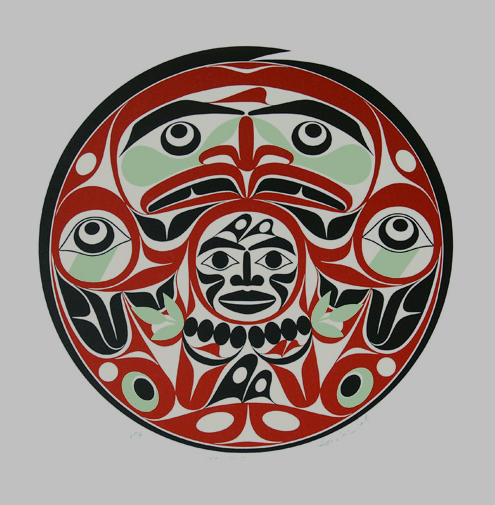
Kwakwaka’wakw artist Rande Cooke has been on my short list of Northwest Coast artists for a couple of years. I knew I wanted one of his works, and it was only a matter of time before I found the right one. When I saw an artist’s proof of “The Poet” at the Alcheringa Gallery in Victoria, I knew I had found the right piece, because it fit so well into my emotional landscape.

You see, “The Poet” is a private edition of twenty prints in honor of Joan Rodgers, the wife of print expert Vincent Rickard, who died on May 23, 2010, at the age of 57. The title takes its name from the fact that Radgers wrote several volumes of poetry (although according to Elaine Monds of the Alcheringa Gallery, did not publish them).

I have met neither Rodgers nor Rickard, but, by the ugliest of coincidence, my wife died on July 5, 2010, aged 55. The synchronicity is not exact, but close enough I responded immediately to it.

The print shows Rodgers kneeling in the middle with two plants below her to represent her love of gardening or creativity (another similarity with my wife). Above her is the raven, with his wings enclosing her. As a being able to travel freely between the mundane and supernatural worlds, the raven is an appropriate psychopomp, or escort of the newly dead into the afterlife.

The surrounding black frame is broken, suggesting the suddenness of Rodger’s death and the disruption that it leaves behind. Another broken circle is suggested by the positioning of green in the design. Another indication that “The Poet” is a memorial piece is suggested by the positioning of the raven’s mouth to suggest a frown.

All of which I can thoroughly relate to just now.

Even so, I would not have bought if the design was not engaging in its own right. It has a fluidity – like all of Cooke’s work that I have seen – that turns the semi-abstract traditional forms into pure abstraction. Caught by the flow of the lines, the viewer’s eye has trouble focusing on the individual forms – until, suddenly, have traveled the diameter of the design, the eye moves into the middle and the forms suddenly come into focus.

I am struck, too, by the use of the pale green as the third color in the design. Green is a common enough color in Kwakwaka’wakw design, but usually it is much darker. Nor does it generally overlay the bolder black and red lines, as it does with the plants in “The Poet.” Here, its sparseness makes it seem almost fragile in comparison to the other colors in the design, and its presence in both the plants and the raven’s wing and face suggests a connection – although one fragmented and incomplete – between the states of life and death. This suggestion is reinforced by the fact that the black decorations on the raven’s wings, just below the patches of green, seem vaguely plant-like.

As an artists’ proof of such a small edition, my copy of “The Poet” should be extremely collectible – an exception to my contention that most prints should not be bought as an investment. However, what strikes me is not the investment potential (which would never lead me to purchase a print), but the subdued dignity it gives to its subject – a kind of refinement that seems highly suited as a memorial to the dead.


Read Full Post »


Ron Telek is primarily a carver and a sculptor. He has worked in everything from wood and stone to cloth and bone, but most of his work is three-dimensional. Consequently, I was curious to see what his first print would look like. I expected a sort of two-dimensional equivalent of film noir, full of shadows and vaguely glimpsed forms, but instead the print was “The Siren: The Keeper of Drowned Men’s Souls,” an intricate piece that more than one viewer has compared to a tattoo design (I envision it stretching across someone’s back).

Besides the medium, another unusual aspect of the print is that its subject and execution includes only one hint of Telek’s Nisga’a background: the design on the back fin of the smaller siren.

Instead, the piece draws on Classical Greek and Roman mythology. At first, the subject is surprising, but, on second thought, why not? Although Telek has a First Nations background, he has mentioned several times the influence of Japanese,African, and South American art on his work and such influences can sometimes be seen in his work. Nor is this the first time he has done a non-aboriginal piece. All things considered, it is not surprising that other cultures should be visible in his work, especially since the siren is not that far removed from several figures in local First Nations mythology, such as the Otter Woman.

At any rate, despite its unusual aspects, many of Telek’s characteristic elements are in “The Siren,” such as the figure in the mouth and spirits in the form of faces erupting all over the body. What is unusual, though, are the suggests of sexual aggression or predation in the breasts, each of which is made of a single spirit with teeth where the nipples should be, or the open mouth with teeth where the vagina should be. This sense is reinforced by the waves of hair, which instead of being seductive become a Medusa-like mass of writhing spirits.

Aggression is also suggested in the heavy shoulders and the reaching left hand, whose size suggests that it is reaching out to the viewer.Telek’s siren does not merely lure men to their doom, but actively preys upon them.

Then, too, the relation between the siren and men she captures is ambiguous – but menacing no matter how you interpret it. Some of the spirits seem resigned, but far more of them appear to be angry or in pain, leaving you to wonder how, exactly, the siren is keeping them. Does she only gain substance and the power to act through the drowned souls? Is the fact that she seems composed of lost souls an indication that she only exists in people’s minds? However you interpret the piece, the siren is not the supernatural beauty that you sometimes encounter in Classical mythology. Instead, she seems a supernatural dominatrix, overwhelming and perhaps luring the drowned men through sheer force of presence.

This is a remarque of the limited edition print – that is, a copy with an additional element not found in the original. Usually, a remarque consists of a quick doodle, but, Telek has added the second siren, adding almost as much detail as in the original image, and increasing the size of the print by nearly half.

The second siren reinforces the impressions hinted at by the first. Its face is more shark-like than that of the original image, evoking the figure of other powerful female figures in various First Nation mythologies, such as the Haida Shark Woman and Dogfish Woman.

In addition, the second figure gives a perspective through the drowned man still wriggling in its hand. The sirens, clearly, are huge.

The idea that the sirens gain substance from the capture of drowned men is further reinforced by the facts that the second figure’s body includes fewer spirits, and that it is somewhat smaller – perhaps a juvenile or teenage siren. Perhaps it is not even sexually mature, since it is much more slender and lacks the mass of flowing hair of the main figure.

Psychologists could go wild on the implications of these images (I know at least one who is sure that Telek was abused as a child on the evidence of his carvings). Personally, though, I prefer to simply enjoy the imaginative possibilities – and to thank Telek for this present, and for adding the remarque before giving it to me.

Thanks, Ron!

Read Full Post »

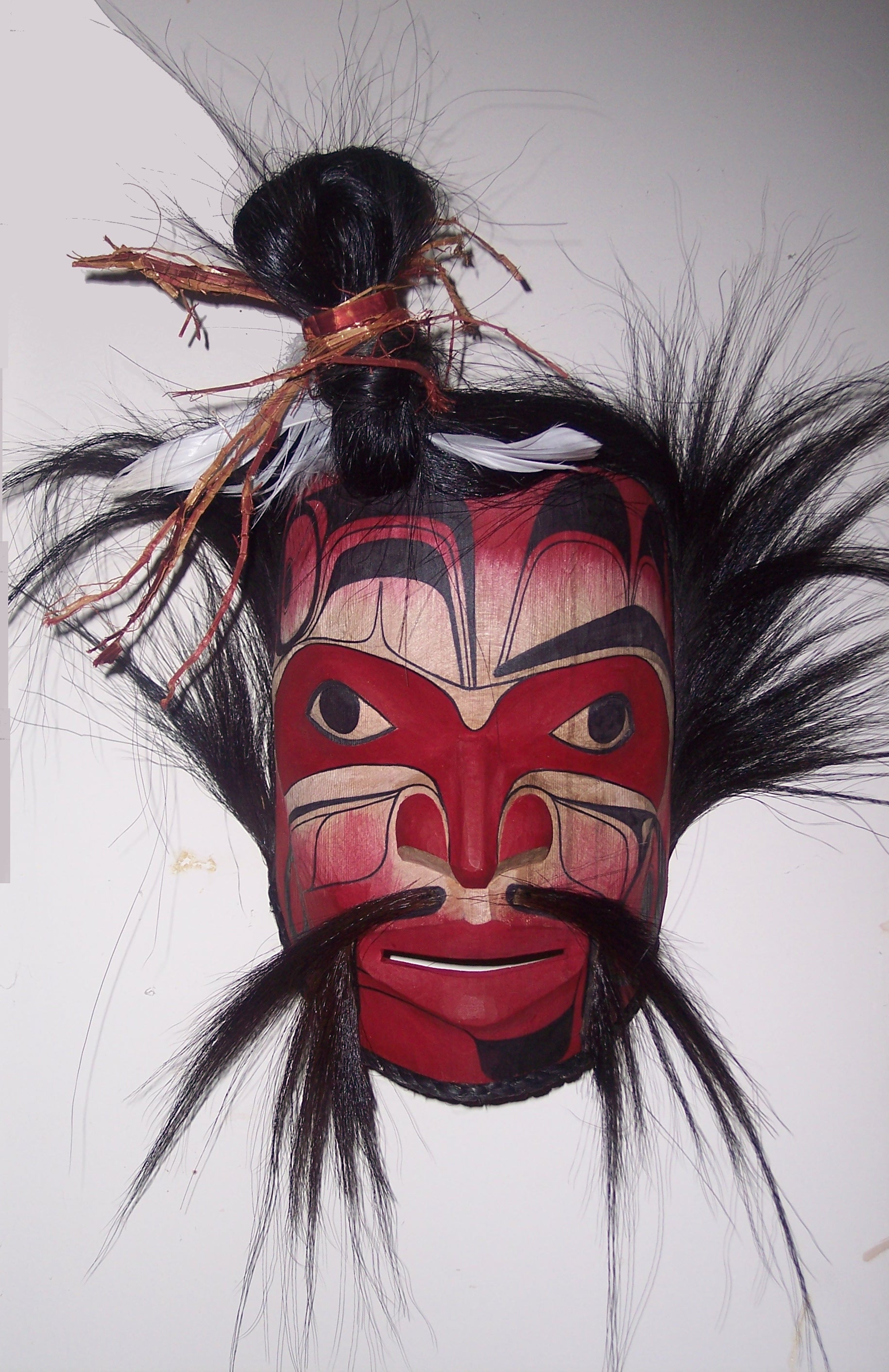
Ian Reid (Nusi) is a Heiltsuk artist whose work I have been watching for a while. For a long time, I was determined that the first Reid piece that I would buy would be one of his Chilkat ravens, like the one that was in the Continuum show at the Bill Reid Gallery. However, when “Working Shaman” came into the Inuit Gallery last month, I leaped at the chance to buy it. The mask is a simple one in some aspects, but all the more appealing for that reason.

If you have read anything about shamanism on the Northwest Coast, you may remember that shamans typically did not wash or cut their hair. This is the main element in Reid’s mask, with its unkempt hair and mustache, its carelessly-tied topknot, and the white feathers. The blending of the red paint into the color of the unpainted wood also suggests a lack of cleanliness, or at least the chapped complexion of someone who spends most of his time outdoors.

Many shamans had a fearsome reputation (certainly, their graves were isolated, and not places where people lingered). This reputation is played upon in many modern renderings of shamans, but Reid has taken a different approach. His shaman is not so much a figure of fear as an eccentric. The unfocused eyes and slightly parted lips suggest the trance state of someone imperfectly grounded in the everyday world.

This is the first Heiltsuk piece I have bought, and I admit to knowing almost nothing of the Heiltsuk artistic traditions, mainly because they do not seem to have been studied in their own right. However, the carving and the painting suggest a tradition that I would expect from the Heiltsuk’s physical location: It mostly resembles the Kwakwaka’wakw, but also has a touch of northern formline as well.

Saying more is complicated by the fact that Reid seems to be drawing on 19th century sensibilities, rather than working as a modern artist familiar with the formal rules of formline. The formline on the mask is looser than modern artists usually draw today, and the U-shapes are independent decorations, not elements contained by the formline. In fact, such formline as appears is thin and almost overwhelmed by the red of the eye sockets and nose, and around the mouth.

Where you can see the plain wood, it looks old rather than recently carved. Add the smearing of the red, and the general impression is of an old mask – dug up, perhaps, from a shaman’s grave to put on display in a museum.

Given that much of Reid’s work is ceremonial and communal, this impression is probably deliberate. Artists who work both commercially and cultural generally make a distinction between the two types of work and, looking for a tradition for non-cultural work, what better place to find it than in a museum? That this is a mask to look at, not to be danced, is emphasized by the fact that not only are there no eye holes, but neither are there are any holes for the nostrils — not even an indication of where they would be.

Portrait masks can be hard to do well. Many carvers – and buyers – prefer bird or animal masks, that seem more imaginative. But in depicting a shaman and giving the mask a patina of historicity, in “Working Shaman,” Reid shows that a portrait mask can be as imaginative as any.

Read Full Post »

With few exceptions, the collecting of Northwest Coast Art did not begin until the 1970s. That means that pieces from those collections are just now starting to appear in estate sales – sometimes at bargain prices, if the heirs are more interested in quick cash than obtaining the full value. Consequently, when a copy of Lyle Wilson’s 1980 limited edition print “Shaman’s World “ showed up at the Inuit Gallery during the summer, I quickly snapped it up.

The print would be unusual today, but, when it first appeared, it must have seemed utterly unique. I tag it in my mind as a Northwest Coast Gothic, a kind of predecessor of Ron Telek’s work. It is also Gothic in a modern sense: monochromatic, macabre, and, quite possibly, self-consciously over the top.

The shaman’s world, apparently is actually two worlds, one the mundane world of light, and the other the dark world of the supernatural and other realms like the sky and the depths of the ocean. In the mundane world is the head of an eagle – perhaps a tutelary spirit to judge from the hand above it – while below it is a figure that may be a man terrified of the shaman, but which I suspect is a masked dancer, trying to make sense of reality through his dance. Meanwhile, in the spirit world, a man transforms into an eagle while below it swims a killer whale, another figure of power.

Neither world has much in common with the other except the shaman, who stands in the middle like a sort of ying-yang symbol, half of him in each world. Both worlds are contained in a frame of human figures (whose formline shapes suggest that they are intended as skeletons), birds and monsters that are apparently wolves. The tops and bottom of the frame are mirror images, perhaps adding the additional dimension of life and death to the cosmology contained within the print.

The shaman’s position, clearly enough, indicates that the shaman mediates between all aspects of the world, as well as their different methods of understanding. It might also be significant that the shaman is less skeletal than the human figures in the outer frame and has a differently shaped-head; perhaps the suggestion is that the shaman is the only piece truly alive.

The formlines in “Shaman’s World” are wonderfully simple, defined largely by interior elements to indicate knees and hips and chests. They flow from one shape to another, as good formline should, but so do the elements of the design. For instance, although the shaman’s arms are held in front his chest, the body of the human transforming into a bird and the first sprouting feathers look, at first, like an additional arm. Similarly, the twisted body and tail-flukes of the killer whale suggest a third leg. Together with the formlines, these flowing shapes help assure that the viewer’s eyes are never still, picking out a detail here and there, but always moving around the design.

Another obvious element is the use of blank space. Although much of the design is symmetrical, especially in the frame, the blank spaces on both sides of the shaman are highly irregular, being open and broad on the mundane side, and narrow and twisting on the spirit side. In this way, both the traditional symmetry of most Northwest Coast art and the asymmetrical preferences of modern design appear in the design – yet another set of elements that the shaman mediates between.

By restricting himself to black and white, Wilson relinquishes whatever a secondary or tertiary formline color might have brought to the print, but probably it is just as well – had he added red or blue or green, the design might have collapsed under its own weight. As things are, it is still a restless piece, full of contrasts and new elements to discover as your eye travels around it again and again.

Read Full Post »

« Newer Posts - Older Posts »