Feeds:
Posts
Comments

Archive for the ‘Bruce Byfield’ Category

Should you – or can you – appreciate works by an artist whose morals or actions you find objectionable?  Today, the question returned to haunt me when a colleague rightly pointed out that a public statement I made about a writer minimized his cruelty and immorality by equating it with shortcomings well within the human norm. That wasn’t the first time the issue or art and morality had come up, and I’m sure that it won’t be the last.

If you consider yourself a person of conscience, the question has no easy answer. In many cases, evoking the cultural relativism of past times just doesn’t provide an excuse. By the standards of any time, Samuel Pepys was a sexual predator. In all likelihood, Byron was, too, although the removal of evidence by his friends allows some people to believe otherwise. Mozart was a brutal egomaniac, Dali a sadist, and Ezra Pound a Fascist sympathizer. Even as seemingly an amiable eccentric as William Blake subjected his wife to poverty and kept her subjugated to his art,insisting that she color in his prints and waking her in the middle of the night to keep him company. The truth is, artists are so far outside the social norms in general that, once you start reading their biographies, many will be found morally lacking.

At times, the exceptions stand out all the more because of their rarity. For example, William Morris was true enough to his ideals of equality that he never divorced his wife, although knowing she was carrying on an affair with Dante Gabriel Rossetti. John Keats also appears to have been a thoroughly decent man, although cynics might question how much poverty and illness simply deprived him of opportunities to offend.

I suspect that how you answer such questions depends on your priorities. If you are only concerned with artistic achievement, then everything else that an artist does is irrelevant. What matters is the art, and the fact that Leni Riefenstahl’s films were propaganda for the Third Reich is irrelevant compared to her cinematic technique.

The trouble with this position is that, if you admire someone for one reason, you often want to admire them in other ways. Unless you are very careful, sooner or later you find yourself making excuses for their behavior, simply because you like their art.

Yet holding artists to the strictest ethics and morality is no easier. For one thing, the artists of which you approve will make a very short list. For another, the question seems a slippery slope. Do you reject Charles Dickens because of his utter inability to portray women as human? Raymond Chandler or Brendan Behan for their alcoholism?  Where do you draw the line for the minor offenders against morality?:When, if any time, do you make an exception?

Just as importantly, there is something crass and insensitive about insisting that art meet other standards as well, perhaps because that is a common practice of totalitarianism. The problem is not so much that at least some arts – especially writing – can have a moral content, as the difficulty of imposing morality upon art without reducing it to the triteness of modern Catholic Holy Cards.

In theory, as George Orwell suggests, it should be possible to hold two separate beliefs — first, that someone is a skilled artist, and, second, that they were reprehensible human beings – but the practice is more difficult. It seems to involve endlessly jumping back and forth between the two extremes, and therefore is likely to satisfy no one. Instead of offering clarity, Orwell’s solution actually invites us to practice double-think – that is, thinking two contradictory thoughts at the same time, a habit that Orwell pointed out is a handicap to clear thinking.

I suspect, however, that is exactly what the majority of us do. We get swept away by the perspective or the choreography, only to start guiltily at enjoying the efforts of someone we disapprove. At other times, we start out disapproving and find ourselves tapping our fingers to the music despite ourselves, or having a memorable phrase lodge in our minds against our sternest judgments. For most of us, the answers don’t come easily or offer much satisfaction when we face the complexity of the situations in which we try to apply them.

Read Full Post »

For the last two years, Kate Beaton’s web comic “Hark! A Vagrant” has been part of my morning reading before I settle down to work. Not only is the comic centered on literature and history, which happens to be my favorite reading material, but Beaton approaches both from a distinctly Canadian viewpoint as I do, as opposed to the usual American or English one. So naturally when her first collection came out, I pre-ordered it.

Naturally, too, my productivity went out with the garbage the morning it arrived, as I eagerly read cover to cover.

So far as I can figure, the collection includes all of the comics posted on the web from March 2009 to June or July 2011. They are all available online, of course, but I believe in supporting artists whose work I admire. Besides, the reproduction on the page is far better than on the screen. And, unless I’m mistaken, Beaton has taken the opportunity to clean up the comics and rearrange them by subject matter – although even online, she tends to publish small bursts of comics on the same subject at one time.

Another advantage of the book is that it allows me to appreciate Beaton’s work more. In particular, until reading the book, I don’t think I fully appreciated how much her loosely rendered style owes to Edward Gorey. It’s by no means a slavish copy of Gorey’s work, being less angular and less-detailed in the background, but the resemblance is obvious when you look at their work side by side. Beaton indirectly acknowledges the influence by devoting a number of comics to the impression that Gorey’s dust jackets give of the contents of the book they adorn; clearly, she knows his work well.

Reading Beaton’s comics in batches also helps me to pinpoint her sense of humor. It’s broader than Gorey’s, and less straight-faced, at turns sarcastic (Jane Eyre telling Mr. Rochester at the end of the story that “We are equals now that I am totally superior to you! Now I can love you”) and willfully literal minded (Nancy Drew telling men seen through a crack in a wall that she will rescue them, and their reply, “we could just walk around”), and more likely to be carried by the words than the drawing.

At times, the humor drifts in to the absurd, as with Queen Elizabeth I’s Tilbury speech, in which her words “I have the heart and stomach of a king” is continued with “and the wingspan of an albatross” and “the left hook of a heavyweight champ.” Often, the humor comes from a juxtaposition of modern and historical outlooks, such as Americans telling the French during The Reign of Terror that “We think your revolution is super creepy” or the Brides of Dracula terrifying Jonathan Harker, not with their sexuality but their desire to vote and own property, and go to university.

There’s no denying that “Hark! A Vagrant” is a geeky comic. It isn’t buttressed with the elaborate footnotes of Sydney Padua’s “2D Goggles,” but, without a knowledge of the historical events or the fiction she is riffing off, the jokes are much less funny, if they work at all. In particular, I can’t help wondering how much non-Canadians can grasp of jokes about people like Lester Pearson, William Lyon Mackenzie, or John Diefenbaker. Beaton’s assumption that the readers have prior knowledge might very well limit her audience, but for those of us who know what she is talking about (I get about 90%), her work is an acquired taste that leaves us hungry for more.

Read Full Post »

I spent most of Grade Six drawing maps. The result is a knowledge of geography that serves me well to this day, except for a few newer states in Central Europe and Asia. Another result is that I fully agree with Diana Wynne Jones’ Tough Guide to Fantasyland that most fantasy maps lack any sense of geography, history, or economics.

Recently, I’ve been spending my free time refining the map that will be the background for my efforts at fiction. As I work, I’ve developed some basic rules for ensuring that, whatever else I might do wrongly, at least the geography in my fantasy world will be plausible:

  • Remember continental drift. Your land masses should look as though they would roughly fit into each other. If you have trouble coming up with realistic land masses, try sketching the outlines of clouds or stains; you’ll be surprised how realistic the result will be.
  • Rivers and streams don’t start and end just anywhere. They arise in the mountains or hills, and usually empty into a larger body of water, such as a lake or an ocean. A few may go underground instead. Almost all grow wider as they move away from their source.
  • Mountain ranges are generally the result of the collision of tectonic plates. This means that they will rarely meet at convenient right angles to each other, the way that the mountains of Mordor do in Tolkien.
  • Ecosystems follow set patterns. You don’t have a rain forest next to tundra or desert. Instead, you have prairie and scrubland inbetween. A half an hour’s research on climate zones should be enough for you to get the idea.
  • Cities, towns, and farms don’t appear just anywhere. They are separated by however much land is needed for them to be self-sustaining, the only exceptions being large towns that are supported by a circle of small towns and farms that support them. In a primarily rural culture, they will be close to a water source. As population and trade develop, habitations may be positioned to service traffic on a road, or to take advantage of a certain trade. When you place a habitation, know why it’s there, even if the reason never gets into the story.
  • Consider how people get around. If water is the main transport, you need either a lot of coast line or else large rivers that can be navigated for much of their length. If roads are used more than water, then you’ll have several grades of road, probably ranging from highways like the Roman roads to half over-grown foot paths. All these decisions will affect how far anyone can travel in a day.
  • Forests and wilderness areas are much larger in pre-industrial cultures than they are today.
  • Most lands have a history that involves a succession of different cultures passing through them. Your names should reflect that, suggesting borrowings or corruptions from several different languages mingling together. A particular region might have a concentration of names from one language, and you should know why.
  • Be prepared for your landscape to evolve as you write. However, if changes are necessary, try to make them follow the rest of the guidelines given here.

Put this way, many of these points may sound obvious. But open the frontspiece of your typical fantasy paperback, and the chances are that the map will suffer from one or more of the faults I mention. Some have nearly all of them.

But take the time to create a believable map, and you’ll know more about your story’s background. You might even find story details or plot elements that wouldn’t have occurred to you if you map didn’t have at least a toehold in reality.

Read Full Post »

Years ago, on a sun-drenched afternoon at the Vancouver Folk Festival, folk singer Utah Phillips was talking about his life. Having just returned from the Korean War, he was working in Joe Hill House in Salt Lake City, and had decided he was a pacifist and an anarchist. Then his mentor told him, “Renouncing violence isn’t enough. You have to give up all the privileges that your life has left you with.”

I’m sure the tale grew in the telling – after all, who in the 1950s talked about privilege? But Utah was a storyteller, and probably would have admitted as much if cornered. But, despite such doubts, the comment stuck in my mind, and became the foundation of my thinking of what it means to be a male feminist. You can’t just announce that you believe in feminist principles or send a donation; you have to try living by your beliefs as well.

What do I mean by that? In some ways, I can more easily explain what I don’t mean. I don’t just mean ruefully admitting the truth of The Male Privilege Checklist. Nor do I mean a Gandhi-like renunciation of your normal life. Still less does it mean somehow a feminization of your thoughts and your actions (whatever that means), neutering yourself, or wallowing in guilt.

Instead, what I am talking about is a final act of maturation. Broadly-speaking, growing up is a gradually increasing awareness of other people and your responsibilities towards them – a journey away from egocentricity. You learn, for instance, to take turns, and not to interrupt others when they are speaking. You learn (or should) that little bits of politeness help people to get along.

Trying to move away from your male privilege might be called the last step in this process. A male feminist needs to rethink his way of interacting with people – especially women. He needs to learn not to be the first to speak when someone asks for suggestions, knowing that social conditioning makes many women slower to express opinions. He needs to learn to listen to women, and not to take charge automatically. He needs to realize that he is not automatically the center of attention, that he won’t always dictate the topic of conversation, or that women will view his concerns as paramount over their own. In general, he needs to learn a sense of restraint, and to extinguish the egocentricity that male gender roles encourage in him.

In particular, the male feminist needs this responsible attitude in matters of sex and gender. He needs to stop assuming, as catcallers on the street do, that, because he is interested in a woman, she will be automatically be interested in him, and that he has a right to impose his attention on her. He needs to learn that, while nothing is wrong with appreciating that a woman is attractive, something is very wrong with expressing that appreciation in any way that makes her uncomfortable. He needs to accept “No” as an answer, and to pay attention to the subtler signals of human sexuality that indicate whether attraction is mutual and might progress. If he misinterprets, he can never retreat into claiming that “I can’t help myself” or “Men are just following their biological imperative,” because he has chosen  to be personally responsible for his behavior.

This rethinking has to be extended to every aspect of his life – even small ones like how he occupies social space. What’s more, he needs to keep his choice constantly in mind, because most of his upbringing and experience tells him to do exactly the opposite of these things. Often, he will fail to meet his own standards, or over-compensate to the point that he looks or feels ridiculous.

Other times, both men and women will give him privileges he hasn’t asked for, listening to him while ignoring a woman, or hiring him in preference to a woman. He may never be sure that is what is happening, but the possibility will haunt him. Sometimes, he may be able to turn his male privilege to an advantage, such as advising that a woman be hired, but that will be qualified satisfaction at best. Most of the time, he won’t be able to do even that.

No question, renouncing your privileges as a man isn’t easy. Nor is it completely possible in our current culture. But it’s one of those things that’s worth trying despite its impossibility. After all, the alternative is to wallow in self-centeredness. And who wants to remain a child all his life?

Read Full Post »

For the past two years, I’ve been digitalizing my music collection. Considering I still have music I bought in high school, it’s a staggering assortment of LPs, EPs, cassettes, and CDs, and I have at least another year before I finish. Probably the only reason I haven’t abandoned the project is the certain knowledge that, if I do, in the near future I’ll be unable to play some irreplaceable music. But the project has led me to rediscover music that I haven’t listened to in years, and taught me something about my musical tastes.

In particular, among the 7200 tracks I’ve digitalized so far, there are some artists to whom I listen far more than others. Putting aside classical favorites for another blog, most of the ones I keep returning to fall into the category of folk rock. Most, too, either have intelligent lyrics, a strong beat, a sense of showmanship (in the sense of how to build excitement in a show or on an album), or all three. Many are English or Scottish.

My fifteen favorite are:

Battlefield Band

One of the two classic Scottish folk groups (the other is Silly Wizard), Battlefield Band has released dozens of albums, and a constantly changing lineup over several decades. Its music always includes a large number of instrumentals, and original lyrics about contemporary or historical Scotland. My favorite album from the group is Celtic Hotel, whose memorable cuts include “The Roving Dies Hard,”a look at the restlessness of Scots over the centuries and “Seacoalers,” a hard, unsentimental look at the bottom of the mining industry.

The Mollys

A Tex-Mex band whose heyday was the Nineties, The Mollys were the front for song-writer Nancy McCallion, whose persona might be described as a milder, female version of Shane McGowan. They did comical updates of standards like “Mershkin Dirkin” and “All Around My Hat,” but also strikingly original songs like “Don’t Wanna Go to Bed,” “Cash for Gold,” and “Yer Drunk Again / Polka Diablo.” And who else would dare to entitle a live album “Wankin’ Out West”?

Richard Thompson

Whether with his ex-wife Linda Thompson, Fairport Convention, or solo, Richard Thompson seems unstoppable, putting out album after album of memorable lyrics backed by equally memorable guitar work. I can’t begin to list the number of classic songs he wrote, but they include, “Down Where the Drunkards Roll,” “I Wanna See the Bright Lights Tonight,” “Pharaoh,” “When I Get to the Border,” and others far too numerous to list. Amnesia is his most memorable album.

The Corries

The Corries were Roy Williamson and Ronnie Browne. Starting in the mid-1960s, The Corries showed a new generation that folk music didn’t have to be stiff and boring. For many people, especially in The Society for Creative Anachronism, they were the first introduction to Scottish standards like “Johnny Cope” and “PrestonPans.” In-between such set pieces, they were also known to write parodies of Top 40 favorites. Ronnie Browne also wrote “Flower of Scotland,” which many people believe should be Scotland’s national anthem.

Maddy Prior

Best-known for her work with Steeleye Span, Prior is one of England’s leading folk singers, writing and performing modern songs and even reviving ballads and hymns from the eighteen century, as well as medieval religious ballads. Her original compositions include “The Sovereign Prince,” which compares Elizabeth I to jet-setting modern young women, “Commit the Crime,” “After the Death” and countless others. The Momento retrospective is probably the best sampling of her range, although her Silly Sisters albums with June Tabor are also worth tracking down.

Michelle Shocked

Michelle Shocked was introduced as a naif singer with The Texas Campfire Tapes. Then, shortly after her third album, she disappeared in a decade-long struggle to gain control of her own recordings. Recently, however, she has re-emerged, in control of her own music, releasing it the way she always wanted it to be heard, and proving herself as versatile, sly, and politically engaged as ever. Her best-known song is “Anchorage,” which was a minor hit, but almost anything she does is worth listening to. In one of her more recent songs, “I Think We Should See Other People,” she likens her relationship to the United States to that of a woman with an abusive husband. Short Sharp Shocked, Captain Swing, and her most recent album, Soul of My Soul, are among her most memorable albums.

Garnet Rogers

The younger brother of the better-known Stan Rogers (see below), in the years since his brother’s death, Garnet Rogers has carved out his own niche as a singer-songwriter. Although self-described as a Hulk Hogan lookalike, Rogers is known for intelligent, often heart-wrenching songs like “The Beauty Game,” “Small Victory,” “Frankie and Johnny,”and “Sleeping Buffalo,” many of which are chunks of life reminiscent of his brother’s best work without being in any way derivative. Unfortunately, none of his albums capture his on-stage banter, but Summer Lightning and Night Drive are good places to start.

Steeleye Span

Someone once compared Steeleye Span to a bus that people are constantly getting on and off. But whichever of its half dozen incarnations you happen across, it’s worth hearing – especially if Maddy Prior happens to be with them. Years ago, Steeleye Span showed that traditional songs were compatible with modern pop with songs like “Thomas the Rhymer,” and, if recent versions of the band are less well-known, they are equally worth listening to. You can start anywhere, but Live at Last and Storm Force Ten are typical of the group’s early days, while The Journey is a capsule history.

June Tabor

Nobody can compress a sense of suppressed melancholy and anger into a song like June Tabor. Now she is in her sixties, she has lost some of the range you can hear on the early Airs and Graces, but her ability to put across a song is stronger than ever on Ragged Kingdom, her newly-released collaboration with Oysterband. Listening to her, you get a sense of someone who has suffered emotionally and emerged stronger from the ordeal, leaving an undefinable sense of sadness and anger. Tabor doesn’t write her own material, but shows her exquisite taste in such pieces as “The King of Rome,” a song about a racing pigeon; “Aqaba,” which concerns the last moments of Lawrence of Arabia, and “Hard Love,” a love song about not expressing what you are feeling. Tabor isn’t always easy to listen to, but she’s always unforgettable. “Aqaba” and “Angel Tiger” are two of her strongest albums.

Ray Wylie Hubbard

Ray Wylie Hubbard is best-known as a Country and Western outlaw, due mainly to his early song, “Up Against the Wall, You Redneck Mothers.” The fact is, he is considerably more complex, mixing rock, the blues, and country into something strikingly unique. Who else would do a song like “Stolen Horses” about reincarnation and horse-stealing? Or a Southern Gothic like “This River Runs Red”? His other songs include slices of life like “Dallas After Midnight” and “Mississippi Flush.” Some of his most complex work was produced by Gurf Morlix, including the albums Growl and Eternal and Lowdown.

The Pogues

This is as close I get to popular music. The Pogues are Irish folk gone punk, with dozens of original songs, ranging from the upbeat “The Sick Bed of Cuchulain” to the surprisingly sentimental “A Rainy Night in Soho.” Much of their magic was due to the song-writing genius of Shane McGowan, but, sadly, his lapse into incoherence on stage also spelled the end of the group as a creative force; these days, they tour, but reocrd nothing new. Red Roses for Me, Rum, Sodomy, and the Lash, and If I Should Fall from Grace with God are among their standout albums.

Stan Rogers

Frequently considered the greatest of Canadian folk singers, Stan Rogers became an instant legend when he died prematurely in a plane crash, apparently while trying to help other passengers. His songs are slices of Canadian life, explored region by region, boomed out in his strong baritone and – thanks largely to his brother Garnet – wonderfully arranged. His “Northwest Passage” is almost an unofficial Canadian anthem, while his “Barrett’s Privateers” is believed by many to be traditional. “Live in Halifax” gives a sense of what his concerts were like, while some of his best work can be found on From Fresh Water, Northwest Passage, and Fogarty’s Cove.

Utah Phillips

If you are interested in labor history as expressed through songs, you don’t need to look any further than Utah Phillips. Without him, songs like “We Have Fed You All For A Thousand Years” and “Where the Fraser River Flows” would be all but lost. His own songs, like “All Used Up,” “Eddy’s Song,” and “Enola Gay” are equally powerful. A strong voice in telling the forgotten labor history of North America, Phillips was also an unparalleled story-teller, as collections like The Moscow Hold and The Past Didn’t Go Anywhere, his collaboration with Ani DiFranco, clearly show. The four CD collection, Starlight on the Rails is the perfect place to become acquainted with his work.

Leon Rosselson

Imagine Flanders and Swan with leftist political beliefs, and you have a dim idea of what Leon Rosselson is like. With anti-monarchist songs like “On Her Silver Jublilee” and the anti-Christian “Standup for Judas,” Rosselson constantly expressed views that were far from mainstream, attacking hypocrisy with comic exaggeration and a strong sense of the ridiculous. Songs of his like “That’s Not the Way It’s Got to Be” and “The World Turned Upside Down” have become activist anthems (in fact, you can hear them being sung by the Occupy supporters). Much of his best work was done with Roy Bailey, and can be found on his just-released retrospective, The World Turned Upside Down.

OysterBand

Originally a dance band, Oysterband are known today for their consummate live performances and strong song-writing abilities. Their sensibility is definitely left wing, but their music comes first. Having recently celebrated their thirtieth anniversary together, Oysterband has over thirty albums to their credit, ranging from the hard rock sound of The Shouting Edge of Life to the acoustic sound of Deep Dark Ocean. Their collaborations with June Tabor, Freedom and Rain and Ragged Kingdom, are memorable as collaborations that are more than the sum of their extraordinary parts.

If I expanded this group to thirty, I could include many other artists to whom I frequently listen – to name a few, Attila the Stockbroker, The Men They Couldn’t Hang, Pete Morton, Kirsty MacColl, Lorenna McKennitt, Sileas, and Tommy Sands.

But the fifteen I mention here are the ones I return to most often. Over the years, they have relaxed and sustained me, relaxed and entertained and moved me. Without them I wouldn’t be who I was, and, looking at them, you can get a sense of exactly who I am, should you happen to care.

Read Full Post »
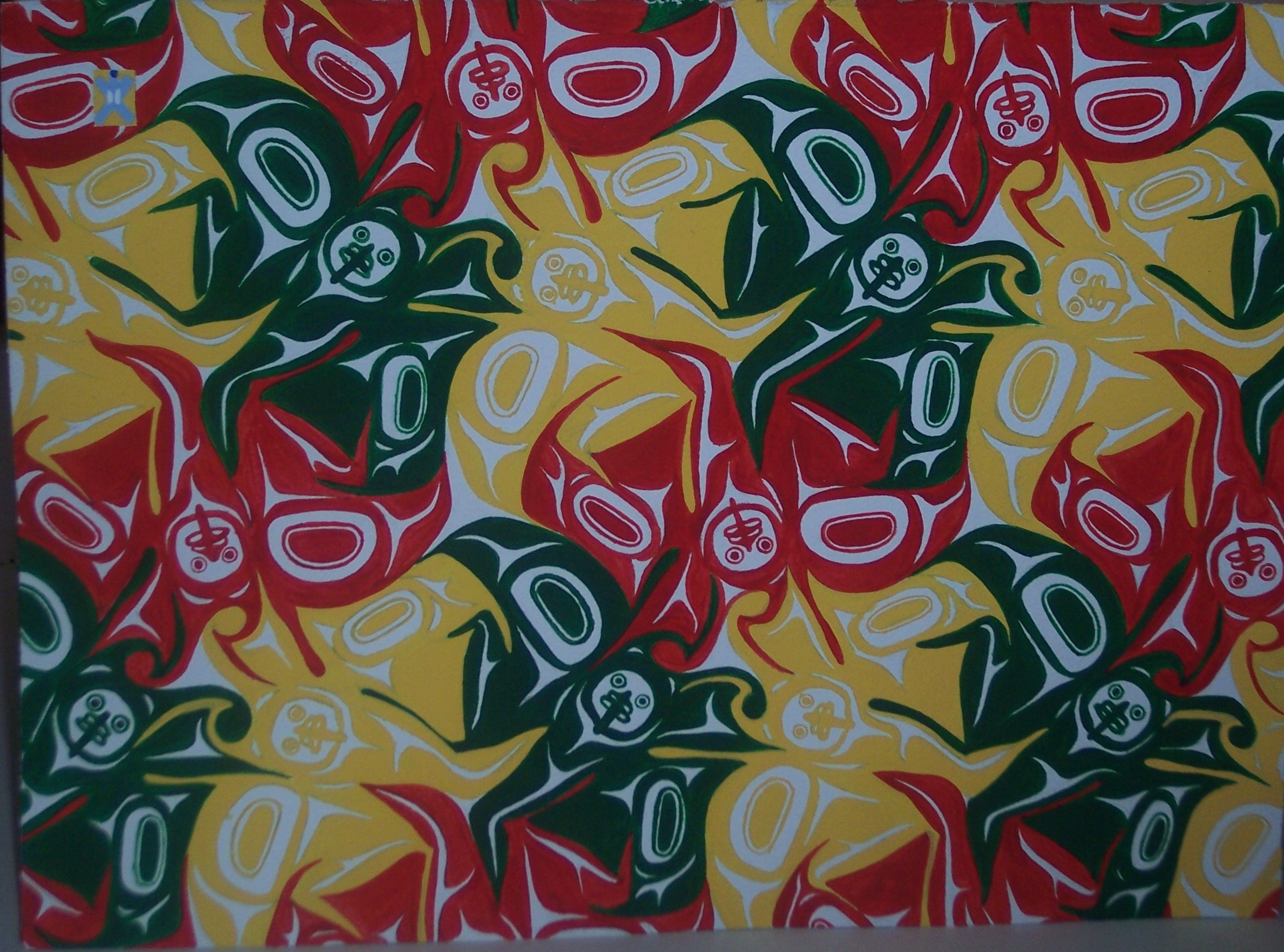
As a general rule, I never buy Northwest Coast Art depicting butterflies. But when I was in Terrace last April, I made an exception for Nigel Fox’s “Butterflies #3.”

The reason for my rule is that butterflies (and hummingbirds, for that matter) are among the most popular designs for tourist pieces. You rarely see them depicted in more serious artistic works. I believe that there used to be a Butterfly family crest among the Haida, and there are still Hummingbird crests among several of the northern First Nations, but today, these designs are often trite and blatantly designed to appeal to tourists. Often, they show a degree of cuteness unlike any other designs.

I’ve joked that these designs are the Hello Kitty of Northwest Coast Art. But the northern First Nations, as I understand things, are even more scathing: satirically, they call butterflies and hummingbirds the white people’s crests.

However, Nigel Fox, a student now in his second year at the Freda Diesing School, has a different take on butterflies. In his blog, he writes about “Butterflies #3,” the third in a series of paintings featuring butterflies, “The piece is about teamwork and is part of a series that I am exploring on the theme of respect, especially among peers, even among “outsiders” or butterflies. Within many northwest coast native cultures, there are crests that are usually animals, that represent families or bloodlines. The butterfly crest is reserved for people who are not part of a nation by blood.”

Fox goes on to explain that his work is about harmony and teamwork.

I’m not sure if he is missing the satiric intent, but it is hard to argue with his results. Fox has a separate career as a painter mostly in the Canadian Impressionist style, and in his butterfly studies, he has combined traditional designs with patterns inspired by the surrealism of M. C. Escher.

Like Escher’s work, “Butterflies #3” has a constant shifting of figure and ground. At the same time, the shape of the butterflies’ wings, with their ovoids and elongated T-shapes continually suggest other shapes, such as the beaks of ravens. By combining his interests in mainstream and Northwest Coast Art, Fox has created a series of paintings unlike anything anyone else is doing, and I look forward to seeing how his work matures in the next few years.

Meanwhile, his butterfly series is a promising start.

Read Full Post »

Today is Ada Lovelace Day, when the tradition is to blog about a woman you admire in science, technology, engineering, or mathematics. I can think of dozens of women who are friends or acquaintances I could write about, but the first subject that comes to mind is Irene Pepperberg, who has quietly revolutionized the field of animal cognition with the help of her parrot colleagues Alex, Griffin, and Arthur (Wart).

Pepperberg and Alex especially are known to thousands from their public appearances. However, I sometimes wonder if many people in the audience appreciate that what they are seeing is not just an African Gray who has learned to respond on cues, but living proof that parrots’ intelligence overlaps with the lower edges of human intelligence. With the ability to use concepts such as difference, greater than, and absence, Pepperberg’s test subjects show the general intelligence of a two year old human child, and, in some cases, of a six year old. This discovery is a complete reversal of the traditional beliefs about avian intelligence – after all, “to parrot” is used as a synonym for “to repeat mindlessly.”

Pepperberg’s proof of avian intelligence is exciting, although to parrot owners, she is only repeating what they have long maintained. However, from a scientific viewpoint, Pepperberg’s proof of avian intelligence is the least of her accomplishments.

When Pepperberg began her studies over two decades ago, animal cognition had been thoroughly discredited by a long series of studies teaching chimpanzees and gorillas to communicate – usually through some form of sign language. These studies produced many touching anecdotes about the intelligence of the primates involved, but they were rightly criticized for poor experimental design and researcher bias. By the time Pepperberg began her first studies with Alex, it took a brave person to even approach the entire subject.

However, Pepperberg’s experimental design eventually gave the entire field of animal cognition greater respectability. As detailed in The Alex Studies, Pepperberg took special care to design studies that reduced the chance of unconscious cuing and was able to duplicate results with different researchers and even strangers. Just as importantly, the tasks that parrots have to perform in her studies are more complex than those solved by the earlier chimpanzees and gorillas, which reduced the possibility that her results were due to chance. As the number of her studies increased, gradually no one who read her work could deny her results.

An especially interesting part of Pepperberg’s designs is the Model-Rival learning method she developed. Unlike the usual stimulus-response model that is usually used to teach all sorts of animals rote behavior and responses, the Model-Rival technique begins with the obvious point that learning takes place in a social setting.

In the Model-Rival technique, experiments require two researchers, one of whom takes the traditional role, and one of whom plays a fellow student. The parrots being tested see the fellow student being praised for giving correct answers, and rewarded with food or the right to play with a toy, and, wanting the same attention and rewards, are motivated to learn. This setup not only serves as a serious challenge to classic behaviorism, but may also be of use in the teaching of humans with autism and other learning disabilities, although it is still not extensively studied.

What makes this new found respectability for animal cognition especially interesting is that you only have to look at Pepperberg interacting with her test subjects on video clips to realize that she adores them as much as the soppiest pet owner. When Alex died unexpectedly four years ago, Pepperberg was devastated, and wrote a memoir called Alex and Me that is one of the most moving true stories about an animal ever written. Yet to her credit, Pepperberg has never let her personal feelings undermine the integrity of her scientific work, beyond the obvious fact that she remains deeply committed to her studies. At times, such as when Alex died, the effort to keep the professional and the personal separate must have been almost impossible for her.

As a long time companion to parrots, I find Pepperberg’s work endlessly fascinating. At one point, I seriously weighed expanding on her work in graduate school, and corresponded with her briefly. Studying parrots proved to be a road not taken, but my admiration for her courage, scientific rigor, and passion remains. Far beyond her personal reputation in the media, Pepperberg remains a scientist’s scientist.

Read Full Post »

Forget Mick Jagger and Super Heavy. If you’re interested in British folk rock — or even aging musicians who still have their creativity intact — then the team-up of the year isn’t Jagger and associates. It’s Ragged Kingdom, the first collaborative album between diva June Tabor and Oysterband since Freedom and Rain in 1990.

That 1990 album remains a cult item, one of those rare collaborations in which the result is something that none of the participants could have managed on their own. You could hear Tabor and Oysterband lead singer John Jones inspiring one another, while the rest of Oysterband transcended their usual versatile excellence to allow Tabor to do arrangements she could never have done by herself, or even with her usual arrangement of a single supporting musician.

Freedom and Rain was also responsible for one of my most memorable concert experiences ever. It was 1991 at the night club at what was then Vancouver’s Plaza of Nations. There, Trish and I listened to two memorable sets that kept cranking the excitement higher and higher. By the encore – a deliberately campy “White Rabbit” complete with dry ice and Tabor in a leather mini-skirt – the only people that weren’t blissfully sated were the waiters, who were sulky about a crowd that had come to listen instead of drink.

Since then, Tabor and Oysterband had played together informally, most notably at Oysterband’s Big Session festivals, and done several covers of rock classics on Tabor’s On Air album. But a studio album was something else altogether, and I have to admit that I first played Ragged Kingdom expecting to be disappointed. After twenty years, how could the magic possibly be repeated?

Well, it can’t be, not in exactly the same way, even though both albums are a similar mix of contemporary and traditional pieces. However, a dozen bars into the first cut, a hard driving version of “Bonny Bunch of Roses,” I knew that I was experiencing something just as extraordinary in its own way. Ragged Kingdom has a harder sound than “Freedom and Rain” – possibly, I would say after listening to his solo album, due to Ray “Chopper” Cooper’s growing involvement in Oysterband’s arrangements – but I haven’t heard a sound with such authority since I first heard Stan Rogers at sunset at the Vancouver Folk Festival or heard Steeleye Span’s “Thomas the Rhymer” coming out of my portable radio when I was in high school.

Or in case you have different touchstones, let me put it this way: right away, I knew I was listening to something original and compelling – something that I had to sit down and listen to, not just have playing in the background as I went about my day.

All the musicians sound like they are enjoying themselves on Ragged Kingdom too much to care much about billing. However, so far as selection is concerned, the album is more June Tabor’s than Oysterband’s. None of their original songs are included. Instead, as on most of Tabor’s releases, the album has an eclectic mix of traditional and new.

Among the traditional pieces, standouts include “Bonny Bunch of Roses,” and “Judas (Was A Red-Headed Man),” two songs I believe that I have heard mentioned in passing, but whose lyrics I’ve never read, and that I have never before heard performed. Both suggest how much potential remains untapped in traditional song, “Bonny Bunch of Roses” being a dialog between Napoleon’s son and his mother about the British Empire, and “Judas” slipping in pious Christianity with decidedly pagan elements and popular tradition. Another piece, “Son David,” belongs to a well-known tradition of a dialog between a fleeing murderer and his mother, but with enough of a new slant in the arrangement to make it interesting.

The contemporary selections are equally varied, ranging from Bob Dylan’s “Seven Curses” to Joy Division’s “Love Will Tear Us Apart.” “Love Will Tear Us Apart” is especially transformed, being transmuted from Joy Divison’s quick and monotonic delivery to a slow, heart-wrenching duet between Tabor and Jones.

Ragged Kingdom has only two minor faults. First, the hard rhythm of most of the cuts could do with a little more variation. Second, “The Dark Side of the Street” seems a slightly weak ending to the album. However, I expect that these faults would disappear in live performance, and I only hope that Tabor and the Oysterband do a tour for the album in North America in the coming months. I suspect that the experience would be as memorable as the Freedom and Rain concert whose memory I still value.

Read Full Post »

One of the unavoidable facts of online publications is that you’re going to make mistakes. Mercifully, some will be typos. Others will be factual errors or passages that need to be made clearer. But no matter how carefully I or my editors proofread, the mistakes will come – in fact, I sometimes think that, the more I try to avoid mistakes, the more likely I am to make them. At any rate, when I make them, once I get over the embarrassment, like any other writer, I am left with two choices of what to do with them: redact them, adding a correction in a footnote or parentheses, or revise them, removing them from the text altogether.

Those who favor redaction argue that revision is useless, that the uncorrected original will always be available online no matter what you do. Some go further, and argue that redaction is more honest, in that you are not trying to cover up your mistakes, but leaving them for everyone to see. Ursula K. LeGuin also suggests that redaction is a feminist technique, an alternative to the pseudo-objectivity and linear thinking of traditional Western thought.

Such arguments have some validity. However, maybe it says something about my own brand of perfectionism (or maybe early toilet training) that I prefer revision to redaction.

For one thing, I’m not a fan of redaction as a reader. In all but a few cases – such as a revision of a well-known article – I react to redaction in much the same way as I react to the extras on a DVD: it’s more than I want to know. Since I suspect that many readers feel the same way, my preference is not to inflict redaction on them.

Just as importantly, redaction always feels to me like a rough draft. Worse – it feels to me that I am not living up to readers’ expectations if I redact. To me, part of my unspoken contract with readers is that I present what I have to say in as polished a form as possible.

It’s not that I’m trying to hide my mistakes – which is impossible on the Internet anyway. Rather, I feel obliged to make each article as factually accurate and as clearly written as possible. Why, I think, would readers be interested in my mistakes? If they really want to see where I went wrong, they can probably find an earlier, uncorrected version of a revised article, but at least I can make clear what the preferred text is. At any rate, that is all that most people are likely to read any way.

However, the main reason I prefer revision is that I consider redaction to be more about the writer than the topic of discussion. Look at me, redaction says to readers. Aren’t I an upright, honest person, willing to show you my imperfections and the development of my thoughts?

In fact, redaction doesn’t necessarily show anything of the sort. In one easily-locatable case, an article begins by stating that I lied. The article has been redacted several times, with an admission that the original claim was the result of a misunderstanding, but the original statement remains, and is all that people see in an online search. To my understandable ire, this is not a form of honesty, but a way of perpetuating the original attack while pretending to be honest.

At any rate, I am not interested in being a focus of readers’ attention. While I hope they want to listen to my arguments and opinions, I have zero interest in being at the center of even a modest cult of personality. To insert a claim about my personality in the form of a redaction seems only a distraction from what I have to say – and, to my George Orwell-influenced mind, anything that interferes with clear communication of my point should be edited out of existence.

If someone who convinces me that I made a mistake expresses a preference for redaction over revision, then I’ll ignore my personal preference and redact instead. But, left to myself, I’ll take revision over redaction every time. So far as I’m concerned, revision serves the argument and the readers better than redaction.

Read Full Post »

If I had to recommend a single work to would-be writers, then unquestionably that work would be George Orwell’s essay, “Politics and the English Language.” First published in 1946, the essay is dated now in its references, but no other work talks as clearly or succinctly about the purpose of writing, or gives such useful rules for accomplishing that purpose.

The larger context of “Politics” is the use of language in social situations. As Orwell had already suggested in works like Homage to Catalonia and Animal Farm (and would later explore in detail in Nineteen Eighty-Four), the essay explores how language is used to manipulate people and conceal thoughts in “the defense of the indefensible.” However, Orwell’s tone throughout the essay makes clear that he thinks such use of language is corrupt and disgusting, and should be opposed by any writer worthy of the name. So far as Orwell is concerned, a writer’s job is to communicate clearly and effectively – both as a matter of self-respect and as a duty to the language and public discourse.

Aside from dishonest intent, the main reason for corrupt language according to Orwell is that most writers and speakers don’t stop to think what they mean. Instead, they riffle through an assortment of clichés, choosing ones that approximately fit their meaning. Orwell lists the general categories of these clichés – dying metaphors, verb phrases, pretentious diction, and meaningless words – and, although many of his examples are dated after sixty-five years,  no one with any interest in language should have any trouble coming up with modern equivalents.

Talking about the role of the writer and giving negative examples would be enough by themselves to make “Politics” worth reading. But then, at the end, Orwell does something extraordinary: he reduces how to write clearly to six simple rules:

(i) Never use a metaphor, simile, or other figure of speech which you are used to seeing in print.

(ii) Never use a long word where a short one will do.

(iii) If it is possible to cut a word out, always cut it out.

(iv) Never use the passive where you can use the active.

(v) Never use a foreign phrase, a scientific word, or a jargon word if you can think of an everyday English equivalent.

(vi) Break any of these rules sooner than say anything outright barbarous.

In less than a hundred words, Orwell not only tells readers everything they need to know about writing clearly, but provides an example of  the type of writing he advocates. The result is a set of guidelines from which anyone can benefit. Considering the thousands of pages that people have written trying to explain how to write, this is an astonishing accomplishment.

One of the reasons why these rules are so useful is their flexibility. You’ll notice that Orwell does not say, for example, “Never use a long word when you can use a short one.” Such a rule would only be another type of pretentiousness, of a sort you sometimes find in Hemingway when he is parodying himself.

Instead, he says, “Never use a long word when a short one will do.” For example, if you just want to convey a general impression of size, then “big” is probably good enough. However, if you want a suggestion of humor, then “humongous” would be more appropriate. Similarly, if want to imply something out of the ordinary range of bigness, then “outsized” might be a more effective choice.

The same goes for a several of his other rules. In general, Orwell suggests, you want to use the active voice – but only when you “can.” If you have a reason for using the passive voice (for instance, to suggest helplessness, you might want to write “A groan issued from his lips” rather than “he groaned”), then do so. In the same way, a foreign expression is only valid if there is no English equivalent; use a Latin or French phrase for any other reason, and you are probably trying to sound impressive when you should be thinking of what you want to say.  Then, just to emphasize the point, he ends by urging that you ignore any of these rules if they fail to aid the clarity of thought and expression that he assumes is a writer’s goal.

If practiced, what these rules do for you is to make you think exactly what you are trying to say. Unlike the rules that other writers propose, these are not suggestions that you can apply by rote. What they really are is a set of suggestions for how to keep your purpose actively engaged while you are writing.

What makes “Politics and the English Language” so unique – and such a necessity – is that, more than any other book or essay on writing I have ever seen, it cuts through the pretenses and the posturings and the assumptions about being a writer to articulate what writing is about and to offer concrete ways to achieve the purpose of writing.

Read (and re-read) “Politics,” and when its rules become a part of your normal writing and editing, and you will understand all you need to know about writing. After that, the rest will be practice.

Read Full Post »

« Newer Posts - Older Posts »