Feeds:
Posts
Comments

Archive for the ‘Bruce Byfield’ Category

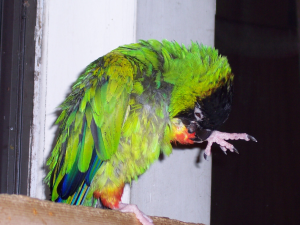
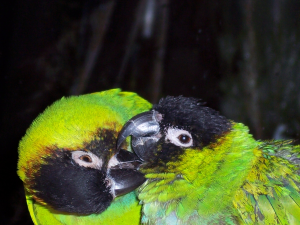
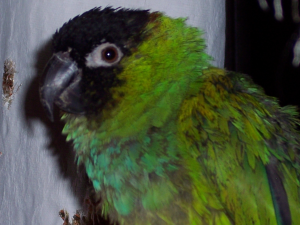
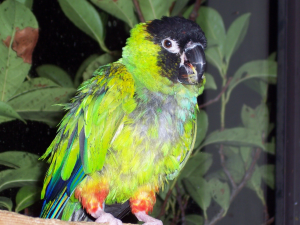
Four days ago, my Nanday conure Ning lost Sophy, his mate of 24 years, to old age. They had nested successfully four times, producing six chicks, and were a model of happy monogamy, constantly preening and never moving more than a few meters from each other. Ning had cared for her as though she were a chick in her final days, standing over her and preening and regurgitating to make sure she was fed. He was beside her when she died, and I have been able to observe first hand how he grieves. Being a widower myself, I feel a certain identification with what he is going through.

He knew at once when she died. Within a few seconds after she died, he nuzzled her once with her beak, and then moved twenty-five centimeters away, looking very small, with his feathers pressed tightly against his body, which is a sign of unhappiness in any parrot. He did not attack me when I placed her body in a shoe box to take to the vet (as I had half-expected), but went quietly up on my hand and into the cage.

When I returned from the vet, he was in the same position and had eaten little from his dish. But he screeched excitedly when I opened the door, and climbed up to my shoulder, pressing as tightly as he could against my neck and staying there for a couple of hours. I neglected the other birds to give him some time, stroking his back far more than he usually allows.

I was worrying that I might need to feed him and that, without his mate, he might no longer be able to hold his own against his arch-rival Beau, but my concerns proved needless.

As soon as I let the other birds out, Ning became manic. So much as 230 grams of bird can, he stamped around the table and the floor, trying to be everywhere at once. He seemed to have decided that he was going to prove his dominance once and for all by a frantic display. If so, it worked incredibly well – Beau is still reluctant to leave his cage when Ning is out. Now, as a result of Ning’s display, the dining room table is no longer a No-Go area for all the birds, but has been thoroughly annexed by Ning.

That evening, Ning preened me more than he had since the days after we brought him home, and he decided I was flock. But he would stop periodically to cheep for Sophy, and would occasionally fly off to the cage, and peer around it as though hoping she was somehow there. Later, when I put the cover on the cage, I could hear him cheeping for her again. I admit that went to bed early that night, because I could not stand to hear him.

The next morning was even harder. Ning went to Sophy’s convalescence cage, and seemed bewildered when neither she nor the towel I had arranged for her was there. After a moment, he moved down to the perch and started regurgitating. For a moment, it felt to me as though he was responding to Sophy’s ghost, and I was glad when he climbed to the top of the cage.

Fortunately, he started eating again on the second day, and his appetite is hearty. But he will take all the chew toys and attention that I tend to give him, and his efforts to preen me have a gentleness and a desperation that they never had before. He obviously needs the closeness – and, to be honest, so do I. At the same time, he regularly asserts his dominance by inspection tours of the area he claims.

It seems to me that the ability to mourn is a sign of sentience. After all, if a creature does not have a sense of itself, how can it feel loss? If it does not have a sense of others, then how can it mourn? If I did not already know from both personal experience and from Irene Pepperberg’s scientific studies that the intelligence of parrots overlaps with the lower levels of human intelligence, Ning’s behavior over the last few days would have proven his sentience ten times over. We’re supporting each other through our mutual loss – and I can only hope that I provide him with half the comfort that he gives me.
Read Full Post »

“In the West End of Derby lives a working man
He says, ‘I can’t fly but me pigeons can
And when I set them free
It’s just like part of me
Gets lifted up on shining wings’”
– “Charlie and the King of Rome”

This morning when I took the cover off the cage, my parrot Sophy was lying on one side, with her mate Ning hovering over her. She didn’t open her eyes, and her breathing was labored. I scooped her up and put her on the table, and she barely opened her eyes. I knew then that she was dying, so I decided that cleaning the cages would wait.

Sophy had been in a convalescence cage for the last few days after she slipped from a perch and started favoring her left leg. But her appetite was healthy and she was otherwise acting normally; the convalescence cage was just so she wouldn’t climb until her leg was better. Last night when I put her and Ning to bed, she was moving better, and I was cautiously optimistic that she was healing.

But she was thirty years old – old for her species — and had been growing quieter over the last year, so her condition this morning was not a total surprise. I debated taking her to the vet, and decided she was better at home, where she could be in the company of her flock when she died. Besides, the way she looked, I was not sure she would live long enough to arrive at the vet, or that the vet could do anything I couldn’t.

So I sat there as the sun rose, scratching her ear and trying to fed her corn. She refused the corn, and the loving regurgitation of Ning. In fact, she seemed to have trouble waking at all.

When the sun poured into the living room, I stood with her for a while so she could bask in the light, something she would do for hours, given a chance. The sun on her feathers roused her, but only a little. I placed her back on the table and continued waiting, scratching her neck feathers.

A few minutes later, she shifted her head awkwardly once or twice, as though trying to get comfortable. The eye that I could see grew misty. She seemed to stiffen, and all at once she had stopped breathing. Ning prodded her with his beak, and, when she did not respond, moved a body’s length away, preening himself with an air of apprehension.

That was the end of my twenty-four year relationship with Sophia J. (for Jabberwock) Bandersnatch. It was an end that I could hardly have predicted from the start.

When we bought Sophy from the bird-sitter, she had been neglected and abused for several years. She had no tail-feathers, and she had plucked her breast. Recognizing her as a nanday conure was so hard that we almost had to take the fact on faith.

We were told that she had locked in a cage for at least three years, and fed only on sunflower seeds. When she made a noise, a hand or a thrown boot hit the side of her cage. The only noise she could make was an outraged squawk.

Under these conditions, what could we do? If ever a bird needed rescuing, it was Sophy. When the bird-sitter reported back to her original owner that we found that she had a sweet personality, his reply was, “Sophy has a personality?” – more proof, if we had needed any, that he had no idea how to care for her.

When we brought her home, we placed her in the spare room, thinking to quarantine her for a month before introducing her to Ning. But the two birds started calling so excitedly that after a couple of hours, we brought Ning in for a visit.

We were ready to supervise, but there was no need. Ning leaped down off my shoulder and sidled up to her on the perch and immediately started regurgitating. Sophy made a stifled sound of surprise, as though to say, “Excuse me, sir, but have we been introduced?” but her objections could not have been too serious. Moments later, they were mating.

After that, Sophy and Ning were nearly inseparable, eating, bathing, playing with chew toys, climbing up on me. Always, in season and out, they mated, even on my shoulder. If one of them strayed more than the width of the living room, the other would start making anxious squawks. Ning was the more independent and aggressive of the two, but we soon noticed that anything Sophy wanted, she got. In anything she cared about, she was the dominant bird.

With Ning as her companion, Sophy blossomed and started to accept us. She would go everywhere with him, even occasionally down on the floor, which she obviously regarded as a dangerous place. I remember the two of them constantly worrying a small tin back and forth as though playing football.

One time, she crawled into one of Trish’s boots that was lying flat on the floor. She made an inquisitive cheep and, frightened by the echo, retreated squawking.

Over the next couple of years, her feathers grew in. But she remained an over-zealous preener, so that her feathers often looked ragged and you could see the gray of her down on her breast.

A few years later, she was healthy enough that she started laying eggs. The first one surprised her as much as it did us. She kept looking behind her at the egg, as if she could not quite believe that she had produced it.

Other eggs followed – so many at first, that she became egg-bound had to visit the vet just after Christmas. Ning moped around, and, early on New Years’ Day, we took him to pick her up. His rapturous purr as he started preening her in the examination room was as true a sign of devotion as you could see anywhere.

We bought a nest box, and watched her excavate the peat moss that lined it to her liking. Soon, eggs and hatchlings followed – Frumious (because what else should a Bandersnatch produce?), Jabberwock, and Rambunctious, Rogue and Rapscallion, and Madrigal, all born in the living room. Sophy would spend hours cooing over her hatchlings, over-preening them but caring for them fastidiously until they were weaned. Once they were eating for themselves, they were Ning’s concern for a few months so far as she was concerned, and she always seemed relieved when her offspring left for new homes.

A flock, a mate, and babies mellowed Sophy immensely. She never was much for hands after her previous experience, but she came to trust us enough that she would simply press her beak firmly around an encroaching finger, instead of drawing blood.

We knew that she trusted us, because every morning, she would lean from the top of the cage to preen our faces, more gently than any parrot I have ever met. She was the only bird I trusted to preen my eyes, because even a sudden noise would not excite her into nipping me. When I lowered a shoulder, she would scramble across the cage, careless of any obstacles, to climb up on me.

She would sit for hours on my shoulder, with or without Ning, as I worked at the computer. Sometimes, I would sing silly songs to her, and she would shake her tall and fluff out contentedly just at the corner of my vision.

I could go on and on – but I see that I already have. But I can hardly remember a time that her playful and loving presence was not part of my home life. All the birds were a comfort to me in the weeks after my wife died, but she was the one who sat with me the most, and seemed most sensitive to my grief. In return, remembering her sitting contentedly on one leg on the back of the cage, I like to think that we helped her put the years of abuse and neglect behind her.

As I type, Ning is restless, hopping from my shoulder to the table to the floor, and flying up to the cage. He keeps looking around as though expecting to see her, and is unable to keep still.

Without any anthropomorphizing whatsoever, I know exactly how he feels. Even after watching her die, I still can’t believe that gallant little Sophy is gone.

Read Full Post »

I think of Haisla artist John Wilson as primarily a mask carver, and certainly that is where most of his efforts have gone in the last few years. However, his prints show a certain talent for two-dimensional design as well, which is why I was pleased to pick up this abstract “Wolf.”

Most Northwest Coast Art is abstract to a greater or lesser extent, of course, in that it is highly stylized and uses a number of basic shapes not found in nature to achieve its effects. However, the sub-genre specifically referred to as abstract is less naturalistic than most. In an abstract piece, some of the distinguishing features of a subject are often missing or distorted and often only one or two remain. The figure is further distorted by the surface it is on. The end result is a figure far removed from the semi-naturalistic figures in the tradition – so much so that viewers either need the title or some familiarity with the art in order to know what is being depicted. These conditions open up possibilities for original self-expression that are often harder to find in semi-naturalistic figures.

All these generalities are true in “Wolf.” The bushy tail that is one of the defining characteristics of wolf figures (and often an opportunity for considerable ingenuity by artists) is squeezed into the rectangle of the figure below the jaw, so that at first you might mistake it for ornamentation. Only the short ears and perhaps the muzzle and teeth are left to identify the figure – and the muzzle and teeth might easily be a bear’s. Since the figure is turned sideways and presented upright, there is only one foot and a couple of claws, which increases the abstraction even further

What is left is mostly teeth and claws, creating an impression of fierceness, especially since the claws are outsized. This impression is strengthened further by the elaborateness of the eye with its tilt, as well as the red of the tail bisecting the image.

Technically, the print might be called a study in threes. Three parts of the wolf – the head, the tail, and the foot – are depicted. There are three black ovoids — the eye, foot and nostril – that frame the image, each with a slightly different shape as well as different interior decorations. In addition, three parallel lines –the tail itself, the bottom line of the heat and the top of the foot – cut across the picture. Three black lines form the foot, although only part of the two claws are parallel. In addition, the eye is made elaborate by three clusters of U-shapes, each with some variation of a T-shape inside it to thin it out. For variation, the patterns of three are sometimes broken, as in the red decorations around the eye, only two of which have a tripartite structure, but the grouping are enough to give the figure of “Wolf” a strong unity.

An especially interesting cluster of threes is the tail with its knick in the middle. It is minimalistically echoed in the thin red line beneath the claws, and in the mirror image that touches the ear on one side and the muzzle on the other.. I am not absolutely sure of Wilson’s intention, but the way that the top structure mirrors that of the tail suggests to me that it is part of the tail, so you have to imagine the tail wrapping around the wolf, stretching from the bottom of the image to the top behind the figure, where you can’t see it.

The formlines, too, are worth pointing out. For much of their lengths, they are a uniform thickness, and bend at almost the same angle. However, they are saved from being monotonous by their long, tapering ends, and surprisingly few other techniques. Instead, they create a sense of boldness that seems to fit with the ferocity of the wolf.

In fact, if I had to use one word for “Wolf,” that word would be “bold.” In a way, I regret that the print is so small, because “Wolf” is a design that almost demands to be blown up for a house-front or some other large-scale depiction.

(Note: Being a responsible blogger, I want to take this opportunity to strongly deny the rumor that the print is also available in a limited edition of one in pink and mauve. This alleged alternative version does not exist, and you should not ask the artist about it. Nor did you view it here if you are interrogated. Okay?.)


Read Full Post »

One of my minor irritants is the way that the word “creativity” is used in our culture. Too often, it is applied too freely, while other times it is used in a way that suggests that the speaker has little sense of what creativity is about.

These mis-uses matter to me, because creativity is central to my life and self-image. In fact, I might summarize my life so far as a series of movies closer and closer to the point where I could focus on creativity – specifically, writing – and make a living from it. I have an idealistic view of creativity, considering it one of the highest values to which humans can aspire, and the expression of all that is best in us.

Taking the subject so seriously, I feel the slightest pinch of annoyance when it is used too loosely. These days, “creativity” is used in all kinds of places where it shouldn’t be – not just of a craft (which is sometimes just an art with a low social status), but of marketing, business strategy, or simply lifestyles. Frequently, “creative” almost becomes a synonym for “skillful” or “interesting.”

I can accept this usage as an analogy. Like a Venn diagram, all these things overlap to a certain degree with creativity; for example, they all involve skill, hard work, and ingenuity. But, for the most part, to describe such things as creative seems to exalt them more than they deserve, just as comparing an executive to a Japanese samurai or Antarctic explorer does. The connection is a bit of a stretch and should not be taken literally.

What creativity has that these other things lack is sincerity – an aspiration to achieve the highest results regardless of effort or sacrifice. Instead, the motivation of such things is more mundane – utilitarianism, selling products, getting a promotion, or closing a deal, perhaps. The purity of intent I associate with creativity is either totally absent from them or secondary. A marketing campaign may be apt or clever, but if you insist that it literally creative, then I can’t help thinking that we need another word for what a musician or a writer does.

I have the same sort of annoyance when I hear people talk about waiting for inspiration to strike – or, as I recently heard, someone talking about the time of day when they are most creative.

To a large extent, I can see scheduling your work for a time when you are least likely to be interrupted (although as I write that, I can’t help reflecting that if many writers, especially women with family or social demands, like Jane Austen or Sylvia Plath, had waited for the perfect moment, they never would have finished anything). And I appreciate the rare gift that arrives fully formed in my mind that needs only minor touchups to the first draft to complete it.

But, in my experience, the correlation between when you feel most creative and when you do your best work is practically non-existent. At times, a passage that feels like a gift from the gods becomes, in the cold light of revision sloppy, incomplete, or worthy only of deletion. Even more frequently, the passages that work best in my work originate, not in an instant of inspiration, but in reworking upon reworking. Most of the time, creativity seems to reside not in some magic attunement with the sources of inspiration, but in the ability to take pains to get something right. Yet I doubt that most people — even many artists — can be persuaded of the fact.

I suppose that both these misunderstandings about creativity reflect the high value that we place upon it. In modern industrial culture, creativity is widely seen as the highest form of accomplishment (consider how we remember artists but rarely business executives, and the importance of musicians and actors in popular culture). Everyone wants to be seen as creative, and many of us seem to want the maverick image that artists have had in our culture for the last two centuries. But, as these examples also prove, most of us have no real idea of what creativity might actually be.

Read Full Post »

I don’t believe in motivational speakers – those who claim that they can help you find love, or make you happier, healthier, or richer if only you take control of your life and pay them. But that doesn’t stop me from being fascinated by them. The motivational industry is such a hodge podge of airheaded optimism, pseudo-science, and half-truths that it reveals like nothing else the lengths to which people will go to find a shortcut to their goals.

At first, you might think that these New Age entrepreneurs have nothing in common. After all, they are all offer advice in different fields. Yet even when you look at them, the resemblance to each other is amazing.

Often, they even physically resemble each other. All too often, their clothes and the houses they are fond of filming themselves in have the bland taste of the aspiring middle class. The women among them have shoulder-length hair, often of that ash-blond color that you never see in nature, while the men sport mildly unruly surfer dude haircuts that suggest that they might have had an athletic past. Both sexes are tanned and seem to have had one face lift too many, leaving them with smiles that last a little too long, and show an alarming amount of gum. Both, too, have the unctuous manner of funeral directors – the types of postures and gestures that are never quite in sync with their body language.

Personally, their politeness always tempts me (purely in the interests of scientific research, I assure you), to see how long I can insult them until their facade collapses. I never do, but I am uncomfortable around most of them because they are so determined to project a Stepford Wife-like niceness that they are social hypocrites, and you can never be quite sure what they are thinking.

Yet even those who escape the physical stereotypes generally pitch a philosophy that resembles Norman Vincent Peale’s The Power of Positive Thinking or Dale Carnegie’s How to Win Friends and Influence People.

This philosophy can be summarized as the belief that, if you feel good about yourself and project an air of confidence, you will succeed in whatever you are trying to do. To help you develop faith in yourself, the philosophy offers inspiring quotes (often ripped wildly out of context), and suggests that followers practice various forms of affirmation (repeated statements of their goals and general worthiness ranging from prayers and mantras to repeatedly speaking or writing declarations of it), The variations and the jargon are as endless as the speakers themselves, but the underlying similarity rarely changes; the perennial best-seller The Secret is a typical example of the belief system.

The trouble is, the only studies that suggest that any form affirmation leads to success either show a weak correlation or else are poorly designed, which makes their conclusions questionable. In fact, the result of teaching self-esteem in school for the last few decades are starting to seem like adults who expect to be rewarded simply for trying, and who become easily discouraged.

Such results fit well with my personal experience as a long-distance runner, when I found that being confident going into a race slid easily into over-confidence and losing. Pessimism and fear were actually more useful, because they encouraged me to think of tactics and stay alert.

When faced with contrary scientific evidence, motivational speakers and their disciples rarely respond by modifying their views. If anything, they are apt to ignore such results. If cornered, they are apt to launch into a condemnation of science and its narrow mindedness.

Yet, strangely, at the same time, the motivational industry is always eager to evoke science to create an air of respectability. Usually, however, their science is painfully outdated and simplistic, like the Myers-Briggs personality indicators. More often, it is not real science in the least, but pseudo-science – fringe beliefs like crystal healing that offer the appearance of science, down to the specialized terminology, but that lacks the rigor and testing procedures of true science.

Not that such limitations bother the speakers and their listeners – the appearance of science only needs to be superficial, since the point is to borrow the credibility of science, not to adopt its actual practices or criteria for truth. What the motivational industry is really concerned about is creating a closed belief system that can never be questioned or debunked, because no real standards apply.

I suspect that the reason that the motivational industry is structured this way is that the truth is very simple. Except in cases of glandular disorders and other medical conditions, the way to lose weight is to eat less and exercise more, and find a balance between these two necessities that helps you to keep the weight off. Similarly, any real effort to teach people to successful would have to acknowledge that what is involved is acquiring skills, careful planning, and some luck – and that having money and connections doesn’t hurt, either.

But such answers are not very satisfactory for people looking for quick answers and minimal effort. Nor are they nearly as simple as affirmations. They are more qualified, and carry no guarantees, and who is going to pay for something that complicated?

In the end, all the motivational industry can supply (other than a way to spend money with very little to show for it), is a series of half-truths. Yes, a visible lack of confidence can work against you, but that does not mean that confidence is all you need. Yes, prayer might help you focus your mind on what is about to happen, but it the focus that is likely to prove useful, not the magic of divine intervention on your behalf. And, yes, science makes mistakes, and scientists can be as petty as anyone – but that doesn’t mean that science isn’t usually a more reliable way of interacting with the world than cultivating your self-esteem.

If anything, the motivational industry is constantly threatening to descend into either irrelevancy or farce. I know of one alleged relationship expert (with troubled relationships of their own) who preaches that the way to find a happy marriage is to settle for someone who is agreeable, a suggestion that is not going to be very satisfactory to those who want a particular person, or is dreaming of passion and true love. Still another suggests – with every sign of sincerity – that redecorating your bedroom is a key to finding a glamorous new lifestyle. In other words, in the case of the motivational industry, there is continual reason to believe that the emperor is not only buck-naked, but doing a lap dance.

What fascinates, frustrates, and frightens me is that, despite the ease with which the motivational industry can be debunked, millions continue to believe in it. Apparently, the desire for simple answers is so strong that nobody notices that the motivational speakers themselves are as flaky as phyllo.

Read Full Post »

In the common room they’ve got the biggest tree
And it’s huge and cold and lifeless
Not like it ought to be,
and the lit-up flashing Santa Claus on top
It’s not that same old silver star,
you once made for your own
First Christmas away from home.

– Stan Rogers

This time a year ago, I was rushing downstairs with every knock on the door, hoping to get there before Trish did. At the door, the Kevin and Kell collections I’d ordered for her might be waiting, or the DVD of Oysterband’s 25th Anniversary Concert, or the Northwest Coast masks I’d bought. If one of them was, then I would have to figure a place to stash them until Trish was out and I could hide them more effectively.

This year, I am by myself, reflecting on how many traditions can accrete around a relationship in thirty-two years, and dreading the blankness of a Christmas without them.

The first Christmas we shared, Trish and I had barely been a couple for six weeks. We spent much of it at our separate families, but not before we exchanged gifts; she gave me a ceramic chess set, and I gave her Renaissance’s Live at Carnegie Hall. I still have both, although much of the Renaissance album is a bit lush for my tastes today.

The next year, we were an established couple, and backed each other up on all the obligatory Christmas visits. In fact, between dashing over to West Vancouver on Christmas Day, then to Parksville on Boxing Day, and half a dozen other places as well, we overdid the traveling so much that one of our first traditions was born: Never again. In future years, we confined our dashing about to the parents, and maybe one or two other events that we either couldn’t avoid or wanted to attend.

Other traditions were born that year, too. That was the year Trish started her tradition of giving her craftwork as gifts. Blackwork embroidery, cross-stitch, crochet, beaded ornaments, embroidery – over the years, the diversity was astounding, and all done to her perfectionist standards. One year, she made several hundred angels and bells, and sold them to buy Christmas presents, an effort she never quite equaled again. One year, too, I threatened the efficiency of her assembly line by doing candles, but the results were too mixed for me to do so a second time.

Trish’s crafts brought other rhythms to our Christmas as well. The one where she stayed up until three in the morning on Christmas Eve to finish a piece was one I might have done without. But the one of decorating our tree with her ornaments is one that always gave me a flash of pride, to have something so utterly unique in the living room.

Another tradition revolved around gift-giving. While I was a student and later as a grad student, we had a budget so tight that it always threatened to snap like a rubber band stretched too far, so we never got into the habit of buying large presents for each other. Besides, where was the fun in that? In our second year as a couple, we got into the habit of buying a couple of dozen small gifts for each other. Later, when our income increased had increased, we might include one or two moderately priced items, but, by then, the pattern had been set, and the small gifts continued – so much so that, over the years, Christmas and birthdays were when most of the books, music, and movies came into the household.

One advantage of buying small gifts was the amount of loving conspiracy that they inspired: splitting the alphabet in various gift categories so that we wouldn’t buy duplicates, secret phone conversations, and mysterious deliveries, all accompanied by cryptic and increasingly outrageous hints. We started using recycled gift boxes, wrapped in the most exotic papers we could find, and adding tags with puns and hints that would have made a veteran solver of crossword puzzles weep at their obscurity – tags that only really became meaningful after the gift to which each was attached was opened.

We learned quickly to take only some gifts for each other on Christmas Day, because other people became impatient with our exchange. But that worked out, too, since it meant we had a few presents to open when we awoke, and still more when we got home after visiting my folks on Christmas Day, and Trish’s folks on Boxing Day.

Then there were the stockings. There was always a marzipan pig in mine, and a Birk’s spoon in hers, either from her mother and me. Trish especially had a genius for finding the exotic and improbable at dollar stores, and often her stocking was the repository of the earrings I had found for her. In later years, when we decided the last thing we needed was more knickknacks or novelty items, the stockings were full of gourmet candies and sauces, which we would be happily discovering well into March.

Somewhere around December 28th or so, when the visits had temporarily slackened, came the gloating over the loot – I mean our first real chance to dive into the gifts and thoroughly explore them. Since our tastes overlapped so much, most of the time a gift could be appreciated by both of us, so we felt slothful and luxurious as we lounged around and made happy discoveries.

New Year’s Eve were for board games. Most of the time, there were just the two of us, but for a half dozen years, a couple of nephews were included, who always fought over the rules and pleaded with us for more alcohol than we would let them have. These massive game sessions would last for eight or ten hours, with pauses to refill the punch bowl on the kitchen counter and for me to cook a hearty lasagna of four or five cheeses.

And, finally, when the New Year had begun, and the guests were gone, came the tarot reading. Neither of us believed in such things, except perhaps as a psychological aid, but we both liked the atmosphere. Anyway, if New Years isn’t a time for omens, then when is?

After that, the days would drift back to normal until January 6th. On Twelfth Night, Trish insisted half-seriously, the tree and ornaments must be stowed away for another, or we would risk bad luck. So down they came, each hand-made ornament carefully wrapped away for another year, and I would march about the house all day singing a song from an old Steeleye Span album:

Oh, Christmas is past,

Twelfth night is the last,

And we bid you adieu,

Pray joy to the new.

This year all these things are gone with Trish. My Christmas shopping is much easier, but much less interesting, and my chances to see how gifts are received greatly reduced. I don’t really need the stacks of recyclable gift boxes in the walk-in closet, and I won’t be doing much visiting, since all except one branch of Trish’s family has apparently decided to drop me. I suppose I could start a new tradition and do some extensive volunteering throughout December, but I’m not sure you can call something a tradition if only one person is involved – and, anyway, it wouldn’t be the same.This year, every time I pass a gift that I no longer have reason to buy, I’m in mourning for the traditions that have died along with the person who shared them with me.

Read Full Post »

In Sylvia Plath’s The Bell Jar, the main character gets hold of a diagnostic checklist of psychological conditions. In her downward spiral, she concludes that she is suffering from all of them. The episode is partly black humor, but many people today would probably miss the joke. They’re too busy diagnosing themselves with as suffering from all sorts of conditions, both dubious and real.

I first became aware of this modern tendency in the days after the 9-11 attacks. In the aftermath, people who lived on the other side of the continent from the attacks, people who had no friends or relatives killed or wounded in the attacks, and, in some cases, had never been to the sites of the attacks, were suddenly claiming that they were suffering from post-traumatic stress. Nor did they have any pre-existing trauma that the attacks might have triggered. Having heard of the condition, they were dignifying their alarm by elevating it to a psychological state. Very few (in fact, none, I would guess) had been officially diagnosed, or saw any need to be.

Soon after, I became aware that some computer programmers liked to claim that they were suffering from Asperger’s syndrome, a mild form of autism. The claim provided an excuse for any anti-social behavior, and, because Asperger’s is often associated with high intelligence, helped them to feel better about their shyness. Yet I never met one who had consulted a clinical psychologist to be properly diagnosed.

Since then, the habit has spread like a fire from an oil-soaked rag. I have heard people struggling to get by on four hours’ sleep each night allege that they were suffering from Chronic Fatigue Syndrome and people wired on eight or nine cups of coffee announce that they were suffering from Adult Attention Disorder Deficit. One person, starting to exercise after over a decade of inactivity and feeling a soreness and trembling in their arms and legs, claimed that they had Fibermyalgia; another, notoriously self-centered, states that they suffer from Prosopagnosia, or face-blindness. In one or two cases, I have heard people make one of these claims even after they had been diagnosed as not having the condition with which they identified so closely.

What makes these self-diagnoses particularly ludicrous is that some of these conditions are either not widely accepted as a physiological or psychological condition or else exist only under very specific conditions. However, such details are generally over-looked by the would-be sufferers.

Why people should make such unsubstantiated claims is not hard to understand. Saying that you have, for example, Chronic Fatigue Syndrome is more interesting, even to yourself, than admitting that you don’t take care of yourself. It also requires much less effort than changing your habits.

In the same way, to say you have face-blindness sounds far better than saying you are incompletely socialized, and need to learn to look beyond yourself and notice other people.

More importantly, if you have a psychiatric condition or a genetic predisposition, then your behavior isn’t your fault. You don’t have to do anything about it. You can excuse your behavior (at least to yourself) and go right on doing it. If anyone calls you to account, then they are the crass ones, not you. You are the victim of circumstance, and are not obliged to help yourself.

I make these statements with some confidence, because people who truly have these conditions generally act very differently. They do not announce their conditions to everyone they encounter – to the contrary, they often go to great lengths to conceal them, often changing their lifestyles or employment, or adding a battery of work-arounds to their arsenal of habits so that nobody will ever know. Far from being proud of their problems, they see them as handicaps or deficits for which they have to compensate and struggle against.

That is to say, people who really have problems don’t try to ennoble or publicize them. They’re too busy trying to do something about them.

In fact, what concerns me most about the self-diagnosing is that they can reduce the credibility of genuine sufferers. If employers encounter too many people using post-traumatic stress as an excuse for anti-social behavior, they may run out of patience and not give the necessary sympathy for the genuinely shell-shocked.

Similarly, anyone who encounters Adult Attention Deficit Disorder being used as an excuse for lack of concentration might very well be out of patience when they meet the real thing. After all, even reputable psychologists need time for a proper diagnosis, so how is anybody without training going to be able to separate the dubious condition from the true.?

I’m almost tempted to wish that the self-diagnosing could be inflicted for real with the conditions they already claim to have. But that would be cruel – many of these conditions are not ones that I would wish on anyone.

So instead, I’ll wish that the self-diagnosing would either grow up or keep quiet. What they are talking about is far too serious to tolerate their games. Unlike Esther Greenwood in The Bell Jar, many of them do not even have the excuse of adolescence or actual problems to justify their self-indulgence.

Read Full Post »

Writer’s block is a problem that writers discuss a lot. Wannabes discuss it even more, possibly because the problem is more dramatic than sitting down and writing. Personally, though, I tend not to use the term, because it suggests an obstacle, and I consider writer’s block a signal from my unconscious to which I should pay attention.

Not, you understand, that I have more than a passing familiarity these days with the condition. For one thing, I find that writer’s block always disappears when I have a deadline – when I am under pressure to produce, I don’t have time for doubts and blockages, so I just ignore them and push onwards. Contrary to what you might expect, the result is not much worse or better than when I feel inspired. By contrast, I was much more prone to writer’s block when I was an amateur, and didn’t write for food and shelter.

For another, I don’t consider uncertainty anything more than a temporary problem. If I have no topic, then scanning the Internet and brainstorming produces two or three within a couple of hours – often more. If I have trouble writing a particular passage, I have enough sense of structure – either from my scribbled notes or my experience in developing a topic – that I write another part of a piece and return to the problem area later, when I have a better sense of what I’m trying to express. There is almost always a factual, non-controversial part that is easy to write, and I don’t have to start with beginning, which half the time only emerges after the rest of a piece is written.

Occasionally, though, I find myself at a complete loss about how to proceed. I lose not only the words, but – more importantly – the idea or the argument, and find myself typing the same words over and over again. Sometimes, I re-type several previous paragraphs, hoping that the I will rediscover the continuity. I grab a snack or do a small household chore, or go exercise, and, when I return, I am still no closer to knowing what I should write.

Not long ago, this state would leave me frustrated. As often as not, I would quit work in despair, and feel the world unfair and rigged against me.

Then I was hit by one of my periodic flashes of the obvious: The writer’s block was not an obstacle that kept me from writing. That was a misinterpretation (and one I believe that most people make). Instead, it was the first sign of a recognition deep in my mind that what I had already written or what I planned to write didn’t work. Either I need to review my argument, or restructure it or reword it.

In other words, writer’s block was not a sign of my incompetence or lack of direction. It was my understanding of writing trying to get my attention. Instead of resisting it and trying to overcome it by brute determination, what I actually needed was to acknowledge it and actively work with it.

Exactly what the problem was might require a little trial and error. Perhaps I need to delete a passage, or reposition it. Perhaps what I thought was a minor point is a major one, and needs to be given more attention than I had initially planned. Or perhaps two points are really one, or something is missing from the argument or the plot, like an important point or detail, or I need to anticipate and argue against a viewpoint that otherwise would counter mine. But the problem is not lack of inspiration, an inability to concentrate, or any of the other explanations I had heard. It is a structural problem, and relatively easy to solve with some thought and effort.

Once I had found that perspective, writer’s block stopped being a problem, and transformed itself into an opportunity to improve my writing. Now, when I start to lose the sense of what I’m writing or of what I will write next, I treat that loss as a signal to rethink what I’m doing. I no longer worry about the state, because I’ve learned how to work with it.

Looking back, I am only puzzled that I failed to reach this conclusion sooner. A cabinet maker faced with a problem doesn’t stop and agonize over their plight; they try to design their way around it. So why should a writer be any different, except that they have greater tradition of self-dramatization? When you stop thinking of writer’s block as an external affliction that mysteriously descends upon you and start thinking of it as a sign that something is wrong, then it becomes a problem that you can solve by making concrete changes. Once you change your thinking, you may find writer’s block not only misnamed, but also more useful than you ever imagined.


Read Full Post »

Usually, I don’t worry much about what people think about me. Oh, I like most people, and want them to like me. And I know that I can be regarded very differently, depending on what others have seen of me and the baggage they bring to their observations. Yet, except in specific circumstances like a job interview, in the past, I haven’t usually agonized over other people’s perceptions, although whether this attitude is confidence, arrogance, or self-defense, I have no idea. In recent months, however, events have made me more conscious than usual of others’ opinions.

One reason is that I heard from someone I went to school with, who discovered me on the Internet. We were never close, although the circles we moved in overlapped until she moved away in Grade 10. She wrote to me:

“I happened to be talking about you the other day. I’m not really sure how you came up but I was relating a childhood memory to a friend. I said something along these lines: “There was this boy in my elementary school who was painfully shy and awkward. He was brilliant, that much was obvious, but I doubt many people bothered to get to know him because of his shyness. But. When he would run, he was magic!” It went on from there while I described not knowing you as a person, but cheering my ass off for you at various track and field events and how you probably never knew that there were people like me who thought you were magic.”

Well, I cop to awkward; that’s what usually happens when you grow up left-handed. But painfully shy? I thought of myself more as brash and apt to blurt out the wrong thing in misplaced confidence. Nor did I lack friends, or an awareness that I had an easy ride through adolescence because I was a bit of a sports star.

The description seemed so incongruous next to my own memories, so deflating in places and so out in left field in others that I had to laugh. I sent my conflicting memories back, and my correspondent found the differences hilarious, too, so now we exchange emails once or twice a week.

Another reason for thinking about how others see me is that I was widowed a few months ago. Soon after my partner’s death, I became aware that everyone I met seemed to be staring at me as if I were a Prince Rupert’s Drop that would shatter if mishandled for even a second. I could see people visibly making an effort to edit their sentences, unsure whether they should mention Trish, or talk about her, and hesitating even more over asking if I wanted company or had any plans about how I was going to live now (I didn’t, and still don’t, for the most part). Suddenly, people were always watching me – and judging me, too. Most of them were well-meaning, but they were still judging me, far more than they would have in other circumstances. Or, possibly, I simply noticed the judging more.

At any rate, I started receiving pity-invitations. Acquaintances started inviting me to events because they had concluded that getting out would be good for me. Friends invited me out to dinner, or to parties for the same reason.

They were right, and I understand that they meant well. But, although I’m sure that people judge me all the time without me knowing, I’m not used to being so obviously judged. I feel like a specimen at the aquarium, living out my life behind a pane of glass beyond which everyone stood waiting to see what I could do.

I am aware, too, that they mean to help me. That, in itself, is hard to take – not because of any misplaced sense of macho, but because, after twelve years of taking care of someone in failing health, I am far more used to helping than being helped. Although I still accept most of the invitations, a self-consciousness has entered my dealings with friends and relatives that leaves the simplest of interactions seem forced and false as I try to ignore it.

The third reason is hardest to describe, because I want to keep most of the circumstances private. Perhaps it is enough to say that I let someone I admire and who could have been a friend think me unstable at best or a player of head-games at worst because I believed that doing so was the right thing to do for everyone.

I still think that way – on alternate days. The truth is, when I’m not feeling ashamed of trying to manipulate someone’s perceptions of me, I’m wondering exactly what those perceptions are. Most likely, I’ll never know, yet I wonder all the same. The result is that, once again, I find myself spending far more time thinking of other people’s perceptions of me than I am used to doing.

Perhaps this newfound awareness is only natural. A marriage – at least, a happy one like mine – is a filter for other relationships. Now that I am a widower, those relationships have to be renegotiated for the first time in years.

Under these circumstances, perhaps spending an inordinate amount of time thinking of other people and how they perceive me is a natural stage that I just have endure until it passes. But, meanwhile, I am getting weary of feeling like my mind and body is one continuous rib-bruise.

Read Full Post »

Having had over 900 professional sales in the last seven or eight years, I am starting to call myself a writer without feeling like a fraud.

To help me make decisions about what other kinds of writing I want to try, I have drawn up a list of my strengths and weaknesses as a writer as honestly as I can. Here they are, in no particular order:

Strengths

  • An omnivorous reading habit: I’ll read anything, and I read constantly. So far as I’m concerned, I couldn’t write if I hadn’t been in love with reading since I was four years old. I would also know much less about the possible choices when I write.
  • A reliance on a spoken vocabulary: I believe that the standard for any language is how it is spoken, so I rarely use words in my writing that I wouldn’t say aloud. I believe this gives a directness to my writing that it wouldn’t otherwise have. I can define far more words than I use in anything except academic writing.
  • An inner ear: I hear what I write or read in my head as though it were spoken out loud. Consequently, my writing has a rhythm to it that helps draw attention to it.
  • A belief in the importance of truth: I don’t believe in objectivity or absolute truth. But I do believe that truth exists externally, and that some viewpoints are more valid than others, and worth expressing as accurately as possible.
  • A difficulty in lying: Thanks to repeated exposure to George Orwell, I am convinced that a writer’s duty is state the truth, even when doing so means facing up to unpleasant facts about themselves or others.
  • An awareness of structure: While I am proud of my ability to reel off memorable phrases, I am prouder of my ability to see the structure in a piece of writing, and to give a suitable shape to my own work. This ability is rarer than the ability to produce striking phrases, and more important to successful writing.
  • An ability to draw analogies: In my experience, most people see differences around them. I see similarities, which means that I can often suggest something new to them.
  • A belief in the need for fairness, and for acknowledging other viewpoints: This belief has nothing to do with being friendly and everything to do with improving the development of my thoughts. I deepen the development of thoughts when I consider alternative explanations. I also give myself more to write about as I explain why my chosen explanation works and what is wrong with other ones.
  • A perception of multiple-causes: I do terribly on multiple-choice questions unless “All of the above” is frequently included. To pretend that one or two reasons are enough to explain most things – especially people’s motivations – is to introduce inaccuracies and falseness into your work. And, by acknowledging multiple-causation, I find still more to write about.
  • A memory strong on recognition, but not outstanding on recall: Often, I cannot dredge up a memory myself. But if someone or something triggers a memory, my mind is better than almost everybody’s. I suspect that recognition is more important than recall for a writer, because, when a memory is buried, all sorts of interesting connections are made to it in your mind. By contrast, I suspect that a photographic memory impedes this imaginative process, which is why I’m glad that I don’t have one.

Weaknesses

  • A reluctance to edit: By the time I finish writing, my mind is already moving on to something else. I can only edit myself by an act of will, and I’m still not very good at it.
  • An over-use of transitions: I’m so obsessed with structure that I would start every sentence with one if I let myself. As things are, one of my routine editing tasks is to delete most of the “first of all”, “on the other hand”s and other transitions.
  • A phobia about fiction: Above all else, I want to be a fiction writer. It means so much to me that it’s taken me years to actually be able to write it. Poetry? Essays? Articles? No problem. But, when I try to write fiction, I freeze up.
  • A straining after effect: I am far too fond of the original or striking phrase, perhaps because my first professional publications were poetry. I’ve taken years to learn that a really pithy expression might not be good for the work as a whole.
  • A handwriting that is indecipherable: In elementary school, I won prizes for neat handwriting. Then I became a university instructor, and wrote so many comments on student essays that my cursive writing became illegible. I switched to printing, and it also became illegible – even to me. I’ll write things down in the middle of the night so I remember them, only to have no idea come morning what I scrawled.
  • An over punctiliousness about references: Not only do I rarely leave “this” unqualified by a following pronoun, but I make a point of using names rather than pronouns. While these habits make for absolute clarity, they often sound awkward, especially when I use a name too many times in the same sentence or paragraph.
  • A love of weasel words: “Appear,” “seems.” and other qualifiers appear far too often in my work. I’m not sure whether they are a remnant of too many academic papers, or reflect a world view in which very little is absolutely certain..
  • An over-emphaticness: In compensating for the qualifiers I use naturally, I often go too far and sound too blunt, or even rude.
  • A tendency to write lists: (Enough said)

A few of these points are probably universal – for example, I don’t think I’ve met a professional writer who didn’t read everything they could get their hands on. However, others probably reflect that I mainly write non-fiction, and still others are undoubtedly idiosyncratic.

Still, I offer them for whatever they might be worth. They are not the formula for success (of a kind), but I hope they might be interesting as one formula for success. I only wonder what I’ve left out because I can’t perceive it.

Read Full Post »

« Newer Posts - Older Posts »