Feeds:
Posts
Comments

Archive for the ‘Bruce Byfield’ Category

If you’re a freelancer, you tend to be haunted by the thought of lacking work. Yet today, against all my freelancing instincts, I walked away from a source of income without having anything to replace it. It was not a step I took easily, but I had no choice if I wanted to keep my self-respect.

The problem wasn’t that the editor was doing their job. I’m a professional, and I have no illusions that my work is perfect or can’t be improved upon. I am incredibly inefficient at editing my own work (although a demon at editing others), and I generally welcome observations that make my wording clearer or more accurate.

Why wouldn’t I? An editor who points out problems before they see print makes me look good.

At the same time, I have worked with half a dozen editors, and I know what editing is generally required to make my work presentable. The number of revisions are roughly the same, no matter who the editor, and rarely require more than half an hours’ work – often less, and almost never more than an hour.

With this editor, though, revisions averaged three or four hours. I admit that he received a few pieces that I wrote while ill or under personal stress and that I should not have submitted in their current shape. However, regardless of the quality of each submission, the editor would almost always return a couple of pages of notes, amounting to a rewrite of the article.

Even if I didn’t have considerable experience, I could have guessed that this amount of revisions was unreasonable. The few times the senior editor looked over a submission, the changes were far fewer, and often minor enough that he made them himself rather than send them to me. But I continued to submit articles, partly because the pay was halfway decent, and partly because I told myself that things would get better once I learned the expected style.

The trouble was, the comments never lessened. Each article I wrote for the editor took twice as long to complete as anything else I wrote. If the revisions weren’t about typos, they were about content.

By my count, about one-third of the comments were legitimate improvements to the article. Another third consisted of explanations of how the editor would have written the article or shibboleths such as insisting that an article should never end in a quote, and one-third nonsense such as labeling a long but grammatical sentence a run-on sentence. I didn’t mind the legitimate improvements, but, to say the least, I felt that I was humoring the editor about the rest just to receive a pay cheque.

Asking other writers, I found that I was not entirely being singled out. Other writers told me that they also expected to waste half a day answering the editor’s notes. But the experience of others showed that the editing process was clearly being used to assert the editor’s authority.

In fact, the criticism was so unrelenting that I began to entertain serious doubts about my writing ability. Once or twice, when I was sick, I was so rattled about the thought of the revisions to follow that what I submitted was definitely below my usual standards. Why bother for quality when you know your article is going to be shredded regardless?

Even so, I might have endured the process while I waited for better times if the work had been regular. But the editor started forgetting my submissions – or so he said – and the one article per week slipped to one article every two weeks. Answers to my queries were delayed so that I had less time to research and write. I strongly suspected that the editor was pressuring me to quit so he wouldn’t have to take any action himself.

This morning, a submission of better than average quality received the same treatment as usual. Annoyed, I queried a couple of points – including one about the slant of the story, which I had based on the senior editor’s request – and received the usual ungracious reply.

Suddenly, I had enough. I was receiving less and less money from the editor anyway, so I had little to lose. Abandoning all plans of waiting until I found replacement work, I emailed saying that I was withdrawing the story and would not be submitting more. With an effort, I refrained from saying anything else.

The reply was a cheerful thanks for my work and best wishes for the future. So far as I was concerned, it was proof that my email had given him exactly what he wanted. Anyone who placed any value on my work, or didn’t want me gone would have asked for reasons.

I still feel nervous and wonder if I have done the right thing. But you know what? I feel so much better now that I’m out of a toxic situation that the challenge hardly daunts me. I’ve already been through far worse.

Read Full Post »

Yesterday, my work on the computer was interrupted by a sustained thunder storm. The storm lasted for hours, so I lost an opportunity to work, but, in doing so, I rediscovered my former pleasure in reading as my dominant leisure activity and in writing by hand.

When the first of the thunder rolled out above me, I was about ten minutes from finishing an article. The sound was distant, but I know how quickly a storm can cross the sky. With memories stirring uneasily about how I had lost a couple of chapters of my thesis to lightning directly overhead, I shut down the computer without waiting for a proper shutdown, and finished the article as best I could by hand. Then I started looking for ways to amuse myself, only to realize that I couldn’t do much of what I wanted to do because of the storm.

I couldn’t go for my daily swim, because a pool is high on the list of places you should avoid during a thunder storm. I did a few chores around the house, but most of what I wanted to do required electricity, so they didn’t seem like sensible ideas, either.

As for leisure activities – well, I didn’t think the stories I heard in childhood about lightning leaping through the screen of a TV were likely, especially these days when cable is more common than an antenna, but I didn’t want to take the chance of being wrong. So, no watching the news or a DVD. No music either, except in the portable player.

I did think of working on the laptop, but the battery was low. Besides, to continue my work, I needed an Internet connection, which would expose the laptop to the same risk as any appliance I might use. I hadn’t felt so out of sorts since the power went down a couple of years ago.

Vaguely, I felt ridiculous. After all, I hadn’t had a computer for much of my life. How had I amused myself before? I imagined myself camping, moping around and complaining about the lack of a wireless access point. How, I wondered, had I become so dependent on electronic devices that I had no personal resources to keep myself busy?

Maybe if I went for a run? But that didn’t seem something I should do in a thunder storm, either.
The trouble was, I hadn’t expected to be interrupted. Listlessly, I put a few DVDs away, and did a bit of tidying her and there, still hoping that the storm would pass and I would get my swim after all.

After three hours, I gave up that idea. From the darkness outside, you might have guessed that sunset had arrived, even though it was still two hours away. Lightning kept catching my eyes whenever my head swung towards the window, and on the porch the rain was rattling against the floor like an animal against the bars of its cage.

Reluctantly, I settled down with a light book. When that paled, I started some writing by hand – the old-fashioned way, the way that I preferred before the pressure of deadlines forced me to learn to compose on a computer. Everything was magnificent, but also a bit frightning.

Both activities felt surprisingly comfortable. How long had it been, I wondered, since I read as my dominant leisure activity, instead of reading a few pages here and there on breaks during my day? Probably not since the last time I was sick in bed, when I couldn’t really appreciate it. As for writing, it had been years since I had scrawled more than a paragraph that arrived in my head in the middle of the night. Yet both were surprisingly pleasant activities – productive, but somehow less rushed than reading or writing on the computer.

Naturally, I logged on to the computer as soon as the storm seemed safely past. Nor do I regret doing so. For efficiency and ease of use, computers are impossible to beat, and in most ways I don’t regret my dependency on them.

Still, there is something to be said for the total relaxation of reading a paperback sprawled back on a couch, and words written by hand somehow seem to express thoughts more accurately than a keyboard could ever hope to.

I doubt that I’ll do either as much as I did in my pre-computer days, but both are sufficiently satisfying that I think I’ll make more time for them. In some ways, I’ve missed them.

Read Full Post »

Nineteen months ago, I bought a three inch copper bracelet by Tsimshian artist Henry Green that depicts Raven and Mouse Woman. I had wanted a first-rate Northwest Coast bracelet for years, and this one far exceeded my expectations, with its size, material, and design combining to make it a unique work of art. I rarely wear it without receiving some comments about it – and they are never anything less than positive.

When someone asks casually about it, they are usually a young woman, interested in the bracelet as a miscellaneous piece of jewelry, or else someone of either gender with enough knowledge to at least recognize what they are seeing. Either way, I tell them the artist and where to see his work. If their eyes aren’t glazing over, I add an explanation of the two figures and their mythological characteristics.

However, it is the artists whose reaction intrigues me. Almost always, they ask if I can take it off so that they can handle it. They take it reverently, and turn it over slowly, since it is impossibly to see the entire design from one perspective. Sometimes, they start from the beginning, and examine it two or three times. They rarely say anything as they look, except a “Thank you” when they hand it back.

All the queries, of course, are a tribute to Henry Green’s design ability. However, although I only commissioned the bracelet, I can’t help feeling that the comments are a reflection on me as well. If nothing else, they suggest that I had the good taste in my choice of artist.

However, I admit that the constant reactions are a little unnerving at some level. Unless I’m very much mistaken, I don’t think that I attract a lot of attention as I’m going about my business. I am reasonably certain, for instance, that I have never featured in an “I saw you” ad in The Georgia Straight (not that I have wish to). But the bracelet is such a conversation piece that people notice it in a way that they were never notice me. It gives them the starting point for a conversation that they otherwise wouldn’t have. Sometimes, it feels as though the bracelet is wearing me, instead of the other way around.

Read Full Post »

When I was growing up, I was amazed that my parents could recall World War II and the abdication of Edward VIII. Similarly, the thought that Queen Victoria was on the throne when my grandfather was born, or that his life spanned the development of the first airlines to transcontinental flight made him seem a living fossil. I’ve only recently considered that I’m well on my way to becoming a living repository of the past myself.

Not every change I’ve seen seems major. For all the fuss at the time, the change from black and white television to color was only a refinement, not a radical shift in technology or culture. Acting or production didn’t change because of color TV – only the number of old black and white units in the landfills.

By contrast, the introduction of the personal phone was more radical. It greatly reduced the number of public phones in any given area, and left those remaining in obscure corners, where they were left in mounds of litter and could be easily vandalized. More importantly, it encouraged people to stay connected wherever they went, not just via phone, but via the Internet as well. It created a culture where someone walking down the street alone and talking loudly of their personal affairs was not assumed to be insane, but a normal consumer.

Another major change has been the shift in attitudes about smoking. When I reached legal age, non-smokers like me took for granted that if you went to a night club or a pub, you would have have to peel smoke-sodden clothes off as soon as you reached home and put them in a separate wash. If you really had problems with secondhand smoke, you didn’t go out. But now, the norm has shifted, and smoker are the ones who have to go to special efforts to indulge their vices.

Similarly, while alcohol remains an important part of socializing, it is no longer an inevitable one. Time was, if you wanted to talk business, you went to a pub or a lounge. Now, you go to a coffee shop instead. From one perspective, that’s one drug exchanged for another, but it means that one folkway has become overgrown while another has become two-lane highway.

But the largest changes I’ve witnessed so far are the rise of the personal computer and the Internet. The personal computer revolutionized writing, removing the makeshift conventions of the typewriter with higher standards of typography. Accounting ceased to be the manual entry of lists or the painful efforts to use a typewriter as the spreadsheet came into its own. And when digital cameras came along, the personal computer meant the end of the dark room and an era in which photos were cheap and plentiful.

As for the Internet – let’s just say I wish that I was thirty years younger or it had come along thirty years earlier. For somebody like me, who has spent a good part of his life researching, the Internet is like being let loose in some science fiction equivalent of the Library of Alexandria. If I half-remember a fact, I can get the details in a minute. If I need to talk to someone, I have several ways of contacting them immediately. If I want to research a topic that I know little about, then I can do so in an afternoon rather than days, and without leaving the house – and that’s even with sifting through dubious and outdated material.

That’s why I have little sympathy with people like Ray Bradbury, who a few weeks ago denounced the Internet as a waste of time: for anybody who reads or writes for a living, the Internet is so immensely convenient that I took to it as if it were made to my personal specifications. Parts of it may be bad or mad, or plain silly, but the Internet saves me hours of time every day. Bradbury doesn’t know what he’s missing.

When I was young, I used to worry that, when I reached my current age, I would become conservative and hopelessly set against all changes. Apparently, though, my fears were needless. I’m far from approving of all the changes I’ve seen (I especially deplore the shift from the culture of liberal optimism of my teen years to the conservative pessimism and stoicism of today), but I’m fascinated by all of them. Not only that, but I can’t wait to see what comes next.

Read Full Post »

Looking back, I sometimes think that my youth was not nearly as mis-spent as it should have been. A case in point: the night I helped to erect the dragon crossing.

The idea began as a joke at the university Medieval Club. Newly moved out from my parents’ house and feeling I had missed out on the socializing at university because I was too busy commuting, I had joined as soon as the fall semester began. Loosely connected to the Society for Creative Anachronism, the club centered largely on dressing up and some moderate drinking in the pub. Punk or new age, it definitely wasn’t – but we enjoyed the thought of what we called “freaking the mundanes” by wearing costumes and doing the odd bit of impromptu theater. Probably, we weren’t nearly the novelty we imagined.

Anyway, we were talking one night about how to publicize the club more. The ideas kept getting sillier as the night wore on. Vaguely remembering something I had seen a few years before, I proposed the idea of a dragon crossing: a sign on the university ring road, with some spray-painted giant tracks going across the road nearby.

The idea wouldn’t do much for publicity, since we couldn’t admit what we had done without risking the wrath of the campus authorities. At best, it would give people a chuckle and get them thinking of things medieval.

At least, so we hoped and so we began preparations. One Club member, who had worked as a flagger on a road crew the previous summer, produced a Yield sign that she had somehow acquired (we didn’t ask how). I produced some giant stencils of foot prints, and someone else some paint.

In theory, we had everything planned. We would gather at the pub for some liquid courage, and wait until closing time, when fewer cars would be on the road to spoil our handiwork. One person would wait up the road and act as a spotter, in case campus security found us. A couple of others would dig a hole for the sign while others painted the foot prints across the road.
In practice, things went with less than Mission Impossible ease.

After the pub closed, we drove to the park next to the campus, and climbed the hill to the ring road. We even thought to turn the cars around so we could make a quick getaway if necessary (we were so proud of that detail).

The hill was steeper and, in the dark, more crowded with trees than we remembered, but with a few stumbles and moments of disorientation, we reached the road. For a long time, that was the last thing that went right.

Crouched in the scrub alder, we waited for the cars to thin out. There were far more than we expected. When we finally psyched up enough to start work, we could barely get a few minutes of work before the spotter called out a warning and we scattered like rabbits with pounding hearts.

A traffic sign, we soon found, needed a far deeper whole than any of us imagined. It also needed packed earth around the base of the post if it wasn’t going to sag.

As for the footprint templates, they would have worked a lot better if anyone had remembered to bring masking tape to hold them in position. It didn’t help, either, that cars kept running over our work before it had dried.

Eventually, the inevitable happened, and campus security surprised us by coming on us from the direction in which we had no spotter. We scattered, quickly getting lost – only to find that one of us had kept her head and, knowing the campus cop, assured him that we weren’t doing anything really destructive. But, good middle-class kids that we were, we were terrified, and called it a night.

A few days later, in the cold light of day, our efforts did not match our vision. The Dragon Crossing sign looked distinctly amateurish, the post it was on had a definite tilt to it, and the tracks were smeared with tire marks. But they made the campus paper, leaving us in paroxysms of regret at the thought that we couldn’t claim credit.

Still, someone must have noticed our efforts. A few years later, the science fiction club produced their own Mutant Crossing, with green glow-in-the-dark footprints. “Immortality is ours,” those of us still on campus murmured. But the truth is that all of us had been scared straight by our own daring, and almost getting caught, and would never again do anything wilder than wear medieval costumes on campus.

Read Full Post »

I’m old enough to have live through four formats for home music: vinyl records, cassettes, CDs, and computers and portable devices (I’m excluding 8 Tracks, which I never used). With each change of formats, some of my music has been left behind, especially since much of my music collection is from small distributors, some of which no longer exist. That’s why I was delighted to buy a USB turntable recently. As I convert my old records to electronic formats, I’m rediscovering music I haven’t heard for years.

Of course, I could have dusted off our old turntable, and jacked it directly into the computer. But, as I wrote in a how-to article I submitted yesterday to Linux.com, a USB turntable has features that, twenty years ago, would have cost ten times what I paid now. The result is a vast improvement in sound-quality, including a reduction of all except the worst hisses and squawks from damaged vinyl.

On a personal level, my first recordings have been a sustained bout of nostalgia. Ordinarily, I regard nostalgia as a middle-aged disease to which I refuse to succumb, but what I’m recording is the music of my youth. If, as Frank Zappa said, the music that you listen to is aural wallpaper, then the first vinyl I’ve converted is a direct reflection of what I used to be.

The closest these first recordings come to Top 40 are several albums by Alain Stivell, the virtuoso Breton harpist, and some early releases by the folk rock-group Steeleye Span. Otherwise, most of them are by solo singer-songwriters. Most, too, have a more or less leftist political perspective, although it’s sometimes covert. They include, for instance, Pete Morton’s first album, Frivolous Love, a couple of albums by the Australian singer Eric Bogle, early albums from OysterBand when the group was still in the process of converting from a folk dance band to the more activist group it is today, and lots of satire and political commentary from the English songwriter Leon Rosselson.
I see several common threads running through this list. First, most of these artists pay a lot of attention to the words, something I still value in music today. Ditto the political perspective.

But the strongest influence on me, I think, is that all of these performers insist on never letting their convictions dominate. They aren’t just activists; the music is as important to them as their messages. Just as importantly, they deliver their message with a good deal of humor and wit. Looking back, I think that their example has been as important as any literary influence in determining the sort of writer I would like to be.

So far, I’m enjoying being re-introduced to my young self. I find him naive and short-sighted, but not entirely unlikable. I wonder what I’ll think a few hundred recordings later, when I finish converting all my old music?

Read Full Post »

One of the few services we receive for the maintenance fees in our townhouse complex is a swimming pool that opens a third of the year (I’m excluding the landscaping service that cuts the grass every week and consistently destroys the beauty of the cherry blossoms by pruning the trees down to nothing a month before they bloom). For me, it is basically a lap pool where I can enjoy an alternative exercise, but I am clearly in the minority. For almost every one else, it is place to socialize more than swim.

I don’t know why people feel compelled to gather at the pools. In theory, they could lounge on deck chairs and booze and smoke and suntan anywhere. Yet, somehow that wouldn’t be the same for them. If they are going to laze, apparently they need a body of water to laze beside. Somehow, setting up on the lawn or under a tree wouldn’t be right.

One thing is clear: They don’t need the pool to swim. On hot days, the pool is full of children and their aquatic toys, which probably outweigh the children by a ratio of two to one. Often, especially in the first days after school is out, teenagers up to the age of sixteen or so, will swim too – occasionally, clusters of boys and girls nervously flirting with each other, but, more often, all-boy gangs who play endless games of Marco Polo and never tire of jumping off the practically springless diving board.

But adults – almost never. You sometimes see a parent with a newborn, or standing in the pool near their children. Very occasionally, the local drones might stand up to their waists and toss a tennis ball back and forth. But none of these activities last for very long, and most of the time they don’t involve swimming, either. Most adults don’t even get that wet.

Yet every single one of them insists that their children learn to swim. I don’t know why – with the example they are giving, their kids will never come near the water. Presumably, the hope is that if the kids ever fall into a disused well and Lassie isn’t around to get help, then half-forgotten instincts will kick in and they will be able to tread water long enough to be rescued.

The real reason, I suspect, that the parents never swim is that going to the pool is a part-holiday from minding their children. Just as parents used to park their kids in front of the children’s section in the book store where I used to work (then go off to shop and complain if the staff didn’t watch their little darlings), the pool is a place where they can relax their guards. If their children are screaming from a gnash in their shin, or are systematically drowning a sibling – well, someone else will handle it, surely. Meanwhile, they can read their book or make calls on their cell phones or discuss sports (if they’re men) or diets and TV shows (if they’re women) in lazy, bored voices. Until it’s time for dinner, their children become strangers at the pool, and someone else’s problem.

Meanwhile, I’m trying to swim my lengths, and not making much headway against the sea of tots. When they’re under six, they don’t have much idea of sharing, so the hope that they might leave me enough space to swim if I steer clear of their play area rarely gets realized. They dash into my path, breaking my rhythm. If I change positions in the pool, after a length or two they are back in my path. I sometimes think that I swim twice as far as I actually credit myself with – and, of course, there’s no use appealing to the parents, who have disowned their kids for the duration.

The lack of courtesy used to infuriate me, especially since all I want is a quiet bit of exercise after a day of work. Nowadays, though, I try to be more philosophical. Doing my steady breast stroke, I mentally shake my head about the foibles of pool society, and look forward to the next rain day, when I’ll have the pool to myself.

Read Full Post »

I have two great weakness when buying Northwest Coast art: I love to see artists trying out new media, and I love work that shows the lesser-known figures of mythology. With these preferences, it seems inevitable that I would have bought Morgan Green’s Mouse Woman platter.

Morgan Green is a twenty-five year old artist who seems to be in the middle of deciding what art she wants to do. She is represented in the galleries mostly by her painted leather cuffs, but she has also done fashion design, carved masks and poles, and assisted older artists with painting and metal casting. Add an art teacher and potter for a mother and master carver Henry Green for a father, and it is no wonder that she always seems to be galloping off in all directions (in fact, every time I’ve met or contacted her, she seems about to be preparing for a journey or just returned from one).

The Mouse Woman platter is one of several pieces of ceramics that Green is exhibiting at the Edzerza Gallery. Made from clay that Green recently brought back from Arizona, it is as untraditional as a Northwest Coast piece can be. Ceramics were not a part of the northern coast first nation cultures, and, unlike argillite a century ago or glass in recent decades, have never really caught on, although you can find occasional pieces – usually not very skilled and mostly for the tourist trade.

As for Mouse Woman herself, she remains a bit of a mystery. Few, if any renditions of her survive. But the stories make her a powerful, although minor character. She generally appears as a helper of a hero in a quest. In several tales, for instance, a hero helps a mouse over a log, and then, that evening, comes to a long-house where he is greeted by a noble woman who feasts him and gives him good advice. In other tales, she whispers practical advice about everyday concerns that the hero passes on to his people. In many ways, she is all that Raven is not: domestic where he is a wanderer, a maintainer and restorer of order where he is a bringer of chaos and change, and a representative of civilization where he is the eternal outsider. Where Raven is often a child, she is more often described as a grandmother, perhaps an elder.

Since no one is quite sure what Mouse Woman is supposed to look like, in depicting her, Green is free to let her imagination run wild. She chooses a simple design that goes well the rough, terra-cotta background – a combination that vaguely suggests petroglyphs, an art form that flourished several centuries before the northern formline became codified. Most of the lines are thin, except for those associated with what Green presumably intends as Mouse Woman’s distinguishing characteristics: her incisors, round eyes and ears. For these features, the lines are heavy, giving them added prominence, and elevating them to the equivalent of the orca’s fin or the eagle’s hooked beak – the features that tell you what creature is intended even if the complete shape is not depicted.

The result is a fragile but alert-looking creature, with ovoids that suggest cheeks stuffed with food. The result is a surprisingly naturalistic figure of a mouse, that, at the same time, also suggests a tiny but alert and active grandmother. How artists of a century and a half ago might have depicted Mouse Woman remains unknown, but I’m sure that they would recognize instantly the subject of Green’s depiction.

I don’t know whether Green will continue working with ceramics. Considering her restlessness, my guess is that she won’t for the time being, although she may return to them eventually. But I suspect that her recent YVR scholarship couldn’t have come at a better time. The Mouse Woman platter is a minor piece (in scope, I mean; at twenty-five centimeters it is definitely not so in size), but it suggests to me an artist who is starting to find the themes that interest her.

morgan-green-mouse-woman-plate

Read Full Post »

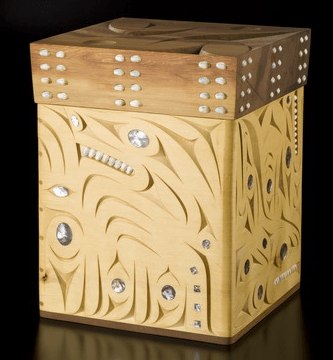
Mostly, I know the work of Salish artists John and Luke Marston from pictures. These days, they seem to be working largely on commissions, and such smaller work as they do is displayed mostly in galleries in Victoria. The few I’ve seen have been mostly at the Inuit Gallery, which has now taken the next step of hosting a show with some two dozen pieces entitled “Honouring the Ancient Ones.” I attended the opening of the show last Saturday, and I was appreciative of the skill I saw there, but a little taken aback by the prices.

The two Marstons are often spoken of in the same breath. Even if they weren’t brothers, that would be inevitable, because both begin in with the Salish tradition, often base works on historical artifacts, and show considerable promise as carvers. However, if you see “Honouring the Ancient Ones,” you are unlikely ever to mistake them again.

Assuming the show is any indication, John Marston favors boxes and rattles.

jm-box

jm-rattle

When he does a mask, it is generally on a stand.

jm-mask

Throughout his work, he shows a strong sense of line – something that loosely resembles the formlines of the northern first nations on the coast, but which follows few of its rules with any consistency.

jm-formline

The result is a body of work that is hauntingly familiar, yet fresh at the same time.

By contrast, Luke Marston seems interested in carving household goods, such as bowls and ladles.

lm-bowl

lm-ladle

He is also the maker of the only two bracelets in the show, although his metalwork skills seem less advanced that his woodcarving ones.

lm-bracelet

He also seems more interested in masks than his brother, including a transformation mask and a contemporary piece called “First Woman,” whose depiction of a woman’s face in the flames was for me the highlight of the show.

lm-first-woman

None of his work shows the same focus on line that his brother’s does, but – at least in this exhibit – he seems more interested in the historical roots of his art, citing several times in the catalog that various works are his rendering of a museum piece.

Both artists are worthy of admiration, but I know that the prices they are charging are causing some concern among Northwest Coast artists and galleries. There is an unspoken understanding that artists’ prices reflect their experience, and many people feel that neither Marston has paid enough dues to justify their prices. When I say that Luke Marston’s “First Woman” mask is in the same price range as master and elder carver Norman Tait, you will understand what I am talking about. I even know one gallery that decided against trying to host a show of the Marston’s work because its curators decided it could not afford the initial outlay of buying such expensive pieces.

On the one hand, this criticism has some justification. John and Luke Marston are outstanding carvers, but they are still relatively young and, for all their promise, they are still perfecting their skills. Not that anything is wrong with their finishing skills, you understand, but when you compare them to those of someone like Ron Telek or Stan Bevan, you can see that Marstons still have things to learn. For example, neither shows a strong sense of the grain, and their matching of abalone inlays while adequate, is not always as close as it should be.

On the other hand, the Marstons can obviously receive the prices they are asking. Despite the recession, sales were brisk at the opening. As I write, three days into the show, two-thirds of the works on display have sold, including some of the most expensive.

Judging from the crowd, I suspect that one reason they can charge as they do is that they are breakout artists – ones whose appeal extends beyond the usual Northwest Coast collectors and enthusiasts and appeal to the local mainstream art crowd. You might wonder if their work will increase in value as quickly as other artists’ given its initially high prices, but what are they supposed to do – deliberately undercharge what the market will bear? That seems too much to ask of anyone.

In the end, I decided the question of their pricing was secondary (especially since most of their work was beyond my bank balance). The way the Marstons are developing, the issue is likely to become moot in another five to ten years as their skill is generally recognized.

Read Full Post »

The other day, I read that Kodak would no longer be producing analog film. The newspaper did its best to make the new an end of an era story, with people lamenting the end of a tradition. But I admit that the laments left me cold. Technological nostalgia simply is not part of my personality.

It’s not as though I haven’t live through changes in technology. But many, such as the size and fuel of cars, are minor in the sense that they don’t affect the pace of daily life. Whether you ride in a sub-compact or a luxury car, the immediate experience is much the same. I feel the same way about black and white as opposed to color television, despite my fondness for film noir.

Other changes in technology seem improvements to me. A push-button phone is quicker and easier to use than a rotary one, although I remember being fascinated by the dials when I was in kindergarten.

As for typewriters, I understand that some older writers are used to them and want to stay with what they know. But give me a word processor and computer keyboard any day. I remember having to fiddle with whiteout and carbon paper, and having to retype a page because it had too many errors, and I have no wish to deal with these nuisances ever again. Nor am I fond of being restricted to red and black ink and (assuming you were lucky enough to have an IBM Selectric) a very limited set of typefaces – none of which had the collection of accents and umlauts needed to deal with every western European language, let alone anything else. While I took some time to get used to writing on a computer, now I wouldn’t go back to a typewriter at any cost.

The same goes for the old photographic processes that are now being lamented. I put in time at my high school’s darkroom and had a makeshift one at home for a few years, and I admit that there is an esoteric feel to developing films or producing a print with an enlarger (perhaps working in darkness or infra-red light has something to do with that feeling). And for years, it made sense that professionals should stick to the old techniques when digital cameras lacked the features they needed. But those days are at least five years past. Digital cameras and graphics editors get the same results while being cheaper, quicker, less fussy, and more efficient. So why would I want to stick with the old techniques?

Maybe my interest in results is part of why I don’t get nostalgic about technology. I tend to focus on similarities more than differences, an attitude that makes me see word processors and typewriters as means to a similar end. If I can get the same results with less effort from one means, that’s the one I’m going to use.

With this attitude, I’m neither a technophobe nor a technophile. I neither feel threatened by technology nor get excited by new technology, although I do keep informed about areas that interest me. When upgrading makes sense, I upgrade. With this attitude, I’m unlikely to feel any strong attachment to technology one way or the other. It’s a tool to me, and nothing else.

Still another reason I’m not nostalgic about technology is my memory. I have only good recall, but my recognition borders on the photographic. By that I mean that, although I can’t always generate detailed memories unaided, putting the right artifact or place in front of me is like starting a movie on the DVD player – it’s that vivid. So, when older technology is discussed, I’m not under any illusions about it, pro or con. And accuracy of my sort, I suspect, is incompatible with nostalgia. It’s hard for the reworkings of the mind to occur when you can access direct memories.

But the main reason for my lack of reaction seems to be my suspicion that most nostalgia for technology is really a nostalgia for when you are young. Just as most people’s attitudes or sense of prices tends to get stuck somewhere between the ages of 25 and 35, so most people’s sense of how technology should look and function gets stuck at a similar age. So, when people become nostalgic for an obsolete technology, what they are really doing is lamenting the fact that they are no longer young.

That seems just another form of distortion to me, and one that I am determined to avoid. Trying to perceive accurately isn’t always easy or pleasant, but I am determined to attempt it.

Sometimes, an older technology will have advantages that a newer one doesn’t – for example, so far, paper books are still more convenient and portable than ebooks (although that might change). But, for the most part, technological change simply happens, and I am content to observe and stoically accept.

Read Full Post »

« Newer Posts - Older Posts »