Feeds:
Posts
Comments

Archive for the ‘First Nations art’ Category

You don’t have to dig very deeply into Northwest Coast art to stumble across a representation of Raven stealing the light from the chest where its owner has cached it. Whether you’re looking at a print, a piece of jewelry or a sculpture, in any gallery, you have an almost certain chance of finding a representation of the myth. In many ways, the story is to modern Northwest Coast art what the crucifixion or a Madonna and child were to the Italian Renaissance – a standard subject that most artists tackle sooner or later. That’s why Bill Hudson’s “Raven Opens the Box of Daylight” tickled our sense of humor so much that an artist’s proof of the cartoon was under our Christmas tree this year.

Bill Hudson is the spouse of Clarissa Hudson, the Tlingit weaver and painter. From what I’ve seen, much of his own work is more mainstream and includes a good deal of commercial and theatrical design. However, some of his work shows a Northwest Coast influence, including a poster he did for the twentieth anniversary of the Alaska Folk Festival that shows Raven, human with a mask for a head, wrapped in a robe of his own feathers and strumming a balalaika.

What I like about Hudson’s cartoon is the way that he has reduced a myth from the dawn of creation to a modern, mundane scene around a breakfast table, complete with orange juice and toaster. Far from being a great treasure, the light is contained in a commercial cereal box. It’s a good-natured but hilarious comment on just how common the story is; I’ve described the piece to several Northwest Coast artists, and all of them have understood the point immediately.

At the same time, Hudson has paid close attention to detail. Outside the window, you’ll notice, the stars and moon are visible, since in any form, the story predates the sun. Also, the raven’s feathers are not just black, as ninety-nine out of a hundred people would describe them, but tinted with a dark blue, as a raven’s feathers actually are. I appreciate such close attention to detail in what, for all its satire, is essentially a slight piece – so much so, that I have started paying closer attention to the rest of Hudson’s work, on the grounds that anyone who takes such pains is (at the very least) a thorough-going professional.
box-of-daylight-small

Read Full Post »

Last month, a friend phoned to ask my advice about the price of a Northwest Coast mask that he had commissioned. The price the artist had quoted seemed high to him, but he was still interested in the mask. Thanks to my frequent gallery browsing – both in person and online — I was able to reassure him that, for a piece of that size by an artist of that reputation, he was getting a reasonable price.

More recently, I saw a piece by a new artist and instantly recognized the price as too high for this moment in the artist’s career.

From these two experiences, I realized that, not only is the price of Northwest Coast masks is determined by a couple of factors – the artist’s reputation and the size and finish of the mask – but that there is a rough consensus about how those factors affect the price. This consensus exists throughout British Columbia, so, contrary to what you might expect, you are unlikely to find many bargains outside of Victoria or the Lower Mainland regions. It is undoubtedly due to the fact that galleries and artists are always comparing notes and the fact that a handful of artists are widely viewed as a guide to pricing. In particular, Beau Dick, although widely recognized as a leading carver, has never priced his works as high as he probably could, but varies his prices according to the complexity and size of his work.

As near as I can construct it, here is a list of what you can expect at each price range when you buy a Northwest Coast mask. All prices are in Canadian dollars:

  • Under $2000: The largest group in this category are masks for the tourist trade, generally by artists who have few chances of selling to upscale galleries such as Douglas Reynolds. New artistically-oriented carvers and minis (masks 7×7 inches or smaller) – also fall into this category.
  • $2000-$3000: In this category, you can find average-sized masks (roughly 12-14 inches high) by artists who are starting to gain a solid reputation, or simple or experimental masks by established artists. Most artists’ work does not stay in this price range for very long, except for some long-established carvers for tourists.
  • $3000-$6000: This category is by far the largest. Most masks in most galleries usually fall within it. Here, you find works of average size and complexity by artists who have a modest reputation for their carving. You also occasionally, large works by lesser-known artists in this range, but the restrictions on beginning or relatively unknown artists are tight enough that such works appear only rarely.
  • $6000-$10,000:This price range seems reserved for large or intricate works by artists whose work usually falls within the previous category. One of the signs of consensus is that you find relatively few artists whose prices fall consistently within this category.
  • $10,000 and above: Only large and elaborate masks or normal sized ones by master carvers fall into this category. Very few masks sell above $18,000, although I have seen a Beau Dick mask over four feet tall selling for $28,000.

These ranges are only generalities. A lesser-known carver making a bid for more recognition may temporarily or permanently raise their prices, while a more established artist may lower the price on a specific piece that they feel does not represent their best work. Similarly, a smaller or larger size may bump a specific mask from the artist’s norm. Almost always, reputation trumps size: for instance, I recently saw a mini by Dempsey Bob selling for just under $5,000, a price that reflects both his fame and the fact that these days he does little non-monumental work in wood.

I should also mention that artists do not necessarily view this consensus as fair. They argue that, especially in the lower categories, it hardly pays to take the time to finish the mask – and no doubt they are right.

However, other artists figure that selling in the lower categories is a part of their career that they simply have to endure – and they are right, to. Unless an artist is lucky enough to live on commissions or has another means of exhibiting work to the public, they have little choice except to participate in a market in which both they and their work are evaluated in detail by the market.

Read Full Post »

Ron Telek, the Nisga’a carver, can always be counted on for the unexpected – anything from the disturbingly haunting to the eerily beautiful, and in every form imaginable. I’ve even seen a shaman marionette by him. Our latest acquisition, “Transformation Rattle: Eagle to Wolf” is no exception. Only a handful of other Northwest Coast artists could take a utilitarian object like a rattle and turn it into a sculpture while keeping it functional.whole-small

One of the characteristics I’m starting to associate with Telek’s pieces is an unusual degree of three-dimensional awareness in the design. Like many of his pieces, “Transformation Rattle” is impossible to capture fully with a single photo. I took five pictures for our records, and I’m not sure that I shouldn’t have taken a sixth to cover it fully.

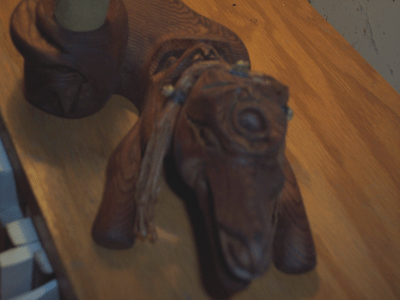
The rattle consists of two parts: The rattle, which is the eagle, and the rattle’s base, a lean-looking wolf with a curved tail and, around its neck, a garland of cedar boughs. The rattle rests inside the tail, and can be removed from it. At first glance, you are lucky to notice that it’s a functional rattle. Your first clue is the leather wrapped around the bird’s tail as a hand grip, but even that could simply be part of the surreal sculpture.

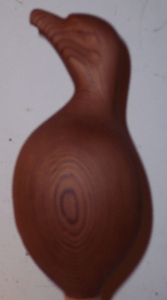
The rattle depicts the transformation perhaps two-thirds of the way through. On the right side, the bird’s features are depicted fully, but the left side of the body is mostly blank, with the features indicated by a few indentations, and the wing by the grain of the wood.

smooth-side-eagle-small

Its feet, too, are gone, absorbed into the wolf. Perhaps to indicate the transformation’s incompleteness, the bird’s wing is wrapped around its rounded stomach, as though it is pregnant with itself.

finished-side-eagle-small

The wolf is more complete, but its lack of claws and teeth or fully-formed rear legs shows that it, too, is an unfinished figure. wolf-small

Its thinness and slightly rough carving, especially in the comparison with the eagle further suggests the wolf’s incompleteness – and, perhaps, the energy expended to make the transformation.

The fact that the two figures are the same is suggested by the spirit in the middle of the eagle’s right wing and atop the wolf’s head. Furthermore, the wolf’s garland of cedar suggests that this is not a born wolf, but a human – no doubt a shaman – going through these transformations. Supporting this idea is the much larger, more human-looking spirit erupting from the wolf’s back, as well as the fact that, if you look closely, the rear legs are more human than wolf-like.wolf-front-small

All this complexity is heightened by Telek’s characteristic attention to the direction of the grain. An employee at the Art of Man Gallery in Victoria told me last week that Telek often carves down until he finds the grain he wants, and, looking at “Transformation Rattle,” I have no trouble believing it. Although both the rattle and its base is carved from a single piece of red cedar (and stop and think about the difficulty of that for a moment), the carving is literally never against the grain. Even on the wolf’s curving tail, the grain moves with the sculpture. And, on the eagle, the round pattern of the grain not only suggests the bird’s body, but creates a semi-abstract form as simple as it is beautiful.

The overall result is a contrast with the tall, rounded shape of the eagle, and the ground-hugging, angular shape of the wolf. It’s an accomplished piece of work, which I’ve place on top the shelves on my computer desk, where I can look up at it periodically, or even take the rattle out for a shake if I feel like it. We’re seriously thinking of mounting it on a lazy susan, so that it can be viewed in its entirety more easily. Meanwhile, I’ve already switched its position around several times in the day since we brought it home so I can admire another aspect of it.

Read Full Post »

Not too many years ago, you only had to walk down Government Street in Victoria to find more shops selling Northwest Coast art than you could properly absorb in a day. Looking back, I’m not sure of the quality of some of the shops, but they were there. But times are harder, with many store fronts along Government empty, and now you have to search for galleries.

Descending on Victoria yesterday, these are the galleries we managed to find:

  • Art of Man: Located in the mall in the basis of the Empress Hotel, the Art of Man specializes in Inuit and First Nations masks and sculpture. The pieces for sale included four or five from Ron Telek, including a meter high blue shaman (this from an artist who rarely uses color), and a shaman marionette fending off a spirit attacking his foot with other spirits resting in his hand. Daryl Baker, the nephew of the LaFortune brothers Doug, Perry, and Aubrey, is also represented by highly-detailed designs that border on the surreal, and that are all marked by a close attention to finishing details. The Art of Man also seems to get first pick of Tim Paul’s work – so much so that I realize that only his lesser pieces reach Vancouver. Other artists whose work is available at this gallery are John and Luke Marston, whose work shows an awareness of history that I had never realized before that it possessed. In general, the quality of the work at the Art of Man is extremely high, making it by far the premier gallery of Northwest Coast art in downtown Victoria.
  • Hill’s Native Art: Like the Vancouver store, the Victoria Hills is mainly a tourist shop. However, the Victoria store seems to have a slightly better ratio of art to high-end tourist pieces, as though it gets first choice of all the locations. But perhaps this impression is due partly to the fact that it is less crowded and better lit.
  • Alcheringa Gallery: From the web site, I had the impression that this gallery was huge. The reality, though, is that this is a gallery with only a few of its pieces on display – and about half of those are given to works from Papua New Guinea, which is worth seeing, but doesn’t engage my interest the way that the Northwest Coast tradition does. Still, you can see some works by Tim Paul and John Marston there. I was also interested in seeing two works I had seen on the Internet, one by Ron Telek and another by Dean Heron.
  • Pacific Editions: Unfortunately, this story is closed on Mondays, which meant that we walked six blocks out of our way for nothing. But what we could see through the window confirmed the impression I had from the web site: Pacific Prints has a huge collection of limited editions prints. I look forward to spending a happy few hours there the next time I’m in Victoria.
  • Eagle Feather Gallery: A mixture of art and tourist pieces, this gallery is only a block from the Empress Hotel – but on a side street that you may have trouble finding. It specializes in the work of Doug, Perry, and Aubrey LaFortune, especially Doug (in fact, he was due to drop by the day that we visited, although we missed him). Daryl Baker and Pat Amos also have a couple of pieces, while Francis Dick has at least a dozen 2-D works from throughout his career at the gallery. Whether the gallery is worth a visit probably depends on your opinions of these artists, although its stock gives you a good opportunity of evaluating Doug LaFortune thoroughly.
  • Out of the Mist Gallery: This gallery specializes in antiques. Its modern selection is devoted largely to the Hunt family, and includes a few curios like a mask carved by Richard Hunt when he was a teenager, a formal, somewhat stiff print from the start of Beau Dick’s career, and a two meter-long eagle by Roy Henry Vickers. The quality of the antiques is completely indiscriminate, and includes some pieces from across North America. If your taste runs to antiques in Northwest Coast art, you could probably find something to your taste, but the somewhat dim lightning and the bored staff makes the effort hardly seem worthwhile.

As with previous lists I’ve made of galleries, this one makes no effort to be comprehensive. We did not, for instance, have to visit the Provincial Museum’s gift shop, which I seem to remember as having a few art pieces. So if you know of any other galleries in the Victoria area that might be worth a visit, please add a comment and let me know.

Read Full Post »

Kwakwaka’wakw carver Beau Dick is one of the names on my short list of people from whom I would one day like to buy a mask (for the record, the others are master carver Norman Tait, Nishga’a surrealist Ron Telek, and Tlingit carver Stan Bevan). Not only does Dick have a subtle sense of color that is rare in Northwest Coast mask-makers, but he manages to find endless creative possibilities in two main figures — Bukwus, the wild man of the woods, and Tsonoqua (also called Dzunuk’wa), the wild woman – producing countless masks of both without repeating himself very much. And, like the others on my list, he is meticulous about finishing details, although he often chooses a rougher look than Tait, Telek, or Bevan. So, last month, when I came across a few sketches by Dick for about the price of a quality limited edition print, I was instantly tempted to buy.

The first Dick sketches I saw were at the Inuit Gallery in Gastown. One was a colored pencil sketch of a mask with a quick gradient background, one was a mask done in charcoal, and the third was a colored sketch of a dancer. At first I thought them unique, but a week later at the Latimer Gallery, I saw some similar works, as well as some colored pencil sketches of dancers that I suspected were done from photos. The Latimer Gallery pieces were dated about four years later than the Inuit Gallery mask sketch, and were about two-thirds the price, although I judged them not quite so interesting.

From what I was told at the Latimer Gallery, the mask sketches were the result of a period in which Dick had sketched his designs before carving them. He had tried this experiment at least twice, once in 1999 and again in 2003. I don’t know, but I surmise that he either was not especially satisfied with the results, or found the exercise not useful for his carving since (so far as I know), he only tried the experiment a few times with masks. I hope one day to learn more.

Meanwhile, I was disappointed to find that the sketches weren’t as unique as I had imagined. Instead of coming down the next week to buy the mask sketch at the Inuit Gallery, I went to other galleries instead.

But, last Saturday, Trish was well enough to take a brief tour of some of the downtown galleries. When we reached the Inuit Gallery, she was as intrigued by the sketch as I had been, and we bought it on the spot, bearing it home in a mailing tube sealed with tape at both ends to keep out the rain and wrapped in a plastic bag. Tomorrow, it goes to the framer.

What interests me in the sketch is partly the subject matter. If you have ever been in the northern rainforest alone, especially near nightfall, you have no trouble understanding how Tsonoqua entered the local myths; she’s the sense of something terrifying moving just behind the trees.

But, just as importantly, the sketch is interesting for the way it is rendered. If you examine the lines of the face, you’ll see that they are not lines so much as surfaces. Even a single line, like the ones on either site of the mouth are not so much lines as areas, and their shadows are likewise. In other words, Dick is sketching with a carver’s eye.

The only exception to this approach is the hair of both the head and the shaggy eyebrows (although even the individual hairs tend to be thick). The mixture of the two different approaches only adds to the oddness of the face. So does the red patch on just one of the cheeks.

The sketch is rough, but not so rough that Dick didn’t give it a bit of a finishing touch with the gradient background. I suppose that some people would consider the roughness a fault, but, really, what else do you expect in a sketch?

Anyway, a calculated roughness is a common characteristic in a lot of Dick’s work, and seems to suit a character that has been living rough.

One day, I might be lucky enough to find the mask that matches the sketch. But, for now, the sketch is a small and slightly curious addition to our small art collection.

B

Tsonoqua Mask by Beau Dick

Read Full Post »

Years ago, when we were buying Northwest Coast limited edition prints, our main criteria was often whether our budget could stretch to buying one. That is still a consideration, since although we have more spare cash than we did then, we are still far from wealthy. Besides, I’m born of Depression-era parents, so getting value for my money is as reflexive as breathing to me. But, the limited budget aside, I am starting to articulate my philosophy for buying art.

To begin with, I will buy nothing that I don’t like. I am not buying for an investment, even if it is at the back of my mind that in four or five decades I might be glad to be able to sell a few pieces so that I can buy the necessities of life. I am buying to bring a new strain of enjoyment into my daily life, something that can catch my straying glance or surprise me with its line or color or concept when I rediscover it in passing. I suppose you could say that I am more of an aficionado than a collector.

Second, I am not much interested in safe art that does what I have seen before. Some people want safe art as a kind of wallpaper, and there is no shortage of artists to provide it. But I want art that challenges or provokes me in some way. For example, one mask by Norman Tait has long eyelashes of hair that cover the eyes, giving a disturbing sense of blindness, or, perhaps more accurately, the sense of someone peering out from behind the illusion of blindness. The mask unsettles me, to say the least. If I can ever afford the mask, I’ll probably buy it, just so I can wrestle with why it makes me uneasy – and I’m guessing that understanding my reaction will take years. I’m fascinated with the surrealism of Ron Telek’s sculptures for much the same reason.

These two principles lead naturally to a third: I will not buy a piece simply because of the artist’s reputation. For one thing, buying work by artists like Robert Davidson or Susan Point, as talented as they are, is like buying Sony hardware – you are paying a premium for the name (or perhaps I should say brand).

More importantly, buying for the name means that you are letting someone else do your thinking for you, that you are becoming a consumer. Seduced by the name, you could just as easily buy a good piece as a bad, and third rate art by a first rate artist is still third rate. I consider art the antithesis of consumerism, so I refuse to hunt for art by brand.

That’s not to say that I reject buying anything by well-established artists. Currently, I have my eye on half a dozen well-known artists whose work intrigues me enough that I might buy one of their pieces if I find the right one. But I would rather wait for that right piece than buy something that pleases me less – even if I never find that right piece.

As a corollary to that third principle, I would rather find small masterpieces by lesser known artists than buy a piece from someone with an existing reputation. In the same way that I would rather discover a small, ethnic cafe with superlative food than eat at the latest trendy restaurant, I would rather find a largely unknown carver with superb finishing details or a quirky piece outside what a famous artist is known for than buy something safe and famous.

It’s not that I want a bargain, because I could just as easily wind up overpaying as finding a strong investment. Rather, half the fun of strolling the galleries for me is to find the unusual and go beyond the commonplace. Northwest Coast is an especially appropriate field for this habit, because it is full of newcomers, all determined to make their names – and many of them are succeeding. The discovery of such artists and their works is one of the pleasures of appreciating it.

Looking back, I’m afraid that these principles sound hopelessly unaesthetic, to say nothing of overly-suspicious and in the worst middle-class traditions. Tell you what, though: I bet that they give me more pleasure than buying from the exhibit book does for a dozen wealthier connoisseurs.

Read Full Post »

I’ve always thought that Beau Brummel has a lot to answer for. He’s the one who, in the early 19th century, set the standards that reduced the color palette in men’s clothes to brown, black, gray, and dark blue and – even worse – restricted men’s jewelry to rings, watches, cuff links and tie pins. No doubt his look was an improvement on Prinny’s excesses, but what Beau did was to condemn us to drabness. And if, like me, you don’t wear ties or French cuffs or carry a wrist watch because you look at it every twenty seconds if you do, your choices are even more limited. But, yesterday, I found a way around these restrictions that nobody can find fault with: I took home a three inch West Coast bracelet.

I suppose I could have opted for the full Scottish effect for formal wear. Never mind that I don’t have the remotest connection to a tartan; kilts suit short-legged, barrel-torsoed men like me, and, like my late friend Paul Edwin Zimmer, I could have used an unclaimed one like Ancient MacAlpin. And Scottish regalia has the advantage of allowing you to wear more jewelry, although too much of it has banal thistle designs and you have to be careful that nobody that nobody calls your skean dhu a concealed weapon. But kilts are even more trouble than suits, and fabulously expensive as well.

I suppose, too, that I could have got a tattoo. But tattoos are too permanent for my liking, and good ones surprisingly rare. And why go through discomfort for the sake of mediocrity?

Instead, for almost twenty years, I’ve wanted a thick West Coast copper bracelet. At least in British Columbia, such bracelets are works of art, thanks to the fame of artists like Bill Reid, and nobody is going to make tiresome remarks about effeteness if you’re lucky enough to have one to wear (not that I would care if they did; my identity as a straight male is well-established, thanks very much). Not only First Nations men, but men of every ethnicity can wear West Coast bracelets and nobody thinks twice about it – everyone’s too busy envying them.

But most West Coast bracelets you see are in silver or gold, metals that don’t catch my eye nearly as much as copper, even if they are more expensive. Besides, although I know that modern West Coast art is a blend of First Nations traditions and modern metal work techniques, copper seems more appropriate because the local cultures did work copper before their first contact with Europeans.

Moreover, few bracelets in any metal are more than an inch and a half wide, and most are made for the tourist trade. What I wanted was an original work of art, on a surface whose size would do the design full justice, and a weight that I could never forget while it was on my wrist. And for years I couldn’t afford one, although I came close once or twice to placing an order.

But in December, I suddenly had the the spare cash. I had long since narrowed down the shops to order from to two or three that were far above the watered down traditions in the Gastown tourist shops. Further investigation showed that Coastal Peoples in Yaletown was the only shop among those known to me that would take custom orders, so I placed my order there.

My choices were limited by a lack of artists who work in copper. However, I did have three or four possible artists – assuming any were available for a commission. After careful consideration, I decided I wanted Tsimshian artist Henry Green. Not only is Green a versatile artist who works in several media – his carved masks are especially fine – but all his work had a strong sense of line that the others lacked.

The Coastal People staff were polite, but non-committal about whether Green would accept the commission. However, a few days later, one emailed to tell me that he could do the piece in about a month. I rushed to put a deposit down before his schedule filled.

Then came the design decision. Not wanting to be too exacting for fear of receiving uninspired or merely competent work, I diffidently suggested that the design include Raven and Mouse Woman. Raven, of course, is the trickster, while the lesser-known Mouse Woman is the keeper of tradition and domestic values, so I thought the combination an interesting contrast. So, apparently, did Green, since he told Coastal Peoples that he liked the idea.

We did bandy about the idea of receiving a sketch from Green of the design, so that I could approve it. However, when I learned that it would be only a sketch and not a finished design, I decided it was not worth the additional sum he would charge. I abandoned the idea and settled down to wait.

A month passed, and I heard nothing. I didn’t want to get impatient. Art doesn’t work well to timetables, and, besides, the holiday season had intervened, yet I was nearly shaking in anticipation.

Then, yesterday afternoon, I received a call that the bracelet was ready. I soon abandoned the pretense of working, and knocked off early to pick it up; one of the advantages of being freelance is that you rarely have to work to schedule.

The work was – overwhelming, in a word. Green had created not only an inspired work of art, but, between the size, metal, and design, a unique one. It was also a well-engineered one, since Green had chosen the gauge of the copper to be thick enough for strength, yet thin enough to be pliable and relatively light. Even the staff at Coastal Peoples seemed impressed. I told the clerk to tell him that I was extremely satisfied, and left wearing it.

I plan to wear it in the future whenever possible, until it becomes my trademark for the rest of my life. Living with art is always uplifting, and, while Green did all the work, as the patron of the work with my stipulations, I can’t help feeling that I played a small part in its creation. And to have waited so long to get something that exceeded my expectation means that I couldn’t be more pleased to have this cuff of copper on my wrist

Someday, I might get a matching bracelet for my other wrist, and cement my reputation for eccentricity. Meanwhile, I keep looking at the design of Mouse Woman in the center and raven below her, and marveling at the bit of metallic beauty that has come into my life.

Bracelet by Henry Green

Read Full Post »

« Newer Posts