Feeds:
Posts
Comments

Archive for the ‘native art’ Category

I have two great weakness when buying Northwest Coast art: I love to see artists trying out new media, and I love work that shows the lesser-known figures of mythology. With these preferences, it seems inevitable that I would have bought Morgan Green’s Mouse Woman platter.

Morgan Green is a twenty-five year old artist who seems to be in the middle of deciding what art she wants to do. She is represented in the galleries mostly by her painted leather cuffs, but she has also done fashion design, carved masks and poles, and assisted older artists with painting and metal casting. Add an art teacher and potter for a mother and master carver Henry Green for a father, and it is no wonder that she always seems to be galloping off in all directions (in fact, every time I’ve met or contacted her, she seems about to be preparing for a journey or just returned from one).

The Mouse Woman platter is one of several pieces of ceramics that Green is exhibiting at the Edzerza Gallery. Made from clay that Green recently brought back from Arizona, it is as untraditional as a Northwest Coast piece can be. Ceramics were not a part of the northern coast first nation cultures, and, unlike argillite a century ago or glass in recent decades, have never really caught on, although you can find occasional pieces – usually not very skilled and mostly for the tourist trade.

As for Mouse Woman herself, she remains a bit of a mystery. Few, if any renditions of her survive. But the stories make her a powerful, although minor character. She generally appears as a helper of a hero in a quest. In several tales, for instance, a hero helps a mouse over a log, and then, that evening, comes to a long-house where he is greeted by a noble woman who feasts him and gives him good advice. In other tales, she whispers practical advice about everyday concerns that the hero passes on to his people. In many ways, she is all that Raven is not: domestic where he is a wanderer, a maintainer and restorer of order where he is a bringer of chaos and change, and a representative of civilization where he is the eternal outsider. Where Raven is often a child, she is more often described as a grandmother, perhaps an elder.

Since no one is quite sure what Mouse Woman is supposed to look like, in depicting her, Green is free to let her imagination run wild. She chooses a simple design that goes well the rough, terra-cotta background – a combination that vaguely suggests petroglyphs, an art form that flourished several centuries before the northern formline became codified. Most of the lines are thin, except for those associated with what Green presumably intends as Mouse Woman’s distinguishing characteristics: her incisors, round eyes and ears. For these features, the lines are heavy, giving them added prominence, and elevating them to the equivalent of the orca’s fin or the eagle’s hooked beak – the features that tell you what creature is intended even if the complete shape is not depicted.

The result is a fragile but alert-looking creature, with ovoids that suggest cheeks stuffed with food. The result is a surprisingly naturalistic figure of a mouse, that, at the same time, also suggests a tiny but alert and active grandmother. How artists of a century and a half ago might have depicted Mouse Woman remains unknown, but I’m sure that they would recognize instantly the subject of Green’s depiction.

I don’t know whether Green will continue working with ceramics. Considering her restlessness, my guess is that she won’t for the time being, although she may return to them eventually. But I suspect that her recent YVR scholarship couldn’t have come at a better time. The Mouse Woman platter is a minor piece (in scope, I mean; at twenty-five centimeters it is definitely not so in size), but it suggests to me an artist who is starting to find the themes that interest her.

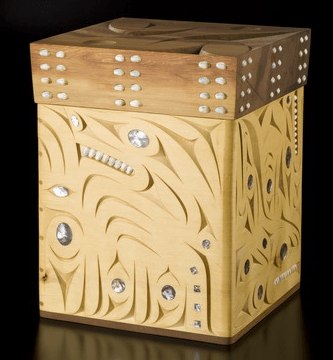
morgan-green-mouse-woman-plate

Read Full Post »

Mostly, I know the work of Salish artists John and Luke Marston from pictures. These days, they seem to be working largely on commissions, and such smaller work as they do is displayed mostly in galleries in Victoria. The few I’ve seen have been mostly at the Inuit Gallery, which has now taken the next step of hosting a show with some two dozen pieces entitled “Honouring the Ancient Ones.” I attended the opening of the show last Saturday, and I was appreciative of the skill I saw there, but a little taken aback by the prices.

The two Marstons are often spoken of in the same breath. Even if they weren’t brothers, that would be inevitable, because both begin in with the Salish tradition, often base works on historical artifacts, and show considerable promise as carvers. However, if you see “Honouring the Ancient Ones,” you are unlikely ever to mistake them again.

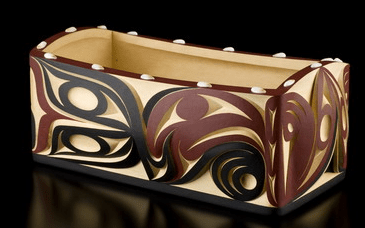
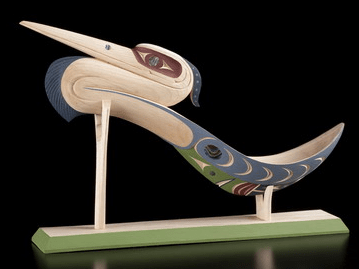
Assuming the show is any indication, John Marston favors boxes and rattles.

jm-box

jm-rattle

When he does a mask, it is generally on a stand.

jm-mask

Throughout his work, he shows a strong sense of line – something that loosely resembles the formlines of the northern first nations on the coast, but which follows few of its rules with any consistency.

jm-formline

The result is a body of work that is hauntingly familiar, yet fresh at the same time.

By contrast, Luke Marston seems interested in carving household goods, such as bowls and ladles.

lm-bowl

lm-ladle

He is also the maker of the only two bracelets in the show, although his metalwork skills seem less advanced that his woodcarving ones.

lm-bracelet

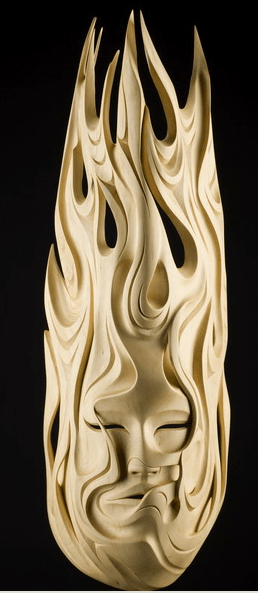
He also seems more interested in masks than his brother, including a transformation mask and a contemporary piece called “First Woman,” whose depiction of a woman’s face in the flames was for me the highlight of the show.

lm-first-woman

None of his work shows the same focus on line that his brother’s does, but – at least in this exhibit – he seems more interested in the historical roots of his art, citing several times in the catalog that various works are his rendering of a museum piece.

Both artists are worthy of admiration, but I know that the prices they are charging are causing some concern among Northwest Coast artists and galleries. There is an unspoken understanding that artists’ prices reflect their experience, and many people feel that neither Marston has paid enough dues to justify their prices. When I say that Luke Marston’s “First Woman” mask is in the same price range as master and elder carver Norman Tait, you will understand what I am talking about. I even know one gallery that decided against trying to host a show of the Marston’s work because its curators decided it could not afford the initial outlay of buying such expensive pieces.

On the one hand, this criticism has some justification. John and Luke Marston are outstanding carvers, but they are still relatively young and, for all their promise, they are still perfecting their skills. Not that anything is wrong with their finishing skills, you understand, but when you compare them to those of someone like Ron Telek or Stan Bevan, you can see that Marstons still have things to learn. For example, neither shows a strong sense of the grain, and their matching of abalone inlays while adequate, is not always as close as it should be.

On the other hand, the Marstons can obviously receive the prices they are asking. Despite the recession, sales were brisk at the opening. As I write, three days into the show, two-thirds of the works on display have sold, including some of the most expensive.

Judging from the crowd, I suspect that one reason they can charge as they do is that they are breakout artists – ones whose appeal extends beyond the usual Northwest Coast collectors and enthusiasts and appeal to the local mainstream art crowd. You might wonder if their work will increase in value as quickly as other artists’ given its initially high prices, but what are they supposed to do – deliberately undercharge what the market will bear? That seems too much to ask of anyone.

In the end, I decided the question of their pricing was secondary (especially since most of their work was beyond my bank balance). The way the Marstons are developing, the issue is likely to become moot in another five to ten years as their skill is generally recognized.

Read Full Post »

« Newer Posts