Feeds:
Posts
Comments

Archive for the ‘Personal’ Category

When I was a teenager, the norms of swearing changed. Even now, the conflicting messages leave me firmly in neither camp.

On the one hand, according to the old standard, swearing was something no decent man did in front of women and children, but was essential for membership in some aspects of masculine culture. Women weren’t supposed to swear at all, and the most feisty woman looked embarrassed if she did.

On the other hand, with publication standards being relaxed and the rise of the counter-culture, everyone was starting to swear. In fact, to swear was to be modern and unbound by convention.

Today, this time of transition feels so remote as to be incomprehensible. What, anybody under forty-five might ask, was the fuss about? Yet knowing when you could swear and when you couldn’t was an important social skill, and swearing inappropriately said more than anyone today can imagine about your class and personality.

For example, to my father, who had been in the army and was employed in working class positions for most of his life, an atmosphere of casual swearing was a normal part of his week day. Yet perhaps because he was upwardly mobile or because my mother would never approve, he was careful about his swearing outside work.

Until I was fifteen and worked my first summer in the Canadian Telephone and Supply shops where he was a front-line supervisor, I was under the impression that he hardly swore at all. He might use “bloody” or “hell and damnation” if he was frustrated with one of his house-building projects in the basement, of “hell’s bells” if he was seriously fed up, but never when any of the family were in the same room. These mild swear words were as much as I ever heard, and my impression was their English-flavored colorfulness made them almost acceptable.

Laboring under this illusion, I was surprised when, after I made a mistake in the shops, he loudly asked, “What the heck you were doing?” and was greeted by howls of uncontrollable laughter by the workers he supervised. For weeks afterward, they would exclaim, “Heck!” around him in a good-natured way, and he would respond with a burst of ordinary profanity and mock-anger. A few times, I joined in myself.

More than anything else, this episode drummed into me that, for years, my father had been restraining his normal vocabulary around me. But that was what men of his generation did, living with a double-standard for expression. Any man who didn’t swear at all was considered effeminate or snobbish, but any man who swore in what was called “mixed company” was uncouth and boorish.

In such a complex atmosphere, I went through a period when when I was eight or nine when I prudishly avoided swearing. When my best friend took up the habit of saying “shit” at every opportunity, after a couple of months, I shocked his younger sister by telling her what he was saying. A few days later, he shamefacedly promised me he would change his language.

I was not going to be “one of those teenagers,” I repeated told my mother, referring to those who accepted modern standards (and were no doubt unruly because they didn’t speak properly). I believed firmly in the old standard’s last line of defense: swearing showed a lack of imagination and vocabulary, and I could prove that I had both by not swearing.

I still find that condemnation of swearing true. Now, however, I have to add that the whole point of swearing is to have some forceful words available when you have no time to be imaginative. When you want to swear, being original isn’t your priority (although I do envy some of the medieval kings, who, according to T. H. White, had such oaths as “By the head, teeth, and the splendor of God.”).

However, the times were changing, as I said. By cultural and personal necessity, in adolescence I found I could no more do without swearing than anyone else. I knew better than to swear in front of my parents; strangely enough, my father wouldn’t have approved any more than my mother. But I started using some of my father’s milder and more colorful expressions, like “bloody.” At the time, I still had a residual Christianity, so “God” seemed a suitable addition to my vocabulary as well. Both remain with me – although the religion does not. “Bloody” in particular seems to delight some American women when spoken with an English accent.

For several years, I held out against the more popular words like “fuck” or “shit.” I even winced when someone used them. They just weren’t words I could bring myself to use.

However, by the time I started university, the change in standards was complete. Swearing or not swearing was no longer an indicator of anything. Almost everybody was swearing, and there was something wonderfully liberating about hearing women swearing as freely as men – both to my ears and, so far as I could observe, to the women themselves. It seemed part of the march towards equality that such superficial gender differences had disappeared overnight, and that men no longer needed the double-standard of my father’s generation, except when talking to the old.

Now, of course, swearing is not even remotely a political act. A generation, if not two, no longer think twice about swearing as the mood hits them. It’s just another means of expression, and I no longer react to it. In a hard-swearing company, I usually notice myself swearing freely myself as I unconsciously try to fit in.

Still, childhood habits persist. Left to myself, I remain an infrequent swearer, a habit that gives me a reputation for politeness. Even today, I’m most likely to use “fucking” when reporting what someone else says, or in fiction because it’s part of how a character would talk. If you listen carefully, when I do swear, a small catch in my voice reveals the last trace of my first conditioning.

Mostly, though, I just consider swearing a matter of personal style – and that’s how such words should be viewed. They’re just words among words. They never were worth the worry they used to cause.


Read Full Post »

One benefit of digitalizing my music is the rediscovery of artists. Thanks to the digitalizing, I’ve tracked down at least a dozen artists and found what they’ve been doing since I first heard their music, including The Men They Couldn’t Hang, Michelle Shocked, Kirsty McColl, and Mark Graham. My latest re-discovery is Sam Weis, a twelve-string guitar player and writer of original songs from Washington State.

I don’t remember the first time I heard Weis, but it must have been at a Rogue Folk concert at the WISE Hall in East Vancouver. Possibly, I’d run across her previously at regional science fiction conventions; if not, it was someone remarkably similar. She had a vaguely punk sensibility that appealed to the front-row lesbians who seemed to attend every local folk concert in those days, and a twelve-string guitar that seemed almost too big for her and with which she could do almost anything. I especially remember the audience joining on the “Ride, ride, ride” chorus of “Til We’ve Seen It All,” and many of those around me crying at the longing expressed in the song.

At some point, we bought her Restless album, and over the years I played it often. But the CD lost its cover, and Weis seemed to be performing less, perhaps concentrating on her painting, which she also does professionally. Occasionally, I searched the Internet for her, but never found anything.

It was only last week, as I searched through my digital collection, that I realized that I had been looking for “Weiss,” adding an erroneous “s” to the end of her name. Having grabbed a clue, I located and downloaded her other three albums, and have been enjoying them for the past six days.

Finding an analogy for Sam Weis’ work isn’t easy, because it appeals in a number of different ways. Listening to her cover of “Dancing Barefoot,” I might compare her to Patti Smith with a stronger voice and better guitar work. Listening to “’55 Ford,” you might mistake her for a rocker. Her instrumental “Helix” is reminiscent of the Scottish harp duo Sileas. Another instrumental, “Train to Blue Sky” sounds like something the Allman Brothers might have recorded in their heyday, while “Breakfast with Bob” has an acoustic quietness. Philosophical pieces like “Why Not Utopia?” are reminiscent of Tori Amos in expression, while “Seven Sisters Road” suggests Michelle Shocked feeling nostalgic. Some critics have compared her to Joan Armatrading because of her probing relationship songs.

All these comparisons have a grain of insight, and none is accurate by itself, if only because Weis’ versatility is always supported by her strong guitar skills and a voice that, while ordinary in range, has a husky vibrato that suggests ambiguity and repressed emotion, making it second to very few in expression.

At times, her lyrics teeter at the edge of triteness, often as she finds herself boxed in by a scarcity of non-cliched rhymes. Such low points are especially likely to happen when she waxes philosophical in songs like “Why Not Utopia?” or “Shape of Time.” Not that such songs aren’t redeemed by the arrangements, but tackling such topics in a three or four minute song is only slightly easier than doing so on Twitter.

By contrast, Weis’ lyrics are at their height when she deals with personal emotions, whose complexities and ambiguities she expresses better than almost anyone. For instance, in “Seven Sisters Road,” she talks about youthful sessions with friends “where we invented destiny / And traded rage for poetry.”

Her lyrics are at their best when describing the intricacies of love in plain language. In “Restless Heart,” for example, she pleads, “Open up and let me come in / My lessons have been learned and I want to try again” and invites her lover to “slow dance on the back porch.” Similarly, in “Moment to Moment,” she expresses the obsessiveness of love with:

I don’t want to spend one more night
With you on my mind,
I’m going to be so tough when I pretend
I can leave this love behind.

However, my personal favorite remains “Til We’ve Seen It All.” I suppose you might argue that, in modern times, a song about cruising the highways with a lover isn’t environmentally correct. All the same, the poignancy remains despite such quibbles:

This is how I see
The golden American Dream,
Three thousand miles of asphalt,
Four wheels and a holy machine;
I’ve been chasing the illusion
Like an astronaut running down a star,
The dream to go fast, go hard,
Go now and go far.

I’m sure that the only way that any listener can fail to be moved by the longing is if they’ve completely given up their own ambitions and dreams.

None of this is to dismiss Weis’ instrumentals – just to say that I’m more qualified to discuss her words. Instrumentals like “Cosmo and Peanut” and “Helix” from her just-released album Paradox have already kept me sane while riding public transit, and I plan on them doing the same many times in the future. The fact is, all Weis’ albums have a permanent place on my music player, and I”ll happily listen to whatever other music she releases.

The only question I have is: Why isn’t this artist better known?

Read Full Post »

To my distinct displeasure, I am now the owner of a credit card and a smart phone.

To anybody else, these possessions may seem trivial, such a regular part of daily life that they aren’t worth talking about. However, to me, they represent major compromises between how I would prefer to live and modern culture.

You see, all my adult life, I have been wary of manufactured needs. I never bothered with a mobile phone because I mostly work from home, where a landline is available. When I’m away from home, I’m on my own time, and didn’t want to be accessible to business colleagues. As for friends and family, they never had business so urgent that they couldn’t wait for a few hours to get in touch. By not carrying a phone, I removed unnecessary stress from my life.

Similarly, I didn’t carry a credit card because I worried about plunging into debt, and because I am scornful of demands for instant gratification. Instead, I used a debit card and PayPal, paying as I went and resting much easier as a result.

The trouble is, personal phones and credit cards are so convenient that modern life no longer leaves room for those like me who would prefer to be without them. Oh, I suppose I could live an Amish-like existence, but, for all my stubbornness, I’m not prepared to do that. In the last few years, the inconvenience of not using these artifacts of modern life have simply become too great.

I started carrying a phone because Trish’s illness meant that I needed to be accessible in case of an emergency. Ironically, I bought my first phone two weeks before her death, but I kept it because around the same time pay phones started to disappear. You can still find them at Skytrain stations, but elsewhere in greater Vancouver, they are almost extinct. When you do find them, they are in dark corners where nobody sensible ventures, and using them means standing knee-high in garbage and trying not to gag on the smell of urine that’s all around.

Also, many bus stops no longer post schedules. Schedules are usually a case of wishful thinking at the best of times, but if I want any indication of when the next bus might come, my only alternative is to use the phone.

In the same way, credit cards have become equally unavoidable. I can do without them from day to day, but the book and music stores that I used to frequent have slowly disappeared. For that matter, so has the large Virgin and later HMV store downtown. I can order in one or two stores, but have to wait three to six weeks for delivery, and then only if I don’t want an e-book. By contrast, an online order saves me money, and, in the case of music and ebooks, is often immediately downloadable. Usually, the sites I order from won’t take PayPal, or online debit from my credit union. Under the circumstances, I can be perversely stubborn and penalize myself or else get a credit card. I chose not to penalize myself.

I have to admit, the credit card is convenient and the smart phone I bought yesterday is a marvelous piece of technology (there was a sale on; otherwise, I’d have stuck with a basic phone). And I do keep within reason. The credit card has a low limit that’s paid off monthly, and I’m not going to be doing much searching of the web on the new phone.

But I still feel like I’ve lost my integrity. More importantly, I feel angry that I can’t live the way I prefer unless I do without and suffer inconvenience.

I didn’t ask much – just to pay as I go, and not be tied to a piece of technology that keeps me always accessible. To me, these seem both modest and sane goals, and I suppose that I could have denied myself a few things to have the satisfaction of standing on principle.

Yet after a while, such rearguard actions become futile. Peevishly, and with a good bit of grumbling, I’ve been dragged along with everybody else — and feel lesser because I’ve given in.

Read Full Post »

“There’re no atheists in foxholes,” religious people like to say. What they mean, of course, is that when you’re in trouble, the idea of a deity becomes more inviting. I’ve always thought the comment smug, to say nothing of beside the point, since belief does nothing to prove that a deity actually exists. So, while I can’t speak for atheists, I’m proud to say that I’m one agnostic who hasn’t found religion in the foxhole.

Mind you, I can see the attraction. Twenty months ago, I was abruptly widowed, and everything I expected about the rest of my life changed when I was still relatively young. Then, five months ago, just when I thought I found a group to identify with and maybe give me new direction, that was snatched from me, too. Under the circumstances, it would be reassuring to think that all the loneliness and existential angst had some purpose and that all had happened for the best.

The trouble is, I can’t reconcile these ideas with the senselessness of what I’ve lived through. If anything, my recent life seems evidence of randomness, of the stark fact that the only purpose is what I choose to adopt, and that even self-chosen purposes can be punctured by chance. To insist on an external purpose in the face of such evidence seems nothing more than wish-fulfillment.

Anyway, assuming that a deity exists, what would she/he/it/they think of my new-found belief? It wouldn’t be based on a sincere faith; it would be based on being frightened. Nor do I think much of a deity that used fear to gain followers.

The situation all comes down the familiar problem of pain. Endless pages have been written on this subject, but it amounts to one simple, unanswerable question: how can you reconcile the idea of a loving deity with all the hurt that’s in the world?

Suggesting everything is part of a larger plan doesn’t answer the question. Nor does the suggestion that, without suffering we could never appreciate happiness.

No matter what you answer, you’re still left with one of two situations, assuming that a deity exists. Either that deity has no control over how things operate, or that deity is amoral. In both cases, that deity is by definition unworthy of worship.

Instead of wrestling with such problems, it’s simpler – more logical, and more in accordance with my observations – to believe no one’s in charge. Far from encouraging me to find religion, if anything the last two years have nudged me from neutrality closer to outright atheism.

And if you suggest that the last two years were intended to teach me a lesson, all I can say is that I have more pride than to acquiesce to the machinations of a bully, no matter how powerful and no matter how badly I’ve been mugged.

You might call that perverse. Personally, I call it self-respect.

So, please, no smug talk about what happens in foxholes – especially if you’ve never been in one.

Read Full Post »

Slide shows have done more to reduce the quality of speeches than anything else. They encourage presenters to peak too soon by writing out their entire talk in detail. They chop logic into a series of small bullet points, none of which seem more important than the other. They tempt presenters to read their speech and ignore the audience. But probably their worst offense is that they encourage the tendency of presenters not to move, as though the soles of their shoes were crazy-glued to the spot.

Not that the average presenter needs much encouragement to be motionless. For as many as two-thirds, the purpose of a podium is to give them something to hide behind. For the other third, having found a spot to stand, they barely shift their weight from one leg to another, much less use the space around them effectively.

Why does being motionless matter? Because public speaking is performance. It’s not only performance – obviously, you need something worth saying, too. But unless you can entertain as well, what you have to say is going to be as flat as wine left uncorked in the back of the fridge of a couple of weeks. When you speak in front of an audience, you almost always have space to move, whether a stage or the front of the classroom, so you might as well use it to get your point across.

If you want proof of the importance of movement in speaking, go find a video of Bill Hicks on YouTube. Listen to him first without looking at the video. You’ll probably smile, maybe grin, and think he’s an okay comedian. Then listen while watching the video, and you’ll be wishing you spent more time building up your abs at the gym because you’re laughing so hard. The difference is the way he moves. As funny and as wise as his routines are, they’re not half as funny as the way he moves through the space around him, sometimes with exaggeration, and at others times with the economy of motion of a martial artist.

Very likely, your subject and tone are more serious than Bill Hicks’. But you still have opportunities to use your movement to bring your points across.

The trouble with standing still is that nothing changes. With you rooted on the spot, the audience relaxes, and sinks back in their seats, getting into the routine, and gradually – unless you have more animation in your gestures and voice than the whole of Hayao Miyazaki’s production studio – they stop listening.

By contrast, if you move from the podium to somewhere else, suddenly your audience shifts and pays attention. Chances are, that means they pay more attention to the point you start to make from your new position.

Similarly, when you are impersonal or logical, move to the back of the stage. When you want to connect with your audience on a personal level, move to the front, even down into the aisles (why do you think so many musicians do it?).

Or if there’s a table, sit on top of it when you want to be casual and intimate. When the time comes to be serious, or to emphasize your point, get up. If you are recounting a problem and how you solved it, pace and stop at random spots so that your movements mirror the confusion you are describing, then dart to the white board to jot down a keyword of the solution. You don’t have to move quickly – just move at all. So few speakers do that you’ll automatically have another way of connecting to the audience.

In fact, once you start being aware of the concept, you’ll soon find all sorts of ways you can use movement while you speak. Once, for example, I turned the fact that a college class wanted to be on the other side of the windows on a hot summer morning by moving up and down in front of the windows for much of my lesson, forcing the class to look at me as much as the window. Think a while, and you’ll find other impromptu possibilities.

In the same way, consider how a little choreography can discourage both you and your audience from spending the entire talk looking up at your slides. Leave the stage and face the screen, and you can read it without being obvious. You should also entice some of your audience to watch you instead of staring at your slides.

Sometimes, of course, you won’t have much space. Or, as happened to me when I spoke in Calgary a few years ago with a swollen foot, you might need the podium to keep yourself upright, and going across the stage just isn’t a possibility. Yet even when you can’t move very far, you can still suggest movement by shifts in your posture. In such cases, even a little movement is an improvement over the immobilization that reading your slides to the audience usually encourages.

Read Full Post »

Haida/Tsimshian artist Mitch Adams seems to be making a career out of smaller pieces. Not that he avoids larger pieces; his “Blue Moon Mask” is one of my favorite pieces on the walls of my townhouse. However, in the last year or so, he has done masks from laminated blocks of wood about the height of my finger, a brass magnifier, a couple of combs, and, most recently, a briarwood pipe, filling a niche shared by few other artists. With a length of ten centimeters, his “Raven Rattle” is another of his miniatures – and one of my favorites among his work.

Contrary to what you might think, rattles of this size are not a recent development. Although modern tools makes carving at smaller sizes much easier, rattles the size of this one appear in artifacts of a century and a half ago. Some might have been used, concealed, in the magic and theatrics of the winter ceremonies. More likely (since the sound doesn’t carry far), small rattles might have been used by shamans, working up close with sick patients.

Aside from the obviously modern paint, Adam’s main innovation is his material – boxwood. The stand is a piece of driftwood, or (as I like to think of it), two-thirds the price of a Special Platter at The Afghan Horseman, where I last had dinner with Mitch and his wife Diana and took the rattle home with me. Unpainted, the base provides a contrast with the largely painted rattle. The rattle can be left on the base, in a position in which it resembles a rocket, or else lifted free and used, in which case it gives a delicate, half-hissing sound.

Like the size, the subject and composition is also traditional. The rattle depicts Raven the trickster, the face in his belly representing the light that he has stolen from the chief who hoarded it. On his back is a red human figure facing a raven’s head, their tongues intertwining to suggest communication, and a reminder of Raven’s ability to change from human to bird shape. You might also take the quasi-sexual posture of the two figures, as well as the round belly containing the face in the light of some of the details of the story: Raven has impregnated the chief’s daughter with himself to be reborn as the chief’s grandson, so he might have a chance to get close to the light.

As for the composition, it, too, has a long tradition. For instance, just before writing this entry, I came across a picture of this two centuries-old Haida piece in the McCord Museum in Montreal:

The subject is different, but the composition similar, although Adam’s piece was never meant to rest on its bottom, and has a more streamlined look. With a few minutes’ research, I could easily turn up another two of three similarly arranged rattles.

None of these comments are meant to suggest in any way that Adams lacks originality. Rather, I’ve made them to point out that the rattle is a piece within a tradition. Its shape and intricate painting of details are more than enough to establish Adam’s ability – and to make me curious about what he will do next.

Read Full Post »

For academics, their thesis defense is often a highlight of their lives. Not for me. My defense was over so quickly that I almost felt disappointed. In fact, it was so quick that sometimes I almost wonder if I’m really entitled to the Master’s degree that the diploma says that I earned.

Probably every grad student sweats over their oral, and, nine times out of ten, I’m told, it’s wasted anxiety. A successful grad student is a form of prestige in academia, and few supervising committees will let a candidate defend unless they are likely to succeed. A failing student makes their committee look bad, so, while committee members may harrow a student who’s preparing, and ask a few tough questions at the defense, they’re generally not out to cause problems.

However, as a grad student I didn’t know the situation. It didn’t help that the one defense that I witnessed so I would know what to expect was a last ditch effort to squeeze the student out the door before she used up her time in graduate school. Unlike most defenses, that one was testy, especially since the candidate obviously had trouble thinking on her feet and several inadequate answers resulted in extended cross-examinations. When she was finally told that she had passed, you could see the tension draining out of her. Watching her, I got the idea that a defense was an ordeal, and success was by no means as pre-ordained as it usually is.

In addition, I had my own reasons to be nervous. I was writing about science fiction – and not science fiction old enough to be of historical interest, like the H. G. Wells thesis that had been successfully defended a few years earlier. My subject, the fantasist Fritz Leiber, was new material, and, in many department members’ eyes, somewhat dubious. I had heard enough remarks to realize that, were I to fail, several tenured faculty members would not be unbearably disappointed, and never mind that my thesis was original work and almost guaranteed publication.

As if that wasn’t precarious enough, my thesis supervisor was the department’s token humanist. By working with him, I had announced to the entire department that I was not in any of the popular critical camps, such as the feminists or the post-colonials. It wasn’t that I disagreed with these camps politically or socially, you understand – quite the contrary. But, unlike members of these camps, I had been heard to express a number of heresies. Books were to be enjoyed, I had insisted at departmental meetings, and not simply studied. Moreover, I had often said that conscientious critics should fit the theory to the work, not the work to the theory. Such ideas amounted to a questioning not only of critical method, but of how most members of the department worked. Under these circumstances, I didn’t feel I could take my defense for granted.

My particular worry was my second reader. The thesis supervisor wasn’t a problem, or he wouldn’t have been working with me in the first place, and all his objections had already been handled while I was struggling with the drafts. Similarly, the external examiner was a minor fantasy writer, so he was unlikely to be hostile, even though he would probably ask some questions to determine the extent of my knowledge.

However, the second reader was a problem. He had made the odd comment that suggested that he disapproved of my subject matter, and he hadn’t had time to read my thesis until just before the defense, so I didn’t know what points he was likely to bring up. About all I could do was prepare some explanations of why my subject was worthy of attention, readying a defense in depth that guarded against every attack which I could anticipate. And, being imaginative, I could anticipate a lot of possible attacks.

With these worries, I spent a fitful night the day before the defense. The morning was worse; tap me on my shoulder from behind, and I would have exploded like a Prince Rupert’s drop. Mercifully, the defense was early in the morning, or I might have collapsed in fetal position in the nearest corner.

I sauntered into the room with all the nonchalance of a condemned prisoner being taken for execution. But to my amazement, my own defense was nothing like the one I had witnessed. My supervisor and the external examiner asked a few questions to probe my knowledge, and I found I could not only speak but summon some eloquence as well.

However, all the time, I waited for the second reader to pounce. To my eye, he looked abstracted, a little impatient, as if just waiting for his chance to shoot me down. Yet, apart from a comment that Leiber hadn’t done anything in forty years as effective as his story “Coming Attraction,” the second reader took no part in the discussion, although my supervisor turned to him several times.

I couldn’t understand it. But, finally, my supervisor asked the second reader if he had any questions. The second reader muttered something, and my defense was over, fifteen minutes after it began. I followed tradition by leaving the room while the merits of my work were discussed, and, anxiously fretted to Trish about what the second reader might be saying without me in the room.

But I needn’t have worried. Less than twenty minutes after my defense began, I was called back and told that, apart from a few exceptionally minor corrections, my thesis was accepted and I had my second post-secondary degree.

The second reader disappeared almost immediately, and the supervisor explained his strange behavior. The second reader was subject to petit mal, moments of mental blackout in which he could barely function, and an attack had hit him during the defense. However, rather than plead illness and ask for a rescheduling, the second reader preferred to act as though nothing was wrong and nobody had noticed the lapse.

To this day, I still don’t know if the second reader planned to give me a tough time. Possibly not; he had a reputation for being exacting and a bit grumpy, but also fair. But after all my uncertainty leading up the defense, his reaction was so much of an anti-climax as to be ironic. More relieved than I could possibly explain, I went off to treat my supervisor and external examiner to an afternoon-long lunch, at which I polished off a bottle of retsina by myself, and barely noticed the effects.

Later, I started wondering if I had missed something. I wondered if I could have been better prepared for life as an academic if I had faced a withering and ruthless quizzing and managed to stand my ground. It all seemed too easy somehow, and, although no one complained, to this day I often feel like I obtained my Master’s under false or irregular circumstances.

Read Full Post »

Since Christmas, I have been dabbling on a couple of dating sites. I’m doing so diffidently, not really looking for another relationship, but urged by friends to move past being widowed, and finding my distaste for the traditional gender roles even stronger now – if that’s possible – than when I was young. Undoubtedly, in this (as in so many things) I have the wrong attitude, but I’m not expecting much from the efforts.

One of the arguments that is supposed to justify dating sites is that you meet more people that way, and therefore you are likelier to find someone compatible. That sounds reasonable, and, for many people, probably is. But I say with neither pride nor shame – just an admission of the obvious – that in many ways I fall outside the statistical norm.

I mean, let’s stop and summarize: intellectual interests, geeky inclination. Strong interest in art and music, as well as heavy physical exercise. I can practically hear the odds of success dropping as I itemize my traits. People like me are rare, and the chances that any remotely similar woman of the right age will be hanging out on dating sites rarer still. So having a larger potential audience doesn’t help me much, because it’s the wrong audience for me.

Yet, even putting that problem aside, I’m skeptical that the techniques of the dating sites will make finding a match easier. Just because someone has similar interests doesn’t mean their temperament is compatible with mine. For example, one person might be interested in art because they have artistic ambitions – perhaps thwarted ones. Another might enjoy being a patron of the art. Still someone else might enjoy an in-depth study of artistic technique. None of these people will necessarily find each other compatible. Each might actually be abhorrent to the others.

Now multiply that by the dozens of interests and attitudes that dating sites drag out of those who sign up. Very quickly, you’re back in randomness again.

Just as importantly, the personal traits are as apt to drive people apart as together. If I were to say that any woman I find must have a deep sense of social justice, I am only telling the truth. Yet the language I’ve used is the language of the political left. From experience, I know there are conservatives and middle of the roaders with a strong sense of social justice who demonstrate their beliefs by working long hours for particular causes, many of which I could also support. Yet by my statement, I’ve probably just excluded any such people from considering me.

The same works the other way, of course. To be truthful (and there’s not much point to the whole exercise if I’m not), I have to say that I’m an agnostic. Or, as one site puts it, “neither religious nor spiritual.” This dismayed one woman, who thought it meant I had no interest in such matters, instead of simply saying that I didn’t belong to any particular organization. As a kind of pantheist, she wanted a soul mate who felt the way she did, and I sounded crippled to her, like someone tone-deaf but also somehow reprehensible.

In fact, I am widely read on the subject of religion, as well as related philosophical topics such as morality and purpose, and would be happy to discuss such subjects, at least for an evening. Yet, because of the categorization, she excluded the possibility of getting to know me – a mistake that would be far less likely were we to meet in person, because my interest in such matters would have become obvious from my conversation.

The truth is, the data that online dating sites collect isn’t much useful even to establish general preferences. If asked, I would say that I would prefer not to date a smoker. Yet I lived with a smoker for fourteen years until she quit. The same could be equally true of body type, ethnicity, or any other preference I might express. For all the insistence on scientific matching techniques (based, inevitably, on “proprietary algorithms”), dating sites simply borrow the prestige of science to justify their existence.

That leaves me to judge people by their pictures and be ashamed of my shallowness, or to make hasty decisions based on the traits I think I would prefer and what I think other people’s answers might mean. Yet for all the elaborate preparation, I’m still missing some of the essentials of attraction – how a woman moves, her body language, her conversation, her attitudes – until very late in the game. Before I can even experience such things, I have to go through a maze of arbitrary choices that, despite all rationalizations, have no better than a random chance of ensuring that I end with anyone who’s compatible. In fact, I sometimes wonder if random chance would give me a better chance of finding company for an evening, let alone someone I wanted to invite into my life. In the end, I’m only really guessing about the people with whom I’m supposed to be a match, taking part in a digital meat market which feels faintly crass.

Online dating sites often suggest that they are much more efficient than meeting someone by attending a meetup group, taking a night school course, or other traditional means of meeting people. But if you don’t meet someone by traditional means, at least you’ve had a night out and maybe learned something. By contrast, all an online site does is invite you to buy – literally — into an elusive dream of the future while giving you little hope of anything in the present. In fact, like a casino, dating sites depend on most people being unsuccessful while promoting their few chance successes to keep them coming back.

Read Full Post »

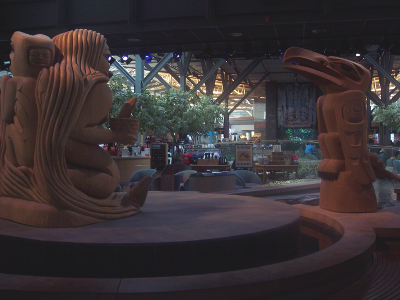
YVR, Vancouver’s airport, is noted for its collection of local First Nations art. I’ve wanted a tour for over a year, but they aren’t always easy to come by, since they involve weaving in and out of security areas. However, today my chance came at last. Together with Ann Cameron, the editor of Coastal Art Beat and my colleague on the YVR Art Foundation board, we followed Rita Beiks, the airport’s art consultant, back and forth through the terminal until I was throughly lost, but marveling at the airport’s collection.

We met at the foot of Don Yeoman’s “Celebrating Flight,” a four-story pole that mixes Haida mythology with Celtic knotwork and a greeting in Chinese. The knotwork and Chineese characters, Rita said, replaced the originally planned figures because of some knots in the wood that made the figures impossible. By itself, the pole is impossible to photograph without a crane and bucket, but when you realize (as I had not) that everything from the panels representing the northern lights at the top to the mosaic on the floor and the moon some distance away are all part of the installation, then taking a complete picture becomes even more impossible.

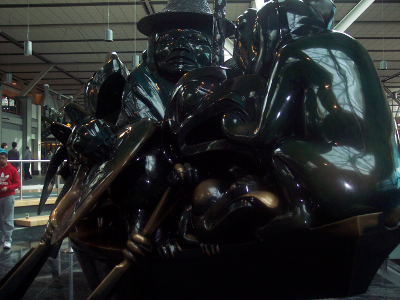
From the pole, we walked to the terminal’s best-known installation: Bill Reid’s “Jade Canoe,” version of “The Spirit of Haida Gwaii.” The “Jade Canoe” is a copy of the “Black Canoe” at the Canadian embassy in Washington, D.C. However, while the “Black Canoe” is barely visible for security reasons, the “Jade Canoe” is so accessible that people have rubbed the bronze patina off the paddles and some of the other reachable parts of the sculpture. A sign telling people not to climb the sculpture is necessary, and the tradition has grown up that rubbing Mouse Woman’s nose is good luck.

Rita gave a brief history of the negotiations for the piece, which cost three million – an unheard of figure for an airport to spend on art in the early 1990s, and mentioned that the piece was orginally intended to have a copper patina, and changed to bronze only after a phone call from airport official Frank O’Neil to Reid, who at the time was in intensive care. She also pointed out that Lutz Haufschild’s “The Great Wave Wall,” which replaces the nearby windows on the terminal, was chosen as a suitable backdrop to Reid’s iconic piece.

Leaning over the railing, we looked down at the arrival level to Nu-chu-nualth artist Joe David’s “Clayoquot Welcome Figures.” Originally carved for Expo 67, the figures are on permanent loan from the Vancouver museum. Their popularity is so great that they needed a railing to protect them; even so, money is still regularly found in their hands.

We then moved into the secure area for departure and arrivals. Strangely enough, Rita and Brenda Longland, the airport official with us, both had to submit to the usual inspection of their belongings, while Ann and I sailed through without any problems with our visitors’ badges.
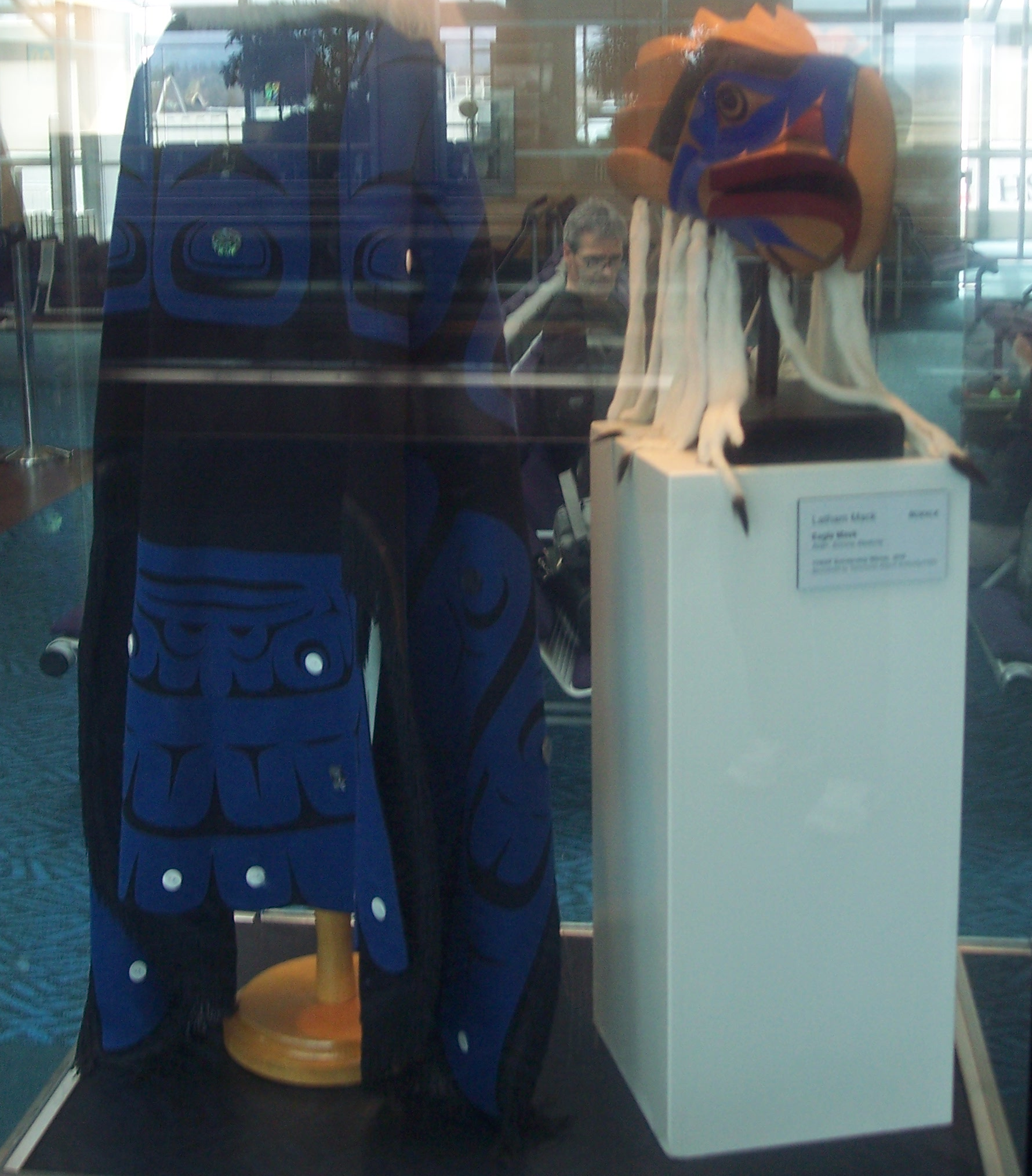
We passed display cases with the works of YVRAF scholarship winners from 2010, including Latham Mack’s Nuxalk mask and robe, and Todd Stephen’s drum. Like the other scholarship pieces scattered throughout the terminal, these pieces will be on display until June 2012, when they will be replaced by the work of the 2011 scholarship winners.

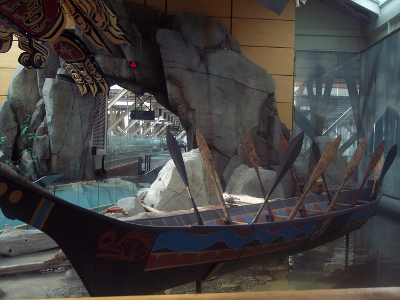
The next permanent display was the Pacific Passage in the arrivals area, a combination of diorama and original art.

I had seen the Pacific Passage several times, but always after a long flight that left me rushing to the fresh air, and uninclined to give the art treasures on display more than a passing glance.
That was a mistake on my part, because the display is well worth lingering over. It is dominated by Connie Watt’s thunderbird.

Also in the area is an aluminium panel by Lyle Wilson and a canoe by Tim Paul, as well a number of smaller pieces. Bird sounds start as soon as you enter the area, and I was amused to see the swallows who live in the terminal sheltering in the empty eagle’s nest that was added to the dioramas for realism.

Walking down the overhead walkways, we stopped next at the Musqueam Welcome area, the contribution of the First Nations people on whose territory the airport stands. According to Rita, Frank O’Neill, the airport official responsible for the idea of the First Nations collection, was convinced of the need for the area when the Musqueam chief told him that not having the local nation included there would be like having a sign in Ireland saying, “Welcome to the United Kingdom.”

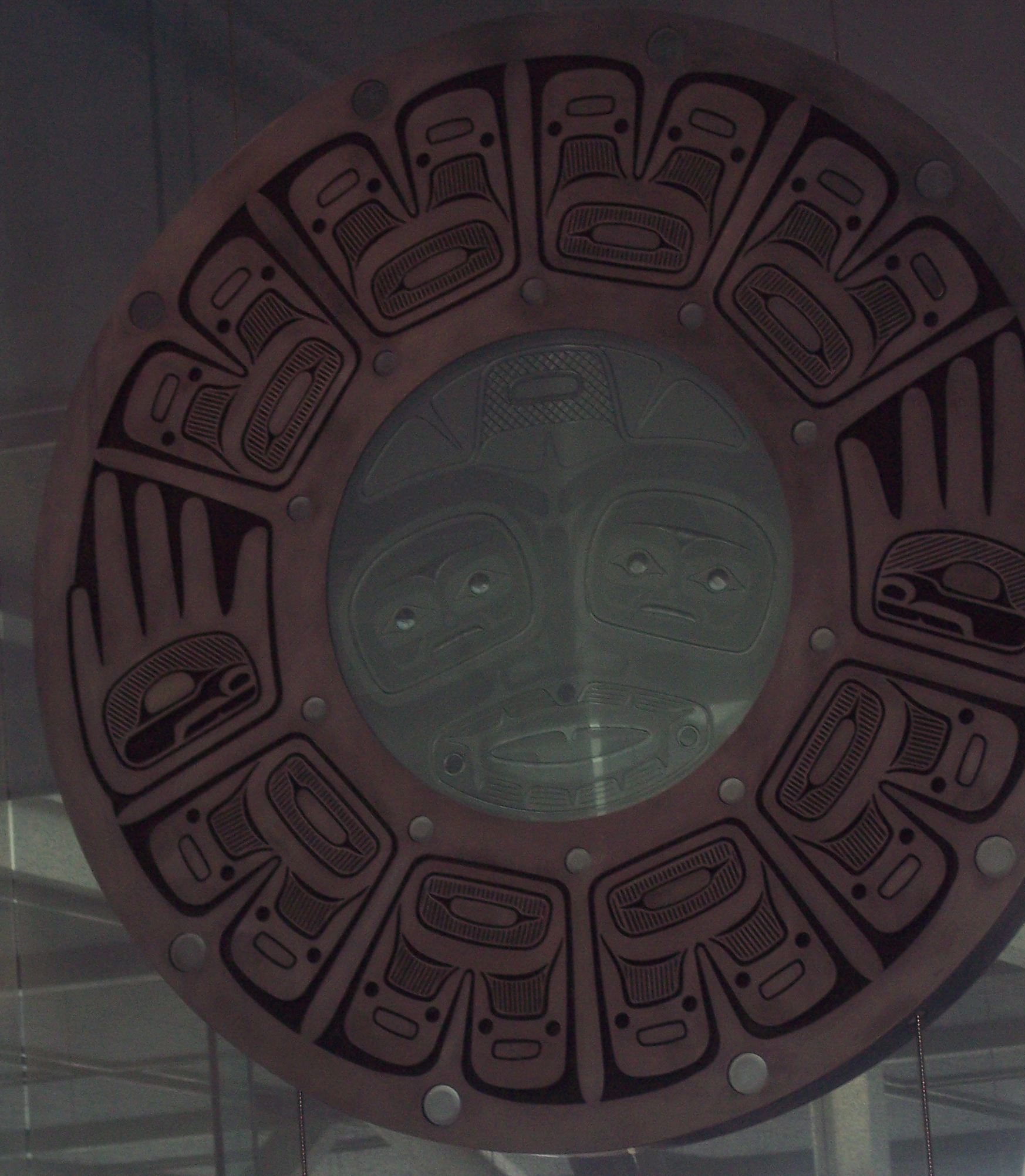
Accordingly, arrivals are greeted first by the Musqueam, and then by Canada. One of the first sites arrivals see is Susan Point’s giant spindle whorl set against a waterfall – an impressive site even if you have been flying all night (although the palms to each side are incongruous; can’t native plants be used instead?).

Turning to the stairs and escalators that lead down to the custom booths, the first thing arrivals see are free-hanging samples of Musqueam weaving.

Moving to the steps and escalators, below them arrivals see the Musqueam welcome figures. These were originally carved by Shane Point, but when Musqueam women complained about the sagging breasts on the female figure, it was replaced by the less controversial figure by Susan Point that stands there today.

Only as you descend do you appreciate the sheer size of the figures; by the time you are on the same level, you realize that they are enormous.

Our next stop was the artificial river that begins with an installation by Tahltan master carver Dempsey Bob, and winds down to an oceanic aquarium dominated by another piece by Haisla master Lyle Wilson.

Bob’s piece is “Fog Woman and Raven.” It is based on the tale of how Fog Woman, mistreated by her husband Raven, gathers up all the salmon from the streams and smoke houses, and prepares to depart the world with them. A little stiffer than many of Bob’s works, it is still a piece worth lingering over because of the details like the salmon caught in Fog Woman’s hair.

The figures are carved from laminated blocks of cedar – an expensive process that is rarely done because it involves shutting down a mill for the better part of a day. In fact, the first laminted block for Fog Woman was found to be punky inside, and had to be abandoned.

Bob’s tableau is surrounded by chairs, and would be a pleasant piece to linger beside, but, unfortunately no food vendors are nearby, so nobody does. Annoyingly, too, small merchandise displays are crowding the piece (we asked a cashier to move an obscuring sign, but it was back when we passed by again half an hour later)

At the far end of the river, Lyle Wilson’s “Orca Chief and the Kelp Forest” rest on top of an aquarium of fish, so that the chief lies half hidden in the kelp made from glass and looks down at the subjects whom he protects. Rita says that few people look up, and reactions to Wilson’s piece proves her point, since most people looked at the fish moving back and forth, but few ever glanced up to see the art above them.

Our last major stops on the tour were two pieces by Steve Smith. The first, “Freedom to Move,” is a series of painted panels that are intended to slow people down in their hurry through the airport.

Unfortunately, the piece is squeezed into a space too small for it, and the pool that is supposed to surround it is dry, but Smith still managed to slow me down for an appreciative moment or two.

The second of Smith’s installations, “Sea to Sky,” named for the highway to Squamish and Whistler, is a series of drums hung beneath a sky light. What we saw was the second version of the piece, parts of the first having been damage by temperature problems, crumbling with a sound like artillery one winter day (fortunately without anyone being hurt. Smith took advantage of the incident to paint bolder designs, and sold what remained of the first version.

These are only some of the collection we saw today. There were also a number of pieces by Roy Henry Vickers that were originally part of a longhouse that has since been destroyed. The longhouse’s pillars and several other designs are now temporarily scattered throughout the airport, most of them unlabeled.

Display cases throughout the terminal also carried such treasures as Hazel Wilson’s famous “Golden Spruce” blanket, which commemorates the recent felling of a particular tree famous in Haida mythology, Tim Paul’s “ClearCut and Dressed,” and some outstanding non-native work by local artists such as Graham Smith. However, enumerating the entire collection would require a blog five times as long as this one.

For lack of time, we also didn’t get to the “Supernatural World” installation by Dempsey Bob, Robert Davidson, and Richard Hunt on the domestic arrivals level. And the only reason Susan Point’s “Cedar Connection” was included in the tour was that we passed it on the way to the Skytrain and the parking lot as we left.

Still, I didn’t feel cheated by any omissions. After four and a half hours, my brain was as numb as my kneecaps. I had taken in as much art as I could appreciate for the day, and rode the Skytrain home, full of the dazed content that comes from prolonged exposure to fine art.

Read Full Post »

If you’ve spent any time in feminist circles, you may have heard of the Bechdel Test. It’s a simple set of criteria whose application reveals the lack of attention given to women in movies and TV shows. However, there are problems with it – especially when it’s used as a reason to like or dislike drama.

The Bechdel Test originated in a 1985 episode of Alison Bechdel’s Dykes to Watch Out For comic strip called “The Rule.” In the strip, one character tells another that she only watches a movies if:
a.) It has two women in it;
b.) Who talk to each other
c.) About something besides a man

The character adds that the last movie she was able to see was Alien, where “the two women in it talk to each other about the monster.”

As a comment about how much women and their concerns are ignored in popular culture, The Bechdel Test is apt. The three criteria set a very low standard, which makes the fact that so many movies and TV shows can’t meet them a pithy comment on modern drama.

However, as the comment about Alien might be meant to suggest, a movie can pass the Bechdel Test and still not be much concerned with women’s daily lives – let alone qualify as feminist.

The reverse might also be true. A romantic comedy like When Harry Met Sally or The Princess Bride would probably fail the Bechdel Test (I haven’t checked). Yet considering that such movies are all about relationships between the sexes, it seems overly strict to insist that any conversations between two women in them shouldn’t be about a man. What else do people in love talk about except those who attract them? Similarly, unless the setting is modern, can you reasonably expect a war movie to have two women in it?

In practice, too, the Bechdel Test’s third criterion – the subject of the women’s conversation – is not always so easy to apply.

For example, in the half dozen episodes of The Good Wife that I have watched so far, the lead character and the investigator at the law firm she works at regularly talk about their cases, which would seem at first to means that the series passes the test.

Yet in several of those talks, the investigator refers to the sex scandal that sent the lead character’s husband to jail in the first three minutes of the pilot episode. Are those references enough to make the series or a particular episode fail? Moreover, if you argue that overall tendency is what matters, then everything in the series is framed by the title, which implies that every second of every show is about the lead character’s relationship with her husband.

Still another limitation of the Bechdel Test is that it mostly ignores context. A frequent modification of the Test is that the women characters should be named, but that is only one small part of the problem. What is the bias in the actual words? Is the conversation filmed for the male gaze? Even more importantly, is the conversation central to the main plot? The ways that the women’s conversation can be trivialized are almost endless. Yet the Bechdel Test takes nothing into account except checking off three highly generalized points.

I understand and sympathize with the point the Bechdel Test tries to make. But even by its own concerns, it is lacking. Besides, in the end, the idea of checking off criteria to make a judgment on a piece of art leaves me cold – and, the more I think of what is happening, the more appalled I become. The Bechdel Test simply doesn’t deserve the attention it’s been given by feminists. But, to be fair, perhaps it was never meant to.

Read Full Post »

« Newer Posts - Older Posts »