Feeds:
Posts
Comments

Archive for the ‘Personal’ Category

The Bill Reid Gallery kicked off a series of talks about artists from its Continuum exhibit with a slide show by Michael Dangeli, a Nisga’a artist who has started to receive recognition in the last few years. The choice was lucky or inspired, because Dangeli is more articulate about his work than most artists, and has clearly thought carefully about what he is doing.

The Continuum show is supposed to be about the conflict between traditional and contemporary influences in Northwest Coast art. And, in fact, Dangeli was introduced in terms of this conflict. However, he immediately made clear that he rejects such a dichotomy in his own work. Calling his work “traditionally contemporary,” Dangeli made clear that he considers his work a continuity of the past, both an attempt to reclaim it and to expand and to adopt it.

One reason why Dangeli is comfortable with the paradox of living with opposites is that he sees the rest of his life in such terms. Nisga’a by birth, he has lived in the United States and Vancouver, far from his nation’s territory. Deeply interested in his cultural past, he is also aware that he is a modern urbanite in his day to day life. Spiritually inclined, he is also a veteran of two tours of duty abroad in the American military. With such tensions, those between the traditional and contemporary must seem like just one more.

Another reason that Dangeli can have the attitudes he does is probably the fact that he is actively involved in the cultural revival of his people – something that seems especially unusual for an urbanite. During his discussion, Dangeli talked of pieces of art being given as payment for services, and at potlatches, as well as important events such as a betrothal. He talked, too, of being groomed to take over a chieftainship, and of his hesitation about taking on an even larger chieftainship recently. He talked about his dancing, and of acquiring songs and dances and inventing new ones, and of exploring the distinctions between male and female powers and responsibility with his finacee.

Unlike many First Nations artists, Dangeli seems either fortunate enough or determined enough to have lived with a sense of tradition from an early age. Consequently, it is easier for him than many artists to see a continuity rather than an opposition.

This continuity seems to affect his art very strongly. He talked of preferring that his gallery pieces not have eyes that would make them danceable, and of his relief when he managed to buy back an early exception to this preference. He talked, too, of making one of the first stone masks for well over a century, and having it danced.

But the strongest evidence of his artistic continuity came at the end of his talked, when he uncovered three pieces of his work that are reserved for ceremonial purposes: The mask he bought back and modified with a pieced of Ainu cloth; the stone mask, and a frontlet worn by his fiancee. He explained that he generally kept them covered, and treated them as living spirits, requesting that people look them over a few at a time so as not to overwhelm them. It was unclear to me whether any power in the objects was innate or resided in the respect shown to them, but his attitude was curiously moving.

Even if you didn’t share his cultural background or beliefs, they were obviously alive for him – either never having died or after being carefully revived, or some combination of the two. Clearly, he had fought hard to make them meaningful to himself and those around him, and I believe that he has largely succeeded. At the very least, he demonstrated to the audience that his cultures were still ongoing and hadn’t stopped developing with the European conquest.

All this says nothing directly about his work, which ranges from the traditional to the modern, with a variety of color palettes and a frequent emphasis on collaborations with other artists – or “brothers,” as he called them.

I have liked what I’ve seen of Dangeli’s work in the past, and, by the time he had finished talking, I had a much clearer sense of why, and an increased interest in what he might do in the future. And, really, what more can you ask of an artist’s talk? With several dozen slides and intelligent commentary, Dangeli sets a high standard for the next speakers in the series to match.

Read Full Post »

Haida art occupies a privileged place in Northwest Coast art. Because the revival of the art is associated closely with Bill Reid, who began with the Haida tradition, to many people, all Northwest Coast art is Haida, and Tsimshian, Nisga’a, Kwaguilth, Nu-chu-nualth, Salish and the others are not even names. Still, no one can deny that the Haida include many brilliant artists in every medium, so last night I went to the opening of Coastal People’s show, “Haida Masterworks” expecting to enjoy myself. Nor was I disappointed.

In fact, the show exceeded my expectations. Since it had been only lightly advertised, I expected a small show. Instead, what I saw was a showcase of leading Haida artists, with works ranging from the classic to the contemporary.

Several leading Haida artists featured prominently. Master carver Don Yeomans was represented by several circular panels and a mask well over a meter high –examples of what I think of as corporate art, since you need a large lobby, or at least an extremely long room with a high ceiling to display it in a setting that does it justice.

don-yeomans

April White, who paints in styles varying from traditional Haida designs on cedar bark to contemporary landscapes:

april-white

Also prominently displayed was the better part of two years work by Reg Davidson, who is probably the leading carver of masks that can be used for dances and ceremonies. This emphasis gives his masks a simplicity of line and color that is rarely seen, as well as a unique dramatic quality. I am sure, for instance, that the large eye-sockets that characterize his masks increase their theatrical effect when seen in the firelight of a night-time ceremony.

reg-davidson

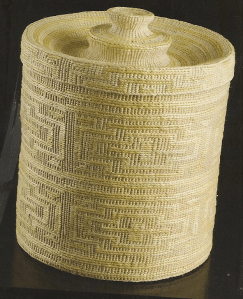
Yet another master artist who is well-represented is Isabel Rorick, a weaver who works largely with spruce roots and natural designs in traditional patterns collected from up and down the coast. I admit that I know little of basket weaving, and ordinarily think less of it. Yet even I could see that Rorick’s work was intricate and uniform. Despite the muted colors, the designs are clearly visible from ten meters away, and, up close, the evenness of her work make clear that she must spend hours upon hours in her craft.

isobel-rorick

Among such works by well-known artists, I almost missed some wood-carvings by newer artists. However, on my second or third round of the gallery, I took time to appreciate some panels by Kyran Yeoman, Don Yeoman’s son, and a mask by Robin Rorick. Also on display was one of the first masks I’ve seen by goldsmith Jesse Brillon.

Contemplating these works was a pleasant way to spend an evening. However, for me, the highlights of the show were the jewelry and small sculptures in the display cases. Jesse Brillon and Gwaai Edenshaw – so far as I’m concerned, the leading goldsmiths in Northwest Coast art – were unfortunately represented by only one work apiece, although both were standouts:

edenshaw-brillion

However, small displays of works by Derek White, Rick Adkins, and Gerry Marks were more than compensation.

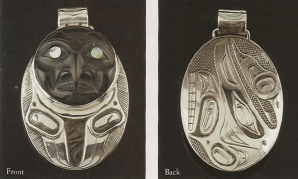
I also took the time to appreciate the two-sided silver and argillite pendants by young artist Ernest Swanson. I had not given much attention to his work before the show, but I plan to correct that mistake in the future because of the fineness of detail in his engraving.

ernest-swanson

But for me, the highlight of the show was the work in argillite by cousins Christian and Darrell White. Christian White, of course, is one of the most-skilled argillite carvers working today, and pieces like “Raven’s Children and “Eagle and Salmon” are typical of the strong lines and sense of restraint that I associate with his work.

christian-white

By contrast, Darrell White has only been working seven years to his cousin’s three or four decades, but he is rapidly perfecting his work. His style is less serene than Christian’s White, reminding me a little of Ron Telek’s, and having the same attention to detail. Pieces like “Thunderbird Captures Killerwhale” and “Raven Dancer” (below) show an originality of design that leave me looking forward to what he will do next.

darrell-white

As usual at such events, appreciating the art was repeatedly sidetracked by the interesting conversations flowing around the gallery. Although I had only expected to stay an hour or so, I suddenly found that three hours had passed and I still hadn’t looked as closely as some works as I had wanted. But that just gives me an excuse to return, so I’m not complaining.

Read Full Post »

Yesterday, I went to the Third Tuesday Vancouver meeting to hear Shel Israel talk about his new book, Twitterville. I have a love-hate relationship with technology pundits constructed equally of envy, scorn, and (since I have been occasionally been called one in my own small field of free and open source software) fellow-feeling, so it was the presentation that interested me, not the hope of any revelations about Twitter. And, sure enough, what I learned was not about Twitter, but about story telling.

I probably wouldn’t have learned the lesson if Israel hadn’t described himself as a non-fiction story teller near the start of his presentation. This offhand remark, so peripheral to the actual topic of the presentation, ended up framing my reactions to Israel remarks.

Israel is an enthusiastic story teller, and he collects stories about the subjects he was researching as though he was a folklorist, or a geeky Studs Terkel. He also has a knack for apt phrases, such as “lethal generosity” (generosity that forces rivals to respond in kind or lose) and “braided journalism” (reporting through a variety of sources) that help to make his stories memorable.

However, as I listened, two things started to irk me about his presentation.

First, his stories seemed to entirely about people winning – that is, accomplishing something through their use of Twitter. This tendency bothered me for two conflicting reasons. On one level, it bothered me because part of the structure of non-fiction narrative is usually an attempt to look at both sides of an issue. To hear Israel, Twitter is an unalloyed good, with no negative effects whatsoever. In fact, Israel appears to have not even looked into situations where Twitter proved limiting or handicapped someone. As a result, his narrative seems not so much non-fiction as mere ad copy – and, as such, contrary to the genuineness that social media participants need if they are going to be accepted by their communities.

On another level, the emphasis on winning seemed to lack morality. Israel did not talk about whether people did good with Twitter, and when someone asked a question that tended in such a direction, he evaded answering. This emphasis got up my nostrils (to use a wonderful phrase I first heard from folksinger Eric Bogle) because it seems to be that all kinds of narratives are essentially about morality. Except in poorly constructed narratives, the morality is not an subtle confrontation of good versus evil. At times, it may be ambiguous. But a sense of which side is right – or at least deserves our sympathies the most – seems embedded in the whole concept of narrative. When such a perspective is missing, the way it was in Israel’s talk, it is like stepping on a stair that isn’t there, jolting me and making me uneasy.

Second, Israel consistently resisted drawing any conclusions from his narratives. I suspect that he would argue that making generalities was not his job, that his role was to report as accurately as possible. And I agree that outright editorializing would have been out of place in his talk. However, I believe that part of reporting is to make implications and relationships clear. Without such efforts to see the pattern, Israel’s presentation struck me as directionless. The effect would have been much the same in a piece of fiction that excluded plot.

I suspect that what I am saying has less to do with general tendencies in storyteller than with what I look for as a member of the audience, or with how I try to tell my own non-fiction stories. Still, in an unexpected way, I am grateful to Israel for having provided the starting point for me to figure out these things – even though what I took away from the evening was almost certainly not what he would have wanted me to take away.

Read Full Post »

When did I stop writing with a pen? To my chagrin, I realize that I am unable to tell more closely than the nearest five years. But I wonder what the transition to the keyboard has done to my writing.

These days, I compose almost everything at the keyboard. The exceptions are paragraphs that arrive ready-formed in the middle of the night, or when I’m away from home – and even the away-from-home fragments might soon be written with a keyboard if I get the netbook I’ve been eyeing.

I didn’t used to be that way. I learned to touch-type when I was in high school (and a more boring class I never took), but for years I was convinced that I need to write everything in order to do my best work. So far as I was concerned, typewriters, then computer keyboards were only for the final draft.

I even had a theory about why writing everything by hand was necessary. The movements of my fingers and hands, I speculated, were closely connected to the rhythms of my brain. On a keyboard, I couldn’t get into that rhythm. And I had to write, too, not print, because the connections between the letters helped to keep my thoughts logically connected, too. These things were so important that I had to write out a final draft as neatly as possibly, with a minimum of cross outs so that I knew that my thoughts were well-formed.

By contrast, typing into a computer requires discrete movements of the fingers, rather than actions of the entire hand. The letters were disconnected, so I could get no sense of the rhythm of my thoughts. Moreover, the words on screen looked so authoritative that I was less likely to criticize them. I was sure I could never get the same rhythm or precision on a computer as with a pen.

But as I switched from being a university instructor to a technical writer, the amount of writing I had to do increased by five or six times. Often, too, I had no room for both a keyboard and writing paper at my work station. So, by default, the keyboard began to win out.

Even so, I resisted. When I had to figure out a procedure, I generally roughed it out on paper first. I also planned the structure of documents – or at least their main points – on paper. Nor have I ever entirely abandoned such habits. Whenever I am having problem with structure, I am still apt to outline on paper before writing.

But, increasingly, I had less time to write everything longhand and then type it into the computer. I believe I wrote most of my Maximum Linux columns long hand in 2000-01. And some technical writing like the manual for Progeny Debian was written entirely on the computer at the same time that I was writing press releases longhand. But, by 2005, when I returned to journalism, I was relying on the keyboard and reconciled to it.

Yet exactly when in that period I made the switch is impossible to say. By the time I made it, the switch did not seem so major.
Even so, my half-developed ideas about the advantages of writing by hand do not seem completely wrong, even now (although, these days, I wonder if what I was following was not the rhythm of my thoughts but unconscious sub-vocalizing). I had to learn the rhythm of typing in a way that I never had to learn the rhythm of writing; I grew up with writing, and came to typing later in life. For a while, I actually felt tone-deaf when typing because I hadn’t developed an ear for its rhythms.

There are other differences, too. When writing by hand, I seem more precise. Even now, I have a larger vocabulary than when I type, and more precision in word-choice and in the development of ideas. I am conciser, too – I long ago learned that, as fond as I am of conjunctions, one of the first tasks when I edit something I typed is to breakup the compound sentences.

Analyzing the difference, I have to say that I have a much different style when I type compared to when I write – and that, probably, it is an inferior one. That conviction is why I always prefer to print out a finished piece of writing so I can be more critical of it than I can usually be while staring at the perfectly formed letters on the screen (although, in the last couple of years, my on-line editing has improved immensely, probably through sheer practice).

But against these disadvantages, I can say that, for some reason, I am more able to envision the entire structure of long pieces when I am at a keyboard. Perhaps that’s because the discrete movement of fingers is (if you pardon the pun) more digital and therefore encourages analysis.

Just as importantly, the rhythm of typing is always urging me onwards. That makes first drafts easier to do, and increases my overall work speed. If I need to be sure that I go back through a keyboard-written article and eliminate phrases that fit the rhythm more than the sense, at least I get that all-important first draft done easily, so I have something to respond to. By contrast, when I use a pen, I become too exacting, which is probably one reason I wrote very little by hand compared to by keyboard.

Having written occasional bits of poetry, where precision counts, I find that I regret moving away from writing everything by hand. But as a full-time hack, I count myself lucky for having discovered how much easier completing a work is when I use a keyboard. In fact, if not for keyboards, I probably never could have become a professional writer of any sort. If I have lost something by rarely writing by hand (and I think I have), I have also gained much more – nothing less than increased competence and fluidity.

Under these circumstances, it is hard to be nostalgic about writing by hand. Unless (as happened a few months ago) a power outage obliges me to fall back on handwriting so that I can make a deadline, I don’t expect that I will be returning very often to the pen again. I no longer need to.

Read Full Post »

Our washing machine started leaking this week, like a puppy relieving itself in a corner, so we’ve been spending our spare time looking for a new washer/dryer combo. It’s a good thing that appliances last over a decade, because it will take at least that long to ease the horror from my mind. Part of the problem is that we have very precise space constraints, but most of the problem is the way that appliances are sold.

Most of the time when I’m looking for hardware, it’s a computer or a computer peripheral. Because the competition is so fierce for computer hardware, manufacturers and vendors document everything about what they’re selling on their websites. Speed, physical dimensions – you name the spec, and you can find it on every site. Consequently, you can spend a hour or two in front of your computer and arrive at the store armed with an exact idea of what you want, and get out fast.

By contrast, household appliances aren’t sold that way. For several local appliance vendors, having a web site is simply a means of announcing their existence. In one case, their site is a single page. In another, you can can learn what brands they carry, but not which models or what the prices might be, because most of their site is simply links to manufacturers. Another one doesn’t bother to give dimensions. None of them update their site with any regularity.

Consequently, if you are trying to be a conscientious consumer and shop around, you have to do a lot of old-fashioned legwork. I’m no stranger to exercise, so ordinarily I wouldn’t mind, except that the trudging around was in the service of a necessity that doesn’t interest me in the slightest. Frankly, reading washing machine stats and peering inside their drums is so mind-numbingly boring that a mentally sub-normal yak would be bored by it. Personally, boredom set in after the second or third examination – and we’ve looked at dozens in the last few days.

Then, just to make matters worse, the sellers of appliances seem strangely reluctant to take your money. Our first stop had only a couple of models on the floor. We could ask about other models, we were told, but how would we know about them if we didn’t see them? We would have to jot down the brands the store sold, then go home and do research.

Our next stop was the Sears store in Metrotown, a complex that has long had my vote for the most hideous shopping complex in the whole of Greater Vancouver. I can’t confirm that minotaurs roam its corridors freely, but if I hear any bull-like rumblings as I pass the service hallways, I’m not investigating.

But the Sears store has its own special horror, because its staff is apparently competing with each other for the fewest times they have to talk to a customer. You can see the staff scuttling low down the aisles a few over, but, by the time you learn how to get one’s attention, you would have the experience to track big game anywhere in the world. About the only thing you can say for this attitude is that it is marginally better than having the clerks dance attendance on you with unrequested information.

At Future Shop, the pricse were good, but each time we were ready to buy, we were told that the warehouse was currently out of stock and was likely to remain so for the next couple of weeks. I strongly suspect (although I cannot prove) that this was a variation on bait and switch. To be fair, we did receive a phone call saying that one of our choices was available, but, by then we had already bought.

The next stop was Home Depot. I realize that the company has built its business on do-it-yourselfers, but the staff didn’t seem to understand that plumbing is a bit beyond the average home owner. The company didn’t even a list of suggested contractors that customers might hire to get their new appliances connected. Nor did the staff see anything ridiculous in the attitude.

Finally, with madness nibbling at our brains like a glimpse of Cthulhu and the Elder Gods, we stumbled into Trail Appliances in Coquitlam. There, we were left to browse for a few minutes before an employee approached us. He was helpful, even giving us some advice we probably wouldn’t have thought of. And, wonder of wonders, the floor model that was our first choice was actually available. Within minutes, we were paying and arranging delivery.

What the other companies didn’t seem to understand was that washers and dryers are not the most glamorous of appliances. While some conscientious but anal souls might conscientiously remember to have them serviced every year, I suspect that many people are like us, and don’t think of them until they need servicing or replacement.

The result is that, when people go shopping for washers and dryers, they are usually in urgent need of a replacement. They can’t afford to spin out the process, because, if they do, they will have to find a laundromat or an obliging neighbor who will let them have the use of the machine.

What Trail Appliances offered was simply efficient service. The result? We’ve decided to replace our fridge at the same time, since it is running on borrowed time, and we’ll do so by returning to Trail again. Trail’s website is no better than any of the others – in fact it is one of the worst ones – but at least its staff understands how to treat customers. So, naturally enough, it gets our other business, too.

Read Full Post »

With Labour Day approaching, I’m coming to the end of my daily swims. At some point in the next three weeks, the strata council of my townhouse complex will decide to close the pool. The gate will be locked, my daily swims will be over until next May. Meanwhile because the council never announces precisely when the pool will close, I arrive each day wondering if I will see the notice of closure and feeling a sense of impending loss.

Part of my sense of loss is simply the wish for selfish convenience. When exercise is less than two minutes from my door, I have few excuses for missing it. Even if I arrive home exhausted, I have a hard time convincing myself that I can’t stagger out and do a few laps. And, once I’ve done a few laps, I’m usually in a rhythm that makes finishing my daily quota easy.
Another part, equally selfish, is my wish for variety. For eight months, I’ll only have running, walking, and the exercise bike for aerobic workouts. Having a fourth choice for a third of the years is always welcome, and swimming is the best of my usual choices for recovering from leg or foot injuries.

However, the major reason for my sense of impending loss is that I feel that I am just getting used to the laps. I am not an especially graceful man; my exercise is usually proof of dogged determination than any real ability. But after a few months of regular swims, I feel a certain power and grace creeping into my swimming. I know the rhythm of my swim, and the distance a single stroke of the arms and legs will send me. What, I wonder, would I be like if I had another month or two? I have a sense of an enhanced state of fitness and consciousness that is beyond my reach, yet one that I am inching inexorably towards.

Of course, I could see if this sense is an illusion by going to a public pool. There are four within ten miles of me, including one that is ten minutes’ walk away. Yet none are free, and none are as convenient as the pool just beyond my door step.

Moreover, the one within walking distance is part of a basement complex that is half dark and full of joyless exercisers. Going there would would be a constant struggle against the physical and emotional gloom of the place. So, the likelihood is that I won’t go to any of them regularly.

Meanwhile, my pleasure in the exercise is tinged with a sense of its impermanence. Each time I finish could easily be my last until next spring.

Read Full Post »

What skills do English graduates bring to the job market? More than you might think – and far more than all the jokes about their unemployability would have you believe. In fact, many of the skills developed by English markets while reading novels and poems make them ideal for senior positions.

To start with, English majors may be comfortable with reading. I don’t mean simply that they can read; I mean that they can read with some ease. Many read as instinctively as they hear. It has become a reflex in them to read whatever words are put in front of them.

Moreover, because they are comfortable with reading and have practiced it, they can read more quickly than most people.

These may seem like minor skills, but when you consider the number of reports, emails, memos, and other documents that the average manager has to plow through every week, they mean increased efficiency; I’ve known at least one politician who found that the worst parts of being an elected official was reading the weekly paper work.

Even more importantly, English majors may have learned not only to be comfortable with reading, but to have gained some skill in it.

If you look at the comments beneath almost any article published online, one of the first things that will probably strike you is how few people can read a comment in context. More often, people take things out of context, and come up with the most fantastical over-simplifications, exaggerations, and misreadings.

Nor, naturally enough, can the average person summarize accurately. In fact, most of the critical skills that English majors learn when producing essays are beyond the average person. After all, you can hardly analyze or compare accurately when you haven’t read accurately. These skills are especially important if you need to keep abreast of legal matters, but they matter almost as much when you are writing marketing copy, producing a white paper on technology, or writing a business plan or competitive analysis.

Finally, like most Art students, whose grading is based largely on essays, English majors have probably learned to research – to find sources, absorb them quickly, and evaluate them both on their own and in comparison to other sources. In other words, they have learned to process information, and reach conclusions that are logically based upon that information. This ability is continually useful in daily business, and, on the Internet it can be invaluable. After all, what is the Internet, if not a giant library waiting for an expert to use it?

Of course, not every English graduate possesses these skills. Because the subject matter of English Departments is subjective, students can coast through them more easily than they can in other Departments. Even in English graduate school, you can find students who don’t read unless they have to, and whose essays have more to do with striking a pose than actual analysis.

But, having been a product manager and a director of communications, I can’t begin to tell you how often I’ve looked down at the task that I’m doing and realized that what I learned taking an English degree has helped me breeze through it.

Contrary to the conventional wisdom, English major do graduate with employable skills – in fact, ones that will help them if they ever become managers or team leaders among the creatives. The only problem is, they don’t realize everything they’ve learned, so they don’t express it.

Read Full Post »

For the past seven weeks, I’ve been using a USB turntable to digitalize our old vinyl records. So far, I’ve done 41 LPs, with about another sixty to go. We haven’t played the LPs for at least fifteen years, so the process is a rediscovery for me – and proof yet again of how, when the dominant recording medium changes, some things are left behind.

Looking through the list of albums on the music player (a Sansa clip, which, incidentally, is much better buy than an equivalent iPod), I’m fascinated at the glimpse of my past. When I started, I wondered whether my tastes would have changed, and whether I would find some of the music that (to paraphrase Frank Zappa) was the aural wallpaper of my youth would now seem callow or outdated.

But, to my relief and considerable satisfaction, the fear was largely unfounded. While songs that call for the freedom of Nelson Mandela, or refer to Solidarity in Poland obvious refer to specific time periods, on the whole the musical choices of my youth manage not to embarrass me, although I do think that my taste has broadened and expanded since I listened to this music regularly.

Part of the secret of its longevity is that intelligent lyrics tend to weather the years better than trendy musical styles. But the main reason, I think, was that when I was a young man, the folk music that formed the bulk of my listening was in the middle of a renaissance full of passion and the fusion of traditional and contemporary that produced innovative and exciting music.

In fact, far from being embarrassed, I wonder how I could ever have stopped listening to some of these albums. For instance, my music player is currently loaded with the last studio album by the Scottish super group Silly Wizard, Michelle Shocked’s “If love was a train” EP, two albums of klezmer music by Klezmorim, an album by Breton harp genius Alan Stivell, another by the Scottish harp duo Sileas, another by the Quebecois group Barde, Malcolm’s Interview’s great punk folk album “Breakfast in Bedlam,” early works by OysterBand, Pete Morton, live albums by the Corries and Steeleye Span – I could go on and on, but I think I already have. Treasures, all of them, although some are considered modern classics and others are entirely forgot.

But by sheer number, my greatest rediscovery has to be Leon Rosselson, a sort of farther-left version of Tom Lehrer, and his sometime fellow traveler Roy Bailey. Eleven of their albums, seven of them made together, are now on my music player, and I can still see why. Bailey, a gay leftist with a strong sense of activism and tradition has one of the great voices of British music, and his covers of songs like “The Hard Times of Old English” or “If They Come in the Morning” resonate in my memory with the least encouragement.

However, if anything, I appreciate Leon Rosselson’s savage wit even more (if that is possible). Even now, I can’t resist Rosselson in the persona of a British tabloid journalist who prides himself on decency and moderation, working himself up into a satirical frenzy ending with:
What we say is hang the muggers,
Deport the blacks, castrate the buggers,
Press the button, drop the bomb on
Peace campers at Greenham Common.

Similarly, after looking in the first person at the various people who would be involved in the decision to use nuclear weapons passing the buck, Rosselson concludes: “So if the end to all creation is global suicide / There’ll be no one who is responsible, ‘cuz no one will decide.” Or look at his parody of the British Labour Party’s song, written in the Sixties, but still appropriate today:
We will not cease from mental strife till every wrong is righted,
And all men are equal quite, and all our leaders knighted;
We are sure if we persist, to make the New Years’ Honours List,
Then every loyal Labour Peer will sing “The Red Flag” once a year.

But I think I like best “The World Turned Upside Down,” his history of the Diggers of the English Revolution and their declaration of freedom:
We work, we eat together, we need no swords
We will not bow to the masters or pay rent to the lords,
Still we are free, though we are poor,
You Diggers all stand up for glory, stand up now.

I remember the time when that song was an anthem for me, and, hearing it again in the original after enjoying covers by Billy Bragg and the Oysterband, I find that it becomes so again.

I know, I know. You haven’t heard of half these names, and most of the other half are mostly obscure to you. But that is my whole point. Just because something is old doesn’t make it worthless and justifiably discarded. Sometimes, things that are old are classics, or deserve to be.

Read Full Post »

When I wandered into the Alcheringa Gallery in Victoria on a day off, I really wasn’t planning to buy another piece of art. My official excuse was to see the gallery’s “More Than Meets the Eye” show, which included a recent piece by John Wilson, and a twenty-five year old piece by Ron Telek. But when I saw an artist’s proof of Wayne Young’s “Wolf Clan,” a purchase was more or less inevitable.

For one thing, Wayne Young is an artist on my short list. Having learned his craft under Dempsey Bob and his uncles Robert and Norman Tait, like his cousin Ron Telek, Young displays in his work all the characteristics you would expect – imagination, a strong sense of line, and careful attention to finishing – while still managing to display a distinctive style of his own. One of his prints at the Alcheringa Gallery was one of the few renditions of Dogfish Woman that didn’t descend from Charles Edenshaw’s sketch via Bill Reid. Another print that I saw at the same time showed Raven and the First People without being dependent on Bill Reid’s monumental work; in fact, unless I miss my guess, it shows a mussel or a chiton rather than a clam shell.

Just as importantly, something that always fascinates me about Northwest Coast art is how the design is rearranged and constrained by the surface it is on. A flat design can be wrapped around the handle of a ladle, for instance, or rearranged to fit into a round panel. The challenge to the eye is to pick out the details of the design and identify it while enjoying the intricacy.

In the case of “Wolf Clan,” the shape of the design is reminiscent of an argillite pipe. The compressed space contains three wolves, two full sized and one small one, perhaps a cub. Of the small one, only the head can be identified for sure, although perhaps its body and legs are to the right of it or to the left across the two central S-curves. Possibly, it is a killer whale, representing a clan related to the wolves. The wolves on the end show few clear signs of their bodies, with most of the space given to their heads and tails, and, on the left, a single paw.

What is mildly unusual for Northwest Coast art is that it is asymmetrical, with all three heads both facing the same way, and the right side of the share by two of the heads. The two S-shaped areas in the middle – at least one of which is a tail, and possibly both – also create the optical illusion that one side is shorter than the other. However, which one seems shorter depends on which S-shaped area you focus on, and measurement proves that the two halves are about the same length.

Notice, too, the variation of repeated elements, such as the eyes and pupils of the heads, and the secondary elements that surround the head and eye. Even the teeth vary, with the wolf on the left sporting an incisor and the one on the right none. The small head, by contrast, actually seems to have incisors that curl up In much the same way, the stripes on the tail vary as well. Since contemporary design is asymmetrical, the overall impression is of a modern sensibility, even though all the elements, taken one at a time, are traditional.

Even more unusual is the extraordinary variation in the thickness of the formline, ranging from the thick lines of the wolf snouts and heads to the pen-thickness of the outline of the tail in the middle, and the extreme tapering of some of the secondary elements where they join another line. This variation gives “Wolf Clan” a certain angularity, despite the roundness and the sweeping curves throughout the design. The variety also makes a sense of constrained motion in the design, moving the eye along one line until it catches the next one.

“Wolf Clan” is a small piece but it shows all the strengths of Wayne Young’s work. I have noticed recently that we have a disproportionate amount of Nisga’a works among our purchases, probably because of the bold simplicity that features in that nation’s traditional designs. To that tradition, “Wolf Clan” adds an intricacy that I’m sure will intrigue me for years to come.

wolf-clan-lo-res

Read Full Post »

I ride the buses at least as often as I do a private car, so I’m as pleased as anyone with the opening of the new Canada Line on the Skytrain system. But I do wish that when the media or casual conversation mentions the new rapid transit line, they would focus on what matters.

To start with, before anyone praises the fact that the line was opened three months early, let’s remember how that was done. It was done by ruthlessly ignoring the effects of construction on small businesses along the route. Dozens have closed as a result, and some may yet manage to get the compensation they deserve through the courts. And let’s not forget the hiring of foreign workers at sub-standard wages, or the farming of the management of the new line to private industry. If such things are the only way to finish a construction project early, then I think I might prefer delays.

For another, just as when the Millennium Line opened a few years ago, the commentators are babbling about the wonderful view on parts of the line. And it’s true that running seven meters off the ground, Vancouver’s transit lines can offer a better than usual view of the scenery. But, for those of us who will actually be using the line, the wonder of the view will last no more than a few trips. Soon, people will be reading, talking on the phone or fiddling with their music players, just as they always do on a routine trip.

The same is true of the comments made by the would-be architectural critics. What matters for daily travelers is not aesthetics, but practicalities. Are the stations well-lit? Are there enough signs so that people know where they are going? Are the stations safe? Can they accommodate the thousands of people passing through them during rush hour? The answers to all these questions seem mostly positive, although I’m willing to bet that the above ground platforms act like a wind tunnel, just as they do on the other lines. But what everyone seems to be commenting on is how the glass and metal and terra-cotta colored walls make an aesthetic experience.

To someone on transit as often as I am, the scenery and aesthetics soon fade into the background, except in unusual circumstances, such as an unusually vivid sunset. What regular riders like me want to know is something far simpler: Does the new line save us time?

I didn’t ride the line on the first day, when the fares were free. But I did ride it on the second day as I went about my business. So, I’m happy to report that, yes, the new line did save me time – some five to ten minutes compared to the bus when traveling across False Creek from Yaletown to Cambie and Broadway, and maybe twenty minutes total on my entire trip. Better yet, the connections were better than on my old route.

Obviously, how much time you save depends on where you’re going. But, for regulars, that is the real story in the new line – the time saved, and the relative convenience compared to the bus or the car. Most of the rest is background, at least for those who will actually be using the new line. I suppose the new line makes a change from the usual stories straight from the police’s media departments, but, as happens all too often nowadays, in this story the media is missing the point.

Read Full Post »

« Newer Posts - Older Posts »