Feeds:
Posts
Comments

Archive for the ‘Personal’ Category

Do you get the sense of history repeating,
Have you made the same mistakes again?
Can’t you see me smiling in the bathroom mirror?
It’s a greeting from the beast within.
– Oysterband, “Walking Down the Road with You”

Over the years, Oysterband has provided some of my more memorable concert experiences. A few days after hearing their rocked-up version of an old Morris song, I heard them in a pack-to-the-limits concert at the Savoy. I’ve heard them shake the mirrors at the Commodore, and, on one especially memorable occasion with June Tabor at the Plaza of Nations, where they ended by covering the Jefferson Airplane’s “White Rabbit,” complete with dry ice. Having missed them last year when they were in town, I wasn’t about to miss them this year.

Saints are drawn to the desert,
Moths to the candle flame,
You know there’s going to be trouble,
But you go there just the same.
– Oysterband, “Meet you there”

Rock (so far as the term has any meaning any more) is supposed to be a young person’s music, but you wouldn’t know that by the band or the crowd. Bass player Chopper (who I persist in thinking of as the new member of the band although he has been playing in it for decades) is solidly into middle-age, and drummer Dil Davies, the real newcomer, is hardly into middle-age at all, but the three originals band members must each be hovering a year or two on either side of sixty. Guitar player Alan Prosser looks leaner than in earlier years, violinist Ian Telfer more like a bearded Scottish sailor than the Presbyterian elder or aging punk of previous visits, while John Jones looked like he dyes his hair, but all of them looked immensely fit and focused. As for the crowd, it varied from ten to seventy year olds, with the median age somewhere in the mid-fifties.

The spirit of a troubled life
Is all I have to give to you,
The simple curse of a wayward life
Is all that I can bring to you.
-Oysterband, “Over the Water”

The first half of the night was dedicated to recent albums. In fact, the first three or four songs songs were the opening tracks of Meet You There, the band’s latest album of new material, which is some of the strongest twenty minutes of folk rock I’ve heard in years. Starting with “Over the Water,” the band quickly moved on to “Meet You There,” “Walking Down the Road with You,” and “Here Comes the Flood,” which I’ve always thought was an apt summary of the band members’ generation of Brits, as well as their free-thinking leftist politics.

I haven’t prayed since God knows when,
My teeth are unAmerican,
Socialism’s orphan child,
Unimpressed, unreconciled,
Some people think I’m crazy, but I’m not:
Here comes the Flood.

– Oysterband, “Here Comes The Flood”

The rest of the fifty minutes was filled out with material from other recent albums, as well as John Jones’ signature song, “Native Son.”

For I was born to tell the truth and run,
Remember me, remember me,
It was all for love, the crazy things I’ve done,
Remember me, I’m still your native son.
-Oysterband, “Native Son”

People were dancing by the third song, and nine out of ten bands (if not ninety-nine of one hundred) would have counted the first set as a success. Oysterband never seems to have forgot that it started thirty years ago as a dance band, because it never fails to orchestrate its playlist, building the energy and alternating fast numbers with just the right number of slow ones, while encouraging the audience to sing the choruses (although, with last night’s partisan crowd, I suspect that the audience could have song all the songs with the band if given the chance).

Maybe we don’t know right from wrong,
Maybe we don’t know what we’re here for,
Maybe it’s time to sing along:
This is an uncommercial song.
-Oysterband, “Uncommercial Song”

However, the first set didn’t quite reach the highest level of energy that the Oysters are capable of, and I suspect that the band was aware of it and spent the interval overhauling its playlist. When the band took over the stage for the second set, its members had plainly come prepared to do battle with their own expectations of themselves. Without waiting to be announced, they launched into Meet You There’s “Dancing as Fast as I Can.”

You can trust in the power of music,
You can trust in the power of prayer,
But it’s only the white of your knuckles
That’s keeping this plane in the air.”
– Oysterband, “Dancing as Fast as I Can”

Then, barely leaving room for applause between songs, it dove into a history of its own career – one inspired, I suspect, by the recent re-recordings of some of its past songs to commemorate its thirtieth anniversary. Much of the material was political and social commentary, and all of it hard-driving musically. Audience participation, already high, rose even higher, orchestrated by a grinning John Jones.

In the middle of a good time,
Truth gave me her icy kiss,
Look around, you must be joking,
All that way for this?
-Oysterband, “All That Way for This”

I seem to remember the energy at previous Oysterband concerts rising even higher than it did last night. But if the first set was more than most groups could aspire to, the second set was one that most couldn’t imagine. By the time the band returned for an acoustic version of “Put Out the Lights,” both the musicians and the crowd were happily exhausted, and more than content to call it a night.

Everywhere that I have been,
Leaves its message on my skin,
So many prophecies and signs,
So little time, so little time.
– Oysterband, “Put Out the Lights”
Read Full Post »

I like to say that the secret of writing well is an understanding of structure. This emphasis on structure probably explains why I am quick to pick up on any writer’s tics – the favorite phrases that they overuse, and fall back on for an easy means of expression.

Some tics belong to a group of writers. For instance, in the 1990s, every second fantasy and science fiction writer seemed to use the sentence “He shook his head to clear it.” The subject of the sentence was never “she;” even now, you can find over 7800 instances of the sentences on Google with “he” and none with “she.” It was used to express astonishment, or, sometimes, a change of direction in thought. Never mind that nobody actually shakes their head in either circumstance. For a while, the phrase was so common that for a while you could make an accurate guess about who had been reading whom.

However, more often, tics belong to individual writers. George Orwell, for example, was fond of lists of all sorts. More recently, Harry Turtledove, the alternate history writer whom I read when I want some intelligent light fiction, has shown such an extreme fondness for having characters “Am I wrong?” or some variation that I find myself keeping count as I read. Turtledove is an extremely prolific writer, so some tics are almost inevitable in his work, but the question always seems unidiomatic to me, especially when asked by a Nazi officer or a Roman governor, perhaps because – to my ear – it would sound best when spoken in a New York Jewish accent.

For me, the worst sense of this awareness of tics is that I am always painfully aware of my own. When I speak, I am painfully aware of every “um” that I utter. When I write, the situation is far worse. I have managed to retire a habit I had a decade ago of starting a sentence with “sure” to give informal emphasis, but other habits have crept in to replace it, such as my fondness for “chances are.” I also have an unusual fondness for the dash, because I tend naturally to a digressive style with quick asides and changes of thought.

But my most obvious tic is a fondness for conjunctions. Because I think hard about structure, I want to make sure that how one sentence or paragraph connects to another is obvious to anyone who reads my writing. The result is that my first drafts are peppered with “however”s, “but”s, and “similarly”s. Give me the faintest hint of a list, I’ll trot out “to begin with” or “firstly.” I’m not sure where the habit began, but I suspect that it’s legacy of teaching composition to hundreds of first year university and college students.

Such tics are, in fact, a form of cliche. Especially when writing quickly or in a first draft, almost everybody will reach for their own set of cliches because they are more concerned with a rough expression of their thoughts than precision or choosing their words carefully. And nothing’s wrong with that. Even Shakespeare had his share of tics, including a fondness for “the primrose path.”

But if you’re a writer with any interesting in expressing yourself well, you will become aware of your own tics, and try to vary or severely limit them. For instance, my tendency to conjunctions is so strong that one of the first things I do when revising is to see where the connection between thoughts is so obvious that I can leave out the conjunction. Usually, I can delete forty percent of them or more. The same is true of my dashes to an even greater degree.

I’m also on watch for new tics creeping in. Otherwise, I risk becoming a parody of myself, a set of mannerisms rather than someone expressing any serious or entertaining thought.

Read Full Post »

Nine months ago, Linux.com stopped publishing. Four months later, the announcement came that its web address had been bought by the Linux Foundation. The change wasn’t the end of independent news about the free and open source software (FOSS)community, but it has left a gap that is still unfilled. And, although as a ex-stringer for Linux.com, my bias is obvious, I can’t help thinking that the community is poorer for it.

Don’t get me wrong: Under the Linux Foundation, Linux.com is far more of a community site than the old version ever was, and often more imaginative, too. I’ve written the occasional article for the new version of the site, and hope to write more for it in the future. But the Linux Foundation has never pretended to be interested in a news site, and it runs far more how-tos than news stories. When it does run news, it tends to mention the bare facts, and add some off-the-cuff commentary. The new site simply has different priorities from the old.

Other news sites exist, but many of them appear to be limping along on starvation budgets. Most stories on Linux Planet and Linux Today are recycled, with the exception of editorials and blog entries by editor Carl Schroder. Datamation and Linux Pro Magazine publish only a few new stories online each week. The Heise publishes more, but is spotty in its coverage, and rarely has stories of more than five hundred words. The most consistent producer of new stories is LWN, and its stories are handicapped by the fact that the site publishes its main edition weekly, which means that its in-depth coverage tends to be confined to ongoing rather than breaking news.

Possibly, I’ve missed one or two sites. Also, some blogs or planets provide news and insightful commentary in their own limited subject matter. Yet the fact remains: the FOSS community has less independent news than it had a year ago.

No doubt some people in the community are hardly aware of the fact. They are busy with their own projects and jobs, and have only a passing interest in what is happening in the rest of the community. Still, from the countless comments I’ve had from people who assume that I’ve disappeared, the old Linux.com was where much of the community went to be informed, and they haven’t moved to the other news sites (if they had, they would know where I’ve been, because I’ve written for most of the other sites in the last nine months).

This lack of news concerns me – and not just as a writer who might benefit if the situation changed. The FOSS community is a complex, quickly changing place, and reliable sources of information can help it to function. Although news sites cannot cover everything, and their selection of what to cover may mean that some events are omitted or under-emphasized, they make the effort of keeping informed much easier for each of their readers. Without news sites, keeping informed requires much more effort. In effect, the sites make the effort for all their readers.

Nor is that a bad thing, so long as the sites make good faith efforts to be thorough and uphold journalistic integrity. If they sometimes make mistakes, they will also publish followups. If they publish a commentary expressing one side of a controversial subject, the next week they may publish another commentary that gives the other side. Although individual articles may fail to meet the highest standards, the overall result of having news site is a better informed community – and an informed community, of course, is essential for the proper functioning of a democratic, grassroots organization like FOSS.

Theoretically, blogs could fill the current gap in news sites. And, in practice, that is where many community members are probably turning. But, while I have nothing against blogs (obviously, or I wouldn’t be writing one), they are only a partial substitute for a news site with journalistic standards.

Blogs can announce news, and comment on it. However, with few exceptions, their writers are less likely than journalists to investigate news, or attempt to balance their sources. Most blogs tend to be short on detail, and to miss nuance. All too easily, they serve to repeat rumors and half-truths that a journalist is more likely to investigate and debunk as necessary. Few bloggers even attempt to uphold journalistic standards, which means that you frequently have to be familiar with the blogger’s previous works before knowing if they are a trustworthy source of information. As flawed as journalism often is, at its best, it holds to higher standards than bloggers and is more reliable overall.

As both a reader and a journalist, I would like to see the gap in FOSS news site filled. The question is, how is that possible? So long as they are under budgetary restraints, the remnant news sites are unlikely to increase their coverage. A group of writers might start a new site, but they would need to have other income while they built audience and revenue. Could an investor or a philanthropist help without compromising the independence of a new site?

The question has no easy answer. However, the more I think about it, the more I am convinced that finding any answer is important.

Read Full Post »

Yesterday, I was talking with the owner of a Northwest Coast gallery when an artist entered carrying an unprotected mask. I instinctively moved away, partly because I could see that the artist was going to try to sell the mask and business needs privacy, but mainly because I knew that he wasn’t going to succeed, and probably wouldn’t want obvious witnesses to his failure.

He was far from the first artist I’ve seen arriving unannounced to sell work. If you hang around galleries as often as I do, you’re bound to see a similar scene sooner or later. It’s frequently a painful scene, because few artists know how to sell their own work. They are nervous and embarrassed, but determined to plunge ahead with the effort.

Their uneasiness reminds me of a singer whose concerts I used to attend, who would grimace to himself if his singing was the least bit off true; in the same way that I used to sympathize deeply with the singer, I sympathize with the artists and their deep discomfort as they try to do something for which they have no talent.

Another reason I sympathize with the artists is that they are almost certainly preparing for failure. While I can’t pretend to understand all the details about how business is done in the Northwest Coast art world, I do know enough to know that only well-established artists can drop by unannounced and have any hope of selling their work or placing it on consignment. Most artists need to make an appointment – and, these days, spend some time exchanging emails and photos of their work, as often as not. Someone who arrives unannounced will have no idea whether the gallery is buying, or even whether a buyer for the gallery is available. For these reasons, they may very likely have wasted their time.

But yesterday’s artist had the odds more stacked against him than most. I could see his mask, and even from a five or six meters away, I could see that its quality was too low for any gallery to buy it. He might be able to sell it on the street, the way that one artist has been selling similar masks this summer outside the Vancouver Art Gallery, but the mask simply wasn’t good enough. All too clearly, the artist didn’t have the proper tools, or else didn’t know how to use them. The mask was roughly finished, front and back, and no amount of paint could hide the fact.

Under the circumstances, the gallery owner was gentle. Perhaps, being an artist himself, he could sympathize with the visitor. Instead of commenting on the quality of the mask, he made a non-committal comment, and simply said that he was not buying right now. Then he talked with the artist awhile, joking that, because of his Hawaiian shirt, he must be a Kanaka, then – when the artist was apparently too lost in his own anxieties to get the joke – exchanging nations. I could guess from the look at the artist’s face that this was not his first rejection of the day, but he responded to the gallery owner’s efforts to draw him almost against his will. Meanwhile, I watch while pretending not to watch, and found identifying with the artist all too easy.

The encounter was over in less than five minutes. But I found it hard to forget. I came away with respect for the gallery owner’s courtesy, and a profound gratitude that I hadn’t been the one to turn the artist down. I probably would have agonized over rejecting the artist, or even bought the mask – unsellable as it was – out of sympathy. In the end, I was very glad that I was just a spectator.

Read Full Post »

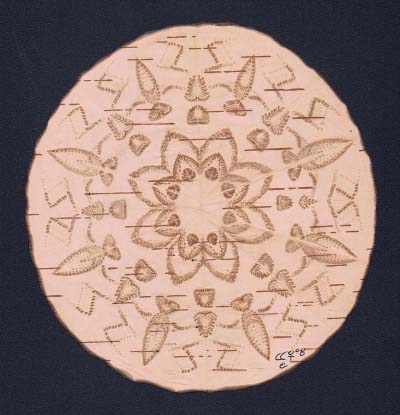
When you first hear of birch bark biting, it seems so unlikely you might assume that someone is having a joke at your expense.

But the truth is, birch bark biting is one of the most intricate and least known of First Nations arts. Concrete knowledge of the art is hard to come by, but, according to Jadeon Rathgeber of Half Moon Studios, whose mother and sister are two of the last practitioners, birch bark biting was widely practiced through North America for centuries, and very likely millennia. Rathgeber and his family are trying to revive the art, both in education and in business.

birch bark

Birch bark biting is exactly what it sounds like: The making of patterns in bark through careful bites. Traditionally, it is an art done by women, in which the artists fold the bark so that it can fit in their mouths, and visual a pattern as they create it with delicate bites, at times one tooth at a time.

“What I’ve found out about the art is that anywhere they had birch trees, they’ve had birch bark biting,” Rathgeber says. “It could have a ten thousand year old history. Nobody really knows. When Contact happened, it sort of got lost along with all our other ceremonies because it was outlawed.”

What is known is that three century old Chippewa examples are in the Smithsonian in the United States. Rathgeber has heard of a recent dig in Shuswap territory that unearthed samples that may be three thousand years old. The art is definitely known to have been widely practiced in eastern and central North America, and there are even rumors of it being practiced on the northern coast of British Columbia. A student at the Freda Diesing School, for example, reports hearing his teachers list birch bark biting among the lost local arts.

Exactly what samples of the art were used for is equally undocumented. However, Rathgeber suggests that the art may have been used to create hunting and fishing maps, and to pass cultural and ceremonial secrets between generations.

“I call it the first Indian printing press,” Rathgeber says.

Examples of the art may also have been used as the equivalent of wampum belts to commemorate exchanges between different groups. Among the Cree, it was also used in historical times as the pattern of bead work, laid directly over the leather the beads were sown to.

The best-known biter in modern times was Angelique Merasty of the Cree Nation, who lived much of her life in Beaver Lake, Manitoba. Rathgeber’s mother, Pat Bruderer (also known as Half Moon Woman), knew Merasty for over two decades, and sometimes assisted in the sale of her work. When Merasty died about fifteen years ago, Bruderer began teaching herself the craft. Bruderer is now regarded as the foremost birch bark biting artist. Perhaps three or four other biters exist, but none approach her skill.

The making of a piece of birch bark biting begins with the gathering of the raw materials. In Rathgeber’s family, the gathering is usually done by his step-father. The bark is taken by trees of the right size that are free of knots after a tobacco ceremony in which the harvester asks forgiveness for what he is about to take. Large strips are sometimes taken, but never enough to kill the tree.

When Bruderer receives the bark, she sorts out the most suitable pieces, and peels them away until they are only one layer thick. The peeling is a delicate craft in itself, in which one rough motion can destroy a piece of bark. Perhaps that is why, when Rathgeber says, “No one can peel birch bark like my Mom can,” he speaks with such obvious pride.

birch bark2

Bruderer has her own ceremony to put here in the right mood of calm alertness to work. According to Rathgeber, she does not need absolute silence in which to work, but prefers a setting that is quiet where she will not be distracted. She folds the bark up to sixteen times — “like a xylophone,” Rathgeber says – and works using different teeth for different effects, with one tooth for drawing lines, her incisors for shading, and another for large details. She can use only very light pressure, or else the bark will tear.

Even so, she sometimes does as many as five or six pieces before getting one that is up to her standards. Rathgeber reports that his mother has as many as five hundred rejects that he hopes one day to use in collages. Each piece takes a couple of hours to complete, and is usually done in one session, since it would be next to impossible to resume work after quitting.

When a piece is finished, Bruderer flattens her pieces using a secret twelve step technique that is one of the hallmarks of her work. Another mark of her work is the singeing the edges of her work to give it give it a border. Her work is either framed by itself between two pieces of glass, or else incorporated into other work, such as boxes by other artists.

For many years, the family sold Bruderer’s work for two hundred dollars and upwards. However, now, as Bruderer talks of retirement and focusing on preserving her skills by teaching thems to another generation, the family is starting to husband her output more carefully, limiting sales and raising prices considerably.

More importantly, Rathgeber is also searching for a museum or teaching institution to display the best of her work as well as Bruderer’s collection of Merasty’s pieces. He hopes that by making some of this work public, he can encourage academic study of the art – study that might, for example, help to determine how bite patterns differed culturally, or even through the ages.

When I talked with Rathgeber, he had just heard that the Bill Reid Gallery’s gift shop and the Path Gallery at Whistler had agreed to take some pieces of birch bark biting for sale.

Should you see any pieces, you should have no trouble identifying it for what it is. Mysterious and meticulous, birch bark biting is like no other art you have ever seen.

bbb3

Read Full Post »

If you’re a freelancer, you tend to be haunted by the thought of lacking work. Yet today, against all my freelancing instincts, I walked away from a source of income without having anything to replace it. It was not a step I took easily, but I had no choice if I wanted to keep my self-respect.

The problem wasn’t that the editor was doing their job. I’m a professional, and I have no illusions that my work is perfect or can’t be improved upon. I am incredibly inefficient at editing my own work (although a demon at editing others), and I generally welcome observations that make my wording clearer or more accurate.

Why wouldn’t I? An editor who points out problems before they see print makes me look good.

At the same time, I have worked with half a dozen editors, and I know what editing is generally required to make my work presentable. The number of revisions are roughly the same, no matter who the editor, and rarely require more than half an hours’ work – often less, and almost never more than an hour.

With this editor, though, revisions averaged three or four hours. I admit that he received a few pieces that I wrote while ill or under personal stress and that I should not have submitted in their current shape. However, regardless of the quality of each submission, the editor would almost always return a couple of pages of notes, amounting to a rewrite of the article.

Even if I didn’t have considerable experience, I could have guessed that this amount of revisions was unreasonable. The few times the senior editor looked over a submission, the changes were far fewer, and often minor enough that he made them himself rather than send them to me. But I continued to submit articles, partly because the pay was halfway decent, and partly because I told myself that things would get better once I learned the expected style.

The trouble was, the comments never lessened. Each article I wrote for the editor took twice as long to complete as anything else I wrote. If the revisions weren’t about typos, they were about content.

By my count, about one-third of the comments were legitimate improvements to the article. Another third consisted of explanations of how the editor would have written the article or shibboleths such as insisting that an article should never end in a quote, and one-third nonsense such as labeling a long but grammatical sentence a run-on sentence. I didn’t mind the legitimate improvements, but, to say the least, I felt that I was humoring the editor about the rest just to receive a pay cheque.

Asking other writers, I found that I was not entirely being singled out. Other writers told me that they also expected to waste half a day answering the editor’s notes. But the experience of others showed that the editing process was clearly being used to assert the editor’s authority.

In fact, the criticism was so unrelenting that I began to entertain serious doubts about my writing ability. Once or twice, when I was sick, I was so rattled about the thought of the revisions to follow that what I submitted was definitely below my usual standards. Why bother for quality when you know your article is going to be shredded regardless?

Even so, I might have endured the process while I waited for better times if the work had been regular. But the editor started forgetting my submissions – or so he said – and the one article per week slipped to one article every two weeks. Answers to my queries were delayed so that I had less time to research and write. I strongly suspected that the editor was pressuring me to quit so he wouldn’t have to take any action himself.

This morning, a submission of better than average quality received the same treatment as usual. Annoyed, I queried a couple of points – including one about the slant of the story, which I had based on the senior editor’s request – and received the usual ungracious reply.

Suddenly, I had enough. I was receiving less and less money from the editor anyway, so I had little to lose. Abandoning all plans of waiting until I found replacement work, I emailed saying that I was withdrawing the story and would not be submitting more. With an effort, I refrained from saying anything else.

The reply was a cheerful thanks for my work and best wishes for the future. So far as I was concerned, it was proof that my email had given him exactly what he wanted. Anyone who placed any value on my work, or didn’t want me gone would have asked for reasons.

I still feel nervous and wonder if I have done the right thing. But you know what? I feel so much better now that I’m out of a toxic situation that the challenge hardly daunts me. I’ve already been through far worse.

Read Full Post »

Yesterday, my work on the computer was interrupted by a sustained thunder storm. The storm lasted for hours, so I lost an opportunity to work, but, in doing so, I rediscovered my former pleasure in reading as my dominant leisure activity and in writing by hand.

When the first of the thunder rolled out above me, I was about ten minutes from finishing an article. The sound was distant, but I know how quickly a storm can cross the sky. With memories stirring uneasily about how I had lost a couple of chapters of my thesis to lightning directly overhead, I shut down the computer without waiting for a proper shutdown, and finished the article as best I could by hand. Then I started looking for ways to amuse myself, only to realize that I couldn’t do much of what I wanted to do because of the storm.

I couldn’t go for my daily swim, because a pool is high on the list of places you should avoid during a thunder storm. I did a few chores around the house, but most of what I wanted to do required electricity, so they didn’t seem like sensible ideas, either.

As for leisure activities – well, I didn’t think the stories I heard in childhood about lightning leaping through the screen of a TV were likely, especially these days when cable is more common than an antenna, but I didn’t want to take the chance of being wrong. So, no watching the news or a DVD. No music either, except in the portable player.

I did think of working on the laptop, but the battery was low. Besides, to continue my work, I needed an Internet connection, which would expose the laptop to the same risk as any appliance I might use. I hadn’t felt so out of sorts since the power went down a couple of years ago.

Vaguely, I felt ridiculous. After all, I hadn’t had a computer for much of my life. How had I amused myself before? I imagined myself camping, moping around and complaining about the lack of a wireless access point. How, I wondered, had I become so dependent on electronic devices that I had no personal resources to keep myself busy?

Maybe if I went for a run? But that didn’t seem something I should do in a thunder storm, either.
The trouble was, I hadn’t expected to be interrupted. Listlessly, I put a few DVDs away, and did a bit of tidying her and there, still hoping that the storm would pass and I would get my swim after all.

After three hours, I gave up that idea. From the darkness outside, you might have guessed that sunset had arrived, even though it was still two hours away. Lightning kept catching my eyes whenever my head swung towards the window, and on the porch the rain was rattling against the floor like an animal against the bars of its cage.

Reluctantly, I settled down with a light book. When that paled, I started some writing by hand – the old-fashioned way, the way that I preferred before the pressure of deadlines forced me to learn to compose on a computer. Everything was magnificent, but also a bit frightning.

Both activities felt surprisingly comfortable. How long had it been, I wondered, since I read as my dominant leisure activity, instead of reading a few pages here and there on breaks during my day? Probably not since the last time I was sick in bed, when I couldn’t really appreciate it. As for writing, it had been years since I had scrawled more than a paragraph that arrived in my head in the middle of the night. Yet both were surprisingly pleasant activities – productive, but somehow less rushed than reading or writing on the computer.

Naturally, I logged on to the computer as soon as the storm seemed safely past. Nor do I regret doing so. For efficiency and ease of use, computers are impossible to beat, and in most ways I don’t regret my dependency on them.

Still, there is something to be said for the total relaxation of reading a paperback sprawled back on a couch, and words written by hand somehow seem to express thoughts more accurately than a keyboard could ever hope to.

I doubt that I’ll do either as much as I did in my pre-computer days, but both are sufficiently satisfying that I think I’ll make more time for them. In some ways, I’ve missed them.

Read Full Post »

Nineteen months ago, I bought a three inch copper bracelet by Tsimshian artist Henry Green that depicts Raven and Mouse Woman. I had wanted a first-rate Northwest Coast bracelet for years, and this one far exceeded my expectations, with its size, material, and design combining to make it a unique work of art. I rarely wear it without receiving some comments about it – and they are never anything less than positive.

When someone asks casually about it, they are usually a young woman, interested in the bracelet as a miscellaneous piece of jewelry, or else someone of either gender with enough knowledge to at least recognize what they are seeing. Either way, I tell them the artist and where to see his work. If their eyes aren’t glazing over, I add an explanation of the two figures and their mythological characteristics.

However, it is the artists whose reaction intrigues me. Almost always, they ask if I can take it off so that they can handle it. They take it reverently, and turn it over slowly, since it is impossibly to see the entire design from one perspective. Sometimes, they start from the beginning, and examine it two or three times. They rarely say anything as they look, except a “Thank you” when they hand it back.

All the queries, of course, are a tribute to Henry Green’s design ability. However, although I only commissioned the bracelet, I can’t help feeling that the comments are a reflection on me as well. If nothing else, they suggest that I had the good taste in my choice of artist.

However, I admit that the constant reactions are a little unnerving at some level. Unless I’m very much mistaken, I don’t think that I attract a lot of attention as I’m going about my business. I am reasonably certain, for instance, that I have never featured in an “I saw you” ad in The Georgia Straight (not that I have wish to). But the bracelet is such a conversation piece that people notice it in a way that they were never notice me. It gives them the starting point for a conversation that they otherwise wouldn’t have. Sometimes, it feels as though the bracelet is wearing me, instead of the other way around.

Read Full Post »

When I was growing up, I was amazed that my parents could recall World War II and the abdication of Edward VIII. Similarly, the thought that Queen Victoria was on the throne when my grandfather was born, or that his life spanned the development of the first airlines to transcontinental flight made him seem a living fossil. I’ve only recently considered that I’m well on my way to becoming a living repository of the past myself.

Not every change I’ve seen seems major. For all the fuss at the time, the change from black and white television to color was only a refinement, not a radical shift in technology or culture. Acting or production didn’t change because of color TV – only the number of old black and white units in the landfills.

By contrast, the introduction of the personal phone was more radical. It greatly reduced the number of public phones in any given area, and left those remaining in obscure corners, where they were left in mounds of litter and could be easily vandalized. More importantly, it encouraged people to stay connected wherever they went, not just via phone, but via the Internet as well. It created a culture where someone walking down the street alone and talking loudly of their personal affairs was not assumed to be insane, but a normal consumer.

Another major change has been the shift in attitudes about smoking. When I reached legal age, non-smokers like me took for granted that if you went to a night club or a pub, you would have have to peel smoke-sodden clothes off as soon as you reached home and put them in a separate wash. If you really had problems with secondhand smoke, you didn’t go out. But now, the norm has shifted, and smoker are the ones who have to go to special efforts to indulge their vices.

Similarly, while alcohol remains an important part of socializing, it is no longer an inevitable one. Time was, if you wanted to talk business, you went to a pub or a lounge. Now, you go to a coffee shop instead. From one perspective, that’s one drug exchanged for another, but it means that one folkway has become overgrown while another has become two-lane highway.

But the largest changes I’ve witnessed so far are the rise of the personal computer and the Internet. The personal computer revolutionized writing, removing the makeshift conventions of the typewriter with higher standards of typography. Accounting ceased to be the manual entry of lists or the painful efforts to use a typewriter as the spreadsheet came into its own. And when digital cameras came along, the personal computer meant the end of the dark room and an era in which photos were cheap and plentiful.

As for the Internet – let’s just say I wish that I was thirty years younger or it had come along thirty years earlier. For somebody like me, who has spent a good part of his life researching, the Internet is like being let loose in some science fiction equivalent of the Library of Alexandria. If I half-remember a fact, I can get the details in a minute. If I need to talk to someone, I have several ways of contacting them immediately. If I want to research a topic that I know little about, then I can do so in an afternoon rather than days, and without leaving the house – and that’s even with sifting through dubious and outdated material.

That’s why I have little sympathy with people like Ray Bradbury, who a few weeks ago denounced the Internet as a waste of time: for anybody who reads or writes for a living, the Internet is so immensely convenient that I took to it as if it were made to my personal specifications. Parts of it may be bad or mad, or plain silly, but the Internet saves me hours of time every day. Bradbury doesn’t know what he’s missing.

When I was young, I used to worry that, when I reached my current age, I would become conservative and hopelessly set against all changes. Apparently, though, my fears were needless. I’m far from approving of all the changes I’ve seen (I especially deplore the shift from the culture of liberal optimism of my teen years to the conservative pessimism and stoicism of today), but I’m fascinated by all of them. Not only that, but I can’t wait to see what comes next.

Read Full Post »

Looking back, I sometimes think that my youth was not nearly as mis-spent as it should have been. A case in point: the night I helped to erect the dragon crossing.

The idea began as a joke at the university Medieval Club. Newly moved out from my parents’ house and feeling I had missed out on the socializing at university because I was too busy commuting, I had joined as soon as the fall semester began. Loosely connected to the Society for Creative Anachronism, the club centered largely on dressing up and some moderate drinking in the pub. Punk or new age, it definitely wasn’t – but we enjoyed the thought of what we called “freaking the mundanes” by wearing costumes and doing the odd bit of impromptu theater. Probably, we weren’t nearly the novelty we imagined.

Anyway, we were talking one night about how to publicize the club more. The ideas kept getting sillier as the night wore on. Vaguely remembering something I had seen a few years before, I proposed the idea of a dragon crossing: a sign on the university ring road, with some spray-painted giant tracks going across the road nearby.

The idea wouldn’t do much for publicity, since we couldn’t admit what we had done without risking the wrath of the campus authorities. At best, it would give people a chuckle and get them thinking of things medieval.

At least, so we hoped and so we began preparations. One Club member, who had worked as a flagger on a road crew the previous summer, produced a Yield sign that she had somehow acquired (we didn’t ask how). I produced some giant stencils of foot prints, and someone else some paint.

In theory, we had everything planned. We would gather at the pub for some liquid courage, and wait until closing time, when fewer cars would be on the road to spoil our handiwork. One person would wait up the road and act as a spotter, in case campus security found us. A couple of others would dig a hole for the sign while others painted the foot prints across the road.
In practice, things went with less than Mission Impossible ease.

After the pub closed, we drove to the park next to the campus, and climbed the hill to the ring road. We even thought to turn the cars around so we could make a quick getaway if necessary (we were so proud of that detail).

The hill was steeper and, in the dark, more crowded with trees than we remembered, but with a few stumbles and moments of disorientation, we reached the road. For a long time, that was the last thing that went right.

Crouched in the scrub alder, we waited for the cars to thin out. There were far more than we expected. When we finally psyched up enough to start work, we could barely get a few minutes of work before the spotter called out a warning and we scattered like rabbits with pounding hearts.

A traffic sign, we soon found, needed a far deeper whole than any of us imagined. It also needed packed earth around the base of the post if it wasn’t going to sag.

As for the footprint templates, they would have worked a lot better if anyone had remembered to bring masking tape to hold them in position. It didn’t help, either, that cars kept running over our work before it had dried.

Eventually, the inevitable happened, and campus security surprised us by coming on us from the direction in which we had no spotter. We scattered, quickly getting lost – only to find that one of us had kept her head and, knowing the campus cop, assured him that we weren’t doing anything really destructive. But, good middle-class kids that we were, we were terrified, and called it a night.

A few days later, in the cold light of day, our efforts did not match our vision. The Dragon Crossing sign looked distinctly amateurish, the post it was on had a definite tilt to it, and the tracks were smeared with tire marks. But they made the campus paper, leaving us in paroxysms of regret at the thought that we couldn’t claim credit.

Still, someone must have noticed our efforts. A few years later, the science fiction club produced their own Mutant Crossing, with green glow-in-the-dark footprints. “Immortality is ours,” those of us still on campus murmured. But the truth is that all of us had been scared straight by our own daring, and almost getting caught, and would never again do anything wilder than wear medieval costumes on campus.

Read Full Post »

« Newer Posts - Older Posts »