Feeds:
Posts
Comments

Archive for the ‘Uncategorized’ Category

Today, my nanday conure Ninguable died, surviving his mate Sophie by just under thirteen months. He died in my hands. It was the last act in a relationship that had lasted twenty-eight years.

He had been listless for the past couple of days, but yesterday evening he had seemed to rally. However, the improvement didn’t last, and this morning he was lying on his back when I opened his cage. I thought him dead, and although he roused feebly, I knew he wouldn’t last out the day.

I had no means to euthanize him, and taking him to the vet would only make his last hours uncomfortable, so I sat with him through the day. He seemed to have suffered a stroke, because he struggled to move his left leg, growing testy at times.. Sometimes, he yawned with his beak tilted up. He didn’t show any signs of pain, just frustration. I was just putting him on to a towel in his cage bottom, so I could use the computer with one hand while stroking him with the other, when he collapsed beak first and twisted sideways.

For a moment, I swear I saw a light in his brown eyes. Then he was gone. I waited a few moments, but I knew what was left was no longer him. The time was shortly before 2PM.

Ning was our first parrot, and responsible for most of the others coming into our lives. We had been fascinated by a friend’s dwarf macaw, and had spent over a month looking for our own small parrot. We briefly considered a blue-crowned conure at the Lougheed Mall pet store, but debated if it was quite right. Then we saw Ning at the store in Kingsgate Mall, and immediately knew he was right for us.

Had we known what we knew a few years later, we probably wouldn’t have bought him. He was missing a nail on one foot, and part of a toe on another – a likely sign that he was wild caught, and had had his feet tangled in a net. Plus the store owner swore he was eighteen months old when by his markings he was under a year. Later, we realized he had probably been smuggled into the country, an abusive practice that we wouldn’t have wanted to support.

But he was so feisty among all the much larger birds in the room, hanging from the bars of his cage and trying to attract the attention of the red lory who was the only bird of his size. We put a deposit on him, and stopped on our way to the Vancouver Folk Festival to feed him cherries and grapes, all of which he greedily devoured.

On Trish’s birthday, we brought him home. We left him to acclimatize while we went out to dinner, but we were both so excited that we could hardly eat. We named him Ningauble, after the ever-curious wizard in Fritz Leiber’s Fafhrd and Gray Mouser series.

In the next few weeks, I worked with several times a day in the spare room, teaching him to climb up on a presented perch, then on a finger, feeding him and praising him loudly as a reward.

In the evenings, I would take him out and herd him on to my shoulder, where he would sit nervously before starting off. He couldn’t fly much, because we had clipped his wings, but that didn’t slow him much. He would glide as far as he could, and resolutely trudge along the floor and up the furniture until he reached his cage.

One evening, we were sitting reading when he reached over and gently preened my hair. Between my nervousness that he would bite my ear and my delight at this sign of trust, I hardly dared to move. But the next evening, he preened one side of my hair followed by the back, careful not to miss a spot, before giving up.

He seemed relieved to realize finally that he wasn’t responsible for all my hair, and after a few more evenings, settled down to a token preen in return for having his ear holes and neck scratched. He would sit and preen me for a couple of hours, then waddle down the couch to Trish to give her a couple of hours of attention.

I was in grad school at the time, and used to work in the spare room we had converted into a library. For a while, I used to take Ning into the library, since he would scream for me if I left him in the living room. Unfortunately, he would not only wander the shelves flinging books off, but also produce what our local used bookseller called parroted editions that had been thoroughly chewed to the point where they were unsellable.

After a couple of years, we decided he needed a mate, so we brought home Sophie, a malnourished, abused bird. Our plans to quarantine her for a month were immediately overturned when the only way to keep them from calling from room to room was to introduce them. Under our anxious eye, Ning jumped into Sophie’s cage and immediately started regurgitating to her.

If Sophie could talk, I swear she would have said, “Excuse me, sir? Have we been introduced?” but they immediately became inseparable, eventually going on to produce six chicks, one of whom is still with me, and one who returned to us before dying at a young age from the second hand smoke in a home where he briefly lived.
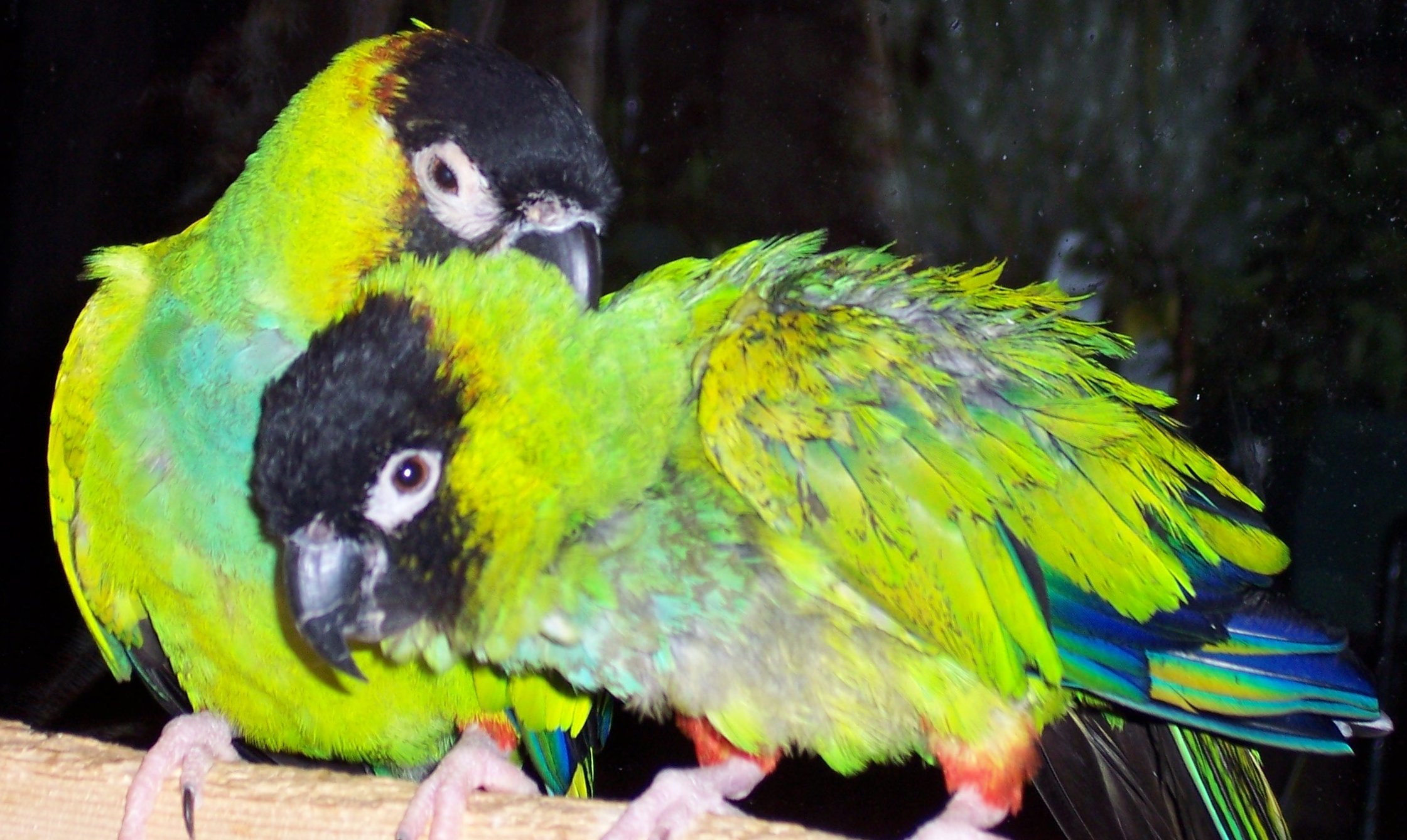
Ning wasn’t that skilled at feeding babies. But he kept Sophie fed while she was brooding, and delighted in teaching them the basics when they left the nest. At that point, Sophie was glad to pass along the responsibility, and Ning always pined when the babies went to other homes.

Because of the trouble and heartbreak of finding new homes for the babies, we eventually stopped allowing eggs to hatch. But Ning and Sophie didn’t seem unduly troubled. They continued in happy monogamy, with Ning in the adventurous lead and Sophie chirping nervously behind, but following him – on to the floor, or up on my shoulder, where they would sit preening each other and occasionally me while I worked on the computer.

In between, Ning would have territorial wars with the other male birds housed in the living room, always with the psychological edge. Although not particularly large for a nanday, his electric blue and green feathers showed he was the epitome of health. And, anyway, he was the cock with the hen.

He also showed an uncanny ability to find what unsettled his rivals the most at the least risk to him – for instance, sitting just inside another male’s territory on the floor, in a spot where he couldn’t be dive bombed.

And so things went on, the living room full of bird calls, affection and avian macho, until I got into the habit of thinking they might go on forever. But Trish sickened and died, and, five months later, Sophie died. Ning responded by a fit of macho, rampaging around the dining table until it was clear that this previously neutral ground was now his. He was also inclined to mope unless he spent as much time as possible with me – something I didn’t mind in the least, considering we were widowers together.

In the mornings, when I came to open the curtains, he would greet the sound of my voice with a liquid trill that would continue for up to a minute — one of the most beautiful sounds I ever heard, and one I wish now that I had got around to recording.

Despite his increasing age, Ning showed few signs of slowing down until the last four months of his life. One day, waddling over the carpet, he stopped and began biting furiously at his right wing. When I picked him up, I could find no damage, but he never flew far again. Instead, he would call anxiously to me, squirming until I picked him up and carried him to where he wanted to be. By this time, I could guess his destination with almost total accuracy.

I had seen similar signs in Sophie, but, considering Ning’s better health, I had hopes that his senior years would be prolonged. Until a few days ago, I even had hopes that with therapy he might fly freely again, since several times he managed short flights when frustrated.

As I write, it’s six hours after his death. I’ve taken his body to be cremated, and removed his cage from the living room – and I still keep looking for him as I type. He’s the one who taught me that parrots had sentience and limited planning abilities. He’s the one who kept me amused with his unabashed enthusiasm, and supported me with a preen and by hanging out when I was discouraged or grieving. He’s the one who taught me that parrots can purr.

Given all this, what could I do but sit with him in his final hours? I talked to him about our years together, sang him his favorite silly songs, and repeated my pet names for him. I cried over the inevitable before it happened and I hoped for a miracle, knowing I wouldn’t get one.

And you know what? I’m not ashamed of any of it. Because those are the sort of things you do for a friend. The only shame would have been to leave him to die alone, and my only comfort is that I did for him what I could.
Read Full Post »

When I was younger, I loved dark chocolate or good quality milk chocolate. Add almonds to either, and, if I wasn’t bodily lifted into heaven, I’d feel that I was about to be. But eight years ago, I gave up chocolate for the same reason that I gave up coffee: the caffeine was too much for me; forty grams, and I’d have a buzz for the next day. It’s been a learning experience, to say the least.

To start with, not eating chocolate is only marginally more acceptable than smoking. Basically, North America is organized for chocolate lovers.

If you don’t believe me, go into a corner store and try to find a snack that doesn’t include chocolate. With luck, you’ll find gum, a few hard candies, and nuts or sunflower seeds so heavily salted that most people should avoid them. The best recourse is usually to find a deli or a bakery, neither of which is especially common.

Go out to dinner, and you have the same problem. If a restaurant has six dessert items, four or five usually have chocolate. Often, the desserts not only have chocolate, but several other sweet, sticky ingredients like raspberry syrup, and could strike you with Type 2 Diabetes if you weren’t careful to gaze at them only in a mirror.

When you eat in somebody’s home, it’s even worse. No matter how often you explain that you don’t eat chocolate or why, friends and family never remember. After the main course, they usher in some masterpiece in chocolate that they’ve slaved over more than the rest of the dinner put together, and you have to tell them that, regrettably, you can’t have any if you plan on sleeping that night.

I’m not sure which is worst: the look of betrayal, or the pitying gaze that follows it, as though to not eat chocolate is to be excommunicate from the communion of desserts. At times, I’m driven to lie and simply say that I’m full, rather than endure that pity or the explanation for my abstention.

There’s no way, either, to tell all those who pity you that you don’t really miss the chocolate. Their tastes are so conditioned that they don’t understand that there are flavors beyond the simple combination of sugar, fats, and caffeine.

Probably, few people would believe you if you tried to persuade them. Honey? Cinnamon? Nutmeg? We are now well into the third or fourth generation of North Americans for whom savories, let alone other forms of sweetness, are not just unknown, but distasteful.

But honestly? Giving up chocolate has helped me to discover so many different flavors that, far from pining for it like an addict, I don’t miss it at all. These days when I’m offered chocolate, my reaction resembles that of Peter Wimsey when offered Turkish delight – I refuse with a delicate shudder, thinking a taste for chocolate childish and unrefined.

And for that heresy I am cast into the social darkness, forced to walk the purgatory of those who avoid the normal social vices and generally unable to snack when away from home.

Like I said, though, I don’t really mind.

The food is really much better where I am. You see, the taste’s not blotted out by chocolate.

Read Full Post »

The turn of the year always leaves me relieved for two reasons. First, every time I go out, I don’t have to watch women exhausting themselves to feed dozens, and refusing all help. Second, most of the year end summaries are over and done with.

I admit that I’ve done my share of year end summaries. As a journalist, I find these stories are almost unavoidable, and I imagine I will do more of them in the future. If nothing else, they are relatively easy – if tedious – to write, which can be a relief at a time of year when I’m distracted by various social demands and low on ideas.

But although I try to find a theme or two for my summaries, so that they are not just a random collection of facts, I’m still uncomfortable about writing them. For me, the only thing worse than writing these stories are reading them.

What I object to is that these stories are the first effort at official history. I have no problem with reporting or reading individual stories as they happen. But selecting which stories are important – that I have a problem with.

I realize, of course, that proposing stories or taking suggestions from editors is itself a form of deciding what is memorable. Sometimes, when I think of the stories that I haven’t told, either because I was too busy or because an editor thinks them too dull or too hot to handle, I feel like Midas’ barber. You know – the one who, seeing his master cursed with donkey ears, dug a hole to whisper his secret to, because he had to tell someone.

However, I can more or less live with this daily selectivity as a necessity. After all, there just isn’t time to cover every story.

But year end summaries go one step further. Starting from the already selected daily news, they go one selection further. That makes them two removes from reality, an abstraction that is even more remote from what’s happening than an everyday story.

Even worse, year end summaries are the beginnings of official history. And, as anyone who has read George Orwell’s”Looking Back at the Spanish Civil War” is aware, official history slips easily into distortions and outright lies.

For example, when Expo 86 was held in Vancouver, there were mass evictions of the poor, and pointed questions asked about government spending priorities. But, after it was all over, the year end summaries proclaimed it a success that silenced all oppositions. Never mind that those of us who objected continued for years to boycott many people and companies who took part: drawing on those year end summaries, people now talk about the whole affair as a golden moment, unsullied by any complaints.

The same transformation has occurred already with the 2011 Winter Olympics. I remember several surveys that showed that, even after the fact, fifty percent of those living in the greater Vancouver area continued to object to the spectacle. Yet, now, less than two years later, mainstream journalists continue to tell how, despite some initial misgivings, residents were won over by the excitement and the Olympic spirit. Inconvenient facts like riots and protests are dealt with simply by not mentioning them.

Fortunately, writing about free and open source software for a variety of websites and magazines, I face almost no pressure to write feel-good stories, nor controversial ones. But, being aware of how easily year end summaries can become part of a corrupt process, I shy away from writing them. I don’t falsify my reactions, but I worry that, by writing such stories at all, I could be lending myself to a process of which I disapprove.

Just as I rarely read such stories, I can barely bring myself to write them. That’s why I’m always glad to see their season depart. Come January 1, for another eleven months, I don’t have to face the dilemma that they represent. Like the spectacle of women being expected (and  expecting themselves) to prepare a huge meal while everyone else socializes, for me year end summaries seriously diminish what whould otherwise be an enjoyable occasion.

Read Full Post »

The change from one year to the next means little to me. It could, and has been at different times of the year over the centuries, and I’ve never thought it a reason to party at inflated prices or to make promises to myself that I probably won’t keep. But, as arbitrary as the change in the calendar is, I find myself wanting to sum up and make some sense of the previous year.

At the risk of being sententious (to say nothing of pretentious), here is what I learned (or, in several cases, relearned) during 2011:

  • Apparently, I’m a relatively tidy person after all. I’m not fanatic about putting things away, but, once everything is in order, I prefer keeping things that way if it’s not too much trouble. This is a real discovery for me; having lived decades with a woman for whom messiness was the norm (and wanting to continue living with her and avoid arguments), I honestly didn’t know.
  • Temperament is more important than interests. Just because you share a belief or interest with someone is no guarantee that you’ll get along. You may find some people whose ideas you despise more agreeable than many supposedly on your side.
  • Anger is the logical, sane response to bullying, injustice, and possibly a few other things. The trick, of course, is to see clearly when anger is appropriate, and not rationalize succumbing to it simply because it is a relief or feels good
  • One reason Proverbs 26 immediately follows “Answer not a fool according to his folly, lest thou also be like unto him” with “Answer a fool according to his folly, lest he be wise in his own conceit.” might be to emphasize that, with some people, you can’t win either way. I’ve decided that I don’t mind fools thinking themselves clever at my expense so long as they do so somewhere else.
  • Logical discussion and efforts to repair relationships both assume that everyone involved has a genuine interest in making progress. If they don’t, you’re wasting your time.
  • Contrary to what I once assumed, the average man or woman under forty-five is much more uptight about sexuality and relationships than my generation. In particular, they are less likely to view frankness in such matters as a virtue. This difference probably means that, twenty or thirty years from now, the middle-aged are going to be embarrassed by what their parents get up to in the retirement home.
  • For me, joining an organization is almost always a mistake. Better for me to be a fellow-traveler, to coach from the sidelines or be a behind the scenes adviser than directly involved. If nothing else, I have trouble keeping my mouth shut when I see something important being neglected – and that’s not a trait that most people in charge appreciate, especially if you turn out to be correct.
  • No matter what their educational background, the average person isn’t interested in nuance or accuracy of observation (that is, what I summarize as “truth”). What they want to know is who is good and who is evil. If you suggest that very few issues are black and white, they usually classify you as evil and therefore fair game.
  • Personal convenience or comfort is more important to most people than ethics,morality, or their own long-term advantage. Asked to sacrifice convenience or comfort, most people will happily jettison their alleged beliefs. Often, they will then do precisely what they object to in others.
  • Once I got over the first shock of being unexpectedly widowed, my circumstances seemed like the chance for a fresh start. And I have changed some aspects of my routine, especially since I am no longer taking care of a slowly ailing person. But, when the dust settles, I have largely fallen into the same routines as before. The difference is that now I have to endure them alone – and the small freedoms I now have don’t begin to compensate for the fact.

Read Full Post »

“There’s no gods, and there’s precious few heroes,

But there’s many on the dole in the land of the leal.”

-Brian McNeil

Over the years, I have learned to avoid meeting heroes and role-models. I don’t think it’s fair to project expectations on anybody. Just as importantly, the meeting is almost always disappointing. Either the gap between the expectations and the reality is too great, or, in order to become the sort of person who might be a hero, people have developed a callousness and disregard for others of which I strenuously disapprove.

Fortunately, I’ve never been much prone to hero-worship. Most of the celebrities that popular culture gossips about leave me indifferent, just as the handful I admire – generally, artists of various sorts or free and open source software (FOSS) contributors — would leave the average person indifferent. Besides, being well into middle-age, I’m past the point where I might need heroes as an example.

Occasionally, meeting heroes does turn out well. Linus Torvalds instantly gained my approval when I suddenly realized after fifteen minutes whom I was talking to, and that he had made no attempt to play celebrity. I will always appreciate, too, David Brin’s graciousness when I made a remark about “the days when the Nebula Awards meant something,” and he immediately replied, “I thought that way, too, until I won one.” As for Paul Edwin Zimmer, my rehearsed remark led to a three hour conversation on the floor of a convention hotel and a life-long friendship.

By contrast, Paul’s sister, Marion Zimmer Bradley, disappointed me so badly that, after meeting her, I could never read her books again. I was surprised that, when I talked about the depth she had added to some of her recent publications, she attributed the change entirely to being able to write longer manuscripts. Now, I wonder if she simply wasn’t willing to talk about her work in any detail, but in subsequent meetings, she proved so gruff and abrupt that my disillusionment was beyond repair, even when her extended family assured me that her behavior was “just Marion being Marion.”

Then there was the FOSS celebrity who saw their ego as the center of everything around them. They were undoubtedly sincere in their advocacy, but the way they twisted every conversation around to themselves quickly progressed from mildly amusing to teeth-grindingly annoying. It didn’t help that in their endless quest for personal celebrity, they would often assume an authority nobody had granted them, and claim to speak for the entire project with which we were both involved – especially since I usually had to clean up after them.

Still another FOSS celebrity, whom many respect, proved a borderline personality, hypocritical and full of their own importance that I came to realize that interacting with them would only be a nagging annoyance, and they would be unlikely to succeed in their latest project anyway.

My disillusion in such cases doesn’t come from the fact that people are human. Rather, it comes from the fact that they make no effort to be decent human beings while aspiring to special treatment. Unlike the rest of us, they appear to have missed the lesson most intelligent people learn during their first semester at university – that they are not necessarily the smartest people in a conversation.

I have lost none of the aspirations that usually lead people to hero-worship. But I have become skeptical that anybody deserves to be considered heroic. These days, I cultivate admiration for specific accomplishments, rather than for the people who carry them out, and generally find myself becoming less disillusioned as result.

Read Full Post »

To the strains of Sileas’ “File Under Christmas,” I’ve just finished my wrapping for tomorrow. It was a feeble echo of the years when Trish was alive, and brings out the loneliness in my life more than ever.

Trish and I always made Christmas a large event. Although we would sometimes buy one moderately priced present for each other, mostly we focused on small gifts like movies, music, graphic novels, and books – always books, so many that each year we would only run out of new reading material about mid-March. Usually, we would buy each thirty or more gifts a year, opening a few in the morning, and the rest when we returned from visiting and needed to unwind. If we had a Boxing Day visit that we weren’t looking forward to, sometimes we saved a few gifts for opening when we dragged home, full of stories about relatives.

So many gifts took some planning. We had plenty of pre-wrapped boxes that I’m now slowly giving away because I no longer need them. Since I was the more organized of the two of us, and usually finished shopping earlier, I would scrupulously divide the pre-wrapped boxes, taking only half of them. Almost always, I had to wrap half a dozen gifts separately that didn’t fit into any boxes.

Then I would sit down and compose the tags. The tags were never as simple as statements about whom the gifts were too and from. They contained this information, of course, but early in our relationship, we started the tradition of adding a cryptic clue about the present. For example, a book by John Mortimer might have a tag declaring that it was “dead in the water” (mort = death, mer = “sea”). An album by The Pogues might be listed as “Before Pictures from the British Dentistry Association” in reference to Shane McGowan’s irregular teeth, while a season of Doctor Who videos might be described as “first of five, medicinally-speaking,” (referring the basic questions Who? What? Where? When? How?). The idea was to be as obscure as possible, so that the recipient would groan in recognition when the gift was opened.

Last year, I was still in deep mourning, and gift wrapping was so much a duty that I hardly noticed it. This year, however, when I am in slightly better shape, it seems colorless and drab. It involves no clues, because the relatives and friends I buy for wouldn’t appreciate the tradition. And it’s over so quickly, too, finished before an album is, where once I’d need five or six albums and an afternoon.

Compared to other years, it was joyless – but, then, to a large extent so was the shopping. I no longer shop with an eye out for something to delight someone. Instead, I settle for what is suitable, and I’m relieved, not saddened, when the process was over.

Christmas, clearly, is no time to be widowed. There are too many memories in gift-wrapping, and no sense of or belief in a future in which the gifts might be enjoyed.

Read Full Post »

No, I haven’t been watching When Harry Met Sally recently. But in the last month or so, I’ve been thinking now and then about the question of whether men and women can be friends without any sexual feelings interfering. About a month ago, a woman accused me (incorrectly) of having an “inappropriate” interest in her, and I was so deeply insulted that I haven’t been able to forgive the affront. The idea that men and women can be friends and nothing more is very much a part of me, and I have proved the fact to my satisfaction so many times that I was unprepared for someone who holds the opposite view. How, I wonder, could such a discrepancy of viewpoints come about?

I don’t deny that heterosexual men and women are always aware that someone is a member of the opposite sex. That is as true as the fact that a straight man can hardly have another man – especially a stranger – move into his personal space without an unconscious feeling of rivalry.

But what I do deny is that such awareness is automatically the defining feature of a relationship. Although I have no idea whether awareness of another person’s gender is biological or cultural (although I suspect a little of both), I don’t believe that it has to dominate a relationship — unless you let it.

Over the years, I have been in several situations in which either I was strongly attracted to a woman or she was strongly attracted to me, yet our relationships were about work or common interests. The attraction may have been difficult at first, but soon became irrelevant, if not always disappearing altogether, for the simple reason that I and the woman involved had decided, generally without any mutual discussion, that it would not be acted upon. It was really no more complicated than that.

However, I am thinking now that not every man can be friends with every woman. Those who can, I think, are largely those who do not define themselves primary by gender, but consider themselves people first.

If you are a man for whom your sexuality is primarily about your own predatorship, or a woman who believes that men see you primarily as prey, then I suspect cross-gender friendships are unlikely. The same is true, in more complex ways for some feminists (I regret to say), who condition themselves to see all interactions in terms of gender politics, or male supremacists brooding over the supposed wrongs that women have done them. In all these situations, the awareness of gender is too strong to be relaxed. Consequently, the people involved can never relax, either.

In their different ways, such people have all come to be obsessed by gender. Instead of gender being only one of many characteristics, for them it has become the dominant one. In fact, for many such people, it has become the only characteristic. At times, gender seems to be all they can see.

By contrast, those of us who can be friends with the opposite sex tend to see gender as important only in certain circumstances. The rest of the time, it is part of the background, either ignored or not considered primary. We don’t generally say things like, “Men are like that” or “Well, you know women,” because we don’t see people mainly in terms of male and female. Instead, we are likely to consider other people in terms of shared goals or common interests. For us, any initial awareness of gender generally fades as other aspects of a relationship become more important. That tends to happen even if the other person is strikingly good-looking.

In my own case, this outlook was strengthened for many years, because I was a well-known monogamist. One of the advantages of being happily married is that – unlike many single people – you don’t think about the availability of a person of the opposite sex when you meet them.  Instead, you are freed to talk about what matters to you. That holds true whether you are with your spouse or alone.

But, whatever the reasons, throughout my adult life, I have had at least as many female friends – both straight and lesbian – as male ones. By seeing women as people first, I have learned more about humanity than I would have otherwise.

That’s why, when someone declares through their actions or words that men and women can’t be friends, I always feel sorry for them. I always suspect that their experience is too limited, or too framed by popular movies and fiction, or perhaps too conditioned by a traumatic experience. I consider them narrow people, and take their insistence on their world views as a personal insult. So far as I am concerned, they are denying both my beliefs and experience – all without knowing what they are talking about.

Read Full Post »

Thanks to the graphic novel and movie V for Vendetta, many members of the Occupy movement sport Guy Fawkes masks. However, while the often-repeated line about Fawkes being the only person to enter Parliament with honorable intentions is good for a laugh, Fawkes is a poor symbol for the movement. In fact, with his plans to restore a Catholic monarchy, Fawkes was a reactionary, and would probably disapprove of the movement if he were alive to see it. Instead, I wonder why no one has looked deeper into some of Fawke’s contemporaries – specifically, the Puritans.

At first, the suggestion sounds ridiculous. Puritans have been the object of ridicule for centuries, from Shakespeare’s Malvolio in Twelfth Night to H. L. Mencken’s definition of Puritanism as “The haunting fear that someone, somewhere, may be happy.” Moreover, at least since the 1960s, to describe some as “Puritanical” has been one of the deepest insults possible. The adjective suggests someone who is humorless and repressed to the point of obsession.

Remember, however, that history is written by the victors – and that, with Charles II’s restoration of the monarchy, the Puritans became the losers. The truth is, our view of the Puritans is about as accurate as an investment banker’s view of the counter-culture of four decades ago.

Yes, many Puritans fit the modern stereotype. But many others did not. Historically, all “Puritan” meant was an extreme form of Protestantism. During the seventeenth century, there were dozens of different schools of Puritanism. The Diggers, Ranters, Levellers, Muggeltonians, the early Quakers – these are only some of the different sects of Puritanism you could find in the early to mid 1600s, and many of them disagreed strongly with each other.

What all Puritans had in common was a deep belief in the essentials of Protestantism: the idea that each person had to work out their own salvation for themselves. This belief led them to question the authorities of their day, both the religious and the secular ones. In fact, since in Anglicanism, the monarch is the head of the church, at the time, there was no real distinction between the religious and the secular (which was one of the circumstances to which many Puritans objected).

The result of much of their questioning sounds very familiar today. Universal suffrage? Votes for women? Communal responsibility for the sick, poor, and the elderly? All these ideas were first raised in the English-speaking world by the Puritans. Some sects went even further, experimenting with communal living and denouncing the evils of property and hierarchy, becoming so much of a threat that less radical Puritans like Oliver Cromwell suppressed them, and called in the troops to disperse some of their experiments with communes.

Admittedly, to the modern mind, their ideas had some strange twists. Living in a religious age in which most people believed that the civic order was ordained by heaven, they did not reject religion so much as reinterpret it. Some Puritans, like the Diggers, recast the Biblical Fall, not as the literal disobedience of Adam and Even to God’s commandment, but as a metaphor for the rise of social hierarchy. Others, like the Ranters, went even further, declaring that all humans were naturally innocent, and that sin was merely the corrupting result of conforming to the social order, which could be removed by everyone giving in to their natural inclinations. The idea that society could do without Christianity seems to have occurred to very few of them.

This religious orientation aside, most of the radical Puritan’s beliefs would sound instantly familiar to most moderns, especially the activists. You could even say with some justification that the shaping of our modern world and its values and aspirations began with movements like The Diggers and The Levellers.

Instead of choosing a figure like Guy Fawkes for a hero, today’s activists might try taking a look at people like Gerrard Winstanley, the intellectual leader of the Diggers, or Abezier Coppe, the prominent Ranter. If their original works are hard to find, you can at least read about them in the works of historians like Christopher Hill, or hear them summarized in some of the songs of English folksinger Leon Rosselson, such as “The World Turned Upside Down” or “Abezier Coppe.” In doing so, you will regain part of the English-speaking world’s heritage that anyone interested in improving society should know about — because, believe it or not, we’ve been here before.

Read Full Post »

A friend of mine insists that everything happens for a reason. If a relative dies, or he receives a disconnection notice from the power company, or he fails to make his rent on time, he consoles himself by repeating this idea over and over. But for all my familiarity with his refrain, it only occurred to me today that he might be right – although not in any way that he would suspect.

I’ve never told him, but the implied resignation in his philosophy always leaves me faintly irritated. If you’ve ever been with someone whose hearing is much better than yours, you’ll understand my irritation, because if there’s a pattern to the events around me, it appears to be beyond my perception. I’m tempted to dismiss the idea out of hand, then I wonder: what if he sees something I can’t?

Even more seriously, if you believe that everything happens for a reason, you quickly confront the idea of inevitability, or of a deity who controls events. In turn, either of these ideas quickly comes up against the so-called problem of pain – in other words, what’s the role of suffering within that all-explanatory reason? And if hurt or loss is either inescapable or ordained by a deity, then the universe is hostile, and any ruling god is, as Mark Twain suggested, “a malign thug,” worthy neither of worship nor resignation towards through the belief that everything happens for a reason.

Such possibilities seem a needless complication compared to the idea that there is no innate reason, and that much of what happens is simply the result of chance and beyond our control. My friend creates a sense of meaning by believing in hidden causation, just as I create meaning by opposing and trying to limit the painful when it randomly occurs.

So far, so existential. But I suddenly realized today that I hadn’t taken my outlook far enough. If no innate reason exists, there is no reason why you can’t settle on your own purpose for everything happening, and take comfort from that, even if that purpose is only finding satisfaction in the fact that what happens is in accord with your perception of how existence works. That may be a distant and unsatisfying outlook, but it would make my friend’s mantra truer than I imagined possible. But what purpose would reconcile me to stoicism in the face of disaster?

Immediately, I thought of a story by Jorge Luis Borges, which mentions in passing that the entire purpose of a greedy Sixteenth Century merchant’s existence was to give Shakespeare the model for Shylock in The Merchant of Venice. Having recently spent a couple of days with fantasist Fritz Leiber’s immediate descendants, that in turn reminded me of Leiber’s comment that seeing everything he experienced as potential story material was part of his adoption to life.

Was there any reason, I wondered, why I couldn’t assume the same perspective? If what happens is story material, then that would be a reason that I could accept for everything that happens. Some events might be horrific, but, softened by being put in a story, maybe even they might instruct, amuse, or distract both me and any audience. The idea requires no belief in destiny or a deity, and morally involves nothing worse than salvaging something from whatever happens.

The only problem is that, so far, I’m not much of a fiction writer. While I’ve sold close to twelve hundred pieces of non-fiction, I’ve only published two pieces of fiction, both so short and so slight that calling them minor is being kind. The potential is there, but time is starting to run out.

Still, there is no reason why I can’t try out the perspective. Cultivating it might even encourage me to use the material I’ve collected, to settle down and make more of an effort at fiction.

That may be expecting too much. But, effective immediately, I’m resolved to see how the perspective works out. Since I’ve been mentally circling the idea since I first thought of it this morning, it seems worth exploring. I’ve rarely had an idea that intrigued me so much.

Who knows? Perhaps in a year or two, when my friend tells me everything happens for a reason, I will nod and tell him that he doesn’t know how true his belief actually is.

Read Full Post »

By mid-December, most New Years’ resolutions are long-forgotten. However, for Arlynn Leiber Presser, December sees her rushing to finish the resolution she made last January: to meet every one of her Facebook friends in a project that she calls Face to Facebook.

Presser and I had exchanged a few emails in the last twenty years, most of them about her grandfather, fantasist Fritz Leiber, whom I wrote my master’s thesis about, and mentioning in passing her father Justin Leiber. But, until yesterday, we had never actually met. Presser, her father, and I had leisurely drinks and dinner, then retired to their hotel suite, where I took the opportunity to interview her.

Face to Facebook began when Presser realized that she was feeling increasingly isolated, except for her contacts on Facebook. “I work at home,” Presser said. “My kids were gone, and my feeling was that I could stay in my house every single day without leaving as long as I could get the pizza delivery boy to stop by the liquor store on his way over to the house.”

At first, Presser found herself thinking that “It’s okay, I have a great social life – I have 325 friends on Facebook. I know what everybody is doing for dinner. I know what music they like, and what their problems are, and what goals they have.”

Yet on closer thought, Presser realized that she had never actually met about half of her Facebook friends, and that some of the meetings were years ago. “I thought, who are these people? So I woke up and said this is my New Year resolution: I’m going to find every one of those friends.”

Furthermore, Presser decided this was one resolution she would keep. “I’ve had New Years Resolutions where, yeah, I’m going to lose those five pounds, I’m going to give up drinking – and I don’t do any of those. But this one I have, although I’m not at the end of it.”

The resolution meant that Presser, who has written several dozen romance novels and worked in a variety of other jobs ranging from lawyer to waitress, would not be working for the year. Instead, she has been living off her savings, with financial assistance from her father and frequent flyer points from her ex-husband.

However, Presser remains philosophical about the lack of income. “Everyone’s losing money,” she says. “I’m just losing money in a different way. I’m losing it deliberately.”

Meeting her Facebook friends has required her to be constantly arranging and rearranging trips in order to meet everyone as efficiently as possible. “I can’t claim to be Napoleon,” she says. “I’m not good at this.”

All the same, she has kept on, always traveling with a chaperon for safety – often, her oldest son Joseph, and, on her most recent trip, her father. She has also gathered a support team around her. In addition to her father, two sons, and ex-husband (who house-sits for her), it includes a friend who makes her travel arrangements, and a cab driver named Murphy, who not only drives her to and from the airport and around Chicago, but arranges to meet her at the end of each visit. “Murphy and I will have an agreed-upon time, and then he will text and say, ‘Look out the window of the restaurant, or the hotel, or whatever,’ and he’ll be there.”

The actual visits have ranged from the disastrous to the unexpectedly magical. One woman promptly unfriended Presser when she refused to buy a Mac computer for her and carry it around the world to Ankara in Turkey.

Even worse, at Comic-Con in San Diego, a male friend said he couldn’t visit because he had walking pneumonia. Then, he added, “But I’d like to stop by the hotel and give you a hug.” He did so, and a few minutes later, “he sends me a text saying, ‘You are so sexy.’ The texts continued, with invitations to his house, which Presser refused.

Then, “Two months later, this dude texted, emailed, and used every communication device known to man to say, ‘Do not blog, do not admit that you know my name, because my girl friend doesn’t like it.’ Then about a week later, I got an email from a girl whom I didn’t know, saying, ‘Did you fuck John Smith? Because if you did, he’s a liar, and he says you’re not that sexy.’ Which I thought was hysterically funny, and I’m thinking, ‘Wow! This is fun!’”

However, the highlights are what seem to have touched Presser the most. For instance, she is especially grateful to her friend Brian Brethauer, who, realizing that his home outside Boise Idaho would require a special visit, arranged to meet her at Comic-Con, and then shepherded her through the experience.

Another memory Presser treasures is her time in Manila. She had hoped to visit a friend there, only to find out – too late to change her itinerary – that he was having his appendix out and would be unable to meet her. When she checked into her hotel, the front desk rang and said that a woman had been waiting to see her for three hours. The woman, who proved to be her friend’s wife, told her, “’I’m so sorry. My husband had his appendix taken out last night. He’s still not well, but can I take you to lunch?’ So I didn’t actually meet that Facebook friend, but I got to meet his wife, and I got to go out into Manila, and it was wonderful. When we were coming home in the cab, my son was still saying, ‘She was the best!'”

Presser still has a busy schedule if she is going to finish the project by December 31, but she already knows how she’ll be spending New Years Eve: “I’m going to be in my pajamas in my bedroom. There’s a little fireplace. I’m going to be there drinking champagne – by myself.”

After that, Presser plans to decide what to do with her blog and other notes. “There was someone who was doing a video,” she says. “But I don’t know, because my history has been to write books. So my mind thinks I’m going to write a book.”

Asked what she has learned from the past year, Presser responds, “I’m not as weird as I thought I was. I’m just very normal.”

But hearing her enthusiasm for the project, even while she is obviously jet-lagged, I suspect that life lessons are beside the point in Face to Facebook. What the project really seems to be is a series of small adventures, mishaps and all – and, if Presser hasn’t enjoyed every moment of travels, she obviously delights in all the stories she’s collected.

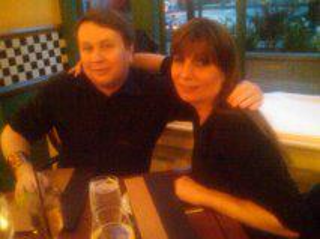
Arlynn Presser and I in the Griffin Room of the Hotel Vancouver

Read Full Post »

« Newer Posts - Older Posts »