Feeds:
Posts
Comments

Archive for the ‘Uncategorized’ Category


Ron Telek is primarily a carver and a sculptor. He has worked in everything from wood and stone to cloth and bone, but most of his work is three-dimensional. Consequently, I was curious to see what his first print would look like. I expected a sort of two-dimensional equivalent of film noir, full of shadows and vaguely glimpsed forms, but instead the print was “The Siren: The Keeper of Drowned Men’s Souls,” an intricate piece that more than one viewer has compared to a tattoo design (I envision it stretching across someone’s back).

Besides the medium, another unusual aspect of the print is that its subject and execution includes only one hint of Telek’s Nisga’a background: the design on the back fin of the smaller siren.

Instead, the piece draws on Classical Greek and Roman mythology. At first, the subject is surprising, but, on second thought, why not? Although Telek has a First Nations background, he has mentioned several times the influence of Japanese,African, and South American art on his work and such influences can sometimes be seen in his work. Nor is this the first time he has done a non-aboriginal piece. All things considered, it is not surprising that other cultures should be visible in his work, especially since the siren is not that far removed from several figures in local First Nations mythology, such as the Otter Woman.

At any rate, despite its unusual aspects, many of Telek’s characteristic elements are in “The Siren,” such as the figure in the mouth and spirits in the form of faces erupting all over the body. What is unusual, though, are the suggests of sexual aggression or predation in the breasts, each of which is made of a single spirit with teeth where the nipples should be, or the open mouth with teeth where the vagina should be. This sense is reinforced by the waves of hair, which instead of being seductive become a Medusa-like mass of writhing spirits.

Aggression is also suggested in the heavy shoulders and the reaching left hand, whose size suggests that it is reaching out to the viewer.Telek’s siren does not merely lure men to their doom, but actively preys upon them.

Then, too, the relation between the siren and men she captures is ambiguous – but menacing no matter how you interpret it. Some of the spirits seem resigned, but far more of them appear to be angry or in pain, leaving you to wonder how, exactly, the siren is keeping them. Does she only gain substance and the power to act through the drowned souls? Is the fact that she seems composed of lost souls an indication that she only exists in people’s minds? However you interpret the piece, the siren is not the supernatural beauty that you sometimes encounter in Classical mythology. Instead, she seems a supernatural dominatrix, overwhelming and perhaps luring the drowned men through sheer force of presence.

This is a remarque of the limited edition print – that is, a copy with an additional element not found in the original. Usually, a remarque consists of a quick doodle, but, Telek has added the second siren, adding almost as much detail as in the original image, and increasing the size of the print by nearly half.

The second siren reinforces the impressions hinted at by the first. Its face is more shark-like than that of the original image, evoking the figure of other powerful female figures in various First Nation mythologies, such as the Haida Shark Woman and Dogfish Woman.

In addition, the second figure gives a perspective through the drowned man still wriggling in its hand. The sirens, clearly, are huge.

The idea that the sirens gain substance from the capture of drowned men is further reinforced by the facts that the second figure’s body includes fewer spirits, and that it is somewhat smaller – perhaps a juvenile or teenage siren. Perhaps it is not even sexually mature, since it is much more slender and lacks the mass of flowing hair of the main figure.

Psychologists could go wild on the implications of these images (I know at least one who is sure that Telek was abused as a child on the evidence of his carvings). Personally, though, I prefer to simply enjoy the imaginative possibilities – and to thank Telek for this present, and for adding the remarque before giving it to me.

Thanks, Ron!

Read Full Post »

As I write, a local newspaper is gearing up for its annual literacy promotion. The cause is hard to fault, especially if you’re a hyper-literate like me. I can’t help wondering, though, exactly what the organizers mean by “literacy,” except a vague, feel-good cause that everybody supports.

After all, there is something self-serving a newspaper promoting literacy. Is the newspaper really interested in the common good, or simply in ensuring a new generation of readers? In these days when obituaries are being written for beloved old newspapers in particular and the medium in general, I have to wonder.

The trouble is, no one ever seems to identify exactly what they mean by literacy. Even at a minimal level of being able to read street signs, ballots, and government documents, a definition of literacy runs into trouble. After all, exactly what abilities does minimal literacy include? The ability to use a colon or semi-colon properly? An ampersand? A hyphen or forward slash? The knowledge of when to use a list, and what a numbered list signals as opposed to a bullet list? When to use and how to pronounce the accents in words borrowed from other languages? By these standards, very few people would ever be counted as literate, even though all of these questions are relatively elementary.

Similarly, what level of comprehension is implied by the term? Does a person, for instance, need to be able to identify a literary effect? To be able to consciously use those effects themselves?

For that matter, is an awareness of language and how it develops required before someone is literate? If so, then thousands of grammar Nazis who condemn any departure from an artificial standard English would be horrified to learn that they were not literate themselves.

Also, sooner or later, a definition of literacy involves a familiarity with the cultural influences that shape a language. True literacy in English, for example, requires a knowledge of Shakespeare and Christianity (or at least the King James Bible), as well as several dozen other authors and cultural influences.

And what about idioms? Should a person who can write and read a language but not understand an idiom or a pun be considered literate?

Discarding any of these requirements is difficult, but that is only half the problem. The other half is what degree of knowledge or skill a literate person is supposed to have in each of these requirements. How can you measure a concept that, the more you consider it, the more complex it becomes?

No wonder that many educators stick to simpler goals, like standardized spelling. At least with spelling, there is usually a definite right or wrong answer, so long as you stick with official English. But including anything that makes reading or writing seem worth developing means entering a more complex world where right and wrong is qualified and weighted, where – horror of horrors – a student might even be able to question a teacher, provided they know how to construct an argument.

In the end, the concept of literacy seems to come down to what you are pointing to when you use the term. But I would be a lot more comfortable if the promoters of literacy did point to anything. For all I know, their concept of literacy – or, at least, what they are willing to settle for – is far different from my definitions.

I can’t help suspecting that authority figures are automatically hypocritical whenever they talk about literacy. Obviously, a technological society needs higher general standards of literacy than other cultures in order to function, but I always have the nagging suspicion that, when promoting literacy, the Powers That Be would vastly prefer that it not be promoted too far – certainly not to the extent that the average person can deconstruct official pronouncements and maybe question them. In the end, I suspect that the level of literacy they are prepared to settle for is far less than the level I would prefer, and that literacy can be a far more radical concept that everyone assumes.

Read Full Post »

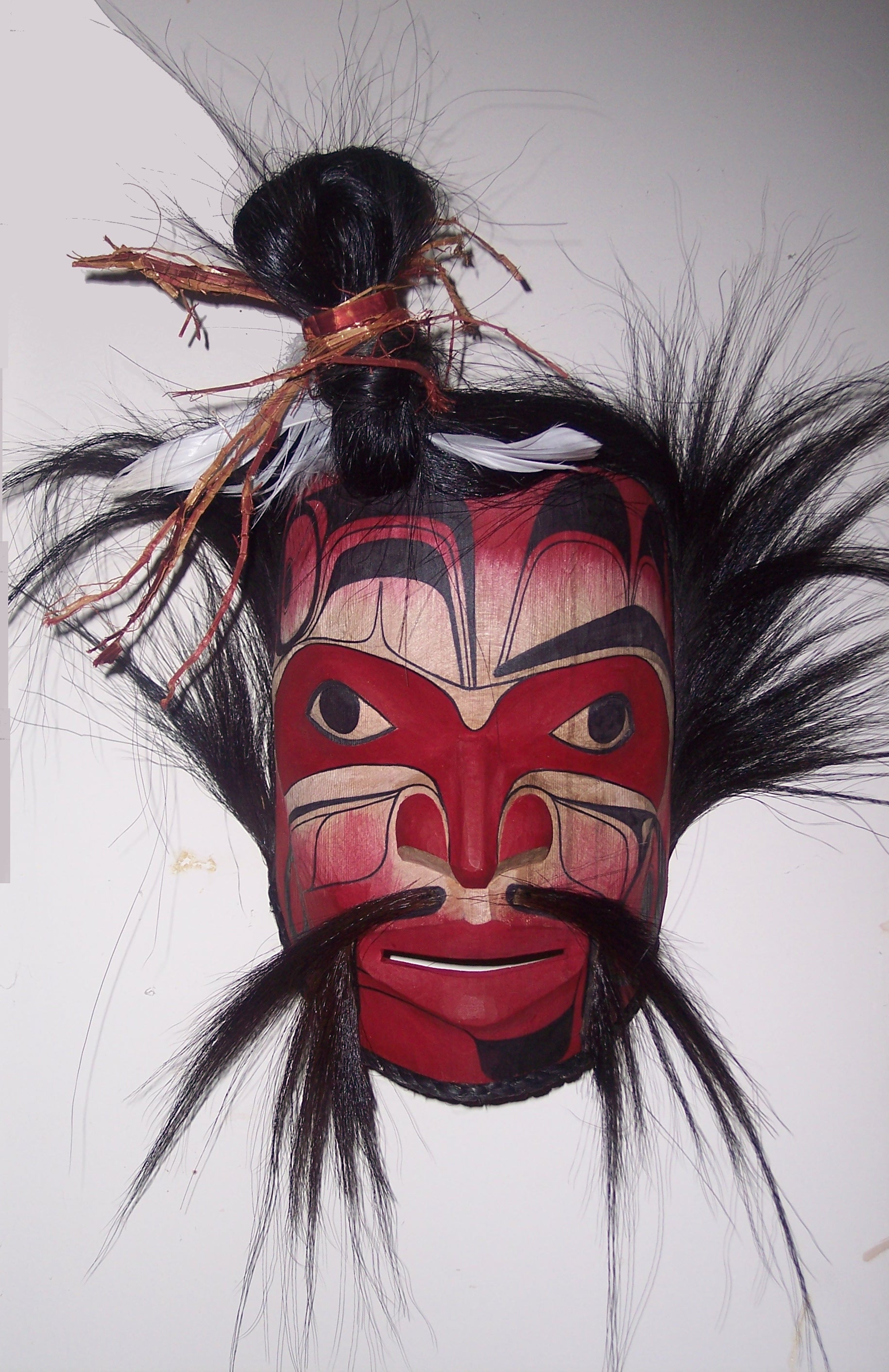
Ian Reid (Nusi) is a Heiltsuk artist whose work I have been watching for a while. For a long time, I was determined that the first Reid piece that I would buy would be one of his Chilkat ravens, like the one that was in the Continuum show at the Bill Reid Gallery. However, when “Working Shaman” came into the Inuit Gallery last month, I leaped at the chance to buy it. The mask is a simple one in some aspects, but all the more appealing for that reason.

If you have read anything about shamanism on the Northwest Coast, you may remember that shamans typically did not wash or cut their hair. This is the main element in Reid’s mask, with its unkempt hair and mustache, its carelessly-tied topknot, and the white feathers. The blending of the red paint into the color of the unpainted wood also suggests a lack of cleanliness, or at least the chapped complexion of someone who spends most of his time outdoors.

Many shamans had a fearsome reputation (certainly, their graves were isolated, and not places where people lingered). This reputation is played upon in many modern renderings of shamans, but Reid has taken a different approach. His shaman is not so much a figure of fear as an eccentric. The unfocused eyes and slightly parted lips suggest the trance state of someone imperfectly grounded in the everyday world.

This is the first Heiltsuk piece I have bought, and I admit to knowing almost nothing of the Heiltsuk artistic traditions, mainly because they do not seem to have been studied in their own right. However, the carving and the painting suggest a tradition that I would expect from the Heiltsuk’s physical location: It mostly resembles the Kwakwaka’wakw, but also has a touch of northern formline as well.

Saying more is complicated by the fact that Reid seems to be drawing on 19th century sensibilities, rather than working as a modern artist familiar with the formal rules of formline. The formline on the mask is looser than modern artists usually draw today, and the U-shapes are independent decorations, not elements contained by the formline. In fact, such formline as appears is thin and almost overwhelmed by the red of the eye sockets and nose, and around the mouth.

Where you can see the plain wood, it looks old rather than recently carved. Add the smearing of the red, and the general impression is of an old mask – dug up, perhaps, from a shaman’s grave to put on display in a museum.

Given that much of Reid’s work is ceremonial and communal, this impression is probably deliberate. Artists who work both commercially and cultural generally make a distinction between the two types of work and, looking for a tradition for non-cultural work, what better place to find it than in a museum? That this is a mask to look at, not to be danced, is emphasized by the fact that not only are there no eye holes, but neither are there are any holes for the nostrils — not even an indication of where they would be.

Portrait masks can be hard to do well. Many carvers – and buyers – prefer bird or animal masks, that seem more imaginative. But in depicting a shaman and giving the mask a patina of historicity, in “Working Shaman,” Reid shows that a portrait mask can be as imaginative as any.

Read Full Post »

Limited edition prints are a standard medium for art, but no school of art has made them its own as much as Northwest Coast art. One reason, I think, is that they were popularized in the 1960s by such leading artists as Robert Davidson. Another reason is that limited prints bridge the gap in price between fine art and tourist curios, with the majority selling for under $400 and many for under $200, and therefore can provide a steady income to printmakers. For buyers, they are a step up from buying a reproduction – although you need to know a bit about prints if you are going to buy sensibly.

The first thing you should know before buying a print is how it was made. The highest quality prints are lithographs or serigraphs (silk screens), but increasingly you find giclee prints, or prints run off a computer via a high-end ink jet printer. Some artists and galleries refuse to handle giclee prints, citing poor quality examples, but their cheapness and the fact that artists can print them on demand mean that giclee prints are increasingly popular. Still, if you do buy one, look closely at how the ink sticks to the paper. If the ink seems loose, or riding above the paper, then your giclee print may have a very short lifespan compared to one made by other methods.

Many people buy a print for the art. However, if you think that you might sell the print someday, notice the print run, which is usually penciled in beside the artist’s name and the title of the print. Forty years ago, print runs of 500 or even 600 were common in Northwest Coast art, but now, a counterfeiting scandal or two later, the norm is now under 200. Private editions, such as those released for an artist’s wedding, may number 25 or less. As a general rule, the lower the number of prints in the edition, the more valuable each print will be in theory.

In practice, however, the number of prints in the run is not always a reliable guide to value. Especially with giclee prints, an artist may not produce the full number of prints in the edition if they are not selling. And, even with traditional prints, some may be spoiled or destroyed, especially as the years go by. Conversely, an artist may deliberately withhold prints from the market in hopes of artificially creating a demand. Unless you know something about a limited edition, it is almost impossible to know how many are actually in circulation. Understandably, artists and galleries are sometimes reluctant to talk about such matters.

For the same reason, buying a print with a low number, such as 1/200 does not always result in a more valuable print. If you later resell a lower numbered print – or a collection of prints with the same number on each print – you may actually get a price that is higher than usual, but the increased value is entirely in the eyes of the buyer.

Similarly, Artist Proofs (AP)are often sold for more than a standard print – often for up to twice the price of an ordinary print. Artist Proofs are supposed to be copies run during printing to check the quality of reproduction. However, today, Artist Proofs are just as likely to be five prints – possibly the first five – run off and labeled as Artist Proofs. Except for their designation, Artist Proofs are unlikely to differ in any way from other prints in the run.

Another way that a print can increase in value is if it is a Remarque (RM). A Remarque is an addition to the print, often hand-drawn, by the artist themselves. A Remarque is usually a small doodle, but it can almost be a substantial edition to the print. Either way, a remarque print often goes for twice the price of other prints.

Still another way to give a print added value is a personal message from the artist. However, such prints rarely come on the market.

However, unless you are a serious collector, worrying about Artist Proofs, Remarques, or personal messages is rarely worth your while unless the artist is well-known, and the print is already about $400. Most prints will only rise slightly in value in two or three decades, regardless of their embellishments.Only a few artists, such as Susan Point or Robert Davidson, release prints that quickly rise in value, and the value of their works rests mostly on the consensus that their work is collectible.

With most prints, therefore, you should probably not think of added value at all. Instead, buy what pleases you. That should be your first criterion anyway — not the return on your investment.

Read Full Post »

With few exceptions, the collecting of Northwest Coast Art did not begin until the 1970s. That means that pieces from those collections are just now starting to appear in estate sales – sometimes at bargain prices, if the heirs are more interested in quick cash than obtaining the full value. Consequently, when a copy of Lyle Wilson’s 1980 limited edition print “Shaman’s World “ showed up at the Inuit Gallery during the summer, I quickly snapped it up.

The print would be unusual today, but, when it first appeared, it must have seemed utterly unique. I tag it in my mind as a Northwest Coast Gothic, a kind of predecessor of Ron Telek’s work. It is also Gothic in a modern sense: monochromatic, macabre, and, quite possibly, self-consciously over the top.

The shaman’s world, apparently is actually two worlds, one the mundane world of light, and the other the dark world of the supernatural and other realms like the sky and the depths of the ocean. In the mundane world is the head of an eagle – perhaps a tutelary spirit to judge from the hand above it – while below it is a figure that may be a man terrified of the shaman, but which I suspect is a masked dancer, trying to make sense of reality through his dance. Meanwhile, in the spirit world, a man transforms into an eagle while below it swims a killer whale, another figure of power.

Neither world has much in common with the other except the shaman, who stands in the middle like a sort of ying-yang symbol, half of him in each world. Both worlds are contained in a frame of human figures (whose formline shapes suggest that they are intended as skeletons), birds and monsters that are apparently wolves. The tops and bottom of the frame are mirror images, perhaps adding the additional dimension of life and death to the cosmology contained within the print.

The shaman’s position, clearly enough, indicates that the shaman mediates between all aspects of the world, as well as their different methods of understanding. It might also be significant that the shaman is less skeletal than the human figures in the outer frame and has a differently shaped-head; perhaps the suggestion is that the shaman is the only piece truly alive.

The formlines in “Shaman’s World” are wonderfully simple, defined largely by interior elements to indicate knees and hips and chests. They flow from one shape to another, as good formline should, but so do the elements of the design. For instance, although the shaman’s arms are held in front his chest, the body of the human transforming into a bird and the first sprouting feathers look, at first, like an additional arm. Similarly, the twisted body and tail-flukes of the killer whale suggest a third leg. Together with the formlines, these flowing shapes help assure that the viewer’s eyes are never still, picking out a detail here and there, but always moving around the design.

Another obvious element is the use of blank space. Although much of the design is symmetrical, especially in the frame, the blank spaces on both sides of the shaman are highly irregular, being open and broad on the mundane side, and narrow and twisting on the spirit side. In this way, both the traditional symmetry of most Northwest Coast art and the asymmetrical preferences of modern design appear in the design – yet another set of elements that the shaman mediates between.

By restricting himself to black and white, Wilson relinquishes whatever a secondary or tertiary formline color might have brought to the print, but probably it is just as well – had he added red or blue or green, the design might have collapsed under its own weight. As things are, it is still a restless piece, full of contrasts and new elements to discover as your eye travels around it again and again.

Read Full Post »

Alano Edzerza is a thirty-year-old Tahltan artist whose work ranges from architectural commissions and uniforms for the Dutch Olympic team to T-shirts and hoodies. Although he sometimes duplicates the same design in different media a little too often, on the whole, his work is a good example of how you can find something for every budget in Northwest Coast art. So long as you’re not looking for one-of-a-kind pieces, you can often find pieces of work for $200-$500 in the gallery that carries his name.

For example, one of the pieces usually available at his shop is this Chilkat belt buckle:

Edzerza has often worked with Chilkat designs, but, because they originate in weaving patterns, seeing a single element like this is startling. More often, a Chilkat design will have a number of elements, often repeated, with the result that you rarely linger over a single element. Isolated here, the design gives you the chance to study the face at length. In fact, it wasn’t until seeing this belt buckle that I realized that Chilkat designs (of which I know very little) are structurally closer to the formline designs of paintings and carvings than I had realized.

Edzerza also occasionally sells castings of other artists’ work, like this one taken from a pendant by Mark Prescott, whose prints have been available in the Edzerza Gallery:

The pendant is non-traditional, of course – if anything, the crouching figure of the shaman reminds me of some Old Norse drawings I have seen of Woden. This (presumably) accidental resemblance seems appropriate, since, like the Old Norse god, this shaman with a rattle in his right hand and a knife in his left combines elements of both the magician and the warrior.

Edzerza has also done a casting of an eagle pendant by Marcel Russ. I believe the original is in argillite:

Unfortunately, this picture suffers from the limitations of my digital camera. As a result, you will have to take my word that this casting manages to capture the strong sense of line for which Russ is famous. That is not an easy thing to do, and many casts I have seen of original works are muddied versions of the original. But here, Edzerza – who also shows a love of a good line, both in the occasional borrowing and his own original ones – has managed to give a strong suggestion of what the original must look like.

Works like these do not increase in value like exclusive works. But, at their best – as in these three pieces – such commercial works make a bit of beauty accessible to any budget.

Read Full Post »

One of the ideas that keeps circulating through books and blogs about business is that emails should always be kept short. The suggested rules for keeping them short vary – less than a hundred words, short enough to be read without scrolling, and, most common of all, two to three sentences – but the idea is similar, regardless. It is also an idea that can do as much harm as good.

There are at least two rationales for this idea. The first is that if you are sending a marketing mailout, shorter ones are more likely to be read than longer ones. However, given that mass mailouts are likely to be flagged by spam filters, I suspect that the length doesn’t matter much, and that mailouts of any length are most likely to go to the Trash folder unread. Moreover, most emails are not mailouts, and, in a business context, you can count on them being read regardless of length.

The second is more convincing: Conciseness is more forceful, and more respectful of the recipients’ time. And, certainly, many emails, such as those arranging a time and place to meet, hardly need more than a sentence or two.

However, if issues are being discussed online, a brief email will hardly be enough. You should still make sure that an email is no longer than it needs to be, but if what you are discussing needs eight hundred words, then by all means you should give it eight hundred words.

By contrast, insisting on conciseness can cause problems of its own. For instance, this morning I received the following email: “Any specific request for the Greek food? How many boxes would you like?”

I immediately understood that the first sentence referred to the Greek food that the sender would be bringing around to my townhouse tonight. However, at first I interpreted the second sentence as a question about how much food should be bought. It was only after I replied that I realized that the second sentence was referring to another matter altogether – how many cardboard boxes the sender should bring, since they were helping me pack. This is a trivial matter, but it shows how easily conciseness can create confusion.

Moreover, in many contexts, being concise can create a negative impression. It can sound curt or rude, or even indifferent, even if your intention is not to create such an impression. Communication is always as much about relationships as it is about the ostensible subject, and, when you are being concise, on of the aspects most likely to be left out is the relationship part. If you get too caught up with efficiency and forget this fact, that you can easily leave the recipient feeling slighted.

I had an example of this when someone recently sent me a three-sentence email in response to news about my partner’s death: “I am so sorry to hear about your loss. It is so sad. My sympathy to you and your family.”

The sentiments were right here, but the shortness of the sentences undermined them, making their expression sound formal and insincere. The email also has a staccato rhythm and regularity of structure which makes it sound even more perfunctory. It sounded so indifferent that I found myself wondering why the sender had even bothered.

By contrast, here is another email I received at around the same time: “I am so very sorry to hear this news – please know that you have many friends thinking of you and sending you support and love.”

It is just as short, and just as obviously from someone who does not know me particularly well. Yet it takes the time too be personal in a way that the other email did not, and as I result, I found some small comfort in it.

Novice writers might be tempted by simple rules to help them write better, but the point is that they rarely work. Follow a rule like the three sentence email, and you can cause yourself more problems than you solve.

Read Full Post »

One of the minor tribulations about grief is that people are continually pressing inspirational poetry upon you. Just as people feel they have the right to touch a pregnant woman’s belly, so even comparative strangers feel that they can offer you material that ordinarily you would never consider reading. Suffer bereavement, and you are aware of this mawkish, archly Christian sub-literature that dozens of people suddenly want to share with you.

They mean well, of course. Whenever someone thrusts a printout at me, I thank them with a straight face, solemnly read the printout, and thank them for their kindness. I don’t want to hurt anyone’s feelings, particularly when they are trying to make a thoughtful gesture.

Inwardly, though, I am wondering, “Why do they imagine that grief has blunted my aesthetic sense?”

You see, what makes this poetry such a tribulation is not that it’s Christian. I am an agnostic, but I live in a post-Christian culture, and I fully accept that, to understand the literature of the past, I have to be fully versed in Christianity. And I am, so much so that I have have read large chunks of St. Augustine and Thomas Aquinas. But when there are such Christian poets as John Donne, Emily Dickinson, or Gerald Manley Hopkins – or even Tennyson, in his ponderous way – why would anyone turn to the mediocrities that I keep receiving?

At least with such poets, the aesthetic pleasure can provide a genuine relief from grief, and deciphering the argument can be an intellectual diversion, even if I reserve judgment on the Christian conclusion.

But the poems that make up the sub-literature of death are usually doggerel, with all the subtlety of an SUV slamming into a pedestrian.

Take, for example, “Do Not Stand,” a poem attributed to half a dozen sources, but probably the work of Mary Elizabeth Frye. “Do not stand at my grave and weep; / I am not there,” it begins, then goes on to explain where the speaker can be found – for instance, in the reflection of the snow, or the sunlight on grain. A statement about survival after death, it is better written than most of this sub-literature, but goes on for about half a dozen lines too many without any development of thought. And when I come to the last line of, “I did not die,” I become possessed by the cynical ghost of Robert Graves, and I am moved to ask why the speaker has a grave, then.

For that matter, why shouldn’t those to whom the poem is addressed cry? That is a natural part of grief, and knowledge of the person’s survival after death does not change the fact that the deceased is no longer present.

Another example of this literature is, “Death is nothing at all,” which is attributed to Henry Scott-Holland, a canon at St. Paul’s Cathedral in the late nineteenth or early twentieth century. According to Scott-Holland, the dead “have only slipped away into the next room” – as if that made them any more approachable.

“I am I and you are you,” Scott-Holland continues helpfully, just in case you were confused, and urges you to act the same as always, and act as though he was still present. “What is death but a negligible accident?” he asks, apparently because “I am waiting for you for an interval / Somewhere very near . . . . One brief moment and all will be as it was before / How we shall laugh at the trouble of parting when we meet again!”

Well, you know, even granting survival after death in some form, I seriously doubt that laughter. I don’t know about anyone else, but falling into each other’s arms with cries of relief sounds more realistic to me. When I reunite with somebody in life, I don’t laugh at my emotions when we parted, so why would I do so after death? There is something so arch and so smug in this doggerel’s sentiment that to me it amounts to a trivialization of death and grief.

Yet even these two pieces sound like masterpieces next to the anonymous “God sends his love.” Sharing some of the archness of Scott-Holland, this one describes the dead person as being chosen to die so that he can help God in his work. It repeats Scott-Holland’s sentiments about not grieving, but at least has the decency to add, “But do not be afraid to cry, it does relieve the pain.” – although the sentiment is immediately spoiled by the nonsensical line, “Remember there would be no flowers unless there was some rain.”

Blithely skirting around the problem of pain, the piece goes on to assert that death is all part of a divine plan that humans cannot comprehend, and urges the mourners to be helpful to those in need, adding

And when you feel that gentle breeze or the wind upon your face, that’s me giving you a great big hug, or just a soft embrace.
And when it’s time for you to go from that body to be free, you’re not going, you are coming here to me.
And I will always love you, from that land way up above, will be in touch again soon.

Then it ends with “Ps God sends his love” – a tug at the heart strings that even Steven Speilberg would feel ashamed to try.

What is interesting about all these pieces is how much they have in common. They all take the form of the deceased talking to those who survived them, assert survival after death, and downplay the importance of grief. The last two also promise that the deceased and the survivors will meet again as a reason not to grieve.

Perhaps some Christians can find some comfort in the repetition of their core beliefs. Presumably, many can, since few seem to object to the use of uninspired modern hymns in place of the masterpieces from the 18th Century in ordinary services.

But, for me, such works seem profoundly inhuman. By insisting that grief is unnecessary, they show no understanding of human psychology whatsoever. And when this inhumanity is expressed so poorly, with so little development of thought – well, is it any wonder that these printouts go directly into the recycling bin when I come home? In every possible way, they seem a mockery of my grief, not a comfort in the least.

Read Full Post »

In the six weeks since my partner died, I have spent much of my spare time cleaning the townhouse. Neither of us were particularly tidy people – although we both placed a high value on hygiene – and we hadn’t done a thorough cleaning in years. She had been sick a long time, and in the last few years, we had had better things to do. Recently, I have been undoing the years of neglect, and finding, somewhat to my surprise, that I am enjoying the process of tidying, and finding it both satisfying and therapeutic.

For a long time, I have referred to reducing clutter as “easing the karmic burden.” That is meant as a wry reference to the idea of not burdening yourself with possessions, but it seems to me literally true. Getting rid of non-essentials feels very much like organizing myself, or perhaps getting rid of distractions.

Then, too, I suppose that creating order out of chaos is one definition of creativity. Organizing my desktop or library may not be actually creative, but it feels like it is. In a milder way, the sense of accomplishment that comes from tidying feels much the same as that when I complete an article or a poem.

In the last six weeks, those feelings have been especially important to me. But, even more to the point, I’ve needed something meaningful or useful as a distraction from grief. I haven’t been capable of much original effort (which makes writing articles painful, let me tell you), but tidying has been something I could accomplish without a great deal of thought.

Moreover, in this case, tidying has been a way of dealing with grief. As I sort through a closet, I remember when something was bought, or who gave it to whom, and what we said at the time. I find parts of our lives that I had forgot about, or even parts of Trish’s that I only knew vaguely, or not at all – something I would have said was impossible after all the years of our marriage. I have even discovered gifts that she had bought for me, but never given. At times, I’ve broken down while cleaning, and worked with streaming eyes, or had to sit down and rest because I was overwhelmed.

I sometimes think that, had I known the scope of the task I was undertaking, I never would have started it. But, mostly, I think I wouldn’t have missed the experience for any reason. In tidying my external environment, I’ve been doing some internal sorting as well. If I finish the process in a few weeks, as I intend, in many ways I’m going to miss it.

I don’t know if I will keep the townhouse as tidy as I’ve already made several rooms and plan to make the rest. I think I will, at least for a while, because the result appeals to the austere side of my nature. But if I backslide, that wouldn’t be the worst thing that could happen, because the effort of tiding will have already served its purpose for me.

Read Full Post »

The concept of a friend on Facebook is (to say the least) elastic. At its loosest, it can mean someone who might be useful to know, but with whom you have never interacted. At the opposite extreme, it can mean an intimate, or someone with whom you regularly interact online. But, no matter how a Facebook friend is defined, unfriending someone is generally considered a serious step, and I’ve only done it three times.

The first time, I made the mistake of accepting a friendship invitation from a friend of a friend. A few days later, the friend of a friend started chatting with me and tried to interest me in what sounded like a pyramid scheme. I made an excuse to log off chat and instantly unfriended them.

The second time involved an acquaintance who indulges in yellow journalism. They are careless of their facts and their logic is slippery, but they expressed an admiration for my writing, and I thought that maybe if they were taken seriously by other writers, they might evolve into an effective journalist. But then they turned their tendencies on me without any warning or apology, and I decided I wasn’t about to mentor someone who wanted to tear me down in order to build their own reputation. That wasn’t what friendship was about, so far as I was concerned, so exit another Facebook friend.

The third time was more complicated. It involved someone I had known for years. A few years previously, we had quarreled, but they approached me on Facebook and, despite some qualms, I accepted their friendship invitation. I had always admired this person’s brains and talents, and I frankly hoped to get to know them – to become a friend in real life, as I expressed the hope to myself.

However, I had forgot that one of the reasons we had quarreled before was this person’s inability to keep up their side of a correspondence. From somewhere – probably a bad book on business management – they seemed to have got hold of the idea that online correspondence should be limited to two or three sentences. To make matters worse, what they did write was so stiff that it sounded cold and condescending – and I have never been able to endure being patronized. The tone killed all efforts to strike up a conversation, and I soon realized that the development of any actual friendship would require the effort put into the first six days of creation and geological units of time, neither of which I had to spare.

Even so, I might not have bothered unfriending under ordinary circumstances. But my wife was hospitalized and dying, and so was a relative of this person. I suggested (in effect) that we might give some mutual support, and received another cold reply, which indicated to me that I was just another part of their effort to compile the largest possible collection of Facebook friends.

Then my wife died. The alleged friend’s reaction? “That is so sad.”

Granted, their own relative had also died. Yet even the person’s own grief could not justify such a chilly reaction. There I was, facing one of the worst experiences anyone can face, and instead of any real sympathy, what did I get? An insincerity worthy of Dale Carnegie. Anyone else would have mustered a little empathy, being in a similar position.

“Sad?” I wanted to phone up and rant. “Rick and Ilsa’s goodbye at the end of Casablanca is sad. The farewells at the end of Lord of the Rings are sad. This is tragedy, you asshole!”

Instead, I unfriended, and – not wanting to appear a coward – sent a brief note saying that I had done so. I said that if they wanted to talk, I would, adding that they probably wouldn’t care for what I had so to say.

I heard nothing, so I knew I was doing the right thing.

Still, I admit that I regret this third and latest unfriending in a way that I never did the first two. But what choice, really, did I have? I have (and have had) friends of both sexes that have my back the way that I have theirs. I don’t need a hanger-on too egocentric to know what friendship is about.

Or do I make too much out of a word that, on Facebook, no longer retains its original meaning, except by chance?

Maybe. But all I know is that recently I am now much choosier about the friendship offers I accept.

Read Full Post »

« Newer Posts - Older Posts »