Feeds:
Posts
Comments

Archive for the ‘Uncategorized’ Category

Online dating sites often advertise themselves as scientific. They ask you to answer hundreds of questions, and encourage you to take endless tests, all in the hopes of finding someone to love. In my experience, the results are about as accurate as a horoscope, and another example of how science is evoked to justify flimflam and phony services. Still, I have to admit that some of the questions do tell you a thing or two about the people who answer them – just not always what the question intended.

The best example of such questions are those that ask you how sexually confident you are,  or how strong your sex drive is. I realize that social media has long ago conditioned most of us to answer any question put to us in a web browser, but these questions are an open invitation to lie.

Think about it: statistically, the only truthful answer for the majority is the choice that identifies them as average. If nothing else, very few of us have the experience to have a statistically meaningful idea about how we compare to others of our gender and age. However, nobody wants to admit they are average. Average is boring, and nobody on a dating site wants to appear boring, which may explain why I have never seen such an answer to those questions.

Still less is anyone going to identify themselves as below average in confidence or sex drive – unless, perhaps, they are under twenty and unusually repressed or inexperienced. I mean, who wants to nurse someone along in order to have a relationship? Not even the unusually repressed or inexperienced, really.

That usually leaves labeling yourself as above average or far above average. Even  if you secretly consider yourself a sexual athlete of world cup standards, you’d have to have the intelligence of a bed of kelp to admit that in public. Not only does it sound like boasting, but it sets an impossibly high standard for your eventual performance.

In the end, the only answer – and the one most people usually give – is that they are above average. However, since the other answers aren’t useful, nobody knows whether the answer is truthful. More likely, identifying yourself as above average only says that you are modest and have given the question of how to game the system some thought.

In other words, the supposedly scientific system cannot be trusted. In fact, for some questions, it encourages users to lie – and we all know how important lies are for building a lasting and mature relationship.

Read Full Post »

Last summer, I contributed to Haida Raid 3: Save Our Waters, an environmentalist animation. I couldn’t resist, given the cause and the perk of a print: Jaalen Edenshaw’s “K’alt’side K’aa” (“Laughing Crow”).

Edenshaw is the brother of Gwaii Edenshaw, one of the foremost jewelers on the coast. Much of his work is on poles and other community art, with only an occasional piece making it as far south to Vancouver. So I was happy when, a few weeks after the Haida Raid fundraiser closed, I received this small sample of his work. Many people assume that Haida art has no humor, and I’m glad to have a piece that proves otherwise.

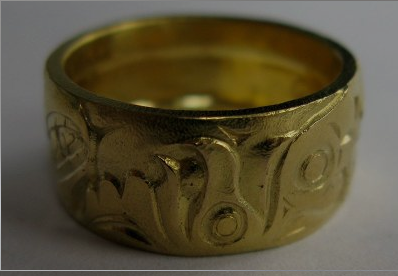
What particularly interests me about this piece is its resemblance to some of the figures on the ring I bought from Gwaii Edenshaw five years ago. I had asked Gwaii to do a ring illustrating the story about how Raven turned the crows black. Not wanting to share their salmon with Raven, the crows put crumbs in the dozing Ravens’ mouth, then try to convince him that he already eaten when he wakes up. But Raven is not deceived, and throws the crows into the fire, singeing them so that their feathers turn from white to black.

bruce-ring3

On the ring, Gwaii depicts the crows in the middle of sprinkling Raven with crumbs of salmon, rolling them into his mouth and along his back. The crow figures resemble the ones on Jaalen’s print, and I mean to ask him which came first the next time I see him.

Meanwhile, the print is a good example of how I can enjoy a hundred dollar piece as much as a ten thousand dollar one. With a print run of 270, the print is unlikely ever to be valuable, but I admire it for its unusual posture, as well as the lines indicating movement on both sides of the figure. Compared to most prints, it is a cartoon – but that, I suspect, is exactly what was intended.

laughing-crow

Read Full Post »

When I was researching my master’s thesis, I became a Jungian. I didn’t plan to. But my subject was influenced by Jung, so I eventually read the complete works of Carl Jung. Often, I wondered if reading Jung in translation was any easier than reading him in German would be, but the experience left a major mark upon my thinking, especially about gender roles.

I must say that, as a person with artistic aspirations, I found Jung more sympathetic that I ever did Freud. Freud and his disciples usually make very clear that they are the experts, and that they know more about your unconscious than you do. By contrast, Jung considered artists as experts in symbolism, sometimes even as people he could learn from, and his respect made me more inclined to consider his perspectives.

Before long, the idea that people think and act largely in terms of symbols began to make sense to me. I questioned if all the archetypes were universal – although some, like the Mother and the Father probably were, but modern, often feminist, schools of Jungian thought included the possibility that some might be cultural, which made sense to me.

Either way, Jungian thought seemed to do more to map the unconscious than psychoanalysis ever did. The idea that symbols were how the unconscious expressed itself explains why rational argument so rarely changes anybody’s mind – there’s a basic translation problem between the conscious mind’s use of language, and the unconscious mind’s use of symbolism. Moreover, the idea that people project their unconscious symbols on to those around them helps to explain why misunderstanding is so commonplace – much of the time, people are reading from different scripts.

This model has been especially useful for me in understanding gender relations. For example, Jung suggested that one of the most influential archetypes for a man is the Anima, or the female version of himself. As much for symmetry as any other reason, he suggested that a woman is motivated by a similar archetype called the Animus, which is the male version of herself.

The Animus seems so much an after-thought in Jung’s writing that a widespread debate, especially among female Jungians, is whether the archetype exists. Realizing that men tend to define themselves in terms of not being a woman – in fact, to treat women as the archetype of the Shadow – I had no trouble in concluding that the Anima exists.

But the Animus? The evidence for that archetype seems much weaker. Some women go into mental contortions, even enduring abuse, to make themselves over in the image that men want, but – to many men’s intense dislike – women as a whole do not seem to define themselves as being the opposite of men. Men need women to tell them who they are, but women do not seem to need men to the same degree or in the same way.

For me, this difference explains the difficulty that many men have in accepting feminism. Because their identify depends on women’s roles, any change in women’s roles means that men’s own identity is under-mined. Already inclined to see women’s roles as mysterious and even sinister, they move easily to seeing any change as a threat – something that the Shadow is never far from being at the best of time.

To avoid this reaction, a man needs to reject the Anima and Shadow as an influence on his thinking. But the two archetypes are such a fundamental part of male thinking that rejection is difficult, and often impossible.

This reaction is one that most feminist theory seems to have largely overlooked. What Jungian theory suggests to me is that male hostility to feminism is generally not about the threat of a loss of privilege or power. Rather, it is about a loss of identity, about no longer having models to tell men who they are (or, to be more accurate, who they are not).

By contrast, women may not approach changes in gender roles easily. If nothing else, habit remains a strong motivation. But traditional gender roles have less to offer modern women than they do men, because less of their identity is based on not being men. Women may feel unsettled when they try to move beyond tradition, but the average woman is far less likely than men to feel that their entire sense of identity is being destroyed in the process.

What makes the situation all the harder is that, because the problems are played out symbolically, men are frequently unable to express what has happened. They may become angry, depressed, or abusive, but these reactions in themselves only indicate that something is wrong – and not what the exact problem is. At best, the number of men – or women – who understand their symbolic life is always going to be very few.

Jung is not the only way to this perception. In Stiffed!, Susan Faludi comes to a similar analysis simply by hearing the same problems over and over from the men she interviews. But my guide was Jung, and he remains – mistakes and all – one of the foundations of my thinking.

Read Full Post »

At the end of The Battle of the Five Armies, Gandalf describes Bilbo as a small fellow in a much larger world. The words are Tolkien’s, but while Tolkien has Bilbo reply, “Thank goodness,” making the description an indication of the self-knowledge he has gained, in the movie, the line does nothing except express Gandalf’s fondness for the hobbit as they part company. This false note is typical of the mis-steps that the movie makes, again and again.

As a writer and a producer, Jackson is at his best when he follows Tolkien most closely. For instance, in The Battle of the Five Armies, Bilbo’s return home in the middle of an auction of his goods to discover he has been declared dead expands Tokien’s brief description of the scene while preserving just the right comic touch. The unexpected arrival of Gandalf and thirteen dwarves at the start of the first movie also works, although Jackson’s version drags because he is less skilled at exposition than Tolkien.

Unfortunately, most of the time, Jackson seems to neither trust nor understand his source material. His favorite mode seems to be Grand Opera, full of world-sweeping events and high dramatics. This tone works in Lord of the Rings, partly because much of the trilogy has the same tone, and partly because when filming Lord of the Rings, Jackson still had the sense to include small intimate moments, and even to invent such incidents as the four hobbits silently toasting each other in the pub after they arrive home.

But The Hobbit is all about intimate moments. The whole point of The Hobbit is that Bilbo is not a hero, and takes a long time to achieve the small heroism that he eventually accomplishes. Jackson, though, ignores most of this tone to replace it with Grand Opera. Almost the entire third movie is Grand Opera, in which a battle that Tolkien barely describes occupies the entire movie to the point that it becomes a kind of fantasy war porn, a tiresome collection of scenes that add up to nothing. Compare The Battle of the Five armies to the Rohan’s arrival at Minas Tirith in The Return of the King, in which the ensuing battle is about defining moments for several of the characters, and you see the lack of purpose in The Battle of the Five Armies immediately.

Part of the problem, of course, is that one movie of material has to be stretched to fill three – a mistake so basic that it should have been restrained regardless of commercial motivations. Some of this expansion is legitimate, although the expulsion of The Necromancer / Sauron from Mirkwood take place in a way that is far from the spirit of Tolkien. However, most of the filler material does not work even so much as that episode manages.

The trouble is, much of the filler is thin to start with, and Jackson seems unable to invent enough to make it interesting. For example, he adds an orc chieftain’s feud with Thorin, the leader of the dwarfs, but fails to flesh it out, leaving the orcs to thrust themselves into already dramatic scenes, with the chieftain shouting such redundant device to his cohorts as “After them!” and “Kill them!” (as though orcs would ever invite Bilbo and the dwarves to tea).

Other pieces of filler are so bizarre that they become ludicrous. When I saw the first movie, the entire audience burst out laughing at Radaghast’s rabbit-driven sled – and it was not a good-humored laugh, but a laugh of rejection. Similarly, when the elf king shows up in the third movie riding what is either a moose or a horse with decorative antlers, I felt the movie had degenerated into a Canadian beer commercial. By the time I saw Dain arrive on a giant pig, or watched the dwarfs clinging to armored mountain goats as they bounced up a mountain, I was throwing back my head and laughing at the inappropriateness of it all.

Somehow, I don’t think that was the reaction that Jackson intended. But it was an indication of how much his judgment has slipped in recent years.

Another major mis-step was the introduction of the elf woman Tauriel and her love for one of the younger dwarfs. What Jackson seems to have missed is that The Hobbit is a children’s story, so the fact that all the main characters are male tends not to matter. Love and sexuality simply don’t enter into the plot. You don’t watch Tolkien movies for the love scenes any more than you watch Marx Brother movies for the inevitable lovers’ sub-plot.

Nor is Jackson’s effort to fix what doesn’t need fixing particularly skillful, since, despite the hints of a love triangle with Legolas, Tauriel remains a flat character so defined by the men in her life that she is more insulting than the absence of women could ever be. Unlike Arwen, whose appearances in Lord of the Rings made for the slowest parts of the movie trilogies, Tauriel is not even allowed to be the tragic figure of an immortal in love with a mortal.

All this would be bad enough by itself, but Jackson’s storytelling seems to have deserted him as much as his invention, leaving him to repeat himself endlessly. Just like the first Lord of the Rings movie tantalized with only glimpses of Gollum, so the first Hobbit movie tantalizes with glimpses of the dragon. All the underground battles involve collapsing bridges and violations of the rules of physics. Main characters fall, are loomed over by a foe, and are saved at the last second by the approach of another character. Gandalf duels with a figure of evil, and is imprisoned.

Jackson’s repertoire is so limited that, near the end of the third movie, he even has the orcs tunneling with giant worms, as though that had somehow drifted into the movie from some forgotten footage of Dune. Jackson’s repetition of tropes is so predictable that he seems an honorary member of Bilbo’s expanded family; while Tolkien describes the Bagginses as being so conventional that you could tell what they would think on any given subject without the bother of asking them, so you can tell how Jackson will develop a scene without the bother of watching it.

Such shortcomings might matter less in any other film adaptation. But The Hobbit is both a classic and a cult book, and another version is unlikely to be made any time soon. Under these conditions, Jackson has an obligation to be true to the spirit of his source material. He should not be expected to use all of the book’s dialogue or events, movies being different from novels, but he can be expected to be true to the spirit of the book, and not just borrow its highly marketable name.

But Jackson only intermittently connects with the spirit of the book. Instead of producing movies that can stand beside the book, all he manages is overblown and easily forgotten nonsense.

Read Full Post »

When I was young and innocently idealistic, you could always infuriate me by quoting an aphorism attributed to Winston Churchill (as well as about a dozen others): “If a man is not a socialist by the time he is 20, he has no heart. If he is not a conservative by the time he is 40, he has no brain.” I didn’t like anyone claiming they knew better than me, or implying that my beliefs were a passing phrase. Yet at the same time, I worried that the quote might be right, and I was doomed to become conservative. Consequently, it comes with considerable relief, now that I am well past forty, to realize suddenly that my core beliefs remain the same as they were when I was sixteen.

What that says about my intelligence, I leave for anyone who wants a cheap shot to suggest. But in retrospect, I should not be so relieved. The beliefs I assembled into a world view in my teens were not the product fashionable thought; I may not have read as much of Karl Marx or Pierre-Joseph Proudhon as I should have, but I definitely read about them, and thought about what I read even more.

Nor was there any question of just mouthing memorable quotes. I called myself a feminist, so when the time came, I attempted to construct a feminist marriage. I wanted work that was meaningful and useful, so when I was free enough of necessity to choose, that was the kind of work I chose. My adult life has not been a clean break from my teens – instead, it has been an attempt to carry out the beliefs that my teen self developed. I suspect I have fallen short of my youthful idealism, but the point is that I am still trying to live up to my long-ago conclusions, and so long as I try, the odds of me turning conservative are not going to be very high.

That is not to say, though, that how I hold those beliefs remains the same. In my teens, I was passionate and I thought a better world was only a matter of time. All that I and people like me had to do was explain our positions to gain supporters. It was only ignorance that made people oppose us.
Now, I am less passionate and more disheartened. I know, too, that people cling to outdated ways of thought for countless reasons: for power or convenience, or out of fear or a dislike of thought or a discomfort with conscience.

An even harder lesson has been that some of those whom my younger self would have identified as part of the problem can be loyal friends so long as you avoid provoking them in certain ways. Sadly, I know, too, that some of those who claim to be on my side are immoral and unpleasant people that I would prefer to avoid.

In fact, there are moments when I regret my lost conviction and feel that every cause is a collision of half-truths. But then I tell myself that, even if that is true, I still have an obligation to take a side, and that the world view I formulated decades ago is still true –even if applying it to what is happening around me is more complicated than I once imagined.

In other words, I believe less intently, but more deeply. More importantly, because my views take in more factors and reflect reality better than they did when they were new, they are truer than they were then. I guess you might say that my heart is still that of a twenty year old, and if my brain is not, it is still as far away from being conservative as it was then.

Read Full Post »

Have you ever sat down to eat outside at a park or public market, only to be mobbed by seagulls looking for a handout? Change the species, and that scenario has become the norm for my dinner – and don’t tell me that two small parrots can’t be a mob, because my first hand experience proves that they can.

For years, I used to eat dinner with Ning and Sophie, and our cripple bird Ram with Trish. Since the deaths in the flock, Ram has taken to eating with me. I scoop him up on to my left shoulder as I come in from the kitchen, and almost before I sit down, he is rappelling down my arm after whatever has caught his attention on my plate – usually, potato, rice, or a piece of chicken. If his target is healthy for him, I put a small portion aside for him, and, when he is temporarily sated, he wanders around the table, pausing for a drink of fruit juice before clambering back up on me.

Beau, my other remaining bird, was a neglected bird, and, for years lacked the confidence to compete with the others – especially Ning, who had him thoroughly mentally dominated. Usually, I tried to make it up to him by offering him some juice before I sat down, but even that made him nervous.

Suddenly, two weeks ago, Beau suddenly found the courage to see what he was missing. He landed on the table with a thud and a small squawk (like most parrots, he is not the most graceful of landers), and started waddling towards my plate.

About thirty-five centimeters from the plate, Beau paused and retreated, keeping the diameter of the plate between him and Ram. With his head down, Ram was so busy making delighted noises and cramming his crop full that I’m not sure he even noticed Beau.

Moving slowly, I broke off a piece of roast potato and offered it to Beau. He grabbed it and retreated to the far end of the table. There, he adjusted his beak’s hold on the potato, and leaped as much as flew to his cage, retreating to its depths where he could enjoy the spoils of his raid undisturbed.

The next night, he repeated his visit. I could tell his growing confidence by the fact that he actually took my offering from the plate, and only retreated as far as the top of a Windsor chair to eat.

Since then, Beau hasn’t missed a night. It takes some alertness on my part. If I am slow to put aside Beau’s portion, he sometimes ventures to help him himself, always with a nervous air as if he is not sure of his right to be there, or as though he anticipates catastrophe if he puts a foot wrong.

At other times, however, he will show his impatience by trying to take a bite out of my book. And should the phone ring or some other unexpected event happens, both Beau and Ram take to the air, forming what the old Elizabethan madrigal described as “a shipwreck in the sky.” Since they both tend to take refuge on me, that usually means that sharp beaks and strongly flapping wings are all uncomfortably close to my face, and both reading and eating a hot dinner have to wait as I try to play peace keeper without one of them striking out at my fingers.

Dinner used to be a quiet time for me, but I’m not complaining. Beau and Ram are edging slowly to detente, and I’m happy to see Beau overcoming his timidness enough to claim his rights. Sometimes, I am tempted to put them in their cages for the night and have a quiet midnight supper, but that seems so lonely compared to dinner with the mob that, so far, I haven’t actually done that.

Read Full Post »

An audience’s response has two sources: what is actually said, and what the audience brings to the hearing. In the case of Anita Sarkeesian’s analyses of popular culture, I can only conclude that only a fraction of the hostility comes from what she says, and most of it from those opposing her.

Sarkeesian’s critiques are easily identified as being grounded in mainstream feminism. Her perspective is nothing new, nothing bizarrely novel. She says nothing that has not been said constantly for the past three decades. So far as theory goes, her main contribution has been the relatively minor one of naming tropes, which is useful, but hardly revolutionary. In fact, although I might have missed something – the anti-Sarkeesian responses being far too numerous for anyone to be familiar with all of them – even her opponents adopt her coinings without objecting to them. Her opponents may refer ironically to Damsels in the Refrigerator or Ms Male, but they use the terms all the same, helping them to become part of the accepted terminology for talking about women in popular culture. Nor should that be surprising, because most of the names she gives tropes are colorful and instantly identifiable.

However, essentially, Sarkeesian is a popularist. She is less notable for adding to feminist theory than for taking academic discourse and translating it for a general audience. This is a difficult accomplishment, and should not be under-estimated, especially since few people are capable of it. Except in some of her conclusions, Sarkeesian generally minimizes jargon, and, when she does use an academic term, she is careful to explain and illustrate it before developing her argument.

Personally, as a former writer of software documentation, I find the ability to explain important, yet it seems, in itself, an unlikely source of controversy. After all, she is only giving a specific examples of a critique whose general outline is familiar in contemporary culture.

Ordinarily, the responses you would expect from work like Sarkeesian’s are queries about her interpretations, and the pointing out of omissions and inaccuracies in her analysis. For instance, her Straw Feminists video can be criticized for its characterization of the third season of the cult TV show Veronica Mars, which mistakes the depiction of feminist activists as flawed and opportunistic – a perfectly appropriate depiction for the show’s noir world where everybody is untrustworthy – as anti-feminism.

Yet this is rarely the kind of criticism she receives. More often, reactions to Sarkeesian are intense and hostile out of all proportion to anything she says.
Perhaps, part of this reaction is due to her critics feeling that something important to them is under scrutiny. This uneasiness is probably all the stronger because Sarkeesian is hardly a participant observer in the best sociological fashion. Even though she is a popularizer, the fact that she speaks from an academic background tends to cast her as an outsider, noisily entering the scene and dispersing judgment from a superior position.

But, whatever the reason, the responses to Sarkeesian are almost never examples of valid arguments. Much of the time, they are personal attacks, accusing her of being a front for a behind-the-scenes lover, or the public figure for some unfolding conspiracy, and at times accompanied by threats and personal, even sexual insults. She is faulted for having a Kickstarter campaigner that resulted in twenty-five times what she asked (as though success was proof of dishonesty), for not being a “real gamer” (as though only a member of the gaming sub-culture can observe it), for turning off comments on her postings (as though the Internet doesn’t have plenty of room elsewhere for responses), and for turning her harassment to some advantage (as though she should simply endure it). Less specifically, she is accused of lying or being evasive. Yet even if some or all of these accusations could be proved, none of them have anything to do with the validity of her arguments. The accusations express hostility, and nothing more.

In fact, attempts to address Sarkeesian’s observations are rare. When they are made, they generally fall short of logic. For example, while she is often accused of cherry-picking her evidence, her attackers fail to explain what else someone with as narrow a topic as Women in Video games is supposed to do. Similarly, complaints that she does not mention the broader context – for example, that only a minority of a popular game’s missions take place in a strip club – fail to address Sarkessian’s basic point of why such missions are included at all.

At other times, efforts to address Sarkeesian’s argument can only be described as willfully blind. One critic, for instance, faults Sarkeesian for mentioning a scene in which players can kill strippers and hide their bodies on the grounds that the game penalizes players for doing so. Yet how many gamers do not carefully save so that they go back and explore the paths not taken? Although the scene is not part of the main storyline, it is still part of the game.

The critics do have one point: Sarkeesian can be careless about citing sources. In response, Sarkeesian cites fair use, and I would add that popular and informal works (including this one) are more casual about sources than equivalent academic works. However, even the validity of this accusation is soon overshadowed by the quickness with which it is inflated to proofs of duplicity. Someone without a grudge would be more likely to attribute careless citing to nothing more sinister than inexperience.

What is troubling about such responses is not that they attack Sarkeesian. She is not, and should not be immune from criticism. However, when the responses attack Sarkeesian as often as her arguments, and employ such tormented logic the few times that they do discuss her arguments, they can hardly be called responses in good faith. They are not interested in discussing her argument to get closer to the truth, and would probably not concede that she was valid on any point whatsoever. Their goal is to deny or silence by any means at hand, no matter how irrelevant or illogical.

Add a sneering tone, and overt sexism, and they can hardly be called responses to Sarkeesian at all. Instead, they seem more projections of what the commenters bring to viewing Sarkeesian’s work.

Fear of feminism or women? Denial and doubts about what effects video games may have? Not being telepathic, I cannot presume to say. But, to all appearances, if Sarkeesian did not exist, at least some of her attackers would need to invent her.

Read Full Post »

I was slow to discover works of Lois McMaster Bujold. For decades, I believed her marketing, and dismissed her books as space opera or military SF. However, thanks to Jo Walton’s blog on the pleasures of re-reading, which devotes several entries to Bujold’s Vorkosigan series, I was persuaded to look beyond the covers. Consequently, the fifteen or so books in the series have formed the major part of my fiction reading in the last month, and I find myself wanting to whimper impatiently as I wait for more.

Bujold’s marketing does her no favors, because her stories of Miles Vorkosigan bear the same relation to standard space opera as John Le Carre’s novels do to the average spy thriller. You won’t find long, lovingly detailed accounts in her novels of ship to ship combat in deep space, or, in fact, very many short ones. In fact, many of the battles take place off-stage. You won’t even find that many descriptions of hand-to-hand combat, since a pre-natal poisoning has left Miles stunted and with brittle leg and arm bones. Miles does pass through the inevitable military academy, but only a small part of those years is ever narrated. Far from the usual war-porn, many novels in the series are better described as mysteries, or perhaps as thrillers.

At one point, Bujold does offer an info dump on the changing military technologies in her universe, but, more often, her concerns are the sociological effects of technology. Falling Free, for example, is about what happens when humans engineered for construction in space suddenly find themselves obsolete. Similarly, an important element in many of the novels in the series is the effect of the uterine replicators that free women from the necessity of childbirth.

In general, too, Bujold shows an acceptance of diversity that contrasts with the conservatism of modern space opera. Her Beta Colony is cosmopolitan and liberal, her Jackson’s Whole Libertarian, and her Cetaganda baroquely hierarchal. If Mile’s home planet Barrayar is still emerging from patriarchy and remains a monarchy, these traits are not depicted with any approval, but provide an opportunity for character and social dilemmas – as well, of course, as inviting a comparison with our own culture.

However, while Bujold’s attitudes are refreshing, they are only part of her appeal. A good deal of Bujold’s appeal is her characters: Miles’ mother Cordelia, a Betan who marries the man she defeats in the first book of the series; his father Aral, leader of the Barrayar progressives and a regent who confounds expectations by giving up power; his emperor Gregor, who grows up thoughtful and humane; his cousin Ivan, born to privilege, but redeemed by his laziness and basic decency;; the genetically modified super-soldier Taura, whose fangs conceal a girlish heart, and a dozen more, all of whom are given a convincing inner complexity and their own voice. Bujold even manages to give Miles’ clone Mark a voice that is both reminiscent yet yet different from Miles’ own when he is the viewpoint character.

Then there is Miles himself, an over-achiever compensating for his deformities, by upbringing half an aristocratic Barrayaran and half a liberal Betan. Full of self-doubts, he still emerges as a leader like Lawrence of Arabia who inspires everyone around him to greater efforts than they could manage by themselves. So far during the course of the series, he has gone from the founder and leader of a mercenary fleet to an imperial troubleshooter invalided out of active service, and from a perpetual bachelor to a man in his early thirties forced very much against his will to slow down because of his injuries and find a new life as a husband and father. All the aspects of his personality are not on display at the same time, but overall, Miles emerges as one of the most complex and satisfyingly complete characters in science fiction.

Another important aspect of Bujold’s success is her writing ability. Cover blurbs frequently describe her as witty, and it is true that her characters often banter in a way reminiscent of Dorothy Sayer’s Harriet Vane and Peter Wimsey. Also, unless I am mistaken, Bujold  often drops allusions to everything from Shakespeare’s As You Like It and the first meeting of Sherlock Holmes and Dr. Watson to John Cleese and Connie Booth’s Fawlty Towers.

All the same, “wit” is not quite the word I would use to describe Bujold’s writing. At times, the comedy is broad as when the woman Miles loves is running away from a banquet at his ancestral home just as his parents return home and he introduces her with, “Mother, Father, let me introduce – she’s getting away!” Similarly, his cousin Ivan interrupts his vows during a marriage of convenience to ask his bride, “what did you say your name was again?”

More often, though, her writing has a wry, even facetious tone that an intelligent person might use to themselves when worried or self-doubting. For instance, here are Miles’ thoughts when he learns that another man has written poetry to the same woman who fled his banquet:

Good God, Enrique was writing poetry to her? Yes, and why hadn’t he thought of poetry? Besides the obvious reason of his absence of talent in that direction. He wondered if she’d like to read a really clever combat-drop mission plan, instead. Sonnets, damn. All he’d ever come up with in that line were limericks.

Obviously, Miles does not mean his thoughts literally. Yet, equally obviously, their not-quite successful lightness is an attempt to cope with the worries that the news causes him.

Bujold’s humor is responsible for the least typical yet strongest novel in the series, A Civil Campaign, which can best be described as a mixture of a Shakespearean comedy and a Georgette Heyer romance. In A Civil Campaign, Miles has fallen in love with a recently widowed woman. Reluctant to intrude on her grief, he decides to court her in secret, while telling everyone except the woman herself about his intentions. Needless to say, everything that can go wrong does go wrong, yet somehow all the plot strands resolve, and at the end, both Miles and the Emperor are both facing marriage. The book is a mixture of all Bujold’s styles of humor, and the only book in years that I have re-read within a couple of weeks of finishing it for the first time.

Having read the complete series to date, I am now embarrassed to have snubbed it for so long. But ignorance is its own punishment, and I can only reflect that my judgment of Bujold’s work by its marketing has deprived me of years of pleasure. Walton, I conclude, is entirely right: Bujold is a writer not only worth reading, but re-reading as well.

I can hardly wait.

Read Full Post »
In 1989, Ursula K. Le Guin spoke at Simon Fraser University. During the question period, amid a lively discussion of feminism, a young woman – probably a grad student – asked with an intense earnestness, “But, Ursula, where do men fit in?”

I’ll never forget Le Guin’s answer. With a shrug that gently but firmly dismissed the entire question, she said, “Why, where ever they want.”

She had nothing against men, she went on to explain. There were many men in her life, including in her family, and she would never dream of telling them what to do.

However, what stays with me is that initial response. At the time, I noted that the questioner had forgotten that, although Le Guin was a feminist, she was also an anarchist.

More recently, however, I find myself remembering Le Guin’s comment as a contrast to the comments on certain modern feminist blogs that seem all too eager to tell male supporters exactly what they must do.

I am not talking, of course, about the common sense changes that a male sympathizer needs to make if their convictions are to be taken seriously. So far as I am concerned, learning how to avoid monopolizing the conversation is not only a sign of feminist sympathies in a man, but a sign of maturity in anyone. It seems only common sense, as well, that having a man as a representative of a feminist group is poor tactics and creates credibility problems.

What I am referring to is the viewpoint that implicitly excludes the idea of male feminism by referring to male supporters as allies. In the circles I am talking about, you can be homosexual, transsexual, or queer and not have your feminist credentials questioned, but only men need to be referred to by a euphemism – a habit that marks them permanently as outsiders.

Allies, this school of thought makes clear, are supposed to be well-disciplined subordinates, accepting instruction in the proper way to be supportive, and never questioning or criticizing feminist perspectives. “You’re not being a good ally when you’re telling members of the oppressed group you’re supposedly allied with how to behave,” Julie Pagano states, but, at the same time, “Being an ally does not shield you from criticism when you make mistakes.” The fear seems to be that allies have no sense of discretion, and, if left unchecked for a moment, every single one of them would burst into an opera of mansplaining and interrupting their betters.

Allies are good for swelling crowd shots, and for giving money, but any sense that they might belong is never considered. As for the idea that they could make any intellectual contribution – that is an absurdity dismissed out of hand.

Whether Le Guin today would reply in the same way to that long-ago question, I have no idea. Nor do I particularly care. What matters to me is that it reminds me that I have had an emotional and ethical stake in feminism since I was fourteen, and that I am long past the need to twist myself into an obedient ally to meet someone else’s standard.

It reminds me, too, that you can’t associate with any activist group without realizing that everyone who supposedly shares your views is not necessarily likable. No doubt the circles I am talking about suppose that their lectures on being an ally will produce better supporters, when their real result is likely to force potential supporters to the conclusion that nothing they do will ever be good enough. But who cares? Feminism has survived eco-feminism, so it can certainly survive the idea that allies can be controlled. Such things simply happen from time to time. Besides, there are still plenty of other feminist individuals and causes I am happy to support.

At any rate, I am not dependent on belonging to a group to make a contribution. As a writer, my most immediate contributions to a feminist future are to be an observer of women in computing, and to do what I can to see that the accomplishments of women get the reporting they deserve. These are tasks that not many people are doing, and ones that I do well, so I am proud to continue doing them.

So call me a partner if you like. Call me a supporter, a sympathizer, or even a fellow-traveler. If your world view allows, call me a male feminist.

But, whatever you do, don’t call me a feminist ally. I’m here for a cause, and that cause is not to obey you.

Read Full Post »

I knew that marrying Trish was a good idea when we both chose the same moment to propose. Better yet, we both had the same condition: she wouldn’t change her name.

This condition was more complicated that it would have been for most people. Trish had been recently widowed when we met, and she had changed her name because her first husband wanted to. However, she had changed her views since then, and didn’t want to go through updating her identity a second time, whether she took my name or returned to her original surname. Besides, she considered her first marriage an important moment in her maturation. The choice seemed completely personal, and we imagined that nobody would think it anybody’s business except ours.

We couldn’t have been more wrong. Everybody felt entitled to advise us – and most wasted no time in telling us that we were wrong. One of Trish’s co-workers, for example, proclaimed in the middle of the office that it was a woman’s “honor and privilege to change her name.” Others insisted that having separate names would be confusing for any children, and they would be stigmatized, or assumed to be her first husband’s – even though, at the time, a couple’s children automatically took their father’s name.

Strangest of all were those who chose to be insulted on my behalf. Although I had made my agreement very clear, some friends and relatives insisted that I was simply putting on a brave front. The choice showed a mental reservation about our marriage, they claimed; Trish was showing a commitment to her first husband that she was refusing to make to me. I should be jealous, even though he was dead.

I did my best to explain. Whenever the matter came up, I said that Trish’s first marriage was part of who she was – that, without it, she might not even be the person I loved. I suggested that I would be selfish to ask her to hide the fact of her first marriage – and that, although I might expect a preference, the choice was really hers.

But nothing I said made any difference. As late as the wedding rehearsal, people were telling us how wrong the decision was, and why it should concern me. I spent the night before the ceremony writing a letter for the priest to read to family members who objected, but whether he ever did, I have no idea. I suspect he may have thought inaction the best course, to let the issue peter out, since we obviously weren’t going to change our minds.

And, in fact, that was what happened. Every once and a while, a family member or two would disinter the issue as another grievance in the middle of another argument, but mostly it didn’t matter. It was even mentioned a couple of weeks ago, although Trish has been dead four years now.

My view now is unchanged from what it was at the time. I marvel at how free people feel to interfere with a personal choice, and I’m left in no doubt that Trish and I made the right choice. The custom of changing a woman’s name when she marries has always seemed dehumanizing to me, and I am proud that we resisted it, and maybe helped in our own small way to make it less of an issue.

Read Full Post »

« Newer Posts - Older Posts »