Feeds:
Posts
Comments

Posts Tagged ‘Nisga’a’

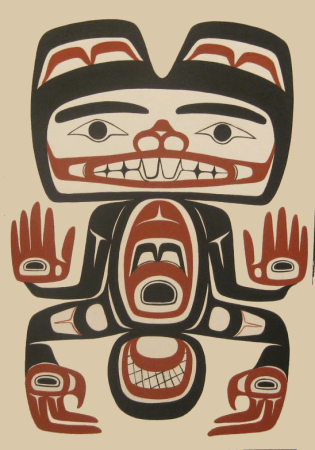
In January, we missed by hours buying a dragonfly frontlet that Nisga’a master carver Norman Tait and his carving partner Lucinda Turner sold through the Inuit Gallery. The gallery told us that its staff would ask the team to do another frontlet, but we had heard nothing for a couple of months and were just concluding that a second one would not be available when we received email notice that it had arrived.

Did we snap it up quickly? somebody asked me via chat. Put it this way: We received the notice at 3:10. I replied that we would buy it at 3:12 – despite the fact that we prefer not to buy sight unseen, and are saving to pay our taxes. Some opportunities you just have to take when they arise, and, having missed the first frontlet, we were determined not to miss this one.

You see, Norman Tait is one of the four artists we most wanted a carving from (the others were Beau Dick, Stan Bevan, and Tait’s nephew Ron Telek). Tait is one of the most acclaimed Northwest Coast artists alive – and rightfully so, given his attention to detail and his careful finishing. In the last two decades, these distinguishing features have been supplemented by Lucinda Turner, who brings the same qualities to carving.

The only problem is, Tait’s acclaim means that their masks start at about $12,000. While this price is more than deserved, it means that their work is largely out of our price range unless we do some extremely careful financial planning over a year or more. By contrast, the frontlet is more within our price range.

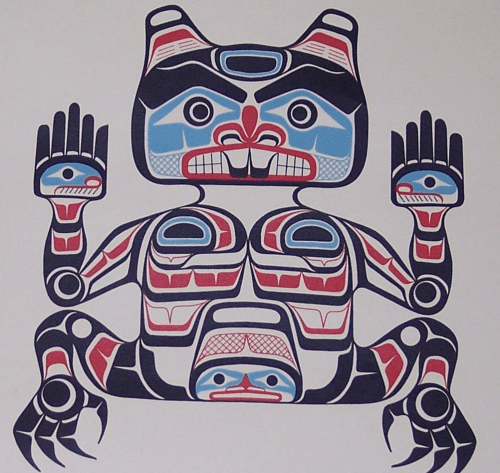
More importantly, the frontlet is a miniature masterpiece in its own right. While in many ways the frontlet’s depiction of a beaver is traditional, it is full of small finishing details — the flare of the nostrils, the roundness of the palms of the hands and the soles of the feet, the roundness of the tail, the prominence of the front teeth and the curled lip – that lift it out of the mundane.

I like, too, the contrast between the heavy lines and planes of the figure and the lightly inscribed shapes along the border, to say nothing of how the beaver’s ears are incorporated in the border so as not to interrupt the line of the head. All the elements in the border are traditional, yet they are so lightly carved that they almost look like the letters of some unknown alphabet.

In short, everything about the frontlet indicates that it is the work of someone who is as comfortable with carving tools as I am with a keyboard or pen. Although it is undeniably a minor work, it displays Tait’s skill so completely that you can easily extrapolate from it what his poles and larger sculptures are like. As a friend said, having the frontlet in our home is bit like having a cartoon from Picasso.

We hung the frontlet near a similarly-sized piece by Ron Telek. That position gave us the additional pleasure of comparing the work of the master and his former apprentice. We could see that the same attention to detail and finishing was present in both works, but there was nothing you could call imitative in Telek’s work. He had learned the craft from Tait, but each carver has an imagination and style all his own.

Norman Tait: Beaver Frontlet

Norman Tait and Lucinda Turner: Beaver Frontlet

Read Full Post »

Six weeks ago, Haisla artist John Wilson sent me pictures from the Freda Diesing School’s mid-term show. Since then, I’ve been trying to contact the artists whose work impressed me. Eventually, I hope to buy work from three or four of them. But, so far, the only one whose work has found its way into our house is Todd Stephens.

I’ve exchanged a few emails with Stephens, but I know very little about him besides the fact that he is Nisga’a, a young father, and one of last years’ recipients of the YVR Art Foundation Awards at the school. But I do know that he is an artist with a studied simplicity of form and enough understanding of the traditional northern style that he is already showing a strong signs of a personal style.

todd-stephens-red-warrior2

You can see Stephen’s simplicity of form in “Red Warrior,” the first piece of his work that attracted my attention. This small acrylic on canvas uses the barest minimum of lines to suggest a traditional maskin a non-traditional style. The thickest parts on the face – the eye and brow, the nostril, and the mouth – ate the parts most likely to be painted on a mask. On the outside, the columns of three lines, with irregular spaces between them help to break up the thickness of the line. The black background and the use of red as a primary color add a touch of innovation to a piece that otherwise is effective largely because of its simplicity. That Stephens should have reisisted the urge to elaborate is very much to his credit – generally, only a much more experienced artist would have trusted so much to simplicity.

Todd Stephens, "Industry"

In “Industry,” Stephens paints a traditional beaver in a traditional pose. He takes considerable care to avoid the thickening of formlines, mostly by tapering them and arching them where they meet.

At first, his major innovation in “Industry” seems to be in having the tail down, rather than held up parallel in front of the body. But, if you compare it to other versions of the beaver in this position (like the Richard Hunt print below), you notice thta it is a rectangular form, rather than the usual squae one. This change makes the body much leaner than in other artists’ versions, especially in relation to the head and hands, resulting in a much less-stolid figure than usual.

Richard Hunt, "Kwa-quilth Beaver"

Even more importantly, the thinner body leaves less room for secondary designs than in other people’s versions. As a result, the arms, legs, and body are decorated simply with only one or two elements apiece, which further emphasizes the outsized hands and feet – an exaggeration that fits in with the title of the piece. And, because so much of the beaver is rendered simply, the head and the tail are, too. The result is a boldness that makes “Industry” far more effective than most Northwest Coast Beavers.

Another of Stephen’s pieces that we have agreed to buy but not yet paid for is “Jorga and I,” a depiction of Stephens and his young daughter with the heads of the animals of their tribes (since the Nisga’a are matrilineal, of course, his daughter belongs to her mother’s tribe). The fact that the mythological heads are black, the traditional primary color in northern works, and the human bodies are red, the traditional secondary color makes the piece a statement of identity, saying clearly, “We are Nisga’a first” — and, because the hands are also black, perhaps “and artists” should be added to the statement.

Todd Stephens, "Jorga and I"

The protective hunching of the figure of Stephens, and the placement of his hands over his daughter’s eyes gives a modern and gently moving touch to the piece. Another modern touch is given by the overlapping of the artists’ hands and his daughter’s eyes, an element I do not recall seeing anywhere else. However, like “Industry,” much of the design of “Jorga and I” is traditional yet distinctive, with close attention paid to formlines, and the use of the distinctively Nisga’a T-shape inside forms to help further reduce their thickness.

This ability to combine a modern sensibility with a mastery of traditional design is the main reason that I think Stephens has a career in art if he wants one and is willing to work hard enough. Stephens still has things to learn, such as trusting to the power of white space enough to give wider margins on his designs, but the fundamentals are so obviously there, especially in the more complicated “Jorga and I,” that he seems likely to learn them – and fairly quickly, too.

Read Full Post »

Ron Telek, the Nisga’a carver, can always be counted on for the unexpected – anything from the disturbingly haunting to the eerily beautiful, and in every form imaginable. I’ve even seen a shaman marionette by him. Our latest acquisition, “Transformation Rattle: Eagle to Wolf” is no exception. Only a handful of other Northwest Coast artists could take a utilitarian object like a rattle and turn it into a sculpture while keeping it functional.whole-small

One of the characteristics I’m starting to associate with Telek’s pieces is an unusual degree of three-dimensional awareness in the design. Like many of his pieces, “Transformation Rattle” is impossible to capture fully with a single photo. I took five pictures for our records, and I’m not sure that I shouldn’t have taken a sixth to cover it fully.

The rattle consists of two parts: The rattle, which is the eagle, and the rattle’s base, a lean-looking wolf with a curved tail and, around its neck, a garland of cedar boughs. The rattle rests inside the tail, and can be removed from it. At first glance, you are lucky to notice that it’s a functional rattle. Your first clue is the leather wrapped around the bird’s tail as a hand grip, but even that could simply be part of the surreal sculpture.

The rattle depicts the transformation perhaps two-thirds of the way through. On the right side, the bird’s features are depicted fully, but the left side of the body is mostly blank, with the features indicated by a few indentations, and the wing by the grain of the wood.

smooth-side-eagle-small

Its feet, too, are gone, absorbed into the wolf. Perhaps to indicate the transformation’s incompleteness, the bird’s wing is wrapped around its rounded stomach, as though it is pregnant with itself.

finished-side-eagle-small

The wolf is more complete, but its lack of claws and teeth or fully-formed rear legs shows that it, too, is an unfinished figure. wolf-small

Its thinness and slightly rough carving, especially in the comparison with the eagle further suggests the wolf’s incompleteness – and, perhaps, the energy expended to make the transformation.

The fact that the two figures are the same is suggested by the spirit in the middle of the eagle’s right wing and atop the wolf’s head. Furthermore, the wolf’s garland of cedar suggests that this is not a born wolf, but a human – no doubt a shaman – going through these transformations. Supporting this idea is the much larger, more human-looking spirit erupting from the wolf’s back, as well as the fact that, if you look closely, the rear legs are more human than wolf-like.wolf-front-small

All this complexity is heightened by Telek’s characteristic attention to the direction of the grain. An employee at the Art of Man Gallery in Victoria told me last week that Telek often carves down until he finds the grain he wants, and, looking at “Transformation Rattle,” I have no trouble believing it. Although both the rattle and its base is carved from a single piece of red cedar (and stop and think about the difficulty of that for a moment), the carving is literally never against the grain. Even on the wolf’s curving tail, the grain moves with the sculpture. And, on the eagle, the round pattern of the grain not only suggests the bird’s body, but creates a semi-abstract form as simple as it is beautiful.

The overall result is a contrast with the tall, rounded shape of the eagle, and the ground-hugging, angular shape of the wolf. It’s an accomplished piece of work, which I’ve place on top the shelves on my computer desk, where I can look up at it periodically, or even take the rattle out for a shake if I feel like it. We’re seriously thinking of mounting it on a lazy susan, so that it can be viewed in its entirety more easily. Meanwhile, I’ve already switched its position around several times in the day since we brought it home so I can admire another aspect of it.

Read Full Post »

« Newer Posts