Feeds:
Posts
Comments

Posts Tagged ‘Personal’

“I’ve been doing art all my life,” Mike Dangeli, the up and coming Northwest Coast artist says. But although he identifies himself mainly as an artist, you cannot talk to him for very long before realizing that he is also many other things — a member of the Git Hayetsk Dancers, the heir to a chieftainship, and a man passionately committed to living in the culture of his Nisga’a, Tlingit, and Tsimshian ancestors within the context of modern technological society. Nor can you separate any of these things from the others, because Dangeli is at least as well known for his artistic work for ceremonies and regalia as for his commercial offerings.

Mike Dangeli

The interconnections go a long way back, although Dangeli took some time to bring them all together. He got his start in art early, making his own dance regalia when he was four or five with his grandmother, artist Louise Barton-Dangeli. He went on to learn acrylics, water colors and oils from her, as well cedar pouches, bags, and beaded necklaces.

At the same time, he learned “everything from weaving to painting to beadwork” from his mother, Arlene Roberts, both individually and as part of the yearly programs at the Chilkoot Cultural Camp in southeast Alaska.

At the camp, he learned from its organizers, Richard and Julie Folta and Tlingit artist Austin Hammond . From an old couple he only remembers as Mr. and Mrs. King, he also learned how to make drums — “that’s everything from taking a deer skin and scraping off the fat to making your own rawhide to string the drum,” Dangeli explains. He enjoyed the process so much that he estimates that by the time he became a professional artist at the age of 27, he had made “over five hundred drums.”

Beaver Drum

Another important early experience was spending the summer travelling on the Alaska ferries with his mother and grandmother, stopping at each port to sell what they made. Dangeli recalls that they did well enough to pay for their fares and his clothes for the coming school year. Through this experience, he also learned from his guardians “how to talk to galleries, to tourist shops, and cultural centers.”

Dangeli’s first training in carving came from his uncle in Prince George. “I spent a summer with him learning basic design and carving bowls and helping him with his work,” Dangeli says. “It was a lot harder than it looked, and I was a teenybopper with a lot of different interests.”

The road to an artist’s life

As a young man, Dangeli staged his own form of rebellion by joining the American army as an Air Ranger. He explains, “I’ve heard all my life that I’m in line to take a chief’s name. When you hear something like that all your life and you have to be good because of it, you decide you’re missing out and think, ‘I’m going to do my own thing.'”

The army seemed a natural choice, because he was thinking of going into law enforcement. “I didn’t see myself as an artist and living that kind of of lifestyle.”

Dangeli spent ten years in the military, rising to Staff Sergeant, but continued carving and designing in his spare time, and visiting family members when possible. It was on these visits that he started gaining a more deliberate understanding of his nation’s Angiosk –traditional territory — and Ayaawx — customs.

Adjusting our frame of reference

When he became a reservist, he attended the University of Alaska and working with his uncle Reggie Dangeli, a historian with the Alaska State Historical Commission. Eventually, he transferred to Washington state.

Matters came to a crisis when he got into a fight with another Staff Sergeant. “He said, ‘That’s the problem with you Indians,’ and of course he said effing Indians, so I smacked him up one side of his head.” At least partly because of the experience, Dangeli decided to leave the military, a move that cost him his university funding.

Finding himself in a well-paying but dead end job, Dangeli drifted towards Robert Boxley’s Seattle dance troupe and eventually apprenticed to him. He went through “a nasty divorce” due to his change of lifestyle, and headed “home to the Nass Valley to lick my wounds.”

The trip got sidetracked in Vancouver when he was asked to finish a pole in Woodland Park.

“I didn’t want to do it,” he says. “It wasn’t a very nice chunk of wood, and I didn’t want to do someone else’s work. So I said, ‘If I do it, it won’t be mine. It will be a community project.'” Hiring ten youths, he finished the pole and celebrated its completion with a potlatch — and, in the process, discovered that he had found himself a community.

“It was such a sad little pole,” he says. “It had been stolen twice, spray painted and a chunk was taken off the side, and someone took a Louisville [baseball bat] to it. It was horrible. But I look at it in retrospect as a physical manifestation of where I was in that moment in time — just beat up and kind of sad. It ended up being something very beautiful — not necessarily the totem pole itself, although it’s still up there and humbling to look at, but because it represents a massive amount of growth. What I created was a community here in Vancouver.”

Lifting up my god-son mask

While carving the pole, Dangeli found studio space at the Aboriginal Friendship Centre at Hastings and Commercial. He remains there to his day, running a program called The House of Culture. At first, the program was a cooperative, through which artists passed like Robert Davidson, Reg Davidson, Henry Green, Simon Dick, and Lyle Campbell, as well as younger artists such as Ian Reid and Phil Gray.

More recently, The House of Culture has become a rental space, because “there were a couple of people who had abused the space because they were abusing themselves in their addiction,” as Dangeli explains the situation. Dangeli now shares the space with Woodlands artist Don McIntyre, and Mari Torizane, a Japanese master painter who works as Dangeli’s assistant. Space is also found from time to time for other artists, such as Ian Reid, whom Dangeli regards as a brother.

Such experiences have left him with a strong interest in collaboration. One such result can be seen on the west side of the Friendship Centre, where Dangeli recently painted a mural with Don McIntyre.

Dangeli now works in a variety of media, including stone carving, wood carving, jewelry making, painting, and sculpture. He works twelve to fourteen hours a day and completes 10-30 pieces per month.

“I love a bit of everything,” he says. “You get lost in what you’re working in, so there is no favorite medium. It’s whatever I’m working on. but I always have five of six projects on the go in various stages. You get bored with one and you want to pick up something else. but then the clock’s ticking on a couple of pieces, and you’ve got to get going on them.”

Ceremonial, commissioned, and commercial art

“What’s become really important to me is the performance and ceremonial part of our art,” Dangeli says. “You can ask every Northwest Coast artist, and they’ll tell you that some of the best carvers and west coast artists are the ones who have an understanding of ceremony. It’s a lot different than creating something for the galleries.”

Part of the difference is that a mask intended to be danced “needs the inside to be functional. It needs to be carved to the dimensions of the face of the person who’s wearing the mask.”

Another part is the “responsibility and rights and privileges that you learn by attending ceremonies and understanding them.”

However, the largest difference, Dangeli says, is the spirituality. “In our languages, masks were naxnox— ‘beyond human power.’ These naxnox embodied the wind, they embodied the spirits, and were able to connect us to that spirit world. There’s an understanding that if you don’t treat these naxnox right, they’ll bite you.

“And I’ve seen that happen. I’ve seen a guy who played around too much with a mask and he was dancing on stage at this one event, and he fell right off the stage. It was a good five foot drop. That was part of the mask saying, ‘I didn’t appreciate that.’ I’ve seen it happen in our own dance group. I’ve even had it happen to me.”

Another consideration is the stories that are told in ceremonial and commercial art. “With a lot of our naxnox, there’s an oral history that’s owned by families that I don’t have the right to go and use. There’s even traditions that belong to my family that I would never go and openly sell. When I do art for potlatching or for individuals who ask me for things that display their clan crest, there’s always a different price. I don’t ever charge the full price in these cases, because the best payment is having one of your pieces used. It’s more of an exchange” of services or goods or artwork.

By contrast, “when I’m doing things for a gallery, there are certain stories that are universal to everybody” that can be used instead. Dangeli suggests that this is not a limitation, so much as a situation that calls upon his ingenuity as an artist. He likens the distinction to his experience of dancing, where there are some dances that are not recorded and others that are brought out for public performance.

Dangeli acknowledges that other artists do not observe the same distinctions, but seems to feel that their choices are not his business. “I find it really sad when I see artists breaking those laws [about what can be publicly displayed], but it’s up to their elders, their chiefs and their matriarchs to put them back into line, not us as artists. Although there are some things you look at and think, ‘Gosh, I can’t believe they did that.'”

These distinctions are increasingly easy for Dangeli to observe because, while he has had work in galleries, today, commissions and ceremonial work mean that he does not rely on the commercial art market to make his living. While he praises some galleries like the Eagle Spirit and the Leora Lattimer Gallery, and speaks of their owners with respect, he is concerned that meeting the galleries’ needs can be restrictive for artists.

In fact, in some cases, dealing with galleries can be “abusive,” he says. He recalls selling a drum and a mask to one gallery, and being told by the owner, “‘Now, don’t go drinking this all up in one spot.’ So I looked at him and said, ‘I don’t need this,’ and I ripped up the cheque and handed it back, and took my pieces.”

This experience was reinforced a few years ago by an incident online in which his building and launching of a canoe received condescending criticism from an academic, and others rallied around him.

“It was really wonderful having support from my own people, indigenous people, and people from museums from all over the place, and I let go of that final fear about what people think of my art. It’s none of my business. If you like it, you like it. If you don’t, that’s fine. I think [this attitude] has made me a better artist, and that taking on more commissions has helped me to focus on more personal items and concentrating more on things for potlatches. It’s wonderful to have that freedom, and I would wish it for every artist.”

Art and the community

Dangeli takes his role as an interpreter of his culture seriously. “There is a responsibility, because artists are our historians. They are people who are able to act as a conduit between our culture and our people to the outside world. They’re historians, they’re writers, they’re creators of things that will be used inside those ceremonies. So, yeah, there’s a lot of importance in being a leader and an artist.”

For Dangeli in particular, this responsibility and importance is augmented because he is heir to two chieftainships, one of which he grew up expecting to inherit and one which he has only recently become heir to. This situation, he says, “has affected me in wanting to convey more of my messages. And taking on that larger chieftainship means that I have more responsibilities, both financially and culturally. Financially in the way of making sure that I can get home to attend feasts and potlatches, culturally by being able to create things for my people. It has affected some of what I create and definitely the responsibility not to do anything embarrassing as well.”
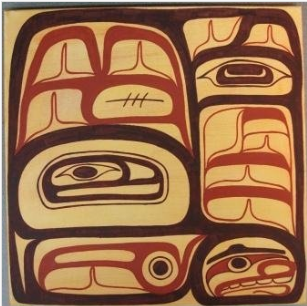
Sunset

However, asked if artists help to restore pride to First Nations communities, Dangeli characterizes the idea as an outsider’s view. “I think that, as an outsider looking in, yeah, it could be construed that way. But are you being made aware of it because individual artists are opening your eyes to what’s going on inside those communities? Because, growing up and witnessing all these wonderful things happening within my community, there’s always been pride. There’s always been this sense of beauty and right and wrong and putting your best foot forward. A lot of artists, especially in the generation before mine, have all grown up with that responsibility.

“There’s a huge responsibility being an artists and growing up in that culture, which is why some artists choose not to be part of it. It is too much responsibility. Everyone always wants you to create things for some sort of giveaway or to do this or that. So there has to be a balance.” For instance, Dangeli will often repurpose a piece, or ask permission to make a print of an original painting, so that he can respond to a request without taking too much of his time. He cites Joe David and Beau Dick as two of the older artists who are models of how to find this sort of balance.

“We have a responsibility because we’re able to function in so many worlds, whether it be the white world, within the art world — and it’s not just the art world, it’s the First Nation’s art world as well — within our communities, culturally, and academically and with art historians. I’ve been able to walk in all these worlds, and been intimidated in all of them.

“I remember when Mique’l [his financee] had moved up here. I was looking through some of the readings she had to do for her Master’s in Art History, and I became worried because art historians analyze everything. And I was like, ‘Look, I was poor this month, and people will say, this is Mike Dangeli’s blue period because I didn’t have anything else but blue paint. That was part of my fear: Is what I’m doing now going to be analyzed and picked apart twenty, forty years down the line?. And that was something else I had to let go.”

But, for all the fears, the responsibilities, the obligations and the need for balance, Dangeli clearly remains committed to all that he has taken on. “I love what I do. It’s not a job, and it’s not a career –although it is both — it’s a passion. I absolutely love it. So to be able to have that opportunity to take what’s inside me, to make my thoughts tangible –”

He trails off for a second, then starts in a new direction.

“I’m able only to put out so much in thirty or forty years. That’s a short time in a person’s life. And I started this when I was a little older than most artists. I was 27 when I decided to become a professional artist. so I have a lot of catching up to do. And, at the same time, I’m grateful to be able to create art and to have people see value in it.”

Read Full Post »

Northwest Coast art has a new medium. It’s called forton, and it’s a mixture of gypsum, fiberglass and plastics, and has the advantages of being non-toxic, lightweight, weather resistant, and capable of imitating anything from marble to plaster or bronze. So far, you can see the largest collection of sculptures in forton in Vancouver at the Douglas Reynolds Gallery, including one cast from James Hart’s Celebration of Bill Reid pole that was officially presented to the public on December 5.

The Celebration of Bill Reid pole is a permanent fixture at the Bill Reid Gallery in downtown Vancouver. Carved by James Hart with the help of Ernest Swanson, Tyson Brown, Carl Hart, and GwaLiga Hart, the pole is topped by a raven whose chest is a stylized version of Bill Reid’s face. Through the Douglas Reynolds Gallery, eighteen copies of the raven are being made in forton – six imitating plaster, and 12 bronze, including three artist proofs.

Hart spoke briefly at the launch, arriving after the crowd had already gathered and was well into the buffet and wine. A tall man with long gray hair, he wore a bright Guatemalan jacket and carried a string of trade beads in his hands that someone gave him as he came in the door. He walked with a stoop and a slight hesitation. As he stood halfway up the stairs in the gallery, he was surprisingly soft-spoken for a well-known artist who is also a chief.

Hart spoke briefly about the pole and its intent to honor Bill Reid. He explained that he not only learned carving from Reid, but how to survive in the city, including such details as how to use an elevator, something he had rarely encountered in his rural youth. Turning to the plaster raven in the corner, he emphasized that it was a white raven, a representation of the trickster before he stole the moon and was singed black in his effort to escape with it through the smoke hole.

Afterwards, I managed to talk briefly to him as he mingled with the crowd. He said that the project was his first effort to work in forton, and that he liked the way it could be carved and was resistant to weather. He also expressed his enthusiasm for the new medium and designs that younger artists from all the local first nations were developing the traditional art forms.

Until the new raven cast, most of the works in forton that I’ve seen were done by Don Yeoman at the Douglas Reynolds Gallery. However, Reynolds mentioned the side of a house in Whistler that recently had several dozen forton panels added to one side, and I suspect that any artists who encounter it are likely to be as interested in it as Hart seemed to be.

One look at the cast and you can understand why. Made from a mold of the cedar original, the pseudo-plaster cast picks up so much detail that you can actually see the wood grain and tool marks in it. With forton offering so many benefits and no drawbacks so far as I can discover, I strongly suspect that, just as local first nations artists adopted to argillite a century and half ago and glass in the last few decades, many are going to seize on forton as yet another medium for their work.

Read Full Post »

(The following is a handout from my days of teaching first year composition at university. It consists of some informal examples of closing paragraph strategies, but should be equally useful for formal essays. Anyone who finds it useful can reproduce it, so long as they give me credit for it)

Summary:
Will North Americans continue to take their high standard of living for granted? Probably not. As we have seen, North Americans use more energy, buy more goods, and create more garbage than even the Europeans. Yet this state of affairs is barely fifty years old, and already it is changing. The North American standard of living has been declining for over a decade, and, as Europe and Japan retool for modern technology faster than we are able or willing to, there is every sign that this decline will continue. Indeed, many people believe that we are overdue to return to a more equitable rate of consumption. Perhaps in another century, historians will look back at Twenty-First Century North America in astonishment, and shake their heads with both envy and disgust.

Final Generalization:
As these examples demonstrate, social networking is transforming the way people work as well as how they play. Clearly, our lives are in the middle of a transformation whose end we cannot yet perceive..

Final Example:
One final example will illustrate the need to quarantine exotic birds. In 1934, a small shipment of cockatiels with Newcastle’s disease arrived in Holland without going through quarantine. Before the birds could be traced and destroyed, thousands of domestic poultry had to be destroyed to stop the spread of the disease, and dozens of farmers lost their livelihood. To make matters worse, 39 people caught Newcastles’ and died from the disease. Ever since, Dutch officials have insisted on a three month quarantine for imported hookbills. Without such precautions, the risk of financial health and illness are simply too high.

Final Analogy:
The disappearance of homo neanderthalis and the prevalence of homo sapiens can be compared to the Norman conquest of England. Contrary to popular belief, there was no widespread slaughter of the Anglo-Saxon population of England by the Normans. Many Anglo-Saxon leaders had died in battle, and many of those who were left chose to swear allegiance to the Normans rather than face execu­tion. Few of the middle-class or laborers were killed, for the simple reason that they were needed to run the country. Anglo-Saxon language, customs and culture were modified, but not destroyed by the Normans. Four centuries later, neither Norman nor Saxon existed–they had all become English. If such assimilation has happened so quickly in historical times, it could just as easily happen in prehistoric times as well, especially since we cannot pinpoint the disappearance of the Neanderthals to within more than five or seven thousand years. It seems likely that, instead of being slaughtered, the Neanderthals inter-married with homo sapiens, disappearing as a distinct species, but contributing their genes to present-day humanity.

Call for Action:
Such evidence indicates that the attempt to do without government automobile testing is a failure. Over half of the vehicles on B. C. roads are mechanically faulty, and over two-thirds do not meet federal emission standards. Clearly, the provincial government must act at once to put an end to this dangerous situation.

Mention of Related Issues:
Obviously, this paper cannot cover all aspects of the question. Given that some dinosaurs were warm-blooded and evolved into birds, what happened to the rest of them? Was giganticism an evolutionary experiment that failed spectacularly? Or did the dinosaurs have some help–perhaps the meteor strike that some theorists have speculated on recently. Or are modern reptiles the direct descendants of the dinosaurs? These are large questions, but they need to answered before our understanding of what happened to the dinosaurs is complete.

Denouement:
There is little left to say. Defeated in his attempts to bring responsible government to the Crown Colony of Vancouver Island, Richard Blanshard returned home to England. He married well, and became known in his home town for his charities. He never held public office again. James Douglas, his successor as governor, continued to represent the interests of the Hudson Bay Company in the area for another twenty years, doing all he could to prevent the rise of responsible government. Douglas became rich, and the center of high society in Victoria. Today, he is known as “the Father of British Columbia” by people too ignorant of the past to know how hard he fought to prevent its existence.

Rhetorical Question:
The issue, then, is clear: do we have the right to imprison and mistreat animals so that we can view them at our ease? Or does anyone dare to suggest that we have no responsibility to our less intelligent neighbors?

Read Full Post »

I’m not a heavy drinker, and, while I appreciate fine food, I don’t stuff myself. But books are another matter. Give me a stack of unread books and the time and place to read them, and I become as gluttonous as anyone.

The habit dates back to my teen years. I’d no sooner get my allowance than I’d descend on the stores to spend it on books. Used books, new books, science fiction, classics, biography, history – it hardly mattered which. After an hour in a book store, I would emerge with a dozen books and rush home to bury myself in my room. Ignoring the parental pleas to come out into the living room and “be sociable,” I’d stretch on the bed, reading intently and staying up as late as possible. In the morning, I’d be at the breakfast table with a book in my hand. If I had to go to school, I’d walk along reading. If I had to go out, I would take along a couple of my new books.

When I reached adulthood, these habits only intensified. When I was in my twenties, I considered the perfect Saturday afternoon a descent upon the local science fiction specialty shop in which I bore home a pile of paperbacks and the odd hardcover for spoils. Just like when I was a child, a good part of my discretionary income went for books.

However, as I grew older, my habits changed. I was no less an avid reader, but except after Christmas or my birthday (when, naturally enough, most people would give me books), my habits became less gluttonous. I’d buy a book or two at a time, and be content. Had I thought of it, I would have said I was a changed man.

Then, about a week ago, I started re-reading a few books by Gillian Bradshaw, the English historical writer. Realizing that the newest one was over a decade old, I started wondering what she had done in the interval. A search on the Internet revealed that not only was she active, but that the local library had at least a dozen titles that I hadn’t read. When Trish checked out five or six, suddenly my book gluttony was back, insatiable as ever.

What triggers the gluttony, I realize now, is not just unread books. It’s books in which I can expect imagination, fine writing, and a variety of them. Although Bradshaw is only one writer, her work stirs the gluttony on all both accounts. Her extrapolations into the remoter regions of the classical past show a convincing imagination, and her understated writing is very much to my taste. Moreover, she writes not only of a variety of classical settings, but also contemporary novels and science fiction for both children and adult. What these things add up to the luxury of choice. When I finish each book, I have a delicious moment when I can stretch and linger over what I am going to devour next.

Fortunately for the rest of my life, these outbursts of gluttony are usually short. But, while they last, I feel wealthier and more privileged than I have any right to feel.

Read Full Post »

The stories of Raven stealing the light or Raven prying open a shell that contains the first people continue to inspire great art, and have the advantage of being no single family’s property. But they are only a fraction of the stories and themes that could be told in Northwest Coast art. That is why, when I buy art, I am always interested in less often heard subjects – the change is interesting to me, and, I hope, a change of pace for the artists as well.

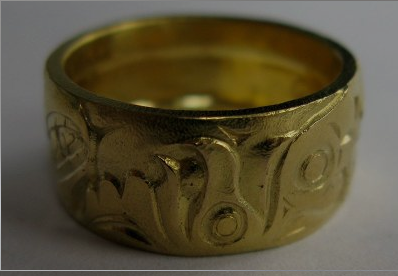
A case in point: “Healing Ring,” the second of the rings made for us by up and coming artist Gwaai Edenshaw (the other ring was “Raven and Crows,” which I blogged about earlier).

Here’s how Gwaai Edenshaw himself describes the ring. He was talking with us as he wrote and using a soft pencil, so I have had to guess here and there as I transcribed:

[The] centre of the ring is Fungus Man, made famous in the story of Raven and the First People. The only [one] of Raven’s helpers that was strong enough to face the feminine energy/sprit, and bring it to humanity. This character was likely Fomitopsis Officinalis. This is a shelf fungus that is analogous to a Chinese medicine (in fact one of Chinese Medicine’s most prized medicines). It was almost definitely used by Haida shamans. Samples of it have been found among shaman’s effects (this was thought to be wooden carvings until a recent test of the wood revealed it to be Fornitopsis. Fungus Man appears out of a bush of K’waay K’ia (Indian Hellebore), a very important medicine to us. Like many medicines it has potential for toxicity, but in the hands of the right practitioner it is a true marvel.

Also called Laricifomes officinalis, the fungus is almost extinct in Europe, but is found in old growth forests in the Pacific Northwest. In various locales, it has been used to treat tuberculosis, pneumonia, asthma, rheumatoid arthritis, infection, and smallpox, and to ensure long life.

I believe that the appearance of the fungus on the ring is one of the first instances in which Edenshaw has combined his interests in Haida botany and art. In fact, aside from what appears to be tobacco leaves and European-influenced floral designs in some argillite work, flora of any sort is rare in Haida art, although some mainland nations have floral crests, such as the Gitksan Fireweed clan.

Edenshaw continues:

On the reverse side is a pair of herons. These are the helper in a number of stories, notably the Gunarsiargit story where they play a small but critical role in the story’s namesake fulfilling his destiny.

More specifically, a heron often dwells on the edge of the village, some distance away from the inhabited houses. This locale reflects the heron’s often lone habits, but might also suggest a shaman, since shamans often lived and certainly were buried separately from everyone else.

For me, these are the kind of details that, when combined with artistic skill, can make Northwest Coast art so satisfying to me. They offer not only aesthetic pleasure, but, for a European ethnic like me a small window into the cultures that produce them. And Edenshaw, besides being a gold smith with a genuine feel for the metal, is also clearly someone deeply knowledgable about his culture as well.

Read Full Post »

One way that you know an artist is talented is when other artists are eager for their work. Gwaai Edenshaw is in that enviable position among the Northwest Coast artists who live in Vancouver. A some-time botanist and Bill Reid’s last apprentice, he works largely in gold, although he has been known to sketch, carve wood, and even experiment with animation. Having admired his work since we first saw it, Trish and I recently celebrated our anniversary by buying two of his rings.

Mine is based on an episode in “Raven Traveling,” the Haida narrative of the Trickster’s wanderings near the beginning of time. On the beach, the raven encounters a group of crows. They begin to cook a salmon. The raven falls asleep, but the crows can’t wait for him to wake, and devour the salmon. Belatedly, they realize that the raven will be angry when he rouses, so they take the remaining crumbs of salmon, and wedge them between his teeth. When the raven wakes, hungry for his meal, they point out the crumbs and ask, “Don’t you remember? You ate it before you went to sleep.” Angry at the deception, Raven throws the crows into the fire, turning them forever from white to black.

I appreciate the story for its broad humor, as well as its extrapolation from nature; crows really do mob ravens, especially when their young are in the nest. If crows could play practical jokes on ravens, they undoubtedly would. Also, the story is not one of the ones that is generally depicted, like raven’s stealing of the light, or even his theft of the salmon from the beavers.

I suggested the subject to Edenshaw, and waited with all the patience that anticipation would allow for six months until he had time to get to it.

The result was more than worth the wait. Edenshaw chose a style that fits the humor of the story, showing the raven with his beak open and crows rollicking around him, pushing the crumbs of salmon into his mouth and their beaks open in excitement, no doubt chortling with glee at the thought of putting one over on their rival.

Since the raven has teeth in the story, and the Haida storytellers must have had plenty of chances to notice that birds have none, I assume that he must have been in human form when he met the crows. However, the fact that Edenshaw chose to show the raven as a bird with teeth in his beak does not detract, any more than the teeth in the beak of the parrot in Aladdin. It is a comic touch, and the result is reminiscent of the lively cartoons that you see in the margins of medieval manuscripts. I especially like the mischievous crow that is pushing a piece of salmon along the raven’s back (You can see the crow’s beak just behind the top of the raven’s head).

At the same time, I appreciate the economy and skill with which Edenshaw rendered the story. Like a business card (only more so), a ring provides a very limited space for depicting anything, yet Edenshaw manages to focus on the main event of the story, while selectively choosing details so that, while the feathers on raven’s head are not visible, the pieces of salmon clearly are. The detail is all the more amazing when you consider that the ring is cast, not engraved.

So far as I am concerned, Edenshaw produced a ring that is utterly unique, and wonderfully rich in humor and detail. After wearing it for several weeks, and having appreciated the small extra touches with which it was delivered (in a small wooden box, with the promise that the mold would be kept, in case the original was lost), I fully intend to buy more of Gwaai Edenshaw’s work. But if, as I suspect, his prices rise as he receives the recognition he deserves, at least we have a couple of samples of his work to console ourselves.

lm

Read Full Post »

“Oh Lord, please don’t let me be misunderstood.”
– The Animals

Every few years, I come across someone who can’t understand me. I don’t mean a man or a woman who thinks so differently from me that they can’t grasp my motivations or the logical progression of my thoughts; this kind of person, I could joke with some seriousness, I meet several times a week. I mean someone who, no matter how slowly I speak, how loudly I project or how clearly I pronounce my words cannot comprehend the literal sense of my words. Inevitably, the result is mutual panic and frustration.

Exactly why a small handful of people cannot comprehend me is a mystery to me (after all, I can hardly ask them). My first inclination is to blame myself. After all, when I was in the first grade, I did take speech therapy. But that was long ago. If anything, speech therapy left me with a tendency to speak precisely and carefully that some people mistake for a British accent.

Similarly, while some people claim that I have a slight secondhand Yorkshire accent I picked up from my father, it’s a mild one (if it exists). Anyway, my vowels are definitely Canadian (for instance, coming from me, “hill” and “hell” sound the same, and so do “don” and “dawn”), so by all reasoning, I shouldn’t be anywhere close to unintelligible. I do speak quickly, but so do many western Canadians, and most of them don’t seem to have the same trouble that I occasionally bump into.

So, as much as the idea goes against my inclinations, I suspect that the problem is usually with those with whom I am unable to communicate. Usually, they are either untraveled Americans, or ESL students who are less than fluent in English. Either way, they are usually in their early twenties.

These common traits suggest that my uncomprehending listeners may lack experience with many accents. Their behavior reinforces this suggestion: always, they are impatient, and regard me as if I am mentally subnormal, giving up attempts to communicate long before I do. Yet I suspect that this is only half the explanation.

In my own case, when I’ve had trouble following thick accents like Glaswegian or Jamaican, the reason has been that I have taken a few moments to catch the rhythm of the speech – how it shifts to ask a question, or asks for a response, for example. Could my unusual precision produce an unintelligible rhythm for some people?

But that only shifts the question back one step. Faced with an accent with a strange rhythm, I usually find that within a few minutes, I can understand the speaker so long as I concentrate. But, when someone can’t understand me, they never gradually start to comprehend me. They stay baffled by me forever.

Could another common element be that these people are tone deaf, at least when it comes to accents? That they cannot catch that subtle rhythm that lets you understand a train of thought and, if necessary, fill in the blanks? So far, that is the best guess that I have come up with.

Yet, if I am right, the explanation is little comfort. It does nothing to solve the problem. Speaking without being understood by your audience is a private hell for a writer and ex-teacher, and I happen to be both. So I stand there, growing more frantic, receiving no help from the other person, until they either retreat from my obvious frustration or enlist the aid of someone else.

Frankly, I’ve had more success carrying on conversations with my high school French, and I neither understand why nor know when another of these encounters is going to occur.

Read Full Post »

One thing you can say about public transit: It may not be cheap or convenient, and you learn more about people’s personal hygiene than you ever wanted to know, but there’s nothing like it for people watching.

Sometimes, the people are just outlandish – and I say that as card-carrying eccentric myself. For instance, last weekend, a couple boarded the Skytrain walking very close together. He was tall, with a near beard and long hair and sun glasses. She was shabbily dressed, in kneeless jeans that only stayed up when she held a belt loop, and bobbing her head in a stoned sort of way to the tracks on her iPod. She also had an odor of at least two types of smoke and unwashed body trailing her like a shadow. Close inspection showed she was wearing a dog collar that was chained to his belt. Every now and again, he would give a little proprietary tug, not hard, but enough so that she would try to fix her eyes on him. I try to be broadminded, but if ever a couple needed to be told to rent a room, this one did. That’s not the sort of role-playing you expect to see in the middle of a Sunday afternoon.

But people on transit frequently reveal so much about themselves that they seem to be under the illusion that nobody around them can see or hear them. I remember one time when a young man got on at Metrotown looking distinctly lumpish. He was carrying a dozen coat hangers, and seemed to be wearing as many shirts and sweaters. I’d say he got on casually, if there wasn’t such a nervous edge to his casualness.

That attitude is especially common with people on cell phones. They talk as loudly as possible, until I’m tempted to clap at the end of their calls. One man even broke up with his lover in the middle of a crowded car I was riding in. “But I love you!” he keep saying, while embarrassment spread around him like a stain. After he left, I could see people relax, and several looked at each other and shook their heads.

It’s encounters like these that generated my first dictum about riding transit: Whatever you do, don’t make eye contact. The risk of having to make conversation with some of your fellow passengers is simply too high.

Read Full Post »

You can tell I took the day off today; I got a haircut. I take time off so seldom that, when I do, it’s usually long past time for me to do something about my hair. There comes a time when I have to ignore my small surge of apprehension about the task and just get it done.

Part of the apprehension comes from childhood haircuts. In elementary school, the barber I was taken to was a Glaswegian. In retrospect, I believe he meant well, but his roaring, incomprehensible accent frightened me. I could never understand what he was saying, and often had to guess, which made our conversations strained at the best of times.

Even worse, he knew one style: a buzz cut. As I grew older, I became deeply ashamed of such haircuts. I would wear a hood whenever the weather made it natural, and often when it didn’t.

Then, when the Glaswegian retired and I had to go to another barber, I started a slow campaign to increase the length of my hair a bit with each haircut. By Grade Nine, I had a decent length of hair, but it took many long years before I could not spend my time n the barber chair glaring balefully at the stylist in the mirror and convinced that I would be shorn to the scalp if I let my attention wander for a second.

These days, that fear is quietened to a rumble, like the ones you occasionally hear from dormant volcanoes. But, unfortunately, it’s been replaced by a morbid fascination that makes me almost as uneasy in its own way.

You see, I go so long between haircuts that the entire shape of my face changes with the length and thickness of my hair. By the time I get a cut, my hair makes my face look round and boyish.

Then, bit by bit, as the hair falls to the floor (and it’s a good thing that I’m not charged by the kilo, let me tell you), someone else emerges – a stranger with a leaner face and a higher hairline. He seems harder and older and more athletic than the person I saw in the mirror that morning, and I’m not sure that I approve of him or even like him.

In fact, as I see him emerge from under my hair, the strangest sense of dislocation sweeps over me. It is as though an alternate world version of myself is surfacing in the mirror, waiting to take me over.

As this feeling increases, I continue chatting and joking as though nothing is wrong. But I think the tension in my body betrays me, and I always slide off the chair and walk towards the cash desk with a sense of relief that I have survived the ordeal without losing my soul. And, as I leave the shop, for the next few hours, I am always glancing at my reflection, as though expecting to see the invader still there.

Of course, this dislocation would never happen if I had my hair cut more regularly. But I associate it so much with having my hair cut, I never manage to get on a shorter schedule. On some level, I don’t care to give that other self in the mirror more chances than necessary to take me over.

Read Full Post »

(The following is a handout from my days of teaching first year composition at university. It consists of some informal examples of opening paragraph strategies, but should be equally useful for formal essays. Anyone who finds it useful can reproduce it, so long as they give me credit for it)

Explanation of Topic’s Importance (Anticipatory Summary):
Computers abound in our houses and offices, exchanging information via modems. Programmers are constantly finding new applications for existing software, and computer technicians are refining the hardware so fast that a new computer is no longer state of the art six months after it is sold. We live in a computer-dominated age, and every citizen should have some knowledge of computers. They make routine decisions in business, education and government, and monitor our defense systems. They help individuals to manage their private affairs, to organize their personal records, and to access goods and services, and municipali­ties and legislatures depend on them for planning future develop­ment. Since a knowledge of computers is so necessary for all of us, computer education–“computer literacy,” as the jargon has it–plays a significant role in our society. To understand this role, we must first consider the importance of computer education to the individual citizen and to the country as a whole; next, we must assess the present quality of computer education at all levels; and, finally, we must examine the ways in which computer education can be improved.

Examples:
For many years, automatic vending machines have dispensed such products as salted peanuts, chewing gum, cigarettes, soft drinks and candy bars. Now these robot sellers are becoming more ver­satile. At one eastern airport, the simple act of inserting a coin in a slot will get you a magazine, a pen, a toothbrush, a pocket comb, a handkerchief, a necktie, a suit of underwear, a cup of hot coffee or chicken soup, a set of puzzle toys, a spray of perfume, an insurance policy or a shoe-shine. There are other machines that will take your blood pressure or give you a thirty-second dose of pure oxygen. One corporation has designed an automatic snack bar–a cluster of automatic vending machines that offer toasted sandwiches, hot soup, chili, baked beans and hot pastries and pies. Another firm has produced an automatic cafeteria with a menu of over fifty dishes, including a roast-turkey dinner; the machines even say “thank-you” in a computer-generated voice. These are only a few examples of the many types of vending machines. How are these mechanical conveniences constructed? What effect do they have on buying habits? As we shall see, the vending machine plays a major role in modern commerce.

Definition:
Although manufacturers are reluctant to discuss it except in general terms, copyright violation is becoming increasingly common in our society. Briefly, copyright violation may be defined as the unauthorized use of an artistic product such as a book or a software program by anyone other than the creators or their representatives. It may involve the use of material in slightly altered form, or the copying and distribution of the work, with or without profit. Some people, especially artists, are violently opposed to copyright violation; others, especially software users, consider it their right and something which is inevitable. However it is viewed, it raises ethical issues of great importance.

Cause and Effect:
For the past two years, I have run an average of four to six miles every morning. The results have been amazing. The daily exercise keeps me calm and alert for the rest of the day. It allows me to eat what I want without worrying about calories, and to sleep well every night. It gives me more energy, and, most of all, it gives me a self-confidence that carries over into everything I do. My experience has convinced me that everyone should have some form of daily exercise.

Comparison and Contrast:
For many years, we have thought of the Vikings as bloodthirsty savages who did their best to destroy European civilization. Now, we are starting to understand that this view is too limited. The Vikings were certainly no more bloodthirsty than those they attacked (who generally defeated them, after all), and in many ways they were more advanced. At a time when merchant ships hugged the coast both for safety and for ease of navigation, the Vikings were building sturdy yet light boats that were capable of surviving all but the roughest storms, and boldly sailing across the open ocean using their navigation skills. At a time when most people lived and died within ten miles of where they were born, the Vikings ranged from North American to Russia, and from Greenland to central Africa. Most European art during the Dark Ages was a crude attempt at representational art; the Viking had an intricate abstract art style that we are only now starting to appreciate. Similarly, while most European literature was oral and poetic, the Vikings had complex poetry and detailed prose stories about the deeds of their ancestors. Until early in the twentieth century, a woman in France or Italy had little say in who she would marry, and almost no right to property or divorce; a thousand years ago in Iceland, women had all these rights under written law. As archaeologists have started to reevaluate Viking culture, we have learnt that, far from the horn-helmeted savages of popular imagination, the Vikings were a literate and sophisticated people who were probably closer to us in their assumptions than the southern Europeans of the Dark Ages.

Rhetorical Question:
Can chimpanzees talk in sign language, or do they simply learn what to do to get what they want? Are dolphins and whales possessed of an intelligence equal to ours, but subtly different in nature? Can parrots really have the intelligence of a five year old child? Biologists are divided about the answers to such questions, but the fact that these questions can be asked at all challenge our assumption of our uniqueness. How the question is eventually answered will have a sweeping effect upon our religions, science and ethics.

Illustrative Anecdote:
Once, I made the mistake of telling the woman who was cutting my hair that I wrote poetry. “Must be nice,” she said. “Just light up a joint, sit back and wait for inspiration, then write whatever comes into your head.” At the time, I could have told her that I didn’t smoke tobacco, let alone anything stronger, but, when I think of all that I have learned in the intervening years, I realize that I could have said a good deal more. Like most people, she had a romantic view of writing that is almost totally unrelated to the reality. The truth is not only that few writers use any stimulants stronger than coffee (at least, while they are writing), but also that they hardheadedly plug away at lonely and time-consuming work that, far from being easy, can ruin your nerves in a week if you take it too seriously.

Opposing View to Be Refuted:
Many people think that keeping parrots is like keeping fish. Just as you keep fish in a bowl, feed them, and sit back and watch them, so you keep parrots in a cage, feed them, and sit back and watch their antics. Pet-store owners tell me that this assumption is so strong that some people buy parrots to match the decor of their living rooms. I don’t know how many people act so careless­ly, but I do know that they are in for a surprise. Far from being passive animals, parrots are curious, intelligent birds, that have to be watched constantly and demand hours of attention each day.

Relevant Quote:
“Violence,” Isaac Asimov writes in his Foundation series, “is the last refuge of the incompetent.” Salvor Hardin, the character who adopts this aphorism as his motto, goes to great lengths to prove it, inevitably outwitting his enemies when he applies it. Cynics may doubt that avoiding violence in real life is as easy as it is for Hardin, but, if my personal experience is any indication, Asimov may have a point. Admittedly, avoiding violence is harder than giving into your impulses, and requires more patience. Yet the simple fact of making the effort is worthwhile for at least two reasons: it leads to creative thinking about problems, and, if successful, to more permanent solutions.

Read Full Post »

« Newer Posts - Older Posts »