Feeds:
Posts
Comments

Posts Tagged ‘Uncategorized’

The stories of Raven stealing the light or Raven prying open a shell that contains the first people continue to inspire great art, and have the advantage of being no single family’s property. But they are only a fraction of the stories and themes that could be told in Northwest Coast art. That is why, when I buy art, I am always interested in less often heard subjects – the change is interesting to me, and, I hope, a change of pace for the artists as well.

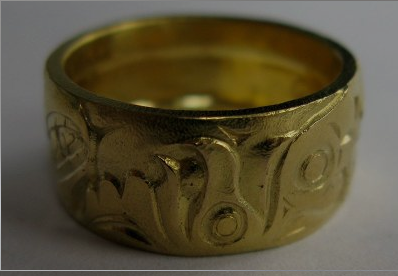
A case in point: “Healing Ring,” the second of the rings made for us by up and coming artist Gwaai Edenshaw (the other ring was “Raven and Crows,” which I blogged about earlier).

Here’s how Gwaai Edenshaw himself describes the ring. He was talking with us as he wrote and using a soft pencil, so I have had to guess here and there as I transcribed:

[The] centre of the ring is Fungus Man, made famous in the story of Raven and the First People. The only [one] of Raven’s helpers that was strong enough to face the feminine energy/sprit, and bring it to humanity. This character was likely Fomitopsis Officinalis. This is a shelf fungus that is analogous to a Chinese medicine (in fact one of Chinese Medicine’s most prized medicines). It was almost definitely used by Haida shamans. Samples of it have been found among shaman’s effects (this was thought to be wooden carvings until a recent test of the wood revealed it to be Fornitopsis. Fungus Man appears out of a bush of K’waay K’ia (Indian Hellebore), a very important medicine to us. Like many medicines it has potential for toxicity, but in the hands of the right practitioner it is a true marvel.

Also called Laricifomes officinalis, the fungus is almost extinct in Europe, but is found in old growth forests in the Pacific Northwest. In various locales, it has been used to treat tuberculosis, pneumonia, asthma, rheumatoid arthritis, infection, and smallpox, and to ensure long life.

I believe that the appearance of the fungus on the ring is one of the first instances in which Edenshaw has combined his interests in Haida botany and art. In fact, aside from what appears to be tobacco leaves and European-influenced floral designs in some argillite work, flora of any sort is rare in Haida art, although some mainland nations have floral crests, such as the Gitksan Fireweed clan.

Edenshaw continues:

On the reverse side is a pair of herons. These are the helper in a number of stories, notably the Gunarsiargit story where they play a small but critical role in the story’s namesake fulfilling his destiny.

More specifically, a heron often dwells on the edge of the village, some distance away from the inhabited houses. This locale reflects the heron’s often lone habits, but might also suggest a shaman, since shamans often lived and certainly were buried separately from everyone else.

For me, these are the kind of details that, when combined with artistic skill, can make Northwest Coast art so satisfying to me. They offer not only aesthetic pleasure, but, for a European ethnic like me a small window into the cultures that produce them. And Edenshaw, besides being a gold smith with a genuine feel for the metal, is also clearly someone deeply knowledgable about his culture as well.

Read Full Post »

One way that you know an artist is talented is when other artists are eager for their work. Gwaai Edenshaw is in that enviable position among the Northwest Coast artists who live in Vancouver. A some-time botanist and Bill Reid’s last apprentice, he works largely in gold, although he has been known to sketch, carve wood, and even experiment with animation. Having admired his work since we first saw it, Trish and I recently celebrated our anniversary by buying two of his rings.

Mine is based on an episode in “Raven Traveling,” the Haida narrative of the Trickster’s wanderings near the beginning of time. On the beach, the raven encounters a group of crows. They begin to cook a salmon. The raven falls asleep, but the crows can’t wait for him to wake, and devour the salmon. Belatedly, they realize that the raven will be angry when he rouses, so they take the remaining crumbs of salmon, and wedge them between his teeth. When the raven wakes, hungry for his meal, they point out the crumbs and ask, “Don’t you remember? You ate it before you went to sleep.” Angry at the deception, Raven throws the crows into the fire, turning them forever from white to black.

I appreciate the story for its broad humor, as well as its extrapolation from nature; crows really do mob ravens, especially when their young are in the nest. If crows could play practical jokes on ravens, they undoubtedly would. Also, the story is not one of the ones that is generally depicted, like raven’s stealing of the light, or even his theft of the salmon from the beavers.

I suggested the subject to Edenshaw, and waited with all the patience that anticipation would allow for six months until he had time to get to it.

The result was more than worth the wait. Edenshaw chose a style that fits the humor of the story, showing the raven with his beak open and crows rollicking around him, pushing the crumbs of salmon into his mouth and their beaks open in excitement, no doubt chortling with glee at the thought of putting one over on their rival.

Since the raven has teeth in the story, and the Haida storytellers must have had plenty of chances to notice that birds have none, I assume that he must have been in human form when he met the crows. However, the fact that Edenshaw chose to show the raven as a bird with teeth in his beak does not detract, any more than the teeth in the beak of the parrot in Aladdin. It is a comic touch, and the result is reminiscent of the lively cartoons that you see in the margins of medieval manuscripts. I especially like the mischievous crow that is pushing a piece of salmon along the raven’s back (You can see the crow’s beak just behind the top of the raven’s head).

At the same time, I appreciate the economy and skill with which Edenshaw rendered the story. Like a business card (only more so), a ring provides a very limited space for depicting anything, yet Edenshaw manages to focus on the main event of the story, while selectively choosing details so that, while the feathers on raven’s head are not visible, the pieces of salmon clearly are. The detail is all the more amazing when you consider that the ring is cast, not engraved.

So far as I am concerned, Edenshaw produced a ring that is utterly unique, and wonderfully rich in humor and detail. After wearing it for several weeks, and having appreciated the small extra touches with which it was delivered (in a small wooden box, with the promise that the mold would be kept, in case the original was lost), I fully intend to buy more of Gwaai Edenshaw’s work. But if, as I suspect, his prices rise as he receives the recognition he deserves, at least we have a couple of samples of his work to console ourselves.

lm

Read Full Post »

“Oh Lord, please don’t let me be misunderstood.”
– The Animals

Every few years, I come across someone who can’t understand me. I don’t mean a man or a woman who thinks so differently from me that they can’t grasp my motivations or the logical progression of my thoughts; this kind of person, I could joke with some seriousness, I meet several times a week. I mean someone who, no matter how slowly I speak, how loudly I project or how clearly I pronounce my words cannot comprehend the literal sense of my words. Inevitably, the result is mutual panic and frustration.

Exactly why a small handful of people cannot comprehend me is a mystery to me (after all, I can hardly ask them). My first inclination is to blame myself. After all, when I was in the first grade, I did take speech therapy. But that was long ago. If anything, speech therapy left me with a tendency to speak precisely and carefully that some people mistake for a British accent.

Similarly, while some people claim that I have a slight secondhand Yorkshire accent I picked up from my father, it’s a mild one (if it exists). Anyway, my vowels are definitely Canadian (for instance, coming from me, “hill” and “hell” sound the same, and so do “don” and “dawn”), so by all reasoning, I shouldn’t be anywhere close to unintelligible. I do speak quickly, but so do many western Canadians, and most of them don’t seem to have the same trouble that I occasionally bump into.

So, as much as the idea goes against my inclinations, I suspect that the problem is usually with those with whom I am unable to communicate. Usually, they are either untraveled Americans, or ESL students who are less than fluent in English. Either way, they are usually in their early twenties.

These common traits suggest that my uncomprehending listeners may lack experience with many accents. Their behavior reinforces this suggestion: always, they are impatient, and regard me as if I am mentally subnormal, giving up attempts to communicate long before I do. Yet I suspect that this is only half the explanation.

In my own case, when I’ve had trouble following thick accents like Glaswegian or Jamaican, the reason has been that I have taken a few moments to catch the rhythm of the speech – how it shifts to ask a question, or asks for a response, for example. Could my unusual precision produce an unintelligible rhythm for some people?

But that only shifts the question back one step. Faced with an accent with a strange rhythm, I usually find that within a few minutes, I can understand the speaker so long as I concentrate. But, when someone can’t understand me, they never gradually start to comprehend me. They stay baffled by me forever.

Could another common element be that these people are tone deaf, at least when it comes to accents? That they cannot catch that subtle rhythm that lets you understand a train of thought and, if necessary, fill in the blanks? So far, that is the best guess that I have come up with.

Yet, if I am right, the explanation is little comfort. It does nothing to solve the problem. Speaking without being understood by your audience is a private hell for a writer and ex-teacher, and I happen to be both. So I stand there, growing more frantic, receiving no help from the other person, until they either retreat from my obvious frustration or enlist the aid of someone else.

Frankly, I’ve had more success carrying on conversations with my high school French, and I neither understand why nor know when another of these encounters is going to occur.

Read Full Post »

One thing you can say about public transit: It may not be cheap or convenient, and you learn more about people’s personal hygiene than you ever wanted to know, but there’s nothing like it for people watching.

Sometimes, the people are just outlandish – and I say that as card-carrying eccentric myself. For instance, last weekend, a couple boarded the Skytrain walking very close together. He was tall, with a near beard and long hair and sun glasses. She was shabbily dressed, in kneeless jeans that only stayed up when she held a belt loop, and bobbing her head in a stoned sort of way to the tracks on her iPod. She also had an odor of at least two types of smoke and unwashed body trailing her like a shadow. Close inspection showed she was wearing a dog collar that was chained to his belt. Every now and again, he would give a little proprietary tug, not hard, but enough so that she would try to fix her eyes on him. I try to be broadminded, but if ever a couple needed to be told to rent a room, this one did. That’s not the sort of role-playing you expect to see in the middle of a Sunday afternoon.

But people on transit frequently reveal so much about themselves that they seem to be under the illusion that nobody around them can see or hear them. I remember one time when a young man got on at Metrotown looking distinctly lumpish. He was carrying a dozen coat hangers, and seemed to be wearing as many shirts and sweaters. I’d say he got on casually, if there wasn’t such a nervous edge to his casualness.

That attitude is especially common with people on cell phones. They talk as loudly as possible, until I’m tempted to clap at the end of their calls. One man even broke up with his lover in the middle of a crowded car I was riding in. “But I love you!” he keep saying, while embarrassment spread around him like a stain. After he left, I could see people relax, and several looked at each other and shook their heads.

It’s encounters like these that generated my first dictum about riding transit: Whatever you do, don’t make eye contact. The risk of having to make conversation with some of your fellow passengers is simply too high.

Read Full Post »

You can tell I took the day off today; I got a haircut. I take time off so seldom that, when I do, it’s usually long past time for me to do something about my hair. There comes a time when I have to ignore my small surge of apprehension about the task and just get it done.

Part of the apprehension comes from childhood haircuts. In elementary school, the barber I was taken to was a Glaswegian. In retrospect, I believe he meant well, but his roaring, incomprehensible accent frightened me. I could never understand what he was saying, and often had to guess, which made our conversations strained at the best of times.

Even worse, he knew one style: a buzz cut. As I grew older, I became deeply ashamed of such haircuts. I would wear a hood whenever the weather made it natural, and often when it didn’t.

Then, when the Glaswegian retired and I had to go to another barber, I started a slow campaign to increase the length of my hair a bit with each haircut. By Grade Nine, I had a decent length of hair, but it took many long years before I could not spend my time n the barber chair glaring balefully at the stylist in the mirror and convinced that I would be shorn to the scalp if I let my attention wander for a second.

These days, that fear is quietened to a rumble, like the ones you occasionally hear from dormant volcanoes. But, unfortunately, it’s been replaced by a morbid fascination that makes me almost as uneasy in its own way.

You see, I go so long between haircuts that the entire shape of my face changes with the length and thickness of my hair. By the time I get a cut, my hair makes my face look round and boyish.

Then, bit by bit, as the hair falls to the floor (and it’s a good thing that I’m not charged by the kilo, let me tell you), someone else emerges – a stranger with a leaner face and a higher hairline. He seems harder and older and more athletic than the person I saw in the mirror that morning, and I’m not sure that I approve of him or even like him.

In fact, as I see him emerge from under my hair, the strangest sense of dislocation sweeps over me. It is as though an alternate world version of myself is surfacing in the mirror, waiting to take me over.

As this feeling increases, I continue chatting and joking as though nothing is wrong. But I think the tension in my body betrays me, and I always slide off the chair and walk towards the cash desk with a sense of relief that I have survived the ordeal without losing my soul. And, as I leave the shop, for the next few hours, I am always glancing at my reflection, as though expecting to see the invader still there.

Of course, this dislocation would never happen if I had my hair cut more regularly. But I associate it so much with having my hair cut, I never manage to get on a shorter schedule. On some level, I don’t care to give that other self in the mirror more chances than necessary to take me over.

Read Full Post »

(The following is a handout from my days of teaching first year composition at university. It consists of some informal examples of opening paragraph strategies, but should be equally useful for formal essays. Anyone who finds it useful can reproduce it, so long as they give me credit for it)

Explanation of Topic’s Importance (Anticipatory Summary):
Computers abound in our houses and offices, exchanging information via modems. Programmers are constantly finding new applications for existing software, and computer technicians are refining the hardware so fast that a new computer is no longer state of the art six months after it is sold. We live in a computer-dominated age, and every citizen should have some knowledge of computers. They make routine decisions in business, education and government, and monitor our defense systems. They help individuals to manage their private affairs, to organize their personal records, and to access goods and services, and municipali­ties and legislatures depend on them for planning future develop­ment. Since a knowledge of computers is so necessary for all of us, computer education–“computer literacy,” as the jargon has it–plays a significant role in our society. To understand this role, we must first consider the importance of computer education to the individual citizen and to the country as a whole; next, we must assess the present quality of computer education at all levels; and, finally, we must examine the ways in which computer education can be improved.

Examples:
For many years, automatic vending machines have dispensed such products as salted peanuts, chewing gum, cigarettes, soft drinks and candy bars. Now these robot sellers are becoming more ver­satile. At one eastern airport, the simple act of inserting a coin in a slot will get you a magazine, a pen, a toothbrush, a pocket comb, a handkerchief, a necktie, a suit of underwear, a cup of hot coffee or chicken soup, a set of puzzle toys, a spray of perfume, an insurance policy or a shoe-shine. There are other machines that will take your blood pressure or give you a thirty-second dose of pure oxygen. One corporation has designed an automatic snack bar–a cluster of automatic vending machines that offer toasted sandwiches, hot soup, chili, baked beans and hot pastries and pies. Another firm has produced an automatic cafeteria with a menu of over fifty dishes, including a roast-turkey dinner; the machines even say “thank-you” in a computer-generated voice. These are only a few examples of the many types of vending machines. How are these mechanical conveniences constructed? What effect do they have on buying habits? As we shall see, the vending machine plays a major role in modern commerce.

Definition:
Although manufacturers are reluctant to discuss it except in general terms, copyright violation is becoming increasingly common in our society. Briefly, copyright violation may be defined as the unauthorized use of an artistic product such as a book or a software program by anyone other than the creators or their representatives. It may involve the use of material in slightly altered form, or the copying and distribution of the work, with or without profit. Some people, especially artists, are violently opposed to copyright violation; others, especially software users, consider it their right and something which is inevitable. However it is viewed, it raises ethical issues of great importance.

Cause and Effect:
For the past two years, I have run an average of four to six miles every morning. The results have been amazing. The daily exercise keeps me calm and alert for the rest of the day. It allows me to eat what I want without worrying about calories, and to sleep well every night. It gives me more energy, and, most of all, it gives me a self-confidence that carries over into everything I do. My experience has convinced me that everyone should have some form of daily exercise.

Comparison and Contrast:
For many years, we have thought of the Vikings as bloodthirsty savages who did their best to destroy European civilization. Now, we are starting to understand that this view is too limited. The Vikings were certainly no more bloodthirsty than those they attacked (who generally defeated them, after all), and in many ways they were more advanced. At a time when merchant ships hugged the coast both for safety and for ease of navigation, the Vikings were building sturdy yet light boats that were capable of surviving all but the roughest storms, and boldly sailing across the open ocean using their navigation skills. At a time when most people lived and died within ten miles of where they were born, the Vikings ranged from North American to Russia, and from Greenland to central Africa. Most European art during the Dark Ages was a crude attempt at representational art; the Viking had an intricate abstract art style that we are only now starting to appreciate. Similarly, while most European literature was oral and poetic, the Vikings had complex poetry and detailed prose stories about the deeds of their ancestors. Until early in the twentieth century, a woman in France or Italy had little say in who she would marry, and almost no right to property or divorce; a thousand years ago in Iceland, women had all these rights under written law. As archaeologists have started to reevaluate Viking culture, we have learnt that, far from the horn-helmeted savages of popular imagination, the Vikings were a literate and sophisticated people who were probably closer to us in their assumptions than the southern Europeans of the Dark Ages.

Rhetorical Question:
Can chimpanzees talk in sign language, or do they simply learn what to do to get what they want? Are dolphins and whales possessed of an intelligence equal to ours, but subtly different in nature? Can parrots really have the intelligence of a five year old child? Biologists are divided about the answers to such questions, but the fact that these questions can be asked at all challenge our assumption of our uniqueness. How the question is eventually answered will have a sweeping effect upon our religions, science and ethics.

Illustrative Anecdote:
Once, I made the mistake of telling the woman who was cutting my hair that I wrote poetry. “Must be nice,” she said. “Just light up a joint, sit back and wait for inspiration, then write whatever comes into your head.” At the time, I could have told her that I didn’t smoke tobacco, let alone anything stronger, but, when I think of all that I have learned in the intervening years, I realize that I could have said a good deal more. Like most people, she had a romantic view of writing that is almost totally unrelated to the reality. The truth is not only that few writers use any stimulants stronger than coffee (at least, while they are writing), but also that they hardheadedly plug away at lonely and time-consuming work that, far from being easy, can ruin your nerves in a week if you take it too seriously.

Opposing View to Be Refuted:
Many people think that keeping parrots is like keeping fish. Just as you keep fish in a bowl, feed them, and sit back and watch them, so you keep parrots in a cage, feed them, and sit back and watch their antics. Pet-store owners tell me that this assumption is so strong that some people buy parrots to match the decor of their living rooms. I don’t know how many people act so careless­ly, but I do know that they are in for a surprise. Far from being passive animals, parrots are curious, intelligent birds, that have to be watched constantly and demand hours of attention each day.

Relevant Quote:
“Violence,” Isaac Asimov writes in his Foundation series, “is the last refuge of the incompetent.” Salvor Hardin, the character who adopts this aphorism as his motto, goes to great lengths to prove it, inevitably outwitting his enemies when he applies it. Cynics may doubt that avoiding violence in real life is as easy as it is for Hardin, but, if my personal experience is any indication, Asimov may have a point. Admittedly, avoiding violence is harder than giving into your impulses, and requires more patience. Yet the simple fact of making the effort is worthwhile for at least two reasons: it leads to creative thinking about problems, and, if successful, to more permanent solutions.

Read Full Post »

I appreciate Northwest Coast art for many reasons. It is semi-abstract, which always captures my imagination. It has a historical and sociological aspect, so I can combine intellectual and aesthetic interests. It is the art of my home, although not of my culture. But, sometimes, I think that my main reason for buying Northwest Coast art is that it is one of the few modern forms that remains largely unaffected by scholasticism.

By “scholasticism,” I refer to the modern trend in many of the arts for artists to be more interested in theories or concepts than in craft or any general audience. It is a trend that has occupied most of the twentieth century, and continues to prevail in the 21st. I’ve seen it first hand in poetry and literature, and it seems equally prevalent in music, painting, and dance. It is the approach that Tom Wolfe slammed, outrageously and a little unfairly in architecture when he wrote From Bauhaus to Our House.

Under scholasticism, what matters is the theory behind it. Before anything else, what interests the artists of scholasticism is demonstrating that they can put the theory into practice. Their work tends to be crammed with obscure references and in-jokes, and their talk is usually more about the theory than the work itself. It creates a vicious circle, with artists losing audiences because of their obscure practices, then retreating into even obscurer theory in reaction to the lack of audience.

While exceptions exist, Northwest Coast art seems largely free of such attitude. Beginners may be told to read Bill Holm to understand the mysteries of formline, but nobody reacts when someone breaks the alleged rules, or strikes out in a new direction, as the Salish artists have in the last few decades. Similarly, while many artists have experimented with the forms of modern art, few seem to become obsessed with the theories behind the forms.

Why Northwest Coast art has been spared this obsession is probably complex. But it is not because the art is in any way primitive, any more than Celtic knotwork is primitive. Such forms can be dismissed as primitive or romantic only to those who have not bothered to learn about them.

Nor is it naive. Many Northwest Coast artists are just as prone to in-jokes as any mainstream artists, but the difference is that the jokes are an extra layer of meaning, not the only one, nor even the most important one most of the time.

Nor does the reason has anything to do with the rigidity of change, or even the marketplace. For the last century and a half, Northwest Coast artists have seized on new media whenever they have had the chance. Argillite, glass, aluminum, canvas – each of these has been eagerly adopted as soon as it became available. The same is true of tools, from steel engraving tools to power tools. And, as often as not, the artists have begun work with new media and tools with only a few denouncements from their peers, people, or clients.

If anything, this versatility may have helped Northwest Coast artists take scholastic art in their stride. Although scholasticism is all about breaks with the past – often, the nosier the better – few Northwest Coast artists seem to consider new media, tools, or techniques a radical departure. This attitude has become very apparent in the Bill Reid Gallery’s current Continuum show, in which the curators’ efforts to start a dialog about the differences between traditional and contemporary first nations art has met with very limited success. Almost all the artists in the show make clear that they don’t see such an opposition.

Another reason for the freedom from scholasticism may be that, unlike modern mainstream artists, Northwest Coast artists tend not feel deracinated. Their art is not only an expression of their cultures, but a statement that their cultures are alive and thriving. Even those who did not grow up in their cultures generally feel an urge to know more about their origins as their art develops, and, for many in their communities, the success of Northwest Coast art is an obvious source of pride. Rediscovering and proclaiming their cultures, perhaps, is more than enough of an agenda to be going on with.
Not only that, but Northwest Coast art has genuine popularity, both among the first nations cultures of the coast and a small segment of the general art-buying public.

Admittedly, this popularity is not an unalloyed good. I have heard artists complain about being limited in their subject matter because something too esoteric won’t sell. Some artists, too, are tempted by the tourist trade, and start producing cheap curios rather than art. In addition, the popularity of the art form ties too many artists to the gallery system, and allows a handful of gallery owners far too much influence on what the public sees.

However, this popularity still gives Northwest Coast artists a huge advantage over their mainstream counterparts. Unlike mainstream artists, Northwest Coast artists know their work is appreciated – sometimes for the wrong reason, sometimes condescendingly, but appreciated all the same. Much of the public art in British Columbia is from the first nations, and, internationally, probably only art from the American Southwest is more eager sought after. In their own cultures, art is increasingly wanted for potlatches and ceremonial purposes.

Unlike many mainstream artists, Northwest Coast artists – even the most reclusive ones – have a dialogue with their audiences. They may not always like what they hear or agree with it, but they can still count on a degree of interest that mainstream artists can hardly imagine. So long as that interest remains, I suspect, it is hard to imagine scholasticism ever getting much of a hold in Northwest Coast art.

Why disengage and retreat into the cloisters when you have people who want to talk about your art? After all, that is what most artists want, even those who are most deeply into scholasticism – an audience that engages their work.

I used to wonder why mainstream art events so rarely included first nations artists in Vancouver. The communities seem very separate, even though a few people like Andrew Dexel or Sonny Assu seem to cross between them. The answer, I now believe, is that the two communities are so different that communication is difficult. Their approaches, attitudes, and perspectives are so much opposed to one another that the surprising thing is not that some Northwest Coast artists are exploring the mainstream. The surprising thing is that any have managed to do so at all. But, apparently, Northwest Coast Arti is in such a healthy state that it can even absorb attitudes that are opposite to its core assumptions without any real difficulty.

Read Full Post »

One of the pleasures of buying work from beginning artists is watching them fulfill their potential. Last January, I saw enough promise in John Wilson’s work to buy one of his masks. Now, in masks like “Shaman and His Helpers,” his work has reached its first maturity.

Compared to most of Wilson’s earlier works, “Shaman and His Helpers” is a busy piece, both in subject and execution. It benefits, too, from Wilson’s study of traditional masks through pictures, the most obvious benefit being the use of eye holes instead of painted irises and pupils.

The mask depicts a shaman and his spirit helpers. One of the spirit helpers sits in the shaman’s mouth, as though resting after a long climb up his esophagus. The other sits in the middle of his forehead like a frontlet. Both these positions suggest that the helpers are indicators of the shaman’s true nature.

The helpers look more or less human, but the one in the mouth is in a vaguely frog-like position, while the one on the forehead is round enough to be a moon. While the shaman’s eyes are narrowed as though he is entering a trance, both helpers have closed eyes, as if asleep or focusing inwardly.

One way or the other, you sense, the shaman’s and the helpers’ eyes are going to be in the same state shortly: Either the shaman is about to enter their world of perception or else the spirits will come into his. No matter which happens, the result is a mask of a half-realized transition.

Interestingly, too, the spirit on the forehead is painted similarly to the shaman, while the spirit at the mouth is left unpainted. That may be an artistic decision made because any paint would be overwhelmed by the red of the shaman’s lips. But the effect is to suggest that the spirits are in some ways opposite.
Are the spirits different aspects of the shaman’s nature? Or perhaps the helper in the mouth is unrevealed, a creature of the dark, and the moon-like one on the forehead is a creature of light? At the point portrayed in the mask, they do not seem at odds, so perhaps they are opposites needed for balance and insight. Whatever the case, a moment of magic and transition is depicted.

The awe of the moment is heightened by the design of the mask. Tall, thin masks are common in the northern tradition, but in this case, the physical dimensions suggest a lean asceticism that seems fitting for a shaman. This asceticism is heightened by the high cheekbones and the deepness of the eye sockets near the nose, which suggest that the shaman might have been fasting. The black eyebrows reinforce this sense of gauntness, especially in a bright light that emphasizes the cheekbones and eye sockets.

At the same time, the mask carries a hint of menace or pain. Especially from a distance, the hands of the spirit in the mouth suggest fangs. Similarly, the unusually bright red used in the mask leave a half-unconscious impression of blood, as though the shaman’s trance is accompanied by a nosebleed and his biting of his own lip. Or perhaps the redness of the lips suggests that the shaman is giving a sort of birth to the spirit clinging to his lips. The suggestions are understated – there are no blatant riverlets of blood trickling from the nostrils or down the chin – but they are only more effective for being subtle.

And always the grain, which Wilson has carefully matched to the contours of the face, stands out, suggesting a movement or fluidity just below the skin. Influenced by his teachers at the Fred Diesing School, Wilson has always shown an awareness of the grain as a finishing detail, but here that awareness is not just a reflection of technical skill, but also an addition to the design.

When this mask first went on the market, I missed the chance to buy it, and cursed my slowness to make a decision. Luckily for me, the first owner changed their mind, and I was able to buy it after all. The more I study “Shaman and His Helpers,” the more I think it is Wilson’s best mask to date. At the same time, knowing that he is a constant carver and likely to have decades to continue his learning of his craft, I can’t wait to see what levels he will reach next.

shaman-and-helpers

Read Full Post »

Because I have been in business for myself during much of my adult life, people occasionally call me an entrepreneur. They mean it for a compliment, so I try to hide the fact that I consider the term an insult.

I can see why they might apply the term to me. I’m rarely at my best in a 9 to 5 job, and I maintain a sole proprietorship called Outlaw Communications that I occasionally remember to declare my GST on. Once or twice, I’ve even created jobs by sub-contracting.

Still, there is a fundamental difference between an entrepreneur and me. An entrepreneur is someone who wants to accumulate money or power, a whole-hearted participant in the game of capitalism set on building their own empire – if only so they can take early retirement. But I’m none of those things.

By contrast, my attitude is that of a bourgeois intellectual. Although I see no nobility in poverty, and don’t object to having a good year for income, I am not especially concerned with accumulating money. My ambition in those directions extends only so far as being comfortable, and having a good chance to be as comfortable as I am now in the future.

As for power over people, while I mildly prefer it to them having power over me, who needs the responsibility? I am far more interested, too, in interesting work now than in early retirement – especially since, if I worked hard enough to take early retirement, I probably would forget how to enjoy it anyway.

Besides, having survived on the outer edge of academia for years, I am full of anti-capitalist sentiment. Accumulating privilege seems a ridiculously trivial way to spend my time when there are so many books, films, songs, and pieces of art to appreciate – to say nothing of exercise, conversation, and food. Why make the effort, especially when it is so soon forgotten? Andrew Carnegie and John Paul Getty may have been known in their times, but their names are only half-familiar at best today.

Consequently, I have a hard time understanding in my heart of hearts why a grown adult would be pleased to be called an entrepreneur, or imagine that I would be. Taking on that role seems to involve an obsession with the banal, and a deliberate decision to ignore most of what makes life worth living while getting nothing worthwhile in return.

Frankly, the idea of being an entrepreneur bores me. As for being called one, why would I pleased that someone considered me so shallow?

This attitude, no doubt, explains why I will never be rich. But, please, don’t strain my manners by calling me an entrepreneur. I aspire to better things than that.

Read Full Post »

This afternoon, I heard Tlingit artist Nicholas Galanin speak at the Bill Reid Gallery. His talk was my first prolonged exposure to concept art applied to Northwest Coast art. I came away stimulated, but not particularly sympathetic to the effort.

Galanin is the latest of several generations of artists, and has done some jewelry in the traditional style. However, at least for the time being, he is not especially interested in traditional art or culture. He talked about traditional art as being confined by the stereotypes imposed by a romantic view of first nations, and – rather tellingly – could not tell where he obtained a traditional song he used in a video, even though in coast cultures, rights in songs and their performance can be important pieces of property. [Note: Both Galanin and Sonny Assu tell me that it was not the traditional song whose source Galanin didn’t know, but a hiphop song that was part of the same work. See the comments below. I apologize for the error].

Instead, Galanin is more interested in exploring the First Nations as another ethnic minority within the dominant culture – in particular, how coastal images are bastardized and exploited by cheap imitations made in Asia for the tourist trade in the Northwest Coast. He discussed, for example, a series of masks he made out of pages of the Bible, talking about how he found it appropriate that the holy book of Christians, who suppressed shamanism, should be converted into a shaman mask. Galanin also talked other paper masks he had made and how they were masks by a first nations person that showed no signs of first nations culture.

Other projects he discussed involved embedding tourist-trade masks in a wall covered with wallpaper that depicted idealized pictures of 19th century life and another in which the same type of masks were covered in Chinoserie. In a pair of videos, he had a traditional dancer (or an approximation of one) and a modern dancer moving to the same traditional song. In yet another series of work, he gave his version of the highly idealized photos of Edward Curtis: naked women with masks added in a graphics editor.

Meanwhile, ten meters from the podium where he stood was his contribution to the Bill Reid Gallery’s Continuum show: A version of Bill Reid’s “Raven and First Men” rendered by a chainsaw. Galanin was seeing his version of the famous sculpture for the first time, because he had outsourced the work – as he does much of his work.

The outsourcing is a commentary on commercialism, but I also had the sense that for Galanin what matters is not the actual work so much as the concept. Apparently, he sees his role as that of impresario, rather than as an artist who necessarily creates works with his own hand.

Having been a grad student in an English department of a major university, I am tolerably well-versed in such approaches to art. Nor do I find anything in Galanin’s social commentary with which I disagree.

But I wonder if I am missing something, because I have never found this kind of concept art very compelling.

For one thing, it seems to have little room for something that is central to my own appreciation of art – the enjoyment of craft, of sheer artistic excellence. Part of this lack may be that it does not delve deeply into tradition, so it has no standards to judge skill by. But the major reason for the lack seems to be that, when you are making a comment, craft becomes unimportant or perhaps a distraction.

Moreover, when you are commenting on commercialism, too much craft is probably out of place. If anything, your message is stronger if an object shows a lack of craft.

This situation helps create another problem: most concept art, including Galanin’s, is like a symphony of a single note. If your ideal is the “well-made object” of Bill Reid’s aesthetics, then viewers can return to it many times, and even discover something new after the first viewing. In comparison, concept art seems simple and to offer few reasons to return to it. Once you have grasped the message – which is often simple enough that you can reduce it to a single sentence, or at least a rather short paragraph – nothing is left to appreciate. Concept art seems to be unambiguous and unsubtle by nature, and, consequently, not very interesting.

In this respect, it is interesting to compare Galanin’s chainsaw Bill Reid knockoff with Mike Dangeli’s ridicule mask, which is also in the Continuum show. Where Galanin’s “Raven and the First Immigrants” seems one-dimensional, Dangeli has reached into his cultural history to bring an old concept into the future: just as the ridicule masks of the past were public announcements of a wrong, so Dangeli’s is a declaration of the wrongs suffered from the first nations. Dangeli’s mask is every bit as social or political as Galanin’s sculpture, but where Galanin’s sculpture seems facile, Dangeli’s mask is ambiguous and complex. And I doubt it is a coincidence that Dangeli is throughly involved in preserving and reviving his culture while Galanin sounds like a typical deracinated intellectual.

But such issues are a matter of taste. Regardless of what I think of Galanin’s work, I have to admit that the very fact that it takes the form that it does illustrates the diversity of Northwest Coast art and proves it a living tradition. And that by itself, I suspect, is something of value.

Read Full Post »

« Newer Posts - Older Posts »