Feeds:
Posts
Comments

Posts Tagged ‘Uncategorized’

Susan Faludi is famous for Backlash: The Undeclared War Against American Women, a detailed description of the hostile reaction to feminism during the 1980s. She is less well-known for Stiffed: The Betrayal of American Men,  her equally in-depth description of male gender roles in the mid-1990s. The reason for this discrepancy? She wrote Backlash as a mainstream feminist for whom the existence of male privilege was an unexamined given. By contrast, by the time she finished writing Stiffed she was an unorthodox feminist critical of the conventional view of male privilege.

In modern feminism,  male privilege is a major explanatory principle. Just as you might explain why objects fall to the ground by invoking gravity, so many feminists evoke male privilege for an explanation of almost anything that men do. For example, a man who makes a sexist remark is demonstrating their position of power over women. So is a catcaller or a rapist. In all these cases, evoking male privilege is all the explanation that is needed. There is no need to go deeper in male psychology, because referring to male privilege says all that is believed necessary.

By contrast, while researching and writing Stiffed, Faludi concluded from her observation that male privilege was only a partial explanation. As she interviewed men across the United States – particularly working class men – she noticed that, far from feeling powerful, many men had been feeling a lack of power since the end of World War Two, and lacked positive role models. Their sole exercise of privilege was their assumption that they could take out their uncertainty and frustration on women, whom they often blamed for their feeling of being trapped.

Faludi’s conclusions have distinct advantages over the conventional analysis of male privilege. For one thing, they are based on observation, not theory, so they carry more conviction. For another, they cast men as fellow victims of gender roles, a view that tends to break down the view of men as Other.

However, the most important aspect of Faludi’s conclusions is that, because they go deeper into the causes of sexism and misogyny, they suggest more productive ways of handling these behaviors.
This advantage became clear to me the other day at a Psychology Dinner meetup on the subject of modern feminism. A woman described how a young man, probably at a night club for the first time, was groping every woman he could reach, including her.

A conventional response would be to shout at him, or call for a bouncer; he was a man with an assumption of privilege. However, while such a response would get him to stop his immediate behavior, it would leave him resentful and more likely to continue his unacceptable behavior in a gesture of defiance.

However, instead of just shouting at him  – although she did that, too – the woman took him aside. Assuming his behavior was due to immaturity, she took it on herself to explain why it was unacceptable. She never saw him again, so she never knew how he responded in the long term, but, by seeing him as human and inexperienced rather that an exerciser of privilege, she at least open the way for him to learn something and modify his behavior. The woman had never read Faludi, but her assessment of the situation was very much like what she might have had if Faludi had inspired her.

Yet despite these advantages, Faludi’s perspective has been rejected and generally dismissed in many feminist circles. It is unorthodox, and it denies the self-righteousness and sense of superiority that evoking male privilege encourages. It is also more humane,  and therefore more difficult to maintain.

In a word, Faludi’s view is too new. It requires a rethinking that many feminists are reluctant to undertake. Instead, they reject it as being soft on sexism and misogyny, and stop thinking of it. Praising Faludi and accepting “backlash” into their vocabulary is one thing when her analysis is conventional, but being asked to critique their core analytical tools is another thing altogether, and completely unacceptable, regardless of the evidence.

Faludi’s response to this reception is that there are many types of feminism, and that questioning orthodoxy does not make her less of a feminist. But to me, the painful part is that mainstream feminism has rejected insights that might have deepened its members’ understanding, and made their analyses of society more detailed and effective. Faludi has been an important influence on my thinking about feminism,  and I regret that her second book was not as welcome as her first one among those who could make best use of her insights.

Read Full Post »

Lately, I’ve been disturbed by an unexpected event. The event was trivial in itself, but every now and then it nags me like a piece of tin foil trapped between my teeth, raising questions about the everyday interactions of men and women.

The event was a brief encounter with a woman who had been a colleague of sorts several years ago. I had questioned her approach to collaboration, coming to believe she had used me when I was vulnerable as a recent widower. She responded condescendingly. It was not my proudest moment, but I became unspeakably angry. For a couple of years I publicly criticized her several times when doing so seemed relevant.

Learning that we would be at the same conference, I tried to make a gesture of apology. It was rebuffed with unnecessary rudeness, but I had become embarrassed by my past behavior, so instead of growing angry again, I simply decided that I would ignore her at the conference. In fact, twice, I dodged her in the hallway to avoid conflict.

I was at a talk of mutual interest, sitting midway in the audience, on an aisle seat. A few minutes into the talk, I noticed that the woman in question was sitting in the back, near the far wall, with half the audience separating us.

For the first twenty minutes, I kept my face mostly to the front. However, when the panel asked for questions, members of the audience spoke from a microphone just behind me, and I turned to face them.

The woman took a couple of moments to notice me, but when she did, she rose hurriedly and left. She did not exactly run because of the crowd at the door, but she looked as though she would have liked to.

I would prefer to think that she was rushing to another talk, but the next sessions were at least twenty minutes from happening. Her departure might have nothing to do with me, except that she looked panicked, even scared — even though being either seems out of all proportion to the event.

Her reaction gave me no satisfaction and no sense of power. Instead, it made me feel both small and imposed upon. I felt like I had been silently condemned as a bully or worse, yet I could not tax myself with anything worse than anger and the occasional sniping. My criticism was never as severe as it could have been, and I had said far less than I might have– as little as the woman is likely to believe that. Even here, I am leaving out details that might identify her.

Nothing was ever said in so many words, but I suspect that I have been press-ganged into her private psycho-drama, playing in her mind a stereotypical man disappointed that I could not have a relationship with her. Nothing to justify that view had ever happened or been said – so soon after my partner’s death, I had had no wish for any new relationship – but my impression was that the woman was reacting to images in her mind and past experiences, and hardly at all to anything I had said and done. So far as she was responding to me, she was slotting my words and behavior into pre-defined categories rather than viewing them independently. Given my views on the typical man, the idea leaves me even more insulted.

Ordinarily, my first instinct in such a situation would be to talk to the woman. However, after seeing her apparent flight, I am reluctant to increase her panic or fear now that I am aware of them as a possibility.

Anyway, I suspect an intervention would never work. It would simply reinforce her interpretation. As much as my reflex is to help, her view of me has such a limited connection to any reality that it is clearly something she has to work out for myself. All I can do is hope that she becomes indifferent to me as quickly as possible; at this point, I can hardly expect her to start viewing me as human.

Meanwhile, in what world is such behavior reasonable? I am left wondering: are relationships between women and men so toxic that other women would react the same way to such a minor series of interactions? I remind myself that the woman has run from at least one female antagonist, so I would like to believe that other women – if not most women – would react differently. But I am left wondering if male-female relationships could generally be as tangled as this, and whether my belief in the possibility of friendship or mutual respect between the sexes is naivety on my part.

Unfortunately, though, I have only fragmented answers. All I have is an uneasy guilt at having unintentionally hurt someone I have sometimes respected, mingled with a sense of being insulted and unfairly accused, and the frustrated conviction that the only action I can take is no action at all. It is a situation that has no effect whatsoever on a daily basis, but it annoys me because it seems so baffling.

Read Full Post »

I once knew a man who mentioned that he was in Mensa as soon as he was introduced. He died a couple of years later while hiking alone. Apparently, he ignored the signs warning to stay on the path, and fell over a cliff, the victim of his conviction that he was always right.

He was only the most extreme example of something I’ve observed dozens of times: people so pleased with their own intelligence that they make trouble for themselves. Usually, the trouble falls into at least one of these seven fallacies:

Thinking themselves the smartest person in the room

Intelligent people often receive so much praise in childhood that they grow used to under-estimating others. They become confident that their opinions are the most accurate, and perhaps even that they can manipulate those around them. The trouble with this outlook, as a psychologist friend remarked, there’s always another room – and another, and another. Sooner or later the intelligent will meet someone smarter, or at least with greater expertise. However, with this attitude, they often fail to notice, which often leads to results that are embarrassing at best and disastrous at worst.

Thinking themselves superior to other people

The Duke of Wellington could get away with his conceit because he was born an aristocrat at a time when that social status meant something. An intelligent person today of any class has no such support for their assumptions of superiority. Unless they outgrow their assumptions or learn to conceal them, they make needless enemies. They leave a trail of resentment that can blow up like a powder train.

Not realizing  that thinking can make you stupid

Early computer programmers used the expression “GIGO” (Garbage In, Garbage Out”), meaning that a solution is only as good as the information it is based on. The same is true of human thought. Intellectual pride encourages leaping to conclusions, the overlooking of data, relying on incomplete data, and worse. Your intelligence doesn’t matter if you use it to think about faulty information.

Thinking they can do what they like

Remember eugenics? That was the pseudo-science that wanted to breed humanity to weed out the unfit. Until Hitler’s Germany showed where eugenics could lead, it was a popular idea among intellectuals across the political spectrum. Strangely, however, no one ever considered themselves unfit, nor questioned their right to make decisions for those who were supposed to be. Today, intellectuals may not go so far, but they still fall into the trap of thinking they can make decisions for others without consultation or permission. Then they’re surprised when they receive anger instead of gratitude.

Thinking they can ignore advice

The logic is obvious: if you’re the most intelligent person in the room, why bother with other opinions? The answer, of course, is that even without other skills, another perspective is often valuable. That’s why science is peer-reviewed, and even the most acclaimed writers often credit a discerning editor as a major reason for their success.

Thinking intelligence makes them experts outside their expertise

Some types of intelligence include the ability to learn quickly and to ask intelligent questions. However, even these types do not make you an instant expert. You need to know the limits of your competence, and to respect the fact that some people will be competent in ways that you are not. Otherwise, over-reaching becomes inevitable.

Thinking intelligence is the most important trait

Any time that you become too proud of your smarts, consider Marilyn vos Savant. Vos Savant has the highest recorded I.Q. of 228. However, all she has done with her intelligence is to write a newspaper column – a worthy enough accomplishment, but a modest one, compared with what you might expect from her intelligence. Hundreds of people have done far more with less intelligence but plenty of imagination, determination, observation, and charisma in various combinations.

Conclusion

 Over the years, I have been lucky enough to meet a number of artists and computer programmers who have gained world wide recognition for their accomplishments. Most have struck me as intelligent, but almost all of them also show what can only be called humbleness or a sense of their limits. They have learned what my Mensa acquaintance never lived long enough to learn: Yes, intelligent matters, but it is rarely enough in itself.

Read Full Post »

Discovering a young artist near the start of their career is always exciting. Jaimie Katerina Nole came to my attention when Haisla carver John Wilson directed me to her Facebook page and “The Pregnant Frog Woman” one recent Saturday afternoon, and I knew at once that I wanted a copy. In fact, I wanted one so strongly that I settled for an ordinary limited edition – all that was left — even though I almost never buy anything except originals, artist’s proofs, or remarques.

I have only met Nole once for about five minutes, but she struck me as a young woman of determination. If I have her story straight, she was enrolled in the Freda Diesing School of Northwest Coast Art a few years ago, but withdrew when she became pregnant. She is apparently planning to return to the school this autumn, but, in the meanwhile, “The Pregnant Frog Woman” seems proof that she is making the most of her situation. When she posted the print, she quickly received over 3,800 Likes on Facebook, and decided to make a print of it.

“The Pregnant Frog Woman” is a striking piece for at least two reasons. For one thing, human forms remain uncommon in the modern revival of Northwest Coast art, female forms even rarer, and pregnant forms almost unheard of. So, although the kneeling posture is a conventional one, Nole quickly makes it her own simply by her choice of subject matter. The use of green and black is much less unusual, but enough to reinforce the impression of originality.

However, what is most striking about the print is Nole’s skill with the traditional forms. The use of ovoids for the shoulder, elbow, hip and knee joints is traditional enough, but those in the print are a variety of shapes, their contents echoing and contrasting with each other. The curve of the knee and breast parallel each other as well, and so does the knee and the buttock. Within the breast, the u-shapes also mimic the overall shape, suggesting the successive swelling of the breast during pregnancy.

Several other features of the design also emphasize the signs of pregancy. For instance, thick, black formlines frame the green uterus and fetus above and below it. Even more interestingly, the formline – which varies far more than usual in beginner’s work – is at its thickest around the breast and the bottom of the hip joint, between which the newborn will eventually pass. Not only is pregnancy the subject, but the design continually calls attentions to the symptoms of pregnancy in subtle ways.

A trace of eeriness is added by the signs of a supernatural creature, such as the long slender fingers and the hand with three digits, all differing little except in size from the visible foot. Since the head is barely sketched in, the focus is on the mysticism of pregnancy – the feeling, you can easily imagine, that the figure herself is feeling as she holds her hand over swelling stomach, perhaps to feel signs of movement.

Nole tells me that she is planning a series of prints of different aspects of motherhood, and, despite being a childless widower, at some point in the series, I would like an original. If “The Pregnant Frog Woman” is any indication, Nole not only understands the tradition in which she works, but has the unusual power of embedding emotion within its strict conventions. If her subsequent designs can match this one, Nole is an artist who seems likely to make her mark.

Jaimie-Nole

Read Full Post »

Reading Helen Macdonald’s H is for Hawk reminds me of my experiences of training parrots. The process is very different from the one that Macdonald describes, since parrots are more intelligent and more social than hawks. However, it requires the same patience and is as much about training you as the bird.

These days, the importing of parrots is banned for conservation reasons, so you rarely see wild birds. However, even handfed birds have to adjust to a new human, and many of the birds available today have been neglected or abused. As a result, the goal of parrot training remains the same as ever: to help the bird bond with you, and to teach them a few behaviors that can help keep them safe. Fortunately, you can usually accomplish both goals at once.

When you bring a new parrot home, place them in a cage where they can see what is going on around them. The cage should have a small tent or a corner covered with a cloth, where they can sit and peer out – most birds’ favorite position.

Before training, give the bird some time to adjust. Talk to them, and feed them by hand, let them come out of the cage if they want, but avoid the temptation to rush into training. Coming to a new place is enough of an adjustment without adding anything else. You can tell when a bird is ready for training, because their feathers will be relaxed and they may even make happy chuckling sounds.

When you start training, carry the bird to a small quiet room. I prefer to sit on the floor, in the hopes of looming less. Let the bird come out of the cage, and practice having the bird come up on a perch, both with and without command. This is a relatively non-threatening behavior to begin with, and can be useful for fetching the bird out of the small corners it may hide in if scared or alarmed. It is also useful for getting a bird down from a high place where you cannot easily reach.

When the bird steps up on the perch, praise them verbally, and offer a treat such as a nut or a piece of fruit. Keep each training sessions no longer than fifteen minutes, and in between sessions, continue talking and feeding the bird.

Once the bird steps consistently up on the perch, repeat the process with your hand, working up gradually to having the bird step up a ladder of hands. The exact training time depends on the bird, but ordinarily takes 3-10 days. Abused birds will take longer.

After this basic training is complete, start carrying the bird around their new home, both on your hand and on your shoulder. Show them where the windows are, and let them inspect the glass with their beak, so they know where it is and can avoid it. Feed them from your hand as much as possible, doing yur best not to flinch when you see the beak coming for your fingers. You will soon learn the difference between a friendly approach and a hostile one.

At this point, the praise, the food, the company and the training should be beginning to teach the bird that you are a friend. From there, it is simply a matter of time before you feel a stubby tongue reach out for the nearest part of you to preen you in friendship. An abused or neglected bird may take several years to start preening you, but may still enjoy your company in other ways.

However, whether the first preen arrives in a week or three years, there is no feeling quite like it. It means that you have learned to befriend a creature with the intelligence of a two to four year old human, and that they have learned to befriend you as well. Across the barriers of species and domestication, you have had your first contact with an alien intelligence.

Read Full Post »

Last summer, I contributed to Haida Raid 3: Save Our Waters, an environmentalist animation. I couldn’t resist, given the cause and the perk of a print: Jaalen Edenshaw’s “K’alt’side K’aa” (“Laughing Crow”).

Edenshaw is the brother of Gwaii Edenshaw, one of the foremost jewelers on the coast. Much of his work is on poles and other community art, with only an occasional piece making it as far south to Vancouver. So I was happy when, a few weeks after the Haida Raid fundraiser closed, I received this small sample of his work. Many people assume that Haida art has no humor, and I’m glad to have a piece that proves otherwise.

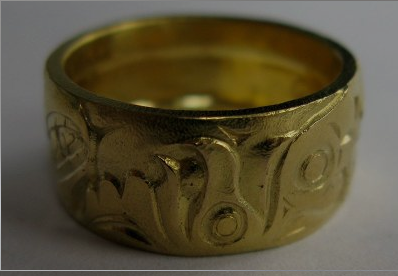
What particularly interests me about this piece is its resemblance to some of the figures on the ring I bought from Gwaii Edenshaw five years ago. I had asked Gwaii to do a ring illustrating the story about how Raven turned the crows black. Not wanting to share their salmon with Raven, the crows put crumbs in the dozing Ravens’ mouth, then try to convince him that he already eaten when he wakes up. But Raven is not deceived, and throws the crows into the fire, singeing them so that their feathers turn from white to black.

bruce-ring3

On the ring, Gwaii depicts the crows in the middle of sprinkling Raven with crumbs of salmon, rolling them into his mouth and along his back. The crow figures resemble the ones on Jaalen’s print, and I mean to ask him which came first the next time I see him.

Meanwhile, the print is a good example of how I can enjoy a hundred dollar piece as much as a ten thousand dollar one. With a print run of 270, the print is unlikely ever to be valuable, but I admire it for its unusual posture, as well as the lines indicating movement on both sides of the figure. Compared to most prints, it is a cartoon – but that, I suspect, is exactly what was intended.

laughing-crow

Read Full Post »

Several years ago, Haisla carver Nathan Wilson was one of the standouts at the Freda Diesing School graduation exhibit. Unlike most of his classmates, he was already regularly selling masks to the galleries. They were well-finished, but, I thought them lacking in individuality. However, his masks also suggested that very soon he would manage that individuality – and I when I saw “ Tagwa” on Facebook, I knew immediately that he had. I immediately offered to buy it, nipping in ahead of several other buyers.

The only catch was that Wilson had done the panel for his YVR scholarship. That meant I would have to wait a year to take it home, while it hung in the Vancouver airport for a year. Then, ominously, when the year was up, Wilson said he wanted to make some adjustments to it.

Knowing something about carvers and perfectionism, I joked that the octopus would probably come back as a grizzly bear. Mercifully, on closer examination, Wilson decided to restrict himself to minor corrections, and the panel arrived at my front door fourteen months after I had reserved it.

“Tagwa” is an abstract piece, with the shape distorted to find the shape of the panel. In fact, the body of the octopus is upside down, with its beak at center left. The abstraction is heightened by the body, which – fittingly – resembles a loose sack of random shapes in which only the beak and eye are visible.

At first, only a few tentacles are visible, the others, presumably, being hidden by the octopus’ body. However, if you look closely, you start to realize that what at first appears to be the formlines for the body could actually be another two tentacles. You also realize that although four tentacle tips are visible in the right half of the panel, they twist in such a way that more tentacles may be present. Stare long enough, and the exact count becomes difficult to decide, because the tentacles seem to start twisting as you try to make sense of them.

The tentacles, they contrast with the body by having a contemporary design. Instead of the ovoids that many artists would have used to indicate the tentacle’s suckers, Wilson contents himself with plain ovals. Instead of a formline design, the tentacles themselves form the center of interest, twining and showing their two sides, one painted red and the other left unpainted cedar. If you look closely at the picture, you can see that the wood mimics the rubbery texture of an octopus’ skin.

This contrast between the two sides of the panel is heightened by its colors. The body reverses the traditional formline colors, making red the primary color and black the secondary one. In addition, as often happens in Haisla works, blue is added as a background color.

The result is a piece that immediately catches the eyes. It now hangs prominently in the center of one wall of my living room, where it catches my eye several times a day, and where in the last nine months it has become one of my favorites pieces. Wilson himself, I am happy to say, has continued to show his own sense of style in his more recent works, consistently proving himself the artist I always suspected he was.
nw

Read Full Post »

Lately, my mind has been focused on friendship, particularly friendship between men and women. Apparently, I am a man who finds friendships with women easy, very few of which have ever turn romantic. That’s not to say that some of these relationships are uncolored by attraction –just that, even without the possibility of sex, people are intriguing enough to keep the attention of anyone with a normal amount of curiosity. In these friends, the women and and I have simply decided  not to follow up on that attraction. Whether we have discussed the matter or come to an unspoken agreement, we’ve decided instead that what matters is the relationship. The expectations of romance can become tiresome, and to dismiss them can be a mutual relief.

Take, for example, a woman I am going to call Kari. We met a number of years ago at a workshop that I was writing an article about. She was one of the organizers, sitting to one side of the audience, and our eyes keep meeting. On my part – and, I believe, on hers – it was not a matter of love at first sight, so much as a recognition that here was a person of obvious character and individuality. After the meeting, we made a point of talking, and quickly went from professional colleagues to friends.

We don’t live near each other, and our lives only occasionally intersect unless we make an effort. In fact, months sometimes pass between phone calls or emails, and even more time between meetings. Yet I frequently wonder what she is doing, and any time we have been out of contact for too long, one of us is sure to remedy the lapse.

Part of our relationship is based on an exchange of favors. I wrote once or twice about an organization that Kari was leading, and, the weekend after my wife died, Kari invited me to just hang – a favor that I badly needed, and will never forget.

However, the relationship long ago became more than any sense of obligation. Part of the relationship is that we can talk to each other about problems and ambitions, perhaps because our interactions can be intermittent.

Yet the friendship goes beyond that. I can’t speak for Kari’s opinion of me, but I take for granted that she will one day leave her mark. It may be in social activism, or in something more mainstream, but short of some appalling random coincidence, one day she is going to be successful, and I sense that she wants that success very badly. If I could, I would like to help her ambitions along, even in a small way, and to witness their fulfillment.

Sometimes we talk about her ambitions, or mine, and what the next steps might be in fulfilling them. Mostly, however, we talk everyday events, and exchange suggestions about how to solve each others’ problems. We make plans, too, to see more of each other, most of which we never carry out. Simultaneously, it is both a distant and a close relationship between two people who think very much alike, yet lead different lives and are just different enough in temperament and pursuits to make discussion insightful.

Since I am a few years older than her, cynics might say that what I have achieved is an avuncular sublimation of sexual attraction, but that, at best, would be an over-simplification. In fact, it would be an insult to both Kari and I, and fails to explain why we have maintained our friendship at the same time as love-relationships with other people I may not understand exactly why we are friends, but it seems to be enough for both of us that we are.

Read Full Post »

Today, I learned from a comment on my blog that a friend had killed himself. His name was Gary Wadham, but I always thought of him as Daffyd ap Moran, his name in the Society for Creative Anachronism (SCA).

We lost touch years ago, but there was a time when Trish and I considered Daffyd one of our closest friends. We were living a few blocks from him in New Westminster, and frequently saw him several evenings a week. On weekends, we often saw him at SCA events, where he served as a marshall during fights and played his guitar at feasts. He had a thin voice, but enthusiasm and a large repertoire of SCA songs more than made up for it. I can still see him in my mind’s eye, playing “Duke Paul,” the “Sam Hall” parody about Paul of Bellatrix,” and, later in the night, the off-color “The Ball of Ballinor,” and, more reluctantly – because he hated the song for its mediocrity despite its local popularity – “Lions Gate the Fair.”

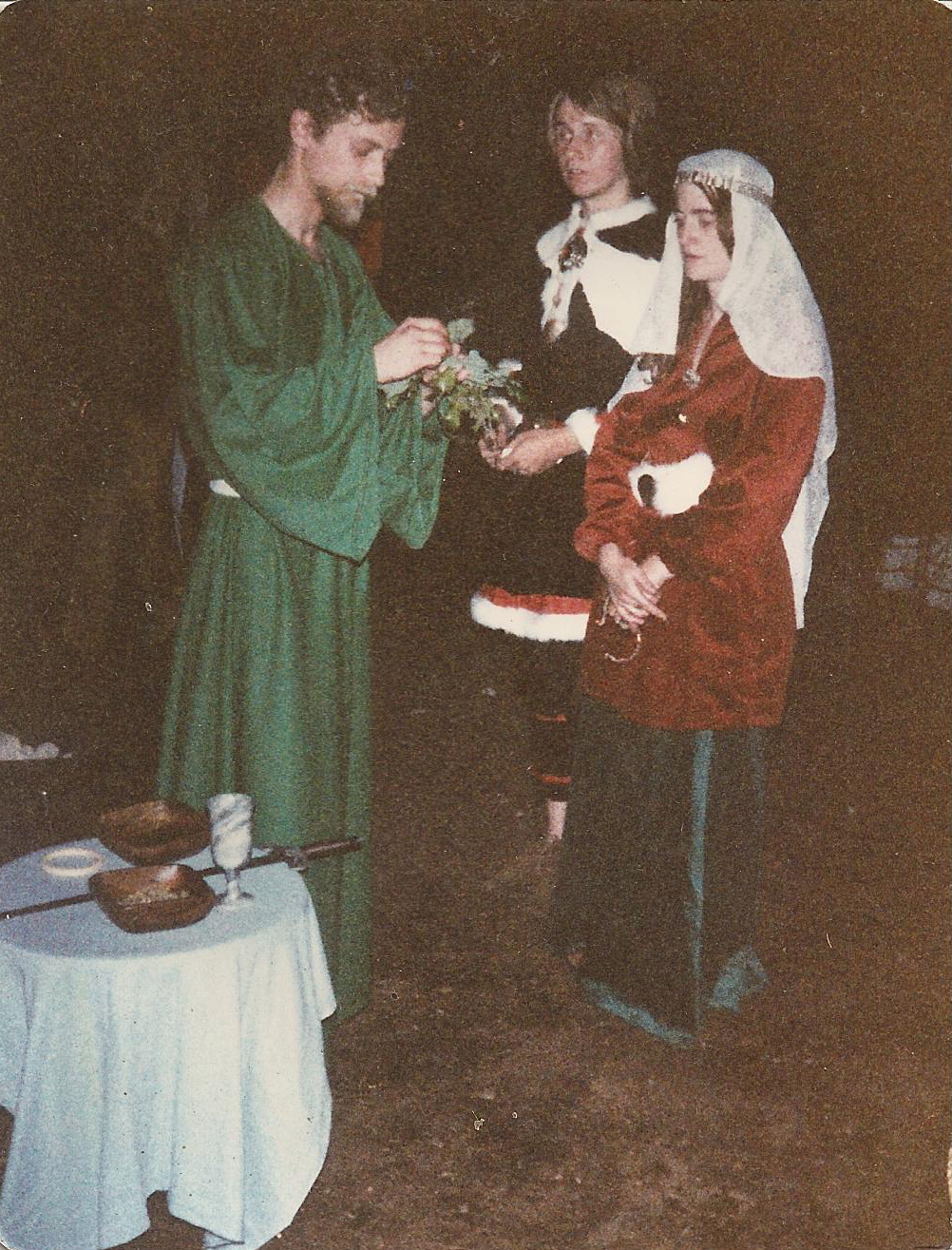
In fact, we were close enough that he presided over our medieval wedding in Druidical green. Although not a pagan, he took his duties seriously, fasting beforehand despite (if I remember correctly) being borderline diabetic, and taking the trouble to pick the exact marble goblet for use in the ceremony. I still have that goblet, enclosed by the wooden ring used in the ceremony.

However, even then, we knew he had troubles. He had a taste for greasy spoons and seedy rented rooms, and his engagement fell through partly because of his moodiness, although it lasted long enough to get him into a marginally more upscale apartment. But he seemed to take a stubborn pride in living, not just simply, but on the edge of squalor.

Even more seriously, he was a mostly functional alcoholic. He did manage to hold down his job as an engineering designer, although he sometimes arrived at work hung over and his idea of breakfast was a couple of beers. But in his own hours, he often drank steadily. I remember one evening in particular when he left our group at the Simon Fraser University pub without saying anything, and a half dozen of us spent an anxious hour or two in the cold night, wandering the campus trying to find him – only to find him, eventually, asleep in his own bed with no memory of how he got there. He was never a nasty drunk that I heard, but his binges often alarmed his friends.

Trish and I lost touched with Daffyd when we moved and quit the SCA; in the circles we had moved in, if you weren’t in the SCA, you didn’t really exist. But from the rumors that reached us from time to time, he continued much as he had been when we knew him, but going slowly downhill, increasingly withdrawing and increasingly ill. In the last few years, I gather, he had largely dropped out of the SCA, and was going blind.

I regret, now, that I never got around to looking him up. Not that I suppose for a moment that I could have done much for him – if anyone ever had their fate written on their forehead, it was Daffyd. But I’ve learned a little about being solitary in the five years that I’ve been widowed, so the feeling persists that I could have done something. But the fact remains that I didn’t keep up the connection, and I lost the right to mourn him long ago, no matter how sorry I am that he died alone.

with-daffyd

Read Full Post »

A few weeks ago, I quit the fantasy book club I had attended for several years. I didn’t especially want to, but I could not have done anything else.

What happened was this:

We had just finished discussing what to read next when, out of nowhere, the woman in whose house the book club met, said something like, “We all love you, Bruce, but I’m glad when we read something you don’t know. When you’ve taught a book or met the writer, it’s too much.”

I was relaxed, so this remark took me by surprise. I kept polite as the meeting ended, even smiling and joking as I left, but, the more I thought, the more the remark vexed me.

True, I have taught third year university courses in fantasy, and for several years attended conventions where I met a variety of writers. But I am not the only one who has met the writers we discussed, and I never brag about my experiences, or mention them to shut down the discussion. I only mention them out of enthusiasm, and because I think they add something to the discussion. Perhaps the woman felt inadequate because I am at least fifteen years older, but shifting the blame to me seems unfair – especially since she tends to dominate the discussion at each meeting.

However, what left me trapped was not the unfairness so much as the lack of alternatives. After that comment, I could either ignore it, making me feel loutishly insensitive, or else watch every word I said, censoring myself during what, after all, was my leisure time, and all because of something I didn’t consider a fault.

Even worse, continuing to attend meetings would mean accepting the hospitality of a woman who – her initial remark not withstanding – obviously held a grievance against me. The meeting location was unlikely to change, and, given her views of me, I would neither eat nor drink – nor even sit – in her house.

Later, waking in the night with the incident in my mind, I also realized that no one else at the meeting had objected to the remark. They might have been as unprepared as I was, but they possibly agreed with the remark. There was no way of finding out without endless discussion, and I would doubt the sincerity of any apologies.

Under these circumstances, I could see no reason for remaining. The next morning, I resigned, keeping quiet when the club organizer asked why I was leaving. I have thought since that I might be over-sensitive, and in some ways I regret leaving, but I didn’t have any other choice that I was willing to accept.

Read Full Post »

« Newer Posts - Older Posts »