Feeds:
Posts
Comments

Archive for the ‘art’ Category

For many people, Bill Reid is the epitome of Northwest Coast art. The reputation is both deserved, given the quality and variety of his work and unfair, given the number of artists in the same tradition who are equally worthy of acclaim. But regardless of how you view his reputation, Reid has a strong claim to being the major Canadian artist of the late twentieth century, with one of his pieces both on display at the Canadian embassy in Washington, D. C. and on the back of the Canadian twenty dollar bill. And, like any admirer of Northwest art, for a long time, I’ve lusted to have one of his works but been unable to afford one – until now.

Even then, I only did so by getting into an area that the collectors haven’t discovered yet. I bought a canvas raven banner whose design is an expansion of the illustrations that Reid did for All the Gallant Beasts and Monsters, which was published in 1991. The banner was part of one of two complete sets of banners from the personal collection of Martine Reid, his widow, and was sold through the recently-opened Bill Reid Gallery in downtown Vancouver, so its provenance is unquestionable. In fact, I’ve left my email address with the gallery so that Martine Reid can give me more details about the banner.

The last stages of Reid’s development as an artist could be called his post-Haida era, in which Reid, while obviously basing his work on tradition, began incorporating more modern or personal elements into his work. The banner fits very clearly into this period.

While the ovoids and wings feathers are in the Northwest tradition, the torso, the foot at the bottom of the tail and head feathers are something else entirely. Similarly, while the twisting of the entire figure as though it is turning away from the viewer seems in keeping with the distortion of figures to fit a particular shape in classic works, Reid handles the distortion with high imagination, inverting shapes on one wing on the other, and presenting some shapes in full on one wing, but only hinting at them in another. It is as though Reid is inventing a new form of perspective that comes from neither Northwest nor modern art, although obviously drawing on both.
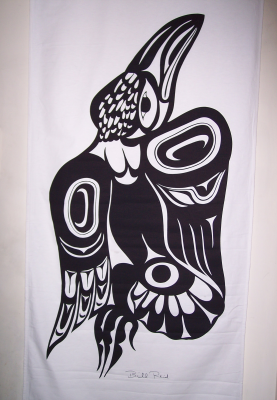
Raven Banner

Reid’s design is equally playful when it comes to symmetry, seeming to abandon it at first glance, but really playing some complex games with it. The body of the raven is defined by the triangle formed by the ovoids on the wings and at the base of the tail, an unusual shape in traditional art. At first, too, the body seems asymmetrical, with the left wing showing three flight feathers and the right wing four – but then you notice that the right wing’s four feathers matches the four toes on the foot and the neck feathers, and forms another triangle whose angles are an inversion of the first triangle.

Then, in contrast to this complexity, there’s the simplicity of the head, with its economical lines and the heavy beak that suggests both the classic depictions of the raven and their actual appearance.

Head Closeup

It’s a complex work, and one that could only come after decades of development, with clean lines that stand out all the more because the design is black on white.

I don’t know if I got a bargain or overpaid, or whether the purchase will prove a good investment. The price was acceptable to me, and, since I bought the work because I admired it, I don’t care if its value increases over time. But the work shows all the mastery of Reid’s last period, and I admire it hugely.

The only trouble is, I’ve hung it in our hallway, and the rest of the hallway cries out for a matching banner. So, I suspect this won’t be the only Reid banner I’ll be buying this year. But if I can get one that intrigues me as much as this one, I’ll be extremely well satisfied.

Read Full Post »

Northwest coast art is one of the healthiest schools of modern art, because it starts from a tradition yet still welcomes innovation. A juxtaposition of local First Nations mythology and the rain forest environment on one hand and advanced industrial techniques on the other, it also seems to reflect the experience of anyone who lives in the area where the artists work. For these reasons, yesterday I fought down the ‘flu that had taken root in my stomach to attend the public opening of the Bill Reid Gallery in downtown Vancouver.

Bill Reid was one of the founders of modern Northwest coast art, and his work from the late 1940s to his death in 1998 is broadly reflexive of the school’s history, starting with imitations of the past and gradually gaining originality as his confidence and knowledge of technique increased. With copies of his monumental Spirit of Haida Gwaii at the Canadian embassy in Washington D.C. and the Vancouver airport – as well as on the Canadian $20 bill – he is perhaps the best-known Canadian artist of the last forty years.

The gallery that carries his name features Reid, but, in recognition of his influence, does not confine itself to his work alone. A tribute pole by Jim Hart dominates the main gallery, and the gift shop has a large room where other Northwest artists are highlighted. Right now, the gift shop features April White, but I understand that the plan is to change the exhibit regularly.

The gallery windows are covered in semi-transparent blowups of Reid’s design, but still let in the natural light. With its high ceiling and dais for speakers, the main gallery suggests a modern version of a Northwest longhouse, the only jarring touches being the carvings around the archway and the computer screens and holograms that stand-in for pieces of Reid’s work that are not in the gallery A mezzanine allows visitors a chance to see close up the top of Hart’s pole, as well as “Mythic Messengers,” a bronze sculpture that is one of Reid’s best-known works.

Although today was the official opening, finishing touches at the gallery are still lacking. Several display cases are empty, and many are unlabeled. Nor does a guidebook or recorded tour exist. For yesterday, little of that mattered, because one or two people were giving tours, but I worry a little that the context may be lost on casual visitors.

Knowing that context is important, because otherwise the gallery might be mildly disappointing. Several of the pieces are smaller versions of Reid’s monumental works, and the change of scale makes it easy to under-estimate them. In particular, a palm-sized version of “Raven and the First Men” looks cramped and intricate where the original at the University of British Columbia’s Anthropology Museum looks spacious and simple.

Still, that is a quibble that seems ungracious when such a gift has been given to the area. With Reid’s preference for deep-carving and, in the last stages of his development, his trust of blank spaces – to say nothing of his consummate knowledge of technique and his frequent experimentation – his work consistently breathtaking. And to see so much of it in one space remains an overwhelming experience, even if his best work is not always represented. I found that I had to wander in and out of the gallery several times, just so I could appreciate all the exhibits properly. Otherwise, I would tend to wander in a sort of daze of admiration.

While I was there, I was also lucky enough to catch Martine Reid, the artist’s widow, talking about the jewelry displays. Although her French-accented English was easy to lose in the crowd, her reminisces helped to bring her husband’s development as an artist into perspective while also revealing something of his human side.

I particularly remember her story of how she bought a silver box he had made several decades previously and gave it to him as a birthday gift; he stared at it, she says, like a parent who had not seen his child for decades – then took a napkin and started polishing it.

Martine Reid also recalled that her husband used to carry a coil of wire and a pair of pliers in his pocket, and would twist the wire into shapes as he sat and talked. His “knitting,” he called it. Apparently, the habit was so ingrained that, even in his final illness, he was moving his hands as though twisting wire.

The Bill Reid Gallery is small — at least, to display an artist with such a long and varied career — but, if yesterday is any indication, I expect it will become an important center in Vancouver, not just for tourists, but for the First Nations community and art-lovers. Lingering for several hours, I completely forgot my ‘flu, swept away by the convictin that a species that can create such an artist obviously has redeeming qualities despite what you read in the newspapers.

Read Full Post »

My friend Bob Ley has been an art collector as long as I’ve known him. The office where he practices psychology is carefully decorated with unique paintings and antiques – mostly modernist, with a tendency to primitivism and abstracts, but all of them a welcome change from the endless reprints of 19th century impressionists or the bland corporate art visible elsewhere. “I’ll never understand why my friends will pay $100 for a print of Van Gogh’s Sunflowers and then another $400 for the frame,” he says, “When for the same price they could get an original work of art.” After my purchase of a custom West Coast bracelet a couple of weeks ago, I know what he means.

Buying original art may be expensive, but it’s also very satisfying. For one thing, in West Coast art, at least, it means experiencing another level of quality. I’ve long been aware of the vast difference in quality between the bracelets and masks in tourist shops in Vancouver and the true art galleries; you don’t need the price difference to see the difference in quality. But when you enter the world of custom art, you discover a new standard altogether. It’s not that the art galleries are full of shoddy work, or that you can’t find quality pieces in the tourist shops if you search carefully. Rather, there’s a freshness in custom work that you don’t usually see in designs knocked off for the tourist shops, or even for limited editions. Custom work tends to engage the artist in ways that other work doesn’t, simply because it’s unique.

For another, when you commission an original piece of art, you experience the pleasure of being a patron. Besides the beauty of the piece itself, you have the pleasure of knowing that, if not for you, the piece wouldn’t have come into existence. The artist, of course, is the primary creator, but, as patron, you have a minor secondary role. On a small scale, you can glimpse why Lorenzo de’ Medici was such an enthusiastic supporter of artists.

Even more importantly, you can view new art with a clean eye, in a way that’s rarely possible with works firmly enshrined in the canons of great art. Short of a radical step such as the cleaning of the Sistine Chapel’s ceiling, I doubt that anyone can appreciate works from the high renaissance like da Vinci’s Mona Lisa in the same way that people in the sixteenth century could. We’ve not only seen these works too often, but we’ve been told too often what to think of them. While some appreciation can be gained by seeing such works in person as opposed to in a print or an illustration, for the most part we’ve lost the power to see these works for themselves. With newer, less familiar works, we can still see the accomplishment for themselves.

This ability is important, because living with art enriches and relaxes us. A room designed by an architect of genius is simply a comfortable place to live or work, although many people would be hard-pressed to notice or tell you why. A room decorated with art that you can still see with fresh eyes has much the same effect. Both are at the opposite end of the spectrum from public institutions with deliberately mediocre art. What’s more, such rooms become more comfortable as people spent more time relaxed in them; the way we use room really can create an impression or aura that we can respond to (which is why I don’t frequent the coffee shop in the old gatehouse of the BC Penitentiary – there’s been too much misery, however justified, in the place for it ever to be a place I’d care to linger).

In the same way, with my new bracelet, I walk a little straighter and my stride has a bit more of a bounce because I am always aware of its weight on my arm, and the way it catches the light. Moreover – even better than an artistic room or a room full of art – I carry the bracelet with me, and can enjoy a closer look at the design whenever I want.

That, really, is the ultimate pleasure in commissioning a new piece of art for yourself: You not only have a unique relation to it, but your life is broadened by an appreciation of something breathtaking and new.

Read Full Post »

« Newer Posts