Feeds:
Posts
Comments

Archive for the ‘British Columbia’ Category

When I was four, going to the kindergarten two blocks from home seemed an enormous expansion of my horizons. Even then, I had a vision of my horizons becoming vaster as I grew up – a vision that I still have, although now I wonder if a time will come when they contract as I grow old and infirm. But the largest single expansion of my horizons was when I moved away from the neighborhood in which I grew up and finally discovered the rest of greater Vancouver.

I grew up in West Vancouver, a suburban community on the other side of the inlet from Vancouver. Physically, my parents’ house is less than half an hour from the intersection of Georgia and Granville, one of the main intersections in downtown Vancouver, but, psychologically, it might as well have been several days away.

Perhaps the intervening water had something to do with this attitude, or perhaps my family was unusual. But, as a child, I had no other point of comparison. All I knew was that West Vancouver was mostly self-contained. My family might venture occasionally into next door North Vancouver, but a trip to Vancouver was a major event because of its rarity. As for remoter cities, like Richmond and Surrey, they were visited only when passing through on the way to the border or the interior. When a girl moved from Surrey the summer before I entered Grade 8, she might as well have come from one of the moons of Pluto, her origin seemed so remote to me.

Having a bicycle and a sense of adventure, by Grade 5, I had started to expand my horizons on my own (although, hobbit-like, I always took care to be home for dinner). I started by exploring West Vancouver, but in a couple of years, I was riding with my friends over to Stanley Park, or even downtown. A few times, I even rode out to the University of British Columbia and back.

But somehow, my horizons never expanded further. Eric Hamber Secondary at 41st and Oak, where I trained once a week with the Vancouver Olympic Club, seemed impossibly far. And when, in high school, my soccer team went out to Vancouver Technical School near Broadway and Renfrew, I was frankly lost; it looked like a tough part of town where I would be instantly mugged for the middle class kid that I was if I strayed too far from the rest of the team.

True liberation from my psychological restrictions didn’t happen until I started commuting to Simon Fraser University when I was eighteen. Catching the Hastings Express downtown and transferring at the Kootenay Loop for the final trip up Burnaby Mountain to the university, I was fascinated by the street scenes and people I saw. Once or twice, when a ride let me off at Main and Hastings, I was apprehensive, but mostly my chief fear came from my uncertainty about just how to get to the familiar downtown area around The Bay (these were less brutal times, and the population of the downtown east side was smaller and considerably less desperate than now).

Leaving my parents’ home accelerated my growing sense of geography, and, by the time I was 21, I was familiar with much of greater Vancouver, and had lived in several parts of it. Gradually, I realized that I grew up isolated by privilege (or semi-privilege, my family being middle class in a primarily upper middle class municipality), with assumptions about personal safety and other people that weren’t nearly as universal as I thought.

This challenge to my assumptions often dimly disturbed me, but I never really doubted that it had to be faced if I were to become an adult. I still believe that, which is why I was surprised when I went to a high school reunion three years ago, how many of those with whom I went to school had never moved out of West Vancouver. I had had a contented enough childhood there, but I wasn’t a child, and I had long ago moved on, as they apparently never had.

Read Full Post »

When you hit middle age, how you face change can become a dilemma. Either you decide to accept every change that comes along in an effort to feel that you are still part of the mainstream in our youth-oriented culture, or else you reject every change as something dangerous that should be denigrated at every turn. Only a few seem to find an alternative to these reactions.

The reasons for this dilemma are not hard to see. As most people age, they start to associate change with decay and, ultimately, with death. It becomes something to deny, either by taking on the mannerisms of someone half your age, or by denouncing it.

The trouble is, neither of the usual two reactions is very satisfying. Nothing is more undignified or embarrassing as a middle-aged person trying to pretend that they are young. A fifty year old woman who tries to dress as a teenager risks being ridiculous, because they don’t have the body of a teenager. The same is true of a fifty year old man who tries to keep up physically with a twenty year old.

Similarly, if either tries to keep up to date on the latest music or Internet fad, they risk acting like an over-aged puppy pathetically trying to please. The fact is, youth culture is not something you are expected to understand or belong to when you’re middle-aged – one of the whole purposes of youth culture is establish an identity that’s different from that of the middle-aged.

By contrast, by rejecting the culture of your generation, you risk losing your own roots for the shallowness of a wannabe who can never belong. You might as well apply to a club whose entire purpose is to blacklist you.

The trouble is, going to the opposite extreme and denying the value of everything new is no better. By doing so, you only increase the impression that you are out of touch (which most people younger than you tend to believe anyway).

Just as importantly, you risk missing new things that you might otherwise appreciate. All that lies behind the elderly curmudgeon is a constant, unending complaint that the world has changed since you first became an adult, and you don’t like it. That is a petty and small-minded attitude for anyone around you to endure; you can see it almost any day in The Globe and Mail, which on subjects such as Facebook or file-sharing often gives the impression of being written by embittered seventy-five year olds for seventy-five year olds.

All the same, pursuit or rejection are by far the most common ways that the middle-aged respond to their growing perception of the unavoidability of change. It takes tremendous sense of structure to resist either response and simply have faith in your own taste, accepting the changes that suit your taste and rejecting those that do no, and fostering a tolerance for other people’s preferences. Yet, considering that the alternative is either to be ridiculous or unpleasant, it seems the only acceptable alternative.

Read Full Post »

Northwest Coast jewelry can easily cost thousands of dollars, especially if you are buying a gold piece. But, fortunately for those with neither the cash nor commitment to spend that sort of money, you can easily find quality designs –usually in silver — for under $300. Naturally, for that price, you don’t get an exclusive design, but you will find intriguing ones.

Here are several random examples I get from looking around the bedroom:

  • Like much of Alano Edzerza’s work in any medium, this ring of a frog head is bold and dramatic, with simple but effective lines. It is also one of the heaviest rings I’ve owned, with a band nearly three-quarters of a centimeter wide at the back. I’ve joked that I’m going to get another four, and I’ll have an effective set of brass – or silver — knuckles.

    gwaai-edenshaw-silver-frog

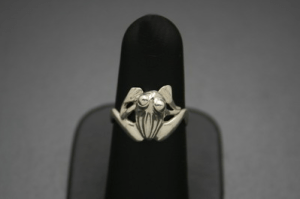
  • By contrast, this frog ring by Haida jeweler Gwaii Edenshaw is altogether more delicate, although suitable for either a man or a woman. This one is unusual for Edenshaw, in that it is silver, rather than the gold he usually works in (although a more expensive version has gold eyes, and an even more expensive one is cast in 18 karat gold, which is about as impure as he generally goes). It is also not particularly Haida in design, except for the ridges down the frog’s back. But it is a whimsical piece, with the frog resting its head on its front flippers and its back flippers locked together on the band on the back.
  • gwaai-edenshaw-silver-frog

  • These earrings are another commercial design by Gwaii Edenshaw, light, with the design just barely visible. They’re suggestive of worn petroglyphs, or perhaps a hand-inscribed design.
  • gwaai-edenshaw-small-earrings

  • Marcel Russ did this unusual design based on the myth of Raven stealing the light. This topic is a common one in many media in Northwest Coast art, and to pull it off, the artist really needs to come up with a different design. Russ’ approach is to show only the Raven’s head and the sun or moon in his beak. The result is a contemporary piece that retains strong roots in tradition.
  • marcel-russ-raven-steals-the-light-earrings1

All these pieces are highly affordable, and the last two are available for $100 or less. In all cases, you would be lucky to find comparable sophistication in a mainstream jewelry store. For the same price, you’d probably get an abstract design, or a mounted semi-precious stone with next to no design at all, and probably with a lower silver content besides.

Of course, Northwest Coast jewelry does have its share of what I think of as touristjunk (all one word), but for the same price as the touristjunk, without much effort you can find superior works like these ones.

Read Full Post »

One reason why Northwest Coast art thrives is the strong tradition of teaching among the artists. Artists regularly take on apprentices, and many regularly assist younger artists in their struggles to establish themselves. One of the newer artists who has benefited from the tradition of teaching and plans to teach others himself one day is John Paul Wilson, a member of the Blackfish clan of the Haisla nation for whom carving masks is both personally satisfying and a means of rediscovering his culture.

john-wilson1
Wilson was born in Kitimat in 1973, but grew up and lives in Terrace, and is currently learning northern carving styles. “I have been taught little things about my culture as I was growing up,” he says, “But I didn’t go to my village. I am now really trying to find my culture as an artist.”

After what he describes as a hard-living youth, Wilson worked in a variety of jobs, including carpentry, forestry, and sales. “Now that I look back on my life,” he says, “I see that what I was doing was training myself to be an artist, whether I knew it or not.” All his work, he believes, helped him to prepare for both the techniques and business of being a carver.

john-wilson2

Although Wilson says that “I have always been doing art,” he only began focusing on carving in 2002, when he began studying under Tsimshian artist Heber Reece. After he “took some time away” from Reece, Wilson continued to return to him for help, and later took a course Reece taught at the local college in 2004. “He always had his doors open for me,” Wilson says of Reece.

More recently, Wilson has been receiving informal advice from Nisga’a carver Ron Telek, especially on the finer points of finishing, and attending the Freda Diesing School of Northwest Coast Art at Northwest Community College, where he is being taught by Stan Bevan, Dempsey Bob and Ken McNeill. In fact, this is the second time he has enrolled in the Freda Diesing School, after a burglary of his home forced him to withdraw the first time for lack of funds.

john-wilson3

Other artists whose work Wilson admires include Robert Davidson, Norman Tait, Klatle-Bhi, and Henry Green.

“The senior artists have given me the drive to to get to where I am as an artist,” Wilson says. He is particularly enthusiastic about the Freda Diesing School, which, although he has only just started the second semester, he describes as having “helped so much that I advise anybody to take the course if they want to get serious about being an artist as a living.”

Rediscovering culture

At first, Wilson admits, his interest about carving was as much about making a living as about art. However, under the influences of his teachers and education, he finds his motivations shifting. “I now realize that it is our culture,” he says. “That means a lot to me, knowing that I am going to help keep our culture alive.”

john-wilson4

As Wilson reconnects with his culture, one of his most personally meaningful discoveries was that his great-great-grandfather was also an artist. The discovery, he says, has made him realize that “without knowing the history, I don’t think I could go forward as an artist.”

He now plans to return to his village to familiarize himself with his culture, and dreams of one day teaching there. “Our culture is our way of telling stories to hand down to the next generation,” he says. “And art is a big part of our culture. It is something we were so close to losing, but I did not find that out until I talked to senior artists at the Fred Diesing School.”

john-wilson5

Learning the life and passing it on

At the same time, Wilson finds his carving, which he describes as “contemporary Haisla,” becoming central to his life. “The art is very important,” he says. “It has changed my life for the better. I have a strong feeling that [art] is the right path, like it is what I was brought on earth to do.”

Besides the technique of carving and his reconnection to his history, one of the things that bemuses Wilson about his chosen career is the need to market himself. “When you finish a piece it’s like creating a kid of your own. Sending a piece out for sale is one of the hardest things to get used to. And I’m still learning how to market myself. A lot of people think that when you’re done your piece that it’s time to rest, but they forget the time and effort it takes to sell the piece. You have to really study the way to market yourself as an artist if you want to make a living doing the arts.”

john-wilson6

Now selling regularly to galleries, Wilson is currently able to support himself as an artist. “Some times are better than most,” he observes, “but it still gets me by comfortably.”

All in all, art has become so central to Wilson’s identity and life that he is now starting to pass on the encouragement he received from senior artists to others. “Just try it,” he advises. “You never know what will happen. Look at Freda Diesing – she didn’t start until she was in her forties, and she won a lifetime achievement award for her efforts at learning and teaching the arts.”

(John Wilson’s work is available in the Black Tusk and Path Gallery in Whistler, The Edzerza Gallery in Vancouver, The Art of Man in Victoria, The Stonington and Steinbrueck galleries in Seattle, the Arctic Raven Gallery in the San Juan Islands, and Neo Concept in White Rock).

john-wilson71

Read Full Post »

For eight years, I made most of my income from technical writing. Not the relatively glamorous technical writing involved with writing articles about free and open source software (FOSS) – glamorous, that is, to those who haven’t done it (those of us who have done it are usually considerably less starry-eyed) — but basic how-tos and detailed instructions to accompany hardware and software. Looking back, I must have been reasonably good at the job, since I went from a beginner to a consultant with a sub-contractor in eight months, and kept myself steadily employed most of the time and well-employed much of the time.

Based on that experience, I would like to offer some advice for those who are trying to fill the gaps in FOSS documentation. It’s a thankless job, under-appreciated and laborious, but, if you’re going to attempt it despite all the disincentives, you might as well do it properly. After all, your satisfaction in doing the job properly might easily be your only reward:

  • You must become an expert in what you are writing about: Some professional technical writers pride themselves on being specialists in communication, and feel they don’t need to know the details of what they are writing about. You can always tell manuals done by them, because they are shallow and have large gaps in them. Likewise, you can always tell this type of technical writer, because they’re despised by any developer with whom they work. The truth is that, while you don’t need to be an expert when you start documenting, if you aren’t expert by the time you’re finished, you aren’t doing the job properly.
  • It all comes down to structure: Anybody with average intelligence or better can learn to write a coherent sentence or paragraph. However, structuring several hundred pages is hard work – much harder work than the actual writing. The need to structure is also why you need to become an expert in your subject; if you’re not, how can you know what information to put first, or what’s missing? Don’t be surprised if you spend 50-75% of your time in planning the structure, or if your first outline changes drastically as you work. Both are indications that your work is developing the way that it should.
  • In the majority of cases, the best structure will be a list of tasks, arranged from the most basic or earliest to the most complex or latest: It will almost never be a list of menu items and taskbar icons, except in brief introductions to the interface. This task-orientation is a major reason why you need to be an expert in what you are writing – if you’re not, you won’t have any idea of what users might want to accomplish.
  • Think of your audience as being attention-deficit: Knowing your material is necessary, but it can also make you forget what new users need to hear. The best way to write to the level you need is to project yourself imaginatively into the position of a new user, but, if you can’t manage that, imagine that you are writing for people with low attention spans who are easily bored. The result may spell out the obvious for some readers, but other readers will be glad that you are thorough. Always remember: What is obvious to you isn’t obvious to your readers.
  • Don’t worry about style: In fiction, writers often call attention to their style. By contrast, non-fiction like technical writing is not about you. Your job is to provide simple, clear prose in which you are invisible. And if that sounds boring or unchallenging, you might consider Isaac Asimov’s observation that stain glass windows have been made for over a millennium, while clear glass was a much later development. In many ways, writing simply and clearly is much harder than writing with flourishes and personality. Focus on clarity and content, and let other style considerations take care of themselves. You’ll be surprised how well they work out without you thinking consciously about them.
  • Use structured prose whenever possible:Bullet lists, numbered lists, tables, and callouts on diagrams – all these techniques are conciser and easier to understand than straight prose
  • Your first draft is probably going to be terrible: But that doesn’t matter, so long as it improves by the end. What matters in the first draft is getting something that you or others can analyze for gaps and make estimates about the finished documentation from. Probably, the physical act of writing will be no more than 25% of your time. Often, it will be much less. If you’re planned properly, and begin writing with a thorough understanding, it should almost feel like an afterthought.
  • Don’t mix writing and editing: Writing is a creative process, editing a critical one. If you try to mix the two, you will probably do both poorly. You may also find yourself freezing up and being unable to write because your self-criticism is interfering with your ability to write.
  • Make sure editing is part of your schedule: Editing should not be a last-minuted effort. Instead, accept it as an important part of your schedule. Expect it to fill 10-20% of your time.
  • Editing is about structure as well as words: Editing is not just about spelling or correcting grammar. It’s just as much about the structure of the work.
  • Get second and third opinions: When you have just finished writing, you are probably unable to judge your work effectively. Get other people to review your work in as much detail as possible. If you can’t get other people to review, put the manuscript aside for several days. If you can’t put it aside, print it out, or take a break before returning to it.
  • Expect revisions: Based on my experience teaching first year composition at university, I can say that the average person takes 3 to 4 drafts to produce their best work. You may be naturally talented or reduce that number with practice, but don’t count on either until you have some experience.Make sure you budget the time. You’ll know if your efforts are succeeding if the general trend is that each draft becomes quicker and quicker to write. If that doesn’t happen – especially if you have to keep reinventing the structure or making major additions – then something is probably seriously wrong.

With any given piece of writing, you may not be able to follow each of these pieces of advice. Deadlines in particular may keep you from giving each of these points the attention it needs. But keep all these points in mind, and you will be more likely to write documentation that people actually use, instead of an after-thought to the software that is never used.

Read Full Post »

Ron Telek, the Nisga’a carver, can always be counted on for the unexpected – anything from the disturbingly haunting to the eerily beautiful, and in every form imaginable. I’ve even seen a shaman marionette by him. Our latest acquisition, “Transformation Rattle: Eagle to Wolf” is no exception. Only a handful of other Northwest Coast artists could take a utilitarian object like a rattle and turn it into a sculpture while keeping it functional.whole-small

One of the characteristics I’m starting to associate with Telek’s pieces is an unusual degree of three-dimensional awareness in the design. Like many of his pieces, “Transformation Rattle” is impossible to capture fully with a single photo. I took five pictures for our records, and I’m not sure that I shouldn’t have taken a sixth to cover it fully.

The rattle consists of two parts: The rattle, which is the eagle, and the rattle’s base, a lean-looking wolf with a curved tail and, around its neck, a garland of cedar boughs. The rattle rests inside the tail, and can be removed from it. At first glance, you are lucky to notice that it’s a functional rattle. Your first clue is the leather wrapped around the bird’s tail as a hand grip, but even that could simply be part of the surreal sculpture.

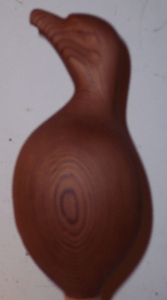
The rattle depicts the transformation perhaps two-thirds of the way through. On the right side, the bird’s features are depicted fully, but the left side of the body is mostly blank, with the features indicated by a few indentations, and the wing by the grain of the wood.

smooth-side-eagle-small

Its feet, too, are gone, absorbed into the wolf. Perhaps to indicate the transformation’s incompleteness, the bird’s wing is wrapped around its rounded stomach, as though it is pregnant with itself.

finished-side-eagle-small

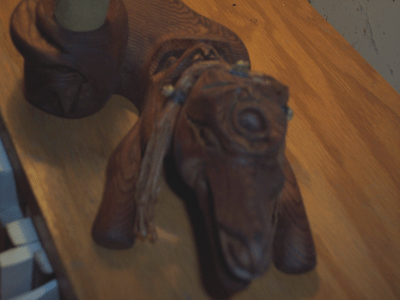
The wolf is more complete, but its lack of claws and teeth or fully-formed rear legs shows that it, too, is an unfinished figure. wolf-small

Its thinness and slightly rough carving, especially in the comparison with the eagle further suggests the wolf’s incompleteness – and, perhaps, the energy expended to make the transformation.

The fact that the two figures are the same is suggested by the spirit in the middle of the eagle’s right wing and atop the wolf’s head. Furthermore, the wolf’s garland of cedar suggests that this is not a born wolf, but a human – no doubt a shaman – going through these transformations. Supporting this idea is the much larger, more human-looking spirit erupting from the wolf’s back, as well as the fact that, if you look closely, the rear legs are more human than wolf-like.wolf-front-small

All this complexity is heightened by Telek’s characteristic attention to the direction of the grain. An employee at the Art of Man Gallery in Victoria told me last week that Telek often carves down until he finds the grain he wants, and, looking at “Transformation Rattle,” I have no trouble believing it. Although both the rattle and its base is carved from a single piece of red cedar (and stop and think about the difficulty of that for a moment), the carving is literally never against the grain. Even on the wolf’s curving tail, the grain moves with the sculpture. And, on the eagle, the round pattern of the grain not only suggests the bird’s body, but creates a semi-abstract form as simple as it is beautiful.

The overall result is a contrast with the tall, rounded shape of the eagle, and the ground-hugging, angular shape of the wolf. It’s an accomplished piece of work, which I’ve place on top the shelves on my computer desk, where I can look up at it periodically, or even take the rattle out for a shake if I feel like it. We’re seriously thinking of mounting it on a lazy susan, so that it can be viewed in its entirety more easily. Meanwhile, I’ve already switched its position around several times in the day since we brought it home so I can admire another aspect of it.

Read Full Post »

Not too many years ago, you only had to walk down Government Street in Victoria to find more shops selling Northwest Coast art than you could properly absorb in a day. Looking back, I’m not sure of the quality of some of the shops, but they were there. But times are harder, with many store fronts along Government empty, and now you have to search for galleries.

Descending on Victoria yesterday, these are the galleries we managed to find:

  • Art of Man: Located in the mall in the basis of the Empress Hotel, the Art of Man specializes in Inuit and First Nations masks and sculpture. The pieces for sale included four or five from Ron Telek, including a meter high blue shaman (this from an artist who rarely uses color), and a shaman marionette fending off a spirit attacking his foot with other spirits resting in his hand. Daryl Baker, the nephew of the LaFortune brothers Doug, Perry, and Aubrey, is also represented by highly-detailed designs that border on the surreal, and that are all marked by a close attention to finishing details. The Art of Man also seems to get first pick of Tim Paul’s work – so much so that I realize that only his lesser pieces reach Vancouver. Other artists whose work is available at this gallery are John and Luke Marston, whose work shows an awareness of history that I had never realized before that it possessed. In general, the quality of the work at the Art of Man is extremely high, making it by far the premier gallery of Northwest Coast art in downtown Victoria.
  • Hill’s Native Art: Like the Vancouver store, the Victoria Hills is mainly a tourist shop. However, the Victoria store seems to have a slightly better ratio of art to high-end tourist pieces, as though it gets first choice of all the locations. But perhaps this impression is due partly to the fact that it is less crowded and better lit.
  • Alcheringa Gallery: From the web site, I had the impression that this gallery was huge. The reality, though, is that this is a gallery with only a few of its pieces on display – and about half of those are given to works from Papua New Guinea, which is worth seeing, but doesn’t engage my interest the way that the Northwest Coast tradition does. Still, you can see some works by Tim Paul and John Marston there. I was also interested in seeing two works I had seen on the Internet, one by Ron Telek and another by Dean Heron.
  • Pacific Editions: Unfortunately, this story is closed on Mondays, which meant that we walked six blocks out of our way for nothing. But what we could see through the window confirmed the impression I had from the web site: Pacific Prints has a huge collection of limited editions prints. I look forward to spending a happy few hours there the next time I’m in Victoria.
  • Eagle Feather Gallery: A mixture of art and tourist pieces, this gallery is only a block from the Empress Hotel – but on a side street that you may have trouble finding. It specializes in the work of Doug, Perry, and Aubrey LaFortune, especially Doug (in fact, he was due to drop by the day that we visited, although we missed him). Daryl Baker and Pat Amos also have a couple of pieces, while Francis Dick has at least a dozen 2-D works from throughout his career at the gallery. Whether the gallery is worth a visit probably depends on your opinions of these artists, although its stock gives you a good opportunity of evaluating Doug LaFortune thoroughly.
  • Out of the Mist Gallery: This gallery specializes in antiques. Its modern selection is devoted largely to the Hunt family, and includes a few curios like a mask carved by Richard Hunt when he was a teenager, a formal, somewhat stiff print from the start of Beau Dick’s career, and a two meter-long eagle by Roy Henry Vickers. The quality of the antiques is completely indiscriminate, and includes some pieces from across North America. If your taste runs to antiques in Northwest Coast art, you could probably find something to your taste, but the somewhat dim lightning and the bored staff makes the effort hardly seem worthwhile.

As with previous lists I’ve made of galleries, this one makes no effort to be comprehensive. We did not, for instance, have to visit the Provincial Museum’s gift shop, which I seem to remember as having a few art pieces. So if you know of any other galleries in the Victoria area that might be worth a visit, please add a comment and let me know.

Read Full Post »

As I visit Northwest Coast Galleries in Vancouver, I’m starting to notice relations between certain galleries and certain artists. Out of friendship, enthusiasm, long-term business relations, or a combination of all three, some galleries simply carry a better selection of some artists than others.
Here are the specializations I’ve been able to detect so far:

  • Coastal People’s Gallery: This gallery has a good general selection of artists, although it seems to be buying less recently, possibly because it’s overstocked. However, it is the main exhibitor in town of Henry Green, especially for his carved and increasingly colorful panels. Coastal People’s also favors Chester Patrick, a less well-known artist who has done a number of acrylic paintings notable for the complex grouping of characters, as well as panel carving. Since the summer, the gallery’s Gastown store has had space set aside for Patrick to work. I’ve heard at least one patron refer to Patrick as the store’s artist-in-residence, although I don’t know whether the arrangement is formalized.
  • Douglas Reynolds Gallery: Douglas Reynolds seems to have first right of refusal on works by Beau Dick, the Kwaguilth mask-maker and Haida artist Don Yeomans, possibly because the artists have a long friendship with the owner. At any rate, the selection of works by both Dick and Yeomans tends to be larger and more varied than at any other gallery – so much so that, in Yeoman’s case, I tended to think that he was past his creative prime based on his work in other galleries. However, based on what I’ve seen at Douglas Reynolds, that’s far from true; I just wasn’t seeing his best work. This same gallery has also started carrying a good selection of jeweler Gwaii Edenshaw.
  • Edzerza Gallery: As you might expect, this new gallery is mainly a showcase for the work of owner Alano Edzerza. However, it has also had the work of newer artists like Ian Reid and John P. Wilson.
  • Inuit Gallery: The Inuit Gallery seems to have good connection with the North, including Alaska artists like Clarissa Hudson and Norman Jackson, whom many galleries neglect – even though importing First Nations art from the United States is supposed to be duty-free. Recently, it has also had a couple of new masks from Tlingit/ Northern Tutchone artist Eugene Alfred, and a number of playful masks from Kwaguilth carver Simon Dick. Other with whom the gallery seems to have a good relation include Salish artist Jordan Seward and Nuu Chan Nulth artist Les Paul.
  • Sun Spirit Gallery: Located in West Vancouver’s Dundarave strip, this small gallery currently has a strong selection of Klatle-Bhi’s work, particularly masks. Much of this work is in Klatle-Bhi’s apparently favorite white and light-blue palette.
  • Spirit Wrestler Gallery: Robert Davidson seems to offer new works to Spirit Wrestler first, and to have an arrangement with the gallery for prints as well. The gallery also gets the pick of new works by Norman Tait, and currently has more work by Dempsey Bob than any other gallery in town. In addition, the gallery seems to cultivate some of the best of up and coming artists, such as Dean Heron and Sean Hunt, making it more adventuresome that I originally thought from my first visit.

As I was making this list, I realized that it represents my own interests as much as each gallery’s specialization. Very likely, I have left out some specializations either because I am not interested in them or haven’t got around to them yet. Still, it’s useful to know which gallery to go to if you’re interested in a particular artist, so I’ll let the list stand, even while acknowledging that it is probably incomplete.

Read Full Post »

For the past three Wednesday evenings, I’ve attended George Macdonald’s lectures on Haida villages at the Bill Reid Gallery. It was time well-spent, and I only regret that the lectures stopped with three. Nobody is boring when talking about an area of expertise, and Macdonald, Director of the Bill Reid Centre for Northwest Coast Art Studies at Simon Fraser University and the author of Haida Monumental Art, was certainly in his element. Just as importantly, he combined knowledge with an informal and lively manner, which made for an absorbing scholarly trio of evenings.

Macdonald divided his subject matter into the southern villages centering on Skidegate, the central villages around Masset, and the northern or Kaigani villages of southern Alaska. Unsurprisingly, the second lecture was the most popular, with many Haida living in Vancouver coming out for it, including artists like Gwaai Edenshaw and Dorothy Grant, but the third was also popular, perhaps because the arbitrary border has resulted in few Canadians knowing much about the Kaigani villages. And the entire series was attended by a core of regulars, including me.

The first surprise in the lecture is how much photographic evidence exists from the 19th and early 20th centuries. Because much of this evidence is not available to the general public, many people, I suspect, are like me and believe that it is very limited. However, Macdonald speaks in terms of thousands of photos (and I’m not sure that he didn’t talk of tens of thousands), to say nothing of sketches by anthropologists and navy officers, and works of art like Emily Carr’s. In fact, so much of this evidence exists that pieces can be cross-correlated, and the distinctive style of individual – if often anonymous – artists can be detected. Macdonald showed perhaps a few hundred slides of this evidence, but his lectures were enough to suggest the surprising wealth of material.

Another source of evidence is family tradition. In many Haida villages, memory or written records have preserved the names of many of the houses, as well as some of their history. For instance, at the third lecture, Dorothy Grant told her grandfather’s story of how his village was abandoned for a centralized, missionary-run new village of running water and electricity. During the burning of possessions that the missionaries insisted upon, her grandfather saved only the contents of the bentwood box in his hands.

Nearly four hours of lecture and audience participation is almost impossible to summarize. However, other topics in Macdonald’s lectures included the patterns of resettlement in the south as European diseases forced the survivors to regroup and, in many cases, regroup again; the use of palisades and hilltops during wars between lineages; the names and appearances of some of the great chiefs and carvers of a hundred and forty years ago; the question of whether Albert Edward Edenshaw was trying to bypass matrilineal inheritance by bestowing property on his son, and the characteristic designs of the graves of shamans. In many cases, too, the villages were illustrated by sketch maps or aerial photos.

Equally fascinating were Macdonald’s own stories of his experiences as an archaeologist in the field. They ranged from the careless destruction of one pole that survived into modern times in Prince Rupert, and the danger of bears while exploring villages. Macdonald also revealed in passing some of the professional issues and puzzles in the study of villages.

This was the first lecture series from the Bill Reid Gallery. The gallery is an ideal place for a small crowd, even if the monumental Mythic Messengers and the smell of cedar from Jim Hart’s work on his tribute pole to Bill Reid sometimes became distractions. But, on the whole, if it is an example of what these organizations plan to offer in the future, then future events deserve to be crowded. Like any good lectures, Macdonald’s have pushed back the boundaries of my ignorance a little while tantalizing me to find out more.

Read Full Post »

Around the turn of the millennium, the Haida clothes designer Dorothy Grant had a shop in the Sinclair Center in downtown Vancouver. When she moved, we lost track of her. But I noticed her at a lecture a few days ago at the Bill Reid Gallery, where she was flashing a pair of earring by Gwaai Edenshaw, and yesterday we made a point of dropping by her new store and studio just off Broadway and Main.

Grant’s downtown store felt like a small clothing boutique, differing from countless of others only in her designs and impeccable tailoring. Her new location feels more like a work space; you go down a hall into a retail space, but the activity seems to be taking place either in the studio and meeting place up the stairs or the work area on the other side of it. The entire area is dedicated with art from Grant’s personal collection: A mask by Beau Dick, a print by Robert Davidson, a glass box by Alano Edzerza, and some recent glass plaques by Grant herself (which leaves no doubt that she could have become a gallery artist rather than an applied artist, had she chosen).

The location is open to the public, but you have to ring for entry, perhaps a reflection of the fact that the space is in the middle of an industrial area that, while not seedy, has probably seen better days.

Or perhaps the locked door reflects that this is more a work space than a retail outlet. It certainly seemed so during our visit, with Grant planning with a couple of other people (for a photo shoot, I think), and only stopping briefly to greet us in the friendly and energetic way that, from the little that I’ve seen, appears to be her most common public persona.

Whether you are female or male, you could easily drop a few thousand dollars going through Grants’ racks. But that few thousand would be exceptionally well-spent, especially compared to what you would get elsewhere for the same price in terms of cut and sturdiness of material, let alone the designs. And if you can’t afford that sort of money, you can still find blouses, shirts and jackets for a few hundred dollars, some of which will be heavily discounted if you arrive at the right time of year.

Even as an old-married, I can’t really speak to Grant’s line for women, although nine years ago I bought several blouses and vests as presents. But, from a male perspective, Grant’s line is a relief from mediocrity. Most men’s clothing is drab and unimaginative, and the most you can hope from more upscale offerings is better tailoring. But Northwest Coast designs are one of the few options for men who want a bit of flamboyance without being inappropriately dressed or having to fend off taunts about their sexuality (the sort that are supposed to be jokes but aren’t, if you know what I mean). And Grant’s simple, but bold designs are works of art in themselves that lend an elegance that nobody would dare to question.

Personally, I have arranged my life so that I only need a suit – much less a tuxedo – only for marriages and funeral. However, if I ever did, Grant’s versions of either, with designs on the lapels on one side would reconcile me to the uncomfortable garments. I might still feel uncomfortable wearing them, but at least I would know that I was artistically and well-dressed, and perhaps signaling to the world that I was indvidualistic, if not outright eccentric.

My life being as it is, I will settle for buying two or three buttoned shirts or polo shirts from the store – and I don’t especially like polo shirts.

I did succumb to a light black jacket with an eagle design on the back and a raven wing design on the left arm. Julie, the store manager insisted that I could carry off the look, and a survey of my image in the mirror suggested she was right. A look at the price tag reinforced her view, so I left with a different jacket than the one that was on me when I came in.

“That will bring all the ladies to you,” she said as we were leaving. I started to mutter about how little good that would be for me as a married man when an old customer arrived wearing a similar jacket.

She turned to him for reinforcement of her claim. He agreed, and called after me, “Better stay away from my part of town, man!”

I’ve looked in a mirror. Given the human material that the jacket has to work with, I remain dubious of Julie’s claims. All the same, I’m sure that I’ll return to Dorothy Grants’ the next time that I want well-made clothes with a bit of flare. When we have so much Northwest Coast art on our walls, why shouldn’t I be wearing some as well?

Read Full Post »

« Newer Posts - Older Posts »