Feeds:
Posts
Comments

Archive for the ‘Bruce Byfield’ Category

Whenever business is slow, the local businesses who rent out benches post ads that read something like, “You’ve just proved advertising works,” with their contact information below. The ads never fail to evoke a small moue of annoyance in me.

My reaction has nothing to do with being caught out. I’m reacting more to the childish glee of the comment. The implication seems to be that someone has been arguing with me, and I have been expressing doubts that advertising works. But if anything is more annoying than someone assuming that they know my thoughts on a subject, it’s someone assuming they know and getting it wrong.

Having done ad design, I have no doubt that advertising can work. Like many people in marketing, I may be inclined to mutter that only ten percent of marketing works, and that the trouble is that we don’t know what ten percent that happens to be, but I am certain that it can.

Anyway, the assertion isn’t true. I haven’t read the ad because advertising works. I read it because, seeing English characters, I am constitutionally unable not to read them. It doesn’t matter whether the characters are an ad, a Biblical verse, a line of poetry or the first lines of a novel – as soon as I see it, I’ve read it. Probably, I have more control over my breathing than I do over whether I read anything. It’s no credit to any power of advertising that I’m a print addict.

Even more importantly, getting noticed is only half of marketing. Successful marketing makes viewers want to take action – to buy, if possible, but at least to know more so they can decide to buy. Since the contact information is in a smaller typeface and hard to read in passing, I’m guessing that these ads don’t prove marketing effective. Even if someone might be interested in renting a bench, they are unlikely to notice whom to contact – and, if other people are the least bit like me, their annoyance will keep most far from the world of bench advertising as they can possible manage.

Read Full Post »

Last week at the Vancouver Folk Festival, my dinner was pulled bison on bannock from Salmon’n’Bannock catering. The meal was so far above what I expected that yesterday, when my editor flew into town, I suggested going to the restaurant of the same name. The result was the most memorable meal I’ve had this year.

Salmon’n’Bannock is a small restaurant on Broadway specializing in First Nations cuisine. Its walls are decorated with Northwest Coast and Woodlands prints of decent but not outstanding quality, and the front of the house is staffed with women dressed in black who provide friendly but unobtrusive service.

What makes Salmon’n’Bannock stand out is its approach to the food. Other First Nations restaurants that have come and gone in Vancouver usually took what might be called the hearty approach, serving thick steaks of game and plenty of greasy (but delicious fry bread). In contrast, Salmon’n’Bannock interprets its roots in terms of light, modern cuisine, and does so with considerable success.

For instance, its cured muskox appetizer is not a slab of meat, but a few slivers of meat with blueberry chutney, served on bannock crackers with a few salad greens. Similarly, the salmon platter for two – which I did not eat, but saw delivered to a nearby table – consists of samples of salmon prepared in four different ways (Indian candy, lox roll, salmon mousse, and pickled sockeye), all of which look unexpectedly delicate.

As might be expected, the restaurant focuses on local sea food, especially salmon and halibut. However, the menu also includes extensive samplings of game from across Canada, including bison, muskox, deer and wild boar. Wild rice, sweet potatoes, and salad greens make most of the garnishes.

My main course was bacon-crusted halibut, served with a garlic cream sauce. At any time, halibut is my favorite fish, its taste being far lighter and more delicate than any variety of salmon, but this was by far the best I had tasted anywhere. The flesh was soft and white, and its subtle taste was emphasized by the juice of the bacon and its fat. From the enjoyment my editor took in the sockeye with creamy dill sauce, I suspect I would have liked it almost as much.

Both the halibut and the salmon were served with a selection of zucchini and carrots, and, at our option with large portions of wild rice. The vegetables seemed a bit of an afterthought, but that seemed excusable, considering that the fish were the main attraction of both dishes, both by intent and execution.

We washed dinner down with alcoholic strawberry and rhubarb cider, and finished a fresh berry pie served with ice-cream that left me wanting to sample more of the menu on a second, or even a third or fourth visit.

If Salmon’n’Bannock has a fault, it is that, instead of cooking traditional dishes, it is more likely to take traditional ingredients and combine them in what – judging from their distribution across North America – could not have been traditional ways.

At times, this choice was probably just as well – I expect, for instance, that most modern diners would prefer to eat the halibut with bacon rather than a pot of grease prepared with their auntie’s special recipe. But I wouldn’t have minded an option for fry bread, even though the baked bannock was almost as tasty. Next time, too, I plan to try the Nuxalk salmon soup, the only traditional dish on the menu.

However, for lovers of fish and game, such faults are minor. I can’t think of another casual restaurant in Vancouver (or any restaurant, period) whose fish I enjoyed so much. So far as I’m concerned, the Salmon’n’Bannock is the place I’ll be taking visitors for the next little while. In fact, I don’t think I’ll wait for my next visitors for my next step in eating through the menu.

Read Full Post »

Early this week, developer Sarah Sharp complained about lack of politeness on the Linux kernel mailing list, singling out Linus Torvalds as a prime example of rudeness. Having not persuaded many people, she took her complaints public. Soon dozen of bloggers were condemning Torvalds, and hundreds of commenters were either joining in the condemnation or defending him. But, looking at all the responses, I wonder what everyone imagined they were doing. Feeling good about themselves, maybe?

Don’t get me wrong – as an ex-university instructor, who used to give out criticism to students, I know that rudeness is a poor way to motivate people to improve. They’re more likely to resent the criticism than to change their ways. True, Torvalds is more interested in issues than people, and seems to accept people answering his rudeness with their own, but I still suspect that the Linux kernel is a successful project despite his manner, not because of it.

However, the difference between me and the people publicly expressing outrage is that, as fond as I am of expressing my opinions (that is, after all, what I get paid for), I don’t make the mistake of believing that my opinion matters. It certainly isn’t going to improve the tone of the kernel list.

Condemning Torvalds in public may satisfy the need for self-expression. It may publicly align you with the forces of Progress and Good. However, one thing it will never do is to improve civility within the kernel project. Even if thousands of people express their outrage, it won’t do anything.

In every way imaginable, Torvalds is immune to such criticism. If nothing else, I doubt he reads it. Furthermore, he rationalizes by assuming a dichotomy between effective bluntness and politeness that, for all its falseness, gives him no reason to consider reforming himself (although he might welcome a good argument as amusing).

But how anyone imagines him vulnerable to public criticism is beyond me. He has never been before. The kernel is his project, and few developers are going to work on a fork in preference to the cachet of working with Linux.

Even pressuring him through the Linux Foundation, his nominal employer, has no chance of success. Sponsoring Torvalds legitimizes the Linux Foundation, which means that it needs him far more than he needs it. In the unlikely event that the Linux Foundation did try to chastise him, as a mufti-millionaire he can walk away any time he pleases.

In the end, being outraged by Torvalds’ rudeness is no more than elaboration on the idea that you are helping world hunger or some other cause by clicking Like on a Facebook link. It’s easy to do, and leaves you pleased with yourself, but you have confused an expression of concern with effective action.

The Internet allows considerable freedom of speech, and the free software community often has a democratic appearance. However, neither of these facts means that all of us have an equal say in every situation. In this case, the only people whose opinion matters are those who have any chance of making a change – kernel contributors.

Instead of mouthing off in public, if you really want change on the kernel list, lobby kernel contributors, especially Torvalds’ lieutenants. If you are a kernel contributor, come out in support of a code of conduct, and try to enlist other contributors. None of these actions have any guarantee of success, but they have a far greater chance of encouraging change than saying, “Me, too!” in public.

Put so bluntly, the choice of tactics sounds obvious. But the fact that so many seem to think that condemning politeness is enough to cause change suggests that, on some levels, for most people it is not at all obvious. In the end, campaigning for change is slow and unglamorous, and lacks the immediate satisfaction of posturing as rebel via a token gesture, yet it has two unarguable advantages – it is unhypocritical, and it just might work.

Read Full Post »

My late friend Paul Edwin Zimmer used to insist that poetry was supposed to be heard. He proved it many times, booming out his verse at bardic circles around the Bay Area and science fiction conventions across North America. His position was a welcome reminder, but I had learned its truth while I was in university during a single magical day.

At the time, I was serious about poetry, writing and publishing regularly, and theorizing about metrics in the little time left over from my academic classes. I was skeptical about the poetic establishment (as any young poet should be), and sure I was going to shake it up (and never be one of those academic poets who taught for a living). When my friend Stuart announced a garden party during which his new poem, a Georgian pastoral, would be read, I quickly took on the voice of the Young Man in the poem.

The day of the reading was one of those hard, bright days that the Lower Mainland sometimes gets in summer. The setting was the garden of Stuart’s parents, which softened the harshness of the day with a mixture of strategic shade and explosions of flowers. Among the guests were Stuart’s girlfriend of the moment and her younger sister of sixteen, as well as my high school English teacher, who lived a few houses down.

I was proud to be taking part and doing my bit to take poetry out of the class room. Aided by a few glasses of wine, I read my part in increasingly rolling tones, like an out of control Laurence Olivier without the talent, intoxicated more by my own self-importance than the alcohol. As always happens when I start reciting poetry, I felt myself taken over by the poetry, and I floated through the rest of the party with a lingering sense of excitement.

But that wasn’t all. When Stuart drove his girlfriend and her sister to catch the ferry to Nanaimo, I went with them. Since we had missed one ferry, we stopped at West Vancouver’s miniature Parthenon.

The place was some millionaire’s folly, with a small temple built on a headland and some credible copies of Classical Greek statues. People used to stop at the first rest stop after the ferry to look down on it and take photos of it with their telephoto lenses and to marvel of the incongruity of the place in the middle of the rain forest.

It’s long gone now, divided into subdivisions after the owner’s death. In fact, it was being dismantled when we visited, the statues hauled from their plinths and a couple of the temple’s columns blackened by fire. Yet, in a way, the ruined splendor added to the attraction. We slipped past the No Trespassing signs in the growing dark, and were soon standing on the plinths, reciting bits of Stuart’s poem, our words booming off the cliffs that ringed the temple on most of its landward side.

For a while, I worried that the sound would bring the police down on us, especially since we were waving bottles of beer and hard cider as we declaimed. I was worrying, too, about how I might get the sister’s phone number before she boarded the ferry. But the sound of our voices was so impressive that I soon forgot such considerations.

Suddenly, the ruins and rocky cliffs reminded me of Coleridge’s “Kubla Khan.” I began reciting it by heart, the sound of my voice much improved by the echoes off the cliffs. I remember experimenting with various pitches, completely overwhelmed by the magnificence of the words rolling through the air around me.

It must have been almost as impressive to the others as it was to me, because when I was done, everyone was silent for a moment, and began praising my delivery. Even I recognized that nothing could follow Coleridge’s masterpiece, and that it was clearly time to go.

I don’t remember dropping off the women, or returning to my parent’s house an hour or so later. But I do remember enthusing to Stuart about the importance of hearing poetry, and turning off the light that night, still glowing from the glory of the sound in the temple. That, I decided, was how poetry should be heard, and I fell asleep full of plans to save the place as a park so that others could enjoy what I had. It was only next morning that I realized I had forgot to get the sister’s phone number, and, even then, I was still so light-headed from the experience that I only minded a little.

Read Full Post »

This morning, I booted my computer to learn than an article of mine had reached Slashdot. It wasn’t the first time, nor even twentieth. All the same, the news made me feel that the engines of the world had received a tune-up overnight, and were now purring along the way they were supposed to.

The first time an article of mine appeared on Slashdot, I was less restrained. Actually, I shouted, “Yes!” in the middle of the office and did a sincere but awkward tap dance down the aisles while I punched the sky and alternated between chortles and meaningless ecstatic sounds. Not bad, I thought, considering that four months earlier I hadn’t even heard of Slashdot, the portal site for geeks and nerds.

However, if my reaction this morning was more subdued, it was just as full of satisfaction. As a reader, I may express disdain for Slashdot’s audience, dismissing its members as immature, misogynistic, and possessed of an instinctive ability to miss the point in any given story. Yet each time Slashdot links to an article of mine, I feel the same heady mixture of satisfaction and vindication.

This reaction is only peripherally connected to the fact that I get a small bonus when Slashdot links to one of my articles. By the time I receive that bonus, at least three weeks will have passed, and the bonus is not so large that I can indulge in much anticipatory spending.

Nor is my ego triggered by the fact that a segment of the free software world will be chewing on my thoughts down to the bone like a school of piranhas. After all, I’ve no stranger to comments, and, although I make the point of reading most of what people say about my articles, familiarity has long ago bred indifference to all but the most quirky or thoughtful reactions.

Besides, by the time Slashdot picks up a story, I’ve usually moved on. Even if only a day or two has passed, I’m working on another story – which makes me wonder how actors and writers manage to promote work they did over a year ago on the talk show circuit. How, I wonder, do they keep up the pretense of caring? If they are anything like me, the works they’re talking about must feel as though they were written or performed by someone else.

Rather, my satisfaction comes from the sense of readership. Writing, as most people who’ve tried it will testify, is a solitary business. Mostly, I don’t mind that, since the alternative is to work in an office on projects that are far less interesting, but sometimes the isolation does get to me – not just socially (which is another story), but in the form of self-doubt. Is anyone reading my stuff? I start thinking. Frequently I have to go out and swim or cycle until I’m too tired to maintain the doubting..

However, when an article makes Slashdot, the question is answered with a resounding affirmative. For a day or two – maybe three or four, if the subject matter is especially controversial — at least a segment of the free software is riffing off my thoughts. For a few days more, the number of blogs about my thoughts increases.

I know, of course, that the interest is transitory. Unless you happen to be a George Orwell, day to day journalism is rarely remembered for its thought or style. I know, too, that if people weren’t discussing my articles, they’d be discussing someone else’s.

All the same, however briefly, the interest is there. It never fails to surprise, humble, and even frighten me. But it also justifies me for a moment. For a short time, I have managed to entertain – intellectually, I hope, for the most part but maybe with some humor and emotional appeal and usefulness occasionally thrown in as well. That’s why appearing on Slashdot is better than any award could ever be (not that I’d accept a nomination in the unlikely event that I was put up for one). It’s proof that something I wrote has interested someone other than me — and almost as satisfying the latest time as the first.

Read Full Post »

The first time I saw Pong, I knew that massive change was coming – and that I would spend my life against the background of that change.

I was a high school junior at the time. I was in Yakima, Washington, with the other top two runners from my training group with the Vancouver Olympic Club. We had spent most of the day on the bus, and had been picked up at the bus depot by the head coach of the running camp we were scheduled to start the next day. The coach found a hotel for us, warned us of the consequences of getting into trouble before he picked us up early the next morning, then left us to our own resources.

Not that there was much chance of trouble. We were upper middle class kids (middle class, in my case), and our idea of a wild time would have been to have a couple of beers. But we were in a small town in eastern Washington on a Sunday evening, so our chances of getting into trouble were mathematically remote. After experiencing the minor thrill of paying for our own dinners, we had several hours to kill and few resources for making them interesting.

Not knowing what else to do, we started walking. Back then, Yakima’s downtown (or at least the part we found ourselves in) consisted mainly of three or four story stone or brick buildings, the newest of which must have been fifty years old. Had I known the labor history I knew a few years later, I might have been amused myself – if not the others – by finding the locations of famous strikes, but at the time I knew nothing of such matters. All the architecture told me was that I was some distance from home.

We passed a couple of taverns, and looked into one, getting cursed for our troubles. Like many athletic teens, we not only looked our age but a couple of years younger, so trying for a drink was out of the question. We passed a strip joint and laughed uneasily at the thought of what we might do there if we were any more daring.

Another store front turned out to be a makeshift chapel. The minister was preaching to a couple of old men and several rows of empty chairs. He saw us, and gestured for us to sit down, all without interrupting his Baptist-style preaching. One of my friends was tempted to listen for a while, but we dragged him out by his elbows, laughing as though we had found those mythical beers after all.

Finally, we found an amusement arcade. Most of it was filled with pinball machines and mechanical games that haven’t existed now for decades. It wasn’t dusty, but looked as though it should have been.

Still, it was a way to spend our evening – if not one that we were going to boast about. Soon, we we working systematically around the machines.

It was waiting for us in the middle of the third wall, obviously newer than the other machines in the arcade, and resembling what even then we recognized as a computer. “Pong,” it said across the top, and the word was strange enough to be enticing.

In these days of 32 bit, 3-D graphics, Pong is nothing much: just two rectangles that move vertically, but not horizontally, and a square representing the ball that moved at angles rather than in a curve. The sole aim was to get the ball past your opponent’s rectangle – either the machine or another player. But we had never seen anything like it. At fifty cents, it was twice the price of the other machines, but as soon as we saw it, we forgot about all the other machines, feeding quarter after quarter into it and pausing only to get more change or to give the others a chance to play.

After all this time, I can’t speak for my friends. But for me, the fascination wasn’t in the game. No doubt a world Pong champion exists who can contradict me, but there wasn’t much strategy that I could see beyond aiming and trying for an angled shot whose trajectory or increased speed might slip past your opponent.

But as we quickly organized a tournament among the three of us, what kept me interested was the possibilities. I had spent much of summer playing board games, usually against myself, and I understood almost at once that in another few versions, such computerized games would solve my lack of opponents problem. I knew Pong was primitive, but I took it as a proof of concept – as a promise of better to come.

When we were finally quarterless, we found our way back to our hotel room, stopping only for the decadence of bedtime milk shakes. As I lay awake in my strange bed, staring up at the ceiling, my excitement wasn’t about the cross-country camp starting in a few hours. It was about that next-to-mindless game of Pong, and the thought of what might come after it.

The next day, ordinary reality reasserted itself. Yet my conviction about the importance of Pong never wavered. A year or two later, when Space Invaders came out, I recognized it immediately as the next step that I had been expecting. I never thought of taking computer science, my talents being more verbal than mathematical, yet the conviction remained absolute..

Forget reading science fiction. I was living in a science fiction age, and the fabulous promises of Pong would be part of the fabric of my life.

Read Full Post »

Sometimes, you may find an artist whose work you admire, but have trouble finding the exact piece you want to buy. Or maybe the artist is selling privately, and few of their works are available on the open market. In such circumstances, you might consider commissioning a piece – but be sure you know what you’re doing before you go ahead. The financial arrangements, the decisions about the subject matter, and how and when the finished work is delivered all require careful thought before the commission goes ahead.

You can commission art either through a gallery, or directly from the artist. Going through a gallery gives you the advantage of expert advice, and could make getting a refund easier if too many problems arise. It is also considered proper etiquette to go through the gallery if it has introduced the artist to you.

However, one problem with commissioning through a gallery is that you will usually pay more overall. Some galleries, too, are so anxious to preserve their position as go-betweens that they will will go to extraordinary lengths to prevent you from meeting the artist, even with a gallery employee. This attitude means that deciding the subject matter is much more difficult. In fact, in one case, it caused the artist and I – both of whom were originally perfectly willing to observe proper etiquette – to make our own arrangements.

By contrast, a direct commission usually takes less time to arrange. You may receive a price closer to the wholesale price – but don’t count on it. You may also have trouble contacting the artist, although these days so many are on social media that is less of a problem than it was a few years ago.

But the most serious problem with a direct commission – for both you and the artist – is whether you can trust each other. Bad faith and outright theft sometimes happen on both sides of a direct commission, so before any money changes hands, you should learn what you can about the artist’s reputation (if they are experienced, they will be doing the same about you). After all, you could be spending thousands of dollars, and, if something goes wrong, your only recourse may be small claims court.

Whatever way you approach the artist, the subject and the design should be a balance between what you want and the artist’s interests. Personally, I see no reason to commission a standard mask such as a Hamatsa raven or a sculpture based on Raven’s theft of the light unless you have an interesting variation in mind. For me, the whole point of a commission is to get something unusual, and to give the artist a chance to do something the market might not otherwise allow them to do.

For that reason, I like to suggest a general subject or design, and hope that the artist will be intrigued enough to develop it in their own way. If possible, I ask for sketches to approve before the final work begins. What I am looking for is something that both intrigues the artist and will satisfy me.

Before the commission begins, you also need to discuss the financial arrangement. Some artists may expect no money until the commission is finished. However, a more common arrangement is for the buyer to pay one-third when the deal is accepted, one-third when the artist finishes, and one-third after any final adjustments requested by the buyer. This arrangement minimizes any possible loss for the buyer, and compensates the artist for their time if the buyer walks away from the deal.

Another matter you should specify is the approximate delivery time. Despite all the jokes artists make about “Indian time,” an increasingly number of artists these days take a professional attitude and do their best to meet their obligations, but, even so, the emphasis here is on “approximate.” You are dealing with art, not utilitarian manufacture, and by definition artists are perfectionists. As a result, a strict deadline would be almost meaningless even if you insisted on it. With the best of intention, slippage may happen, and, so long as you are kept informed, shouldn’t be a matter for concern unless it drags on indefinitely.

Even if completion is delayed, you may be content to wait. One commission took two years to complete – so long that I sometimes concluded that it would never happen. However, I felt reasonably sure that the artist meant to meet his obligation, and, in the end, he delivered a piece that I regularly describe as breathtaking.

As I said, it all comes down to how much you and the artist trust each other.

Speaking of which, it can’t hurt to write down the terms of the commission and have both you and the artist sign it, especially if the two of you have never worked together. In many cases, though, a commission is a verbal agreement, aside from any receipts you may receive from any gallery involved.

With all these considerations, commissioning can be an exhausting experience – and, sometimes, a harrowing one. So why attempt it? The answer is simple: a commission is a mental collaboration. As the buyer, you may not raise a carving tool or dip a paint brush, yet seeing the completed work can be an exhilarating experience. It gives you a small taste of what the Medicis must have felt as patrons of Renaissance Florence – a mixture of pleasure and pride that, indirectly the piece of work in front of you would never have existed except for you. Despite the many setbacks that can happen, that is an addictive feeling that you can easily come to want again and again.

Read Full Post »

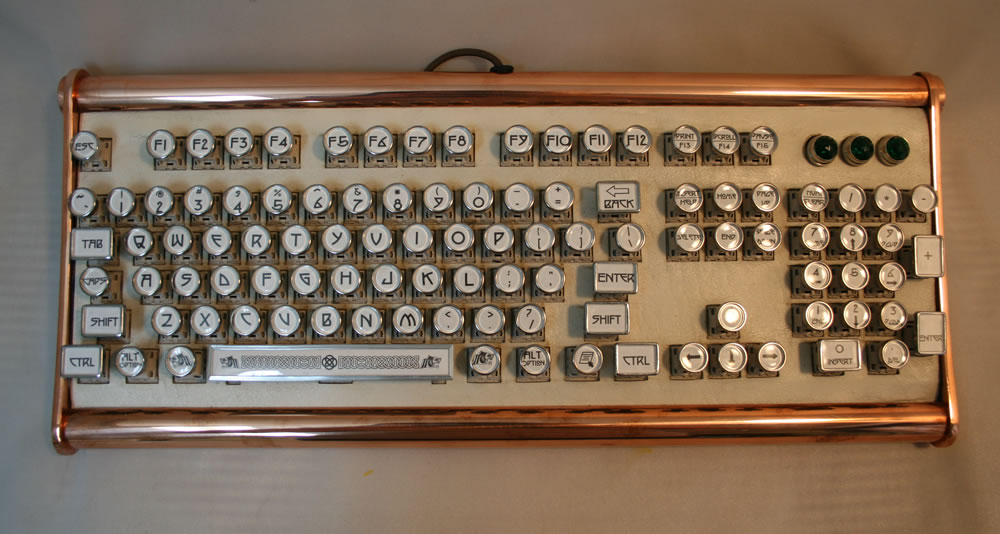
My long-awaited Arts and Crafts keyboard arrived yesterday from Datamancer Enterprises. Its copper and white leather, plus the Celtic knot-work design on the space bar is exactly what I envisioned. But what surprises me is the way the sound and feel of the mechanical action of its keys affects my writing.

It’s been years since I thought I needed special tools for writing. A professional writer, I maintain, ought to be able to work with whatever is at hand. So, while I have my preferences, over the years I have written on everything from a Palm pilot in its graffiti alphabet to the keyboard of a smart phone to a notebook. The point has never seemed the hardware, but preserving the content as quickly as it comes to me. Everything else has seemed pretension to me, like the various software tools that are supposed to help wannabes (Vim or a basic text editor is usually enough for me).

Still, I didn’t always feel that way. As a young adult with poetic aspirations, I was convinced that my writing was somehow tied to the muscular movements of a pen. The words I wrote by hand seemed to have a deeper, more thoughtful tone than things I attempted to write on a keyboard, and possibly a richer vocabulary as well. But somewhere in the first years of the millennium, I learned to do all my writing in front of a computer, and if my style suffered as a result, the damage was not enough to stop me from publishing regularly.

However, as soon as my fingertips connected with the new keyboard, I was aware of a change in how I was writing. It wasn’t that I had to press the keys slightly harder than I do on a cheap keyboard. Rather, I seemed to be paying more attention to what I was doing. What came next seemed to be blossoming in my mind earlier and quicker than with a cheap keyboard, and I was more likely to go back as I was writing and make changes in wording and structure, rather than leaving such changes for my revisions. The right word seemed to come morre easily. On the whole, I seemed to have a greater understanding about what the item I was composing needed.

At first, I thought the change was the result of the louder click alone. That surprised me, at first, because previously I would have imagined that I preferred a silent keyboard. But the sound of my new keyboard is the sound of progress being made – a sort of mechanical cheering to encourage me to keep going.

But that doesn’t seem to be whole of it. The action of the keys seems to be involved, too. The slight extra pressure on the keys seems to make a difference, and not just because at the end of yesterday my fingers felt like they had had an extra workout. Instead, it’s more like the connection between me and the words that I used to feel with a pen has been re-established.

After some thinking, I now wonder if the low-end keyboards I’ve used until now make typing too easy. Their keys are so sensitive that they require little effort on my part. That may sound like a desirable trait, but the lack of effort seems to severe my sense of connection. Now, entirely by accident, that connection has been restored in a way that I never thought possible (let alone necessary) with a keyboard.

Or, to put it another way, my new keyboard is like a bicycle: It extends my capabilities, but by supplementing the movement of my fingers instead of replacing them. By contrast, standard keyboards are a like a car, reducing my muscular actions to no more than a signal, and replacing them with its own actions. The slightly greater effort required by new keyboard is just enough to make me aware of what I was doing.

I’ll have to see how I feel as I’m settling down with the new keyboard. But, for now, I’m convinced that it is bring me closer to what I am doing, engaging me in a way that other keyboards do not.

It seems to me that this is what the best technology should do. Instead, many machines seem to reduce the need for human action. The result is that we are subtly alienated from our production, even when doing something like writing that is supposed to be creative.

All I know for sure is that I already I seem to detect a different cadence in my writing, and a tone that is closer to my speaking voice than most of what I create on the computer. I look forward to using the new keyboard, because it seems to be one the rare tools that really will help me to write more effectively.

copper2

Read Full Post »

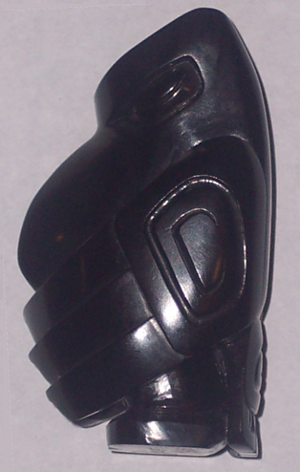
Mitch Adam’s “Dancer” is an example of how art keeps surprising me. I first picked up the piece (which fits comfortably in the palm of my hand), while having a late breakfast at the Northern Motor Inn in Terrace, and it immediately changed my mind about what an argillite piece could be.

Before seeing “Dancer,” I would have said I had firm ideas of what an argillite piece should be. It would be unpolished. It should be in a traditional style, and as detailed as possible.

Almost immediately, I saw that “Dancer” was none of these things. Yet, just as quickly, I realized that I wanted to buy it.

However, I shouldn’t have been surprised. Adams’ “Blue Moon Mask,” which is among the favorites in my collection, is an unusual piece as well. Moreover, Adams regularly produces surprises. Miniature masks in which laminated woods take the place of paint, functional carved pipes, yellow cedar sculptures with more detail than you would imagine the wood could take – through all these pieces, Adams has shown a knack for innovative designs and uses of media. I expect the unexpected but apt from him.

So why does this piece succeed against my expectations? Since I received the finished piece a week ago, it has been sitting just below my computer monitor, where I’ve been studying it at odd moments when my fingers pause on the keyboard, trying to figure out the answer.

The answer I’ve come up with is that the piece is sculpture reduced to its essential lines. The flight feathers are represented by three feathers that differ only in size and position, the feathers on the head to overlapping circles reminiscent of scale armor. Simple, unadorned ovoids join the wings to the body. Turn the sculpture around, and it is mostly unfinished, except for an ovoid with four tail feathers, each decorated by a simple T-shape.

Left to themselves, such decoration would be unexceptionable. However, they are not what the eye notices. Instead, what viewers notices is the strong lines of the piece – particularly curves – that I’ve noticed before in the best of Adams’ work. The top of each wing is matched by the curve of the beak on each side, forming strong but obvious crescents on each side. The shape of the head is an approximation in miniature of the half circle formed by the shoulders and the wings, and the bottom two wing-feathers on each side diminished echoes of the top one.

In addition, there is a strong center line. Initially established by the beak, it remains so strong that you still see where it should be in the empty space below it. Cleverly enough, that empty space forms an arrow, pointing up to the beak, and drawing the viewer’s eyes with it.

In the end, these lines and the negative spaces they create are what makes “Dancer” work. Like a successful formline, they draw the eye around the sculpture, keeping it moving. Since the polishing emphasizes them, it, too, is justified. A natural finish would de-emphasize both. Instead, by polishing, Adams has made the curves stand out, and the negative spaces look darker, to the benefit of both.

“Dancer” is a strong piece at its size. However, over the week that it has graced my townhouse, I find myself repeatedly wondering how it would work at a much larger size. My guess is that, with its lines, it would be an outstanding piece at any size.

dancer0

dancer-sideways

Read Full Post »

Coming back from the pool the other evening, I saw a neighbor dressed in a suit, pacing by his car. He was going to his son’s high school graduation, and worrying that his family was going to be late. I hadn’t thought of my own graduation in years, but before I had reached my front door, the memories drifted back.

For me, graduation came about two years too late. My last two years were memorable largely for Creative Writing, Literature, cross-country and track, and a boredom that I increasingly hid under a diffident politeness while I waited for school to be over. I was given a grudging respect for my running championships, so none of my classmates ever bothered me, but I had developed a reputation as a loner, and was mostly content to keep things that way.

Moreover, for the last six weeks of the year, I had convinced all my teachers except one that my time would best be spent preparing for the provincial exams, in which I was expected to do the school proud. So far as I was concerned, I had already made my mental good-byes.

Still, the ceremony meant something to my parents, so I dutifully climbed into my suit. The summer weather had hit early, and almost immediately I was sweating.

My diffidence had found a new gear, so I remember little of the ceremony. I remember looking from the stage over the gym, where more mothers and fathers and siblings had been crammed into the bleachers and the folding chairs on the floor than I would have imagined. I remember sweating under the lights, and being more bored than I had been in Grade 12 French, which for some months previous had been my standard for measuring boredom against.

Dimly, a small corner of me was scorning the platitudes that speaker after speaker offered to the graduating class. Did these people even remember what being a young adult was like? I wondered. Most of them seemed to have no idea that the advice they offered would have been out of place in an idealized 1953.

I no longer remember the name of the guest speaker. But I do remember that he was an architect of some small local fame, and that he took ninety minutes to develop some analogy between growing up and building a house that I stopped trying to follow after ten minutes.

All I remember of his speech is that, seventy minutes in, a fat old man stood up, pulled on his suspenders with his thumbs and said something like, “If you’re such a great architect, could you build a gym that would house all of us here tonight without half of us collapsing from the heat?”

He was cheered, but the guest speaker gave only a sentence or two in reply before returning to his topic.

Finally, the boredom was over, and the graduates duly marched across the stage. There would be another ceremony in September, after the provincial exam results were released, in which those of us who won scholarships would be officially presented with them, so this exercise was token. We shuffled forward to receive blank sheets of rolled paper, then descended the stairs to the stage and rushed into the hallway to open the back doors, tearing off our jackets and taking turns at the drinking fountain.

Then, suddenly, boys and girls I had known for years – some since I was six – were shaking each others’ hands, and saying things like, “Good to have known you.” They sounded like they were trying to voice the sentiments they had put into year books.

Still stupefied by boredom and heat, I couldn’t understand what they were doing. Most of us would be living in our parents’ houses for the next few years – we lived in a privileged municipality, where the university attendance rate was well over 90%. We would still be neighbors. We could still see each other, if we liked. In most cases, I didn’t like, but we would still probably encounter each other regardless.

I felt like everyone was mouthing the sentiments they thought the occasion demanded, not anything they really felt or believed. After a few minutes of such glad-handing, I escaped upstairs to join my family, anticipating getting home and changing into shorts and a T-shirt.

However, as things turned out, the farewells were warranted. That was the last time I was together with my graduating class until seven years ago when I went to my first reunion (who knows why). Almost all my class was headed to the University of British Columbia, while I opted for the younger, then edgier Simon Fraser University on the other side of town, which reduced the chance encounters and what little socializing I might have done. By the time a handful started at Simon Fraser, I was ahead of them, and had even less in common with them than I had had in high school.

Since then, I haven’t looked back very often. All that really remains of my graduation is a sense of pity that, at this time of year, millions of young adults are enduring boredom for the sake of their families, while the families are enduring an equally acute boredom in the face of platitudes for the sake of the young adults. I hope that none of them have to endure guest speakers like the architect who graced my own graduation ceremony.

Read Full Post »
« Newer Posts - Older Posts »