Feeds:
Posts
Comments

Archive for the ‘Bruce Byfield’ Category

(Note: Because the staff was unsure which exhibits the artists had given permission to photograph, I was unable to take pictures)

When I go to an art gallery, I come prepared to be pleased. Just as when I go to a movie or go to a book, I generally arrive with few expectations. I try to practice the concept that I should understand a work in its own terms, and not through the filter of expectations that I bring with me. Over the years, I have found that this approach has allowed me to appreciate things that I might otherwise have dismissed.

I mention my perspective because I have to report, very much against my wishes, that the new exhibit at the Bill Reid Gallery, “Continuum: Vision and Creativity on the Northwest Coast” is a disappointment. The fact that it comes after the gallery’s first successful show that highlighted Bill Reid’s career, and shares space with the dazzling permanent collection of Reid’s jewelry only makes the show’s failure all the greater.

For the most part, the problem is not with the artists. True, a few of the artists chose to submit the physical equivalent of one-liners. For instance, Shawn Hunt’s “Trickster,” which shows Raven perched atop a can of clam chowder is amusing at first glance, with its reference to Andy Warhol’s famous silkscreen (and also an indication of how Bill Reid’s “Raven and First Men” has altered the traditional story in modern minds, since the recorded historical versions mention a different type of shell). But, on second glance, what the incongruity means remains elusive. It seems only a poke at the commercialization of Northwest Coast art in a way that has already been done before. Personally, given the design ability displayed in Hunt’s Raven, with the grinning faces as part of the body and wing, I would far rather see what he does with less derivative work, especially since he is a relatively new artist.

A similarly limited work is Moy Sutherland’s “The Negotiator.” Sutherland, whose work I have often admired elsewhere, is not the first artist to add First Nations politics into his work. But where Charles Heit (Ya’Ya) rarely lost sight of his art and his comments had an angry wit to them. Sutherland’s use of Canadian flags, five dollar bills, and a dangling carrot is simply angry. It can be reduced to a single short sentence: He is angry with the people negotiating land claims on behalf of his nation. Any work that can be reduced to fourteen words, I submit, is not art at all, regardless of whether I sympathize with the sentiment, as I do with Sutherland’s.

However, the majority of the work exhibit present an interesting variety. In contrast to Sutherland’s work, Mike Dangeli’s “’Redemption’ Ridicule Mask” presents a much more complex reaction to the situation of the First Nations, using an old tradition to comment on contemporary politics.

Similarly, Ian Reid creates a new effect by placing Chilkat patterns and colors on a raven mask. He did so, he explained as an acknowledgement of Tlingit and Tsimshian women who introduced the Chilkat patterns into Heiltsuk society. At a time when many First Nations people are descended from multiple nations or are half European in ethnicity, he said, this acknowledgement seems particularly appropriate. The juxtapostion of two different traditional media more than justified Reid’s motivation, resulting in an arresting and original effect.

Dan Wallace also placed Chilkat patterns in a new medium by engraving them on his silver bracelet, “Remembering our Royalty.” Like Reid, Wallace emphasizes the importance of looking back at history while reflecting on the current situation, and, like Reid, produces a new artistic effect as he does so.

Other pieces worth seeing included a traditional Tsimshian mask and a stop-action video of its carving by Phil Gray, Sonny Assu’s graffiti-like canvas with its reds and pinks and grays, Dean Hunt’s traditional-looking mask “Pk’vs: Wild Man of the Woods,” and Aaron Nelson-Moody’s red cedar and copper panel “Copper Man.” Nor should I forget to mention the wealth textile works, such as Marianne Nicolson’s “Tunic for a Noblewoman,” done in memory of her grandmother; Krista Point’s untitled Salish blanket; Teri Rofkar’s “Tlingit Robe,” and Carrie Anne Vanderhoop’s “Dream of Dragonflies.” Individually, all these works were well-worth lingering over and returning for second and third and fourth looks.

The problem is, while most of the works in the exhibit stand on their own merits, they seem to add up to nothing as an exhibit. Part of the problem may be that the show seems to have changed directions, starting as an exhibit of young artists but transforming into an exhibit with the theme of the tensions between the contemporary and the traditional and adding older, more established artists. But, for whatever reason, the result is a seeming random collection of artists.

For all the obvious skill of individual artists, there seems no particular reason why these particular artists were chosen. Any of four or five dozen other artists could have been swapped in instead, and the impression left by the exhibit as a whole would not be significantly changed (As if in confirmation of this statement, after I left the exhibit, I saw Andrew Dexel, the graffiti artist, at one of the Aboriginal Days booths outside the Vancouver art gallery).

Another problem is that, with only one work allowed per artist at the most (one bracelet was the work of three), you have trouble appreciating anyone’s work. A quarter of the artists, and four or five works apiece would help visitors to gauge each artists’ range. Given the number of newer artists in the exhibit, that sort of context would have been welcome.

As things are, the result is that seeing “Continuum” is not much different from seeing the latest work at a commercial gallery. In fact, I have seen larger shows at commercial galleries, as well as chances to meet the artists that did not include a request for donations at the door.

Nothing is really wrong with such a show – I guess. But the Bill Reid Gallery is not a commercial gallery, and is obviously struggling to be something more. Its difficulty is that it is still struggling to define what that something else might be. In “Continuum,” I suspect it temporarily lost its way in academic critical jargon and posturing (if the catalog is any judge).

I can only hope that, with its next show, the Bill Reid Gallery returns to the success of its first show. If it does, then I will be happy to report the fact. Meanwhile, so far as “Continuum” is concerned, “disappointment” is the mildest word that I can honestly choose.
Read Full Post »

Last night, I was at the reception for Tahltan artist Alano Edzerza’s new exhibit, “Gift of the Raven.” The show features Edzerza’s work of the last six months. Also on display were a number of pieces by Morgan Green, a recent recipient of the YVR Art Foundation Scholarship and (as she may be tired of hearing) the daughter of Tsimshian master carver Henry Green.

The evening started with a performance of “Raven Steals the Light” by Victor Reece’s Big Sky Multi-Media Storytelling Society. The performance was held in the courtyard of the Waterfall Building, the complex in which the Edzerza Gallery is located. It featured a dancer with suitably nervous bird-like movements and a light mask with mirrors for eyes, and ended with him climbing to an overhead walkway to conclude the performance – all in all, a successful blending of the traditional and the contemporary.

Then, the crowd squeezed inside the gallery for the viewing.

The show did not include any new traditional style work by Edzerza. Otherwise, it was a good representation of the different strains in his work. My main problem was dodging the crowd and finding gaps in it that lasted long enough to snap a picture. Combined with the fact that some paintings were hung high, the result is pictures that are less than professional quality (to say the least), but should give some idea of what was on display.

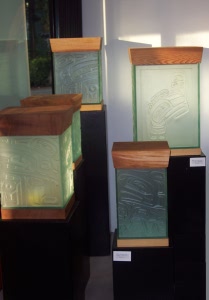
In one corner of the front of the gallery was a collection of Edzerza’s glass boxes:

alano-glass-boxes1

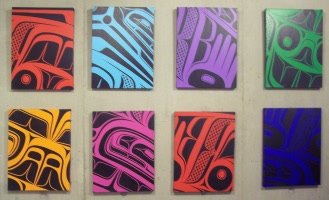
Elsewhere, you could see some of his experiments with color, such as this collection of closeups of traditional formline designs done in the electric colors of pop-art on a back wall:

alano-colors

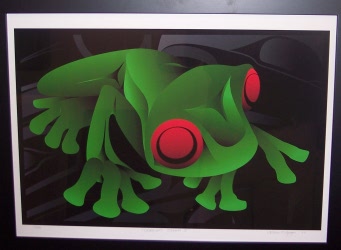
The same pop-art sensibility appeared in a couple of contemporary paintings of frogs, which were inspired, I am told, by a tattoo on a woman’s back:

alano-frog3

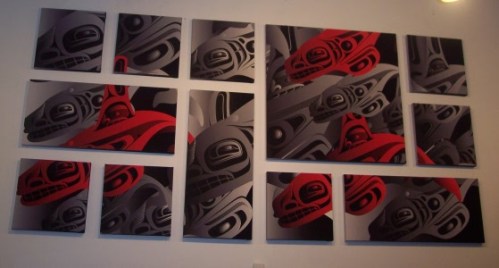
But the major works in the exhibit were the multi-panel ones, like this one that was hung near the ceiling, facing the door:

alano-orca-multi

Another orca design, a triptych, was hung just inside the door, and a triptych featuring ravens on the back wall. The raven triptych was especially dramatic, as one of its panel shows:

alano-eagle-triptych2

All these multi-panel works shared features that are characteristic of Edzerza’s work: A three-dimensional contemporary take on traditional Northwest Coast designs, an experiment with color in mainly grayscale designs, and a dramatic sense of movement that is enhanced by the separate canvases and draws your eyes from one to the next.

Morgan Green is not as an experienced an artist as Edzerza, but, in the last year, her work has matured quickly. Previously, the work by Green that I knew best were her leather cuffs and a somewhat over-ornate wolf helmet in the gallery, but the works I saw last night shows some other sides to her work, and an interest in different media that, if anything, is even greater than Edzerza’s.

Green’s works included a wall hanging and a variety of earth-colored ceramics inspired by a recent trip to Arizona and the First Nations work she saw there. A plate depicting Mouse Woman was particularly striking:

morgan-green-mouse-woman-plate

So far as I know, no historical depictions of Mouse Woman survive. But Green’s rendering seems a reasonable one, with features like the ears, the round eyes and the incisors providing the defining features that you would expect in a traditional design. At the same time, placing the design on grainy ceramic creates a pictograph-like effect, all the more so because the formline is hinted at more than fully realized.

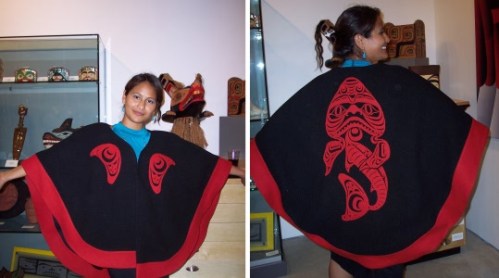
Perhaps the most accomplished work by Green on display was a Dogfish Woman robe she had created for an elder. The design was fairly standard (that is to say, more or less a descendant of Charles Edenshaw’s sketch via Bill Reid), but the cutting of the design and the assembly of the robe made for a first rate piece of work. As Green was discussing it with some of the guests, one of them agreed to model it:

morgan-green-dogfish-woman-robe

The evening was a fund-raiser, with a quarter of all sales going to the Vancouver Foundation. How successful the evening was a fund-raiser, I didn’t ask. But from the perspective of spotlighting two promising young artists, no one could have asked for more. I came away from the evening with increased respect for both, and an even greater determination to watch and enjoy their future growth.

Read Full Post »

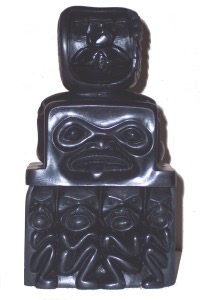
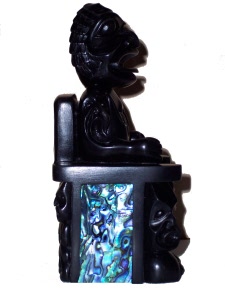
Earlier this week, we received “Master Shaman on His Throne of Power,” the latest sculpture by Ron Telek. We had been waiting for it since last December, so I consider it an act of supreme will power that we did not scream with frustration as we unwrapped the layers of paper, towels, cardboard and duct tape protecting it.

But the result was worth the wait, and then some. We had some photos of the work in progress courtesy of John Wilson, and were impressed enough then, but the finished piece goes beyond anything we could have expected.

The unfinished sculpture

The unfinished sculpture

“Master Shaman” is a carving in African wonderstone, with a black finish that makes it resemble argillite. In fact, Telek told me that he consulted an argillite carver about how to apply the finish. Back in December, I had no idea how he would finish it, but, recently we have started to look more closely at argillite, so his decision was a bit of serendipity so far as I was concerned.

The finished sculpture

The finished sculpture

The subject of the sculpture is self-explanatory: it depicts a shaman on a throne imbued with the spirits he controls transforming into a raven. You can see the spirits in the seat on the supports for the chair’s arms, while on the back, one of the shaman’s enslaved spirits presides over four confined spirits.

The sculpture depicts the shaman in mid-transformation. The spirit of the raven is erupting from his chest and the back of his head has started to sprout feathers while his feet and hands are half-turned into claws. His nose is hooked, suggesting that it is becoming a beak.

As always with the transformations that Telek depicts, you cannot say whether changing shape is an ecstatic or agonizing effort (I tend to think both). However, it is unquestionably intense. The shaman and most of the spirits seem to be screaming, and the shaman’s fist is clenched and his eyes bulging. His erect posture seems more an act of will, as though he would be doubled over in pain if he let himself relax.

Even more ominously, the shaman seems on the verge of losing control. Although the spirit on top of his head seems serene, screaming spirits seem to be erupting from his arms, in contrast to the close-mouthed on his rigidly-positioned knees. Meanwhile, his left hand has been replaced by another spirit that, considering the half-transformed shape of his feet and other hand, might well be an intruder. The overall impression is that the shaman is at best only partially in control of the process he has begun, and that, if he relaxes or allows himself to be distracted, he will lose control entirely.

telek-back

Turn the sculpture around, and you get another dimension – not only literally, but figuratively as well. The face on the shaman’s forehead has a more or less neutral expression, suggesting at most the shaman’s disciplined state of mind. However, the back of his head is hollowed out and contains a figure ripping its abdomen open in direct reflection of the raven spirit erupting from his chest. This figure grimaces in pain, revealing the true state of emotion beneath the shaman’s efforts to remain calm. It also raises the question of whether the transformation is real, or only happening in the shaman’s mind, a question that some of Telek’s other works, such as “Transformation Make: Human to Eagle” also raise.

All these aspects are enhanced by Telek’s usual attention to details. For example, although you cannot see from the pictures, the shaman’s back is separate from the back of the chair far more deeply than strictly necessary, while the feathers sprouting on his head are each individually carved. Similarly, the abalone on the sides of the seat are carefully matched, and both include dark lines in their pattern that complement the black finish of the rest of the sculpture.

telek-right-side

In some ways, “Master Shaman” is a typical Telek piece, balanced uniquely between traditional design and modern sensibilities. A seated figure is reasonably common in traditional argillite carvings, and so are transformation themes, but who other than Telek would add such a modern sense of ambiguity or such a psychological edge? It also has the three-dimensionality and amount of detail that I have come to expect from his work.

However, I know of no other piece by Telek that carries these tendencies to such an extreme as “Master Shaman.” The piece has a Gothic quality that combines traditional roots with the sensibility of the best dark fantasy novels; in fact, I would love to see a graphic novel or piece of animation done in the same style (although I wonder if it would be possible to depict more of the world than the sculpture does).

Phoning to tell me that the piece was ready, Telek commented that he thought the piece was his best yet. Maybe that was just an artist high on having finished a major work, but I’m not about to argue.

“Master Shaman” is an intense, unique work, and I haven’t tired of looking at it after three days of living with it. It sits a meter away from me as I type, and my eyes keep straying to it, even when I’m not writing about it.

Read Full Post »

With no Northwest Coast art on layaway and no must-haves in the galleries or on the web, we didn’t expect to buy any new pieces this month. But luck struck unexpectedly, and early this month we were told that Trish’s ticket had won the pendant being raffled as part of Lyle Wilson’s North Star exhibit at the West Vancouver Museum.

Five centimeters in diameter and made of engraved silver, the pendant is a miniature version of the aluminum piece that was the logo for the show. Wilson’s aluminum sculptures are much more finely cut than most large scale Northwest Coast installations in the same metal, and, mounted some distance from the wall, cast shadows that quite literally give them another dimension. However, Wilson is known primarily for his jewelry, so the pendant is perhaps more representative of him.

lyle-wilson-aluminium

Like much of Wilson’s work, the pendant is a mixture of European and Haisla tradition. The pendant is a compass rose, with the four cardinal points marked by arrows, and the figure of what I believe is a bear in the middle. The pendant differs from the aluminum logo in that the cardinal points do not extend beyond the circumference of the design, and the image of the bear is slightly smaller in diameter.

What the pendant has that the logo lacks is a variety of different hatching techniques. At the outer rim, the hatching is a series of finely etched vertical lines, each extremely fine but distinct. A band of unadorned metal separates the uttermost hatching from a smaller band that continues the vertical lines. The fourth ring of hatching is an equally fine stippled effect that extends into the compass points. The inner figure is separated by yet another fine ring of vertical lines, and is itself a small show piece of diagonal lines, with the face, the lower left and the upper right slanted to the right, and the upper left and lower right to the right. Most design teachers would advise students not to mix so many hatching styles in such a small space, but it speaks volumes about Wilson’s virtuosity that he is able to ignore such standard advice and produce such an intricate design.

The bear design, of course, is appropriate because the north star is in the constellation of Ursa Minor, the little bear. Perhaps, the pendant is the north star itself, with the outer vertical lines the rays of light radiating from it. Or, if you consider the design for a while, you might conclude that Wilson is playing with the idea of the bear being both a constellation and an earth-bound creature. To my eye, at any rate, the outer rim of vertical lines could suggest either the rays of the sun, or perhaps the northern lights, while the heavy stippling suggests the earth. These two realms are bridged by the points of the compass, which are identifiable by taking a bearing (if you pardon the pun), on the north star.

At the same time, you could take the contrast between sky and earth as a reflection of the two cultures that Wilson is caught between. With the emphasis on the compass in the pendant’s design, the sky could be interpreted as modern scientific culture, and the earth as Wilson’s first nation roots. Alternatively, you could reverse the interpretation, and see the bear in the sky as the mythologizing that informs the first nation cultures, the earth the mundane reality of the city in which Wilson lives. The interpretation works either way, because what matters is the contrast.

However, such readings are not my first reaction to the pendant. My first reaction is respect for Wilson’s attention to detail. Looking at the pendant, I am never in any doubt that I am looking at a piece by a master carver, and it is appreciation of his skill that makes me grateful that we have the right to house it.

lyle-wilson-pendant

Read Full Post »

OK, I confess: I am not a team player – at least, not in the sense that the expression is usually used around an office.

This admission is so burdened with nasty connotations that finding the courage to make it has taken most of my adult life. Nobody ever says so in as many words, but the implication is that something is wrong with you if you are not a team player.

In an office setting, not being a team player means that you are uncooperative, unwilling to make sacrifices for the sake of the company for which you work, and probably first in line to be fired. It suggests that something is deeply wrong with you, and that maybe you have other nasty habits as well.

In many ways, the usage reminds me of the admonition by a crowd to be a good sport. In both cases, the implication is that you should conform and do what others want to do, regardless of your own inclinations.

In other words, the threat of being called “not a team player” encourages you to be polite and do what is expected of you. Otherwise, you are letting people (or the company) down.

Such behavior may make daily life easier for a manager. If nothing else, people afraid of having a negative label applied to them can be coerced in endless hours of over-time. But, while I don’t go out of way to be unpleasant, personally I would rather eat sushi made from raw slugs that conform for no better reason than someone else’s convenience.

More importantly, from my observations the sort of behavior implied when the concept of a team player is raised is the exact opposite of what you want when you need to accomplish something.

When I was growing up, I did my share of team sports, mostly soccer and rugby. Perhaps, I was lucky, but, at the time, the pseudo-military atmosphere that prevails in football had no place in those sports. Nor could it; you can easily memorize a few moves from a standard position, but soccer and rugby both require a more active sense of smarts that can adjust to an ever-changing situation.

In such fast-moving games, the last thing you want is conformists. Instead, what you want to know is that the people on your team can think for themselves – that they will be in the position for you to pass the ball to them because they have anticipated what is about to happen on the field. You relied on your team mates’ competence, not their dedication to the team.

In my favorite sport, long distance running, this lesson was even more obvious. Sure, there were cross-country teams and points were tallied for each school at a track meet. At times, someone who was slower might even run interference to help a faster team member break away from the pack. But, mostly, you were alone with your own training and sense of strategy. If your team won, it was because those on it were prepared and alert.

As an adult, I find the same lesson in the free and open source software (FOSS) community. Operating systems like GNU/Linux or applications like Firefox, or Apache have not excelled because they were made in an organization of conformists. Instead, they have succeeded because their development model assumes the competence of those involved. For the most part, people coordinate their work with everyone else, then do it largely on their own and return it to the community for peer review. It is this system of individuals coordinating their separate work that is the secret of such projects’ successes.

A group of team players in the ordinary use of the term needs to work much harder to achieve the same level of excellence as such projects – assuming, that is, they can reach it at all. As for innovation, forget it. So-called team players simply aren’t geared for it. Nor are they likely to have the degree of personal responsibility and discipline needed to work in such a loosely-knit way.

When I have worked in offices that emphasize teamwork, I have always found that my efforts to achieve excellence swamped by the need to appear loyal and to swallow my opinions and interrupt my concentration with endless meetings. Team-players are skilled in jingoism and giving the appearance of getting work done, but the chances of them achieving anything beyond the bare specifications is minimal. When they do, you almost always find that the source of the excellence is someone on the fringes of the team who works on their own as much as possible.

If that is what being a team player means, then I, for one, want nothing to do with the label. To me, it is a code word for mediocrity. I achieve more personal satisfaction – and, in the end, help those around me more (including my employers) – if I work on my own with consultation as needed, and can trust those around me to do the same.

Read Full Post »

The other evening, we received a call from someone we knew fifteen years ago. We hadn’t heard from him for several years, and, while we had nothing particular against him, we were content to drift out of touch. But there he was, a disembodied voice bringing up names that these days we hardly thought of from one year to the next, and urging that we should get back in touch with people with whom we no longer had anything in common. The experience was sad and guilt-provoking in equal measure. At the same time, I resented it, because our caller believed he still had the right to make demands on us.

All in all, it was a perfect example of what American fantasist Harlan Ellison once called taking a tour through his life. He meant, as you can probably figure out, somebody leaping to conclusions about how he thought or felt, then acting upon them rather than responding to what he actually said or did.

I don’t have one-fortieth of the name recognition that Ellison had in his heyday, but as a writer who publishes mostly online, I have people taking tours through my life all the time. They miss the sarcasm, take a phrase out of context, or misread, and then they take me to task for what they imagine I said or believe.

For example, once when I did a brief commentary in which I suggested that a woman-only distribution of GNU/Linux might be worth trying. Among other things, I wrote, “I’m not a great believer in the idea that women are less aggressive than or interact differently from men. Yet even I have to admit that most of the regulars on free software mailing lists for women are politer and more supportive than the average poster on general lists.” Then one of the commenters inferred that I must be single and a loner who knew nothing about women, because they obviously were different from men. He apparently stopped reading with the first sentence of the passage, and was willing to blast me on the basis of his incomplete understanding. Never mind that another five seconds’ reading might have prevented his mistake and public embarrassment.

As an ex-university teacher who tried to encourage careful and sympathetic reading among students, my first impulse is to correct such statements as politely as I can. However, experience has taught me that the effort is usually a waste of time. Nobody likes being proved wrong at the best of times, but, when they are also proved incompetent, most people become defensive and angry. I save everybody’s time and keep my blood pressure lower if I don’t respond, or, at the very most, stop the email exchange after my second message.

That probably leaves the commenter thinking that they’ve won, but I can live with that. I don’t know them, after all.

But some tourists through my life are not simply on a self-conducted tour, but trying to sell other people tickets as well. There’s only two or three of them, but they spend a surprising amount of time on their blogs and web sites attacking me for what I did or didn’t do, or for what they imagine I said.

Why they attack me in particular, I have no idea. Maybe it’s because I write online and seem accessible.

What disturbs me about these tour guides is not that they disagree with me. They have every right to do so. Occasionally, they even point out actual mistakes (although they frequently confuse the concepts of “mistake” and “different opinion”). It is not even their relentless anger (explicable to me only as too much caffeine and too little sleep), their refusal to follow even the basics of civilized discussion, or the question of why they don’t write about someone important.

Rather, what disturbs me is the cognitive dissonance that sets in when I read their comments about me or my articles. Possibly, they get carried away by their own rhetoric, but the image they present of me or my articles is so far from any possible perspective that I can’t even call it a distortion. I suspect they are projecting an image drawn from their own imagination or systematic misreadings and over-simplifications. A Microsoft shill or dupe? A writer who is one with Dan Lyons and Laura Didio? Considering that an even larger group of readers identify me as completely biased to the free software school of thought, these accusations would be laughable if only they were not so humorless and ill-natured.

Emotionally, what they say about me has no resonance whatsoever. It simply strikes me as bizaare.

When I first started receiving these attacks, I used to respond to them, thinking that I couldn’t let such outrageous comments stand unchallenged. But doing so, I quickly found, is an even bigger waste of time than responding to those on the self-guided tours. The tour-guides never give in.

For these reasons, I rarely read the tour-guides. The occasional pingback to my blog or a note from a friend tells me that they are still out there, but I mostly catch only snippets of their latest rants. I tell myself that to be known as someone attacked by such people is a mark of honor, and, considering their other targets in the free software community (many of whom I’ve met and liked, although not always agreed with), I should consider their attacks a sign of distinction, no matter how undeserved.

But increasingly, just as with the former friend who called, when I happen across the tour-guides, what echoes inside my head is Ellison’s reply to the similar people in his own life:

“I don’t know you, and you don’t know me.”

And I, for one, am very content to keep things that way.

Read Full Post »

Someday, I am going to jot down the stories of my art acquisitions. There’s the story of how I had to trek to the South Terminal of the Vancouver Airport not knowing the distance, and the story of how a simple bank transfer assumed nightmare proportions as I returned again and again to the bank. And now, after yesterday, I have the story of stopping by the Chateau Granville to pick up Shawn Aster’s “Raven Heart” to the befuddlement and bemusement of the desk clerk and manager, who had obviously never heard of such a thing.

The situation was no one’s fault – just one of those times when the perversity of the universe seems set to stun. I had reserved the painting when I was in Terrace five weeks ago, but I didn’t have the time to get to a bank machine and return before the show closed for the day. As a result, I didn’t pay until after I returned home. We had floated various schemes for delivery, ranging from leaving the piece at the Grayhound station to picking it up at the Spirit Gallery reception yesterday. But an emergency had forced Aster to return home early, and the hotel desk was his improvised way of getting the piece to me.

Now that Aster has won a couple of scholarships at the Freda Diesing School, his work is starting to sell, and people are expecting a successful career ahead of him. As he takes his first steps, I can’t resist a bit of self-congratulation for having discovered the young Tsimshian artist’s work several months ago at the school’s mid-term show (and some mild complementary scorn for those who needed the scholarships to realize the quality of his work).

Many young artists seem to enjoy designs in which Northwest Coast designs are incorporated into the shapes of modern culture. For instance, Latham Mack, another scholarship winner at the Freda Diesing, did a group figure of traditional designs that formed the outline of a Playboy bunny on a T-shirt. In the same way, “Raven Heart” takes two traditional ravens and constrains them in a heart design.

This practice, I suppose, is the extension of the tradition of adjusting a design to fit the contours of the shape it is on – a pole, or a bowl, spoon, hat, or box. The main difference, of course, is that the possibilities for innovation and commentary open up when a modern shape informs the design. In the case of “Raven Heart,” the two ravens resemble a traditional split design, but, when put into a heart, suggest a rather unhappy relationship, the raven of mythology being associated more with promiscuity than faithfulness, and more with clever and expedient lies than the truthfulness that is generally thought to be a necessity for a successful relationship. A confirmation that the relationship is less than smooth is the constrained feathers on the wings that seem almost like bars confining the trapped figure inside the heart — which has a decidedly unhappy look on its face.

It is probably no accident, either, that the piece was first exhibited at a show shortly before Valentine’s Day this year. The piece seems to play one culture against the other, using each to comment sarcastically upon the other.

But what interests me most about “Raven Heart,” like all of Aster’s work that I have seen, is its technical skill. Its form lines do not have the most graceful curves that I have seen, but for the most part they are suitably varied in thickness, and the use of interior U-shapes to minimize the thickness of the intersections is well done. In addition, of course, the use of red as the primary color – a relatively rare practice, traditionally-speaking – is suited to the heart shape.

The design itself is made up of only a few shapes – notably the U-shapes and T-shapes – which vary in length and whose colors are sometimes inverted. The composition has an obvious horizontal symmetry, but it also includes a less noticeable vertical symmetry, made up of groups of threes and fours: three feathers on the stylized wings, three fingers on the trapped figure’s hands (or are they the claws of the ravens?), four interior shapes on the outer wings, and four tail feathers on the bottom. Each side, too, has three large ovoids filled with black. Similarly, the circles at the joints of the wings are balanced by one that might be the tail-bone, while three circles, irregularly shaped, are also at the center of the trapped figure’s design. There is an economy in the relatively few shapes used in the design, and an almost mathematical precision in the vertical symmetry that is rare in any Northwest Coast art, but especially rare in an artist over thirty.

I have talked off and on with Aster about a commission, and I still hope to see it one day. Meanwhile, “Raven Heart” is a masterful small performance that makes me believe that Aster has a future every bit as promising as everyone is saying.

aster

Read Full Post »

Most Saturdays, noon sees me barely staggering out to the gym. But today, noon or shortly after saw us arriving in Gastown for the reception to mark the opening of the Northern Exposure 2009 show at The Spirit Wrestler Gallery. The show is an exhibit of the graduating class of the Fred Diesing School of Northwest Coast Art, plus this years’ scholarship winners. It has already become a tradition in the three years that the school has existed.

With 19 carvings and no graphics, the show was a subset of the graduation show I saw in Terrace, which had some 75 pieces. One or two second year students were missing, as well as most of the first year, including some artists like Mitch Adams or John Wilson who I’d rate above some of those who were represented. Still, space was limited, so some way of reducing the numbers was probably unavoidable.

At any rate, the reduced number also had the benefit of allowing you to pay close attention to each piece – something that is impossible with four times the number. It was especially interesting to see the graduates’ work beside that of their teachers, Stan Bevan and Ken McNeil. That way, you could see the teachers’ influence, and which students were on their way to establishing their own style.

To my eye, the exhibit was somewhat weaker than last years’, which included the work of Dean Heron, who is rapidly becoming one of the major up and coming young artists in the Northwest Coast Tradition. However, the show included the paddles I had admired in Terrace by Latham Mack and Shawn Aster. Another standout was Mack’s “Northern Beauty” mask with its striking painting and individualistic detailing of the nostrils and mouth.

northern-beauty

I also appreciated two samples of Reynold Collins’ detailed, often intricate work. While I think Collins’ work would be improved by more finishing and greater attention to the grain, his work never suffers from the clumsy blank spaces found in many of the other students’ work and shows a vividness of imagination that makes me suspect it is only a matter of time until I find the right piece of his work to buy.

reynold-collins

Only a half dozen students were at the reception, and their time was in demand. However, because the event was smaller than the graduate show, it was easier to have a few words with them and find what motivated them. I talked briefly with Sophia Patricia Beaton, Darryl W. Moore, and Reynold Collins, each time finding something in the conversation to bring me back for another look at the pieces they were exhibiting.

Last years’ show, as well as the work of other recent graduates was priced somewhat high – a mistake that means that the pieces do not sell, and that the artist is tempted to try to charge prices elsewhere that their reputation cannot sustain. By contrast, this year, the students seem to have priced their own work, and, thanks to the guidance of their teachers, this year, realism prevailed. Most of the pieces were under $1400, and only one over $2000. This realism seems to have helped; as I write seven hours after the start of the reception, some six of the pieces in the show have sold, including two each by YVR award-winners Todd Stephens and Shawn Aster. Not bad for a day’s display.

Especially at realistic prices, the show cannot be much of a money-maker for Spirit Wrestler, which often sells works by Robert Davidson or glass artist Preston Singletary for tens of thousands of dollars. In fact, when the cost of publicity, reception and staff wages are taken into account, the show might even cost the gallery money. That makes the show a public-spirited effort, or at the very least, a long-term investment in the next generation of artists.

Certainly, it means a considerable amount to the artists, many of whom have limited funds and some of whom had to go to some effort to get to Vancouver. But, after several days that included the YVR ceremony, and a tour of several local galleries and a CBC interview for the award-winners, the reception was clearly the highlight of their trip. Many said as much, and their sincerity was unquestionable. The reception gives them a taste of the lives they would like to live – and, thanks to Spirit Wrestler, for some of them, those lives may now be that much closer.

Read Full Post »

As a former teacher, I blame no one for ignorance. The older I get, the more painfully aware I become of my own ignorance in a dozen different areas, so the last thing I’m going to do is look down on someone else for not knowing something. But one thing I cannot endure is willful stupidity.

You’ve probably met willful stupidity, even if you didn’t give it a name. It’s a passive-aggressive behavior, often seen in bureaucracy or in low-paying jobs such as sales clerk in which a person assumes that the little they know is all there is know about a subject, and anybody who contradicts them is ignorant and wrong.

For instance, yesterday, I went into the local London Drugs for an album to hold 5×7 inch photos. Since 5×7 has been a stock size in photography for decades, I imagined I would have no trouble finding an album. However, all I could see on the shelves were albums for 4×6 photos, a size that has become common place since the rise of digital cameras and automatic photo finishing.

When I finally found a clerk, he insisted that 4×6 was the only standard size.

“Since when?” I asked.

“Fifteen years, maybe more. It’s standard everywhere.”

“Such as?”

“Future Shop, Walmart, Best Buy.”

“You mean that 4×6 is the size that your machines are set to handle.”

“No, it’s the standard size.”

“So why do professional photographers offer 5×7 as a standard size?” I asked, thinking to lead him gently out of ignorance.

“They don’t. If you have a 5×7 picture, it will come out cropped.”

“Yes, because that’s how your machines are set.” I was remembering the inadequate job that the store had done a couple of years earlier on some cropped digital photos.

“No, because that’s how it is. Everyone knows that.”

My feet were hurting after a long trek, so at this point I lost my habitual politeness. “Were you born stupid, or did you have to practice?” I asked, and limped away.

As soon as I got home, I opened the London Drugs website. Just as I suspected, it showed 5×7 albums. A phone call later, I confirmed that the store I had been in carried them, too. In fact, my conversation with the clerk took place several meters away from them.

Maybe I’m just getting cranky as I age and losing my senses of patience and humor. But it seems to me that such conversations are becoming increasingly common as I grow old. The students who seem to feel they’ve won if they don’t learn something, the expert who fails to recognize a synonym for a specialized phrase, the computer repairer who knows nothing about GNU/Linux but dismisses it even after I reveal that I have a certain amount of expertise – all these belong to the legions of the willfully stupid. And, increasingly, talking to them is like being the straight man for the collected Marx Brothers (except, of course, for the utter lack of humor). Really, I’ve had more intelligent conversations with voice mail systems.

What annoys me about such conversations is not just the stolid unhelpfulness. Long ago, I worked as a store clerk, and, if I’m being honest, I have to admit that once or twice I found petty ways of taking out my dislike of the job on customers. So I can hardly complain if I receive the same treatment.

No, what bothers me is the willfully stupid’s absolute conviction that they are correct. They know almost nothing about what they are talking about – in this case, not even what stock their store carries. Nor, despite the fact that they are focusing on a topic for much of their working life, have they made any effort to push back the limits of their ignorance, a failure that I find baffling. When I’ve been in similar situations, I’ve learned, partly despite myself and partly so the work would be more interesting. But when people choose to become willfully stupid, not learning seems the whole point of their behavior. In a perverse way, they seem to have scored some victory over the conditions of their lives by refusing to see a point or learn.

But the worst thing about such behavior is that it seems to be self-inflicted. In this sense, it is the mental equivalent of cutting yourself or some other self-destructive behavior. It seems to me that, if you play stupid long enough, you risk becoming stupid permanently. Eventually, you might reach a point where you can’t see evidence or listen to a counter-argument no matter what. And I can only imagine this state as one of diminished enjoyment and intellectual impoverishment.

That, in the end, is why such encounters disturb me. They send my scuttling to my mental mirror for a close scrutiny, wondering if my behavior is ever anything like what I’ve just seen, and wondering if I would know if it were.

Read Full Post »

The Lord of the Rings is one of the books to which I’ve kept returning in my life, and I’ve seen the movies several times. So, when I heard that a group of fans were issuing a prequel called The Hunt for Gollum, and offering it for free viewing on the web (in the hopes that, if profit wasn’t an issue, issues about copyright violation might be ignored), I was immediately intrigued. It’s far from the first movie made this way, but my interest in Tolkien meant that it’s the first that I have actually made the effort of watching. What I saw was a homage to the films, obviously made on the cheap and lacking plot, but far from the worst forty minutes I’ve spent watching a movie.

The movie is a prequel to the trilogy in which Aragorn hunts down Gollum and captures him for questioning. These events are mentioned in The Fellowship of the Ring as having happened recently, but are not shown directly (the better, no doubt to keep Aragorn off stage until he makes his mysterious entrance at Bree).

The camera work, staging, costuming, and music could almost have come straight from Peter Jackson’s Weta Workshop. Like Jackson’s movies, The Hunt has long, panoramic shots of landscapes. When something is about to happen, Aragorn – who is in-camera for most of the forty minutes – strikes a pose while the camera lingers on him. When he is wounded, he has a mystical vision of Arwen, the elf woman who has his heart. Meanwhile, the soundtrack gives unsubtle hints about what is about to happen.

In short, the grand opera mannerisms of Peter Jackson are imitated as closely as possible. Even the characters, from Gollum to Gandalf and the orcs are based heavily on the movie (even if Aragorn does look a little too much like a poetic grad student, and not enough like someone who sleeps rough most nights). You might consider this imitation a lack of originality, but I suspect it shows more the sincerity of the makers. The Hunt is above all else a homage, a re-creation of the atmosphere developed by Jackson by people who full-heartedly love it.

The trouble is, of course, is that a slight difference in budget exists. If you’re looking, you should have no difficulty in seeing where money is conserved. For example, a scene set in a house looks like a modern pub or antiqued kitchen, while a conservatory with anachronistic glass serves as a stand-in for Rivendell. You get one elf, only three or four orcs whose makeup shows. Most obviously, Gollum is seen close up in only one shot, and, in fact, spends most of his time in a sack hung over Aragorn’s shoulder, which poerhaps llows more than one person to play him.

However, most of these budget measures are unobtrusive, unless you make a point of looking for them. The one exception is the unavailability of Gollum in closeup, which reduces much of the drama, leaving poor Aragorn to respond to a sack. Adrian Webster, the actor playing Aragorn, tries valiantly, but no actor, no matter how skilled, can do much to save essentially dramaless scenes.

But the greatest problem with The Hunt for Gollum is the script. Granted, the scope of the story that can be told in forty minutes is limited. All the same, there is a difference between a string of incidents that related to each other only by when they happen, and a plot, in which one incident leads to another – and, for most of the forty minutes, the movie offers only a string of incidents. They are acceptably acted and staged incidents, but they do not form a plotted story.

Still, full credit to the production team for its ingenuity. The same team is already working on a science fiction thriller, and, while I was not absolutely entranced by this first effort, I was impressed enough that I’ll check on its progress every now and then. There are dozens, if not thousands of half hour TV shows that entertained me less, and if I sound flippant, the reason is that my interest in Tolkien made me hope for something marvelous instead of simply well-done. I only hope that, second time out, the team remembers to arm itself with a tighter script.

Read Full Post »

« Newer Posts - Older Posts »