Feeds:
Posts
Comments

Archive for the ‘Bruce Byfield’ Category

Today is Ada Lovelace Day, which honors the first computer programmer. The custom is to observe the day by writing about women you admire in the sciences or computing. This year, I have chosen to mention Cordelia Fine, whose book Delusions of Gender gave me a coherent argument for what I have always believed – that, contrary to the prevailing outlook the brains of men and women are largely the same.

I can’t remember a time I didn’t have this belief, but it received strong confirmation when I taught at university and dealt with several thousand students. However, it was Fine’s book that gave me the evidence and reasoned argument and turned the belief into an even deeper conviction.

To say the least, this conviction is a minority viewpoint. Modern alleged science is full of poorly designed research, and unsupported speculations about the differences between the sexes – to say nothing of Just So stories about pre-historic humans that are supposed to have implications for life today in the suburbs. All this mix is reported uncritically in the media to reinforce common stereotypes. Much of my pleasure in Delusions of Gender is Fine’s obvious delight in debunking such things with a combination of dry wit and thorough analysis, proving that most of the conclusions promoted by people like Simon Baron-Cohen (who actually reviewed the book), Leonard Sax, and John Gray are based on flawed experiments and is little more than a rationalization of conventional sexism – a logical fallacy based on an appeal to biological authority, although Fine never actually uses the term.

In particular, Fine discusses how differences in the organization of men’s and women’s brains are used as evidence that stereotypes about mental capacities. Her dissection is lengthy, but her basic point is simple: how does anyone know that the physical differences translate into behavioral differences and limitations? There is no mechanism for this translation – it is simply assumed. Yet, by contrast, when people are brain-damaged, and one part of the brain takes over the functions of another, nobody automatically assumes a similar translation. In the end, Fine condemns such views as the modern descendant of discredited views such as phrenology and cranial capacity as determinants of behavior. She calls this assumption “neuro-sexism.”

Fine also provides the answer I had been waiting for to those well-meaning parents who insist that gender must be biological, because their children are showing stereotypical behavior. Fine’s answer is that the reinforcement of stereotypes is unconscious, even among those who try to avoid them. In fact, stereotyping is so prevalent that expectant parents who learn the sex of their offspring before birth immediately start referring to him or her in traditional masculine and feminine ways. Under these circumstances, a biological explanation is unwarranted – it simply fits into people’s conventional ways of thinking.

Currently, the biological determinists prevail in our cultural, along with their sub-text that there is not much we can do about gender differences. By contrast, Fine makes the case for environmental differences, which means that change is possible. The first time I read Delusions of Grandeur, my reaction could be summarized as, “Finally!” and I continue to regard Fine as a voice of sanity. and scientific reasoning.

Read Full Post »

Marriage is viewed uncomfortably by many feminists. For years, women placed themselves at a significant disadvantage when they married, and, even now, marrying means a constant battle against traditional assumptions. In fact, many would question if a feminist marriage – a marriage that attempts to practice gender equality, legal or common law – is even a possibility between a man and a woman.

I happen to be in a position to say that it is possible. One of the proudest boasts is that I practiced feminist marriage for thirty years, and with considerable success.

In fact, if my partner Trish had not died unexpectedly young, I would still be married today.

Much of my pride in the accomplishment I shared with Trish is that feminist marriage was hard work. No sooner had we married than people started treating us differently. Suddenly, we were much more acceptable to each other’s families. Friends who had known us for years assumed we would immediately settle down to having a family, and filling traditional roles.

Fortunately, neither of us was conventional enough to be heavily influenced by such expectations, but, all the same, resisting them often took more energy than we expected – although we did enjoy confounding those expectations whenever possibly. At times, we even took a gleeful satisfaction in educating people by going against those stereotypes.

For many couples who want to practice feminist marriage, division of domestic labor is the largest problem. Notoriously, many men cannot get in the habit of doing their share. For us, however, this was never much of a problem.

For one thing, my mother returned to work when I was late elementary school, so I was more prepared to take on my share of responsibilities than most men.

More importantly, by consulting our preferences and the patterns of our lives, we soon talked out any difference. I was a student when we married, and for much of our life together I worked freelance. Usually, I was home long before Trish, and, since I like cooking, having me in charge of meals was only sensible, especially if we were going to eat before eight or nine o’clock. Similarly, Trish did the driving, so maintaining the car fell largely to her. The tasks neither of us cared to do, we compromised on – for instance, Trish turned out to dislike doing the dishes less than I did, while I tolerated vacuuming better than she did. A few tasks, like doing the laundry, fell to whoever happened to need it done at a given moment.

We never found such decisions difficult, because both of us from the start had a commitment to living up to our ideals of a partnership. Part of that ideal was to talk about everything as frankly as possible, even what seemed obvious, just in case what seemed obvious to one of us was not obvious to the other. Early on, we each agreed as well that displays of temper were inappropriate toward the major person in our lives. As a result, we rarely argued – not because we never disagreed, but because we were committed to finding a civilized solution. Also, by the time we reached the point where we might have argued, we generally had long ago agreed how we would handle it.

Still, others’ assumptions were always there. When someone would note that our division of labor was non-traditional, we took to paraphrasing Lloyd Alexander, noting that while some work was called women’s and some was called men’s, the work itself never cared who did it. What mattered was that the work got done. Most of the time, the comment ended the discussion.

Of course, the expectations annoyed us. However, unlike modern feminists, who are fond of saying that their role is not to educate, we did take it upon ourselves to teach – or at least confound – whenever possible. When we were at a restaurant and the waiter handed me a sample of the wine, I would pass it to Trish to taste as well, and we would both discuss it before we both nodded acceptance. At the end of the meal, Trish would pay (not that it mattered, since the money came from the same credit union account). Sometimes, we would make a great Three Musketeers-like display of Trish holding the door for me, or presenting me with flowers on my birthday. These lessons might have been spoiled by the fact that both of us would end up giggling, but, we would quote Utah Phillips and say that people had to learn these things somewhere, and giggle more.

Once, we were sitting in the university pub, and I expressed the opinion that children probably benefited from having a parent at home. A woman who had come late to the conversation immediately accused me of sexism – then, with what I can only call a smile of vicious delight, instead of siding with her, Trish pointed out that I had stated earlier than I was expecting to arrange my life so that half the time I was the parent at home. As things happened, we never brought a pregnancy to term, but I did arrange my working life so that I could have been a hands-on parent.

Breaking these expectations was a way to get some of our own back on those who wanted us to act traditionally. Instead of exploding in anger or exasperation, we gave them a teachable moment (and ourselves a moment of amusement).

Our marriage was not a matter of us against the world. However, it had something of that flavor. You might say more accurately that it was our beliefs against the world’s, and that we were allies in a shared cause.

Yet, however our marriage is described, its success was undeniable. People meeting us after we had been together for twenty five years thought we were a new couple after seeing us together in public. At Trish’s memorial service, several speakers mentioned the strength of our marriage, and I took some comfort in hearing that several nieces considered us an example for them to live up to. So if you accuse me of filtering memories through nostalgia and grief, you are wrong.

What I have described was real enough, if rare, and we both realized how lucky we were to have it. Except we knew that luck had little to do with it. It was hard work and ideals that was responsible. To me, there is no question whatsoever: marriage in defiance of convention made me a better feminist, and what we built is one of the accomplishments of my life.

Read Full Post »

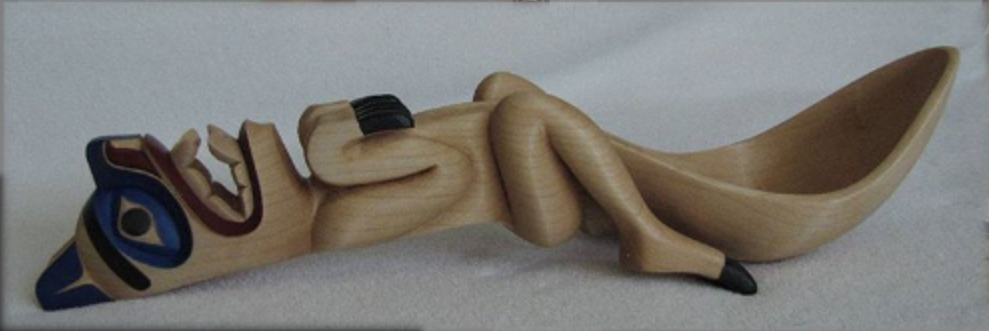
I first became aware of Nuxalk artist Latham Mack when I visited Terrace for the Freda Diesing School graduate exhibit. He had already won one YVR scholarship, and would go on to win another, and his paintings and drawings were among the best in the class – so much so that the teachers gave him the privilege in his second year of working in the Nuxalk rather than the Northern tradition. In fact, when he showed me a sketch for a painting of the Four Carpenters, I said I would buy it sight unseen. However, that painting was never done, and at the time his sculptural work was no more than competent, the best feature of his masks being the painting.

lmgbs2

Mack’s patience and hard work, though, mean that his story today is very different. Under the mentorship of Dempsey Bob, Mack has become one of the outstanding carvers of his generation, and the prices of his work should soon edge beyond my affordability. So when he showed me his relatively inexpensive “Grizzly Bear Spoon” outside Dempsey Bob’s “North” exhibit in 2014, I jumped at the chance to buy. I had to wait six months while the spoon was on display at the Richmond Art Gallery, but in early 2015 I finally carried home an example of his work.

My understanding is that Mack began the spoon while still at the Freda Diesing School and finished it in 2014. Certainly its quality and execution is closer to that of his current work than his student masks. If I didn’t know Mack’s connection to Bob, I might have guessed it by the minimal paint job, although Mack does use what I mentally tag “Nuxalk Blue” around the eyes and ears. The wood is soft to the touch, and the lines of the paint completely straight, both signs of a highly-finished work (and, in the case of the paint, a steady hand. What I especially like is that, with the minimal paint, the contours of the grain because as much a part of the result as the carving.

Adding to the piece are the proportions and curves of the spoon’s bowl. They are framed by the legs, with the knees marking where the bowl begins to widen, and the descent of the bowl’s curve by the calves. Further up the handle, the start of the bowl is framed by the claws.

Most of the body is simply carved, with the roundness of legs and arms emphasizing the wood’s grain. But what really catches the eye is the depth of the carving on the head. Typically, deep carving is a sign of excellence in northwest coast carving, and this spoon is no exception. The tip of the chin is at least three centimeters from the base of the neck, and the inside of the mouth slightly more. The lips are half a centimeter thick, the eye-sockets symmetrically about the same. The result is dramatic, especially when painted, and even more so in dim light.

Currently, “Grizzly Bear Spoon” sits on a tea trolley in my living room, where I pass it twenty times a day and my glance can hardly help but linger on it. I suppose it is a minor work compared to Mack’s larger pieces, but between the curves, the grain, and the depth of the carving, I consider it every bit as much an accomplishment.

lmgbs

Read Full Post »

Although I am committed to feminism, some of its advocates grab hold of strange ideas. For example, in their rejection of body-shaming, some praise acceptance of being overweight, ignoring the fact that it is unhealthy (although evidently, less so than anorexia). Not too long ago, you could also find those who, with no definite evidence, believed in the existence of a prehistoric matriarchy. More recently, some claim that the taking of selfies strengthen women’s self-confidence, and to object to selfies for any reason is a sign of secret hatred for women. By contrast, I would argue that selfies encourages women in traditional stereotypes, urging them to promote self-esteem instead of grounding them in self-confidence.

Erin Tatum gives a typical argument in favor of selfies. According to her “Selfies and Misogyny: The Importance of Selfies as Self-Love,” selfies matter because women take them for no justification except their own enjoyment. Instead of acting out what the fashion industry or the men in their lives tells them to – and usually feeling inadequate — selfies are a way for women to appreciate themselves and each other. Far from being narcissistic, selfies “provide girls with the means to create their own positive image of themselves, thereby severely diluting the impact of outside opinion. If your confidence comes from within, you can’t be controlled as easily.”

An obvious flaw of this argument is that, despite jokes about young women making duck faces in selfies, selfies are not particularly associated with women. For instance, when The Oatmeal discussed selfies, the one taking them was a man, and the one objecting to them is a woman . Under this circumstance, I have trouble seeing criticisms of selfies being a displaced attack on women.

Just as importantly, when Tatum and other defenders assert that selfies are not narcissistic, their words sound narcissistic. According to Tatum, for example, selfies are about self-love (which I presume is an accidental double-entendre, since it goes against what she says), they are “all about you;” and she ends by urging women to “embrace yourself with your selfie.” Even as Tatum argues, her choice of words creates the impression that selfies really are everything she claims they are not.

Even more obviously, although Tatum asserts that selfies are a way to break away from the demands of the fashion industry, I would argue that they are nothing more than an internalization of female stereotypes. Like a model on a runway, or a fashion spread in the paper, the message of selfies is that what is real about women is their exterior. When Tatum says that taking selfies is like playing dress-up, she unconsciously expresses exactly what makes me uneasy about selfies: they are infantalization of women, a reduction of them to their exteriors. In other words, their message is precisely that of consumerism, internalized, but no less dismissive of innate self-worth.

True, selfies might be considered an improvement in that they are not primarily about the male gaze. However, a lot of selfies are taken for men or end up in men’s hands, and are commented on by men on social media. Everything considered, selfies seem more of the same in the lightest of disguises.

When Tatum suggests that girls or women with low self-esteem can feel better about themselves by taking a selfie, she encourages exactly the same superficiality she denounces. “Selfies challenge the idea that you need a justification to be seen,” she writes in bold face, that what matters is feeling good about yourself – and not what you have actually done. By posting your selfies, you are claiming a part of other people’s time solely on the basis that you are you — and what could shallower than that?

This is the message that women have always been given, and it makes the enjoyment of selfies the precise opposite of the confidence that creates a self-actualized person. Instead of grounding women in accomplishment and maturity, selfies offer a foundation that is fragile because it is exterior to them, and easily shattered by an outside opinion.

If I have misgivings about selfies, it is not because I secretly hate women, but because I want better for them than more of the same. I believe women’s rights need to be based on an internalized confidence, an understanding of themselves – and that is something no selfie can ever hope to offer.

I admit that I do not usually think of selfies this way. In fact, usually I do not think of them at all. When I do, I lump them in with activities like watching sports or becoming involved with media fandom as silly but essentially harmless activities that people use to pass the time. But when people start claiming that selfies promote feminism, I start thinking that they are seriously under-estimating the persistence of the stereotypes of women, and how easily they adapt to the latest fads.

Read Full Post »

The arrival of new appliances later this week mean that I have to move the bookshelves on the stairs. Roused to long-overdue action I’ve been using the necessity to cull books, mostly from historical and children’s fiction. My goal is to eliminate all double rows of books on the shelves, but I’m finding it harder to condemn books than I thought.

The historical fiction will survive with only minor culls; it’s full of books by Gillian Bradshaw, Bernard Cornwell, Robert Graves,. Rosemary Sutcliff, and Henry Trease, and Patrick O’Brian. However, I won’t be keeping the Dudley Popes, which are no more than adequately written, nor the odd library remainder with a wretched-looking cover. Admittedly, I haven’t read any of the twenty or so Georgette Heyers, but I figure that anything Trish liked so well should be worth a read some time; perhaps after I’ve read them all, I’ll keep the best half dozen.

Most of my culls are from the children’s section. I’m keeping the Arthur Ransom series, figuring I’ll read them some day. However, I’ve decided that I can live without most of the Doctor DoLittles, the Green Gables, and the Mary Poppins books.

However, it’s wretched to cull any books, and harder still to cull Trish’s book and the odd volume we bought anticipating having children. But I tell myself that keeping a book I’m not going to re-read is hoarding, and denying others a chance to read is simply wrong. All the same, there’s such a clear history of my life on the shelves that I half-believe I could commit a series of murders more easily than I can discard even books I’m not going to read.

Read Full Post »

I am a devil’s advocate by profession. Some articles I sell ask hard questions. Many anticipate the responses to the opinions they express so I can answer them and strengthen the opinion. So when I hear people banning devil’s advocacy, I find their attitude short-sighted and have to struggle not to be offended personally.

The concept of devil’s advocate originates in the canonization process of the Catholic church.  In the debates about whether someone should be recognized as a saint, the devil’s advocate was tasked with asking the hard questions. Is the candidate’s behavior always of the highest? Did the miracles claimed for the candidate really occur? In the struggle to answer such questions, the decision was improved, and the final verdict could be given more confidently.

Never mind that, from my agnostic’s position, the fact that the process involved accepting miracles suggests that it was not applied strictly enough. The decisions were undoubtedly less credulous because a skeptical position was considered and answered. It seems no accident that, when Pope John Paul II wanted to create hundreds of modern saints, he weakened the role of the devil’s advocate so he could hurry the process.

I like to think that the position of devil’s advocate contains a sense of justice, implying that even the devil deserves representation in an inquiry into the truth. Playing devil’s advocate is such a useful exercise that I practice it as regularly in my personal life, as in my profession, deliberately imagining the worst that could be said or happen before making major decisions. From experience, I know that, by challenging my opinions, I round them out, modify them, and, in the end, hold them more thoughtfully and with more confidence because I have freely entertained doubts. I rarely finish playing my own devil’s advocate without being convinced that my opinion is the better for the exercise, and I can only conclude that those who would outlaw it have values very different from mine.

At the very least, those who make the ban appear to value self-esteem over intellectual rigor. Perhaps they believe they already have the truth, so an investigation into it is unnecessary. At the very least, they appear to value personal comfort over truth – which is understandable, because even when devil’s advocacy is an internal debate in someone’s mind, it can be disturbing and unpleasant.

Admittedly, some people have been known to claim they are playing devil’s advocate as an excuse for expressing unpopular opinions. When their opinions are questioned, they retreat by saying they are playing devil’s advocate. In this way, they evade responsibility for their opinions while sniping at other people’s. Still others claim to be playing devil’s advocate when what they really want is to have an argument, and care nothing for the topic. Both these behaviors are disgusting bits of dishonesty which only make me impatient.

However, banning devil’s advocacy because the concept is sometimes abused makes no more sense than banning cars because some drivers have accidents in them. Almost any claim of intellectual effort is open to abuse. An argument, which should be based on logic, can be debased by a couple of dozen fallacies, including appeals to authority, either-or propositions, non sequiturs, and post hoc arguments. A claim to logic can also be a way to avoid examining personal biases and prejudices, especially when made by someone in a position of power. Yet very few would suggest throwing out logic altogether. After all, much of the technology that shapes our lives is based on the application of logic – and part of that application of logic is the consideration and rejection of alternatives such as the ones that devil’s advocacy is designed to eliminate.

Frankly, I am shocked and saddened that anyone would discard devil’s advocacy so lightly. It is such a useful way of arriving at a better approximation of the truth that I am unable to view its outlawing as anything less than anti-intellectualism of the most distorted sort. The fact that idea can be entertained by people whom might otherwise be considered intellectuals only makes it even more tragic.

Read Full Post »

Online dating sites often advertise themselves as scientific. They ask you to answer hundreds of questions, and encourage you to take endless tests, all in the hopes of finding someone to love. In my experience, the results are about as accurate as a horoscope, and another example of how science is evoked to justify flimflam and phony services. Still, I have to admit that some of the questions do tell you a thing or two about the people who answer them – just not always what the question intended.

The best example of such questions are those that ask you how sexually confident you are,  or how strong your sex drive is. I realize that social media has long ago conditioned most of us to answer any question put to us in a web browser, but these questions are an open invitation to lie.

Think about it: statistically, the only truthful answer for the majority is the choice that identifies them as average. If nothing else, very few of us have the experience to have a statistically meaningful idea about how we compare to others of our gender and age. However, nobody wants to admit they are average. Average is boring, and nobody on a dating site wants to appear boring, which may explain why I have never seen such an answer to those questions.

Still less is anyone going to identify themselves as below average in confidence or sex drive – unless, perhaps, they are under twenty and unusually repressed or inexperienced. I mean, who wants to nurse someone along in order to have a relationship? Not even the unusually repressed or inexperienced, really.

That usually leaves labeling yourself as above average or far above average. Even  if you secretly consider yourself a sexual athlete of world cup standards, you’d have to have the intelligence of a bed of kelp to admit that in public. Not only does it sound like boasting, but it sets an impossibly high standard for your eventual performance.

In the end, the only answer – and the one most people usually give – is that they are above average. However, since the other answers aren’t useful, nobody knows whether the answer is truthful. More likely, identifying yourself as above average only says that you are modest and have given the question of how to game the system some thought.

In other words, the supposedly scientific system cannot be trusted. In fact, for some questions, it encourages users to lie – and we all know how important lies are for building a lasting and mature relationship.

Read Full Post »

Susan Faludi is famous for Backlash: The Undeclared War Against American Women, a detailed description of the hostile reaction to feminism during the 1980s. She is less well-known for Stiffed: The Betrayal of American Men,  her equally in-depth description of male gender roles in the mid-1990s. The reason for this discrepancy? She wrote Backlash as a mainstream feminist for whom the existence of male privilege was an unexamined given. By contrast, by the time she finished writing Stiffed she was an unorthodox feminist critical of the conventional view of male privilege.

In modern feminism,  male privilege is a major explanatory principle. Just as you might explain why objects fall to the ground by invoking gravity, so many feminists evoke male privilege for an explanation of almost anything that men do. For example, a man who makes a sexist remark is demonstrating their position of power over women. So is a catcaller or a rapist. In all these cases, evoking male privilege is all the explanation that is needed. There is no need to go deeper in male psychology, because referring to male privilege says all that is believed necessary.

By contrast, while researching and writing Stiffed, Faludi concluded from her observation that male privilege was only a partial explanation. As she interviewed men across the United States – particularly working class men – she noticed that, far from feeling powerful, many men had been feeling a lack of power since the end of World War Two, and lacked positive role models. Their sole exercise of privilege was their assumption that they could take out their uncertainty and frustration on women, whom they often blamed for their feeling of being trapped.

Faludi’s conclusions have distinct advantages over the conventional analysis of male privilege. For one thing, they are based on observation, not theory, so they carry more conviction. For another, they cast men as fellow victims of gender roles, a view that tends to break down the view of men as Other.

However, the most important aspect of Faludi’s conclusions is that, because they go deeper into the causes of sexism and misogyny, they suggest more productive ways of handling these behaviors.
This advantage became clear to me the other day at a Psychology Dinner meetup on the subject of modern feminism. A woman described how a young man, probably at a night club for the first time, was groping every woman he could reach, including her.

A conventional response would be to shout at him, or call for a bouncer; he was a man with an assumption of privilege. However, while such a response would get him to stop his immediate behavior, it would leave him resentful and more likely to continue his unacceptable behavior in a gesture of defiance.

However, instead of just shouting at him  – although she did that, too – the woman took him aside. Assuming his behavior was due to immaturity, she took it on herself to explain why it was unacceptable. She never saw him again, so she never knew how he responded in the long term, but, by seeing him as human and inexperienced rather that an exerciser of privilege, she at least open the way for him to learn something and modify his behavior. The woman had never read Faludi, but her assessment of the situation was very much like what she might have had if Faludi had inspired her.

Yet despite these advantages, Faludi’s perspective has been rejected and generally dismissed in many feminist circles. It is unorthodox, and it denies the self-righteousness and sense of superiority that evoking male privilege encourages. It is also more humane,  and therefore more difficult to maintain.

In a word, Faludi’s view is too new. It requires a rethinking that many feminists are reluctant to undertake. Instead, they reject it as being soft on sexism and misogyny, and stop thinking of it. Praising Faludi and accepting “backlash” into their vocabulary is one thing when her analysis is conventional, but being asked to critique their core analytical tools is another thing altogether, and completely unacceptable, regardless of the evidence.

Faludi’s response to this reception is that there are many types of feminism, and that questioning orthodoxy does not make her less of a feminist. But to me, the painful part is that mainstream feminism has rejected insights that might have deepened its members’ understanding, and made their analyses of society more detailed and effective. Faludi has been an important influence on my thinking about feminism,  and I regret that her second book was not as welcome as her first one among those who could make best use of her insights.

Read Full Post »

Lately, I’ve been disturbed by an unexpected event. The event was trivial in itself, but every now and then it nags me like a piece of tin foil trapped between my teeth, raising questions about the everyday interactions of men and women.

The event was a brief encounter with a woman who had been a colleague of sorts several years ago. I had questioned her approach to collaboration, coming to believe she had used me when I was vulnerable as a recent widower. She responded condescendingly. It was not my proudest moment, but I became unspeakably angry. For a couple of years I publicly criticized her several times when doing so seemed relevant.

Learning that we would be at the same conference, I tried to make a gesture of apology. It was rebuffed with unnecessary rudeness, but I had become embarrassed by my past behavior, so instead of growing angry again, I simply decided that I would ignore her at the conference. In fact, twice, I dodged her in the hallway to avoid conflict.

I was at a talk of mutual interest, sitting midway in the audience, on an aisle seat. A few minutes into the talk, I noticed that the woman in question was sitting in the back, near the far wall, with half the audience separating us.

For the first twenty minutes, I kept my face mostly to the front. However, when the panel asked for questions, members of the audience spoke from a microphone just behind me, and I turned to face them.

The woman took a couple of moments to notice me, but when she did, she rose hurriedly and left. She did not exactly run because of the crowd at the door, but she looked as though she would have liked to.

I would prefer to think that she was rushing to another talk, but the next sessions were at least twenty minutes from happening. Her departure might have nothing to do with me, except that she looked panicked, even scared — even though being either seems out of all proportion to the event.

Her reaction gave me no satisfaction and no sense of power. Instead, it made me feel both small and imposed upon. I felt like I had been silently condemned as a bully or worse, yet I could not tax myself with anything worse than anger and the occasional sniping. My criticism was never as severe as it could have been, and I had said far less than I might have– as little as the woman is likely to believe that. Even here, I am leaving out details that might identify her.

Nothing was ever said in so many words, but I suspect that I have been press-ganged into her private psycho-drama, playing in her mind a stereotypical man disappointed that I could not have a relationship with her. Nothing to justify that view had ever happened or been said – so soon after my partner’s death, I had had no wish for any new relationship – but my impression was that the woman was reacting to images in her mind and past experiences, and hardly at all to anything I had said and done. So far as she was responding to me, she was slotting my words and behavior into pre-defined categories rather than viewing them independently. Given my views on the typical man, the idea leaves me even more insulted.

Ordinarily, my first instinct in such a situation would be to talk to the woman. However, after seeing her apparent flight, I am reluctant to increase her panic or fear now that I am aware of them as a possibility.

Anyway, I suspect an intervention would never work. It would simply reinforce her interpretation. As much as my reflex is to help, her view of me has such a limited connection to any reality that it is clearly something she has to work out for myself. All I can do is hope that she becomes indifferent to me as quickly as possible; at this point, I can hardly expect her to start viewing me as human.

Meanwhile, in what world is such behavior reasonable? I am left wondering: are relationships between women and men so toxic that other women would react the same way to such a minor series of interactions? I remind myself that the woman has run from at least one female antagonist, so I would like to believe that other women – if not most women – would react differently. But I am left wondering if male-female relationships could generally be as tangled as this, and whether my belief in the possibility of friendship or mutual respect between the sexes is naivety on my part.

Unfortunately, though, I have only fragmented answers. All I have is an uneasy guilt at having unintentionally hurt someone I have sometimes respected, mingled with a sense of being insulted and unfairly accused, and the frustrated conviction that the only action I can take is no action at all. It is a situation that has no effect whatsoever on a daily basis, but it annoys me because it seems so baffling.

Read Full Post »

I once knew a man who mentioned that he was in Mensa as soon as he was introduced. He died a couple of years later while hiking alone. Apparently, he ignored the signs warning to stay on the path, and fell over a cliff, the victim of his conviction that he was always right.

He was only the most extreme example of something I’ve observed dozens of times: people so pleased with their own intelligence that they make trouble for themselves. Usually, the trouble falls into at least one of these seven fallacies:

Thinking themselves the smartest person in the room

Intelligent people often receive so much praise in childhood that they grow used to under-estimating others. They become confident that their opinions are the most accurate, and perhaps even that they can manipulate those around them. The trouble with this outlook, as a psychologist friend remarked, there’s always another room – and another, and another. Sooner or later the intelligent will meet someone smarter, or at least with greater expertise. However, with this attitude, they often fail to notice, which often leads to results that are embarrassing at best and disastrous at worst.

Thinking themselves superior to other people

The Duke of Wellington could get away with his conceit because he was born an aristocrat at a time when that social status meant something. An intelligent person today of any class has no such support for their assumptions of superiority. Unless they outgrow their assumptions or learn to conceal them, they make needless enemies. They leave a trail of resentment that can blow up like a powder train.

Not realizing  that thinking can make you stupid

Early computer programmers used the expression “GIGO” (Garbage In, Garbage Out”), meaning that a solution is only as good as the information it is based on. The same is true of human thought. Intellectual pride encourages leaping to conclusions, the overlooking of data, relying on incomplete data, and worse. Your intelligence doesn’t matter if you use it to think about faulty information.

Thinking they can do what they like

Remember eugenics? That was the pseudo-science that wanted to breed humanity to weed out the unfit. Until Hitler’s Germany showed where eugenics could lead, it was a popular idea among intellectuals across the political spectrum. Strangely, however, no one ever considered themselves unfit, nor questioned their right to make decisions for those who were supposed to be. Today, intellectuals may not go so far, but they still fall into the trap of thinking they can make decisions for others without consultation or permission. Then they’re surprised when they receive anger instead of gratitude.

Thinking they can ignore advice

The logic is obvious: if you’re the most intelligent person in the room, why bother with other opinions? The answer, of course, is that even without other skills, another perspective is often valuable. That’s why science is peer-reviewed, and even the most acclaimed writers often credit a discerning editor as a major reason for their success.

Thinking intelligence makes them experts outside their expertise

Some types of intelligence include the ability to learn quickly and to ask intelligent questions. However, even these types do not make you an instant expert. You need to know the limits of your competence, and to respect the fact that some people will be competent in ways that you are not. Otherwise, over-reaching becomes inevitable.

Thinking intelligence is the most important trait

Any time that you become too proud of your smarts, consider Marilyn vos Savant. Vos Savant has the highest recorded I.Q. of 228. However, all she has done with her intelligence is to write a newspaper column – a worthy enough accomplishment, but a modest one, compared with what you might expect from her intelligence. Hundreds of people have done far more with less intelligence but plenty of imagination, determination, observation, and charisma in various combinations.

Conclusion

 Over the years, I have been lucky enough to meet a number of artists and computer programmers who have gained world wide recognition for their accomplishments. Most have struck me as intelligent, but almost all of them also show what can only be called humbleness or a sense of their limits. They have learned what my Mensa acquaintance never lived long enough to learn: Yes, intelligent matters, but it is rarely enough in itself.

Read Full Post »

« Newer Posts - Older Posts »