Feeds:
Posts
Comments

Archive for the ‘First Nations art’ Category

Gwaai Edenshaw was long overdue for a solo exhibit. Both a goldsmith and a traditional carver, he is an artist’s artist, and his work is in popular demand. However, for his first exhibit, he has chosen to emphasize another aspect of his work: his graphite and ink drawings, and their role in his artistic process. “Sounds Good on Paper,” currently at the Petley Jones Gallery, does include some his work in gold, but largely to illustrate the importance of his preliminary drawing in his jewellry.

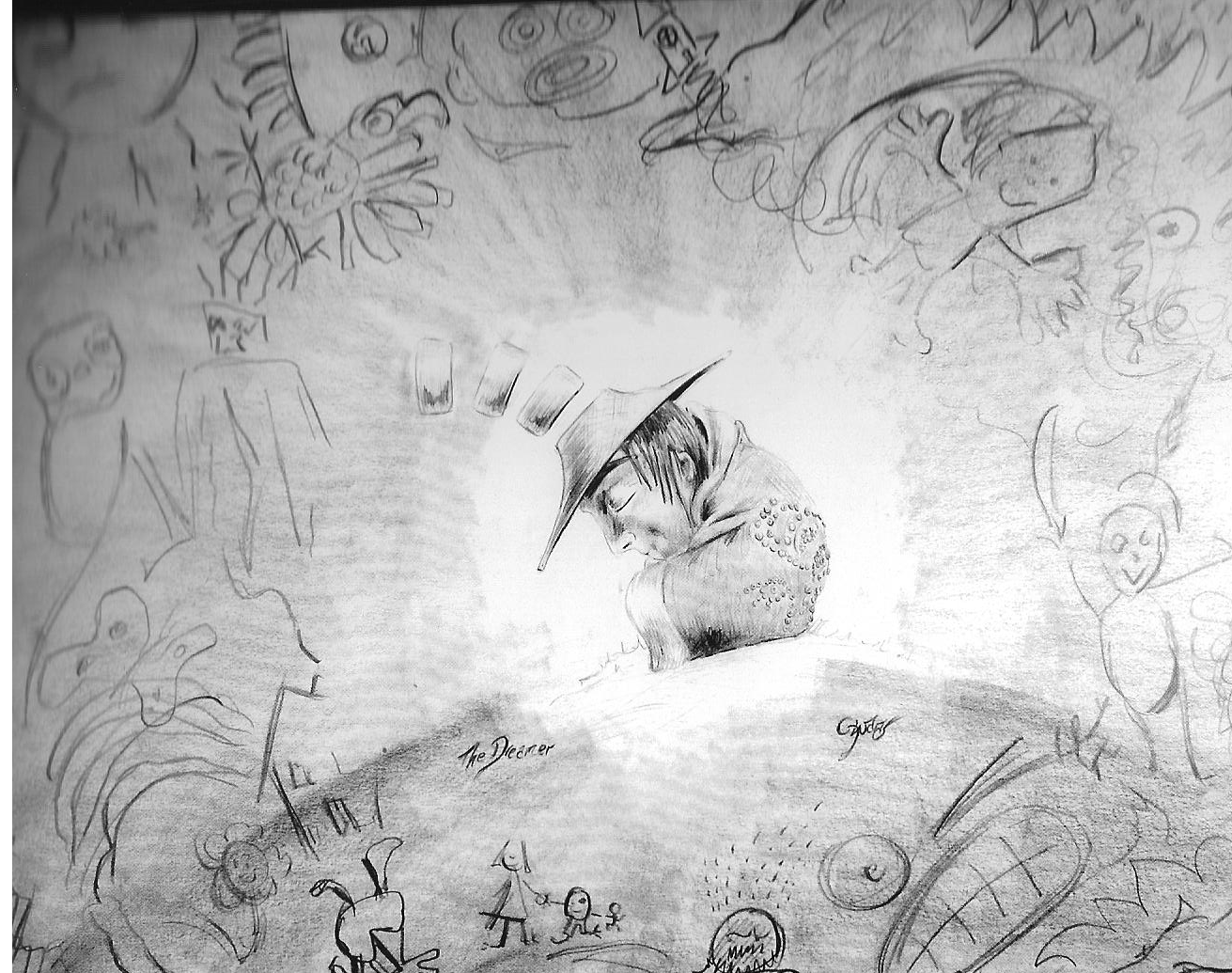
With this theme, the show’s catalog inevitably chooses “The Dreamer” as the piece on the cover. The piece is not only an obvious choice for the theme of the artistic process, but for Gwaai himself (to use the name with which he signs his work). The cartoon style is a reminder of his animation prototypes for teaching the Haida language, and the rings on the hat, a sign of high status in traditional culture an indication of the importance of art among the Haida today. At the same time, the doodles around the margin, as rough as they are, have a non-traditional look. Also, to anyone who has sat down with Gwaai for any length of time, they are a reminder of his constant doodling.

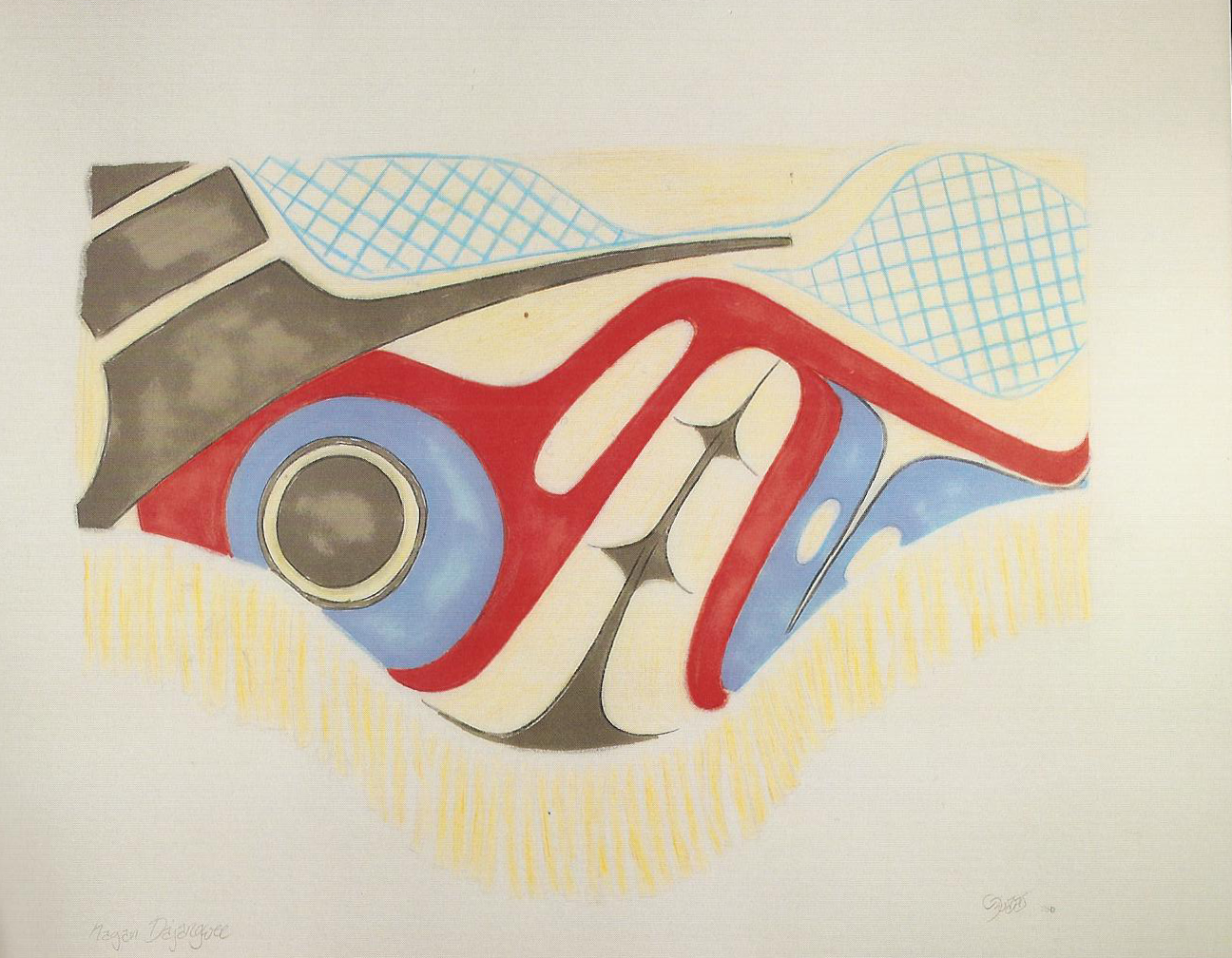
Other pieces in the show emphasize Gwaai’s different traditions and influences. Some, like “Kagan Dajangwee,” are slightly stiff exercises in the northern First Nations style, with their formline and cross hatching:

Others, like “Nanasimget,” a depiction of an Orpheus-like figure in Haida mythology, look like a two-dimensional rendering of a metal casting (and, perhaps not coincidentally, are reminiscent of some of the sketches of Bill Reid, Gwaai’s mentor when he was a teenager):

At the opposite extreme are more mainstream pieces. “Ts’aahl Girl” (Eagle Girl), for instance, combines realism with a touch of whimsy:


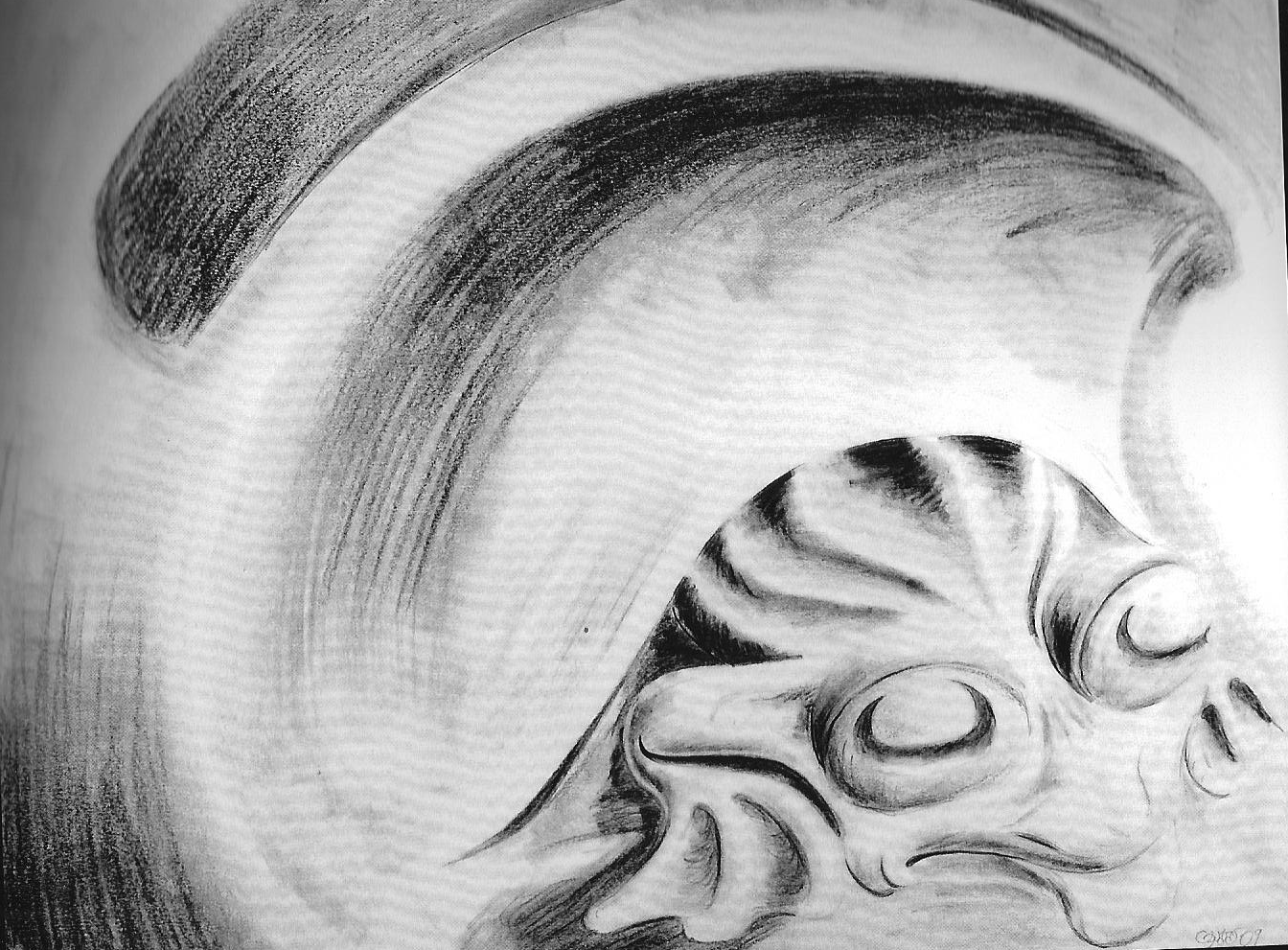
Similarly, the two studies of Gagiid, the Haida wildman whose lower face is pierced by the spines of the sea-urchins he is forced to eat after being castaway, bear a distinct resemblance to Gollum as portrayed by Andy Sirkis in The Lord of the Rings:

This movement between traditional Haida culture and urban industrial life – so effortless that it includes analogies – suggest the position of the modern First Nations artist. For those of us who have met him, it also seems very typical of Gwaai’s wide-ranging mind.

Some of the most interesting pieces in the show offer a glimpse of the creative process.For example, “Detail: The Two Brothers Pole” shows the precision-drafted plans for a pole that Gwaai recently completed with his brother Jaalen, and a view of the raised pole. The pole is located in Jasper National Park, and was a replacement for a repatriated pole that was appropriated from the Haida in 1907 and that is often attributed to Charles Edenshaw:

A more personal glimpse of the relation between sketches and other media is provided by “Sons of Djillaquon” and the gold pendant “Sons of Djillaquons:”

Both the sketch and the pendant are powerful works in their own right, but together they illustrate what is gained and lost in the transfer between media, as well as the limitations of each. It is this relationship that makes the oxymoron title of “Sounds Good on Paper” a suitable title for the exhibit.

Casual observers might be tempted to to describe “Sounds Good on Paper” as a minor show. And, in one sense, they would be right: most of what is displayed are not the pieces for which Gwaai has rightfully gained his growing reputation.

Yet such a view would also be short-sighted. More than anything else, “Sounds Good on Paper” is a very personal show. It displays many different aspects of Gwaai’s personality – probably not all –and offers a tantalizing hint or two of his creative process and his interest in different media.

My only regret is that the show couldn’t include some examples of Gwaai’s argillite prototypes for his jewellry. Placed beside the finished jewellry, these prototypes could have provided yet another perspective on the concerns of the show.

However, even without this touch, “Sounds Good on Paper” remains interesting both aesthetically and psychologically. It’s been a long time since I’ve seen an exhibit that shows so much of the artist without a hint of arrogance.

Asked the day after the opening what I thought of the exhibit, my first response was, “It’s very Gwaai.” Having had a few more days to think, I still that response the most accurate I could have given.

Read Full Post »

Haida/Tsimshian artist Mitch Adams seems to be making a career out of smaller pieces. Not that he avoids larger pieces; his “Blue Moon Mask” is one of my favorite pieces on the walls of my townhouse. However, in the last year or so, he has done masks from laminated blocks of wood about the height of my finger, a brass magnifier, a couple of combs, and, most recently, a briarwood pipe, filling a niche shared by few other artists. With a length of ten centimeters, his “Raven Rattle” is another of his miniatures – and one of my favorites among his work.

Contrary to what you might think, rattles of this size are not a recent development. Although modern tools makes carving at smaller sizes much easier, rattles the size of this one appear in artifacts of a century and a half ago. Some might have been used, concealed, in the magic and theatrics of the winter ceremonies. More likely (since the sound doesn’t carry far), small rattles might have been used by shamans, working up close with sick patients.

Aside from the obviously modern paint, Adam’s main innovation is his material – boxwood. The stand is a piece of driftwood, or (as I like to think of it), two-thirds the price of a Special Platter at The Afghan Horseman, where I last had dinner with Mitch and his wife Diana and took the rattle home with me. Unpainted, the base provides a contrast with the largely painted rattle. The rattle can be left on the base, in a position in which it resembles a rocket, or else lifted free and used, in which case it gives a delicate, half-hissing sound.

Like the size, the subject and composition is also traditional. The rattle depicts Raven the trickster, the face in his belly representing the light that he has stolen from the chief who hoarded it. On his back is a red human figure facing a raven’s head, their tongues intertwining to suggest communication, and a reminder of Raven’s ability to change from human to bird shape. You might also take the quasi-sexual posture of the two figures, as well as the round belly containing the face in the light of some of the details of the story: Raven has impregnated the chief’s daughter with himself to be reborn as the chief’s grandson, so he might have a chance to get close to the light.

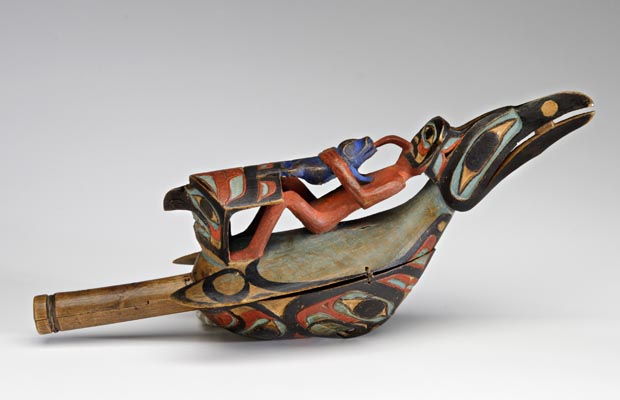
As for the composition, it, too, has a long tradition. For instance, just before writing this entry, I came across a picture of this two centuries-old Haida piece in the McCord Museum in Montreal:

The subject is different, but the composition similar, although Adam’s piece was never meant to rest on its bottom, and has a more streamlined look. With a few minutes’ research, I could easily turn up another two of three similarly arranged rattles.

None of these comments are meant to suggest in any way that Adams lacks originality. Rather, I’ve made them to point out that the rattle is a piece within a tradition. Its shape and intricate painting of details are more than enough to establish Adam’s ability – and to make me curious about what he will do next.

Read Full Post »

YVR, Vancouver’s airport, is noted for its collection of local First Nations art. I’ve wanted a tour for over a year, but they aren’t always easy to come by, since they involve weaving in and out of security areas. However, today my chance came at last. Together with Ann Cameron, the editor of Coastal Art Beat and my colleague on the YVR Art Foundation board, we followed Rita Beiks, the airport’s art consultant, back and forth through the terminal until I was throughly lost, but marveling at the airport’s collection.

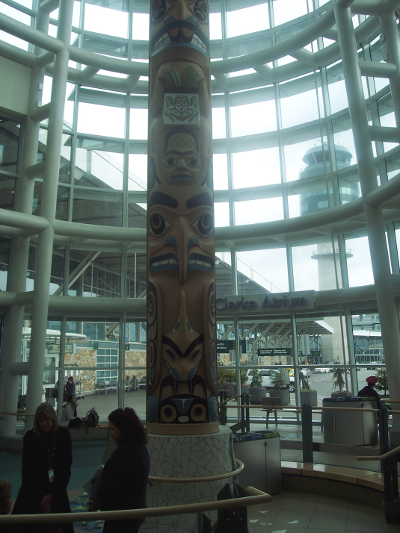
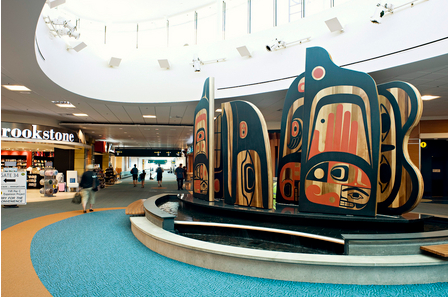
We met at the foot of Don Yeoman’s “Celebrating Flight,” a four-story pole that mixes Haida mythology with Celtic knotwork and a greeting in Chinese. The knotwork and Chineese characters, Rita said, replaced the originally planned figures because of some knots in the wood that made the figures impossible. By itself, the pole is impossible to photograph without a crane and bucket, but when you realize (as I had not) that everything from the panels representing the northern lights at the top to the mosaic on the floor and the moon some distance away are all part of the installation, then taking a complete picture becomes even more impossible.

From the pole, we walked to the terminal’s best-known installation: Bill Reid’s “Jade Canoe,” version of “The Spirit of Haida Gwaii.” The “Jade Canoe” is a copy of the “Black Canoe” at the Canadian embassy in Washington, D.C. However, while the “Black Canoe” is barely visible for security reasons, the “Jade Canoe” is so accessible that people have rubbed the bronze patina off the paddles and some of the other reachable parts of the sculpture. A sign telling people not to climb the sculpture is necessary, and the tradition has grown up that rubbing Mouse Woman’s nose is good luck.
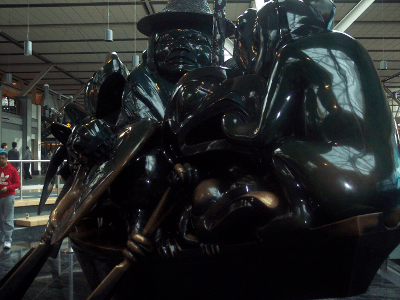
Rita gave a brief history of the negotiations for the piece, which cost three million – an unheard of figure for an airport to spend on art in the early 1990s, and mentioned that the piece was orginally intended to have a copper patina, and changed to bronze only after a phone call from airport official Frank O’Neil to Reid, who at the time was in intensive care. She also pointed out that Lutz Haufschild’s “The Great Wave Wall,” which replaces the nearby windows on the terminal, was chosen as a suitable backdrop to Reid’s iconic piece.

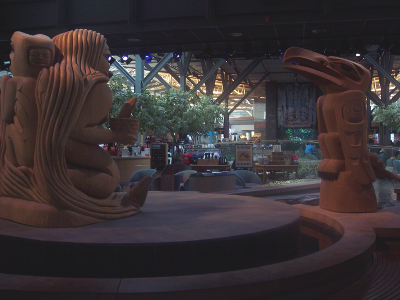
Leaning over the railing, we looked down at the arrival level to Nu-chu-nualth artist Joe David’s “Clayoquot Welcome Figures.” Originally carved for Expo 67, the figures are on permanent loan from the Vancouver museum. Their popularity is so great that they needed a railing to protect them; even so, money is still regularly found in their hands.
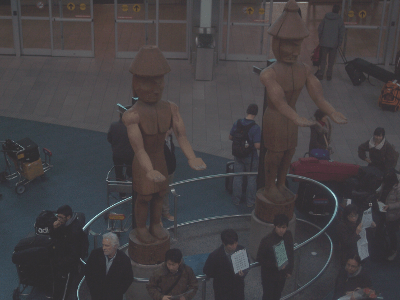
We then moved into the secure area for departure and arrivals. Strangely enough, Rita and Brenda Longland, the airport official with us, both had to submit to the usual inspection of their belongings, while Ann and I sailed through without any problems with our visitors’ badges.
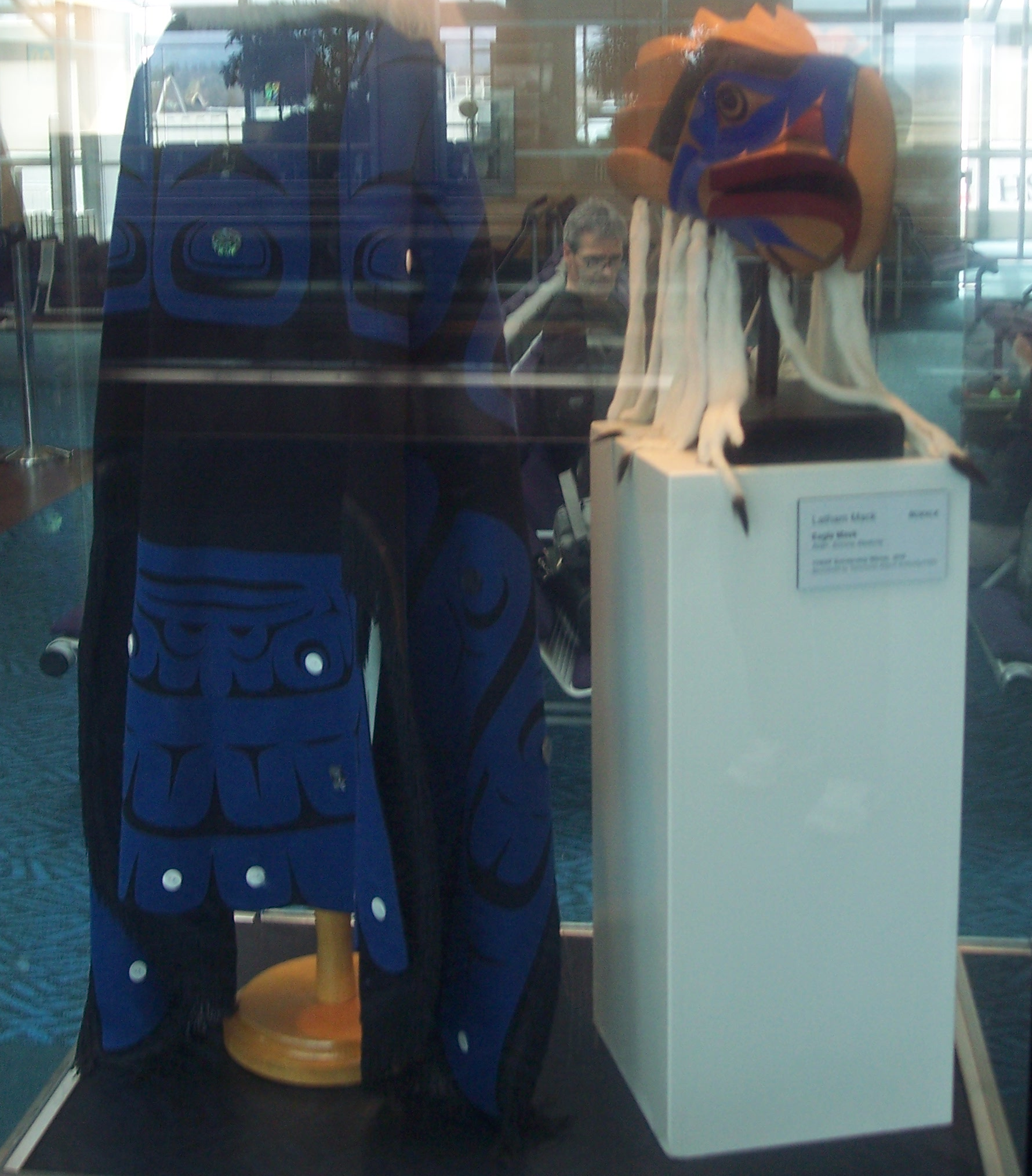
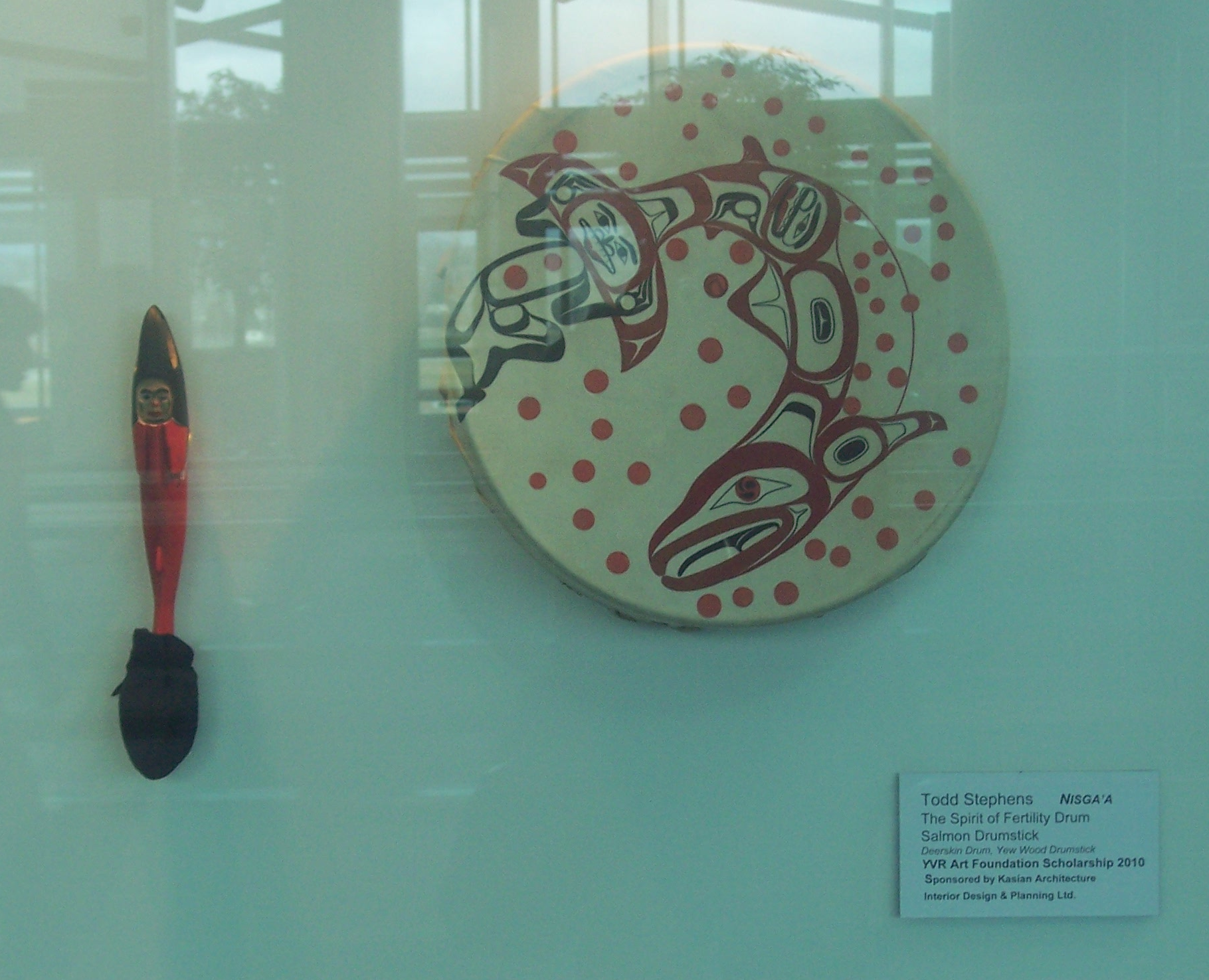
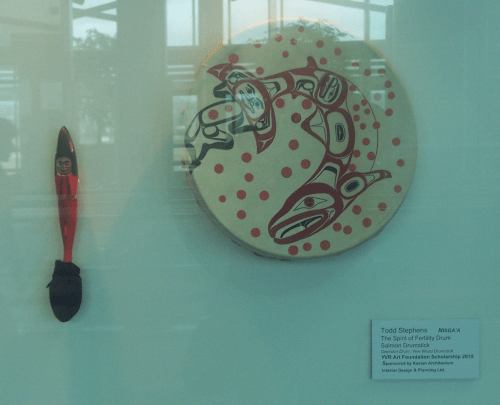
We passed display cases with the works of YVRAF scholarship winners from 2010, including Latham Mack’s Nuxalk mask and robe, and Todd Stephen’s drum. Like the other scholarship pieces scattered throughout the terminal, these pieces will be on display until June 2012, when they will be replaced by the work of the 2011 scholarship winners.

The next permanent display was the Pacific Passage in the arrivals area, a combination of diorama and original art.
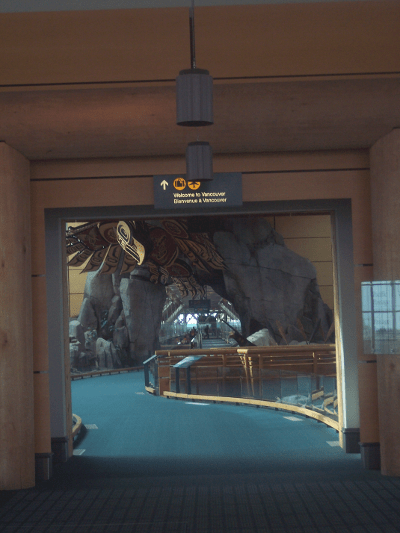
I had seen the Pacific Passage several times, but always after a long flight that left me rushing to the fresh air, and uninclined to give the art treasures on display more than a passing glance.
That was a mistake on my part, because the display is well worth lingering over. It is dominated by Connie Watt’s thunderbird.

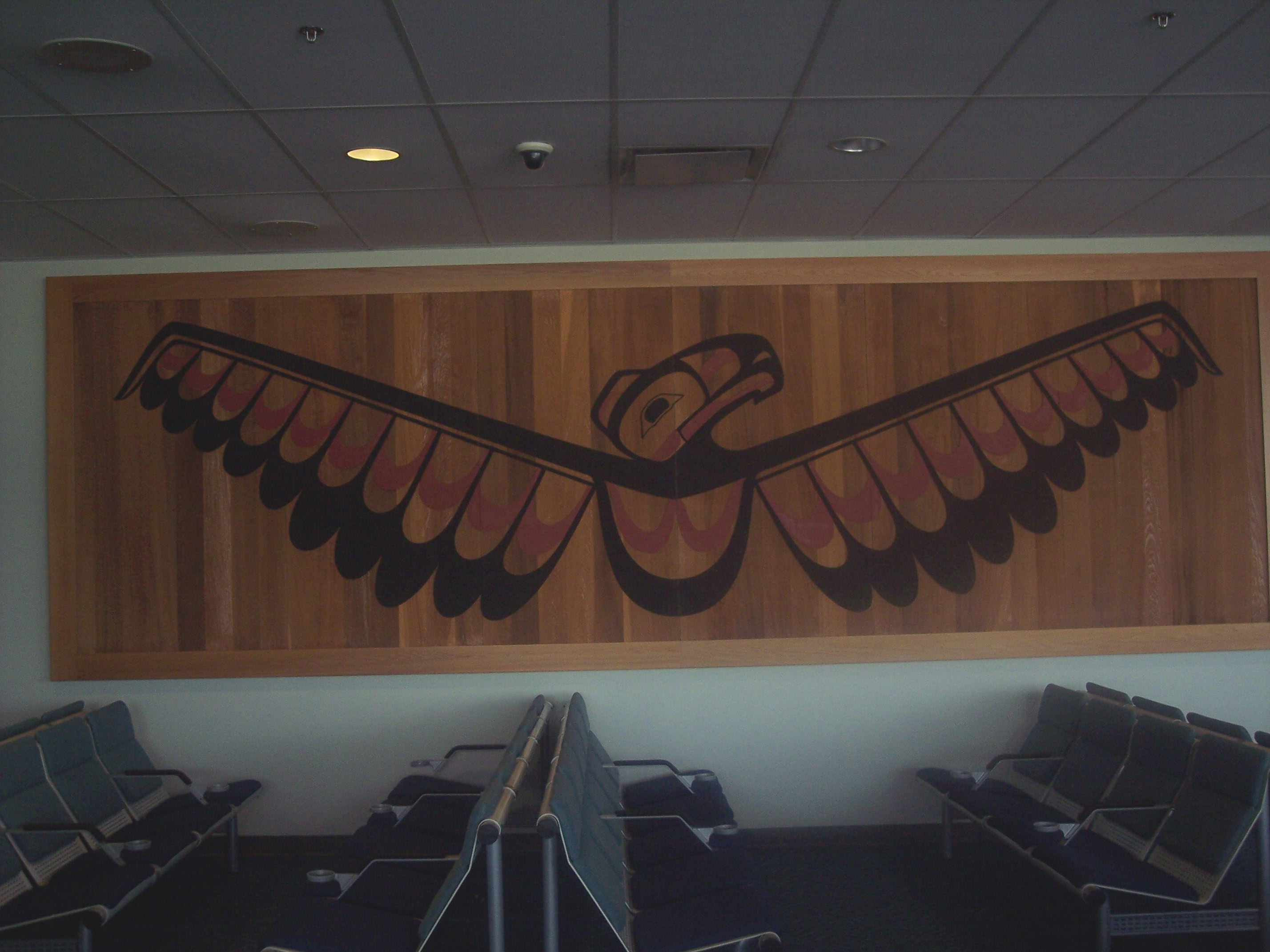
Also in the area is an aluminium panel by Lyle Wilson and a canoe by Tim Paul, as well a number of smaller pieces. Bird sounds start as soon as you enter the area, and I was amused to see the swallows who live in the terminal sheltering in the empty eagle’s nest that was added to the dioramas for realism.
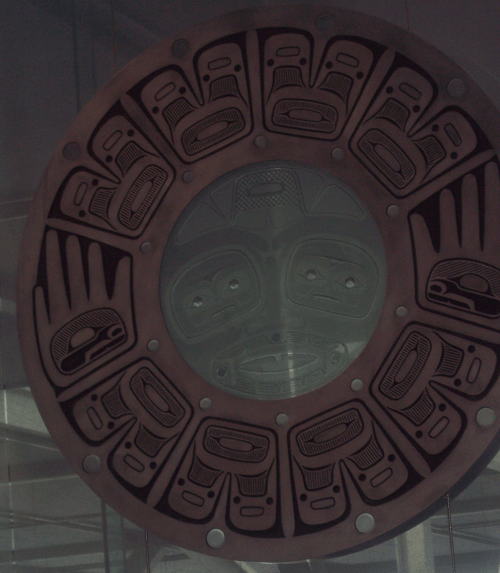
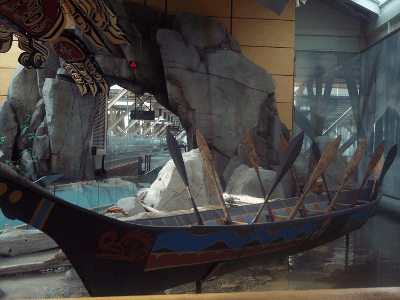
Walking down the overhead walkways, we stopped next at the Musqueam Welcome area, the contribution of the First Nations people on whose territory the airport stands. According to Rita, Frank O’Neill, the airport official responsible for the idea of the First Nations collection, was convinced of the need for the area when the Musqueam chief told him that not having the local nation included there would be like having a sign in Ireland saying, “Welcome to the United Kingdom.”

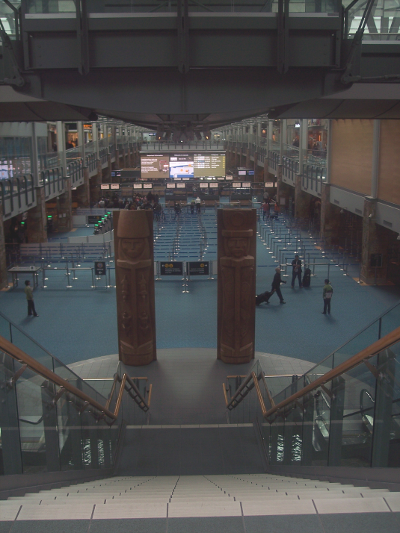
Accordingly, arrivals are greeted first by the Musqueam, and then by Canada. One of the first sites arrivals see is Susan Point’s giant spindle whorl set against a waterfall – an impressive site even if you have been flying all night (although the palms to each side are incongruous; can’t native plants be used instead?).
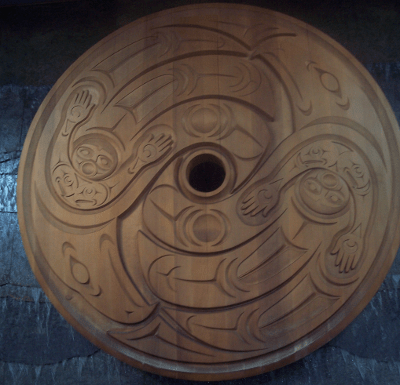
Turning to the stairs and escalators that lead down to the custom booths, the first thing arrivals see are free-hanging samples of Musqueam weaving.

Moving to the steps and escalators, below them arrivals see the Musqueam welcome figures. These were originally carved by Shane Point, but when Musqueam women complained about the sagging breasts on the female figure, it was replaced by the less controversial figure by Susan Point that stands there today.

Only as you descend do you appreciate the sheer size of the figures; by the time you are on the same level, you realize that they are enormous.

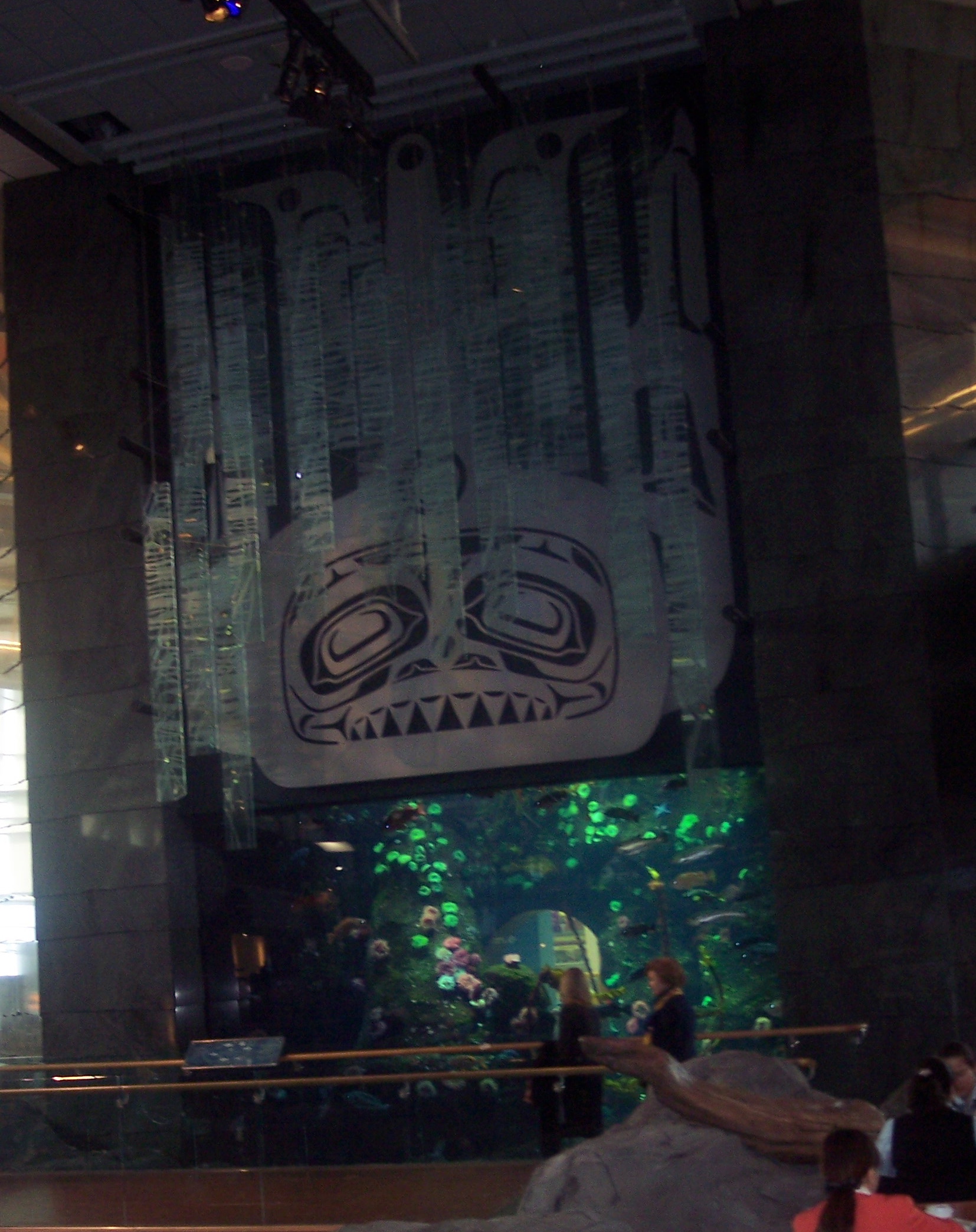
Our next stop was the artificial river that begins with an installation by Tahltan master carver Dempsey Bob, and winds down to an oceanic aquarium dominated by another piece by Haisla master Lyle Wilson.

Bob’s piece is “Fog Woman and Raven.” It is based on the tale of how Fog Woman, mistreated by her husband Raven, gathers up all the salmon from the streams and smoke houses, and prepares to depart the world with them. A little stiffer than many of Bob’s works, it is still a piece worth lingering over because of the details like the salmon caught in Fog Woman’s hair.

The figures are carved from laminated blocks of cedar – an expensive process that is rarely done because it involves shutting down a mill for the better part of a day. In fact, the first laminted block for Fog Woman was found to be punky inside, and had to be abandoned.

Bob’s tableau is surrounded by chairs, and would be a pleasant piece to linger beside, but, unfortunately no food vendors are nearby, so nobody does. Annoyingly, too, small merchandise displays are crowding the piece (we asked a cashier to move an obscuring sign, but it was back when we passed by again half an hour later)

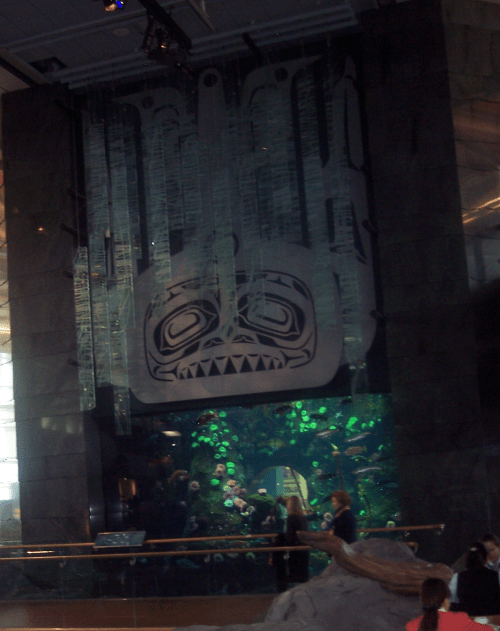
At the far end of the river, Lyle Wilson’s “Orca Chief and the Kelp Forest” rest on top of an aquarium of fish, so that the chief lies half hidden in the kelp made from glass and looks down at the subjects whom he protects. Rita says that few people look up, and reactions to Wilson’s piece proves her point, since most people looked at the fish moving back and forth, but few ever glanced up to see the art above them.
Our last major stops on the tour were two pieces by Steve Smith. The first, “Freedom to Move,” is a series of painted panels that are intended to slow people down in their hurry through the airport.

Unfortunately, the piece is squeezed into a space too small for it, and the pool that is supposed to surround it is dry, but Smith still managed to slow me down for an appreciative moment or two.

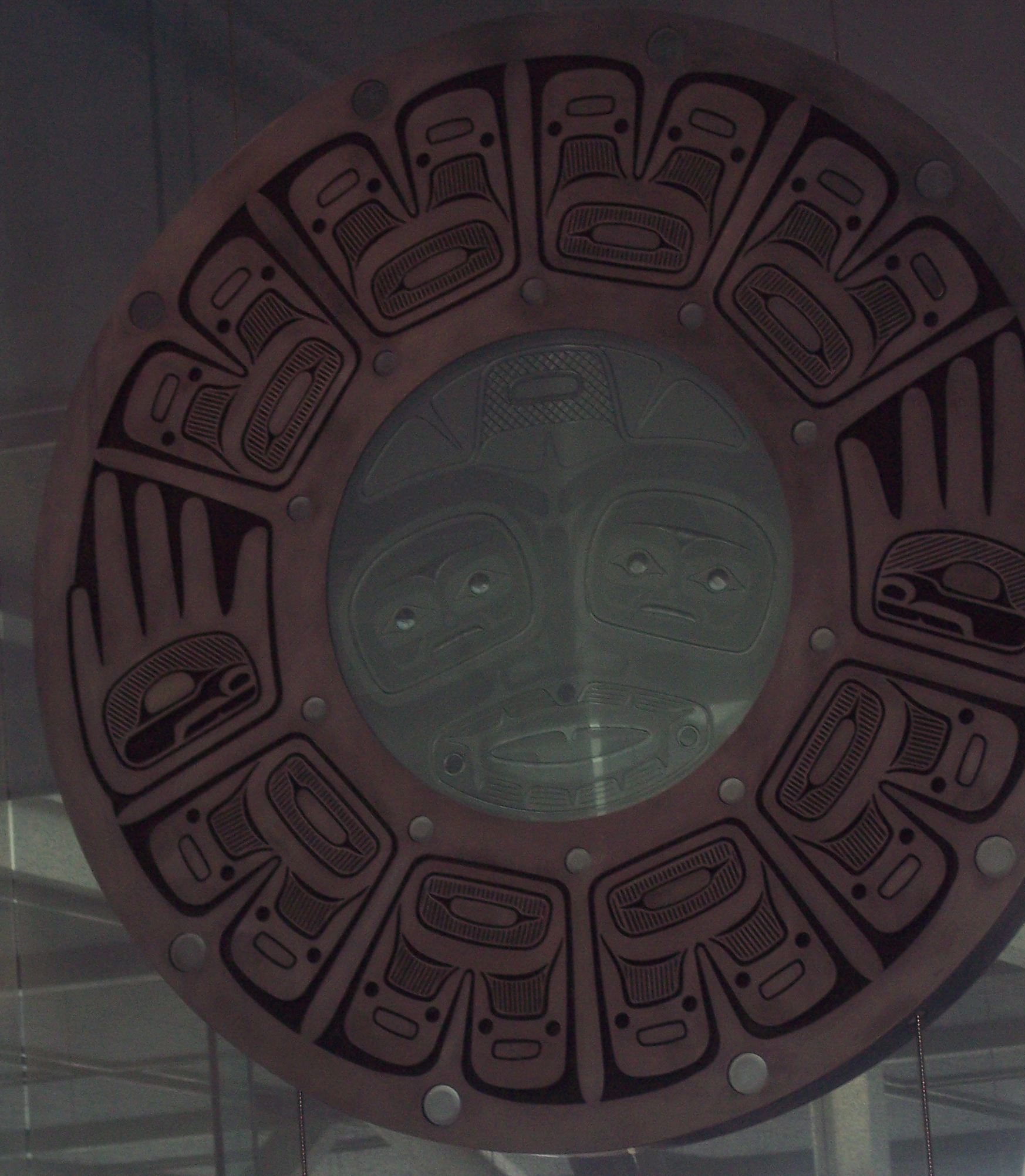
The second of Smith’s installations, “Sea to Sky,” named for the highway to Squamish and Whistler, is a series of drums hung beneath a sky light. What we saw was the second version of the piece, parts of the first having been damage by temperature problems, crumbling with a sound like artillery one winter day (fortunately without anyone being hurt. Smith took advantage of the incident to paint bolder designs, and sold what remained of the first version.

These are only some of the collection we saw today. There were also a number of pieces by Roy Henry Vickers that were originally part of a longhouse that has since been destroyed. The longhouse’s pillars and several other designs are now temporarily scattered throughout the airport, most of them unlabeled.
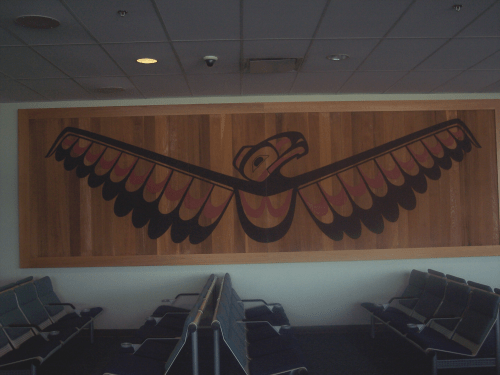
Display cases throughout the terminal also carried such treasures as Hazel Wilson’s famous “Golden Spruce” blanket, which commemorates the recent felling of a particular tree famous in Haida mythology, Tim Paul’s “ClearCut and Dressed,” and some outstanding non-native work by local artists such as Graham Smith. However, enumerating the entire collection would require a blog five times as long as this one.

For lack of time, we also didn’t get to the “Supernatural World” installation by Dempsey Bob, Robert Davidson, and Richard Hunt on the domestic arrivals level. And the only reason Susan Point’s “Cedar Connection” was included in the tour was that we passed it on the way to the Skytrain and the parking lot as we left.

Still, I didn’t feel cheated by any omissions. After four and a half hours, my brain was as numb as my kneecaps. I had taken in as much art as I could appreciate for the day, and rode the Skytrain home, full of the dazed content that comes from prolonged exposure to fine art.

Read Full Post »
Last year, I started the Northwest Coast Art Meetup Group. But the assistant organizer proved unreliable, and, I couldn’t afford renting meeting space in downtown Vancouver every month – a necessity, since I’m in the suburbs. Lacking support, I stepped down as organizer. But I regretted the failure, and was as pleased as I could possibly be when Stacey Jessiman. took over and announced a new meeting.

Last night, a half dozen of us met at Stacey’s house on the west side of Vancouver to hear Bill McClennan, a curator at the Museum of Anthropology, deliver a slide show on the recently-concluded Charles and Isabella Edenshaw exhibit. Meeting in her house helped to keep the atmosphere informal, and the expenses down.

Charles Edenshaw is generally considered the premier Nineteenthh Century Haida artist, and recently his wife Isabella has received the credit she deserves for spruce root weaving of baskets and hats, many of which were painted by her husband. The show at the Museum was an unprecedented bringing together of his silver work (although not, unfortunately, his argillite carving) and her surprisingly well-preserved weaving, and I had visited it twice in the last year.

Not that I objected to seeing slides of some of the pieces, many of which came from private collections or distant museums, and aren’t easy to see. Charles Edenshaw’s work, with its use of negative space, remains surprisingly modern, especially in its use of blank space – perhaps because he heavily influenced artists like Bill Reid and Robert Davidson. Similarly, I am intrigued by the thought that Isabella’s work has distinct knots and patterns that, to an expert, identifies it as hers.

In addition, Bill did a good job of putting the Edenshaws in context, showing surviving pictures of the houses where they lived, and even the general store on the banks of the Skeena where Charles Edenshaw sold his art while Isabella Edenshaw labored in the salmon canneries down the beach.

However, I was equally intrigued by Bill ‘s behind-the-scenes account of the exhibit. The Edenshaws’ descendants number in the hundreds, and perhaps a quarter attended a private viewing and celebration the night before the official opening.

For example, Bill relates that as the descendants entered the exhibit’s gallery, he was surprised to see that many left quickly. Apparently, some were concerned that the spirits connected to the pieces were upset by the chaos of the crowd, and only re-entered after elders performed a ceremony to calm the atmosphere.

Bill also explained that, at any exhibit, some pieces always receive more attention than others, and that he was curious to see what those pieces would be at this one. To his surprise, the main attraction was a blown-up photograph of Isabella Edenshaw. Although the Haida were forced to become patrilineal by English and Canadian society, matrilineal remnants are still strong among the Haida (so much so that some thought the patrilineal descendants shouldn’t be invited), so Isabella was of of more interest than Charles. Many, too, were interested in the Edenshaw’s four daughters for the same reason, and some had never seen pictures of their female ancestors.

In fact, interest was so strong that the pictures were carried out of the gallery into the main hall for the celebration. In the slides Bill showed, the pictures stand in the background, almost, as he said, as though Isabella and her daughters were waiting to speak or to enter the dance floor. For me, hearing about these personal touches helped me to recognize that the exhibit was not just an artistic event, but a cultural and familial one as well.

This information was delivered informally, with Bill propped against a cushion on the floor next to the projector, and the rest of us arranged on the furniture around the fire. It was an atmosphere that rented space could never have matched, even without the buffet of salad, bread, cheese, and drinks that Stacey prepared.

All in all, I’d call it a successful re-launch. I look forward to the next meetings (although I suggest they be potluck, so that everyone can enjoy them). Obviously, the meetup is now in much more capable hands than before.

Read Full Post »

Over the last few years, I’ve received four masks and three prints from Haisla artist John Wilson, as well as a bentwood box carved and painted by him. The masks in particular are among my favorites hanging in the townhouse, and show Wilson’s increasing expertise as an artist. My latest purchase from Wilson, “Blind Shaman in a Trance,” illustrates the level he’s reached – one that makes his work stand out among the artists who have established themselves in the last five years.

“Blind Shaman” depicts a common theme in historical Northwest Coast art, and one popular among many modern artists: a shaman going about his business as the mediator between different aspects of reality. A blind shaman was thought to be compensated for his lack of sight by greater inward vision, and this one has the additional support of frogs as spirit helpers. As creatures who change form as they grow, and as adults move freely between the water and the land, frogs are especially suitable as helpers, because they embody exactly the freedom of movement between planes of existence that the shaman tries to develop. Unsurprisingly, the placement of spirit helpers like mice or frogs on the cheeks and forehead are a common feature in shamanistic masks in the northern tradition, particularly among the Tlingit.

Like much of the work that Wilson has done this year, “Blind Shaman” is more complex than the portrait masks that comprise the bulk of his work. Although his past work shows that a face alone can be interesting, “Blind Shaman adds additional figures, making for a more complex composition, even before painting. In fact, in some ways, a picture of the mask in progress that Wilson posted on Facebook is more interesting than the final version, because the lack of paint emphasizes the carving more, as well as the shadows it creates.

However, the mask has an effect when painted that it could never have when unpainted. By rising to the top of the nose, the blue triangle that covers the lower face allows an easy reversal of figure and ground. At first glance, the mask appears to be a face surrounded by frogs, all much smaller than the face. But if you focus on the mouth of the figure on the forehead, then suddenly the frogs on the cheeks look like hands, and a much larger figure is looming over the shaman’s face, consisting of mostly uncarved wood. Focus again, and the mask appears in its original form. This reversal emphasizes the fact that the shaman’s trance involves him opening up to forces larger than himself, perhaps even inviting possession.

From either perspective, “Blind Shaman in a Trance” is an arresting piece of work. I look forward to seeing what Wilson does next – and, meanwhile, this latest mask is a welcome addition to one wall of my bedroom.

Read Full Post »

Kelly Robinson is a new artist of mixed Nuxalk and Nu-chu-nualth ancestry. His silver jewelry is starting to become a regular feature of Vancouver galleries, and in the last year he has begun carving masks in both his traditions. However, he tells me that his first medium was painting, and, to judge from “Mother of Mischief,” it remains one that he is deeply interested in developing.

“Mother of Mischief” is done in the Nuxalk style, and is the first art in that tradition that I have bought. Geographically located between the northern nations such as the Haida and the Tsimshian and the central Kwakwaka’wakw, the Nuxalk culture has been comparatively overlooked and has had little written about it – so much so that an artist of another nation spent most of an afternoon trying to figure out how to carve the eyes of a Nuxalk mask with Robinson.

However, from what I have been able to learn from first and second hand sources, the Nuxalk tradition might be called loosely-rendered formline. By that I mean that it shares many of the individual elements of the northern formline, such as the ovoids and U shapes, but follows more informal rules about their positioning. Nor, on the whole, are Nuxalk designs as intricate as any of those in the northern tradition. Instead, Nuxalk designs have a bold simplicity that give them a strong visual appeal, especially when shown at large sizes.

Another characteristic of Nuxalk art appears to be a wider variation of colors than in the northern formline traditions. While northern formline favors black for the primary formline and red for the secondary, only occasionally reversing the color scheme or adding a third color, the Nuxalk palette seems broader, with greater use of blue and green, as in Kwakwaka’wakw work.

From this brief description, you can see why “Mother of Mischief” seems to me to be rooted firmly in the Nuxalk tradition. Centering on a Raven hen and her offspring ,at three feet by three feet, the painting has all the boldness of the best Nuxalk work, with three realms of existence – the land, water, and sky – depicted by rectangles of different blues.

Once you see realize the organization, the picture falls into place, with the middle blue strip representing the water where the salmon swim and the sun positioned both in the sky and, because of its reflection, in the water as well. On the land is a salmon or salmon roe that that the mother has found (for, contrary to common belief, ravens are not just scavengers; they can fish and hunt as well as other birds, but often carrion makes for an easier meal).

At the same time, the painting has a surprisingly modern feel to it. Parts, such as the ovoid at the top of the mother’s wing resembles the simple outlines of a sports logo, in particular, the old hockey stick logo of the Vancouver Canucks, a team that I happen to know that Robinson follows. Other parts of the design, such as the bent wing tips and the reduction of the mother’s body to a single tapering line, are reminiscent of late period Bill Reid.

Nor, do I think that a traditional design would be so strongly asymmetrical, or depict the raven fledgling as mirroring the mother’s positioning and design, with minor differences. Maybe you would have to be familiar with birds to notice, but, to me, the fledgling’s bare beginnings of a curved beak suggests immaturity.

Similarly, the lack of an oval in the eye or a visible tongue between the upper and lower beak suggests that the fledgling doesn’t share the mother’s watchfulness. Instead, it seems to be looking fixedly at the salmon on the shore, ready to waddle after it without worrying about the possibility of danger.

Robinson may be a newcomer, but”Mother of Mischief”shows that he is already an artist to reckon with. I’ve hung it over the largest couch in the living room, and, sooner or later, I expect it to be joined by either another of Robinson’s paintings, or perhaps one of his masks.

Read Full Post »

As a general rule, I never buy Northwest Coast Art depicting butterflies. But when I was in Terrace last April, I made an exception for Nigel Fox’s “Butterflies #3.”

The reason for my rule is that butterflies (and hummingbirds, for that matter) are among the most popular designs for tourist pieces. You rarely see them depicted in more serious artistic works. I believe that there used to be a Butterfly family crest among the Haida, and there are still Hummingbird crests among several of the northern First Nations, but today, these designs are often trite and blatantly designed to appeal to tourists. Often, they show a degree of cuteness unlike any other designs.

I’ve joked that these designs are the Hello Kitty of Northwest Coast Art. But the northern First Nations, as I understand things, are even more scathing: satirically, they call butterflies and hummingbirds the white people’s crests.

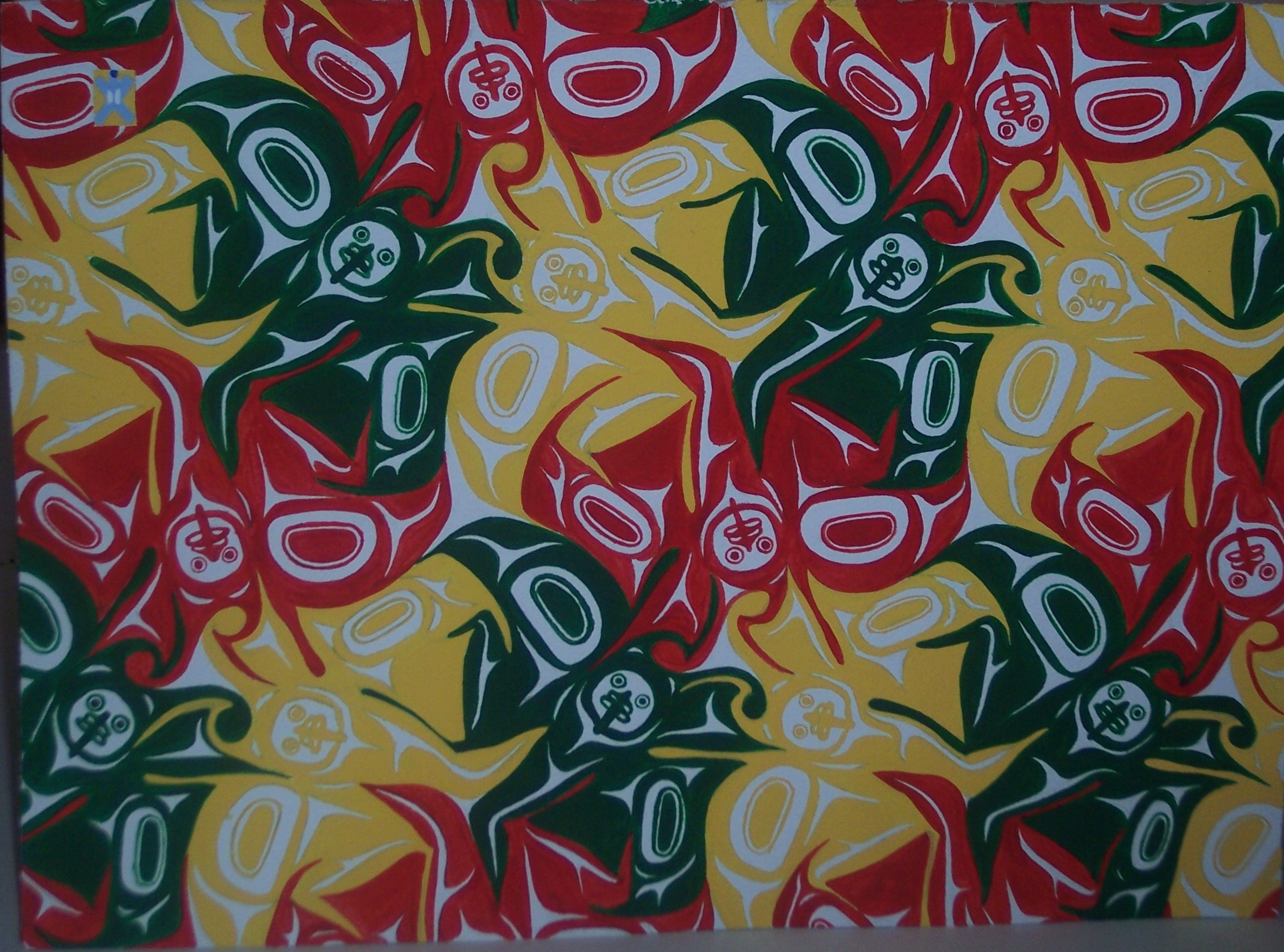
However, Nigel Fox, a student now in his second year at the Freda Diesing School, has a different take on butterflies. In his blog, he writes about “Butterflies #3,” the third in a series of paintings featuring butterflies, “The piece is about teamwork and is part of a series that I am exploring on the theme of respect, especially among peers, even among “outsiders” or butterflies. Within many northwest coast native cultures, there are crests that are usually animals, that represent families or bloodlines. The butterfly crest is reserved for people who are not part of a nation by blood.”

Fox goes on to explain that his work is about harmony and teamwork.

I’m not sure if he is missing the satiric intent, but it is hard to argue with his results. Fox has a separate career as a painter mostly in the Canadian Impressionist style, and in his butterfly studies, he has combined traditional designs with patterns inspired by the surrealism of M. C. Escher.

Like Escher’s work, “Butterflies #3” has a constant shifting of figure and ground. At the same time, the shape of the butterflies’ wings, with their ovoids and elongated T-shapes continually suggest other shapes, such as the beaks of ravens. By combining his interests in mainstream and Northwest Coast Art, Fox has created a series of paintings unlike anything anyone else is doing, and I look forward to seeing how his work matures in the next few years.

Meanwhile, his butterfly series is a promising start.

Read Full Post »
Shawn Patrick Aster’s “Raven Turns the Crows Black” has a longer history than most of the art in my townhouse. Aster took over two years to deliver it, but I consider it well worth the wait.

Aster’s work was brought to my attention by another artist in late 2008, as someone whose work was admired even by master carver Dempsey Bob. I immediately commissioned a piece from him, wanting an early piece from an already skilled artist who seemed sure to make a name for himself.

A few months later in April 2009, when I attended my first year end exhibition for the Freda Diesing School, I was amused to see that others gave Aster’s work no special attention – until he won two awards. Moments later, all his work in the show had sold.

But the commission had progressed little. Aster seemed nervous (I believe it was his first commission outside his family and friends) and couldn’t satisfy himself with the design. A month later, I bought “Raven Heart” from him, but I was still waiting for the commission.

By the next year end exhibition, Aster was looking distinctly apologetic when he saw me. Jokingly, I started referring to him as “the most promising artist” I knew, since he had promised the piece for over sixteen months – although I made clear that I was more than willing to wait. Secretly, though, I had decided he was unlikely ever to deliver. I was disappointed, although I bought other pieces from him.

Then, last March, Aster told me on Facebook that he had finally completed the design. It had apparently changed since he first started designing it, but I was happy to see it. I paid indirectly at the 2011 year end exhibition, and it was delivered by Aster’s fellow Freda Diesing graduate Todd Stephens at the YVR Art Foundation’s reception in May – a good deal of which I spent showing the piece to others and worrying that food might be spilled on it.

“Raven Turns the Crows Black” depicts an episode from the Haida epic “Raven Traveling,” a work that  many now consider the common heritage property of all First Nations people on the northwest coast. In the story, Raven the Trickster sees crows roasting a salmon on the beach. They agree to share the food, and Raven falls asleep while he waits for it to cook.

Unwilling to share, the crows devour the salmon. Belatedly worried at what Raven’s reaction is going to be, they put crumbs of the salmon meat on his clothes and between his teeth. When he wakes, they try to convince him that he ate before he slept, but Raven in his anger throw them into the fire, from which the survivors emerge forever singed and black.

Aster’s rendering of the story makes for a unusual design in what is already a tradition apart. Shared by several northwest coast nations but possibly Tsimshian in origin, the Chilkat style is based on weaving patterns. The style is constrained by the limits of weaving, so it tends to consist of discrete blocks of design, rather than the flowing formline found in painting and carving. This tendency makes it both geometric and highly abstract.

Aster’s design shows Raven in the center, his teeth bared (and if you ask why Raven has teeth, I can only reply, why does the parrot in Aladdin? Although, probably, Raven was in human form in the story, shape-changing being his most common power). I interpret the design as showing Raven in two states: in the middle, hungry and asleep, with his wings folded, and at the top center, angry and awake with his wings outstretched.

On the left are the white crows, on the right the black; like the raven, their wings and other features are abstracted into blocks of forms. The designs on each side are not quite symmetrical, with only the outlines of the heads to suggest the transformation in the story.

The background includes the characteristic Chilkat blue and yellow. However, to suggest the fire – and, perhaps, the salmon meat and Raven’s anger – Aster adds red to his design. Although I am far from an expert in Chilkat design, I have never seen any other Chilkat design use red. However, Aster’s innovation succeeds, largely because the red is relatively dark and sparingly used.

The result is one of the most bold-looking pieces of art in my collection. And while I admit that I grew impatient while waiting, I’d gladly wait another twenty-eight months for another work that is equally striking.

Read Full Post »
I’m at the point where I tremble when Gary Minaker Russ comes to town. I know that he will have at least one outstanding piece of argillite to sell, and that if I so much as glimpse it, I will be unable to resist the temptation to buy it, even if I can’t really afford to. That’s the story, really, of “Haida Shaman,” the latest piece I’ve bought from him.

When Russ first brought it to town, he sold it to the Inuit Gallery, where I admired it regularly. But no one bought it, and Russ prefers not to have his work languish for too long in a gallery. So he swopped it for his latest piece, and when we met at the Rhizome Cafe that afternoon, he hadn’t resold it.

A quick trip across the street to the bank machine, and it was mine, the balance to be paid  over the next month. One nervous Skytrain trip later, I had it beside my computer workstation.

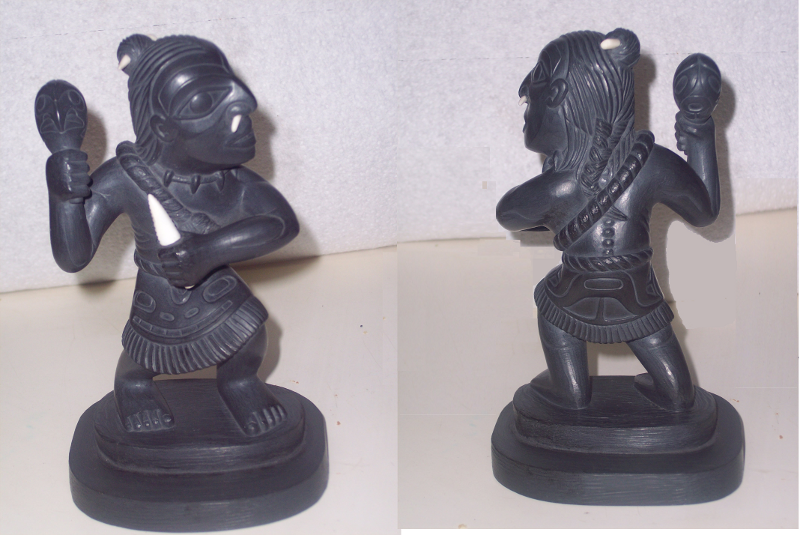
“Haida Shaman” is a traditional piece. I mean that description in two senses, both complimentary. First, the pose is one that has been widely used throughout the hundred and eighty years of recorded argillite carving (as opposed to the unknown amount of time – decades? centuries? millennia? — that argillite may have been carved far more rarely, before it became one of the first cultural exports for the Haida).

The proportions, with the head a third of the body height, and the stance, one arm uplifted and the other in front of the chest, can be seen in any number of pictures, if you search libraries or even the Internet for pictures of argillite. So, in one sense, Russ is working in a very set subject, in much the same way a Renaissance European painter would be when painting a Madonna and child.

What you won’t see – at least today – is this pose done in the amount of detail that Russ has lavished on “Haida Shaman.” You’ll see the basic proportion and posture, yes, but not the detail. Most modern argillite carving is closer to engraving. It is covered with embellishments of inlaid precious and semi-precious stones, with the shapes hinted at rather than fully developed.

In several  pieces, the result is so abstract that only the posture is recognizable and there is little else to indicate that a shaman is depicted. The modern argillite market does not reward taking pains, and, in too many cases, the quality of the carving has declined while the cost of the raw materials have sent the prices soaring.

By contrast, “Haida Shaman” shows the attention to detail that I associate more with nineteenth century argillite pieces. Russ himself describes it as being more in his original – and preferred – style, and not the simpler style he has moved towards in the last decade and a half in order to make a living as an artist in an increasingly obscure art form.

This is the second sense in which the piece is traditional – in the pure sense of craft that has gone into it. For a style that is only partly representational, “Haida Shaman” packs an extraordinary amount of detail. Some of it may be hard to see in a picture, but the carving is full of realistic detail like the definition of the muscles on the arms, or the braiding of the rope the shaman wears, or the mass of hair in his topknot. I joke that the sculpture is a “traditional Haida action figure,” but behind that rather flippant comment, there is nothing but respect for the care that has gone into it.

These details are enhanced by the sparing use of ivory to contrast with the darkness of the argillite. Unlike many modern argillite carvers, Russ has not produced a gaudy piece, valued largely for its inlays. Nor has he added so many inlays before starting to carve that they get in the way of the detailing. Instead, the ivory appears where it doesn’t hide or overwhelm the details. It is used sparingly, with a restraint that allows it to work with the argillite, rather than against it.

You might say that “Haida Shaman” is an artist’s piece, done to satisfy Russ’ sense of how he should be working, with little regard for what sells. I am not in the least surprised that it didn’t sell while on display because, amid the other argillite extravaganzas available in the local galleries, “Haida Shaman” is an understated piece, with an emphasis on the craft of carving.

It’s because of pieces like “Haida Shaman” that I secretly look forward to Russ’ visits to town, not knowing what wonders he will quietly unwrap to tempt me with. I only know that most of what he brings to town will be wonders, and I will be tempted to bring at least one of them home.

Now, if I only didn’t have to explain that I wasn’t buying from a drug dealer when I deposit large sums of cash in his account, I would have nothing to complain about. I am both soothed and honoured to have pieces like “Haida Shaman” in my townhouse.

Read Full Post »
In the fall of 2010, Tshimshian artist Morgan Green set out to raise the money for her tuition in goldsmithing. In return for my donation, she agreed to do a small wall-hanging. Near the end of April, 2011, she delivered “Raven and the Grouse” to me downtown, considerably brightening up an otherwise dismal evening for me.

The story is one of the lesser-known Tsimshian stories of Raven – or Txamsem, as he was known to the Tsimshian. In fact, Green had never heard the story, despite the fact that she probably has a stronger background in traditional culture than most First Nations artists in their mid to late twenties. My only source for it is the two-volume reprint of Tsimshian Narratives by Marius Barbeau, William Beynon, John J. Cove, and George F. Macdonald. There, it is listed as “Raven and the Grouse Prince,” and as being told to Beynon by Emma Wright of the village of Gitlaxdamks in 1954.

One of the things I like about the story (apart from the fact that is not the worn story of Raven stealing the light) is the glimpse of traditional life that it gives:

Txamsem was very hungry and could not catch any more salmon as these had all left with the salmon women. He left his little canoe and went into the forest to see if he could get any game. As he went into the woods he saw a large house ahead of him. He went to it and looking in saw that there was a man and his wife with many small children. He saw there was food in the house and he was very hungry.

Seeing three ravens in a tree he immediately called them, “One of you will pretend to be my wife and the other two will be our children.” He transformed these ravens to human form. They approached the house of the Prince of Grouse. When they were near the house, the Grouse Prince saw the man and woman with their two children approaching, so he called to them, “Come my friends, come and rest in my house.” Leading the way he led Txamsem and his raven wife and children to the rear of the house. “Bring food for my guests who are tired,” he called to his servants. Then he made a place for his guests to rest and sleep.

The Grouse Prince began to make a great many arrows which he piled by his sleeping place. He arose very early and was not gone for long when he returned with the carcasses of many mountain goat. Txamsem still pretended he was very tired and was resting all the time. He go up when the Grouse Prince went out with all his arrows and followed behind him.

After traveling some distance into the woods the prince came to a high steep bare rock mountain. It was impossible to climb this, so the prince took his arrows and shot three from his bow. When he had shot all his arrows, he called out, “Come great Supernatural One, come to the aid of the arrows you gave me.” Almost immediately a man appeared and waved his spear up at the mountain and at once a great many mountain goat came falling off the steep sides of the high cliff. These the prince took down to his house.

Txamsem had seen all this and had returned to the house. He asked the prince, “Do you go every day to hunt?” “No,” the prince replied, “tomorrow I shall rest and prepare all the meat I have got.” Txamsem said, “I will go tomorrow as I feel rested now.” He made a large number of arrows and next day he set off early to go to the cliff where he had followed the Grouse Prince.

When he got there, he shot off the arrows as he had seen the prince do and these went into the high precipice and then he called out, “Help my arrows O supernatural One.” As he said this a man stepped in front of him. “Whose arrows do you shoot?” Txamsem was at a loss and did not know the right answer. So he replied, “These are my arrows, Supernatural One.”

With that the walls of the precipice fell down and Txamsem became buried under them. His raven wife flew away as did the two raven children. Txamsem nearly died and was ill for a long while. He finally recovered and went down to where the grouse Prince’s house stood, but behold! It was gone. Then he went to where he had left his little canoe and being very hungry he set out traveling on down the river, in search of food.
(Note: I have changed the paragraphing for easier reading)

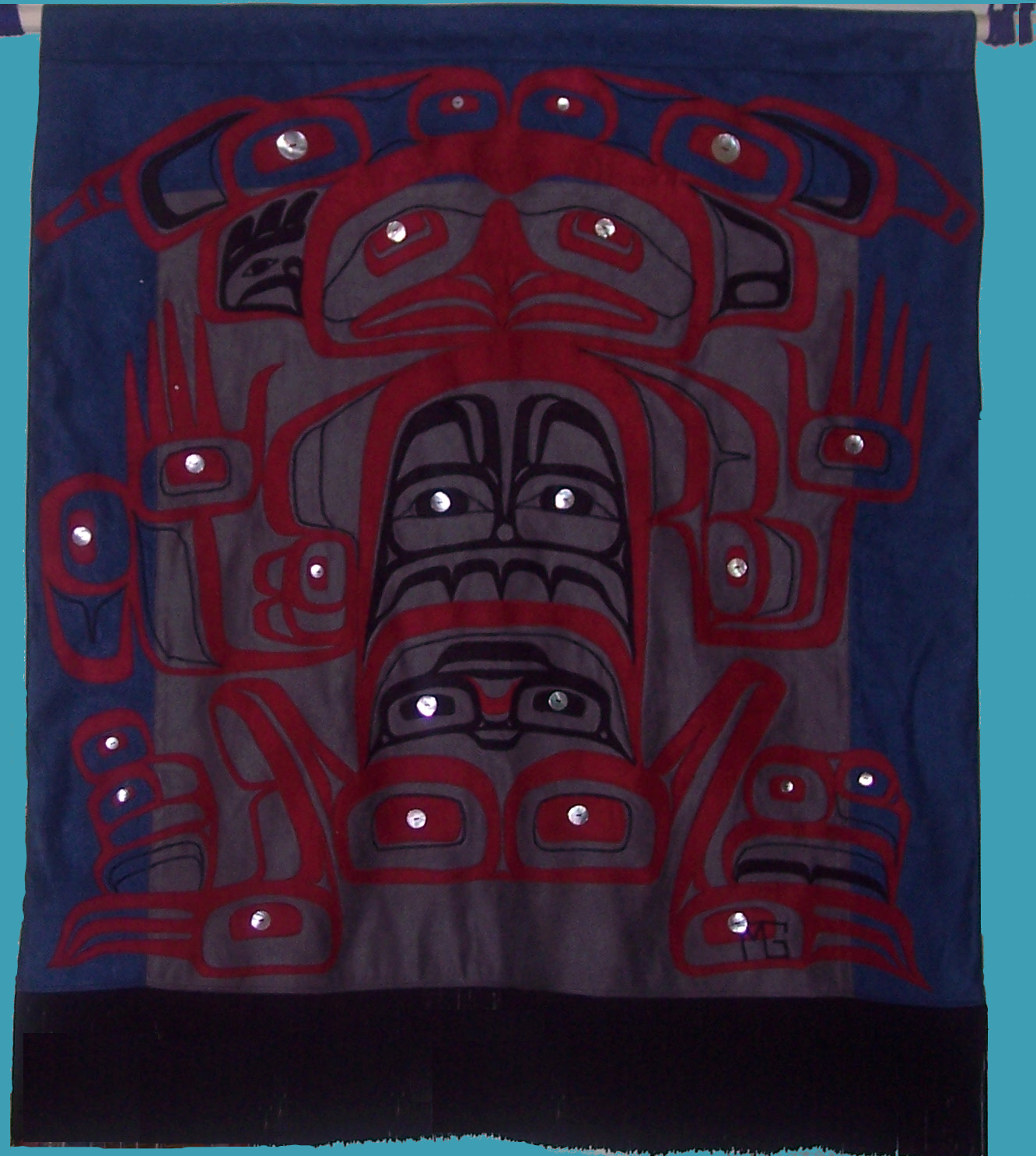
Green’s design is based on a picture of a historical house front. She has used that starting point to show Raven about to buried beneath the falling rock of the precipice. Inside Raven’s body, some of the goats are shown. The gray in the background, perhaps, might be taken as the silhouette of the Grouse Prince’s house in the distance.

What the photo cannot show is the care with which the applique has been sown on to the heavy background fabric. The stitches must number in the tens of thousands – reason enough for Green to take six months to complete the hanging, even if she wasn’t going to school and creating other pieces at the same time.

Green is a multi-talented artist, who restlessly explores different media, as the ceramic Mouse Woman platter shows that we bought a couple of years ago. But her first and most accomplished work, I’ve always felt, lies in fabric, which is one reason why I requested “Raven and the Grouse.”

I’ve hung the finished piece above my headboard, where it hides a wallpaper mural from the 1970s that one of these days has got to go. With the curtain drawn, the hanging has a somber impressiveness, with the buttons catching whatever lights I have on. During the day, with the indirect light from the window, the red outline of Raven becomes more noticeable, but the effect is no less impressive.

Read Full Post »
« Newer Posts - Older Posts »