Feeds:
Posts
Comments

Archive for the ‘journalism’ Category

Ron Telek, the Nisga’a carver, can always be counted on for the unexpected – anything from the disturbingly haunting to the eerily beautiful, and in every form imaginable. I’ve even seen a shaman marionette by him. Our latest acquisition, “Transformation Rattle: Eagle to Wolf” is no exception. Only a handful of other Northwest Coast artists could take a utilitarian object like a rattle and turn it into a sculpture while keeping it functional.whole-small

One of the characteristics I’m starting to associate with Telek’s pieces is an unusual degree of three-dimensional awareness in the design. Like many of his pieces, “Transformation Rattle” is impossible to capture fully with a single photo. I took five pictures for our records, and I’m not sure that I shouldn’t have taken a sixth to cover it fully.

The rattle consists of two parts: The rattle, which is the eagle, and the rattle’s base, a lean-looking wolf with a curved tail and, around its neck, a garland of cedar boughs. The rattle rests inside the tail, and can be removed from it. At first glance, you are lucky to notice that it’s a functional rattle. Your first clue is the leather wrapped around the bird’s tail as a hand grip, but even that could simply be part of the surreal sculpture.

The rattle depicts the transformation perhaps two-thirds of the way through. On the right side, the bird’s features are depicted fully, but the left side of the body is mostly blank, with the features indicated by a few indentations, and the wing by the grain of the wood.

smooth-side-eagle-small

Its feet, too, are gone, absorbed into the wolf. Perhaps to indicate the transformation’s incompleteness, the bird’s wing is wrapped around its rounded stomach, as though it is pregnant with itself.

finished-side-eagle-small

The wolf is more complete, but its lack of claws and teeth or fully-formed rear legs shows that it, too, is an unfinished figure. wolf-small

Its thinness and slightly rough carving, especially in the comparison with the eagle further suggests the wolf’s incompleteness – and, perhaps, the energy expended to make the transformation.

The fact that the two figures are the same is suggested by the spirit in the middle of the eagle’s right wing and atop the wolf’s head. Furthermore, the wolf’s garland of cedar suggests that this is not a born wolf, but a human – no doubt a shaman – going through these transformations. Supporting this idea is the much larger, more human-looking spirit erupting from the wolf’s back, as well as the fact that, if you look closely, the rear legs are more human than wolf-like.wolf-front-small
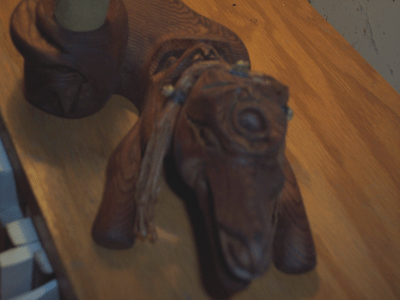
All this complexity is heightened by Telek’s characteristic attention to the direction of the grain. An employee at the Art of Man Gallery in Victoria told me last week that Telek often carves down until he finds the grain he wants, and, looking at “Transformation Rattle,” I have no trouble believing it. Although both the rattle and its base is carved from a single piece of red cedar (and stop and think about the difficulty of that for a moment), the carving is literally never against the grain. Even on the wolf’s curving tail, the grain moves with the sculpture. And, on the eagle, the round pattern of the grain not only suggests the bird’s body, but creates a semi-abstract form as simple as it is beautiful.

The overall result is a contrast with the tall, rounded shape of the eagle, and the ground-hugging, angular shape of the wolf. It’s an accomplished piece of work, which I’ve place on top the shelves on my computer desk, where I can look up at it periodically, or even take the rattle out for a shake if I feel like it. We’re seriously thinking of mounting it on a lazy susan, so that it can be viewed in its entirety more easily. Meanwhile, I’ve already switched its position around several times in the day since we brought it home so I can admire another aspect of it.

Read Full Post »

As a journalist, I don’t often come straight out and endorse anything. Having worked as a marketer, I have had a strong reaction against hype of any sort, including my own. Nor is endorsement my style. Anyway, just by writing on an issue, I can often do far more by encouraging others to support it than I could if I were to volunteer time or money. However, every once in a while, a cause comes along that is so obvious worthy that I make an exception.

Take, for example, the Free Software Foundation’s high-priority list. How anyone who is the least interested in free and open source software (FOSS) could not support this cause is almost inexplicable to me.

As you may know, the Free Software Foundation (FSF) and thousands of other groups have been working for years to create a computer environment that users control – one that they can use on as many computers as they want, that doesn’t require registration or activation, and doesn’t report on your activities to the manufacturer without your permission. That environment is almost there, in the form of GNU/Linux and a few other operating systems like FreeBSD. Only a few gaps such as an unecumbered Flash player and 3-D drivers for the leading video cards remain to be done, and they should be ready in a matter of a few years.

The high priority list is a way to call attention to these last remaining gaps in functionality. A couple of weeks ago, the FSF relaunched it as a campaign, soliciting donations to help in the development of the needed applications. These donations will not be used to pay developers directly, but may be used for such purposes as organizing face to face developer sprints to help the projects developing the applications, or to make people aware of the need.

The donations were kicked off by Russell Ossendryver of Worldlabel.com, whom I like to think of as a friend I haven’t met yet. Russell is a small business owner, but believes in free and open source software enough that he has pledged $10,000 to the high priority list.

You can argue over which applications are needed most, and about the content of the list (and the FSF encourages you to submit your thoughts). Very likely, you can’t match Russell’s donation (I can’t myself).

But if you have any interest whatsoever in FOSS, the high-priority list is a matter of getting down to basics. What could be more basic than finishing the free desktop? That’s been the goal all along – not our present 90% free and 10% doing without or compromising with proprietary software for the sake of expediency, but a completely user-controlled desktop. Anyone involved with FOSS who doesn’t donate what they can, or at least join the discussion about what should be on the list should ask some serious questions to themselves about their own sincerity.

With support, the FSF’s relaunching of the high priority list could be one of the major moments in FOSS. What more can I say, except to repeat my request to support it?

And before you ask, yes, I plan to sync my money with my mouth and send my own small cheque before the end of the year. Like I said, this is one time that my usual words in public aren’t enough.

Read Full Post »

Much to my bemusement, I see that James Maguire has listed this blog as one of the top 200 technology blogs, in the GNU/Linux/ Free and Open Source category.

James is my editor at Datamation, who shows amazing toleration for my inability to edit my own work, so I already know him for a decent sort. So, I figure he just needed to round out the spaces he had allotted for the category. Not that I don’t appreciate the honor, but I can see myself clearly enough to know that I don’t deserve it.

For one thing, look at the company I’m keeping. My entries here certainly aren’t a match for the varied articles at Linux.com, which is also on the list. Nor do they come close to the combination of astute legal analysis and wonky opinion on Groklaw. As for equating my efforts here with the industry analysis in the blogs of Mark Shuttleworth, Jim Zemlin, or Matt Assay – no way, man, as we used to say in my increasingly distant youth. I mean, I didn’t call this blog “Off the Wall” at random, you know what I mean?

What is really ironic is that, when I started this blog, I intended it as a place where I could write about things other than free and open source software. At the very most, it would be a sandbox for ideas that weren’t ready to be articles, or ones that I didn’t think I could sell. Nor do I often write on such topics, although I have plenty to say about my life as a journalist who covers such topics.

Yet, if I’m being honest, I have to admit that, when I do cover free and open source topics directly, the posts attract an entire order of magnitude more readers than my other topics. And I mean that literally, without any exaggeration whatsoever. So, maybe James is right, and this is a technology blog after all.

Anyway, I was taught that, if someone pays you a compliment, you say thanks and smile warmly – especially if the compliment isn’t true. So, that’s exactly what I’m going to do, figuratively speaking.

Read Full Post »

Why are mainstream journalists so threatened by blogging? The question is starting to nag me, because the response is so widespread – and based, I believe, on some key misunderstandings.

The strongest recent expression of mainstream journalists’ discomfort is from Christie Blatchford of The Globe and Mail. A few weeks ago, she used her report from the Olympic Games as an attack on blogging. Blogging, she says, is “the unofficial end to journalism as I know it.” Claiming that she is not complaining just because she is a Luddite, she says that she objects to blogging because she only has so many stories in her, and she doesn’t want to fritter them away. More importantly, she feels that blogging will diminish the craft of journalism, because blog entries and reader comments open up an unfiltered conversation.

I have a certain amount of sympathy for Blatchford’s view. Frankly, I find many people who are famous for blogging a pretentious waste of time. However, the term “blogging” covers so many different types of writing – everything from a teenager’s angst-ridden diary of her love life to columns by both semi-professional and professional journalists – that I can’t accept her catch-all condemnation. So far as I can see, when Blatchford talks about blogging, she is referring to any sort of writing published online.

In other words, when she says it’s not just because she’s a Luddite, I have the feeling that, yes, it is because she is a Luddite. She sounds worried that the ability to write something publishable is debased by the Internet, but, mostly, what I hear in her complaints is the cry of the middle-aged, bemoaning the fact that the world has changed.

Mostly, I find her fears groundless. Yes, online-publication – whether you call the result a blog, a column, or an article – is now open to everyone. However, the ability to write a piece that someone will pay to publish remains the dividing line between the professional and the amateur. Expertise – to say nothing of the ability to make deadlines — still matters, and, so far as I can see, always will.

The fact is, writing remains writing, regardless of the medium. The ability to choose worthwhile topics, to research and express them, are not diminished by the Internet. They are still rare skills that people respect and will pay for accordingly. If anything, suck skills stand out all the more in the new tidal waves of illiterate and self-indulgent prose.

As the old signature tag used to say, it was once thought that an infinite number of monkeys on an infinite number of typewriters would eventually write the complete works of Shakespeare. Now, thanks to the Internet, we know that isn’t true.

Admittedly, the ease with which readers respond online does create a new relationship with writers. And this relation is scary, and takes some getting used to, because readers assume an absolute egalitariansm with the writer, and do not automatically respect the writer. A professional online writer has to learn the give and take of such a relationship, and learn when – and when not to – take its demands seriously.

Much more so that the traditional print journalist, the online writer has to develop careful filters for reader commentary, knowing that much of it is worthless and that conflicting opinions often cancel each other out, yet remaining open to the small percentage of valid criticism. They have to learn not to take abuse seriously, nor praise either. Online writers also need to budget their time, to ensure that they do not lose too much time in endless debates with readers (my personal rule is to respond no more than twice to any except in exceptional circumstances).

But, if all the increased commentary gets irksome at times, online writers can at least take comfort in the fact that people are reading. They may be misunderstanding, taking thoughts out of context, and using your ideas as a starting point for their own rants, but they are reading. And, in the case of online publications, the audience can consist of millions rather than the tens of thousands for traditional journalists – figures that any writer is sure to appreciate.

I am equally dubious about Blatchford’s concern about running out of stories. Journalists don’t concoct stories out of pure imagination; they respond to the events on their beat. In my experience, the problem is not finding a topic, but deciding which one most deserves coverage or is most interesting to you or your readers. And deadlines, I find, are a marvelous antidote for writer’s block. Would Blatchford, I wonder, have the same concern about the number of columns she has left in her?

However, Blatchford has been a professional journalist much longer than I have, so I can’t completely discount the possibility that I won’t have the same concern when I have her experience.

Apparently, I am on the other side of the digital divided from Blatchford, even though I am probably not that far from her age. My own journalistic career is almost entirely online, except for a handful of print articles each year, and the conditions that Blatchford seems to fear are simply normal working conditions to me. But it seems to me that the worries of Blatchford and other traditional journalists are nothing more than a fear of change, and mostly groundless. Change happens, but most of it is far less revolutionary than the claims of its supporters.

Read Full Post »

“Keeping the old game alive” is the name of a chapter in Gwynne Dyer’s book War. In the chapter, Dyer discusses those who, in this age of mass destruction, are responsible for old-fashioned military interests like the infantry. I’m not sure whether Dyer intended the title to be sarcastic, but for me it has always suggested that the effort was futile and irrelevant, and that those involved in it were in denial of this fact. However, that is the implication that I’ve meant as I’ve started to apply the phrase to all sorts of other situations.

For example: Traditional newspapers are concerned that the Internet has overtaken them and eroded their reader bases. However, instead of analyzing their practices or considering how they might make themselves more appealing to readers, many journalists and newspaper managers take refuge in pride. They may not be as quick off the mark as online journalists, they say, but they provide deeper, more thoughtful analysis. They are better trained than online journalists, and somehow more legitimate.
Behind the scenes, they may be frantically trying to imitate online news (something they can never altogether manage to do), but the image they present to the world is that of the respected Fifth Estate, the spiritual heirs of Ed Murrow or Joseph Addison. In other words, they have retreated part way into fantasy, pretending that nothing has changed since the heyday of the newspaper and they are still leading figures, keeping the old game alive by being in strenuous denial.

Similarly, voter apathy seems at an all-time high in Canada. Participation in elections has plummeted to 55% or less, where it was 20-30% higher less than two decades ago. Even a new party such as the Greens is unable to interest many people, even among the young, who are the most disaffected. Other parties remain within a few percentage points of where they were at the last election, apparently because nobody is following political events closely enough to react – or, perhaps, because people consider all politicians from any party to be interchangeably corrupt.

A sane reaction to this situation would be to change the way you do politics. Some forthrightness, a principled stand, maybe a cause or two might all work wonders, assuming they were genuine and consistent.

But instead, all the Canadian parties prefer to keep the old game alive, attacking each with ritual savagery in Parliament and accusing each other of chicanery as if they still have the support of the electorate. Politics becomes a formal ritual, in much the same way that a verbal war with people swearing and shouting at each other in the House of Commons becomes officially recorded as “Some Honorable Members: Oh, oh!” And, in this case, the more artificial that elected politicians’ behavior becomes, the more disenchanted the public becomes, and the fewer people are watching the government and opposition to help to keep the corruption down.

Really, keeping the old game alive is a form of double-think – the holding of two contrary ideas at the same time. On some level, those who keep the old game alive are very aware that the importance of what they are doing is decreasing. They may even discuss the problem and suggest solutions for it. But, at the same time, their behavior is a denial that any such problem exists.

That, no doubt, is why they often sound so hysterical as they play the old game. The contradiction in their attitudes is easy to detect, and they have to insist that nothing has changed in order to go on at all.

It all seems a lot of effort to me compared to looking for solutions. Yet I suppose that, in some ways, keeping the old game alive is more comforting, contradictions and all, than seeing the world for what it is – especially if you’re middle-aged and realizing that the standards that existed when you were in your twenties no longer apply.

Read Full Post »

When I was a boy, I imagined that one day I might become so skilled as a writer that I would silence all the critics. I was very young, and, of course naive. But I can’t help remembering that dream now that I am a writer and have made some permanent enemies as a result of my modest success.

Even now, I’m close enough to the dreaming boy whom I once was that the word “enemy” sounds melodramatic, even paranoid. Yet what other word can I apply to people who imagine that I am always writing about them, and who spend an inordinate amount of time not only bad-mouthing me, but writing abusive posts and emails to repudiate my opinions? “Critic” or “detractor” might do, but neither word suggests the fury or the personal rancor of these people. So I suppose “enemy” will have to do.

Still, no matter what word I use, the idea of having enemies bemuses me. I seem to be such a poor hater that I have trouble imagining dislike in others. And, to be honest, when I first became aware of the fact, I was taken by surprise. Until about a year ago, I had had a gentle reception as a journalist. Very little of the attacks that other free software journalists have endured had come my way, and never from steady, identifiable sources. So I hardly knew how to react to the situation.

However, over the last six months, I’ve developed a habit of ignoring them. I won’t mention them by name in public, nor respond to their comments. In fact, I very rarely read anything they write, regardless of whether it’s about me or not; with all the intelligent and informative material about free software on the web, why should I waste my time? Most of what I hear about them comes in passing second hand references, or from reading a link on a portal site.

Yet, almost despite myself, I can’t help learning a little about my enemies. For example, I can’t help noticing that none of them seem to be contributors to any free software projects. Moreover, the other people whom they attack (my enemies being very far from discriminating) are among the leaders of the community, and hard workers as well, even if I often don’t share their opinions or think their energies misplaced. So, while I would rather not be among those my enemies focus upon, I suppose their attention is a wry compliment to my articles. After all, if I was completely unsuccessful in expressing myself or providing unusual or thoughtful arguments, then they probably wouldn’t bother with me.

But, even more importantly, when I do come across the writing of my enemies – regardless of whether it’s about me or some other straw man of the day – I’m starting to find that they help define me in a negative way. Just as, in the 1970s being on Richard Nixon’s enemy list was a sign that you were an effective social activist, so being a target of these kinds of people helps me to define the sort of person and writer that I want to be – in essence, everything that is the opposite of them.

For starters, I have no wish for prolonged flame wars. I might toss off an angry reply, or even a second one, but, after that, I can’t sustain the emotion. There are so many more interesting ways to spend my time that I quickly lose interest.

For another, while most of my writing about free software is advocacy journalism in the sense that, by choosing my specialty, I am implying that the subject is worthy of attention, I have no interest in attack journalism (I suppose that comes from getting enough sleep and not being wired on coffee all the time). I can disagree with a person or a corporate policy very well without any need to denounce explicitly. In the end, I would much rather stand for something than against something.

Anyway, if I present the facts accurately enough, I don’t need to condemn – if someone or something is unpleasant, the fact will come through without me belaboring the point.

Even more importantly, while I wince at typos and factual errors, taking them as proof of my own carelessness, I am far more concerned about logical errors. I don’t believe that, just because you find a tenuous connection to Microsoft that you have proved a conspiracy, or that simply because one event follows another that the first caused the second. I try very hard to keep an open mind as I research a story, which is why I usually can’t say the perspective I am taking until shortly before I start to write. I believe that quotes and other evidence needs to be taken in context, not jammed anywhichway into my existing beliefs as if I were some remote descendant of Procrustes. You don’t arrive at the truth by over-simplification or jumping to conclusions; you get there by acknowledging as much of the complexity as you possibly can.

But perhaps the biggest difference between my enemies and me is that I don’t think that my writing is all about me. When I sit down to write, my goal is cover the topic thoroughly, and support any opinions I state so that they are plausible to a fair-minded person. However, I rarely write to justify myself when I’m reporting on free software, nor do I expect everyone to agree with me. In fact, those who disagree with me often force me into a more nuanced and therefore more accurate view of the subject. In the end, my goal is to send off a finished article with what Balzac called “clean hands and composure” — by which I mean the knowledge that, given my material and time restraints, I have done the best job of expressing my point that I could.

Sometimes, I wish my enemies would find another target and leave me alone. Increasingly, though, I find myself accepting the fact that they are not going away in a hurry, even thinking that they are useful to me. For all the annoyance they provoke, they are examples of the sort of person and writer that I do not wish to be. So long as I act in the exact opposite way that they do, I can continue to be a person with whom I can live.

Read Full Post »

In the last few days, I’ve had several experiences that make me think about my role as a journalist in the free and open source software community:

The first was a reaction I had from someone I requested some answers from. Although I thought I was being polite, what I got back was an attack: “I am not prepared to answer any of these questions at this time. The intent of your article is to feed the flames and I will have no part in that. The fact that people like you like to stir up controversy is to be expected, since that is the job of any writer trying to get readers.”

This reply not only seemed presumptuously prescient, since I hadn’t written the article, or even decided what angle it would take, but also unjustifiably venomous, given that I didn’t know the person. Moreover, although I am in some ways a contrarian, in that I believe that questioning the accepted wisdom is always a useful exercise, when I write, I am far more interested in learning enough to come to a supported conclusion or to cover an interesting subject than I am in stirring up controversy for its own sake. The fact that an editor believes that a topic will get a lot of page hits is meaningful to me mainly because the belief sets me loose to write a story that interests me.

Still, I don’t blame my correspondent. He probably had his reasons for his outburst, even though they didn’t have much to do with me. But the fact that someone could react that way says some unpleasant things about some current practioners of free software journalism — things that alarm me.

Another was the discovery of the Linux Hater’s Blog (no, I won’t link to it and give it easy page hits; if you want to find it, do the work yourself). I don’t think I’ve ever come across a more mean-spirited and needlessly vicious blog, and I hope I never do. However, recently as I’ve been preparing stories, I’ve come across some commenters on individual mailing lists who were equally abusive. They are all examples, not only of what I never want my work to be, but the sort of writing that makes me scrutinize my own work to ensure that it doesn’t resemble them in anyway whatsoever.

Journalism that stirs up hate or encourages paranoia — or even journalism whose focus is sensationalism — is journalism played with the net down, and I’m not interested in it. Oh, I might make the occasional crack, being only human, or use the time-honoured tactic of saying something outrageous then qualifying it into a more reasonable statement. But, mostly, I prefer to work for my page hits.

Such sites also suggest that the line between blogging and journalism is sometimes being blurred in ways that aren’t very complimentary to bloggers. While some bloggers can deliver professional commentary, and do it faster than traditional media, others seem to be bringing a new level of nihilism to journalism.

A third is the unexpected death of Joe Barr, my colleague at Linux.com. Joe, better known as warthawg or MtJB (“Mister the Joe Bar,” a story he liked to tell against himself) encouraged me with his kindness when I was first becoming a full-time journalist. Later, when I started writing commentaries, his editorials were an indicator for me of what could be done in that genre. As I adjust to the idea that Joe isn’t around any more, I’m also thinking about how I’ve developed over the last few years.

The final link was a long interview – almost twice my normal time – with Aaron Seigo, one of the best-known figures in the KDE desktop project. One of the many twists and turns in our conversation was the role of journalism in free and open source software (FOSS). As Seigo sees things, FOSS journalists are advocate journalists, acting as intermediaries between FOSS projects and the larger community of users. He wasn’t suggesting that FOSS journalists are fan-boys, loyally supporting the Cause and suppressing doubts; nothing in his comments suggested that. But he was pointing out that FOSS journalists are an essential part of the community. In fact, much of what he said echoed my own half-formed sentiments.

Seigo also discussed how a small number of people making a lot of noise can easily deceive journalists who are trying to be fair and balanced by making the journalists think that the noisily-expressed beliefs are held by more people than they actually are. As he points out, the American Right has been very successful in this tactic, especially through talk-radio. He worried that part of the recent user revolt against KDE 4 might be due to something similar.

Listening to him, I tried to decide if I had fallen for this ploy in the past. I decided that I might have been, although usually I try not just to be thorough, but also analytical enough to sift down to the truth.

I was going to try to summarize what I had learned from these four separate experiences, but my efforts to do so only sounded sententious – to say nothing of self-important and over-simplified. But I’m thought of all four as I’ve exercised recently, and I’ll be thinking of them for some time to come, too.

Read Full Post »

On Canada Day, I had planned to be at a picnic at the Barnet Marine Park. However, when I came in from my morning run, a message from a publicist was on my business line. Would I be interested in a story?

Does a parrot love millet stalks? Suddenly, my plans for the day changed.

There’s something about a breaking news story that I can’t resist.

I wasn’t always that way. Several years, when I first started working as a journalist, I much preferred feature stories, although I didn’t know what they were called. With a non-timely story (as I called them to myself), I could take the time to get the facts right, and choose the details to use carefully – maybe even set each one aside a day or two before submitting it so I could reconsider the wording and structure in the cold, rational light of second thoughts.

By contrast, news stories terrified me. Writing for a largely North American audience, I am at a natural disadvantage compared to writers on the east coast, who are awake and working three hours before I am. The idea of rushing to finish a story in a few hours, especially with my time zone handicap, seemed rash. Undoubtedly, I would make a mistake.

But that was before I had tried writing a breaking story, and before I had made at least my share of mistakes. Now, the challenge exhilarates me.

In fact, a large part of the appeal lies in the challenges. In the space of a few hours, I have to decide who to interview, talk to them and transcribe the results, then produce some sort of coherent story. I’ve learned a lot of tricks of the trade in learning how to cram all these tasks into as little time as possible.

I’ve also learned to work through my fears, ignoring the little inner voice that is constantly yammering that I’m not going to finish in time – and that, too, is a form of challenge. Douglas Adams can joke all he want about the sound of deadlines whooshing over his head as they zoom by, but meeting a deadline – especially an impossibly close one – can be a measure of skill and a source of accomplishment, so long as you don’t have to manage the miracle four or five times a day.
Moreover, the flip side of urgency is a feeling of accomplishment when you’re done. And if you’ve beaten the other three or four writers on your beat and posted your story before they have posted theirs, then the accomplishment feels even greater. You’ve proven your ability to come through in a crisis.

Never mind that the portal sites will link to other stories on the subject as readily as to yours, or that the wisps of glory are ephemeral, blown away and forgotten within three or four days. For a few hours after your story appears, you can enjoy the delusion that you know something about writing after all.

These are all reasons why, despite all my efforts to be hard-headed, I can’t resist a news story. Let me sniff one, and I’ll foam at the mouth in my eagerness to enjoy the sense of purpose it brings.

Read Full Post »

“I don’t think I have ever been quoted as well by a reporter before.”

I like to think that I’m immune to compliments but this comment from someone I interviewed earlier this week got through my defenses. I interpret it as saying that I reported what the person said accurately.

Or, to be exact, my reworking of what the person said was a close reflection of their thoughts. Because, of course, no journalist quotes an interview subject word for word – unless, that is, they want to portray the subject as a incoherent half-wit. If you have transcribed as many interviews as I have, you’ll know that even the most fluent speaker can be made to look rambling and dull by quoting every little pause, space-filler, and change of direction in thought. To make the story read better, all journalists routinely edit quotations to help the continuity of their stories. If they are also ethical journalists, they do while making sure that they preserve the sense of what the subject said.

At any rate, the comment pleased me, because accurately reflecting what someone has to say is a skill on which I pride myself. When I pitch a story to my editors, I rarely have a fixed opinion on the subject, except when I’m writing a commentary. Instead, I want to write the story because I’m interested in learning more about the subject. My opinion emerges from the as I research the story and talk to different people; on those occasions when I do have an opinion on a subject, I frequently alter it as I develop the story.

This habit does little to soothe the nerves of potential interviewees who ask what my perspective on the subject we’ll discuss happens to be, or ask in advance for the questions I want answered. If I were being completely honest, I’d have to explain that, in most cases, I don’t have the least idea what the perspective will be in the story. Similarly, while I jot down topics I want to cover, I rarely prepare specific questions. When I do, the resulting article is never an example of my best work. Instead, I develop my questions while listening to the interviewee. But these explanations, I suspect, would not be believed by the suspicious. They’d be sure I had a hidden agenda. The more I explained, the more paranoid they would become.

All the same, they’re the truth. While I taught in an English Department when post-colonialism was the prevailing critical theory, I’ve never been a believer in completely subjective truth. At the risk of sounding naive, I believe, if not in objective truth, then in the effort to find it. I’m well aware that my bias creeps in to everything I writer, regardless of my intentions, but I don’t believe that my perspective is endlessly interesting, so I try to vary it with the opinions of those whom I talk to.

That’s not to say that I don’t have a define viewpoint by the time I finish an article – although I do try to subdue the expression of it, because I happen to think that a gently-delivered truth that guides readers to the conclusions I want to give them is more effective than a thundering oration. But if I want to persuade people to accept my outlook, I want to make my development of my points as accurate as possible to make them more logically acceptable.

So, yes, I do try to report the gist of what other people say. It is both part of my code of ethics and part of my style of discussion to do so. No doubt I often fail, both ethically and stylistically, but such are my ideals – and I’m warmed by the thought that someone has noticed.

Read Full Post »

After writing professionally on the web for several years, I’m no stranger to careless readers and wonky comments. I learned long ago that not only can you not count on everyone to read your thoughts carefully, but that some subjects, such as Microsoft’s intentions towards free software, cause many people’s critical facilities to go on holiday. But none of the subjects I’ve written about provoke as much blind reaction as the suggestion that grammar should be descriptive rather than prescriptive.

I was reminded of this fact recently when I noticed that my article “Tech-writers, Grammar, and the Prescriptive Attitude” had not survived a redesign of the Techwr-l site where it was originally posted. Because I still get requests for it, I asked Deb and Eric Ray, who maintain the site, to send me a copy of the published version, and posted it on my blog. The request also prompted them to repost the essay on the original site. In the days since, I’ve been fielding a comment or two per day from both sources, most of them sent privately.

Some people approve the sentiments in the article, but perhaps half are outraged. They set out to correct my thinking by pointing out that, without consistency, language ceases to communicate. Their assumption seems to be that only official English has consistency. I answer that all forms of English have their own rules – for instance, a double negative, which is considered wrong in official English, is perfectly understandable with the context of some Afro-American dialects (and, I might add, Old English). So far, none of these conversations have continued beyond this point.

Another conversation about the article begins with someone asking if I’m saying that we (by which the reader usually means sophisticated, literary folk like themselves) should go along with mispronunciations or incorrect uses, usually in sarcastic tones that suggest that, of course, I mean no such thing. I reply that I do mean exactly that, that, when a pronunciation or usage reaches a certain degree of popularity, it becomes standard usage.

To this comment, my correspondent usually replies that it is the duty of the literate to fight against such barbarisms. My response is that you are, of course, free to use any language that you care to, but, if you imagine that your example is going to inspire an outbreak of proper usage, then you think far too much of yourself. The most anyone can do is avoid usages that are vague in the name of clarity and personal style – and, at that point, another conversation peters out.

And these are just the most common ones. I’ve been accused of advocating complete chaos, of insisting on poetic language at the expense of clarity, and all sorts of other stances that have nothing to do with what I wrote, no matter how you construe my words. Often enough, people insist that I believe something that I frankly state that I do not believe. Apparently, many people – particularly those who work with words – have so much invested in their self-image as initiates into the secrets of proper grammar that any suggestion that their knowledge is as useless as heraldry immediately robs them of their ability to read and analyze text.

Personally, I find the idea that we have, not one but dozens of versions of English exciting and challenging. It means that, as a writer, I have more to explore than I can possibly learn in one lifetime. But that, unfortunately, seems to be a minority viewpoint.

A good thing that I thrive on being a contrarian, or I might find the hostile responses disheartening.

Read Full Post »

« Newer Posts - Older Posts »