Feeds:
Posts
Comments

Archive for the ‘Personal’ Category

For the past two years, I’ve been digitalizing my music collection. Considering I still have music I bought in high school, it’s a staggering assortment of LPs, EPs, cassettes, and CDs, and I have at least another year before I finish. Probably the only reason I haven’t abandoned the project is the certain knowledge that, if I do, in the near future I’ll be unable to play some irreplaceable music. But the project has led me to rediscover music that I haven’t listened to in years, and taught me something about my musical tastes.

In particular, among the 7200 tracks I’ve digitalized so far, there are some artists to whom I listen far more than others. Putting aside classical favorites for another blog, most of the ones I keep returning to fall into the category of folk rock. Most, too, either have intelligent lyrics, a strong beat, a sense of showmanship (in the sense of how to build excitement in a show or on an album), or all three. Many are English or Scottish.

My fifteen favorite are:

Battlefield Band

One of the two classic Scottish folk groups (the other is Silly Wizard), Battlefield Band has released dozens of albums, and a constantly changing lineup over several decades. Its music always includes a large number of instrumentals, and original lyrics about contemporary or historical Scotland. My favorite album from the group is Celtic Hotel, whose memorable cuts include “The Roving Dies Hard,”a look at the restlessness of Scots over the centuries and “Seacoalers,” a hard, unsentimental look at the bottom of the mining industry.

The Mollys

A Tex-Mex band whose heyday was the Nineties, The Mollys were the front for song-writer Nancy McCallion, whose persona might be described as a milder, female version of Shane McGowan. They did comical updates of standards like “Mershkin Dirkin” and “All Around My Hat,” but also strikingly original songs like “Don’t Wanna Go to Bed,” “Cash for Gold,” and “Yer Drunk Again / Polka Diablo.” And who else would dare to entitle a live album “Wankin’ Out West”?

Richard Thompson

Whether with his ex-wife Linda Thompson, Fairport Convention, or solo, Richard Thompson seems unstoppable, putting out album after album of memorable lyrics backed by equally memorable guitar work. I can’t begin to list the number of classic songs he wrote, but they include, “Down Where the Drunkards Roll,” “I Wanna See the Bright Lights Tonight,” “Pharaoh,” “When I Get to the Border,” and others far too numerous to list. Amnesia is his most memorable album.

The Corries

The Corries were Roy Williamson and Ronnie Browne. Starting in the mid-1960s, The Corries showed a new generation that folk music didn’t have to be stiff and boring. For many people, especially in The Society for Creative Anachronism, they were the first introduction to Scottish standards like “Johnny Cope” and “PrestonPans.” In-between such set pieces, they were also known to write parodies of Top 40 favorites. Ronnie Browne also wrote “Flower of Scotland,” which many people believe should be Scotland’s national anthem.

Maddy Prior

Best-known for her work with Steeleye Span, Prior is one of England’s leading folk singers, writing and performing modern songs and even reviving ballads and hymns from the eighteen century, as well as medieval religious ballads. Her original compositions include “The Sovereign Prince,” which compares Elizabeth I to jet-setting modern young women, “Commit the Crime,” “After the Death” and countless others. The Momento retrospective is probably the best sampling of her range, although her Silly Sisters albums with June Tabor are also worth tracking down.

Michelle Shocked

Michelle Shocked was introduced as a naif singer with The Texas Campfire Tapes. Then, shortly after her third album, she disappeared in a decade-long struggle to gain control of her own recordings. Recently, however, she has re-emerged, in control of her own music, releasing it the way she always wanted it to be heard, and proving herself as versatile, sly, and politically engaged as ever. Her best-known song is “Anchorage,” which was a minor hit, but almost anything she does is worth listening to. In one of her more recent songs, “I Think We Should See Other People,” she likens her relationship to the United States to that of a woman with an abusive husband. Short Sharp Shocked, Captain Swing, and her most recent album, Soul of My Soul, are among her most memorable albums.

Garnet Rogers

The younger brother of the better-known Stan Rogers (see below), in the years since his brother’s death, Garnet Rogers has carved out his own niche as a singer-songwriter. Although self-described as a Hulk Hogan lookalike, Rogers is known for intelligent, often heart-wrenching songs like “The Beauty Game,” “Small Victory,” “Frankie and Johnny,”and “Sleeping Buffalo,” many of which are chunks of life reminiscent of his brother’s best work without being in any way derivative. Unfortunately, none of his albums capture his on-stage banter, but Summer Lightning and Night Drive are good places to start.

Steeleye Span

Someone once compared Steeleye Span to a bus that people are constantly getting on and off. But whichever of its half dozen incarnations you happen across, it’s worth hearing – especially if Maddy Prior happens to be with them. Years ago, Steeleye Span showed that traditional songs were compatible with modern pop with songs like “Thomas the Rhymer,” and, if recent versions of the band are less well-known, they are equally worth listening to. You can start anywhere, but Live at Last and Storm Force Ten are typical of the group’s early days, while The Journey is a capsule history.

June Tabor

Nobody can compress a sense of suppressed melancholy and anger into a song like June Tabor. Now she is in her sixties, she has lost some of the range you can hear on the early Airs and Graces, but her ability to put across a song is stronger than ever on Ragged Kingdom, her newly-released collaboration with Oysterband. Listening to her, you get a sense of someone who has suffered emotionally and emerged stronger from the ordeal, leaving an undefinable sense of sadness and anger. Tabor doesn’t write her own material, but shows her exquisite taste in such pieces as “The King of Rome,” a song about a racing pigeon; “Aqaba,” which concerns the last moments of Lawrence of Arabia, and “Hard Love,” a love song about not expressing what you are feeling. Tabor isn’t always easy to listen to, but she’s always unforgettable. “Aqaba” and “Angel Tiger” are two of her strongest albums.

Ray Wylie Hubbard

Ray Wylie Hubbard is best-known as a Country and Western outlaw, due mainly to his early song, “Up Against the Wall, You Redneck Mothers.” The fact is, he is considerably more complex, mixing rock, the blues, and country into something strikingly unique. Who else would do a song like “Stolen Horses” about reincarnation and horse-stealing? Or a Southern Gothic like “This River Runs Red”? His other songs include slices of life like “Dallas After Midnight” and “Mississippi Flush.” Some of his most complex work was produced by Gurf Morlix, including the albums Growl and Eternal and Lowdown.

The Pogues

This is as close I get to popular music. The Pogues are Irish folk gone punk, with dozens of original songs, ranging from the upbeat “The Sick Bed of Cuchulain” to the surprisingly sentimental “A Rainy Night in Soho.” Much of their magic was due to the song-writing genius of Shane McGowan, but, sadly, his lapse into incoherence on stage also spelled the end of the group as a creative force; these days, they tour, but reocrd nothing new. Red Roses for Me, Rum, Sodomy, and the Lash, and If I Should Fall from Grace with God are among their standout albums.

Stan Rogers

Frequently considered the greatest of Canadian folk singers, Stan Rogers became an instant legend when he died prematurely in a plane crash, apparently while trying to help other passengers. His songs are slices of Canadian life, explored region by region, boomed out in his strong baritone and – thanks largely to his brother Garnet – wonderfully arranged. His “Northwest Passage” is almost an unofficial Canadian anthem, while his “Barrett’s Privateers” is believed by many to be traditional. “Live in Halifax” gives a sense of what his concerts were like, while some of his best work can be found on From Fresh Water, Northwest Passage, and Fogarty’s Cove.

Utah Phillips

If you are interested in labor history as expressed through songs, you don’t need to look any further than Utah Phillips. Without him, songs like “We Have Fed You All For A Thousand Years” and “Where the Fraser River Flows” would be all but lost. His own songs, like “All Used Up,” “Eddy’s Song,” and “Enola Gay” are equally powerful. A strong voice in telling the forgotten labor history of North America, Phillips was also an unparalleled story-teller, as collections like The Moscow Hold and The Past Didn’t Go Anywhere, his collaboration with Ani DiFranco, clearly show. The four CD collection, Starlight on the Rails is the perfect place to become acquainted with his work.

Leon Rosselson

Imagine Flanders and Swan with leftist political beliefs, and you have a dim idea of what Leon Rosselson is like. With anti-monarchist songs like “On Her Silver Jublilee” and the anti-Christian “Standup for Judas,” Rosselson constantly expressed views that were far from mainstream, attacking hypocrisy with comic exaggeration and a strong sense of the ridiculous. Songs of his like “That’s Not the Way It’s Got to Be” and “The World Turned Upside Down” have become activist anthems (in fact, you can hear them being sung by the Occupy supporters). Much of his best work was done with Roy Bailey, and can be found on his just-released retrospective, The World Turned Upside Down.

OysterBand

Originally a dance band, Oysterband are known today for their consummate live performances and strong song-writing abilities. Their sensibility is definitely left wing, but their music comes first. Having recently celebrated their thirtieth anniversary together, Oysterband has over thirty albums to their credit, ranging from the hard rock sound of The Shouting Edge of Life to the acoustic sound of Deep Dark Ocean. Their collaborations with June Tabor, Freedom and Rain and Ragged Kingdom, are memorable as collaborations that are more than the sum of their extraordinary parts.

If I expanded this group to thirty, I could include many other artists to whom I frequently listen – to name a few, Attila the Stockbroker, The Men They Couldn’t Hang, Pete Morton, Kirsty MacColl, Lorenna McKennitt, Sileas, and Tommy Sands.

But the fifteen I mention here are the ones I return to most often. Over the years, they have relaxed and sustained me, relaxed and entertained and moved me. Without them I wouldn’t be who I was, and, looking at them, you can get a sense of exactly who I am, should you happen to care.
Read Full Post »

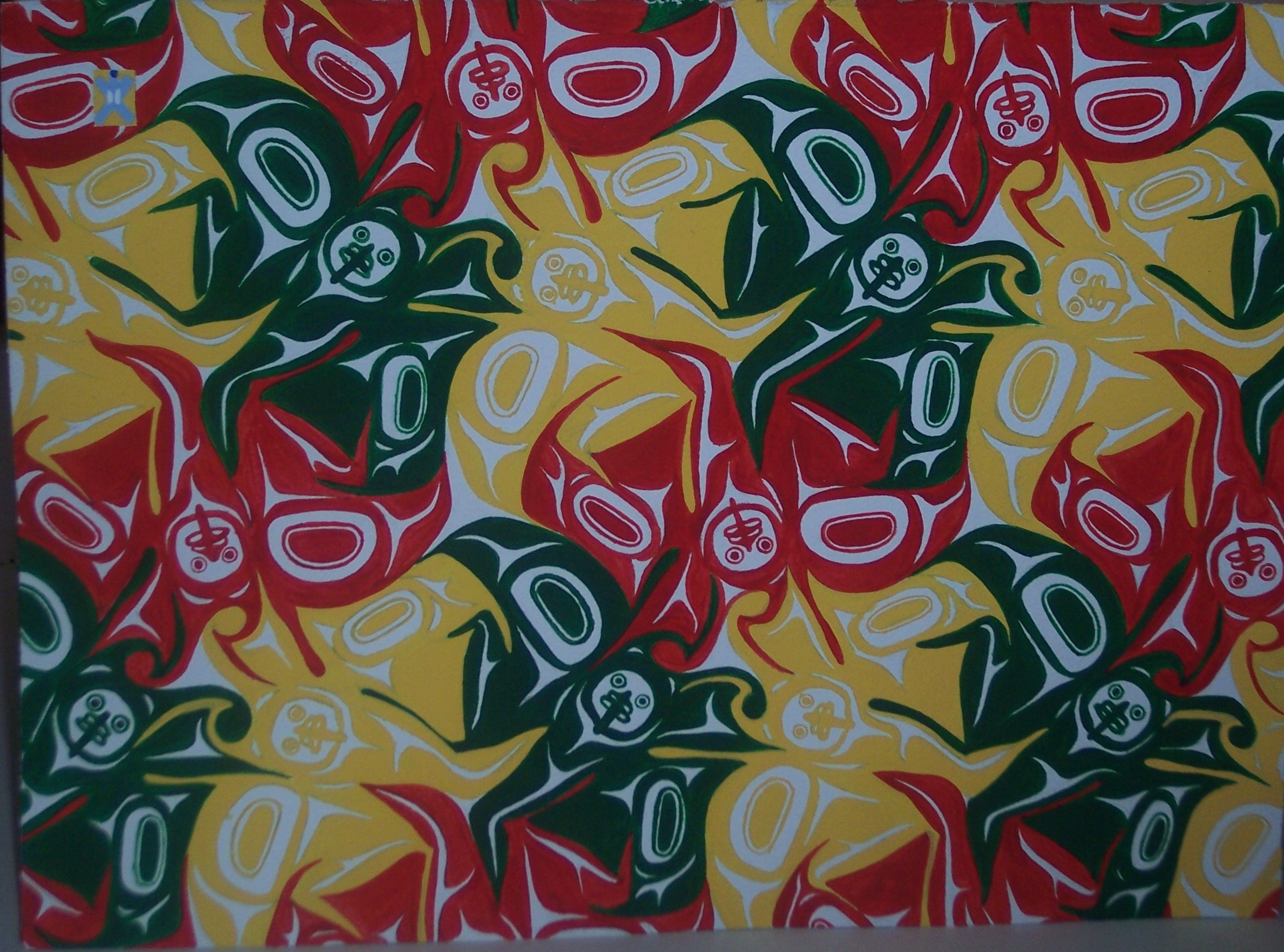
As a general rule, I never buy Northwest Coast Art depicting butterflies. But when I was in Terrace last April, I made an exception for Nigel Fox’s “Butterflies #3.”

The reason for my rule is that butterflies (and hummingbirds, for that matter) are among the most popular designs for tourist pieces. You rarely see them depicted in more serious artistic works. I believe that there used to be a Butterfly family crest among the Haida, and there are still Hummingbird crests among several of the northern First Nations, but today, these designs are often trite and blatantly designed to appeal to tourists. Often, they show a degree of cuteness unlike any other designs.

I’ve joked that these designs are the Hello Kitty of Northwest Coast Art. But the northern First Nations, as I understand things, are even more scathing: satirically, they call butterflies and hummingbirds the white people’s crests.

However, Nigel Fox, a student now in his second year at the Freda Diesing School, has a different take on butterflies. In his blog, he writes about “Butterflies #3,” the third in a series of paintings featuring butterflies, “The piece is about teamwork and is part of a series that I am exploring on the theme of respect, especially among peers, even among “outsiders” or butterflies. Within many northwest coast native cultures, there are crests that are usually animals, that represent families or bloodlines. The butterfly crest is reserved for people who are not part of a nation by blood.”

Fox goes on to explain that his work is about harmony and teamwork.

I’m not sure if he is missing the satiric intent, but it is hard to argue with his results. Fox has a separate career as a painter mostly in the Canadian Impressionist style, and in his butterfly studies, he has combined traditional designs with patterns inspired by the surrealism of M. C. Escher.

Like Escher’s work, “Butterflies #3” has a constant shifting of figure and ground. At the same time, the shape of the butterflies’ wings, with their ovoids and elongated T-shapes continually suggest other shapes, such as the beaks of ravens. By combining his interests in mainstream and Northwest Coast Art, Fox has created a series of paintings unlike anything anyone else is doing, and I look forward to seeing how his work matures in the next few years.

Meanwhile, his butterfly series is a promising start.

Read Full Post »

Today is Ada Lovelace Day, when the tradition is to blog about a woman you admire in science, technology, engineering, or mathematics. I can think of dozens of women who are friends or acquaintances I could write about, but the first subject that comes to mind is Irene Pepperberg, who has quietly revolutionized the field of animal cognition with the help of her parrot colleagues Alex, Griffin, and Arthur (Wart).

Pepperberg and Alex especially are known to thousands from their public appearances. However, I sometimes wonder if many people in the audience appreciate that what they are seeing is not just an African Gray who has learned to respond on cues, but living proof that parrots’ intelligence overlaps with the lower edges of human intelligence. With the ability to use concepts such as difference, greater than, and absence, Pepperberg’s test subjects show the general intelligence of a two year old human child, and, in some cases, of a six year old. This discovery is a complete reversal of the traditional beliefs about avian intelligence – after all, “to parrot” is used as a synonym for “to repeat mindlessly.”

Pepperberg’s proof of avian intelligence is exciting, although to parrot owners, she is only repeating what they have long maintained. However, from a scientific viewpoint, Pepperberg’s proof of avian intelligence is the least of her accomplishments.

When Pepperberg began her studies over two decades ago, animal cognition had been thoroughly discredited by a long series of studies teaching chimpanzees and gorillas to communicate – usually through some form of sign language. These studies produced many touching anecdotes about the intelligence of the primates involved, but they were rightly criticized for poor experimental design and researcher bias. By the time Pepperberg began her first studies with Alex, it took a brave person to even approach the entire subject.

However, Pepperberg’s experimental design eventually gave the entire field of animal cognition greater respectability. As detailed in The Alex Studies, Pepperberg took special care to design studies that reduced the chance of unconscious cuing and was able to duplicate results with different researchers and even strangers. Just as importantly, the tasks that parrots have to perform in her studies are more complex than those solved by the earlier chimpanzees and gorillas, which reduced the possibility that her results were due to chance. As the number of her studies increased, gradually no one who read her work could deny her results.

An especially interesting part of Pepperberg’s designs is the Model-Rival learning method she developed. Unlike the usual stimulus-response model that is usually used to teach all sorts of animals rote behavior and responses, the Model-Rival technique begins with the obvious point that learning takes place in a social setting.

In the Model-Rival technique, experiments require two researchers, one of whom takes the traditional role, and one of whom plays a fellow student. The parrots being tested see the fellow student being praised for giving correct answers, and rewarded with food or the right to play with a toy, and, wanting the same attention and rewards, are motivated to learn. This setup not only serves as a serious challenge to classic behaviorism, but may also be of use in the teaching of humans with autism and other learning disabilities, although it is still not extensively studied.

What makes this new found respectability for animal cognition especially interesting is that you only have to look at Pepperberg interacting with her test subjects on video clips to realize that she adores them as much as the soppiest pet owner. When Alex died unexpectedly four years ago, Pepperberg was devastated, and wrote a memoir called Alex and Me that is one of the most moving true stories about an animal ever written. Yet to her credit, Pepperberg has never let her personal feelings undermine the integrity of her scientific work, beyond the obvious fact that she remains deeply committed to her studies. At times, such as when Alex died, the effort to keep the professional and the personal separate must have been almost impossible for her.

As a long time companion to parrots, I find Pepperberg’s work endlessly fascinating. At one point, I seriously weighed expanding on her work in graduate school, and corresponded with her briefly. Studying parrots proved to be a road not taken, but my admiration for her courage, scientific rigor, and passion remains. Far beyond her personal reputation in the media, Pepperberg remains a scientist’s scientist.

Read Full Post »

Forget Mick Jagger and Super Heavy. If you’re interested in British folk rock — or even aging musicians who still have their creativity intact — then the team-up of the year isn’t Jagger and associates. It’s Ragged Kingdom, the first collaborative album between diva June Tabor and Oysterband since Freedom and Rain in 1990.

That 1990 album remains a cult item, one of those rare collaborations in which the result is something that none of the participants could have managed on their own. You could hear Tabor and Oysterband lead singer John Jones inspiring one another, while the rest of Oysterband transcended their usual versatile excellence to allow Tabor to do arrangements she could never have done by herself, or even with her usual arrangement of a single supporting musician.

Freedom and Rain was also responsible for one of my most memorable concert experiences ever. It was 1991 at the night club at what was then Vancouver’s Plaza of Nations. There, Trish and I listened to two memorable sets that kept cranking the excitement higher and higher. By the encore – a deliberately campy “White Rabbit” complete with dry ice and Tabor in a leather mini-skirt – the only people that weren’t blissfully sated were the waiters, who were sulky about a crowd that had come to listen instead of drink.

Since then, Tabor and Oysterband had played together informally, most notably at Oysterband’s Big Session festivals, and done several covers of rock classics on Tabor’s On Air album. But a studio album was something else altogether, and I have to admit that I first played Ragged Kingdom expecting to be disappointed. After twenty years, how could the magic possibly be repeated?

Well, it can’t be, not in exactly the same way, even though both albums are a similar mix of contemporary and traditional pieces. However, a dozen bars into the first cut, a hard driving version of “Bonny Bunch of Roses,” I knew that I was experiencing something just as extraordinary in its own way. Ragged Kingdom has a harder sound than “Freedom and Rain” – possibly, I would say after listening to his solo album, due to Ray “Chopper” Cooper’s growing involvement in Oysterband’s arrangements – but I haven’t heard a sound with such authority since I first heard Stan Rogers at sunset at the Vancouver Folk Festival or heard Steeleye Span’s “Thomas the Rhymer” coming out of my portable radio when I was in high school.

Or in case you have different touchstones, let me put it this way: right away, I knew I was listening to something original and compelling – something that I had to sit down and listen to, not just have playing in the background as I went about my day.

All the musicians sound like they are enjoying themselves on Ragged Kingdom too much to care much about billing. However, so far as selection is concerned, the album is more June Tabor’s than Oysterband’s. None of their original songs are included. Instead, as on most of Tabor’s releases, the album has an eclectic mix of traditional and new.

Among the traditional pieces, standouts include “Bonny Bunch of Roses,” and “Judas (Was A Red-Headed Man),” two songs I believe that I have heard mentioned in passing, but whose lyrics I’ve never read, and that I have never before heard performed. Both suggest how much potential remains untapped in traditional song, “Bonny Bunch of Roses” being a dialog between Napoleon’s son and his mother about the British Empire, and “Judas” slipping in pious Christianity with decidedly pagan elements and popular tradition. Another piece, “Son David,” belongs to a well-known tradition of a dialog between a fleeing murderer and his mother, but with enough of a new slant in the arrangement to make it interesting.

The contemporary selections are equally varied, ranging from Bob Dylan’s “Seven Curses” to Joy Division’s “Love Will Tear Us Apart.” “Love Will Tear Us Apart” is especially transformed, being transmuted from Joy Divison’s quick and monotonic delivery to a slow, heart-wrenching duet between Tabor and Jones.

Ragged Kingdom has only two minor faults. First, the hard rhythm of most of the cuts could do with a little more variation. Second, “The Dark Side of the Street” seems a slightly weak ending to the album. However, I expect that these faults would disappear in live performance, and I only hope that Tabor and the Oysterband do a tour for the album in North America in the coming months. I suspect that the experience would be as memorable as the Freedom and Rain concert whose memory I still value.

Read Full Post »

One of the unavoidable facts of online publications is that you’re going to make mistakes. Mercifully, some will be typos. Others will be factual errors or passages that need to be made clearer. But no matter how carefully I or my editors proofread, the mistakes will come – in fact, I sometimes think that, the more I try to avoid mistakes, the more likely I am to make them. At any rate, when I make them, once I get over the embarrassment, like any other writer, I am left with two choices of what to do with them: redact them, adding a correction in a footnote or parentheses, or revise them, removing them from the text altogether.

Those who favor redaction argue that revision is useless, that the uncorrected original will always be available online no matter what you do. Some go further, and argue that redaction is more honest, in that you are not trying to cover up your mistakes, but leaving them for everyone to see. Ursula K. LeGuin also suggests that redaction is a feminist technique, an alternative to the pseudo-objectivity and linear thinking of traditional Western thought.

Such arguments have some validity. However, maybe it says something about my own brand of perfectionism (or maybe early toilet training) that I prefer revision to redaction.

For one thing, I’m not a fan of redaction as a reader. In all but a few cases – such as a revision of a well-known article – I react to redaction in much the same way as I react to the extras on a DVD: it’s more than I want to know. Since I suspect that many readers feel the same way, my preference is not to inflict redaction on them.

Just as importantly, redaction always feels to me like a rough draft. Worse – it feels to me that I am not living up to readers’ expectations if I redact. To me, part of my unspoken contract with readers is that I present what I have to say in as polished a form as possible.

It’s not that I’m trying to hide my mistakes – which is impossible on the Internet anyway. Rather, I feel obliged to make each article as factually accurate and as clearly written as possible. Why, I think, would readers be interested in my mistakes? If they really want to see where I went wrong, they can probably find an earlier, uncorrected version of a revised article, but at least I can make clear what the preferred text is. At any rate, that is all that most people are likely to read any way.

However, the main reason I prefer revision is that I consider redaction to be more about the writer than the topic of discussion. Look at me, redaction says to readers. Aren’t I an upright, honest person, willing to show you my imperfections and the development of my thoughts?

In fact, redaction doesn’t necessarily show anything of the sort. In one easily-locatable case, an article begins by stating that I lied. The article has been redacted several times, with an admission that the original claim was the result of a misunderstanding, but the original statement remains, and is all that people see in an online search. To my understandable ire, this is not a form of honesty, but a way of perpetuating the original attack while pretending to be honest.

At any rate, I am not interested in being a focus of readers’ attention. While I hope they want to listen to my arguments and opinions, I have zero interest in being at the center of even a modest cult of personality. To insert a claim about my personality in the form of a redaction seems only a distraction from what I have to say – and, to my George Orwell-influenced mind, anything that interferes with clear communication of my point should be edited out of existence.

If someone who convinces me that I made a mistake expresses a preference for redaction over revision, then I’ll ignore my personal preference and redact instead. But, left to myself, I’ll take revision over redaction every time. So far as I’m concerned, revision serves the argument and the readers better than redaction.

Read Full Post »

If I had to recommend a single work to would-be writers, then unquestionably that work would be George Orwell’s essay, “Politics and the English Language.” First published in 1946, the essay is dated now in its references, but no other work talks as clearly or succinctly about the purpose of writing, or gives such useful rules for accomplishing that purpose.

The larger context of “Politics” is the use of language in social situations. As Orwell had already suggested in works like Homage to Catalonia and Animal Farm (and would later explore in detail in Nineteen Eighty-Four), the essay explores how language is used to manipulate people and conceal thoughts in “the defense of the indefensible.” However, Orwell’s tone throughout the essay makes clear that he thinks such use of language is corrupt and disgusting, and should be opposed by any writer worthy of the name. So far as Orwell is concerned, a writer’s job is to communicate clearly and effectively – both as a matter of self-respect and as a duty to the language and public discourse.

Aside from dishonest intent, the main reason for corrupt language according to Orwell is that most writers and speakers don’t stop to think what they mean. Instead, they riffle through an assortment of clichés, choosing ones that approximately fit their meaning. Orwell lists the general categories of these clichés – dying metaphors, verb phrases, pretentious diction, and meaningless words – and, although many of his examples are dated after sixty-five years,  no one with any interest in language should have any trouble coming up with modern equivalents.

Talking about the role of the writer and giving negative examples would be enough by themselves to make “Politics” worth reading. But then, at the end, Orwell does something extraordinary: he reduces how to write clearly to six simple rules:

(i) Never use a metaphor, simile, or other figure of speech which you are used to seeing in print.

(ii) Never use a long word where a short one will do.

(iii) If it is possible to cut a word out, always cut it out.

(iv) Never use the passive where you can use the active.

(v) Never use a foreign phrase, a scientific word, or a jargon word if you can think of an everyday English equivalent.

(vi) Break any of these rules sooner than say anything outright barbarous.

In less than a hundred words, Orwell not only tells readers everything they need to know about writing clearly, but provides an example of  the type of writing he advocates. The result is a set of guidelines from which anyone can benefit. Considering the thousands of pages that people have written trying to explain how to write, this is an astonishing accomplishment.

One of the reasons why these rules are so useful is their flexibility. You’ll notice that Orwell does not say, for example, “Never use a long word when you can use a short one.” Such a rule would only be another type of pretentiousness, of a sort you sometimes find in Hemingway when he is parodying himself.

Instead, he says, “Never use a long word when a short one will do.” For example, if you just want to convey a general impression of size, then “big” is probably good enough. However, if you want a suggestion of humor, then “humongous” would be more appropriate. Similarly, if want to imply something out of the ordinary range of bigness, then “outsized” might be a more effective choice.

The same goes for a several of his other rules. In general, Orwell suggests, you want to use the active voice – but only when you “can.” If you have a reason for using the passive voice (for instance, to suggest helplessness, you might want to write “A groan issued from his lips” rather than “he groaned”), then do so. In the same way, a foreign expression is only valid if there is no English equivalent; use a Latin or French phrase for any other reason, and you are probably trying to sound impressive when you should be thinking of what you want to say.  Then, just to emphasize the point, he ends by urging that you ignore any of these rules if they fail to aid the clarity of thought and expression that he assumes is a writer’s goal.

If practiced, what these rules do for you is to make you think exactly what you are trying to say. Unlike the rules that other writers propose, these are not suggestions that you can apply by rote. What they really are is a set of suggestions for how to keep your purpose actively engaged while you are writing.

What makes “Politics and the English Language” so unique – and such a necessity – is that, more than any other book or essay on writing I have ever seen, it cuts through the pretenses and the posturings and the assumptions about being a writer to articulate what writing is about and to offer concrete ways to achieve the purpose of writing.

Read (and re-read) “Politics,” and when its rules become a part of your normal writing and editing, and you will understand all you need to know about writing. After that, the rest will be practice.

Read Full Post »

I haven’t written a manual for over seven years, so perhaps my opinions about technical writing don’t count for anything. All the same, I’m disappointed to see that writers are still being steered towards distractions such as writing personae I can think of little that could do more to waste a writer’s limited time or cause them to be held in lower regard.

A persona is an imaginary profile that represents one segment of your audience. The ones I’ve seen are usually 200-700 words long, and typically include not simply the segment’s subject matter expertise, but also the kind of detail more suitable for a character in a work of fiction. Age, gender, job title, hobbies, dining preferences, personal likes and dislikes – all these and more can find their way into each persona. Since the audience for technical writing can have several segments, creating personae is demanding, fun – but largely a waste of time.

Admittedly, the exercise of creating a persona can help a write fix audience segments in mind. Should they need to refresh their sense of the audience, they can simply re-read the persona. But for the most part, each of the personae that I have seen has been a nugget or two of information lost in irrelevancies.

The blunt truth is, the main facts that tech-writers need to know about their audience is their technical background and reading ability. Possibly, writers may need to know a few other facts – for instance, the audiences’ languages can affect page layout – but not much more.

And even expertise and reading ability are largely irrelevant, because, rather than trying to second-guess the audience, it’s easier to explain fully and write simply. After all, you never know who might use your manuals, or if the information you’ve received about the audience is accurate.

Under these circumstances, better to stick with the basics. After all, even experts appreciate a brief explanation of context, or may need a reminder of some aspects of your subject. Write a short, coherent explanation of the tasks at hand, and you can’t go far wrong. But spend your limited time on writing personae, and you may guess wrong or find that the context changes. In other words, writing personae just isn’t efficient time management.

My impression is that personae are favored by those who stress the writing in their job title at the expense of the technical. Desperate to have developers and managers take them seriously, they champion arcane embellishments like personae in the hopes of appearing experts and gaining the respect of those around them.

Nine times out of ten, however, such efforts fail, because they are usually made at the expense of actually learning the subject matter, and of writing and editing. The result? You’re left looking pretentious and turn in a finished manual that only reinforces everybody’s impression that you are a lightweight poseur.

If that’s your idea of being a tech-writer, fine – go ahead and fritter away your time on personae But don’t be surprised when you don’t get the respect that you think you deserve. You’ll only get that by mastering the subject matter and presenting it usefully, not by engaging in pointless intellectual exercises.

Read Full Post »

When I’m an invalid, I want reading that is light, long, and  moderately intelligent. Last week when my left knee decided to complain about its lack of cartilage, my choice was the first half dozen books of Eric Flint’s Ring of Fire or 1632 series. Mostly, the choice fit my requirements, although I have a few reservations about the books.

The premise of the series is simple: A small town in West Virginia suddenly finds itself in Germany in the middle of the Thirty Years’ War. With its technological edge, the town rapidly becomes a major power, allying itself with Gustav Adolphus of Sweden, and history begins to change. Originally a single book, the series has expanded as Flint has thrown open the series to other writers and encouraged fan fiction set in the same universe.

Beyond the actual pages, the series is also interesting because Flint is one of the first science fiction writers to see the possibility in ebooks and free downloads. Although he doesn’t go so far as Cory Doctorow and make all his books available for free downloads, Flint has seen the advantage of releasing his earlier works to keep them available, which means that the first two books in the series are free ebooks.

The series’ attractions are not stylistic ones. Flint and his growing list of co-authors are competent writers at best, and fall into the category of storytellers rather than artists or even strong plotters. Not that there is anything wrong with that; I respect an intelligent light read, and appreciate one in certain moods, such as coming home on public transit at the end of the day or — as recently, when I was doped on ibuprofen.

Rather, the series is interesting for two reasons. First, it deals with European history, a topic that most of his English-speaking audience is likely to know little about. Since the era includes such larger than life characters as Gustav Adolphus, Oliver Cromwell, and Cardinal Richelieu, there is plenty to entertain and inform, although obviously these characters soon start acting in non-historical ways. However, if you do know the characters who appear on its pages, then seeing where and how they depart from our history becomes intriguing – all the more so since Flint and the other writers largely resist the temptation to make antagonists outright or villains.

Second, the early books of the series focus on the West Virginian’s survival strategies. Their technological advantage is limited because they lack the infrastructure to support it, so much of their planning involves figuring how to downgrade their knowledge – for example, they decide to focus on 19th Century firearms rather than modern ones. These survival efforts are all the more interesting because the emergent leader and many of his supporters are unionists, and express a vision of the future that is more idealistic than the conscious or unconscious free market philosophy of most American science fiction.

However, as often happens when you read a series (or a chunk of it) in one sitting, The Ring of Fire series soon reveals itself as formula fiction. Each of the books I have read in the series revolves around a plot against the West Virginians by political opponents. Through devious means and native ingenuity, these opponents seek to even the technological odds against them, but, although these efforts keep the books from being a completely adolescent power fantasy, there is never much doubt that the moderns and their allies will win, amalgamating their noble enemies and forcing the rest into retreat. In other words, American imperialism is still very much a part of these books — even if it is a liberal imperialism — and the outcome is never much in doubt.

Another problem is that the scenes in each book tend to be one of two kinds: talking heads – often politicians – and loving descriptions of battles and action that I can only describe as war-porn.

I can mostly endure the talking heads, although I wouldn’t mind more variation in technique. However, the war porn soon becomes tedious.

By “war porn” I do not mean graphic, nauseating descriptions of violence – which are mostly absent in the series – but a devotion to action sequences for their own sake. For the most part, battles in the Ring of Fire series are not described to give background to individual characters’ actions or to make clear why other events are happening, the way they are in Bernard Cornwell’s Sharpe series. Instead, from the tone and the undue length of the descriptions, I get the impression that readers are assumed to be as fascinated with the descriptions as the writers are. I’m not, and often amuse myself in them by deciding which scenes could be deleted and thereby speed up the pace of the books.

Yet another problem is the depiction of women. The series is by no means overtly sexist –  although so far, no one has mentioned how family planning might fit into the priorities of the stranded moderns. Rather, the depiction of women tends to be token and limited. With no exception that I can readily recall, major female characters tend have one-note in a way that the male characters don’t: One is an old activist, another wise, another full of revolutionary fervor, and so on. Mostly, too, they tend to be introduced in a quirky love story, after which any attempt to develop them comes to an abrupt halt. I suppose that Flint and the others deserve points for trying, but I’d still like to see one of them tackle a story about a woman with her own concerns someday.

Some of this criticism is probably due to an overdose. After all, no series is supposed to be read over a few days. Still, while I will probably return to the series some time when I want intelligent light reading, for now I find myself in no great hurry to do so.

Read Full Post »

Twenty years ago today, Linus Torvalds sent the announcement that announced Linux to the world. The Linux Foundation has promoted the anniversary all year, displaying memorabilia and holding a Roaring Twenties theme party ( much to the evident embarrassment of Torvalds, who was conspicuously absent at LinuxCon when invited to take a bow.) – and it’s fitting that the free software ecosystem that has grown around Linux should be celebrated. However, amid all the self-congratulations, I think it’s worth remembering that what is being praised is the goal more than the reality.

I hate to insist on this cold splash of reality, I really do. Although I wasn’t around at the start, I have been involved in free software for twelve years, and I share the dream. For me, free software is as important a part of activism as recycling. One way or the other, it has been my major source of income for most of those twelve years. The community of free software is where I’ve found a modest dollop of fame. Moreover, as I rediscovered at last week’s LinuxCon, where I seem to have spent three days shaking hands and renewing old acquaintances, I feel at home in the community, and many of my closest friends come from it. So, when the keynote speakers on the first morning stood up and celebrated the accomplishments of free software, I was moved in much the same way as other people might be moved by the national anthem of their country.

And yet –

Something whispered in me that the keynotes at Linuxcon were just a little too self-congratulatory. I couldn’t help thinking that the rhetoric of co-operation was sometimes being delivered by the representatives of corporations famed for their cut-throat business practices. I thought, too, of how, despite everything that the free software ecosystem has accomplished – often contrary to the predictions of old-school business and development experts, much to my delight – the community seems to have balked at taking the final steps, putting up with cost-free drivers rather than pushing for free-license ones.

But the largest gap between rhetoric and practice came in the description of the community. The gospel was preached most vividly by Jon “Maddog” Hall.

Hall is a seemingly endless source of friendliness and good will, and part of me hates to contradict him. All the same, I had to raise an eyebrow when he proclaimed – as he had already done in his blog :

I am proud of the Free Software community in embracing diversity. And finally, it is lucky for me that the Free Software community also embraces older people…..

No one asks these programmer/entrepreneurs their age, their race, their religion, their sex or their “sexual orientation”. No one asks them if they were physically challenged, what country they came from, or their political views. No one told them “don’t go there”, “don’t do that”, “you are too young”, “you are too old”, “you are just a…” or “you can not succeed”…..because (as one of my favorite cartoons points out) “on the Internet no one knows that you are a dog”.

All the Free Software community says is “show me the code”.

It’s a wonderful dream, Jon, and I hope that one day it comes true. But read the Geek Feminism wiki, and you soon realize that it isn’t true yet. Pornographic presentations, the litany of sexist bloopers from one community leader after another, the knee-jerk, foul-mouthed hostility to even the suggestion that more should be done to encourage the participation of women – it all buzzes around in your head like loud music when you have a hangover. Before long,  you are forced into the realization that, unfortunately, the community does not always embrace diversity, and that portions of it care very much who you are. In fact, they care so much that they will do their best to prevent you from contributing your code no matter how well-written it is.

Taking time to appreciate the accomplishments of free software is only right. It’s a working community, and many of us don’t take enough time to appreciate what’s being built a bit at a time. But what Jon and the other Linuxcon keynote speakers praised was the ideal, not the way things are.

So, while we should celebrate what is after all a unique accomplishment, let’s also take time to remember that the accomplishment isn’t finished yet, and that we’ve collectively fallen short of the ideal. Forget that, and we risk always being less than we could be and betraying ourselves.

Read Full Post »

Maybe it’s a character flaw, but nostalgia for a technology puzzles me. My bewilderment has last all my adult life, and now, with the all the sentimental preference for paper books over ebooks, it returns to me stronger than ever.

I first became aware of other people’s technology nostalgia when I jumped from a typewriter to a word processor. Did I miss working with carbon paper, or having the choice of redoing a page because of a spelling mistake or getting liquid paper all over everything? Not for a moment. Revision was so much easier on a computer that I barely looked back. The IBM Selectric that I kept in a back closet just in case languished in obscurity for a decade before I realized that I would never use it.

Yet much to my surprise, many people started romanticizing the typewriter. I could understand veteran writers who after several decades were reluctant to mess with their creative processes. But other people insisted that the hum of the computer kept them from concentrating (apparently the even louder hum of an electric typewriter didn’t). Their thoughts, they insisted, were geared to the tap of the keys (as though a century of using typewriters could have produced any significant natural selection in favor of them).

Soon, distressed typefaces that mimicked typewriters with old ribbons or out of alignment keys became a fashion in graphical design. You still see these typefaces occasionally today, a sentimental attachment to all the inefficiencies of the old technology added with more ingenuity than sense to the new technology.

Now, with journalists constantly trumpeting the death of the paper book, the same thing is happening. Suddenly, people are forgetting the tendency of paperbacks to fall apart after one reading (assuming pages didn’t start flying away before then), and talking about the shape and construction of the book – which is largely an accident of cheap production – as something to get sentimental over. Again, I wonder what they are rattling on about.

Not that ebook readers are perfect technologies. You have to learn exactly how hard to tap a paper if they use a touch screen, and how often to refresh so that you can turn a page without a pause interrupting your reading. Every reader, too, could use twice the resolution, even if they have improved considerably from a decade ago. I admit, too, that the end of the standard two page spread leaves me wondering what to do with my spare hand, and that a single page looks odd to my typographically-trained eye.

The mistake that people make is imagining that the medium is the book– which isn’t true for either paper books or ebooks. If it were, then to get the full experience of Catullus or Cicero, we would have to read them on papyrus scrolls. Shakespeare would have to be read on vellum, and Jonathan Swift and George Eliot on rag paper. All of these are simply media.

The book – the play, the oration or the novel – is the words and how they are put together. And that doesn’t change, regardless of whether we read a clay tablet or have the words beamed directly into our brains. If we remember a particular technology fondly, I suspect that it’s because we transfer the pleasure of the words to the medium in which we read them.

Personally, I neither welcome nor decry the rise of ebooks. They have their points, such as reduced storage space or the ability to change fonts, but that’s not what I notice when I read, any more than I notice the convenience and portability of paperbacks, or the smallness of the loss if they fall into the bathtub. When I read, what I notice is the story or the arguments, and the skill in word use. Should I live long enough to see ebooks replaced by something else, I’ll use that something else, just as I use ebooks now.

Like those who romanticized typewriters, the people currently anticipating the end of paper books have lost sight of what’s important when we read. Maybe they’re just afraid of anything that’s new, but the medium is a minor issues so long as we can read without being distracted by inefficiency or inconvenience. What matters is the words. Always.

Read Full Post »

« Newer Posts - Older Posts »