Feeds:
Posts
Comments

Archive for the ‘Personal’ Category

Widowhood is a state of transition. It’s the time when you decide what you are going to do after the most important relationship in your life is gone. Or, to be more specific, it’s the time when you decide whether you are going to risk another relationship, or spend the rest of your life solo. Fourteen months after Trish’s death, that’s a decision I haven’t made, but, what most people don’t understand is that if I end up alone, I wouldn’t be overly disturbed by the outcome.

This fatalism has nothing to do with a morbid nostalgia. Trish and I met a month after her first husband died, and became a couple two months after that, so I don’t feel any need to stay loyal to her memory. In fact, several times, she told me that she hoped I would remarry if she died. So, if anything, I suppose I should be trying to meet people.

But the truth is, while one or two intriguing possibilities exist, I don’t need a relationship merely for the sake of a relationship. I’m comfortable with my own company, and as a writer I need a degree of solitude each day regardless.

Part of my attitude is my hyper-awareness of a fact that is obvious, but that no one likes to emphasize – namely, that a relationship ends with one person either leaving or dying.. As you get older, the possibility increases that the end will involve a death. I would rather not face the other person’s death, and I am no more eager to leave her facing my death and having to settle my affairs.

As time passes, this reluctance will probably fade, of course. But the truth is, I just don’t have the pressure to be in a relationship that people younger than me have. When you’re in your twenties or early thirties, being married or in a common-law relationship is a mark of maturity and independence. It can be a way to settle any lingering doubts you have about your sexual orientation. Most of all, it’s something everyone does, which often panics people into bad relationships, just so they don’t feel left out or appear odd. To be young and single by choice takes great strength of character because a more or less permanent relationship is part of what you’re supposed to want or do.

But at my age, the situation is different. I’ve paid my own way since I was eighteen, so I have nothing to prove. I long ago discovered I was a straight male with eccentric ideas about gender roles and an indifference towards them. Nor, for some reason, does modern industrial culture have many expectations about widowhood and its aftermath.

If I were still married, no doubt I would feel the pressure of the expectations placed on long-married couples – but suddenly, and through no wish of my own, my possible choices are broader than they have been since high school. I don’t have to rush to decide whether I should be single or committed, because the decision doesn’t matter except to me and any woman with whom I might be involved.

And if I do end my days single, so what? I’ve had a relationship that was better than any I see around me. That’s not just my opinion or the distortion of romanticism, either – I lost count years ago of the people who said that Trish and I acted like newly weds or who were surprised that we were polite to each other (as though politeness was something you owed strangers, and not those you loved), or how we consulted each other about mutual decisions.
Should I never be in another serious relationship, I’ve been in one that people envied. So why should I settle for anything less?

That would be the real betrayal of my past – not staying single for the next three to five decades, but blundering into a relationship because when I’m tired or not sleeping I feel lonely. I owe the memory of Trish better, and I owe myself better, too.

Read Full Post »

Shawn Patrick Aster’s “Raven Turns the Crows Black” has a longer history than most of the art in my townhouse. Aster took over two years to deliver it, but I consider it well worth the wait.

Aster’s work was brought to my attention by another artist in late 2008, as someone whose work was admired even by master carver Dempsey Bob. I immediately commissioned a piece from him, wanting an early piece from an already skilled artist who seemed sure to make a name for himself.

A few months later in April 2009, when I attended my first year end exhibition for the Freda Diesing School, I was amused to see that others gave Aster’s work no special attention – until he won two awards. Moments later, all his work in the show had sold.

But the commission had progressed little. Aster seemed nervous (I believe it was his first commission outside his family and friends) and couldn’t satisfy himself with the design. A month later, I bought “Raven Heart” from him, but I was still waiting for the commission.

By the next year end exhibition, Aster was looking distinctly apologetic when he saw me. Jokingly, I started referring to him as “the most promising artist” I knew, since he had promised the piece for over sixteen months – although I made clear that I was more than willing to wait. Secretly, though, I had decided he was unlikely ever to deliver. I was disappointed, although I bought other pieces from him.

Then, last March, Aster told me on Facebook that he had finally completed the design. It had apparently changed since he first started designing it, but I was happy to see it. I paid indirectly at the 2011 year end exhibition, and it was delivered by Aster’s fellow Freda Diesing graduate Todd Stephens at the YVR Art Foundation’s reception in May – a good deal of which I spent showing the piece to others and worrying that food might be spilled on it.

“Raven Turns the Crows Black” depicts an episode from the Haida epic “Raven Traveling,” a work that  many now consider the common heritage property of all First Nations people on the northwest coast. In the story, Raven the Trickster sees crows roasting a salmon on the beach. They agree to share the food, and Raven falls asleep while he waits for it to cook.

Unwilling to share, the crows devour the salmon. Belatedly worried at what Raven’s reaction is going to be, they put crumbs of the salmon meat on his clothes and between his teeth. When he wakes, they try to convince him that he ate before he slept, but Raven in his anger throw them into the fire, from which the survivors emerge forever singed and black.

Aster’s rendering of the story makes for a unusual design in what is already a tradition apart. Shared by several northwest coast nations but possibly Tsimshian in origin, the Chilkat style is based on weaving patterns. The style is constrained by the limits of weaving, so it tends to consist of discrete blocks of design, rather than the flowing formline found in painting and carving. This tendency makes it both geometric and highly abstract.

Aster’s design shows Raven in the center, his teeth bared (and if you ask why Raven has teeth, I can only reply, why does the parrot in Aladdin? Although, probably, Raven was in human form in the story, shape-changing being his most common power). I interpret the design as showing Raven in two states: in the middle, hungry and asleep, with his wings folded, and at the top center, angry and awake with his wings outstretched.

On the left are the white crows, on the right the black; like the raven, their wings and other features are abstracted into blocks of forms. The designs on each side are not quite symmetrical, with only the outlines of the heads to suggest the transformation in the story.

The background includes the characteristic Chilkat blue and yellow. However, to suggest the fire – and, perhaps, the salmon meat and Raven’s anger – Aster adds red to his design. Although I am far from an expert in Chilkat design, I have never seen any other Chilkat design use red. However, Aster’s innovation succeeds, largely because the red is relatively dark and sparingly used.

The result is one of the most bold-looking pieces of art in my collection. And while I admit that I grew impatient while waiting, I’d gladly wait another twenty-eight months for another work that is equally striking.

Read Full Post »

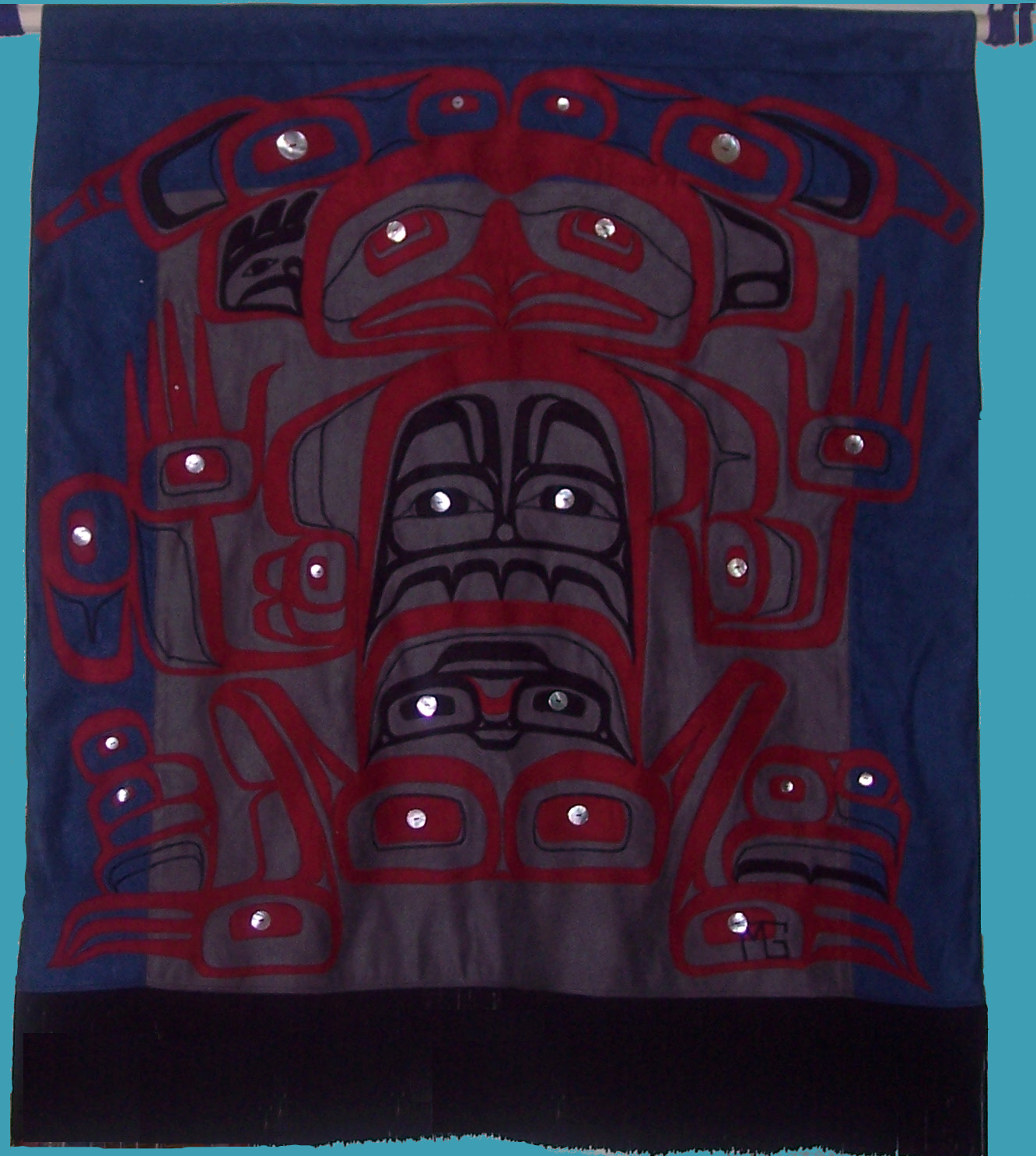
In the fall of 2010, Tshimshian artist Morgan Green set out to raise the money for her tuition in goldsmithing. In return for my donation, she agreed to do a small wall-hanging. Near the end of April, 2011, she delivered “Raven and the Grouse” to me downtown, considerably brightening up an otherwise dismal evening for me.

The story is one of the lesser-known Tsimshian stories of Raven – or Txamsem, as he was known to the Tsimshian. In fact, Green had never heard the story, despite the fact that she probably has a stronger background in traditional culture than most First Nations artists in their mid to late twenties. My only source for it is the two-volume reprint of Tsimshian Narratives by Marius Barbeau, William Beynon, John J. Cove, and George F. Macdonald. There, it is listed as “Raven and the Grouse Prince,” and as being told to Beynon by Emma Wright of the village of Gitlaxdamks in 1954.

One of the things I like about the story (apart from the fact that is not the worn story of Raven stealing the light) is the glimpse of traditional life that it gives:

Txamsem was very hungry and could not catch any more salmon as these had all left with the salmon women. He left his little canoe and went into the forest to see if he could get any game. As he went into the woods he saw a large house ahead of him. He went to it and looking in saw that there was a man and his wife with many small children. He saw there was food in the house and he was very hungry.

Seeing three ravens in a tree he immediately called them, “One of you will pretend to be my wife and the other two will be our children.” He transformed these ravens to human form. They approached the house of the Prince of Grouse. When they were near the house, the Grouse Prince saw the man and woman with their two children approaching, so he called to them, “Come my friends, come and rest in my house.” Leading the way he led Txamsem and his raven wife and children to the rear of the house. “Bring food for my guests who are tired,” he called to his servants. Then he made a place for his guests to rest and sleep.

The Grouse Prince began to make a great many arrows which he piled by his sleeping place. He arose very early and was not gone for long when he returned with the carcasses of many mountain goat. Txamsem still pretended he was very tired and was resting all the time. He go up when the Grouse Prince went out with all his arrows and followed behind him.

After traveling some distance into the woods the prince came to a high steep bare rock mountain. It was impossible to climb this, so the prince took his arrows and shot three from his bow. When he had shot all his arrows, he called out, “Come great Supernatural One, come to the aid of the arrows you gave me.” Almost immediately a man appeared and waved his spear up at the mountain and at once a great many mountain goat came falling off the steep sides of the high cliff. These the prince took down to his house.

Txamsem had seen all this and had returned to the house. He asked the prince, “Do you go every day to hunt?” “No,” the prince replied, “tomorrow I shall rest and prepare all the meat I have got.” Txamsem said, “I will go tomorrow as I feel rested now.” He made a large number of arrows and next day he set off early to go to the cliff where he had followed the Grouse Prince.

When he got there, he shot off the arrows as he had seen the prince do and these went into the high precipice and then he called out, “Help my arrows O supernatural One.” As he said this a man stepped in front of him. “Whose arrows do you shoot?” Txamsem was at a loss and did not know the right answer. So he replied, “These are my arrows, Supernatural One.”

With that the walls of the precipice fell down and Txamsem became buried under them. His raven wife flew away as did the two raven children. Txamsem nearly died and was ill for a long while. He finally recovered and went down to where the grouse Prince’s house stood, but behold! It was gone. Then he went to where he had left his little canoe and being very hungry he set out traveling on down the river, in search of food.
(Note: I have changed the paragraphing for easier reading)

Green’s design is based on a picture of a historical house front. She has used that starting point to show Raven about to buried beneath the falling rock of the precipice. Inside Raven’s body, some of the goats are shown. The gray in the background, perhaps, might be taken as the silhouette of the Grouse Prince’s house in the distance.

What the photo cannot show is the care with which the applique has been sown on to the heavy background fabric. The stitches must number in the tens of thousands – reason enough for Green to take six months to complete the hanging, even if she wasn’t going to school and creating other pieces at the same time.

Green is a multi-talented artist, who restlessly explores different media, as the ceramic Mouse Woman platter shows that we bought a couple of years ago. But her first and most accomplished work, I’ve always felt, lies in fabric, which is one reason why I requested “Raven and the Grouse.”

I’ve hung the finished piece above my headboard, where it hides a wallpaper mural from the 1970s that one of these days has got to go. With the curtain drawn, the hanging has a somber impressiveness, with the buttons catching whatever lights I have on. During the day, with the indirect light from the window, the red outline of Raven becomes more noticeable, but the effect is no less impressive.

Read Full Post »

A week of riding a bicycle around Vancouver reminds me of the first time I took a boat up the Fraser River. Seeing the region from the water, I became aware of industries and activities that most people drive past every day, never imagining nor seeing. In the same way, riding a bike – often on trails and routes that run parallel to main roads, rather than on them – is making me discover corners of the city that I thought I knew. It’s as though I’m continually crossing over into an alternate universe from the one I’ve lived in most of my life.

The small revelations are all the more surprising because, as someone who until a few years ago did some serious daily running, I figured I already knew more than most about the hidden pockets of the city. Yet riding along the south side of Burnaby Lake, I discovered trails that I either never imagined, or had forgot years ago if I ever did know them. Half a kilometer away, traffic on the Trans Canada roared past, yet I was alone on trails through partly reclaimed marshland that gave a green and brackish impression of eternity.

Then, on Friday, I was on the first few kilometers of the Central Valley Greenway, where it crosses from New Westminster into Burnaby. The route passes through Hume Park, which I have been passing for years in cars and on the bus, but of which I’ve been only vaguely aware. To my surprise, the path through the park was surrounded by the tall and dripping green of secondary trees, and passes a semi-professional baseball diamond I never knew existed, and exits into a small urbane oasis of calm only a couple of blocks from the busy streets that made up my definition of New Westminster.

Coming back, I detoured from the Greenway up a steep hill to a path beside the small switching yard for the trains. I’ve run along this part of the Greenway for years, figuring I had a shrewd idea where the path up the hill must lead – but I was wrong by three or four blocks. In fact, the distance from the Greenway to the end of this detour was at least half a kilometer longer than I imagined. In the middle of the city, less than two kilometers from where I live, was a stretch of woodland where I was completely alone, except for the occasional dog walker.

Much the same discovery awaited me this afternoon, when I took the Skytrain to the Main Street station and rode to Granville Island. I was vaguely aware of the Olympic Village, Vancouver’s white elephant from the Winter Games, and the fact that the seawall wound along the south shore of False Creek, but both were far enough from my usual haunts that I had never seen them up close. But today I had a chance to see them up close – even if I did have to keep more than half an eye on the crowds of pedestrians and dawdling cyclists. The Olympic Village struck me as a piece of post-modern minimalism that would benefit from more trees and garden, and I much preferred the older condos closer to Granville Island, but the point is that I had seen neither. I even discovered pubs and restaurants that must cater to a severely local crowd, because I had never heard of them.

The illusion of a parallel world is all the stronger because I’ve met more people in a week than I have in all my years of riding in a car or among the anonymous, iPod-deafened crowds on public transit. Cyclists, I’ve discovered, actually talk to each other. Unlike most of the people you encounter in public, they have potential topics of conversation with each other – and their chosen means of transport actually makes conversation possible.

After all, as a cyclist, you know that any other cyclists is one of the few percent who have chosen a means of transport that depends on their own muscle power. And while the bike routes are mostly well marked, there is often the need to ask directions, or maybe the need to borrow a pump or repair kid.

But, whatever the reason, cyclists talk to each other as they cruise along or wait at lights. One couple even volunteered themselves as guides for several kilometers before we parted ways.

Possibly, my reaction is colored from the wild exuberance and nostalgia I still feel from being back on a bicycle. But I am tickled by the small discoveries I’m making – and more than a little smug that I am now part of a small minority that knows the city in a way that most of its inhabitants never will.

Read Full Post »

“I’m going back on the bicycle,
I just can’t pay the bills,
I’m going back on the bicycle,
And freewheel down the hill.”

–Tommy Sands

In my teens, I was welded to my bicycle. I used it to run errands in the village, and in the summer I would organize forty kilometer rides out to Horseshoe Bay or the University of British Columbia. But as an adult, I let my bicycle rust on the porch until it was beyond reclaiming, and walked or rode in a car – until today, when I spent the afternoon becoming a cyclist again.

I’d been contemplating the move for some time. For one thing, I only preserve my sanity when riding an exercise bike at the gym by doing interval workouts – and even then I have to grit my teeth against the sports and diet talk around me. For another, Burnaby, the city where I live, has kilometers of urban cycle trails, including the Central Valley Greenway, which goes all the way into Vancouver, as well as dozens of trails through the nearby green belt. Just as importantly, now that I’m by myself, I felt the need of doing something new, something just for me.

Still, for a while I thought I wasn’t fated to be a cyclist again. Twice when I planned to find a bike, the Skytrain broke down. Two other times, I had a swollen ankle that kept me near home. Another time, a friend arrived unexpectedly in town, causing me to cancel my plans. But today, the stars were finally aligned, and shortly after noon, I arrived at the shop and started trying bikes.

Supposedly, you never forget how to ride. But in my case, that’s a half truth: in my first effort, I managed to stay upright, but I wobbled like the backside of a duck.

Fortunately, my inner ear and muscles soon started half-remembering the skills I hadn’t used in years, and within twenty minutes I was no longer disgracing myself quite so badly and could almost look over my shoulder without veering out of control. If I couldn’t turn on a dime, I could just about manage the maneuver on a baseball diamond.

I did, though, need to go back and try the first bike again. The first time I tried it, I was too busy clinging to the handle bars and trying not to yelp with terror when the bike store employee gave me a push.

I had come with a definite idea of what I wanted – a refurbished bike, with racing handle bars, and a good gear ratio so I wouldn’t bang my chin with my knees when pedaling on the flat. But a slightly used hybrid (half mountain, half road) was almost the same price, gave a better ride with regular handle bars, and gave me more options for the kinds of riding I was likely to do. So that’s what I ended up buying, even though twenty-one gears seems a ridiculously large number.

Then it was time to accessorize. When I was a teenager, I just hopped on my bike and rode. In contrast, today the law requires a helmet and a bell at the very least (never mind that I would forget all about the bell and most likely shout on any occasion when it might be useful). If I ride at night, I need a rear reflector. A basket and lock were necessary for quick hops to the store. I also wanted fenders, since the idea of my back being spotted by mud didn’t appeal – and, living in the Lower Mainland, sooner or later, I knew I would be riding in the rain. Still, somehow I fought the madness and managed to keep my spending down to only ten dollars more than I had planned.

“How are you going to get home?” the store clerk asked.

I had planned to take my new purchase on the Skytrain and only ride a couple of kilometers home, but in a fit of bravado I said, “I’m going to ride it.”

“Good for you! Way to go!” The clerk enthused. But when he asked me where I lived, I couldn’t help imagining that he looked glad to think that he was unlikely to be on the road while I was. He’d seen me testing bikes.

Since home was ten kilometers away, I was already repenting my rashness. Yet I couldn’t back down without condemning myself as an empty boaster, even if nobody except me would know. So I set off, my hands a little uncertain on the gears, worrying that any moment I was going to end up curled in a ball, like the centipede who become uncoordinated when asked how he walked. So long as I didn’t think too much, I kept telling myself, I could trust my old reflexes to get me home – even if I took three hours to get there, and walked most of the way.

But you know what? Within a kilometer of leaving the store, I was having the most fun I had had in over a year. Like walking, cycling keeps me in touch with what’s happening around me, but it has the advantage of letting you travel reasonably quickly.

Moreover, unlike a car, a bicycle is a machine that enhances your muscular effort. Where a car simply carries you, a bike improves your efficiency, helping you to climb a hill more easily in lower gears, and to travel farther with each revolution of the pedal in higher gears.

The result was a wild joy in my heart, of a sort that only the best of runs can provide. I felt strong and unlimited, as though I wanted to sing but too many songs were clamoring to be sung for me to know which to voice first.

Thirty minutes later, I was regretting the end of the trip, and only the knowledge that I had to get other things done kept me from prolonging it.

I’m sure that my muscles will pay the price tomorrow. But I’m going out for a ride tomorrow, too, hoping to recapture more of that strenuous pleasure from my teen years that I’d forgotten.

Read Full Post »

As an ex-English major and instructor, I’m hyper-aware of genre. That’s why the idea of the bingo card fascinates me – not the cards used in playing the game, you understand, but parodies of them that summarize common responses to certain issues. What fascinates me is not just that the bingo card seems less than two decades old and remains a largely unacknowledged genre, but also that it’s a product of the Internet in general, and of feminist thought in particular.

One of the first bingo cards (if not the first) was probably the Buzzword (aka Bullshit) bingo card, which is full of business cliches like “synergy” and “user-centric,” and is supposed to be used to pass the time at long meetings. Wikipedia specifically identifies the inventor as an employee of Silicon Graphics in 1993, but, as with most popular culture, how accurate this attribution is uncertain – I seem to remember the Buzzword bingo card circulating a year or two earlier, when I first started using the Internet.

What is more certain is that the idea seems to have been popularized in Dilbert in 1994, and quickly became one of those Internet memes that well-meaning people were always sending to everybody in their email address books.

However, these early uses didn’t extend much beyond pointing out cliches and expressing a mild satirical rebellion. At some point, the basic structure was taken over by feminist thinkers and became more politicized.

One possible inspiration for this second generation card is Joanna Russ’ 1983 book, How to Suppress Women’s Writing, whose cover summarizes all the ways to dismiss or minimalize women’s writing in a way that is reminiscent of the bingo card. But this attribution may be too narrow. It might be more accurate to say simply that this sort of anticipation of opposing views has a long tradition in feminist analysis, and the bingo card just happens to fit the tradition very well.

Whatever the origins, the Feminist bingo card (to coin a phrase) has proved even more popular than the Buzzword card. I know of close to twenty Feminist bingo cards, most of them with a feminist or at least an activist perspective. For example, there are Anti-Feminist and Sexist bingo cards, as well as ones for Porny Presentations, Anti-Breastfeeding, Anti-Bisexuals, Rape Apologists, Rapists and White Liberals. Almost certainly, there are more.

The Feminist bingo card keeps the satirical intent of the Buzzword card. What makes the Feminist card different from earlier cards is that (at least when done well, with the arguments organized and the free square used imaginatively) the squares on the card are anticipations of the arguments and evasions that opponents might use. Not only does it alert its audience to the replies they can expect, but, in effect, it informs opponents that they can’t possibly say anything that hasn’t been anticipated, so there is not much point in arguing. Moreover, since many of the points on any card contradict each other, when applied, a card provides quick proof that an argument lacks consistency.

You might call it an assertion of intellectual superiority, or at least of preparation for debate. You might, if you are feeling Lacanian, call the Feminist card a deconstruction of opposing viewpoints.

No matter how you describe it, when done accurately, it evokes a wry smile of recognition, like a cutting political cartoon. And should you find one or two of your own thoughts echoed on one of these bingo cards, surrounded by other viewpoints with which you disagree, it might even cause you to rethink your assumptions.

I appreciate the way that the Feminist bingo card has taken a more or less inane meme and given it a purpose. Were I still an academic, I would try to expand these notes into a monograph, going deeper into structure and interviewing the authors when I could find them (I know Mary Gardiner and Kirrily “Skud” Roberts have written bingo cards, but many other authors seem to be anonymous, or else their names have been deleted in transmission. Some cards are probably group efforts).

As a recovering academic, though, I just enjoy them, and never fail to click on the link to one. I never could resist a new or clever structure, and, with bingo cards, I don’t even try.

Read Full Post »

Every piece of art, several collectors have told me, comes with a story. Gradually, as I’ve bought art, I realized that this statement is true, so on my spreadsheet for insurance purposes, I’ve created a column where I can type the story of how the piece was acquired.

I have no trouble remembering the first piece of serious art I bought. It was a three inch copper bracelet by Tsimshian artist Henry Green. I’d wanted such a piece for years, and suddenly realized I could afford one. I still remember my breathlessness as I approached the gallery to pick it up, and my sigh of relief when it proved more awe-inspiring than I could ever have hoped.

A couple of months later, I saw that the Bill Reid Gallery was selling canvas banners from a set that had been stored in Bill Reid’s house since 1991. Trish and I bought one, realizing that it was our best chance of affording any work by Bill Reid, then quickly bought another to balance the wall where the first one hung. Soon after, we bought our first mask, a moon by Ron Telek that is both eerie and strangely modernistic.

More soon followed. There was a Beau Dick sketch of a mask, unusual in that, with his carver’s eye, he depicted planes, not lines. The Lyle Wilson pendant Trish won in a raffle at an exhibit – the best $5 that either of us had ever spent. The small Telek mask that I fetched from the South Terminal of the Vancouver airport by walking from the end of the bus line and back again. The Gwaii Edenshaw gold rings we bought for our anniversary. The miniature argillite transformation mask by Wayne Young that I trekked over to Victoria for after Trish’s death and repaired and remounted because it was so magnificently unique. The wall-hanging commissioned by Morgan Green to help her through goldsmith school. And so the stories accumulate, so far as I’m concerned, as innate as the aesthetics of the piece.

For instance, there’s Mitch Adam’s “Blue Moon Mask,” which I saw in 2010 at the Freda Diesing School’s year end exhibit. It was labeled NFS, bound for the Spirit Wrestler show for the school’s graduates a month later. I happened to mention to Mitch that I would have written a cheque right away had it been for sale – not hinting, just praising – and a few hours later he came back and said the piece was mine if I were still interested. I was, and immediately became the envy of half a dozen other people who also wanted to buy it, but had never had the luck to ask. One of them still talks enviously when we meet.

Then there’s Shawn Aster’s “Raven Turns the Crows Black,” a painting that we had discussed in 2009, but didn’t seem to gel in his mind. After a year, I had stopped expecting him to finish it, and took to calling him a promising artist, because he kept saying that he was still working on it. But he did complete it – making it a Chilkat design (which I had not expected), and showing a promise of a different kind.

Two other pieces were commissions in memory of Trish after her death: John Wilson’s “Needlewoman” and Mike Dangeli’s “Honoring Her Spirit.” I made “Needlewoman” a limited edition of twenty, and gave it to family members for Christmas 2010. Mike’s painting, more personal, I kept for myself, carrying it up Commercial Drive from Hastings Street on a chilly January Sunday, because cabs wouldn’t come to the Aboriginal Friendship Center where I picked it up.

Other pieces were gifts from friends: a print of “January Moon” by Mitch Adams in return for some advice on galleries I gave him; a bentwood box Mitch Adams made and John Wilson carved and painted in memory of Trish; a remarque of Ron Telek’s “Sirens” print, and an artist’s proof by John Wilson and another print by Shawn Aster, both apologies for the late delivery of other pieces.

Of course, such stories mean that I can never sell any of the pieces I buy. The associations have become too much a part of me. But since I never buy to invest, only to appreciate, that is no hardship – my appreciation is only deeper for the personal connections.

Read Full Post »

A year ago, at 2:55PM, I was widowed. About an hour later, my sister-in-law and I stumbled out of Royal Columbian Hospital into a summer day that was strangely normal, and I began the process of figuring out how I was going to live the rest of my life.

Fifty-two weeks later, I can’t say that I’ve got very far in the process. A happy relationship that lasts for decades becomes a filter for everything you do, and, in part of my mind, I’m still married.

Nor is a year long enough to shake off fifteen years of nursing an invalid. I still don’t fully realize that my time is now my own, or that I can travel. I’ve spent much of the year just coping, making no great plans. I’m camping out in the ruins of my life, just getting by day by fragile day.

Ever sat in a movie theater until the credits rolled, and the lights came up? That’s where I am now, the story ended and what comes next uncertain.

Still, I’ve changed in numerous small ways in the last year, and learned more about myself. I’ve learned that I’m a tidy person, but, while personally clean, not too reliable about dusting or vacuuming. Perhaps that’s because of too many years when caring for Trish was more important than housework.

I’ve learned to endure washing dishes, which was never my task in our division of labor. I did the cooking, which I’ve also had to relearn, since portions for one always seem too small.

I’ve learned that it’s easier to do a chore when I notice it needs doing. Now that most of the townhouse is in ordered to a degree that it hasn’t been since before Trish took ill, attending to things immediately is the easiest way of keeping the place uncluttered.
I run more errands, because there’s nobody to split them with. The same goes for paying bills on time.

I wander more, and stay out longer and later. When there’s no one to come home to except your pets, regular hours don’t seem so important. I stay up later and wake later for the same reason.

I’m still learning now to have a social life by myself, although I had occasional practice in the last few years as Trish became more house-bound. But I can’t say that I’m easy yet, socializing when I’m no longer part of a well-established team. I’ve joined the board of a couple of non-profits, and organized a couple of meetups about art, just to counter any tendency to become a hermit.

As for being a single man, mostly I don’t go there. Although sometimes not being in a relationship hits me like a kick in the ribs, I’m not sure I’m ready for another one. Maybe I’ll never be; the social games of men and women seem more mutually degrading than anything else.

Probably, I’ve grown more eccentric, talking more to my parrots, recording my remarks in my journal or on Facebook and Twitter, because nobody’s around to share them. I grin more at my own jokes. I work harder and longer, but at more irregular hours. I tend to work out too much at a gym. I talk more to neighbors, and to people on the bus. I wonder if I’ll end up as one of those garrulous old men who pour out their life story to polite but secretly embarrassed strangers.

I worry that I might get sick or be crippled and no one will know. I wonder if one day I’ll be found weeks dead on the living room floor, and whether the birds might starve to death if a car hits me. I’ve made my will, but life appears capricious and arbitrary.
But what I’m going to do with myself for the next few decades? Frankly, I don’t have a clue. The wounds may have scabbed over, but they have a tendency to open again if I move the wrong way (or hear the wrong song, or pass the wrong place, or have the wrong memory come bubbling up out of the unconscious).

One year later, I’m still waiting to see what happens. The most I can say is that, if a new career comes along, or a new cause or a woman to share some time with, I’ll respond like one of King Arthur’s knights, thanking the God in whom I don’t believe for the adventure. But deliberately seeking a particular direction is still more than I can manage.

Meanwhile, so much of the texture of my life has changed that I sometimes look back at episodes in my married life and wonder if I really am the man who said or did those things. Often, that time seems to be sinking into the past much faster than the calendar would indicate.

The only thing that hasn’t changed is that I still feel like an amputee, learning to walk on one leg or to dress myself with one hand. And I suspect that phantom pain will be with me the rest of my life.

Read Full Post »

When I was twelve, I thought J. R. R. Tolkien the greatest writer in the world. By the time I was 15, I was appreciating Shakespeare, and reading systematically through the collected poems of Byron and Shelley. But it wasn’t until after my bachelor’s degree in English that I could read Dickens for pleasure, and I was doing my master’s before I became a fan of Jane Austen, Thomas Hardy, and the other Victorian novelists. These experiences, I believe, indicate something that is often overlooked in high schools and universities – namely, that you can only read a writer in your own time, and when that time occurs is partly dependent on gender.

The question is not just one of age, although those who try to classify young adult fiction would have you believe everything is that simple. Admittedly, my own trail shows a progression in subtlety, from Tolkien’s action-packed adventures to the verbal cleverness of Shakespeare and the iconoclasm and revolutionary spirit of the Romantic poets (so suitable to a boy who believed in social causes), and becomes increasingly nuanced after that. But it is also a matter of increased experience and perception as well.

Just as few great novels are written by anyone under twenty-five, so few great novels are likely appreciated by men under twenty-five. The majority of teenage boys (and I was no exception) simply don’t have the experience to have developed the taste for demanding works when they’re young. The insights that underlie a novel, let alone the rhythms of a strong prose stylist, represent a kind of aesthetic puberty that teenage boys and young men haven’t reached yet. Few of them can appreciate such things any more than a pre-pubescent child can appreciate the intricacies of sex and love.

By contrast, plot-driven stories such as Tolkien’s seem accessible to males at a relatively young age. You only have to see the selection of blockbuster movies aimed at the taste of young males to see the truth of this fact. In much the same way, as a dramatist, Shakespeare externalizes experience, with introspection served up in the breaks in the action represented by the soliloquy. The shift to perception and point of view that is characterized by the novel is subtler than either – and also a relatively recent literary development, and one that wouldn’t have been possible without adventure tales and plays having been developed first.

The trouble is, the average male adolescent, no matter how full of social causes and good intentions, isn’t socially conditioned to want to seek out a female point of view like Austen’s. The definitions of male sexuality in the culture don’t encourage them to be aware that a female point of view even exists. If they do discover it, they are likely to be too egocentric to care much about it. If they approach it at all, they usually do so with reservations.

With the best will in the world, the female perspective is too foreign to them – and the novel, whoever writes it, has always been more about female perspectives than any other structural genre in English (which is why terms such as “chick lit” are nonsense). The average male in modern industrial culture needs five to ten years of relationships and even marriage to appreciate a socially-centered or psychological novel.

By contrast, the female experience seems quite different. Women start off with an advantage because, if they are interested in adventure at all, they have to learn early how to read around the male dominance in such stories. Probably, too, they are ready for the novel earlier, because its territory is more familiar to them – when I was teaching university English, I couldn’t help but notice that in the novel courses I taught, three quarters of the young students were women, while poetry and drama courses tended to have a slight majority of men.

Middle-age is a great equalizer, and I am glad to have arrived at an age where I can view both Tolkien and Hardy as great writers, each in their own way. But when I think of the gender-influenced delays and detours I took, I wish that I could have more daring or imagination and expanded my horizons more quickly. If I had, I could have had another decade or more to enjoy George Elliot! But, considering the odds, maybe I should just be glad that I managed to reach my current perspective at all.

Read Full Post »

Todd Stephens is one of maybe a dozen First Nations artists whose work I watch closely. A graduate of the Freda Diesing School and two-time winner of the YVR Art Foundation Scholarships, he paints in a style that is traditional, yet displays his technical skill and individuality. “Jorja and I,” a painting of Stephens and his young daughter, remains one of my favorite pieces in my collection, hanging above my workstation. So, a couple of months ago, when Stephens was selling another major painting, “Txeesim’s Escape,” (“Raven’s Escape”) I jumped at the chance to buy, also purchasing two smaller pieces, “Midiik” (“Bear”) and “Ganaa’w” (“Frog”).

To my surprise, I’ve heard another art buyer dismissed Stephen’s work as scholastic, suggesting that he hadn’t evolved a style of his own. However, that description confuses classicism with lack of originality. In a classically oriented piece in any field of art, what you look for is discipline, and originality within the tradition. By these criteria, Stephens’ work sets a high standard – in fact, it often shows a surprising amount of variation, even with the same piece.

Look, for example, at “Ganaa’w.” Even in this relatively simple piece, the formline varies from the length of the back to the thinness of the hind leg, parts of which are half, or even a quarter the thickness of the back. As you trace the formlines, you will also find variations in how they are joined, with most tapering long and dramatically in the primary black formlines, and often hardly at all in the secondary red formlines. Notice, too, how often the black formlines create a T-shape out of negative space, especially at the throat and the base of the back, reducing the overall weight of the forms. The contents of the ovoids shows a similar variation in their contents, although the feet, naturally enough, are nearly identical.

Many of the same things happen in “Midiik.” In this piece, though, the thick black formlines are used together with the ovoids and U-shapes to create a sense of the bear’s powerful legs – in fact, there is a distinct impression of musculature in the upper legs that, more than the claws or the rough outlines of the teeth, convey a sense of the bear’s strength. Another interesting aspect is that the asymmetry of the eye leaves the impression that the bear is looking out at the observer, possibly in a menacing way.

However, of these three pieces, “Txeesim’s Escape” is by far the most accomplished. The title refers, of course, to the story or raven causing himself to be born as the grandson of the chieftain who keeps the light in a chest so that he can steal it (you can see the light at the tip of his beak, and the shape of the grandson in the tail). It’s an old story, and one that I sometimes think is depicted too often at the expense of equally interesting stories, but one that can always be renewed by originality or craft, as Stephens proves.

The design of “Txeesim’s Escape” is a bold one. It makes me think of house-fronts, the decorative boards that the northern First Nations of British Columbia brought out of storage to decorate their longhouses during celebrations. Evidently, that is what Stephens had in mind as well, since the painting is not only just short of three feet by two, but also so busy that many of the details are lost at a smaller size.

The design is economical. The raven’s body is hardly shown at all, except for a thick formline. Instead, the design is dominated by the head, wing, and tail, with a single foot whose main purpose is to balance the design. These body parts are shown in a profile that would be almost impossible to hold for any bird to hold for more than a second in reality. Here, though, the position suggests startlement, as though the raven has heard or glimpsed something behind him, and is flashing a quick glance over his shoulder to check for pursuers.

But the most outstanding feature of the design is the sheer amount of variation in the ovoids, U-shapes, and other elements within the form lines. The amount of variation seems almost disorganized in the tongue and upper beak, but Stephen keeps it partly in control in the wing and tail feathers by having the design elements in the outer feathers match. As for the many faces in the ovoids – or appearance of faces – they serve as a reminder that the raven is a master shape changer, capable of assuming many forms. The overall impression is a pleasing confusion that seems not only suitable to a creature being chased, but completely appropriate to a being that is, in many ways, the embodiment of chaos.

I have no idea how conscious Stephens is about such things – some artists are very conscious of the effects they create, while others are either unaware or wary of examining the process too closely. However, these comments should be enough to show why I consider Stephens an artist skilled in working in a classic mode. He displays his work regularly on his Facebook page, and is currently selling glicée prints of the four main clan crests at a surprisingly affordable price.

Read Full Post »

« Newer Posts - Older Posts »