Feeds:
Posts
Comments

Archive for the ‘Personal’ Category

Northwest Coast jewelry can easily cost thousands of dollars, especially if you are buying a gold piece. But, fortunately for those with neither the cash nor commitment to spend that sort of money, you can easily find quality designs –usually in silver — for under $300. Naturally, for that price, you don’t get an exclusive design, but you will find intriguing ones.

Here are several random examples I get from looking around the bedroom:

  • Like much of Alano Edzerza’s work in any medium, this ring of a frog head is bold and dramatic, with simple but effective lines. It is also one of the heaviest rings I’ve owned, with a band nearly three-quarters of a centimeter wide at the back. I’ve joked that I’m going to get another four, and I’ll have an effective set of brass – or silver — knuckles.

    gwaai-edenshaw-silver-frog

  • By contrast, this frog ring by Haida jeweler Gwaii Edenshaw is altogether more delicate, although suitable for either a man or a woman. This one is unusual for Edenshaw, in that it is silver, rather than the gold he usually works in (although a more expensive version has gold eyes, and an even more expensive one is cast in 18 karat gold, which is about as impure as he generally goes). It is also not particularly Haida in design, except for the ridges down the frog’s back. But it is a whimsical piece, with the frog resting its head on its front flippers and its back flippers locked together on the band on the back.
  • gwaai-edenshaw-silver-frog

  • These earrings are another commercial design by Gwaii Edenshaw, light, with the design just barely visible. They’re suggestive of worn petroglyphs, or perhaps a hand-inscribed design.
  • gwaai-edenshaw-small-earrings

  • Marcel Russ did this unusual design based on the myth of Raven stealing the light. This topic is a common one in many media in Northwest Coast art, and to pull it off, the artist really needs to come up with a different design. Russ’ approach is to show only the Raven’s head and the sun or moon in his beak. The result is a contemporary piece that retains strong roots in tradition.
  • marcel-russ-raven-steals-the-light-earrings1

All these pieces are highly affordable, and the last two are available for $100 or less. In all cases, you would be lucky to find comparable sophistication in a mainstream jewelry store. For the same price, you’d probably get an abstract design, or a mounted semi-precious stone with next to no design at all, and probably with a lower silver content besides.

Of course, Northwest Coast jewelry does have its share of what I think of as touristjunk (all one word), but for the same price as the touristjunk, without much effort you can find superior works like these ones.

Read Full Post »

One reason why Northwest Coast art thrives is the strong tradition of teaching among the artists. Artists regularly take on apprentices, and many regularly assist younger artists in their struggles to establish themselves. One of the newer artists who has benefited from the tradition of teaching and plans to teach others himself one day is John Paul Wilson, a member of the Blackfish clan of the Haisla nation for whom carving masks is both personally satisfying and a means of rediscovering his culture.

john-wilson1
Wilson was born in Kitimat in 1973, but grew up and lives in Terrace, and is currently learning northern carving styles. “I have been taught little things about my culture as I was growing up,” he says, “But I didn’t go to my village. I am now really trying to find my culture as an artist.”

After what he describes as a hard-living youth, Wilson worked in a variety of jobs, including carpentry, forestry, and sales. “Now that I look back on my life,” he says, “I see that what I was doing was training myself to be an artist, whether I knew it or not.” All his work, he believes, helped him to prepare for both the techniques and business of being a carver.

john-wilson2

Although Wilson says that “I have always been doing art,” he only began focusing on carving in 2002, when he began studying under Tsimshian artist Heber Reece. After he “took some time away” from Reece, Wilson continued to return to him for help, and later took a course Reece taught at the local college in 2004. “He always had his doors open for me,” Wilson says of Reece.

More recently, Wilson has been receiving informal advice from Nisga’a carver Ron Telek, especially on the finer points of finishing, and attending the Freda Diesing School of Northwest Coast Art at Northwest Community College, where he is being taught by Stan Bevan, Dempsey Bob and Ken McNeill. In fact, this is the second time he has enrolled in the Freda Diesing School, after a burglary of his home forced him to withdraw the first time for lack of funds.

john-wilson3

Other artists whose work Wilson admires include Robert Davidson, Norman Tait, Klatle-Bhi, and Henry Green.

“The senior artists have given me the drive to to get to where I am as an artist,” Wilson says. He is particularly enthusiastic about the Freda Diesing School, which, although he has only just started the second semester, he describes as having “helped so much that I advise anybody to take the course if they want to get serious about being an artist as a living.”

Rediscovering culture

At first, Wilson admits, his interest about carving was as much about making a living as about art. However, under the influences of his teachers and education, he finds his motivations shifting. “I now realize that it is our culture,” he says. “That means a lot to me, knowing that I am going to help keep our culture alive.”

john-wilson4

As Wilson reconnects with his culture, one of his most personally meaningful discoveries was that his great-great-grandfather was also an artist. The discovery, he says, has made him realize that “without knowing the history, I don’t think I could go forward as an artist.”

He now plans to return to his village to familiarize himself with his culture, and dreams of one day teaching there. “Our culture is our way of telling stories to hand down to the next generation,” he says. “And art is a big part of our culture. It is something we were so close to losing, but I did not find that out until I talked to senior artists at the Fred Diesing School.”
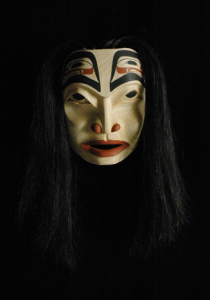
john-wilson5

Learning the life and passing it on

At the same time, Wilson finds his carving, which he describes as “contemporary Haisla,” becoming central to his life. “The art is very important,” he says. “It has changed my life for the better. I have a strong feeling that [art] is the right path, like it is what I was brought on earth to do.”

Besides the technique of carving and his reconnection to his history, one of the things that bemuses Wilson about his chosen career is the need to market himself. “When you finish a piece it’s like creating a kid of your own. Sending a piece out for sale is one of the hardest things to get used to. And I’m still learning how to market myself. A lot of people think that when you’re done your piece that it’s time to rest, but they forget the time and effort it takes to sell the piece. You have to really study the way to market yourself as an artist if you want to make a living doing the arts.”

john-wilson6

Now selling regularly to galleries, Wilson is currently able to support himself as an artist. “Some times are better than most,” he observes, “but it still gets me by comfortably.”

All in all, art has become so central to Wilson’s identity and life that he is now starting to pass on the encouragement he received from senior artists to others. “Just try it,” he advises. “You never know what will happen. Look at Freda Diesing – she didn’t start until she was in her forties, and she won a lifetime achievement award for her efforts at learning and teaching the arts.”

(John Wilson’s work is available in the Black Tusk and Path Gallery in Whistler, The Edzerza Gallery in Vancouver, The Art of Man in Victoria, The Stonington and Steinbrueck galleries in Seattle, the Arctic Raven Gallery in the San Juan Islands, and Neo Concept in White Rock).

john-wilson71

Read Full Post »

Six weeks ago, I wrote that freelancers were better equipped than full-timers to survive a recession, because they were more accustomed to looking for work. At the time, I had only the vaguest suspicions that I would be putting my confident words to the test less than ten days later. Linux.com, which was buying most of my articles, was going along much the same as usual, and, and, because SourceForge, its parent company, is publicly traded, I knew it had money in the bank. If anyone were recession-proof, then surely I was. And, in the end, I was right, although not in the way that I had expected.

By freelancing standards, I had grown complacent. Ordinarily, I try to diversify my sources of income. But I was already writing the maximum number of stories that I could write per month without increasing my work hours, so I hadn’t done so as much as I might. Instead, I had allowed myself to become heavily dependent on a single buyer.

Imagine my surprise, then, when my main buyer suddenly stopped buying stories – just in time for Christmas.

After I picked myself up out of the bomb crater, my first reaction was relief that I had at least diversified enough that I could cover my monthly expenses. But I wouldn’t have much left over, and I didn’t feel like giving up my newly acquired art habit, even if it is a luxury.

As I exchanged a flurry of emails and IRC conversations with my fellow writers, I realized that I had to move at once. Quickly putting together a mental list of the most likely buyers for articles on free and open source software, I sent out some queries – not detailing what was happening, but simply saying that some slots in my writing schedule had opened up.

The results, to say the least, were gratifying. Five hours later, I had replaced 85% of the income I had obtained each month from my main buyer. Within three days, I had not only replaced it all, but had done so with a reduced work load. I didn’t even have to go through half my list of potential buyers, although I still might.

Of course, for the past month, I’ve been kept busy getting to know new editors and their ways of doing things. Also, there was paper work — all the more so because I’m a Canadian writing for American-based sites. But all that’s a small price to pay for self-preservation.

Am I lucky? I am painfully aware that I am, especially when I had let myself become so comfortable. But, to some extent, I made my own luck. I still had enough of a freelancer’s instinct to know what I had to do, and that I had to do it fast before anyone else did. And, apparently, despite the vocal minority that like to badmouth me, I seem to have developed a reasonably good reputation – in fact, some of that reputation seems founded on the grounds that anyone badmouthed by certain people must be all right.

Still, my escape was far too close for me to be self-congratulatory. To some extent, I’m still in panic mode.

I don’t know if Linux.com will still be a market for me when the dust clears. But, just now, I doubt that I will return to becoming so dependent on it – or any other single outlet. More than anything else, I am coming out of the last month with my belief intact: As a freelancer, I really was equipped to handle recession.

Read Full Post »

I’ve never seen an episode of “That Was the Week That Was,” the British comedy series from the early 1960s often referred to as “TW3.” However, I’ve read that each episode always started with a song whose first lines were, “That was the week that was; it’s over – let it go.” Sitting here six hours before New Years’, trying to resist the temptation to reflect back and look ahead, that would be the most honest expression of my reaction to the change of year. It’s over – let it go.” I feel much the same about every year, which is why I don’t plan on any resolutions, either.

It’s not that 2008 was a kind of wild ride of horrors sweeping across my horizon, although it did have its share of moments I’d just as soon forget. And it’s not that there weren’t high points that have left me a partly different person from whom I was a year ago.

But I don’t see much point in dwelling on either horror or highlights simply because the calendar has reached an arbitrary point. Long ago, the year used to start on March 25, and other cultures celebrate the change of year by a different, fluctuating count, so there is nothing special about January 1st.

Nor is there any point in making resolutions – a custom, I suspect that is more often joked about and talked about than actually observed these days. I imagine that, for companies that benefit from what is left of the custom are hustling right now – companies that offer fitness coaching, for instance, or job advice – but I don’t happen to be one of them.

The closest I came to making money off the change of the year was to write an article a couple of weeks ago about what several prominent people thought about the outlook for free and open source software in 2009 – and, even then, I felt like I was pandering to popular prejudice.

Besides, the cynical part of me that stands to one side of my brain making flippant remarks can’t help point out how commercialized the whole idea of resolutions has become. Instead of being a time for renewal of purpose, the new year has become, in its way, as commercialized as Valentine’s Day or Christmas – and that’s I trend with which I have little sympathy or patience.

I do have plans, of course. I always have plans. But, just as I have long observed that people who talk about the books they are going to write rarely finish them, so I have noticed that people who talk about their plans never seem to carry them out. Last year, for instance, I noticed a rise in the people going to the local gym for the first few weeks of January – and a drop by the end of the month, as most of the newcomers disappeared. I have a half-superstitious belief that making a talking about my plans is a sure way to guarantee that I don’t follow my plans, so you won’t hear anything about resolutions from me.

Besides, they’re kind of private, you know? I don’t feel like telling everyone about the domestic changes I’d like to see, or the quarrels I plan to end, or the places I hope to sell my writing. Like charity – like prayer, according to the parable in Luke about the Pharisee and the publican – plans and resolutions are private concerns that you don’t parade in public if you sincerely mean to follow them.

For these reasons, I plan on starting the next year neither nostalgic or full of resolves I am incapable of keeping. Instead, I’ll plod along one step and one day at a time, the same as I always do. And, if you think that sounds Grinchish or just plain unimaginative, I’ll tell you what: I bet I reach my personal goals before you reach yours.

Read Full Post »

Humans have been keeping parrots for thousands of years. Unfortunately, though, most of what the average person thinks they know about parrots is incomplete, inaccurate, or just plain wrong. The result of this ignorance is often the mistreatment of birds, made all the sadder (but no less serious) because it is unintentional.
In the hopes of helping people to avoid mistreatment through ignorance, here are 10 common errors about parrots:

  • Parrots are tropical birds: It’s true that many parrots live in the tropics. However, just as members of the corvidae (blackbirds, crows, and ravens) have filled every ecological niche in the northern hemisphere, the psitaccines (parrots) have filled every niche in the southern hemisphere. In other words, you’ll find parrots in temperate zones and even above the snow line in the foothills of the Andes and the Himalayas, not just in warmer climates.
  • All parrots talk: Some parrots pick up words on their own, but, behind every parrot with a large vocabulary is a human who has spent hundreds of hours helping the bird to learn. Nobody can guarantee that a parrot will talk, although you can increase the chances by choosing the species and a bird with talking parents and patient early trainers. However, many of the most lovable parrots I have met don’t talk at all, and, in general, talking ability should be the least important reason for buying a parrot.
  • Parrots don’t understand what you are saying: Despite the use of the verb “to parrot” to mean “to repeat without understanding,” the work of Irene Pepperberg shows that parrots have an intelligence and language-using ability that borders on the lower edges of humanity’s.
  • Parrots lack expression: Just because a parrots’ face is dominated by a large beak doesn’t mean that they are hard to read. Like most social animals, they have complex body language that expresses a variety of moods and reactions. Observe or ask around, and you’ll have no trouble understanding how a parrot is responding.
  • Parrots require less attention than dogs or cats: In fact, the opposite is true: Most parrots are intensely social, and require much more attention than most pets. Confining a parrot to a cage all the time is actually a form of abuse, even if the SPCA doesn’t recognize it as such.
  • Parrots are dirty: In fact, parrots are as fastidiousness as cats. They will spend hours cleaning and grooming their feathers into the proper position. And, given half a chance, most will learn to relieve themselves in one particular area. Generally, whenever you see a dirty bird, you are seeing the result of improper treatment.
  • Keeping a parrot in a cage is cruel: All parrots are very territorial, and, as adults, will have their private space. In the wild, that space is usually a nest. But, for domestic parrots, that space is often a cage, or includes it. So long as a parrot can come and go for large parts of the day, providing a cage is not only far from cruel but also essential for a bird’s mental health.
  • Parrots only eat seed: Seed can be an important part of a parrots’ diet. However, to stay healthy and live a long life, parrots also need fresh fruit and vegetables. These days, several types of pellets exist to give them the proper nutrition, but you should probably vary pellets with other foods, if only to give the birds some variety. After all, no matter how much you love lasagna, you probably don’t want to eat it every day for three meals a day.
  • When a parrot reaches for you with his or her beak, it’s going to bite you: Well, sometimes. But parrots also use their beak to help them climb, and their tongues to taste a human or other bird as a tentative gesture of trust. The trick is to learn parrot body language so that you know what the bird reaching for you intends and how you should respond. Otherwise, you may get a bite simply because a bird is responding to your nervousness in kind.
  • Parrots mix well with other animals: Some parrots get along well with other animals. However, others do not. The truth is, you should never let different species interact unsupervised, because one species may not understand the other’s body language. If you do, you are risking injury and trauma to one or more animals – and not always to the parrot; more than one cat has learned the hard way that a beak is a deadly weapon.
  • Parrots can live to be over a hundred years old: A parrot’s life expectancy depends on the species. Some macaws are known to have lived into their eighties, while a cockatoo at the San Diego Zoo was over 100 and blind when it died. Other parrots seem to live 40-70 years. However, very little research has been done on the subject, and we don’t know much about parrot life spans, except to say that, properly cared-for domestic birds probably live an average of twice as long as their wild counterparts.

There is much more that you can learn about parrots, but a great deal of that is learnable only over years. However, if you remember these debunkings, you will at least not have to unlearn very much before you start to understand parrots.

Read Full Post »

You don’t have to dig very deeply into Northwest Coast art to stumble across a representation of Raven stealing the light from the chest where its owner has cached it. Whether you’re looking at a print, a piece of jewelry or a sculpture, in any gallery, you have an almost certain chance of finding a representation of the myth. In many ways, the story is to modern Northwest Coast art what the crucifixion or a Madonna and child were to the Italian Renaissance – a standard subject that most artists tackle sooner or later. That’s why Bill Hudson’s “Raven Opens the Box of Daylight” tickled our sense of humor so much that an artist’s proof of the cartoon was under our Christmas tree this year.

Bill Hudson is the spouse of Clarissa Hudson, the Tlingit weaver and painter. From what I’ve seen, much of his own work is more mainstream and includes a good deal of commercial and theatrical design. However, some of his work shows a Northwest Coast influence, including a poster he did for the twentieth anniversary of the Alaska Folk Festival that shows Raven, human with a mask for a head, wrapped in a robe of his own feathers and strumming a balalaika.

What I like about Hudson’s cartoon is the way that he has reduced a myth from the dawn of creation to a modern, mundane scene around a breakfast table, complete with orange juice and toaster. Far from being a great treasure, the light is contained in a commercial cereal box. It’s a good-natured but hilarious comment on just how common the story is; I’ve described the piece to several Northwest Coast artists, and all of them have understood the point immediately.

At the same time, Hudson has paid close attention to detail. Outside the window, you’ll notice, the stars and moon are visible, since in any form, the story predates the sun. Also, the raven’s feathers are not just black, as ninety-nine out of a hundred people would describe them, but tinted with a dark blue, as a raven’s feathers actually are. I appreciate such close attention to detail in what, for all its satire, is essentially a slight piece – so much so, that I have started paying closer attention to the rest of Hudson’s work, on the grounds that anyone who takes such pains is (at the very least) a thorough-going professional.
box-of-daylight-small

Read Full Post »

This year, I have no serious work and nothing more pressing than the wrapping of a few gifts for Christmas Eve. I don’t even have to go outside, except for exercise, which is a relief, because what passes for a blizzard here is pelting down on the other side of the window. I’m glad to be able to cocoon, and I’m not missing in the slightest those office Christmas Eves in which everyone pretends to work and keeps waiting for the executive officers to set a holiday example and leave early. And, as I smugly settle to loaf, I’m especially thankful that I haven’t spent the past few weeks working in a mall store.

Between my university degrees, I spent three Christmases in a mall book store, and they were the worst so far in my life. It didn’t help that, one Christmas, the mall had only two albums, which the management played incessantly from November 15 – nor that one of them was a Smurf Christmas special. To this day, I retain an aversion to squeaky voices and blue-colored midgets.

Pre-Christmas shopping means longer hours of operation for a store, and more money for the part-time staff, of which I was one. But the extra money did not compensate for the stress of that month. The crowds would always pin two staff to the cash register – the most boring part of the job – and random questions would keep everyone else from housekeeping work like stock checking or re-stocking the shelves. A few minutes snatched in the back room would be a relief, just to get away from the crowd. After a week or so, things were so bad that no one wanted to venture into the mall to eat – although, if you stayed in the back, you would probably be called to help with an emergency on the floor.

The uncomfortable truth is, pre-Christmas shopping in a mall reveals middle-class North Americans at their worst: Impatient, cranky, rude, and self-centered. Everyone wanted the staff’s attention at the same time, and a vocal minority did not believe in taking turns. For many, pre-Christmas marked their only foray into a book store all year, and many were uncomfortable there. Some would try to haggle on already discounted books. Others insisted on special attention that no one had time to give them, such as running their purchases to the post office and sending them off to relatives in Europe. A few always seemed to mistake the book store for the daycare center, and would drop their pre-school kids off to rummage through the children’s section, where only constant policing kept the books in saleable condition, and screaming children running through the aisles added to the chaos of hundreds of people doing something they hated. The situation wasn’t helped by the fact that most of the customers were dressed for winter, and quickly became over-heated in the mall.

Then, just to make matters worse, most of the customers were only interested in only a handful of books that were making headlines just then. That meant that, if you weren’t trapped at a cash register, as a staff member you were bombarded with the same questions several dozen times in a shift. I still think that a white board with the most common questions and answers would have helped. Not that many people will read anything unless prompted, but it might have helped the temper of the staff.

Closing time was almost impossible. Some people didn’t want to leave, and had to be told outright that they had to go. Others would dash in at the last minute, if a staff member wasn’t posted at the door, denying them entry. Even then, the staff was lucky if its members didn’t put in forty minutes of unpaid overtime before limping home, tired and irritated to collapse into bed – where they faced nightmares of endless hordes of customers, and tried not to think that they would be having another extended shift in twelve hours.

The pre-Christmas season was so stressful that I didn’t enjoy any of the Christmases I spent in the book store – not least because, after Christmas, the return season was almost as bad, its only improvement being a return to regular hours.

The only good that came out of the experience was that the third Christmas in the book store gave me the incentive to go back to school for another degree. I had no idea of what I would do with it, but, for a few years, I figured, I would have sources of income that didn’t involve fending off a mob.

But the experience had some long-lasting effects. Even now, years later, I avoid shopping malls whenever possible, but particularly from mid-November to mid-January. If I have to go to a mall around Christmas, I go on a commando raid, at a quiet time, and getting in and out as quickly as possible. My Christmas shopping, I do mostly elsewhere. And, at this time of year, I look back with a shudder, glad that period of my life is over, and only relived in stories.

Read Full Post »

Last month, a friend phoned to ask my advice about the price of a Northwest Coast mask that he had commissioned. The price the artist had quoted seemed high to him, but he was still interested in the mask. Thanks to my frequent gallery browsing – both in person and online — I was able to reassure him that, for a piece of that size by an artist of that reputation, he was getting a reasonable price.

More recently, I saw a piece by a new artist and instantly recognized the price as too high for this moment in the artist’s career.

From these two experiences, I realized that, not only is the price of Northwest Coast masks is determined by a couple of factors – the artist’s reputation and the size and finish of the mask – but that there is a rough consensus about how those factors affect the price. This consensus exists throughout British Columbia, so, contrary to what you might expect, you are unlikely to find many bargains outside of Victoria or the Lower Mainland regions. It is undoubtedly due to the fact that galleries and artists are always comparing notes and the fact that a handful of artists are widely viewed as a guide to pricing. In particular, Beau Dick, although widely recognized as a leading carver, has never priced his works as high as he probably could, but varies his prices according to the complexity and size of his work.

As near as I can construct it, here is a list of what you can expect at each price range when you buy a Northwest Coast mask. All prices are in Canadian dollars:

  • Under $2000: The largest group in this category are masks for the tourist trade, generally by artists who have few chances of selling to upscale galleries such as Douglas Reynolds. New artistically-oriented carvers and minis (masks 7×7 inches or smaller) – also fall into this category.
  • $2000-$3000: In this category, you can find average-sized masks (roughly 12-14 inches high) by artists who are starting to gain a solid reputation, or simple or experimental masks by established artists. Most artists’ work does not stay in this price range for very long, except for some long-established carvers for tourists.
  • $3000-$6000: This category is by far the largest. Most masks in most galleries usually fall within it. Here, you find works of average size and complexity by artists who have a modest reputation for their carving. You also occasionally, large works by lesser-known artists in this range, but the restrictions on beginning or relatively unknown artists are tight enough that such works appear only rarely.
  • $6000-$10,000:This price range seems reserved for large or intricate works by artists whose work usually falls within the previous category. One of the signs of consensus is that you find relatively few artists whose prices fall consistently within this category.
  • $10,000 and above: Only large and elaborate masks or normal sized ones by master carvers fall into this category. Very few masks sell above $18,000, although I have seen a Beau Dick mask over four feet tall selling for $28,000.

These ranges are only generalities. A lesser-known carver making a bid for more recognition may temporarily or permanently raise their prices, while a more established artist may lower the price on a specific piece that they feel does not represent their best work. Similarly, a smaller or larger size may bump a specific mask from the artist’s norm. Almost always, reputation trumps size: for instance, I recently saw a mini by Dempsey Bob selling for just under $5,000, a price that reflects both his fame and the fact that these days he does little non-monumental work in wood.

I should also mention that artists do not necessarily view this consensus as fair. They argue that, especially in the lower categories, it hardly pays to take the time to finish the mask – and no doubt they are right.

However, other artists figure that selling in the lower categories is a part of their career that they simply have to endure – and they are right, to. Unless an artist is lucky enough to live on commissions or has another means of exhibiting work to the public, they have little choice except to participate in a market in which both they and their work are evaluated in detail by the market.

Read Full Post »

During today’s Christmas shopping expedition, I witnessed a short scene that taught me something about my concepts of artistry.

I was in a local gallery dedicated to Inuit and Northwest Coast art. A well-known First Nations artist was working in the back, refurbishing the cedar braid on one of his works in the gallery, and doing the same for the work of his son, who is an artist in his own right, and has been for some years now.

While he was working, he looked at one of his son’s carvings. “I don’t know why he finished that with a rope,” he muttered in disgust, seeing that the rope was nylon. A few minutes later, he muttered, “And why did he use such big nails to hold it in?” As he complained to himself, he was stripping off the rope and replacing it with bundles of cedar branches.

The artist was unquestionably right in his aesthetic judgment: His son’s carving was greatly improved by the removal of the rope and its replacement with cedar bundles. Still, I found myself reacting simultaneously in two different ways.

One part of me was reflecting ruefully and with some amusement how hard it must be to study under your father, and to have him improving your work even after you are recognized as a artist yourself.

At the same time, another part of me was shocked. Like most people in modern industrial culture, I tend to view art as an individual form of expression. From this perspective, correcting another artist’s work is unacceptable, a form of aesthetic hostility and violation that seems even worse than physical harm. It is also lying to the audience, who pay expecting a work by one author, but actually get a pastiche. The fact that most audience members will never realize the switch doesn’t matter; they are still not getting what they paid for.

But, when I reflect more deeply, it’s really nothing new. I remember having the same reaction when I learned that various members of a group of writers I once knew would happily pitch in and finish each others’ work to help meet a deadline or to add a level of expertise that the person whose name would be on the cover couldn’t provide. For them, it was a sensible thing to do, especially since some of them shared a house. By volunteering their anonymous services, they were helping to ensure that the taxes and utilities would be paid.

Moreover, similar helping hands have been extended for centuries by masters to apprentices. I know, too, that many of the carvings attributed to Bill Reid were partly a collaboration, with Reid providing the design skills and other members of the team providing the carving skill. So my shock is hardly a valid reaction.

What matters, I keep telling myself, is the finished work of art. Could it really be considered a lesser piece if another artist than the accredited one contributed to it? Logically, that would be an absurd point to defend.

I suspect that my reaction shows that I am unlikely to enjoy collaboration on any of my own efforts – a fact that I might have also deduced from my uneasiness at being edited, even when the editing improves my work.

Read Full Post »

For eight years, I made most of my income from technical writing. Not the relatively glamorous technical writing involved with writing articles about free and open source software (FOSS) – glamorous, that is, to those who haven’t done it (those of us who have done it are usually considerably less starry-eyed) — but basic how-tos and detailed instructions to accompany hardware and software. Looking back, I must have been reasonably good at the job, since I went from a beginner to a consultant with a sub-contractor in eight months, and kept myself steadily employed most of the time and well-employed much of the time.

Based on that experience, I would like to offer some advice for those who are trying to fill the gaps in FOSS documentation. It’s a thankless job, under-appreciated and laborious, but, if you’re going to attempt it despite all the disincentives, you might as well do it properly. After all, your satisfaction in doing the job properly might easily be your only reward:

  • You must become an expert in what you are writing about: Some professional technical writers pride themselves on being specialists in communication, and feel they don’t need to know the details of what they are writing about. You can always tell manuals done by them, because they are shallow and have large gaps in them. Likewise, you can always tell this type of technical writer, because they’re despised by any developer with whom they work. The truth is that, while you don’t need to be an expert when you start documenting, if you aren’t expert by the time you’re finished, you aren’t doing the job properly.
  • It all comes down to structure: Anybody with average intelligence or better can learn to write a coherent sentence or paragraph. However, structuring several hundred pages is hard work – much harder work than the actual writing. The need to structure is also why you need to become an expert in your subject; if you’re not, how can you know what information to put first, or what’s missing? Don’t be surprised if you spend 50-75% of your time in planning the structure, or if your first outline changes drastically as you work. Both are indications that your work is developing the way that it should.
  • In the majority of cases, the best structure will be a list of tasks, arranged from the most basic or earliest to the most complex or latest: It will almost never be a list of menu items and taskbar icons, except in brief introductions to the interface. This task-orientation is a major reason why you need to be an expert in what you are writing – if you’re not, you won’t have any idea of what users might want to accomplish.
  • Think of your audience as being attention-deficit: Knowing your material is necessary, but it can also make you forget what new users need to hear. The best way to write to the level you need is to project yourself imaginatively into the position of a new user, but, if you can’t manage that, imagine that you are writing for people with low attention spans who are easily bored. The result may spell out the obvious for some readers, but other readers will be glad that you are thorough. Always remember: What is obvious to you isn’t obvious to your readers.
  • Don’t worry about style: In fiction, writers often call attention to their style. By contrast, non-fiction like technical writing is not about you. Your job is to provide simple, clear prose in which you are invisible. And if that sounds boring or unchallenging, you might consider Isaac Asimov’s observation that stain glass windows have been made for over a millennium, while clear glass was a much later development. In many ways, writing simply and clearly is much harder than writing with flourishes and personality. Focus on clarity and content, and let other style considerations take care of themselves. You’ll be surprised how well they work out without you thinking consciously about them.
  • Use structured prose whenever possible:Bullet lists, numbered lists, tables, and callouts on diagrams – all these techniques are conciser and easier to understand than straight prose
  • Your first draft is probably going to be terrible: But that doesn’t matter, so long as it improves by the end. What matters in the first draft is getting something that you or others can analyze for gaps and make estimates about the finished documentation from. Probably, the physical act of writing will be no more than 25% of your time. Often, it will be much less. If you’re planned properly, and begin writing with a thorough understanding, it should almost feel like an afterthought.
  • Don’t mix writing and editing: Writing is a creative process, editing a critical one. If you try to mix the two, you will probably do both poorly. You may also find yourself freezing up and being unable to write because your self-criticism is interfering with your ability to write.
  • Make sure editing is part of your schedule: Editing should not be a last-minuted effort. Instead, accept it as an important part of your schedule. Expect it to fill 10-20% of your time.
  • Editing is about structure as well as words: Editing is not just about spelling or correcting grammar. It’s just as much about the structure of the work.
  • Get second and third opinions: When you have just finished writing, you are probably unable to judge your work effectively. Get other people to review your work in as much detail as possible. If you can’t get other people to review, put the manuscript aside for several days. If you can’t put it aside, print it out, or take a break before returning to it.
  • Expect revisions: Based on my experience teaching first year composition at university, I can say that the average person takes 3 to 4 drafts to produce their best work. You may be naturally talented or reduce that number with practice, but don’t count on either until you have some experience.Make sure you budget the time. You’ll know if your efforts are succeeding if the general trend is that each draft becomes quicker and quicker to write. If that doesn’t happen – especially if you have to keep reinventing the structure or making major additions – then something is probably seriously wrong.

With any given piece of writing, you may not be able to follow each of these pieces of advice. Deadlines in particular may keep you from giving each of these points the attention it needs. But keep all these points in mind, and you will be more likely to write documentation that people actually use, instead of an after-thought to the software that is never used.

Read Full Post »

« Newer Posts - Older Posts »