Feeds:
Posts
Comments

Archive for the ‘Uncategorized’ Category

A few moments ago, I changed the flapper tank ball on the toilet. That would be an unpromising beginning for a blog entry, except for the unwarranted satisfaction I took from the job. Not that the repair needed a plumber, but I grew up thinking that I wasn’t the least bit handy. The fact that I am now in any way competent at home repairs I attribute largely to over a decade of using free and open source software.

So far as I remember, nobody ever told me I was clumsy in so many works as I was growing up. But, with one thing and another, I certainly received that impression. For one thing, I am left-handed, and, while like many lefties, I am necessarily more ambidextrous than the rest of the population, to the average eye, I looked clumsy. More importantly, I usually had to reverse any demonstrations I was given, an effort that few young children can successfully make, no matter how bright they happen to be. Consequently, I was a long time learning to tie my shoes or swim – which only justified everybody thinking me clumsy – including me.

Probably, I wasn’t helped, either by the fact that I tried to compensate for my clumsiness by being energetic and aggressive when I played sports. These traits gave me a rough and ready ability, but I wasn’t initially chosen for the school soccer team in Grade Six, or as one of the Saturday morning players tapped for going into the premier division a few years later. I only learned the skills a soccer player needs to control the ball or work with a team a few years later.

Besides, I was bookish and liked academic subjects in school. Naturally I wasn’t supposed to have any physical skills as well. That would have been against all the laws of stereotyping.

Consequently, between one thing or another, I grew up thinking myself uncoordinated – a self image that, unsurprisingly, often made me just that. Whenever I tried anything new, I expected to do it poorly, so often I did.
Once, when I called myself a slow learner, a teacher replied, “Yeah, but I bet than when you do learn, you don’t forget it.” But that was not much compensation.

It was only when I became a university instructor and later a technical writer that I realized another source of my clumsiness: Most people are terrible teachers, even when they teach for a living. Few have the patience to work with beginners. Even fewer can remember the days when they were beginners. Inevitably, they leave out important steps when they try to instruct, or fail to mention what to do in unusual circumstances. Probably, the main reason why I taught English and wrote manuals successfully is that I tried to give students and users the instructions that I would need myself.

But the real revelation came as I started using GNU/Linux as my main operating system. Like everybody else, using Windows had taught me how to be helpless. The default resources discouraged me from exploring Windows, and the information I needed was mostly lacking.

GNU/Linux, though, is different. It is designed for users to poke about and configure. If you run into trouble, help is only an Internet search away.

Without making any conscious decision, or being aware of what was happening, slowly I started to learn how to troubleshoot. I learned that very little I could do would harm my installation, much less cause the motherboard to belch flames, as I half-feared. All I had to do was observe, take a few precautions, and work systematically, and I could do far more than I had ever imagined when I was a Windows user.

Gradually, I transferred this same mind-set to other parts of my life. To my surprise, I found that it was usually just as applicable to home repairs as those on the computer.

I won’t say that I have any particular talent for handiwork. But, somewhere along the line, I stopped thinking of myself as clumsy. I no longer approach every new physical task with the expectation of failure, and, far more often than not, I succeed at it. Even on those occasions when a real expert is needed, I often understand what the problem is . A surprising amount of the time, I just lack the tools or the parts to do the job myself.

This personal change is one of the biggest reasons that I am committed to free software. Using Windows only reinforced my belief in my own incompetence at fixing or improving things. By contrast, free software proved to my that I was capable of far more than I had ever imagined.

Read Full Post »

Yesterday in a local gallery, I saw a Northwest Coast mask selling for $22,000. The price surprised me, because, ordinarily, only a recognized master could ask this sort of price. However, the carver was an artist I would characterize as an experienced journeyman – someone known for his skill an with a growing celebrity, but lacking the years and a sufficient body of work to be considered a master.

Tentatively and politely, I suggested to a gallery employee that the mask was over-priced. I was told that the carver had originally planned on asking for even more.

This was not the first time I have seen artists asking higher prices than their reputation would justify, and it never fails to arouse mixed feelings in me.

On the one hand, an artist’s ability to command a price is not tied absolutely to their reputation. If an artist can find someone to buy at what I consider an inflated price, then in the most basic sense, that is all the justification the price.

Moreover, why shouldn’t artists get the best price they can? The typical Northwest Coast artist starts by selling so cheaply that the price hardly repays the price of their labor. Part of me argues that, after years of underselling their work to keep the gallery system going, artists deserve a little bit of compensation later in their careers (although, personally, I’d like to see fairer prices for newer artists).

On the other hand, the hierarchy of prices is well-established for Northwest Coast masks. New artists’ work usually sells for less than $1500, usually with 40-60% of the retail price going to the artist. As artists become better known, their prices gradually rise, although the size of a mask and its finishing details can also affect the price. When their prices hit about $4000 for an average-sized mask, you know that the artists are starting to be respected. When the prices rise to $6,000-$8000, you know you are dealing with well-respected artists. Over $10,000, and the artists are recognized as masters. At prices above $20,000, artists have international reputations like those of Bill Reid or Robert Davidson.

Exceptions exist to this rough outline – for instance, as acknowledged masters, both Beau Dick and Henry Green could increase their prices by fifty percent or more and probably still sell. However, this hierarchy is the norm, and recognized by most Northwest Coast artists.

To go outside this pricing scale is dangerous for an artist. Prices that are set too high can condemn an artists’ work to gathering dust in the gallery. But, just as importantly, when artists set their prices higher than their status, it seems to me a form of boasting. For instance, the mask I saw yesterday seems to proclaim that the artist considers himself the equal of all the great names in Northwest Coast art – to which I can only answer that he might be some day, but he isn’t yet. The mask was certainly skilled, but it was hardly outstanding, either. I have seen (and bought) masks at a fraction of the price that I considered better works of art.

Possibly, I’m showing a middle-class crassness with these reactions. At the best of times, I find a system in which even mediocre works by a major artist are worth more than an outstanding work by an unknown artist. But I do know that I would feel foolish buying a piece at an inflated price. Even if I could afford such prices, I would feel in the back of my mind that I had been conned, and that would diminish my enjoyment of the art.

So maybe it’s just as well that the price I saw yesterday was beyond what I could afford, and that I wasn’t overwhelmed by the mask. In this case, the question of putting my money where my ambivalence is doesn’t arise. But I wonder what I would do if I see a similarly over-priced piece that I really would like about the house.

Read Full Post »

As I write, I am several days into resuming my normal exercise routine. I’ve spent the last two weeks sidelined with a knee injury – not the first time this has happened, and probably not the last, although I hope it is. But as I shake myself clear of my Ibuprofen-induced haze, as always I am aware of an overwhelming truth:

Walking is wasted on the able-bodied.

Seriously, there is nothing like losing an ability to make you appreciate it. When you have a leg injury, your entire perspective changes. Whether you’re limping along unaided or using a cane or crutches, suddenly distances seem to increase, because you need more time to travel them. Public transit, you realize, is far less convenient than you once believed, due to the distances between stops or the need to walk up to the platform. Even going from the living room to the bed room can seem a long journey that needs to be planned; if you forget something, you are not exactly going to nip back to pick it up.

When your legs aren’t functioning properly, you feel more vulnerable, too. The vulnerability is especially strong in public, where, if you must be a cripple, you hope you can at least appear to be a sturdy one who is capable of beating wallet-snatchers off with your cane. Yet, in the safety of your home, the vulnerability is only marginally less, if, like me, you hate being dependent on someone. A few days of limping, and you can work up a fine cloud of depression at your increased helplessness.

You start to wonder if what you’re experiencing is a foretaste of old age. If so, you conclude, you are probably not strong enough to endure the experience. The line “Hope I die before I get old” becomes, not a line from the heyday of The Who, but a completely reasonable point of view.
After a few days, you have to keep reminding yourself that your condition is not permanent. A couple of weeks, and civility is stripped from you like the veneer of civilization that it is. If you can’t impress through physical activity, your hind brain insists, then you will impress through crankiness instead.

Then, just as despair threatens to win, you wake up one morning feeling strangely lightened. You are still not walking well, so you take a while to realize that the chronic pain that you’ve been living with is faded to a dull ache. Suddenly, you have something to anticipate.

A day or two later, and you are walking on your own again. You are taking short, unbalanced steps like an upright hippo probably would, but at least you are walking. Ten minutes of being upright tires you like sprinting a couple of kilometers, but at least you can do it.

When you stand, you can feel the muscles in calves and thighs shifting to propel you upright and keep your balance. From the way you hurl yourself upright, you realize that most of the effort in standing has been made recently by your arms, and that you can transfer the effort back to your legs again.

Start to walk, and you wonder how you ever took for granted the interplay of muscles that make you a bipedal ape. You can feel muscles that generally you are hardly aware of contracting and pulling against one another. The physical awareness is such a joy singing through you that it feels a like a brief return to your teens. The fact that bipedalism is the result of endless evolutionary compromises only makes it seem all the more wonderful.

Soon enough, you start to forget the marvel called walking. It becomes automatic again, and you stop thinking about it. But for the first day or two after you return to walking, you find yourself looking at all the people around you who are oblivious to this simple delight and thinking, “You ungrateful bastards. You need a week on crutches to appreciate what you have.”

Read Full Post »

If you believe the media, Canada is the model of a modern multicultural society. The official story is that Canada is a place where people of different cultures meet and interact without much friction. You sometimes hear about people being stopped by the police for “driving while black” or the recent allegations that the niqab is a security risk, but these are generally seen as exceptions caused by a dwindling minority of bigots. Most of us, the official message reassures us, are not like that.

Recently, however, I’ve become increasingly aware that at least one group (or, more properly, one set of groups) for whom face to face racism is a daily given – the First Nations.

In some ways, this realization doesn’t come as a surprise. The media is quick to depict First Nations people as uneducated, rural hicks, and victims. You rarely hear about the small but growing professional classes among the First Nations, people who balance urban life and upper middle class expectations against a wish to remain rooted in their own cultures. For the most part, First Nations cultures are barely acknowledged, except when they can add quaint experiences to tourism. You have to search long and hard to find any media depictions of the First Nations as people rather than stereotypes, so in one sense it seems understandable that non-First Nations people should respond to the stereotypes while ignoring the realities.

However, as I explore Northwest Coast art and become friendly with some of the artists, I’ve come to understand that casual racism is part of many First Nations people’s daily lives. Even the artists – gifted people who deserve respect for their accomplishments – have to endure it. Almost every First Nations person I get to know has a story or two about racism, and some people bring them out as a sort of test, to see how strangers will react and to judge their trustworthiness.

For instance, one First Nations instructor says that people regularly compliment him on how well he speaks English. What do they expect? That in 2010 he speaks broken English, or maybe Chinook? Since he teaches, he must have at least a master’s degree, if not a doctorate. What would be surprising is if he didn’t speak well.

Similarly, an up and coming artist tells me that a client who commissioned a carving by him told him at length how “his people” were so spiritual and connected to nature compared to the rest of industrial society. The client had never met him, and did not even know what nation he was from – let alone his clan – yet she was convinced that she could tell him all about his culture. Probably, she thought she was complimenting him. Still, at least she was paying for the privilege (personally, I would have added another few hundred dollars to the price).

Still another artist who is scheduled to inherit a chieftainship, told me that during the Olympics torch relay, an official asked him if “you could get your people to line up on the side of the road to hoot and holler.” A big man, he looked down and said calmly, “We do not hoot and holler.”

Another First Nations man says that he doesn’t receive much open racism because he is tall and stocky, and was raised in an upper middle class family. But he does receive all sorts of covert racism – things like bank clerks lingering just a little longer than necessary when checking his I.D. or cashiers treating him as though he was brain-damaged. Similarly, one artist tells me that when he tried to deposit a large cheque, the teller asked if he was a drug dealer. And, because of similar experiences, another artist has a note on his bank account, explaining what he does for a living in the hopes of keeping bank officials from jumping to conclusions.

I could go on and on, but the point should be clear enough. First Nations men and women regularly endure treatment and comments that are sometimes lacking in epithets but is hardly less vicious for that lack. Often, the remarks are made with a false heartiness that means that taking offense will put their recipients socially in the wrong.

I suppose that to some extent, they get used to the casual abuse, and perhaps they feel they have no choice except to endure, because they will be blamed if an argument or a fight breaks out — the law, quite clearly, is not on their side.

All the same, I wonder how they do endure such comments. I sometimes think that, in similar situations, I would show considerably less restraint. But then, as the descendant of English people, I am used to being treated more politely.

Still, I no longer wonder, as I used to, about a Metis classmate of mine who never mentions her ancestry and dyed her hair blonde. If you can escape from such situations, why wouldn’t you be tempted to try? Even pride and determination must become awfully thin defences after a while.

On some level, I am not surprised by this realization. I know all too well that there are official versions of reality created by the government and the media that have little to do with what has actually happens.

All the same, I can’t help feeling some righteousness anger over this realization. I shouldn’t be surprised or upset to discover yet again that the official version is a lie – but, all the same, I am. And I realize, too, that experience of other groups is undoubtedly as ugly as that of the First Nations. In some ways, this official story is as offensive as the racism itself.

Read Full Post »

The process of digitalizing a life time of music keeps bringing rediscoveries. One of the recent rediscoveries is Michelle Shocked, who is not only still recording, but has also managed to regain control of her own music.

Shocked first became known in folk circles in the late 1980s with The Texas Campfire Tapes. The album was based on some casual recordings by a British music producer who misrepresented himself as a journalist, and produced an edited version of her music that, due to faltering batteries, recorded some of her music too slowly and made her voice sound higher than it was. Nobody has quite said so in as many words, but, from what is carefully not said, the impression is that the album was either released without her permission, or with permissions obtained under questionable pretenses.

The album launched her career, but its promotion also created an image of Shocked as a naive genius, despite the diverse influences, intelligent lyrics, and wry humor of many of the songs themselves. Considering the many changes of direction in her musical career, this image must have handicapped her career, with her record company trying to pigeon-hole her into a category that didn’t fit.

I didn’t know about all this back story when I bought a cassette of The Texas Campfire Tapes years ago. But, as the story surfaced, I felt more than a little guilty. I mean, the songs were worth hearing, yet wasn’t listening to the album a sign of disrespect to Shocked? Perhaps this guilt was one reason that, over the years, I stopped listening to Shocked, although I was vaguely aware that she had released other albums, and her second album, Short Sharp Shocked, was briefly one of my favorites.

Now, after a couple of decades of fighting with record companies, and Shocked has control over her own material again. A few years ago, she re-released her first album under the title of the Texas Campfire Takes, which I hurried to purchase as a download from her web site.

The Takes includes the original material played at the proper speed, as well as the raw material, complete with introductions and a few new songs, from which her first album was edited. In some cases, the edited versions of the songs sound more professional – or, at least, better produced – but the raw material, despite being uneven, is often more satisfying, and provides more context.

But the important thing is that now we can hear the music the way that Shocked prefers it. The result is a small victory of an artist over a recording company, and I’ve celebrated it in the only possibly way – by discarding the old cassette and replacing it in the music collection with the new download.

And somewhere deep inside, an old guilt seems to have quietly died. I’ve started listening to Shocked again, and I am slowly ordering her backlist an album or two at a time.

Read Full Post »

Finishing details, a carver once remarked to me, are what makes a mask. Our latest acquisition, Ron Telek’s “Coming of the Winter Storm” is a perfect illustration of this basic truth.

Stripped to the basics, the mask is a standard Telek face. The nose, with its short length and separate cups for each nostril, is visible on any number of Telek’s previous works. So are the lines of the cheek, the even width of the lips, and the broad forehead. The eyes are somewhat unusual, since each wraps around two sides of the face, but not their shape. All in all, the basic face is so characteristic of Telek’s work that it could have been roughed out by an apprentice (and by some accounts, it might have been).

However, what makes this piece are the finishing details. For example, the hands raised to the face suggest the depiction of the winds on old European maps. Yet, if you look closely, you see that they are much smaller than the size of the face would make you expect. Either the wind spirit is a dwarf like the Bukwus, or its proportions are altogether non-human.

Then there is the paint. Like his uncle Norman Tait, Telek does not often use color, and, in the few instances I’ve seen where he does, the color is not especially subtle. But on “Coming of the Winter Storm,” Telek manages a delicate blending of red and blue to suggest cold and chafed skin that is completely unexpected. When I say that the blending is worthy of Beau Dick or Simon Dick, followers of Northwest Coast art should understand how subtle it is.

But of course the most striking feature of the mask is its hair and eyebrows. The difference in their color is a master-stroke by itself, emphasizing the non-humanity of the spirit. The same is true of the unusual angles of the hair, and the length and angles of the brows. The fact that the hair and brow are formed by four dozen separate plugs shows a patient attention to detail.

Another point I might have missed if we didn’t already own four pieces by Telek is the finishing. Almost all of Telek’s wood sculptures are sanded so smooth they might be ivory, with a careful consideration of how the grain might enhance the work. Here, though, Telek has left parts chipped and rough – largely where the daubs of red appear. It is a detail that seems much more appropriate to this rough figure than Telek’s usual finishing.

This attention to detail uplifts what could have been something ordinary into the extraordinary. Quite literally, it made us decide to postpone redoing the kitchen floor in order to obtain the mask while we could. Now, it sits below the clock, an eye-catching piece from any angle in our living room.

Read Full Post »

Aboriginal artists in British Columbia have been combining traditions for some years now. Preston Singletary, for example, has collaborated with Maori artist Lewis Gardiner, while Terrance Campbell is strongly influenced by the jewelry of the American Southwest. But I admit I was skeptical about the collaborations of Mike Dangeli and Don McIntyre. Maybe the problem was my own ignorance, but I wondered how much artists like Dangeli in the Northwest style and McIntyre in the Woodlands style could exchange, beyond good will.

Don McIntyre (left) and Mike Dangeli (right)

However, in practice, the mingling of traditions works much better than I expected in “East Meets West: Throwing Power,” Dangeli and McIntyre’s combined show currently at the art gallery in the Student Union Building at the University of British Columbia.

The main reason, I suspect, is the obvious closeness of the two artists. Dangeli and McIntyre share studio space and are adoptive brothers. They share such a sympathy that at times, they say, they have trouble remembering who painted which line when they collaborate.

The mixture of their style may be sometimes jarring, but it succeeds because, while both Dangeli and McIntyre show a firm understanding of their respective traditions, they are also concerned with adopting those traditions to contemporary urban life, often with a sense of humor that begins with the titles of their works and continues with their choice of subject matter. Despite the large differences in traditions, this similarity of outlook allows them to meet in the middle, as their paintings do literally in the galley.

If you look at a selection of Dangeli’s work with any knowledge of the northern formline style, it immediately becomes obvious that he is intimately familiar with the tradition. And some of his work does not stray very far from that tradition, apart from the selection of colors.

However, in many of his pieces in this show, Dangeli’s rendering of that tradition is a departure from the norm. In the classical northern tradition, ovoids and U-shapes are rendered as though from a template – in fact, in large scale projects like house-fronts, artists often work from stencils.

Dangeli does work in this tradition. However, just as often – and perhaps increasingly – he favors a looser, hand-drawn rendering of classical shapes – a sketch as opposed to a smoothly finished work. Often, too, he combines shapes in non-classical ways. The result is that, where in his tradition, formlines tend to flow together, dragging the eye through a work, Dangeli’s looser renderings sometimes seem fragmentary and disjointed.

Perhaps the effect is a stylistic commentary on the survival of the northern tradition in industrial urban life. If so, the style is well-suited to Dangeli’s habit of commenting on this lifestyle.

The titles alone indicate his on-going commentary on the modern relations between First Nations people and this lifestyle, for instance, “Bright Shining Lie,” “For Those Who Had to Hide,” and “We Will Not Be Boxed In. Often, the titles are referenced by the techniques in each work, so that “Surviving the White Wash” literally has a wash of white over everything, while “We’re Not Open for Business,” an anti-Olympic statement,” has the shape of a Closed sign.

Don McIntyre’s relation to his tradition closely resembles Dangeli’s. Like Dangeli, McIntyre sometimes produces a piece that fits comfortably within his tradition, as in “A Place to Come Back To.”

"A Place to Come Back To"

Yet even when McIntyre appears to be working in the tradition, first impressions can be deceptive. His apparently innocuous drum (shown above), if you look closely, shows the union of sky and earth as an act of sex, and his title for this depiction of creation is “The Big Bang.”

Yet, where many Woodlands artists continue to depict natural scenes that have little in common with the cities in which they live, McIntyre tries to advance his school of painting by transferring its traditions to what he sees around him.

At times, the difference is subtle. As he pointed out to me at the exhibit’s opening, “Natural Urbanity” could easily be a classical work, if the streetlights were replaced by trees. At other times, as in “New Counsel,” nature creeps into the cityscape only in small oases, like the log that the birds in the canvas cling to.

"Natural Urbanity"

"New Counsel"

And, as in Dangeli’s work, McIntyre often turns his extension of his tradition into social commentary. In “(Dis) Placed Illusions,” for example, McIntyre combines an inukshuk, the symbol of the Vancouver 2010 Olympic Winter Games, with a sleeping polar bear, drawing a line between cultural appropriation and global warming .

"(Dis) Placed Illusions"

Combined with their friendship, such similarities make Dangeli and McIntyre’s collaborations exactly what collaborations should be: not just a juxtaposition, but something that neither could achieve by themselves.

For me, the most successful of the several collaborations on display was “Ben Couver: Olympic Gluttony.” The central figure, with its extended belly, fits in well with McIntyre’s style, in a way that it would not into Dangeli’s.

Yet, at the same time, Dangeli’s image of broken coppers being thrown into the water adds its own dimension. Moreover, the combination of Dangeli’s self-consuming two-headed serpent and McIntyre’s Wendigo provide two complementary images of destruction.

“East Meets West” is a small show, but it is an ambitious one. To its credit, though, it convincingly draws parallels between the two traditions in the show, and produces intriguing art in the process. While the gallery may be obscure for many people, it is well worth searching out just to see this show.

Read Full Post »

Four years ago, a doctor diagnosed me as having a mild case of osteoarthritis in my knees. I had run too many kilometers for too many years on blacktop, and now I was paying the price. My running days, he told me, were over, and the best I could do was light exercise. But trial and painful error has shown that the doctor was mostly wrong. If I was selective, I found, I could still do the kind of heavy daily exercise I’ve been accustomed to since I was eight. I simply had to make some changes in my routine.

The first change was to add some exercises to my daily routine. Half-squats, I’ve found, are ideal for building up the muscles around my knees to take some of the strain from them. I also do some stretching, one leg at a time, with a piece of surgical tubing while sitting on a bed or mat, and lie on the floor and walk an exercise ball up the wall.

For my main exercise, I’ve left the road for the gym. I now do repetitions on an exercise bike, varying the speed, tension, and duration from day to day and repetition to repetition to keep my interest up. The bike allows me a sweaty workout, but, because my weight is off my legs, pedaling puts very little pressure on my knees – in fact, even more than the exercises, it helps to reduce the aches around my knees. True, switching from running to cycling has changed the shape of my leg muscles, but that’s a small price to pay.

Recently, I’ve also added sessions on the summit climber. At first, I thought the motion would be too much like climbing stairs for me to manage, but the machine is designed to minimize pressure on the legs. If anything, the summit climber is even better than the bike for strengthening my leg muscles so I can work around my lack of meniscus. However, it is harder on the knees than the exercise bike, so I only use it in moderation.

Sometimes, too, three or four kilometers of walking is beneficial. I’ve never liked the slow pace of walking, but I can do it.

The doctor was right that I can’t sustain the sixteen kilometer runs that I used to do. I can run one without trouble, but on the second day, my knees start to give way. If I am stupid enough to persist for four or five days, my knees start to swell.

But I can manage five kilometers a day indefinitely, especially when they are added to my time on the bike and the summit climber. And, every now and then, for a change of pace when I’m feeling nostalgic, I can do ten or twelve kilometers. If my speed isn’t what it was – well, growing older was slowing me anyway.

At first, I worried that these exercises would hurry the degeneration of my knees. However, from experience, I doubt that is the case. My legs are stronger and my knees hurt less after a session on the bike, and I am now healthier and more active than I was when the doctor delivered his verdict of doom, and generally have much less discomfort in my knees, too.

Obviously, how active you can be with osteoarthritis depends on its severity. I’ve been lucky that my problems are relatively mild. But I’m convinced that the exercises I have discovered can not only help alleviate the symptoms of osteoarthritis, but also keep many of those with the condition far more active than they (or my former doctor) imagines. My only regret is that the doctor who diagnosed me has since moved away, so I can’t have the satisfaction of telling him that he was wrong.

Read Full Post »

For many modern Northwest Coast artists, improving their skills means discovering their culture. Kaska/Tlingit artist Dean Heron is no different, except that he came to his art and culture later than most of his peers – and, that, in pursuit of both, last year he moved north to Terrace, instead of staying in the south where many NorthWest Coast artists now spend at least part of the year.

“I was adopted as a child,” Dean explains, “and grew up in a non-First Nations family,” mostly in Whitehorse, Kitimat, and Powell River. “I had grandparents who lived in Victoria, so we’d often go down to Victoria in the summer time. My parents always used to drag me to the Royal British Columbian Museum to look into my culture, but at that point I was six or seven, and I was more interested in riding my bike, playing street hockey – being a kid.”

Creating the Watchmen

Then, when Heron grew up, he worked as an assistant manager at a Milestones restaurant, and later in the IT department of the British Columbia Ministry of Health in Victoria.

Heron did have a general interest in art of all sorts, and he remembers a two-week survey of First Nations art when he was in Grade Seven in Kitimat. However, it was only after he met his wife Therese that his interest in his ancestral culture and art began to take shape.

“She was very inquisitive, always asking me questions about Tlingit culture,” Heron recalls. “We’d go down to the Royal BC Museum and she’d ask me all sorts of questions. And I was just blank. I didn’t really have any idea.”

Then, one Christmas in the early 1990s, when they were both students and short of money, Heron was pondering how he could give presents. “I had no idea. So Therese said, ‘Why don’t you create something?’ I think I laughed out loud, actually. I didn’t think I had an artistic bone in my body. But she went out and bought a book on First Nations art, and that was the beginning.”

Returning Sockeye

Making the artistic connections

Even then, for years art was more a hobby than anything else. Heron know no artists, but he received encouragement from Victoria gallery directors such as John Black and Elaine Monds. “I would take my early paintings down to Elaine or John Black, and get criticisms on them and come back and produce something else.”

At the time, Monds’ Alcheringa Gallery was displaying the works of master carver Dempsey Bob and his star pupils Stan Bevan and Ken McNeil, although most of them sold quickly. Heron also remembers visiting Vancouver to see the Inuit Gallery.

“But what really did it for me was a book that Dempsey Bob had produced with the Grace Gallery called Dempsey Bob Tahltan Tlingit – Carver of the Wolf Clan. It was this little catalog, way out of print now – I don’t know if you could even find it. There was a picture of a wolf forehead mask, and I had never seen anything like it. It was distinctly Dempsey Bob’s style – it was brilliant. And I just went, ‘Wow! That’s exactly what I want to be doing’ – although at that time I didn’t really know how I was going to do it.”

Moon Mask

Then, somehow, “it all just sort of fell into place for me.” A few weeks after his family moved into a house in Victoria, he met Dempsey Bob’s son and his family at a children’s birthday barbecue. A couple of weeks later, he met Bob himself, “and it changed everything.”

Bob invited Heron to Manawa – Pacific Heartbeat, an event sponsored by the Spirit Wrestler Gallery in Vancouver featuring Maori and First Nations artists from British Columbia. There, Heron says, “I realized just how rich the culture was, and just how much I’d been missing.” Near the end of the event, Bob mentioned that the Freda Diesing School was about to open at the Terrace campus of Northwest Community College, and invited him to enroll and learn to carve.

Finding roots in the north

Deciding to accept Bob’s offers “was a giant leap of faith for me,” Heron recalls. His children were six and one, and both Heron and his wife had jobs in the provincial Ministry of Health. “But I never looked back. I think it was the best decision I ever made.”

Killer Whale Comb

After Victoria, life in Terrace “was a huge culture shock. We had everything in Victoria. That’s probably what I miss the most – having a good theater and good restaurants to choose from,” Heron says.
However, the adjustments in daily life soon seemed unimportant compared to what Heron was learning about his ancestral culture and art. Suddenly, Heron was being taught by Dempsey Bob, Stan Bevan, and Ken McNeil – three artists he had admired for years.

Today, Heron praises them for their commitment towards art, their professionalism and work ethic, and their dedication. “Although established artists, they are always learning and pushing themselves forward – and thus pushing the art forward,” Heron says. “As well, they share all their knowledge with their students. Dempsey always says, ‘Why wouldn’t I share it? If I did not, we could lose all that we have gained in a generation – it is why I am here.’”

In the new environment, Heron found his relationship to traditional culture and art changing.

“Back when I was working on art on my own, I didn’t know the rules completely. Working with Stan and Ken and Dempsey, the whole idea is that you learn the rules and make them your own. Then, you can star innovating. But you have to work from a base of tradition, which the school does.

“The first eight weeks of school, all we did was draw ovoids and U forms and secondary figures. And they break down the components of the design, so they do wing design one week and they do head designs another week. Then they’ll do feet designs and tail designs, and then you put the pieces together. The first year, there were only seven [students], so it was a really tight group of friends.

SmallTlingit Portrait Mask

“Another thing that Stan and Dempsey have really convinced me of is [the value of] collecting books. At the time I was working on my own, I was looking at galleries and contemporary works of artists like Robert Davidson, Joe David, and Art Thompson, and I never really gave any validity to the old works that are in museums and collections. That was my mentality – that’s a long time ago, that’s history. But I think everybody’s who’s doing the art and is a professional will look at the old art. [The old artists] are still pertinent today. Their advantage was they lived the art. The art was around them all the time. They used the spoons, they used the bowls, and they saw the regalia all the time.”

The result of this discipline and re-evaluation, according to Heron, is that “I’m starting to realize that there’s a lot more rules involved in creating pieces. You can’t just go out and create a frog headdress without getting permission from chiefs or elders. I’m starting to learn a lot more of those rules, where before I just drew and painted what I wanted without any thought of the culture itself. Now, I’m more careful with what I’m creating.”

Killer Whale Plaque

This new attitude created a crisis of faith when Heron, perhaps motivated by his new sense of traditional culture, looked for his birth family. Although his biological mother declined to contact him, Heron did learn that he was part Kaska, not completely Tlingit, as he had assumed.

“I remember the day I found out, my first thought was, ‘I can’t practice the art. I’m tied to those Kaska roots.’ But I found digging into my family history that there was more of a Tlingit side. So I paint particularly in the Tlingit style.”

Today and Onwards

Now, Heron thinks he might explore the Kaska side of his heritage. “I’m starting to think that as a person I have the right to know where I’m from,” he says. “So I’m looking more into the Kaska side.” In the summer of 2010, he hopes to take his family to Watson Lake for Kaska Days.

However, whether he will explore Kaska art remains uncertain. “It’s much different from the coastal art. A lot of it is beading, and moose antler carving, drumming and singing. I think they were a more nomadic people [than the Tlingit]. There’s not a lot of information out there.”

Meanwhile, Heron is keeping busy. In the fall of 2009, he completed a mural for the Snowboard Pavilion at Cypress Mountain for the Vancouver 2010 Olympic Games. “I’ve had lots of people comment on it, via email and letters,” he says.

Snowboarding Mural, Cypress Mountain

.
In addition, for much of the last year, he has been painting designs for a longhouse on the grounds of the Terrace campus of Northwest Community College. Stan Bevan is doing the formlines, and Heron and student Shawn Aster are doing the secondary elements. Currently, the interior screens are done, and the house front is being completed. The longhouse is scheduled to be completed in early May.
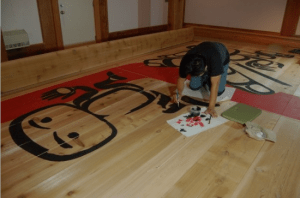
Dean Heron at work in the longhouse

When the longhouse is complete, Heron plans to continue carving his own work. In addition, “I have lots of images that I’d like to get printed.” He would also like to begin doing clothing designs, and learning jewelry-making.

Dedicating himself to art and moving into a community that was strange to him was a huge gamble, but Heron clearly feels that it has paid off for him.

“Growing up, I always felt that I was at the front door, but not right inside – always looking through the window and looking at these sculptures and not understanding the whole of them. I mean, I still don’t. And I think that’s part of the experience of being adopted and being First Nations. I’m at the point now where I’m straddling two different cultures, really. I have a non-first Nations family, so I’m getting an outsider’s point of view, but now I’m living in the community and understanding a lot more of it.”

Read Full Post »

Well, that was unexpected.

Passing through downtown Vancouver yesterday on my last errands until the end of the Winter Olympics, I imagined I’d be affected by the games preparations in any number of ways. Not being a sports fan, I thought I might be offended by the waste. I might flee the crowds and the traffic prepared to be a hermit. I might be angry for the sake of the business owners who had to close down because the traffic restrictions mean that their staff can’t get in and they can’t get deliveries. I might even have been blown away by the spectacle and find myself looking forward to the games after all.

What I didn’t expect was to look around and feel that I had been dipped in tacky excess. Everything I saw was so over the top that it might have been orchestrated by Albert Speer.

The first thing that caught my eye were the banners covering a few of the buildings. Do we really need blowups of athletes six stories high? A Canadian flag ditto, covering most of two sides of a building? Boasts that the corporate owner of a building was an Olympic sponsor? Endless urgings to “Go, Canada, Go?”

Descend to the Skytrain stations, and the excess continued. So far as I can figure, three advertisers had each won the privilege of monopolizing a transit station, and responded by covering as much of their station as possible. At Granville, it was Coca Cola, at Burrard, Macdonald’s, and Acer Computers at Waterfront.

Junk food and cheap computers? How does Vanoc square these with the Olympic ideals of athleticism and excellence? And I wonder who first imagined that repeated the same half dozen ads fifty or sixty times in a confined space was effective advertising, instead of an annoyance.

And everywhere, there were the officials and athletes from out of town, wearing their team uniforms that were not only gaudy but usually with the manufacturers’ names as large as the names of the country. Again, the connection to the Olympics eluded me. The out of towners were so gaudy that they might almost have been wearing Hawaiian shirts.

Yet the out of towners were restrained compared to some of the locals. Well over three-quarters were simply going about their Sunday business, but a minority were as gaudy as the out of towners and jingoistic as well, with Canadian flags flying from their cars and the marquees on their buses giving us a “Countdown to Gold” and urging Canadian athletes on. It was like the hockey playoffs, only on a larger scale.

A two year old might be fascinated by all the bright colors and larger-than-life consumerism, but it’s been a while since I was a child. Surrounded by such general tackiness, I could only complete my errands as fast as possible, and get out of the downtown. Except, perhaps, to see the Aboriginal Pavilion, I don’t plan on coming back until after the Olympics, when the city is back to itself.

Read Full Post »

« Newer Posts - Older Posts »