Feeds:
Posts
Comments

Archive for the ‘Vancouver’ Category

The other night, I woke in the early hours to the sound of coyotes howling. The howling is a thin quaver that seems to rise slowly through the sky then disappear, and I can think of others sounds that I would prefer to awaken me. But, once awake, I lay on my back with my hands behind my head enjoying the eeriness and the thrill that fluttered through me. I hadn’t heard them in months, and I was starting to think that the local pack had moved on.

Probably, I am a minority in my enjoyment of coyotes. Many people call them vermin. Others are convinced that coyotes will drag young children away, although that has only happened once or twice. Still more are angry because their cats or lapdogs have become the snack for a pack – although the real blame lies with their own irresponsible treatment of their pets.
But I figure that you have to expect that the wilderness is going to creep in one way or the other in an urban area, especially one so full of parks and trees as greater Vancouver. And when you live hard against a green belt as we do, then inevitably the occasional cougar or bear is going to stumble into someone’s back yard. Compared to such visitors, coyotes make good neighbors, going about their business while causing a minimum of fuss.

I used to hear them frequently at night, answering the sirens trailing from the nearby fire station. Sadly, that ended when a patch of woods a couple of blocks away was replaced by condos. However, they are frequent in the daylight. Once or twice, I’ve seen half-grown ones partly concealed by the bushes, but the adults put on a bold front, making so little fuss about walking down the street that at first you think they are stray dogs. Once, I even saw one passing through the middle of our townhouse development, ignoring the people and mostly unnoticed.

Several times, too, I’ve seen them on the sidewalk, sitting waiting for the flow of vehicles to change with the traffic light. I suppose they are watching the vehicles, not the light, but sometimes I am not so sure. The few times I’ve made eye contact with a coyote – from a safe distance, let me assure you – I’ve wondered afterwards if it was a sentient creature evaluating the level of threat I represented. After those experiences, I’m not quite prepared to rule out the possibility that some of them know which light it is safe to cross the street on, even though they are presumably as color-blind as dogs.

Coyotes are not creatures of beauty. If anything, they are scrawny things, living lives of desperation. Still, I admire them for being a part of the wilderness that can adopt to the city. I sometimes think that urban life is an isolated one that leads everyone to imagine that they can control everything about their lives. As the coyotes slip from park to park throughout the urban sprawl, eating our garbage and denning in greenbelts in the ravines of creeks, they disprove such ideas with a quiet disdain.

Their continued experience shows that, no matter how we try to isolate ourselves, we cannot deny nature. Despite all the radical changes to their environment, despite the way they are hunted, coyotes still survive. And I, for one, appreciate their casual upsetting of all our assumptions about ourselves and our cities.

Read Full Post »

The Bill Reid Gallery kicked off a series of talks about artists from its Continuum exhibit with a slide show by Michael Dangeli, a Nisga’a artist who has started to receive recognition in the last few years. The choice was lucky or inspired, because Dangeli is more articulate about his work than most artists, and has clearly thought carefully about what he is doing.

The Continuum show is supposed to be about the conflict between traditional and contemporary influences in Northwest Coast art. And, in fact, Dangeli was introduced in terms of this conflict. However, he immediately made clear that he rejects such a dichotomy in his own work. Calling his work “traditionally contemporary,” Dangeli made clear that he considers his work a continuity of the past, both an attempt to reclaim it and to expand and to adopt it.

One reason why Dangeli is comfortable with the paradox of living with opposites is that he sees the rest of his life in such terms. Nisga’a by birth, he has lived in the United States and Vancouver, far from his nation’s territory. Deeply interested in his cultural past, he is also aware that he is a modern urbanite in his day to day life. Spiritually inclined, he is also a veteran of two tours of duty abroad in the American military. With such tensions, those between the traditional and contemporary must seem like just one more.

Another reason that Dangeli can have the attitudes he does is probably the fact that he is actively involved in the cultural revival of his people – something that seems especially unusual for an urbanite. During his discussion, Dangeli talked of pieces of art being given as payment for services, and at potlatches, as well as important events such as a betrothal. He talked, too, of being groomed to take over a chieftainship, and of his hesitation about taking on an even larger chieftainship recently. He talked about his dancing, and of acquiring songs and dances and inventing new ones, and of exploring the distinctions between male and female powers and responsibility with his finacee.

Unlike many First Nations artists, Dangeli seems either fortunate enough or determined enough to have lived with a sense of tradition from an early age. Consequently, it is easier for him than many artists to see a continuity rather than an opposition.

This continuity seems to affect his art very strongly. He talked of preferring that his gallery pieces not have eyes that would make them danceable, and of his relief when he managed to buy back an early exception to this preference. He talked, too, of making one of the first stone masks for well over a century, and having it danced.

But the strongest evidence of his artistic continuity came at the end of his talked, when he uncovered three pieces of his work that are reserved for ceremonial purposes: The mask he bought back and modified with a pieced of Ainu cloth; the stone mask, and a frontlet worn by his fiancee. He explained that he generally kept them covered, and treated them as living spirits, requesting that people look them over a few at a time so as not to overwhelm them. It was unclear to me whether any power in the objects was innate or resided in the respect shown to them, but his attitude was curiously moving.

Even if you didn’t share his cultural background or beliefs, they were obviously alive for him – either never having died or after being carefully revived, or some combination of the two. Clearly, he had fought hard to make them meaningful to himself and those around him, and I believe that he has largely succeeded. At the very least, he demonstrated to the audience that his cultures were still ongoing and hadn’t stopped developing with the European conquest.

All this says nothing directly about his work, which ranges from the traditional to the modern, with a variety of color palettes and a frequent emphasis on collaborations with other artists – or “brothers,” as he called them.

I have liked what I’ve seen of Dangeli’s work in the past, and, by the time he had finished talking, I had a much clearer sense of why, and an increased interest in what he might do in the future. And, really, what more can you ask of an artist’s talk? With several dozen slides and intelligent commentary, Dangeli sets a high standard for the next speakers in the series to match.

Read Full Post »

Yesterday, I went to the Third Tuesday Vancouver meeting to hear Shel Israel talk about his new book, Twitterville. I have a love-hate relationship with technology pundits constructed equally of envy, scorn, and (since I have been occasionally been called one in my own small field of free and open source software) fellow-feeling, so it was the presentation that interested me, not the hope of any revelations about Twitter. And, sure enough, what I learned was not about Twitter, but about story telling.

I probably wouldn’t have learned the lesson if Israel hadn’t described himself as a non-fiction story teller near the start of his presentation. This offhand remark, so peripheral to the actual topic of the presentation, ended up framing my reactions to Israel remarks.

Israel is an enthusiastic story teller, and he collects stories about the subjects he was researching as though he was a folklorist, or a geeky Studs Terkel. He also has a knack for apt phrases, such as “lethal generosity” (generosity that forces rivals to respond in kind or lose) and “braided journalism” (reporting through a variety of sources) that help to make his stories memorable.

However, as I listened, two things started to irk me about his presentation.

First, his stories seemed to entirely about people winning – that is, accomplishing something through their use of Twitter. This tendency bothered me for two conflicting reasons. On one level, it bothered me because part of the structure of non-fiction narrative is usually an attempt to look at both sides of an issue. To hear Israel, Twitter is an unalloyed good, with no negative effects whatsoever. In fact, Israel appears to have not even looked into situations where Twitter proved limiting or handicapped someone. As a result, his narrative seems not so much non-fiction as mere ad copy – and, as such, contrary to the genuineness that social media participants need if they are going to be accepted by their communities.

On another level, the emphasis on winning seemed to lack morality. Israel did not talk about whether people did good with Twitter, and when someone asked a question that tended in such a direction, he evaded answering. This emphasis got up my nostrils (to use a wonderful phrase I first heard from folksinger Eric Bogle) because it seems to be that all kinds of narratives are essentially about morality. Except in poorly constructed narratives, the morality is not an subtle confrontation of good versus evil. At times, it may be ambiguous. But a sense of which side is right – or at least deserves our sympathies the most – seems embedded in the whole concept of narrative. When such a perspective is missing, the way it was in Israel’s talk, it is like stepping on a stair that isn’t there, jolting me and making me uneasy.

Second, Israel consistently resisted drawing any conclusions from his narratives. I suspect that he would argue that making generalities was not his job, that his role was to report as accurately as possible. And I agree that outright editorializing would have been out of place in his talk. However, I believe that part of reporting is to make implications and relationships clear. Without such efforts to see the pattern, Israel’s presentation struck me as directionless. The effect would have been much the same in a piece of fiction that excluded plot.

I suspect that what I am saying has less to do with general tendencies in storyteller than with what I look for as a member of the audience, or with how I try to tell my own non-fiction stories. Still, in an unexpected way, I am grateful to Israel for having provided the starting point for me to figure out these things – even though what I took away from the evening was almost certainly not what he would have wanted me to take away.

Read Full Post »

Our washing machine started leaking this week, like a puppy relieving itself in a corner, so we’ve been spending our spare time looking for a new washer/dryer combo. It’s a good thing that appliances last over a decade, because it will take at least that long to ease the horror from my mind. Part of the problem is that we have very precise space constraints, but most of the problem is the way that appliances are sold.

Most of the time when I’m looking for hardware, it’s a computer or a computer peripheral. Because the competition is so fierce for computer hardware, manufacturers and vendors document everything about what they’re selling on their websites. Speed, physical dimensions – you name the spec, and you can find it on every site. Consequently, you can spend a hour or two in front of your computer and arrive at the store armed with an exact idea of what you want, and get out fast.

By contrast, household appliances aren’t sold that way. For several local appliance vendors, having a web site is simply a means of announcing their existence. In one case, their site is a single page. In another, you can can learn what brands they carry, but not which models or what the prices might be, because most of their site is simply links to manufacturers. Another one doesn’t bother to give dimensions. None of them update their site with any regularity.

Consequently, if you are trying to be a conscientious consumer and shop around, you have to do a lot of old-fashioned legwork. I’m no stranger to exercise, so ordinarily I wouldn’t mind, except that the trudging around was in the service of a necessity that doesn’t interest me in the slightest. Frankly, reading washing machine stats and peering inside their drums is so mind-numbingly boring that a mentally sub-normal yak would be bored by it. Personally, boredom set in after the second or third examination – and we’ve looked at dozens in the last few days.

Then, just to make matters worse, the sellers of appliances seem strangely reluctant to take your money. Our first stop had only a couple of models on the floor. We could ask about other models, we were told, but how would we know about them if we didn’t see them? We would have to jot down the brands the store sold, then go home and do research.

Our next stop was the Sears store in Metrotown, a complex that has long had my vote for the most hideous shopping complex in the whole of Greater Vancouver. I can’t confirm that minotaurs roam its corridors freely, but if I hear any bull-like rumblings as I pass the service hallways, I’m not investigating.

But the Sears store has its own special horror, because its staff is apparently competing with each other for the fewest times they have to talk to a customer. You can see the staff scuttling low down the aisles a few over, but, by the time you learn how to get one’s attention, you would have the experience to track big game anywhere in the world. About the only thing you can say for this attitude is that it is marginally better than having the clerks dance attendance on you with unrequested information.

At Future Shop, the pricse were good, but each time we were ready to buy, we were told that the warehouse was currently out of stock and was likely to remain so for the next couple of weeks. I strongly suspect (although I cannot prove) that this was a variation on bait and switch. To be fair, we did receive a phone call saying that one of our choices was available, but, by then we had already bought.

The next stop was Home Depot. I realize that the company has built its business on do-it-yourselfers, but the staff didn’t seem to understand that plumbing is a bit beyond the average home owner. The company didn’t even a list of suggested contractors that customers might hire to get their new appliances connected. Nor did the staff see anything ridiculous in the attitude.

Finally, with madness nibbling at our brains like a glimpse of Cthulhu and the Elder Gods, we stumbled into Trail Appliances in Coquitlam. There, we were left to browse for a few minutes before an employee approached us. He was helpful, even giving us some advice we probably wouldn’t have thought of. And, wonder of wonders, the floor model that was our first choice was actually available. Within minutes, we were paying and arranging delivery.

What the other companies didn’t seem to understand was that washers and dryers are not the most glamorous of appliances. While some conscientious but anal souls might conscientiously remember to have them serviced every year, I suspect that many people are like us, and don’t think of them until they need servicing or replacement.

The result is that, when people go shopping for washers and dryers, they are usually in urgent need of a replacement. They can’t afford to spin out the process, because, if they do, they will have to find a laundromat or an obliging neighbor who will let them have the use of the machine.

What Trail Appliances offered was simply efficient service. The result? We’ve decided to replace our fridge at the same time, since it is running on borrowed time, and we’ll do so by returning to Trail again. Trail’s website is no better than any of the others – in fact it is one of the worst ones – but at least its staff understands how to treat customers. So, naturally enough, it gets our other business, too.

Read Full Post »

I ride the buses at least as often as I do a private car, so I’m as pleased as anyone with the opening of the new Canada Line on the Skytrain system. But I do wish that when the media or casual conversation mentions the new rapid transit line, they would focus on what matters.

To start with, before anyone praises the fact that the line was opened three months early, let’s remember how that was done. It was done by ruthlessly ignoring the effects of construction on small businesses along the route. Dozens have closed as a result, and some may yet manage to get the compensation they deserve through the courts. And let’s not forget the hiring of foreign workers at sub-standard wages, or the farming of the management of the new line to private industry. If such things are the only way to finish a construction project early, then I think I might prefer delays.

For another, just as when the Millennium Line opened a few years ago, the commentators are babbling about the wonderful view on parts of the line. And it’s true that running seven meters off the ground, Vancouver’s transit lines can offer a better than usual view of the scenery. But, for those of us who will actually be using the line, the wonder of the view will last no more than a few trips. Soon, people will be reading, talking on the phone or fiddling with their music players, just as they always do on a routine trip.

The same is true of the comments made by the would-be architectural critics. What matters for daily travelers is not aesthetics, but practicalities. Are the stations well-lit? Are there enough signs so that people know where they are going? Are the stations safe? Can they accommodate the thousands of people passing through them during rush hour? The answers to all these questions seem mostly positive, although I’m willing to bet that the above ground platforms act like a wind tunnel, just as they do on the other lines. But what everyone seems to be commenting on is how the glass and metal and terra-cotta colored walls make an aesthetic experience.

To someone on transit as often as I am, the scenery and aesthetics soon fade into the background, except in unusual circumstances, such as an unusually vivid sunset. What regular riders like me want to know is something far simpler: Does the new line save us time?

I didn’t ride the line on the first day, when the fares were free. But I did ride it on the second day as I went about my business. So, I’m happy to report that, yes, the new line did save me time – some five to ten minutes compared to the bus when traveling across False Creek from Yaletown to Cambie and Broadway, and maybe twenty minutes total on my entire trip. Better yet, the connections were better than on my old route.

Obviously, how much time you save depends on where you’re going. But, for regulars, that is the real story in the new line – the time saved, and the relative convenience compared to the bus or the car. Most of the rest is background, at least for those who will actually be using the new line. I suppose the new line makes a change from the usual stories straight from the police’s media departments, but, as happens all too often nowadays, in this story the media is missing the point.

Read Full Post »

Yesterday, I was talking with the owner of a Northwest Coast gallery when an artist entered carrying an unprotected mask. I instinctively moved away, partly because I could see that the artist was going to try to sell the mask and business needs privacy, but mainly because I knew that he wasn’t going to succeed, and probably wouldn’t want obvious witnesses to his failure.

He was far from the first artist I’ve seen arriving unannounced to sell work. If you hang around galleries as often as I do, you’re bound to see a similar scene sooner or later. It’s frequently a painful scene, because few artists know how to sell their own work. They are nervous and embarrassed, but determined to plunge ahead with the effort.

Their uneasiness reminds me of a singer whose concerts I used to attend, who would grimace to himself if his singing was the least bit off true; in the same way that I used to sympathize deeply with the singer, I sympathize with the artists and their deep discomfort as they try to do something for which they have no talent.

Another reason I sympathize with the artists is that they are almost certainly preparing for failure. While I can’t pretend to understand all the details about how business is done in the Northwest Coast art world, I do know enough to know that only well-established artists can drop by unannounced and have any hope of selling their work or placing it on consignment. Most artists need to make an appointment – and, these days, spend some time exchanging emails and photos of their work, as often as not. Someone who arrives unannounced will have no idea whether the gallery is buying, or even whether a buyer for the gallery is available. For these reasons, they may very likely have wasted their time.

But yesterday’s artist had the odds more stacked against him than most. I could see his mask, and even from a five or six meters away, I could see that its quality was too low for any gallery to buy it. He might be able to sell it on the street, the way that one artist has been selling similar masks this summer outside the Vancouver Art Gallery, but the mask simply wasn’t good enough. All too clearly, the artist didn’t have the proper tools, or else didn’t know how to use them. The mask was roughly finished, front and back, and no amount of paint could hide the fact.

Under the circumstances, the gallery owner was gentle. Perhaps, being an artist himself, he could sympathize with the visitor. Instead of commenting on the quality of the mask, he made a non-committal comment, and simply said that he was not buying right now. Then he talked with the artist awhile, joking that, because of his Hawaiian shirt, he must be a Kanaka, then – when the artist was apparently too lost in his own anxieties to get the joke – exchanging nations. I could guess from the look at the artist’s face that this was not his first rejection of the day, but he responded to the gallery owner’s efforts to draw him almost against his will. Meanwhile, I watch while pretending not to watch, and found identifying with the artist all too easy.

The encounter was over in less than five minutes. But I found it hard to forget. I came away with respect for the gallery owner’s courtesy, and a profound gratitude that I hadn’t been the one to turn the artist down. I probably would have agonized over rejecting the artist, or even bought the mask – unsellable as it was – out of sympathy. In the end, I was very glad that I was just a spectator.

Read Full Post »

(Note: Because the staff was unsure which exhibits the artists had given permission to photograph, I was unable to take pictures)

When I go to an art gallery, I come prepared to be pleased. Just as when I go to a movie or go to a book, I generally arrive with few expectations. I try to practice the concept that I should understand a work in its own terms, and not through the filter of expectations that I bring with me. Over the years, I have found that this approach has allowed me to appreciate things that I might otherwise have dismissed.

I mention my perspective because I have to report, very much against my wishes, that the new exhibit at the Bill Reid Gallery, “Continuum: Vision and Creativity on the Northwest Coast” is a disappointment. The fact that it comes after the gallery’s first successful show that highlighted Bill Reid’s career, and shares space with the dazzling permanent collection of Reid’s jewelry only makes the show’s failure all the greater.

For the most part, the problem is not with the artists. True, a few of the artists chose to submit the physical equivalent of one-liners. For instance, Shawn Hunt’s “Trickster,” which shows Raven perched atop a can of clam chowder is amusing at first glance, with its reference to Andy Warhol’s famous silkscreen (and also an indication of how Bill Reid’s “Raven and First Men” has altered the traditional story in modern minds, since the recorded historical versions mention a different type of shell). But, on second glance, what the incongruity means remains elusive. It seems only a poke at the commercialization of Northwest Coast art in a way that has already been done before. Personally, given the design ability displayed in Hunt’s Raven, with the grinning faces as part of the body and wing, I would far rather see what he does with less derivative work, especially since he is a relatively new artist.

A similarly limited work is Moy Sutherland’s “The Negotiator.” Sutherland, whose work I have often admired elsewhere, is not the first artist to add First Nations politics into his work. But where Charles Heit (Ya’Ya) rarely lost sight of his art and his comments had an angry wit to them. Sutherland’s use of Canadian flags, five dollar bills, and a dangling carrot is simply angry. It can be reduced to a single short sentence: He is angry with the people negotiating land claims on behalf of his nation. Any work that can be reduced to fourteen words, I submit, is not art at all, regardless of whether I sympathize with the sentiment, as I do with Sutherland’s.

However, the majority of the work exhibit present an interesting variety. In contrast to Sutherland’s work, Mike Dangeli’s “’Redemption’ Ridicule Mask” presents a much more complex reaction to the situation of the First Nations, using an old tradition to comment on contemporary politics.

Similarly, Ian Reid creates a new effect by placing Chilkat patterns and colors on a raven mask. He did so, he explained as an acknowledgement of Tlingit and Tsimshian women who introduced the Chilkat patterns into Heiltsuk society. At a time when many First Nations people are descended from multiple nations or are half European in ethnicity, he said, this acknowledgement seems particularly appropriate. The juxtapostion of two different traditional media more than justified Reid’s motivation, resulting in an arresting and original effect.

Dan Wallace also placed Chilkat patterns in a new medium by engraving them on his silver bracelet, “Remembering our Royalty.” Like Reid, Wallace emphasizes the importance of looking back at history while reflecting on the current situation, and, like Reid, produces a new artistic effect as he does so.

Other pieces worth seeing included a traditional Tsimshian mask and a stop-action video of its carving by Phil Gray, Sonny Assu’s graffiti-like canvas with its reds and pinks and grays, Dean Hunt’s traditional-looking mask “Pk’vs: Wild Man of the Woods,” and Aaron Nelson-Moody’s red cedar and copper panel “Copper Man.” Nor should I forget to mention the wealth textile works, such as Marianne Nicolson’s “Tunic for a Noblewoman,” done in memory of her grandmother; Krista Point’s untitled Salish blanket; Teri Rofkar’s “Tlingit Robe,” and Carrie Anne Vanderhoop’s “Dream of Dragonflies.” Individually, all these works were well-worth lingering over and returning for second and third and fourth looks.

The problem is, while most of the works in the exhibit stand on their own merits, they seem to add up to nothing as an exhibit. Part of the problem may be that the show seems to have changed directions, starting as an exhibit of young artists but transforming into an exhibit with the theme of the tensions between the contemporary and the traditional and adding older, more established artists. But, for whatever reason, the result is a seeming random collection of artists.

For all the obvious skill of individual artists, there seems no particular reason why these particular artists were chosen. Any of four or five dozen other artists could have been swapped in instead, and the impression left by the exhibit as a whole would not be significantly changed (As if in confirmation of this statement, after I left the exhibit, I saw Andrew Dexel, the graffiti artist, at one of the Aboriginal Days booths outside the Vancouver art gallery).

Another problem is that, with only one work allowed per artist at the most (one bracelet was the work of three), you have trouble appreciating anyone’s work. A quarter of the artists, and four or five works apiece would help visitors to gauge each artists’ range. Given the number of newer artists in the exhibit, that sort of context would have been welcome.

As things are, the result is that seeing “Continuum” is not much different from seeing the latest work at a commercial gallery. In fact, I have seen larger shows at commercial galleries, as well as chances to meet the artists that did not include a request for donations at the door.

Nothing is really wrong with such a show – I guess. But the Bill Reid Gallery is not a commercial gallery, and is obviously struggling to be something more. Its difficulty is that it is still struggling to define what that something else might be. In “Continuum,” I suspect it temporarily lost its way in academic critical jargon and posturing (if the catalog is any judge).

I can only hope that, with its next show, the Bill Reid Gallery returns to the success of its first show. If it does, then I will be happy to report the fact. Meanwhile, so far as “Continuum” is concerned, “disappointment” is the mildest word that I can honestly choose.

Read Full Post »
Last night, I was at the reception for Tahltan artist Alano Edzerza’s new exhibit, “Gift of the Raven.” The show features Edzerza’s work of the last six months. Also on display were a number of pieces by Morgan Green, a recent recipient of the YVR Art Foundation Scholarship and (as she may be tired of hearing) the daughter of Tsimshian master carver Henry Green.

The evening started with a performance of “Raven Steals the Light” by Victor Reece’s Big Sky Multi-Media Storytelling Society. The performance was held in the courtyard of the Waterfall Building, the complex in which the Edzerza Gallery is located. It featured a dancer with suitably nervous bird-like movements and a light mask with mirrors for eyes, and ended with him climbing to an overhead walkway to conclude the performance – all in all, a successful blending of the traditional and the contemporary.

Then, the crowd squeezed inside the gallery for the viewing.

The show did not include any new traditional style work by Edzerza. Otherwise, it was a good representation of the different strains in his work. My main problem was dodging the crowd and finding gaps in it that lasted long enough to snap a picture. Combined with the fact that some paintings were hung high, the result is pictures that are less than professional quality (to say the least), but should give some idea of what was on display.

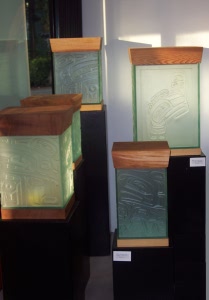
In one corner of the front of the gallery was a collection of Edzerza’s glass boxes:

alano-glass-boxes1

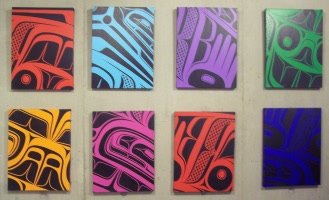
Elsewhere, you could see some of his experiments with color, such as this collection of closeups of traditional formline designs done in the electric colors of pop-art on a back wall:

alano-colors

The same pop-art sensibility appeared in a couple of contemporary paintings of frogs, which were inspired, I am told, by a tattoo on a woman’s back:

alano-frog3

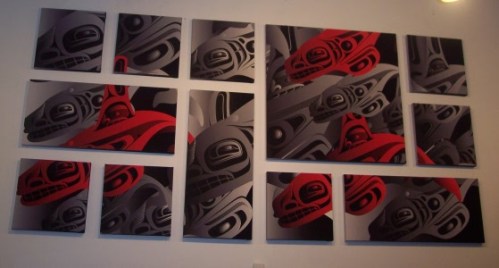
But the major works in the exhibit were the multi-panel ones, like this one that was hung near the ceiling, facing the door:

alano-orca-multi

Another orca design, a triptych, was hung just inside the door, and a triptych featuring ravens on the back wall. The raven triptych was especially dramatic, as one of its panel shows:

alano-eagle-triptych2

All these multi-panel works shared features that are characteristic of Edzerza’s work: A three-dimensional contemporary take on traditional Northwest Coast designs, an experiment with color in mainly grayscale designs, and a dramatic sense of movement that is enhanced by the separate canvases and draws your eyes from one to the next.

Morgan Green is not as an experienced an artist as Edzerza, but, in the last year, her work has matured quickly. Previously, the work by Green that I knew best were her leather cuffs and a somewhat over-ornate wolf helmet in the gallery, but the works I saw last night shows some other sides to her work, and an interest in different media that, if anything, is even greater than Edzerza’s.

Green’s works included a wall hanging and a variety of earth-colored ceramics inspired by a recent trip to Arizona and the First Nations work she saw there. A plate depicting Mouse Woman was particularly striking:

morgan-green-mouse-woman-plate

So far as I know, no historical depictions of Mouse Woman survive. But Green’s rendering seems a reasonable one, with features like the ears, the round eyes and the incisors providing the defining features that you would expect in a traditional design. At the same time, placing the design on grainy ceramic creates a pictograph-like effect, all the more so because the formline is hinted at more than fully realized.

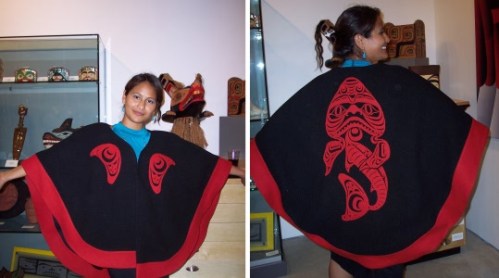
Perhaps the most accomplished work by Green on display was a Dogfish Woman robe she had created for an elder. The design was fairly standard (that is to say, more or less a descendant of Charles Edenshaw’s sketch via Bill Reid), but the cutting of the design and the assembly of the robe made for a first rate piece of work. As Green was discussing it with some of the guests, one of them agreed to model it:

morgan-green-dogfish-woman-robe

The evening was a fund-raiser, with a quarter of all sales going to the Vancouver Foundation. How successful the evening was a fund-raiser, I didn’t ask. But from the perspective of spotlighting two promising young artists, no one could have asked for more. I came away from the evening with increased respect for both, and an even greater determination to watch and enjoy their future growth.

Read Full Post »

Most Saturdays, noon sees me barely staggering out to the gym. But today, noon or shortly after saw us arriving in Gastown for the reception to mark the opening of the Northern Exposure 2009 show at The Spirit Wrestler Gallery. The show is an exhibit of the graduating class of the Fred Diesing School of Northwest Coast Art, plus this years’ scholarship winners. It has already become a tradition in the three years that the school has existed.

With 19 carvings and no graphics, the show was a subset of the graduation show I saw in Terrace, which had some 75 pieces. One or two second year students were missing, as well as most of the first year, including some artists like Mitch Adams or John Wilson who I’d rate above some of those who were represented. Still, space was limited, so some way of reducing the numbers was probably unavoidable.

At any rate, the reduced number also had the benefit of allowing you to pay close attention to each piece – something that is impossible with four times the number. It was especially interesting to see the graduates’ work beside that of their teachers, Stan Bevan and Ken McNeil. That way, you could see the teachers’ influence, and which students were on their way to establishing their own style.

To my eye, the exhibit was somewhat weaker than last years’, which included the work of Dean Heron, who is rapidly becoming one of the major up and coming young artists in the Northwest Coast Tradition. However, the show included the paddles I had admired in Terrace by Latham Mack and Shawn Aster. Another standout was Mack’s “Northern Beauty” mask with its striking painting and individualistic detailing of the nostrils and mouth.

northern-beauty

I also appreciated two samples of Reynold Collins’ detailed, often intricate work. While I think Collins’ work would be improved by more finishing and greater attention to the grain, his work never suffers from the clumsy blank spaces found in many of the other students’ work and shows a vividness of imagination that makes me suspect it is only a matter of time until I find the right piece of his work to buy.

reynold-collins

Only a half dozen students were at the reception, and their time was in demand. However, because the event was smaller than the graduate show, it was easier to have a few words with them and find what motivated them. I talked briefly with Sophia Patricia Beaton, Darryl W. Moore, and Reynold Collins, each time finding something in the conversation to bring me back for another look at the pieces they were exhibiting.

Last years’ show, as well as the work of other recent graduates was priced somewhat high – a mistake that means that the pieces do not sell, and that the artist is tempted to try to charge prices elsewhere that their reputation cannot sustain. By contrast, this year, the students seem to have priced their own work, and, thanks to the guidance of their teachers, this year, realism prevailed. Most of the pieces were under $1400, and only one over $2000. This realism seems to have helped; as I write seven hours after the start of the reception, some six of the pieces in the show have sold, including two each by YVR award-winners Todd Stephens and Shawn Aster. Not bad for a day’s display.

Especially at realistic prices, the show cannot be much of a money-maker for Spirit Wrestler, which often sells works by Robert Davidson or glass artist Preston Singletary for tens of thousands of dollars. In fact, when the cost of publicity, reception and staff wages are taken into account, the show might even cost the gallery money. That makes the show a public-spirited effort, or at the very least, a long-term investment in the next generation of artists.

Certainly, it means a considerable amount to the artists, many of whom have limited funds and some of whom had to go to some effort to get to Vancouver. But, after several days that included the YVR ceremony, and a tour of several local galleries and a CBC interview for the award-winners, the reception was clearly the highlight of their trip. Many said as much, and their sincerity was unquestionable. The reception gives them a taste of the lives they would like to live – and, thanks to Spirit Wrestler, for some of them, those lives may now be that much closer.

Read Full Post »

One of the drawbacks to being raised on stories about King Arthur and Robin Hood is that seeing abuses of authority make me want to leap to the defence of their victims.

For instance, I was waiting on the Skytrain platform today when I saw a man hauling a bicycle up the escalator. As he got to the top, I saw that it was a woman’s bike, and that he had several garbage bags bulging with cans and bottles strapped to the handlebars. The man himself was dressed in threadbare clothing that was not too clean, and had a bearded face that look as though he had lived roughly. As he came closer, I smelled beer on his breath. If he wasn’t actually homeless, he was near to that state.

A Skytrain attendant at the other end of the platform saw him at once. Immediately, she started walking towards him.. As she got closer, she seemed to stand straighter and to affect a bully’s swagger – but that could just be my jaundiced eye.

Still, I was completely unsurpised when she started lecturing him about not taking a bicycle up the escalator.

Technically, she was right – not because that’s the regulation, but because handling something the length of the bicycle can block the escalator, and it can easily slip. But she hadn’t said anything to the woman who took an equally-barred baby carriage up the escalator, and she had passed someone eating – something else you’re not supposed to do – on the way to the man. Clearly, she had profiled him as someone who needed admonishing on general principles, someone she could exert her authority over.

The man responded with the assumed cheeriness of someone who has been dumped on many times, but who has told himself that he will be damned if he will let the situation get to him. “That’ll be easier than taking the stairs,” he said when the attendant pointed out the platform elevator.

His cheeriness must have bothered the attendant, because, when he walked away, she followed him. He had to be careful, she said, of not taking more than two bags on the Skytrain. He said he was only going to the next stop, to the liquor store, but that didn’t stop her from lecturing him for another three minutes about this non-existent regulation.

At this point, I was standing about a meter away from the man, and seriously debating whether I should tell the attendant to leave the man alone. After all, he hadn’t done anything. In fact, he had remained polite, despite her unwarranted bullying.

But, perhaps his politeness was what made her so intent on going after him. She stood beside him for a moment, and I imagined that she was debating asking to see his ticket. But she had no reason for doing so. Besides, about then she noticed me watching her. She frowned, and slowly walked away.

The man laughed and made a joke to me about how she didn’t say how big the two bags could be. Next time, he added, he would board with two giant ones.

I shook my head. “Man, she was really on your case.”

He did a double-take, surprised that anyone else had noticed. We exchanged a couple more sentences, then went our own ways when a Skytrain arrived.

Sitting down in a car, I regretted not intervening at this petty bit of tyranny. But maybe my interference would have made the attendant worse. At least I had treated the man the same as anyone else.

I suppose I am as much to blame for my discomfort as anyone else. After all, small abuses of authority are common enough. The only reason I don’t see more of them is that I work from home. All the same, the attendant’s behavior grated, and I resented her intrusion on to my day.

Read Full Post »

« Newer Posts - Older Posts »