Feeds:
Posts
Comments

Archive for the ‘writing’ Category

One of the unavoidable facts of online publications is that you’re going to make mistakes. Mercifully, some will be typos. Others will be factual errors or passages that need to be made clearer. But no matter how carefully I or my editors proofread, the mistakes will come – in fact, I sometimes think that, the more I try to avoid mistakes, the more likely I am to make them. At any rate, when I make them, once I get over the embarrassment, like any other writer, I am left with two choices of what to do with them: redact them, adding a correction in a footnote or parentheses, or revise them, removing them from the text altogether.

Those who favor redaction argue that revision is useless, that the uncorrected original will always be available online no matter what you do. Some go further, and argue that redaction is more honest, in that you are not trying to cover up your mistakes, but leaving them for everyone to see. Ursula K. LeGuin also suggests that redaction is a feminist technique, an alternative to the pseudo-objectivity and linear thinking of traditional Western thought.

Such arguments have some validity. However, maybe it says something about my own brand of perfectionism (or maybe early toilet training) that I prefer revision to redaction.

For one thing, I’m not a fan of redaction as a reader. In all but a few cases – such as a revision of a well-known article – I react to redaction in much the same way as I react to the extras on a DVD: it’s more than I want to know. Since I suspect that many readers feel the same way, my preference is not to inflict redaction on them.

Just as importantly, redaction always feels to me like a rough draft. Worse – it feels to me that I am not living up to readers’ expectations if I redact. To me, part of my unspoken contract with readers is that I present what I have to say in as polished a form as possible.

It’s not that I’m trying to hide my mistakes – which is impossible on the Internet anyway. Rather, I feel obliged to make each article as factually accurate and as clearly written as possible. Why, I think, would readers be interested in my mistakes? If they really want to see where I went wrong, they can probably find an earlier, uncorrected version of a revised article, but at least I can make clear what the preferred text is. At any rate, that is all that most people are likely to read any way.

However, the main reason I prefer revision is that I consider redaction to be more about the writer than the topic of discussion. Look at me, redaction says to readers. Aren’t I an upright, honest person, willing to show you my imperfections and the development of my thoughts?

In fact, redaction doesn’t necessarily show anything of the sort. In one easily-locatable case, an article begins by stating that I lied. The article has been redacted several times, with an admission that the original claim was the result of a misunderstanding, but the original statement remains, and is all that people see in an online search. To my understandable ire, this is not a form of honesty, but a way of perpetuating the original attack while pretending to be honest.

At any rate, I am not interested in being a focus of readers’ attention. While I hope they want to listen to my arguments and opinions, I have zero interest in being at the center of even a modest cult of personality. To insert a claim about my personality in the form of a redaction seems only a distraction from what I have to say – and, to my George Orwell-influenced mind, anything that interferes with clear communication of my point should be edited out of existence.

If someone who convinces me that I made a mistake expresses a preference for redaction over revision, then I’ll ignore my personal preference and redact instead. But, left to myself, I’ll take revision over redaction every time. So far as I’m concerned, revision serves the argument and the readers better than redaction.

Read Full Post »

If I had to recommend a single work to would-be writers, then unquestionably that work would be George Orwell’s essay, “Politics and the English Language.” First published in 1946, the essay is dated now in its references, but no other work talks as clearly or succinctly about the purpose of writing, or gives such useful rules for accomplishing that purpose.

The larger context of “Politics” is the use of language in social situations. As Orwell had already suggested in works like Homage to Catalonia and Animal Farm (and would later explore in detail in Nineteen Eighty-Four), the essay explores how language is used to manipulate people and conceal thoughts in “the defense of the indefensible.” However, Orwell’s tone throughout the essay makes clear that he thinks such use of language is corrupt and disgusting, and should be opposed by any writer worthy of the name. So far as Orwell is concerned, a writer’s job is to communicate clearly and effectively – both as a matter of self-respect and as a duty to the language and public discourse.

Aside from dishonest intent, the main reason for corrupt language according to Orwell is that most writers and speakers don’t stop to think what they mean. Instead, they riffle through an assortment of clichés, choosing ones that approximately fit their meaning. Orwell lists the general categories of these clichés – dying metaphors, verb phrases, pretentious diction, and meaningless words – and, although many of his examples are dated after sixty-five years,  no one with any interest in language should have any trouble coming up with modern equivalents.

Talking about the role of the writer and giving negative examples would be enough by themselves to make “Politics” worth reading. But then, at the end, Orwell does something extraordinary: he reduces how to write clearly to six simple rules:

(i) Never use a metaphor, simile, or other figure of speech which you are used to seeing in print.

(ii) Never use a long word where a short one will do.

(iii) If it is possible to cut a word out, always cut it out.

(iv) Never use the passive where you can use the active.

(v) Never use a foreign phrase, a scientific word, or a jargon word if you can think of an everyday English equivalent.

(vi) Break any of these rules sooner than say anything outright barbarous.

In less than a hundred words, Orwell not only tells readers everything they need to know about writing clearly, but provides an example of  the type of writing he advocates. The result is a set of guidelines from which anyone can benefit. Considering the thousands of pages that people have written trying to explain how to write, this is an astonishing accomplishment.

One of the reasons why these rules are so useful is their flexibility. You’ll notice that Orwell does not say, for example, “Never use a long word when you can use a short one.” Such a rule would only be another type of pretentiousness, of a sort you sometimes find in Hemingway when he is parodying himself.

Instead, he says, “Never use a long word when a short one will do.” For example, if you just want to convey a general impression of size, then “big” is probably good enough. However, if you want a suggestion of humor, then “humongous” would be more appropriate. Similarly, if want to imply something out of the ordinary range of bigness, then “outsized” might be a more effective choice.

The same goes for a several of his other rules. In general, Orwell suggests, you want to use the active voice – but only when you “can.” If you have a reason for using the passive voice (for instance, to suggest helplessness, you might want to write “A groan issued from his lips” rather than “he groaned”), then do so. In the same way, a foreign expression is only valid if there is no English equivalent; use a Latin or French phrase for any other reason, and you are probably trying to sound impressive when you should be thinking of what you want to say.  Then, just to emphasize the point, he ends by urging that you ignore any of these rules if they fail to aid the clarity of thought and expression that he assumes is a writer’s goal.

If practiced, what these rules do for you is to make you think exactly what you are trying to say. Unlike the rules that other writers propose, these are not suggestions that you can apply by rote. What they really are is a set of suggestions for how to keep your purpose actively engaged while you are writing.

What makes “Politics and the English Language” so unique – and such a necessity – is that, more than any other book or essay on writing I have ever seen, it cuts through the pretenses and the posturings and the assumptions about being a writer to articulate what writing is about and to offer concrete ways to achieve the purpose of writing.

Read (and re-read) “Politics,” and when its rules become a part of your normal writing and editing, and you will understand all you need to know about writing. After that, the rest will be practice.

Read Full Post »

I haven’t written a manual for over seven years, so perhaps my opinions about technical writing don’t count for anything. All the same, I’m disappointed to see that writers are still being steered towards distractions such as writing personae I can think of little that could do more to waste a writer’s limited time or cause them to be held in lower regard.

A persona is an imaginary profile that represents one segment of your audience. The ones I’ve seen are usually 200-700 words long, and typically include not simply the segment’s subject matter expertise, but also the kind of detail more suitable for a character in a work of fiction. Age, gender, job title, hobbies, dining preferences, personal likes and dislikes – all these and more can find their way into each persona. Since the audience for technical writing can have several segments, creating personae is demanding, fun – but largely a waste of time.

Admittedly, the exercise of creating a persona can help a write fix audience segments in mind. Should they need to refresh their sense of the audience, they can simply re-read the persona. But for the most part, each of the personae that I have seen has been a nugget or two of information lost in irrelevancies.

The blunt truth is, the main facts that tech-writers need to know about their audience is their technical background and reading ability. Possibly, writers may need to know a few other facts – for instance, the audiences’ languages can affect page layout – but not much more.

And even expertise and reading ability are largely irrelevant, because, rather than trying to second-guess the audience, it’s easier to explain fully and write simply. After all, you never know who might use your manuals, or if the information you’ve received about the audience is accurate.

Under these circumstances, better to stick with the basics. After all, even experts appreciate a brief explanation of context, or may need a reminder of some aspects of your subject. Write a short, coherent explanation of the tasks at hand, and you can’t go far wrong. But spend your limited time on writing personae, and you may guess wrong or find that the context changes. In other words, writing personae just isn’t efficient time management.

My impression is that personae are favored by those who stress the writing in their job title at the expense of the technical. Desperate to have developers and managers take them seriously, they champion arcane embellishments like personae in the hopes of appearing experts and gaining the respect of those around them.

Nine times out of ten, however, such efforts fail, because they are usually made at the expense of actually learning the subject matter, and of writing and editing. The result? You’re left looking pretentious and turn in a finished manual that only reinforces everybody’s impression that you are a lightweight poseur.

If that’s your idea of being a tech-writer, fine – go ahead and fritter away your time on personae But don’t be surprised when you don’t get the respect that you think you deserve. You’ll only get that by mastering the subject matter and presenting it usefully, not by engaging in pointless intellectual exercises.

Read Full Post »

Just because a number has a couple of zeroes in it doesn’t make it special. Still, I notice that, with my last entry, I have now posted five hundred entries to this blog. Not bad, for a blogger who doesn’t believe in blogging.

By that, I mean that the average blog has all the excitement of a wet dish towel. The problem isn’t that the topic is personal, or about everyday joys and angsts – a skilled writer can make any topic absorbing, even when the topic sounds uninteresting in the abstract. But a few paragraphs of stream-of-consciousness can rarely persuade me to read. Even when I know the writer, reading such material is a chore. And, when I don’t know the writer, their outpourings often seem an expression of self-importance more than anything else.

That’s why, when I started this blog, I decided to ignore what everyone else was doing. I wasn’t going to write stream-of-consciousness, but short essays, with a central topic, a beginning and an end, and an organized middle. So, for the most part, that’s what I’ve done with each of the past 500 entries.

The result is often entries between 800 and 1200 words (or even more), which people occasionally tell me is far too long for a blog entry. And, had I listened, I probably would have far more readers; give people what they think they want, and you’ll never lack an audience.

However, because I have no trouble getting an audience for my paid writing, I’ve never worried much about how many people read this blog. In fact, one of the reasons I started this blog was to publish pieces that I wrote purely for myself – sometimes to warm up before starting my professional work, sometimes to wind down at the end of the day, and, sometimes to get down a line of discussion that formed spontaneously in my mind as I exercised or cooked.

For these selfish reasons, I’ve never worried too much about the size of the blog’s audience. I know that, if I chose to write about free and open source software, as I do for pay, I could get more than 1800 readers a day, because two or three times I have. But, on the whole, I’m content to laze along with 130-150 daily readers, writing — as the coat of arms of the Dukes of Denver would have it — as my whimsy takes me.

Overall, I’ve no complaints, so I plan to keep going the same way for the next five hundred entries. And if that sounds arrogant, that’s okay. I don’t suppose I’ll be any fond of other approaches to blogging at the end of the next five hundred entries than I am now – or than I was four years ago when I started.

Read Full Post »

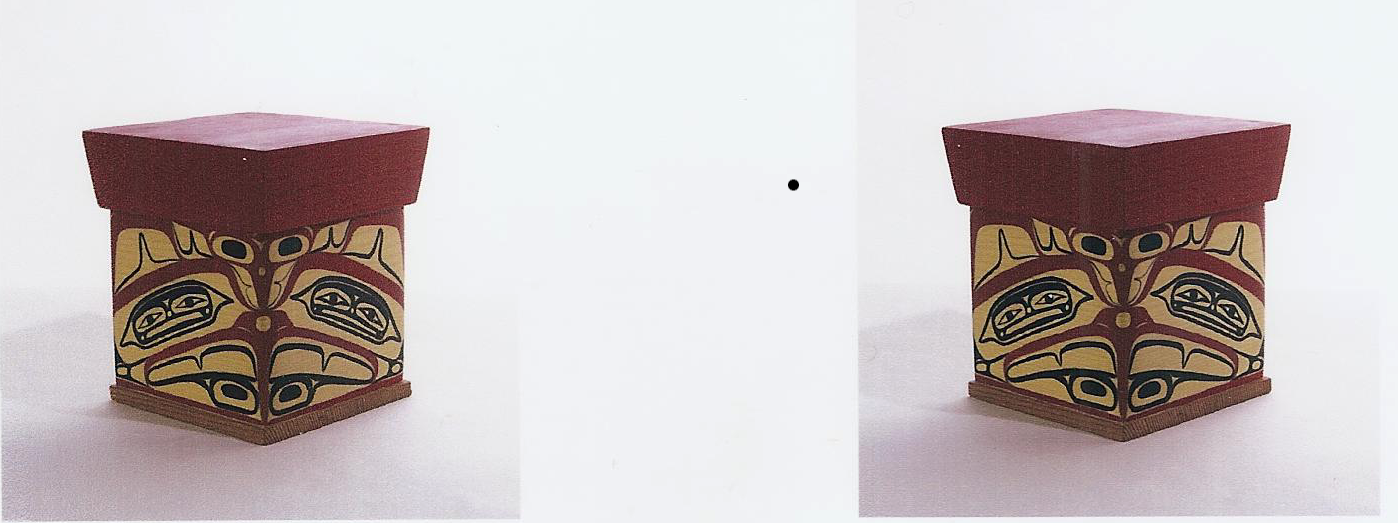
Last week when I was in the Lattimer Gallery, I received my copy of the book for the 2010 Charity Bentwood Boxes. It’s a small but well-designed book, and it reminded me that I hadn’t blogged about the box I bought in the auction.

2010 was the fourth year of the auction, with the proceeds going to Vancouver Aboriginal Health. The concept is simple: James Michels makes and donates the boxes, which are decorated by Northwest Coast artists, and the boxes are sold in a silent auction. In 2010, $10,850 was raised – more than double the amount raised the year before.

Over the last couple of years, the decorating of the boxes has become increasingly competitive as artists try to outdo each with their concepts. In 2010, for example, Landon Gunn added copper moon faces to his box, and Jing painted his in a Chilkat design. Steve Smith made his box a rattle. Even more extravagantly, Ian Reid (Nusi) crowded his with Tibetan pray flags and images of the Buddha, while Rod Smith chopped up his box and reassembled it. Perhaps the most ingenious box was Clinton Work’s “The Shop Thief,” a little man with the box for a body and the lid for a hat surrounded by the tools he had stolen – a theme that proved especially popular with the artists. If anything, the competition to be original promises to be even fiercer next year, with some artists already planning their designs for 2011.

I bid on several boxes, but, as I expected, the bidding soon got out of hand (even if it was for a charity). In the end, I was pleased to bring home “Hawk,” by Haida artist Ernest Swanson, a traditional piece that many people overlooked.

Part of the reason “Hawk” was overlooked may have been that it was on the bottom shelf of the display case, so you had to get down on your hands and knees to see it properly. But a larger reason, I suspect, was that it was a traditional piece with none of the embellishments of the more extravagant designs. When I contacted him online, even Swanson sounded like he thought he should produced something more original.

For my part, I have no complaints. Although I own a number of contemporary Northwest Coast pieces, I appreciate a traditional piece, too. Moreover, despite the fact that Swanson is relatively young, he has a reputation for traditional design, and for several years he has been on my short list of artists whose work I wanted to buy some day. I was delighted to get a sample of his work for a reasonable price – a sentiment that may sound unsuitable to a charity event, but I would be less than honest if I didn’t state it.

Much of Swanson’s work seems to be jewelry, a medium in which he is rapidly reaching the stage where his prices are soon likely to take a big jump upwards. That makes “Hawk” a bit of an exception in his work.

Nonetheless, I appreciate the boldness of the design, which has relatively little variation in line thickness. At the same time, it manages to be a busy design, perhaps because of the relative lack of red as a secondary color – a design decision that is almost a necessity, since too much secondary red would be garish and overwhelming given the bright red lit.

I appreciate, too, how the fact that centering the face on corners makes the design seem abstract from most angles, with the pattern only becoming obvious as you turn the box.

“Hawk” is a piece that you have to study for a while to appreciate. It stands now on my dresser, holding spare keys (because I feel that such a practical a thing as a box should be used, so long as it is used respectfully), and I find that my appreciation has grown even greater over the months of seeing and using it.

Read Full Post »

Advice from writers is always suspect. More often than not, the advice is only what the person giving it would do, and there are several alternatives that would work just as well. That means that would-be writers really need to read several pieces of advice on the same topic before deciding what the best approach for them might be.

All the same, a time arrives for many writers when they are moved to give advice. This is my time, and I can only hope that my experience teaching first year university students how to write helps to make my advice a little more universal than most such efforts.

At any rate, for better or worse, here are seven things that I wish someone had told me when I first started writing that I think are likely to be true for most writers:

  • Read widely: How else can you know what has been done and what people think is possible? (they may be wrong, of course). Genre writers in particular need to read outside their chosen genre if they want to do more than produce a mid-list book that will fit one of a publisher’s monthly slots then disappear forever.
  • Hard work is more reliable than inspiration or natural talent: Inspiration is wonderful when it hits, but, by definition it rarely does. Working regularly, regardless of inspiration, produces far more writing than inspiration. Writing, it turns out, is like anything else: The more you do it, the easier it becomes. That’s why so many people tell you to write daily. The same goes for natural talent, too: I have seen many writers and artists of all sorts who had natural talent fail to produce anything memorable and many initially less talented writers and artists who succeed through their determination to improve.
  • Structure is more important than style: Learning how to turn a clever phrase, or even a clever paragraph, is relatively easy. Most people can learn it in a matter of a few months. By contrast, understanding structure – what needs to be said, in what order – takes years before you gain even a basic competence. A large part of the problem is that it is hard to teach, and therefore is rarely taught. Another part of the problem is that the language to discuss it often doesn’t exist (film scripts sometimes come close, but there are things you do in writing that you can’t on film). Consequently, you need to study the structure of what you admire and loath by yourself. Unfortunately, most people don’t realize the need.
  • Writing and editing are two different functions: Writing is largely intuitive and unanalytical, while editing is logical and thoughtful. Both are needed to create a piece of writing, but trying to do both at the same time only makes both harder, because you are are always stopping and starting. Except when you realize that you are completely on the wrong track, try to relax your efforts at editing when you are writing, especially in the first draft. You’ll make the process much easier on yourself.
  • Don’t worry about style: Concentrate instead on writing as well as you can. Style is the by-product of effective writing, not an end in itself. Focus on expressing yourself as well as you can, and your style will soon emerge.
  • Only the anal-retentive obsess about grammar: A writer by definition should have a better than average knowledge of the language that they write in. However, that does not mean that they need to be experts in grammar. Grammar matters when you submit a manuscript, because you want to create the best first impression possible with an editor or agent. But, until then, worry about making what you write effective. Until then, obsessing about grammar is like worrying about the wrapping on a present, or the transitions in a slide show instead of the contents.
  • You can’t please everyone: No matter how good a writer you are, nothing you write will ever please everyone. Often, some people will love and hate your work for the same quality. The reason is that everyone brings expectations and experiences to writing that are beyond your control, and very few people can distinguish between what they like and what is well-written. If most people say the same thing about a piece of writing, then they are probably right, but if one or two say something, you’re just seeing the variety of reactions to your work

Almost certainly, there are more useful pieces of advice that I could give. However,these seven points are enough to start with. Understand them and make them part of your approach to writing, and you’ll be well on your way to being a professional writer. Chances are, too, that you will have saved yourself years of development.

Read Full Post »

Bentwood boxes have always fascinated me. The intricacy of their making, which requires steaming the wood until it can be coaxed into shape, has always seemed an indication of just how technologically advanced the First Nations cultures of the Pacific Northwest were. In the same way, the fact that they are both decorated and utilitarian indicates the sophistication of these cultures. I have wanted a bentwood box for years, looking longingly at the works of Richard Sumner, the leading specialist in making them, but somehow never quite finding the right one.

Then last summer, after my partner Patricia Louise Williams died, Mitch Adams and John Wilson, two Terrace-based carvers and friends, said they would make a box as a memorial for me. Adams was experimenting with making the boxes (using a giant plastic bag, apparently, to trap the steam needed to shape the wood). He had already made one for his wife Diana after one or two tries, and, after another attempt had snapped, he produced a second one, passing it to Wilson to carve and paint.

For me, an agony of waiting followed, punctuated by jokes online how it was going to be the first see-through bentwood box, or would be painted pink and lime green, or some other non-traditional color, such as purple. But John had a living to make, and was nervous about wrecking the box. He also suffered a repetitive stress injury that kept him from carving for weeks, and slowed his notoriously fast carving. All too quickly, the days of waiting turned from days into weeks and from weeks into months.

I hope I didn’t nag him too often or too insistently. And I’m reasonably sure I didn’t actually utter the death-threats that impatience sent flitting through my brain, because, the last I checked, John was still talking to me.

Still, with one thing or the other, it was only when Mitch and Diana came down to Vancouver for the Chinese New Year in February that I finally held the box in my hands. I had spent the morning while we ate dim sum, wanting to ask if the box had been carried down on the plane as promised, and not wanting to ask in case it hadn’t. So, as soon as I had removed enough bubble wrap to smell the Varathane, a big sloppy grin was slapped across my face.

If possible, my first sight of the box made my grin wider still. According to John, the red side represents Trish, and the black side me. Considering that black is the primary color in formline designs and red the secondary, these seem the appropriate colors for the living and the dead, and I’ve taken to turning the box on my dresser according to my mood, turning to the red side when I’m thinking of Trish, and to the black when my grief weighs on me less than usual. So far, it tends to have the red side outwards four days out of five.

I didn’t quite hunch over my sports bag as I took the box home on the Skytrain, but it was a near thing altogether. Had anyone tried to snatch the bag from me, they would have seen my wolverine imitation, but the trip passed uneventfully.

I have no plans to sell any of the art I’ve bought. However, if I ever did, the box would be among the last. It’s become a symbol of more things than I can quickly describe, and often it’s the last thing I look at before turning off the light at night.

Thanks, guys, for the right gift at the right time. I know that Trish would have appreciated it as much as I do.

Read Full Post »

News releases are less common than they were a few years ago. Particularly in computer technology, they have been partly replaced by blogs. However, many organizations still rely on releases when they have major news, and when an acquaintance recently asked my advice on the frequency of releases, I also started thinking of the mechanics of writing them.

The first thing to remember about writing releases is that they are your organization’s bid for attention. Unfortunately, though, you are competing with dozens – sometimes hundreds – of publicists, all trying to get attention of the same journalists. These journalists see more news releases in a month than you will probably write in your life. They can’t pay close attention to them all, and, in some cases, familiarity has bred contempt.

Under these circumstances, try to envision the audience for your release as people with attention deficit disorder. They aren’t inclined to read your release all the way through, so you have one of two goals: to try to keep them reading, or, failing that, to make sure they get your basic message before they stop reading.

These goals shape the structure of every release. Basically, your news release is a repetition of whatever you have to announce: first as a phrase, next as a paragraph, and finally as several paragraphs.

Step 1: The Headline

The phrase is your lede or headline. Probably, it’s the most difficult part of writing a release, because it needs to summarize your news in about half a dozen words and encourage jaded journalists to read the rest. For this reason, you often want to write the lede last, when your main message is probably clearest in your mind.

Some releases use a sub-lede, in a slightly smaller font, in the hopes of embedding two thoughts instead of one in readers’ minds. This technique can be especially effective with a tantalizing lede that is immediately followed by a more explicit sub-lede.

Most of the time, though, a sub-lede is a waste of effort. If you can’t summarize in six to eight words, then twelve to sixteen often aren’t going to help you that much. You can’t be sure that readers will go beyond the first headline anyway.

Step 2: The First Paragraph

However, in the hopes that they are interested enough to read on, the next stage is to summarize your news in perhaps a hundred words in the first paragraph.Traditionally, the first paragraph starts off with a dateline — the name of the city, in brackets, from which you are writing. However, in the Internet era, a dateline is only necessary if the story is local and you wish to emphasize that you are writing from where the action is.

If possible, the gist should be in the first sentence, but this is the place where writers start to flounder in a number of different ways. One common mistake in the first paragraph is to echo the language of the lede too closely – if you start repeating yourself so quickly, you create the impression that you don’t have much to say, and readers will not bother with the rest.

Another mistake is to cram the first sentence with as many adjectives and adverbs and clauses and sub-clauses as possible, in the effort to summarize the news. Torturous sentences don’t encourage anyone. Far better to divide such a first sentence into several shorter sentences that are easy to read.

Still another mistake is to reach for cliches. For instance, a few years ago, every organization that issued a release liked to claim it was “a world leader” in its field. However, cliches will defeat your goals every time, because the whole problem with cliches is that, since they are familiar, they encourage readers to pay less attention, and skip over the rest.

Instead of these mistakes, focus on stating the main points clearly: who is making the announcement, what the announcement is, and why anyone else should care about the announcement.

Of these points, why anyone should care is the most important, and the hardest to write. If you are unfamiliar with the subject matter, you may have to pump someone for the information. Conversely, if you are familiar with the subject matter, you may take its importance for granted, or find trivial reasons far more important than anybody else would. At other times, the only honest answer would be that the subject is not important at all, and that you wouldn’t be writing the release in the first place, except that somebody in authority insisted, in which case what you say will sound unavoidably feeble. Yet stating the subject’s importance in a few sentences — perhaps even half a sentence — is the entire reason for the release; leave it out, and nobody has any reason to read the rest of the release. You need to imaginatively project yourself into an outsider’s frame of reference, and ask yourself what might matter to potential readers (or, to be more precise, what journalists think might matter to potential readers).

Given the pitfalls and the difficulty of stating your points, don’t be surprised if you spend more time over the first paragraph than the rest of the paragraphs in the release combined. However, after you have wrestled with the first paragraph, the remainder of the release generally comes more easily.

Step 3: The Body of the Release

The rest of the release is formulaic. Usually, the second and sometimes third paragraph give more details about your news in three to five sentences apiece.

About the third or fourth paragraph, readers may be getting a little restless, so it’s usually an idea to bring in a quote to encourage them to keep going. A quote breaks up the release and (unless it’s so stilted that no one obviously said it) is a personal touch – which readers always appreciate.

The best quote is one from a person who is relevant to your news, either an expert in the field or an executive in the organization that is issuing the release. Ideally, it should be something that the person could actually say out loud. Next best is one that the speaker writes for themselves.

However, if you have a good ear for the way that people speak, don’t hesitate to write the quote, then ask the person to whom the quote is to be attributed to approve it as something they would actually say. If the alleged speaker is a senior executive, that may be the only way you’re going to get your quote. Too often, an executive is either too busy to write the quote themselves or else, as often happens with technology releases, knows too little about the mechanics of whatever is being discussed to say anything that sounds knowledgeable.

After the quote, a release often has a paragraph or two that gives a less important detail or two. You can get away with such paragraphs because, having come so far, readers are likely to finish reading just out of habit. Still, you want to keep such secondary paragraphs short so you don’t tax readers’ patience too much.

In the last paragraph, you can provide a few housekeeping details, such as when an event is taking place or a product is scheduled for release. This matter is necessary, but not terrifically interesting, so personally, I like to augment it with another quote that stresses the importance or interest of the news, or its implications. That way, you might reinforce your message in readers’ minds one last time.

During the release, I like to describe the organization with only a short phrase. Stopping to describe the organization in detail is a distraction from the main purpose of the release. However, some of those who read the release all the way through may want to learn more about the organization without clicking a llink. For these readers, I like to put at the bottom of the release, separated from the rest by a sub-heading, a paragraph or two about the organization. It’s there if anyone wants it, and, being clearly marked, can be ignored by everybody else.

Final Preparation

And with that, you have the 200-400 words of the release. Rewrite it until it’s as short as possible – you can only get away with long releases if your news is unusually important. Proofread it endlessly. Simplify the language, and cut where you can. Grab a couple of people and get their reactions, and edit yet again, paying special attention to the lede and first paragraph, since you are now in a better position to know what they should say.

Then, just before you send out your news, check that you have included the email and phone number for whoever readers can contact for more information or to set up an interview. I like to put this information at the top of the release, above the lede, on the grounds that at, the very least, people will see that you have news and know where to learn more. This practice may mean that you endure clueless questions from people too lazy to read the release, but at least it means that you have connected with them.

One last point: Don’t let my suggestion that you assume readers are easily bored tempt you into doing something truly outrageous, such as sending out a release on bright pink paper with a novelty font. Ploys like that will get you attention, all right – but not the kind you want. More likely, it will result in people snickering at you.

Instead of going so far, concentrate on expressing your news in straightforward, effective language, and as concisely as possible.There’s an art to writing a news release, but it’s a starkly functional art whose structure shouldn’t be obvious to anyone except another publicist.

Read Full Post »

When I was at university, I used to write essays from the beginning. I would ponder the title for hours, labor over the first paragraph almost as long, then gradually pick up speed as I realized what I had to say. People who contact me about my published articles often assume that I must still write that way, but teaching composition and more experience has taught me that these work habits are inefficient.

To start with, I can’t remember the last time that I approached a subject with a definite position in mind. As I’m researching, people often ask what my perspective is, and I can almost never tell them, because I honestly don’t know. I may have a predisposition towards a certain viewpoint, but as I research, that predisposition transforms, sometimes morphing out of all existence, and at the very least becoming more qualified and richer as I test it against facts. I’m sure that some people suspect me of equivocating when I tell them I don’t know what my perspective is, but all I can honestly say is that a topic interests me, either personally or because of its importance.

As I research, some ideas may start to emerge. But they are tentative, and usually change as I work, assuming they are there at all. It’s only when a deadline looms or sources start to get repetitive and I’m unlikely to pick up any additional nuances that my opinion start to take definite shape.

Just before I actually write, I start sorting my notes. At times, I print them out so that I can get a different perspective on them. I go through them, noting important points and quotes that I would like to use. Especially for a longer article, I may jot down a rough order that I think will present my opinion in the strongest way possible.

Then I begin to write. Perhaps one time in five, an opening sentence or two comes to me. But, even when I’m so lucky, I don’t spend much time on the first paragraph or section early in the process. I know that I will probably change it drastically before I’m done, and I prefer not to rewrite when I can wait for clarity instead.

The same is even truer for the title. Since I’m paranoid about losing material, I usually save whenever I pause in typing, but the file name is usually only the most general description of the topic.

Instead, I usually start with the second paragraph or section, which generally includes some background facts that don’t require much of an opinion and are therefore easy to write. However, if I’m really unclear about what I’m thinking, I scan my rough outline to find a part that I can develop easily. That’s one of the advantages of knowing the overall structure – I don’t have to start at the beginning and discover the structure through trial and error as I work.

As I start to work on my chosen starting point, I’m sometimes hoping that finishing it will help me discover another section I can write on. Without exception, it usually does, and I settle down to writing.

As I write, I stop sometimes to check a fact or the spelling of the name, thankful for how easy such checks are on the Internet. Almost always, I think of additional points that I have to add, or realize that a quote would be more effective some place else. But I almost never rearrange points in the first draft, and doing so is a sign that I’ve lost my way and need to stop and restructure. For the first draft, what matters is getting something into the file that is reasonably good.

After a five minute break, I start on the second draft. That’s where the serious restructuring and rewording happens, although, increasingly, as I gain experience, I find less and less is required. It’s here, too, that the first paragraph or section and the title take shape, since by this point my perspective is fully formed.

I leave my least favorite parts of writing – spelling and punctuation checking – for last. And, yes, that sometimes means that I skimp on them if time is short, I’m ashamed to say. But it helps that I know some of the things I need to look for, such as leaving two spaces instead of one, or the words or phrases I tend to overuse, which vary, but generally include too many unnecessary connectives.

By far the greatest part of this cycle is the research and initial organizing. It usually takes up nearly two-thirds of my time. The actual physical act of writing, when I finally begin it, is almost an epilogue to the process, taking less than fifteen percent of my time, with editing taking up the rest.

These allotments may seem counter-intuitive, but they allow me to work efficiently and produce salable copy, so I don’t think I’m likely to tinker with them much. I only wish I had discovered this work flow sooner, instead of spending so much time constantly writing and rewriting the same passage in the hopes that clarity and continuity would eventually strike and I could move on.

Read Full Post »

Having worked freelance for most of my adult life, I’ve set up my desk in countless locales. It took me a while, though, to realize how to set up the desk in relation to the view. That’s not the kind of thing I was ever taught – I had to learn the hard way, through experience.

When I was a sessional instructor in the English Department of Simon Fraser University, my desk was mainly something to lean on while I talked with students about their essay preparation and results. I always counted myself lucky that I had entered grad school in English, because the Communications Department – my other choice was in the windowless maze of the Classroom Complex. By contrast, the English Department was on the north and west side of the sixth floor of the Academic Quadrangle. Each semester, I would have a variation on one of two views: The inner one, where I could see people passing through the quadrangle and, in summer, lounging on the grass, and the outer, which gave a spectacular view of the mountains to the north. I could, and did spend hours at my desk staring out at that semester’s view. But I never expected to get much work done anyway, because it would be sure of being interrupted just as I became absorbed.

When I became a technical writer, and later a marketing and communications consultant, the view became more important. At one long-term position, my window overlooked the top of the Hudson Bay parkade in downtown Vancouver. Looking down, I could see not only the people coming to and from their cars, but also the car thieves going systematically down the row of cars. I can’t have been the only one watching, because security guards would always come along a few moments before I thought to call them. But I was lucky that the project kept changing directions over the thirty months of its existence, or else I might have been too obsessed with the view below to keep up.

The same was true when I worked in Yaletown. The two storey building across the road had a flat roof that, over the decades, had accumulated enough top soil to support meter-high weeds. The weeds make the roof a perfect place for seagulls to nest out of sight of predators. Later, when the chicks came, they would scurry into the grasses to escape the detection of crows. Later still, they made their first stumbling efforts at flight across the roof, crash landing in the clumps of weeds. I was more fascinated by the progress of the fledglings than in the work I was doing, by far.

But my real downfall came when I worked on the twenty-third floor of Harbour Centre. I was the fourth person hired, so I more or less had my choice of locations for my desk. I placed it squarely facing the window, looking down at the harbor and beyond it to the mountains. The view was relaxing when I was negotiating ad space and bundling agreements on the phone, but a disaster when I was trying to write a manual or ad copy. I’d find myself staring out the window, and realize guiltily that I had left my thoughts to rove freely for the last ten minutes.

I wasn’t prepared to give up the view entirely, so I moved my desk at right angles to the window. That way, I could focus on my work without the distraction of a seaplane landing or a cruise ship docking, but, when I was on the phone or wanted to take a moment’s break, I only had to swivel in my chair.

I’ve followed the same arrangement ever since. Now, as I write in my townhouse, I am at right angle to a view of the trees beyond my third floor balcony. The view is not as breath-taking as some I’ve had away from home, but with the parliament of crows thirty meters away and its occasional visit by red-tailed hawks, there is still more than enough to distract me if I permitted it. But by not looking at it directly, I keep my productivity high, and can still enjoy the sight of the swaying tops of the evergreens when I stand, stiff and in need of a stretch after a long bout of work.

Read Full Post »

« Newer Posts - Older Posts »