Feeds:
Posts
Comments

Posts Tagged ‘art galleries’

(Note: Because the staff was unsure which exhibits the artists had given permission to photograph, I was unable to take pictures)

When I go to an art gallery, I come prepared to be pleased. Just as when I go to a movie or go to a book, I generally arrive with few expectations. I try to practice the concept that I should understand a work in its own terms, and not through the filter of expectations that I bring with me. Over the years, I have found that this approach has allowed me to appreciate things that I might otherwise have dismissed.

I mention my perspective because I have to report, very much against my wishes, that the new exhibit at the Bill Reid Gallery, “Continuum: Vision and Creativity on the Northwest Coast” is a disappointment. The fact that it comes after the gallery’s first successful show that highlighted Bill Reid’s career, and shares space with the dazzling permanent collection of Reid’s jewelry only makes the show’s failure all the greater.

For the most part, the problem is not with the artists. True, a few of the artists chose to submit the physical equivalent of one-liners. For instance, Shawn Hunt’s “Trickster,” which shows Raven perched atop a can of clam chowder is amusing at first glance, with its reference to Andy Warhol’s famous silkscreen (and also an indication of how Bill Reid’s “Raven and First Men” has altered the traditional story in modern minds, since the recorded historical versions mention a different type of shell). But, on second glance, what the incongruity means remains elusive. It seems only a poke at the commercialization of Northwest Coast art in a way that has already been done before. Personally, given the design ability displayed in Hunt’s Raven, with the grinning faces as part of the body and wing, I would far rather see what he does with less derivative work, especially since he is a relatively new artist.

A similarly limited work is Moy Sutherland’s “The Negotiator.” Sutherland, whose work I have often admired elsewhere, is not the first artist to add First Nations politics into his work. But where Charles Heit (Ya’Ya) rarely lost sight of his art and his comments had an angry wit to them. Sutherland’s use of Canadian flags, five dollar bills, and a dangling carrot is simply angry. It can be reduced to a single short sentence: He is angry with the people negotiating land claims on behalf of his nation. Any work that can be reduced to fourteen words, I submit, is not art at all, regardless of whether I sympathize with the sentiment, as I do with Sutherland’s.

However, the majority of the work exhibit present an interesting variety. In contrast to Sutherland’s work, Mike Dangeli’s “’Redemption’ Ridicule Mask” presents a much more complex reaction to the situation of the First Nations, using an old tradition to comment on contemporary politics.

Similarly, Ian Reid creates a new effect by placing Chilkat patterns and colors on a raven mask. He did so, he explained as an acknowledgement of Tlingit and Tsimshian women who introduced the Chilkat patterns into Heiltsuk society. At a time when many First Nations people are descended from multiple nations or are half European in ethnicity, he said, this acknowledgement seems particularly appropriate. The juxtapostion of two different traditional media more than justified Reid’s motivation, resulting in an arresting and original effect.

Dan Wallace also placed Chilkat patterns in a new medium by engraving them on his silver bracelet, “Remembering our Royalty.” Like Reid, Wallace emphasizes the importance of looking back at history while reflecting on the current situation, and, like Reid, produces a new artistic effect as he does so.

Other pieces worth seeing included a traditional Tsimshian mask and a stop-action video of its carving by Phil Gray, Sonny Assu’s graffiti-like canvas with its reds and pinks and grays, Dean Hunt’s traditional-looking mask “Pk’vs: Wild Man of the Woods,” and Aaron Nelson-Moody’s red cedar and copper panel “Copper Man.” Nor should I forget to mention the wealth textile works, such as Marianne Nicolson’s “Tunic for a Noblewoman,” done in memory of her grandmother; Krista Point’s untitled Salish blanket; Teri Rofkar’s “Tlingit Robe,” and Carrie Anne Vanderhoop’s “Dream of Dragonflies.” Individually, all these works were well-worth lingering over and returning for second and third and fourth looks.

The problem is, while most of the works in the exhibit stand on their own merits, they seem to add up to nothing as an exhibit. Part of the problem may be that the show seems to have changed directions, starting as an exhibit of young artists but transforming into an exhibit with the theme of the tensions between the contemporary and the traditional and adding older, more established artists. But, for whatever reason, the result is a seeming random collection of artists.

For all the obvious skill of individual artists, there seems no particular reason why these particular artists were chosen. Any of four or five dozen other artists could have been swapped in instead, and the impression left by the exhibit as a whole would not be significantly changed (As if in confirmation of this statement, after I left the exhibit, I saw Andrew Dexel, the graffiti artist, at one of the Aboriginal Days booths outside the Vancouver art gallery).

Another problem is that, with only one work allowed per artist at the most (one bracelet was the work of three), you have trouble appreciating anyone’s work. A quarter of the artists, and four or five works apiece would help visitors to gauge each artists’ range. Given the number of newer artists in the exhibit, that sort of context would have been welcome.

As things are, the result is that seeing “Continuum” is not much different from seeing the latest work at a commercial gallery. In fact, I have seen larger shows at commercial galleries, as well as chances to meet the artists that did not include a request for donations at the door.

Nothing is really wrong with such a show – I guess. But the Bill Reid Gallery is not a commercial gallery, and is obviously struggling to be something more. Its difficulty is that it is still struggling to define what that something else might be. In “Continuum,” I suspect it temporarily lost its way in academic critical jargon and posturing (if the catalog is any judge).

I can only hope that, with its next show, the Bill Reid Gallery returns to the success of its first show. If it does, then I will be happy to report the fact. Meanwhile, so far as “Continuum” is concerned, “disappointment” is the mildest word that I can honestly choose.
Read Full Post »

Last night, I was at the reception for Tahltan artist Alano Edzerza’s new exhibit, “Gift of the Raven.” The show features Edzerza’s work of the last six months. Also on display were a number of pieces by Morgan Green, a recent recipient of the YVR Art Foundation Scholarship and (as she may be tired of hearing) the daughter of Tsimshian master carver Henry Green.

The evening started with a performance of “Raven Steals the Light” by Victor Reece’s Big Sky Multi-Media Storytelling Society. The performance was held in the courtyard of the Waterfall Building, the complex in which the Edzerza Gallery is located. It featured a dancer with suitably nervous bird-like movements and a light mask with mirrors for eyes, and ended with him climbing to an overhead walkway to conclude the performance – all in all, a successful blending of the traditional and the contemporary.

Then, the crowd squeezed inside the gallery for the viewing.

The show did not include any new traditional style work by Edzerza. Otherwise, it was a good representation of the different strains in his work. My main problem was dodging the crowd and finding gaps in it that lasted long enough to snap a picture. Combined with the fact that some paintings were hung high, the result is pictures that are less than professional quality (to say the least), but should give some idea of what was on display.

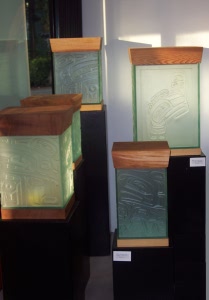
In one corner of the front of the gallery was a collection of Edzerza’s glass boxes:

alano-glass-boxes1

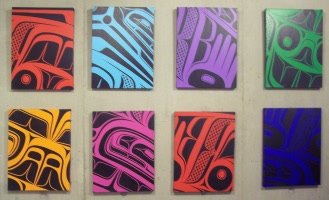
Elsewhere, you could see some of his experiments with color, such as this collection of closeups of traditional formline designs done in the electric colors of pop-art on a back wall:

alano-colors

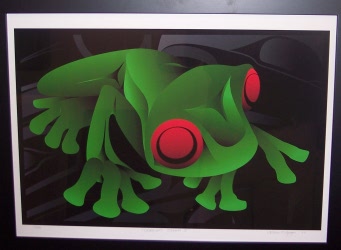
The same pop-art sensibility appeared in a couple of contemporary paintings of frogs, which were inspired, I am told, by a tattoo on a woman’s back:

alano-frog3

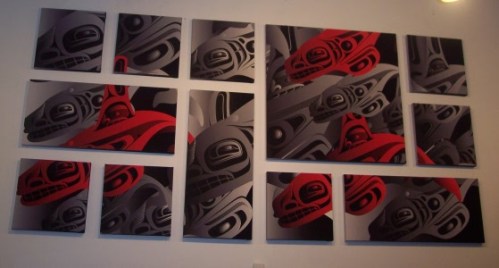
But the major works in the exhibit were the multi-panel ones, like this one that was hung near the ceiling, facing the door:

alano-orca-multi

Another orca design, a triptych, was hung just inside the door, and a triptych featuring ravens on the back wall. The raven triptych was especially dramatic, as one of its panel shows:

alano-eagle-triptych2

All these multi-panel works shared features that are characteristic of Edzerza’s work: A three-dimensional contemporary take on traditional Northwest Coast designs, an experiment with color in mainly grayscale designs, and a dramatic sense of movement that is enhanced by the separate canvases and draws your eyes from one to the next.

Morgan Green is not as an experienced an artist as Edzerza, but, in the last year, her work has matured quickly. Previously, the work by Green that I knew best were her leather cuffs and a somewhat over-ornate wolf helmet in the gallery, but the works I saw last night shows some other sides to her work, and an interest in different media that, if anything, is even greater than Edzerza’s.

Green’s works included a wall hanging and a variety of earth-colored ceramics inspired by a recent trip to Arizona and the First Nations work she saw there. A plate depicting Mouse Woman was particularly striking:

morgan-green-mouse-woman-plate

So far as I know, no historical depictions of Mouse Woman survive. But Green’s rendering seems a reasonable one, with features like the ears, the round eyes and the incisors providing the defining features that you would expect in a traditional design. At the same time, placing the design on grainy ceramic creates a pictograph-like effect, all the more so because the formline is hinted at more than fully realized.

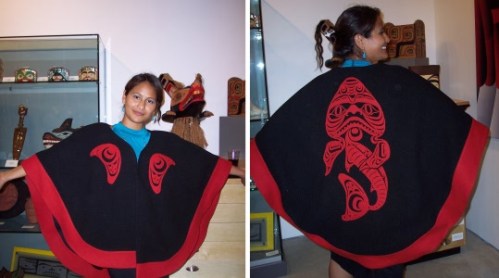
Perhaps the most accomplished work by Green on display was a Dogfish Woman robe she had created for an elder. The design was fairly standard (that is to say, more or less a descendant of Charles Edenshaw’s sketch via Bill Reid), but the cutting of the design and the assembly of the robe made for a first rate piece of work. As Green was discussing it with some of the guests, one of them agreed to model it:

morgan-green-dogfish-woman-robe

The evening was a fund-raiser, with a quarter of all sales going to the Vancouver Foundation. How successful the evening was a fund-raiser, I didn’t ask. But from the perspective of spotlighting two promising young artists, no one could have asked for more. I came away from the evening with increased respect for both, and an even greater determination to watch and enjoy their future growth.

Read Full Post »

In the last six months, a free Saturday or Sunday afternoon will likely find me down at a Northwest Coast art gallery. For me, it’s a pleasure that ranks with a good book or music store.

In fact, in one particular sense, an art gallery has an advantage over a book or music store. In a music store, you are lucky to get a quick sampling of an album if you get one at all; usually, if you want to listen before you buy, you have to do so via your own home Internet connection. A book store is much better, but, even so, reading more than a few pages will quickly make you unwelcome.

By contrast, at a gallery you are expected to give pieces a careful look. So long as you don’t touch anything without an invitation, few staff members in a gallery are going to mind if you examine piece after piece for a long time. After all, nobody expects you to drop a few thousand dollars on a mask or print without making up your mind. Paradoxically, because you are surrounded by expensive items, nobody expects you to be in a hurry to spend.

This attitude has the advantage of making your browsing session inexpensive nine times out of ten (the tenth time, admittedly, you are apt to find yourself putting down the cash that would buy dozens of books or albums, or talking about lay away plans). But unless the lust to acquire hits you, usually you can stand and admire a formline or the use of color for hours and not spend a cent.

To some extent, of course, you can browse online. But online, you miss many of the details, and your opinion of a piece can change drastically depending on whether you see it online or up close. Moreover, even the most conscientious galleries do not always have all their stock online, so you never know what you might see when you actually visit. Once or twice, I’ve even seen new pieces that have just arrived.

Art galleries are businesses, and, sooner or later, a staff member may ask if you need help, the same as in any other store. But while someone selling music or books is likely working at minimum wage and has a corresponding minimal interest in what they are selling unless they work in a small specialty store, most members of a gallery staff are only too pleased to talk art, too. If you are a novice, many are happy to educate you. If you have deeper knowledge, most are just as willing to share their enthusiasms with you. After all, they are interested in the art as well, and, while they have more to do than deal with customers, on the weekends gallery staff members expect to be busy with customers. And, because they know that most people don’t buy lightly, they are quite willing to cultivate customers to encourage another visit.

For these reasons, you have a good chance of combining aesthetic pleasure with a bit of education – or even some friendly gossip about various artists and an informal sociology lesson. If you keep returning, before long, you may have struck up something that is not quite a friendship (since, after all, money is ultimately the basis of the relationship), but is certainly a friendly acquaintance or professional relationship. In fact, of half a dozen galleries which I visit with any regularity, there is only one in which the staff is unfriendly – and, not coincidentally, it’s the gallery that I visit least, enjoy least, and have not bought from.

Best of all, though, is the time you take to enjoy the art itself. Northwest Coast art has its banalities of form and its mediocre artists, just like any other art form, but the standards of craft tend to be higher than in most forms of modern art. Even if a piece doesn’t make me want to buy, I can still learn from it, if only by trying to codify why it succeeds.

And when a piece does succeed – well, I am simply lighter of heart for seeing it. I don’t have to possess it (and good thing, too, since some of the best pieces are well beyond my price range); I am simply happier with being alive for having had the privilege of seeing the really first-rate.

The modern world, it seems to me, does little to encourage the cultivation of aesthetic emotions. Even much modern art is so tangled in consumerism and posturing that aestheticism is often ignored, if not actually ridiculed. But such attitudes have never completely taken hold in Northwest Coast art, perhaps because it is still partly rooted in culture and tradition, no matter how innovative it becomes. All I know for sure is that I come away from an afternoon at the Northwest Coast galleries feeling subtly relaxed, and never regretting the time I spend indulging my aesthetic senses.

Read Full Post »

You don’t discover the fact right away, but if you start buying Northwest Coast art regularly, you soon learn that most art galleries stock two types of works: The type that gets displayed, and the type that sells without ever been hung in the gallery or appearing on a web-site.

The type that never gets displayed comes from a number of sources. It may be a piece that is being resold after the original buyer has died, lost interest, or needs to make room in their connection. Sometimes, it is a piece by a top artist for whom the demand is so great that the gallery staff have a shrewd idea of who might buy it. It may be a piece that has been brought into the store for an upcoming exhibition.

Occasionally, it is a piece that is half-finished, such as the half-finished panel in one gallery that was abandoned because it developed a crack, or the telephone chest I saw at one gallery that had Bill Gates’ initials on it because the artist thought only someone like Gates would want to buy it – but he didn’t. The origin can even be as simple as a piece that the gallery currently has no room for, and has tucked away in a closet that most potential customers never see.

Another source of undisplayed art is the artists themselves. Some artists, particularly better known ones, have enough of a following that they don’t need the galleries except as a form of marketing. Much of their work is either begun as a commission or else sold soon after completion to people on the artist’s contact list.

Whatever the exact origin, these undisplayed pieces are frequently the best or the quirkiest work available. For instance, I know of one gallery that has a collection of original acrylics by an artist who recently died. As soon as news of the artist’s death reached the gallery, the owner pulled the pieces until he could decide what to do with them, and hasn’t displayed them since.

In another case, a highly regarded but not very prolific artist delivered his latest masterpiece to the gallery. The gallery never displayed it, but sent word to a few select customers. Despite the high price tag, the work was sold within two weeks. In a similar case, a master carver placed his latest work on consignment, and the gallery sold it in less than 24 hours. Only a handful of regular customers got to see so much as an online photo.

If you want to see such work, the only way you can is to cultivate relationships with the senior staff at galleries or with the artists. Some artists prefer not to deal directly with buyers, but, otherwise, many staff members and artists are only too pleased to talk about what interests them. They can teach you a lot, and, as they get to know you, introduce you to the work of other artists, and, if you let them know your interests, they will gradually include you in the list of people who learn when undisplayed work becomes available. But building relationships is the only way you are likely to have a chance to buy – or just admire – some of the best work in the field.

Read Full Post »

Last month, a friend phoned to ask my advice about the price of a Northwest Coast mask that he had commissioned. The price the artist had quoted seemed high to him, but he was still interested in the mask. Thanks to my frequent gallery browsing – both in person and online — I was able to reassure him that, for a piece of that size by an artist of that reputation, he was getting a reasonable price.

More recently, I saw a piece by a new artist and instantly recognized the price as too high for this moment in the artist’s career.

From these two experiences, I realized that, not only is the price of Northwest Coast masks is determined by a couple of factors – the artist’s reputation and the size and finish of the mask – but that there is a rough consensus about how those factors affect the price. This consensus exists throughout British Columbia, so, contrary to what you might expect, you are unlikely to find many bargains outside of Victoria or the Lower Mainland regions. It is undoubtedly due to the fact that galleries and artists are always comparing notes and the fact that a handful of artists are widely viewed as a guide to pricing. In particular, Beau Dick, although widely recognized as a leading carver, has never priced his works as high as he probably could, but varies his prices according to the complexity and size of his work.

As near as I can construct it, here is a list of what you can expect at each price range when you buy a Northwest Coast mask. All prices are in Canadian dollars:

  • Under $2000: The largest group in this category are masks for the tourist trade, generally by artists who have few chances of selling to upscale galleries such as Douglas Reynolds. New artistically-oriented carvers and minis (masks 7×7 inches or smaller) – also fall into this category.
  • $2000-$3000: In this category, you can find average-sized masks (roughly 12-14 inches high) by artists who are starting to gain a solid reputation, or simple or experimental masks by established artists. Most artists’ work does not stay in this price range for very long, except for some long-established carvers for tourists.
  • $3000-$6000: This category is by far the largest. Most masks in most galleries usually fall within it. Here, you find works of average size and complexity by artists who have a modest reputation for their carving. You also occasionally, large works by lesser-known artists in this range, but the restrictions on beginning or relatively unknown artists are tight enough that such works appear only rarely.
  • $6000-$10,000:This price range seems reserved for large or intricate works by artists whose work usually falls within the previous category. One of the signs of consensus is that you find relatively few artists whose prices fall consistently within this category.
  • $10,000 and above: Only large and elaborate masks or normal sized ones by master carvers fall into this category. Very few masks sell above $18,000, although I have seen a Beau Dick mask over four feet tall selling for $28,000.

These ranges are only generalities. A lesser-known carver making a bid for more recognition may temporarily or permanently raise their prices, while a more established artist may lower the price on a specific piece that they feel does not represent their best work. Similarly, a smaller or larger size may bump a specific mask from the artist’s norm. Almost always, reputation trumps size: for instance, I recently saw a mini by Dempsey Bob selling for just under $5,000, a price that reflects both his fame and the fact that these days he does little non-monumental work in wood.

I should also mention that artists do not necessarily view this consensus as fair. They argue that, especially in the lower categories, it hardly pays to take the time to finish the mask – and no doubt they are right.

However, other artists figure that selling in the lower categories is a part of their career that they simply have to endure – and they are right, to. Unless an artist is lucky enough to live on commissions or has another means of exhibiting work to the public, they have little choice except to participate in a market in which both they and their work are evaluated in detail by the market.

Read Full Post »

Not too many years ago, you only had to walk down Government Street in Victoria to find more shops selling Northwest Coast art than you could properly absorb in a day. Looking back, I’m not sure of the quality of some of the shops, but they were there. But times are harder, with many store fronts along Government empty, and now you have to search for galleries.

Descending on Victoria yesterday, these are the galleries we managed to find:

  • Art of Man: Located in the mall in the basis of the Empress Hotel, the Art of Man specializes in Inuit and First Nations masks and sculpture. The pieces for sale included four or five from Ron Telek, including a meter high blue shaman (this from an artist who rarely uses color), and a shaman marionette fending off a spirit attacking his foot with other spirits resting in his hand. Daryl Baker, the nephew of the LaFortune brothers Doug, Perry, and Aubrey, is also represented by highly-detailed designs that border on the surreal, and that are all marked by a close attention to finishing details. The Art of Man also seems to get first pick of Tim Paul’s work – so much so that I realize that only his lesser pieces reach Vancouver. Other artists whose work is available at this gallery are John and Luke Marston, whose work shows an awareness of history that I had never realized before that it possessed. In general, the quality of the work at the Art of Man is extremely high, making it by far the premier gallery of Northwest Coast art in downtown Victoria.
  • Hill’s Native Art: Like the Vancouver store, the Victoria Hills is mainly a tourist shop. However, the Victoria store seems to have a slightly better ratio of art to high-end tourist pieces, as though it gets first choice of all the locations. But perhaps this impression is due partly to the fact that it is less crowded and better lit.
  • Alcheringa Gallery: From the web site, I had the impression that this gallery was huge. The reality, though, is that this is a gallery with only a few of its pieces on display – and about half of those are given to works from Papua New Guinea, which is worth seeing, but doesn’t engage my interest the way that the Northwest Coast tradition does. Still, you can see some works by Tim Paul and John Marston there. I was also interested in seeing two works I had seen on the Internet, one by Ron Telek and another by Dean Heron.
  • Pacific Editions: Unfortunately, this story is closed on Mondays, which meant that we walked six blocks out of our way for nothing. But what we could see through the window confirmed the impression I had from the web site: Pacific Prints has a huge collection of limited editions prints. I look forward to spending a happy few hours there the next time I’m in Victoria.
  • Eagle Feather Gallery: A mixture of art and tourist pieces, this gallery is only a block from the Empress Hotel – but on a side street that you may have trouble finding. It specializes in the work of Doug, Perry, and Aubrey LaFortune, especially Doug (in fact, he was due to drop by the day that we visited, although we missed him). Daryl Baker and Pat Amos also have a couple of pieces, while Francis Dick has at least a dozen 2-D works from throughout his career at the gallery. Whether the gallery is worth a visit probably depends on your opinions of these artists, although its stock gives you a good opportunity of evaluating Doug LaFortune thoroughly.
  • Out of the Mist Gallery: This gallery specializes in antiques. Its modern selection is devoted largely to the Hunt family, and includes a few curios like a mask carved by Richard Hunt when he was a teenager, a formal, somewhat stiff print from the start of Beau Dick’s career, and a two meter-long eagle by Roy Henry Vickers. The quality of the antiques is completely indiscriminate, and includes some pieces from across North America. If your taste runs to antiques in Northwest Coast art, you could probably find something to your taste, but the somewhat dim lightning and the bored staff makes the effort hardly seem worthwhile.

As with previous lists I’ve made of galleries, this one makes no effort to be comprehensive. We did not, for instance, have to visit the Provincial Museum’s gift shop, which I seem to remember as having a few art pieces. So if you know of any other galleries in the Victoria area that might be worth a visit, please add a comment and let me know.

Read Full Post »

As I visit Northwest Coast Galleries in Vancouver, I’m starting to notice relations between certain galleries and certain artists. Out of friendship, enthusiasm, long-term business relations, or a combination of all three, some galleries simply carry a better selection of some artists than others.
Here are the specializations I’ve been able to detect so far:

  • Coastal People’s Gallery: This gallery has a good general selection of artists, although it seems to be buying less recently, possibly because it’s overstocked. However, it is the main exhibitor in town of Henry Green, especially for his carved and increasingly colorful panels. Coastal People’s also favors Chester Patrick, a less well-known artist who has done a number of acrylic paintings notable for the complex grouping of characters, as well as panel carving. Since the summer, the gallery’s Gastown store has had space set aside for Patrick to work. I’ve heard at least one patron refer to Patrick as the store’s artist-in-residence, although I don’t know whether the arrangement is formalized.
  • Douglas Reynolds Gallery: Douglas Reynolds seems to have first right of refusal on works by Beau Dick, the Kwaguilth mask-maker and Haida artist Don Yeomans, possibly because the artists have a long friendship with the owner. At any rate, the selection of works by both Dick and Yeomans tends to be larger and more varied than at any other gallery – so much so that, in Yeoman’s case, I tended to think that he was past his creative prime based on his work in other galleries. However, based on what I’ve seen at Douglas Reynolds, that’s far from true; I just wasn’t seeing his best work. This same gallery has also started carrying a good selection of jeweler Gwaii Edenshaw.
  • Edzerza Gallery: As you might expect, this new gallery is mainly a showcase for the work of owner Alano Edzerza. However, it has also had the work of newer artists like Ian Reid and John P. Wilson.
  • Inuit Gallery: The Inuit Gallery seems to have good connection with the North, including Alaska artists like Clarissa Hudson and Norman Jackson, whom many galleries neglect – even though importing First Nations art from the United States is supposed to be duty-free. Recently, it has also had a couple of new masks from Tlingit/ Northern Tutchone artist Eugene Alfred, and a number of playful masks from Kwaguilth carver Simon Dick. Other with whom the gallery seems to have a good relation include Salish artist Jordan Seward and Nuu Chan Nulth artist Les Paul.
  • Sun Spirit Gallery: Located in West Vancouver’s Dundarave strip, this small gallery currently has a strong selection of Klatle-Bhi’s work, particularly masks. Much of this work is in Klatle-Bhi’s apparently favorite white and light-blue palette.
  • Spirit Wrestler Gallery: Robert Davidson seems to offer new works to Spirit Wrestler first, and to have an arrangement with the gallery for prints as well. The gallery also gets the pick of new works by Norman Tait, and currently has more work by Dempsey Bob than any other gallery in town. In addition, the gallery seems to cultivate some of the best of up and coming artists, such as Dean Heron and Sean Hunt, making it more adventuresome that I originally thought from my first visit.

As I was making this list, I realized that it represents my own interests as much as each gallery’s specialization. Very likely, I have left out some specializations either because I am not interested in them or haven’t got around to them yet. Still, it’s useful to know which gallery to go to if you’re interested in a particular artist, so I’ll let the list stand, even while acknowledging that it is probably incomplete.

Read Full Post »

I could be wrong, but I’m starting to see a darker side to art galleries – at least, the ones that specialize in Northwest Coast art. If you are a potential customer, you are unlikely to see this side. Most of those who work in a gallery are as passionate about the art as the customers, and – especially if you are a returning customer – will happily talk for hours. I wish, though, that I could be sure that the artists receive the same courtesy. I’m starting to wonder.

This doubt began to flicker when I first became aware of a common figure in the galleries: A first nations person – almost always a man – hovering around a gallery, looking as though he feels out of place. Sometimes, such a man has a knapsack or even a large duffel bag that he lays very carefully on the floor. If he doesn’t, at some point he will take out a carefully wrapped bracelet or other piece of jewelry from his pocket. Typically, he waits until the gallery is mostly deserted, and then gingerly approaches the nearest gallery employee. He is, of course, an artist hoping to make a sale, and his manner is very much that of a supplicant, nervous if not outright afraid.

Then, yesterday, a gallery owner regaled me with stories of how artists used to be lined up outside his door in the morning. Sometimes, he said, there would half a dozen in line, including many famous ones. The first one or two might make a sale, or even the first three, but, after that, the owner said, he usually lacked the money and was suffering from too much sensory overload to buy anything else. So, at least half the line would have waited hours for nothing.

At the same time, I’ve heard grumbling from several artists. Sometimes, they’re talking about how they feel that a particular gallery has cheated them. But, just as often, it’s grumbling against the gallery system in general. They complain that the galleries sell their work for three times what they were paid for them. And the younger ones especially complain that no major gallery for Northwest Coast art in the province is owned by a member of a first nation (although perhaps Alano Edzerza’s new gallery will change that).

I don’t want to be dramatic, but such scenes make me uncomfortable. Not only are the artists at the hub of the system, but Northwest Coast art is an assertion of identity — both personal and cultural — for many artists. It’s an assertion that, despite everything, they and their culture are still here, and being respected. Yet the scenes are not so different from those associated with day-laboring farm workers. Not that people doing piecemeal work aren’t entitled to dignity – they obviously are – but it seems an added injustice that people who are the main producers, people of real talent and sometimes genius should be subjected to this kind of treatment. Yet some don’t even feel at home in the places where their work is being displayed.

Not all, of course have this reaction. Some artists are capable of handling the gallery system with skill and finesse. Others hire someone who can do the business of selling for which they personally have no aptitude. Still others either have enough talent or reputation that a gallery will adopt them and do everything in its power to promote them. But many aren’t so lucky, and they resent the situation without feeling that they can do much about it.

I don’t know what the solution is. Maybe galleries can be justified as a form of promotion that ultimately helps artists’ careers. But I’m starting to think that more artists need to learn more about business so that they can hold their own. Or maybe more Northwest Coast artists need to become gallery owners themselves. Others might group together to form an online co-operative and create a market for their work that bypasses the gallery system.

Personally, I am listening to the artists, trying to separate out individual animosities from trends in the hopes of finding which galleries, if any, are the most ethical. I am also starting to wonder if I should be dealing more with the artists directly – although I’m not much for negotiations myself, even if I have some experience with them. It’s not a situation that has clear answers, but I won’t be easy about my art-buying until I have some.

Read Full Post »

Kwakwaka’wakw carver Beau Dick is one of the names on my short list of people from whom I would one day like to buy a mask (for the record, the others are master carver Norman Tait, Nishga’a surrealist Ron Telek, and Tlingit carver Stan Bevan). Not only does Dick have a subtle sense of color that is rare in Northwest Coast mask-makers, but he manages to find endless creative possibilities in two main figures — Bukwus, the wild man of the woods, and Tsonoqua (also called Dzunuk’wa), the wild woman – producing countless masks of both without repeating himself very much. And, like the others on my list, he is meticulous about finishing details, although he often chooses a rougher look than Tait, Telek, or Bevan. So, last month, when I came across a few sketches by Dick for about the price of a quality limited edition print, I was instantly tempted to buy.

The first Dick sketches I saw were at the Inuit Gallery in Gastown. One was a colored pencil sketch of a mask with a quick gradient background, one was a mask done in charcoal, and the third was a colored sketch of a dancer. At first I thought them unique, but a week later at the Latimer Gallery, I saw some similar works, as well as some colored pencil sketches of dancers that I suspected were done from photos. The Latimer Gallery pieces were dated about four years later than the Inuit Gallery mask sketch, and were about two-thirds the price, although I judged them not quite so interesting.

From what I was told at the Latimer Gallery, the mask sketches were the result of a period in which Dick had sketched his designs before carving them. He had tried this experiment at least twice, once in 1999 and again in 2003. I don’t know, but I surmise that he either was not especially satisfied with the results, or found the exercise not useful for his carving since (so far as I know), he only tried the experiment a few times with masks. I hope one day to learn more.

Meanwhile, I was disappointed to find that the sketches weren’t as unique as I had imagined. Instead of coming down the next week to buy the mask sketch at the Inuit Gallery, I went to other galleries instead.

But, last Saturday, Trish was well enough to take a brief tour of some of the downtown galleries. When we reached the Inuit Gallery, she was as intrigued by the sketch as I had been, and we bought it on the spot, bearing it home in a mailing tube sealed with tape at both ends to keep out the rain and wrapped in a plastic bag. Tomorrow, it goes to the framer.

What interests me in the sketch is partly the subject matter. If you have ever been in the northern rainforest alone, especially near nightfall, you have no trouble understanding how Tsonoqua entered the local myths; she’s the sense of something terrifying moving just behind the trees.

But, just as importantly, the sketch is interesting for the way it is rendered. If you examine the lines of the face, you’ll see that they are not lines so much as surfaces. Even a single line, like the ones on either site of the mouth are not so much lines as areas, and their shadows are likewise. In other words, Dick is sketching with a carver’s eye.

The only exception to this approach is the hair of both the head and the shaggy eyebrows (although even the individual hairs tend to be thick). The mixture of the two different approaches only adds to the oddness of the face. So does the red patch on just one of the cheeks.

The sketch is rough, but not so rough that Dick didn’t give it a bit of a finishing touch with the gradient background. I suppose that some people would consider the roughness a fault, but, really, what else do you expect in a sketch?

Anyway, a calculated roughness is a common characteristic in a lot of Dick’s work, and seems to suit a character that has been living rough.

One day, I might be lucky enough to find the mask that matches the sketch. But, for now, the sketch is a small and slightly curious addition to our small art collection.

B

Tsonoqua Mask by Beau Dick

Read Full Post »

This weekend, I scouted the Northwest Coast galleries around the south end of the Granville Bridge. Here are my impressions:

  • Eagle Spirit Gallery: Located on the edge of Granville Island, this gallery is one of the pleasanter viewing areas that I’ve seen, with lots of natural light and indirect sun. It seems aimed at the corporate or public buyer rather than the individual, with many larger-than-life plaques, masks, and sculptures. Its selection includes some of Robert Davidson’s recent sculptures (which you don’t see much of), as well as works by Lyle Campbell, but, for me, Francis Horne, Sr.’s “Spirit Raven” was the only really exceptional piece. Even browsing casually, I saw a surprising lack of finishing detail on some pieces, including some by artists whose work is usually more polished. In general, the selection seemed a little too safe for my taste.
  • Edzerza Gallery: I discovered this gallery by accident, occupying the space that used to be occupied by the Bentbox Gallery, a block from Granville Island. Owned by the young artist Alano Edzerza, it displays mostly his prints and jewelry, but includes selected pieces from up and coming artists. For a young artist, running your own gallery seems a daring move, but, I’m proof that it pays off, since it means that I noticed Edzerza’s work for the first time, and he’s now on my list of artists whose work I want to buy. While I was there, I also met another artist whose work I admire. The selection is relatively small, but I am sure that I’ll be coming back, both to support the venture and to buy.
  • Latimer Gallery: A block from the Edzerza Gallery, the Latimer features moderately priced limited edition prints, masks, and jewelry I remember this gallery as being more touristy than it was today, so either my memory is faulty or else its stock has gone upscale a little. I had no trouble finding some small treasures, including some old Bill Reid prints, and some very affordable crayon sketches by Beau Dick. I don’t think I’ll be a frequent visitor at the Latimer Gallery, but I will be dropping by now and then to check what they have.
  • Douglas Reynolds Gallery: Located in gallery row a block up from the south end of the bridge, this shop is aimed at the high end of the market. Besides the inevitable Robert Davidson and Susan Point prints, it includes a number of masks by Beau Dick, and at least two striking wall plaques by Don Yeomans. It also includes a selection of gold and silver bracelets, rings, and earrings, including a few small pieces by Gwaai Edenshaw. The stock seemed a little safe to me, but was adventurous enough here and there to make me want to return occasionally.
  • There are still Northwest Coast galleries I haven’t visited in Vancouver, but these four, together with the ones I visited last week in Gastown, are some of the better known ones. Besides finding which galleries seemed right for my own art buying, visiting a number of them has helped me to understand the market a bit better, including such as who are the established and upcoming artists, and what are the going prices for each artists’ work. This knowledge makes my visits well worth the effort, especially since you can easily see a number of galleries in an afternoon without doing much travelling.

Read Full Post »

« Newer Posts - Older Posts »