Feeds:
Posts
Comments

Posts Tagged ‘British Columbia’

I’m not looking forward to the 2010 Winter Olympics in Vancouver. I never watch sports, and I’m concerned about the costs, traffic, and the virtual declaration of martial law during the games. The fact that I once dreamed of being in the Olympics myself only makes me angrier at the travesty that they have become.

Still, I could almost reconcile myself to the games for the sake of all the First Nations art commissioned for them. Some of that art was on display this weekend at the Aboriginal Art Exhibition at Canada Place this weekend, and I thoroughly enjoyed it – even if the lack of organization at the event seems ominous if it is a foretaste of how the games themselves will be run.

Being appreciative of the commissioned art is something you can file under No-Brainer. I mean, what’s not to like about the art? There’re medals with Corrine Hunt designs, commemorative coins by Jody Broomfield. The snowboarding pavilion at Cypress Bowl will have a wall graced with a new work by Dean Heron. GM Place will have a new work by Alano Edzerza, Nat Bailey Stadium a new work by Aaron Nelson-Moody, and the list goes on and on.

After fumbling badly by making the symbol of the game the inukshuk – a symbol that has nothing to do with British Columbia, much less Vancouver – the games organizers have had the sense to commission locally, focusing on less established artists and on members of the Salish nation, whose territory the Vancouver venues are on. I understand that some 45 works of public art will be added to the Lower Mainland as a result of the games, and I consider that an unalloyed good.

Sadly, though, the Olympic organizers fumbled again in their first efforts to bring most of these works to the public. The display was almost completely unpublicized except for newspaper stories just before the event and some Internet transmission. Even then, it was called an exhibition, so that most people arrived unaware that most of the work on display was for sale – an oversight that bitterly disappointed the artists who had taken tables and paid the exorbitant prices charged for parking at Canada Place.

Even worse, the management of the event was haphazard. I heard artists complain that they were unable to set up for credit or debit cards, and the rumor was that the one bank machine in the exhibit hall required a substantial surcharge to use.

And perhaps the worst thing was that, in order to fill up the hall, the organizers seem to have let anyone exhibit who cared to pay for the table. As a result, many tables displayed tourist junk that did not belong in the same exhibit as the commissioned artists.

For me, the incompetence of the organizing was summed up by the sight of two singers on the stage gamely belting out songs to rows of empty chairs, and a snack bar that had closed down at least two hours before the end of the show. Meanwhile, the exhibitors were strolling around talking to each other.

Such poor planning undermines the celebration of the artists. My impression is that the exhibition organizers couldn’t have cared less if the artists were treated with respect.

Perhaps the organizers can learn, but if this is how they put on such a relatively small event, then we should expect chaos during the games themselves. I might be lured downtown to see the aboriginal market at the Queen Elizabeth Theatre, but I, for one, plan to spend the three weeks of the games bunkered down safely in Burnaby, far away from the insanity.
Read Full Post »

The other night, I woke in the early hours to the sound of coyotes howling. The howling is a thin quaver that seems to rise slowly through the sky then disappear, and I can think of others sounds that I would prefer to awaken me. But, once awake, I lay on my back with my hands behind my head enjoying the eeriness and the thrill that fluttered through me. I hadn’t heard them in months, and I was starting to think that the local pack had moved on.

Probably, I am a minority in my enjoyment of coyotes. Many people call them vermin. Others are convinced that coyotes will drag young children away, although that has only happened once or twice. Still more are angry because their cats or lapdogs have become the snack for a pack – although the real blame lies with their own irresponsible treatment of their pets.
But I figure that you have to expect that the wilderness is going to creep in one way or the other in an urban area, especially one so full of parks and trees as greater Vancouver. And when you live hard against a green belt as we do, then inevitably the occasional cougar or bear is going to stumble into someone’s back yard. Compared to such visitors, coyotes make good neighbors, going about their business while causing a minimum of fuss.

I used to hear them frequently at night, answering the sirens trailing from the nearby fire station. Sadly, that ended when a patch of woods a couple of blocks away was replaced by condos. However, they are frequent in the daylight. Once or twice, I’ve seen half-grown ones partly concealed by the bushes, but the adults put on a bold front, making so little fuss about walking down the street that at first you think they are stray dogs. Once, I even saw one passing through the middle of our townhouse development, ignoring the people and mostly unnoticed.

Several times, too, I’ve seen them on the sidewalk, sitting waiting for the flow of vehicles to change with the traffic light. I suppose they are watching the vehicles, not the light, but sometimes I am not so sure. The few times I’ve made eye contact with a coyote – from a safe distance, let me assure you – I’ve wondered afterwards if it was a sentient creature evaluating the level of threat I represented. After those experiences, I’m not quite prepared to rule out the possibility that some of them know which light it is safe to cross the street on, even though they are presumably as color-blind as dogs.

Coyotes are not creatures of beauty. If anything, they are scrawny things, living lives of desperation. Still, I admire them for being a part of the wilderness that can adopt to the city. I sometimes think that urban life is an isolated one that leads everyone to imagine that they can control everything about their lives. As the coyotes slip from park to park throughout the urban sprawl, eating our garbage and denning in greenbelts in the ravines of creeks, they disprove such ideas with a quiet disdain.

Their continued experience shows that, no matter how we try to isolate ourselves, we cannot deny nature. Despite all the radical changes to their environment, despite the way they are hunted, coyotes still survive. And I, for one, appreciate their casual upsetting of all our assumptions about ourselves and our cities.

Read Full Post »

The Bill Reid Gallery kicked off a series of talks about artists from its Continuum exhibit with a slide show by Michael Dangeli, a Nisga’a artist who has started to receive recognition in the last few years. The choice was lucky or inspired, because Dangeli is more articulate about his work than most artists, and has clearly thought carefully about what he is doing.

The Continuum show is supposed to be about the conflict between traditional and contemporary influences in Northwest Coast art. And, in fact, Dangeli was introduced in terms of this conflict. However, he immediately made clear that he rejects such a dichotomy in his own work. Calling his work “traditionally contemporary,” Dangeli made clear that he considers his work a continuity of the past, both an attempt to reclaim it and to expand and to adopt it.

One reason why Dangeli is comfortable with the paradox of living with opposites is that he sees the rest of his life in such terms. Nisga’a by birth, he has lived in the United States and Vancouver, far from his nation’s territory. Deeply interested in his cultural past, he is also aware that he is a modern urbanite in his day to day life. Spiritually inclined, he is also a veteran of two tours of duty abroad in the American military. With such tensions, those between the traditional and contemporary must seem like just one more.

Another reason that Dangeli can have the attitudes he does is probably the fact that he is actively involved in the cultural revival of his people – something that seems especially unusual for an urbanite. During his discussion, Dangeli talked of pieces of art being given as payment for services, and at potlatches, as well as important events such as a betrothal. He talked, too, of being groomed to take over a chieftainship, and of his hesitation about taking on an even larger chieftainship recently. He talked about his dancing, and of acquiring songs and dances and inventing new ones, and of exploring the distinctions between male and female powers and responsibility with his finacee.

Unlike many First Nations artists, Dangeli seems either fortunate enough or determined enough to have lived with a sense of tradition from an early age. Consequently, it is easier for him than many artists to see a continuity rather than an opposition.

This continuity seems to affect his art very strongly. He talked of preferring that his gallery pieces not have eyes that would make them danceable, and of his relief when he managed to buy back an early exception to this preference. He talked, too, of making one of the first stone masks for well over a century, and having it danced.

But the strongest evidence of his artistic continuity came at the end of his talked, when he uncovered three pieces of his work that are reserved for ceremonial purposes: The mask he bought back and modified with a pieced of Ainu cloth; the stone mask, and a frontlet worn by his fiancee. He explained that he generally kept them covered, and treated them as living spirits, requesting that people look them over a few at a time so as not to overwhelm them. It was unclear to me whether any power in the objects was innate or resided in the respect shown to them, but his attitude was curiously moving.

Even if you didn’t share his cultural background or beliefs, they were obviously alive for him – either never having died or after being carefully revived, or some combination of the two. Clearly, he had fought hard to make them meaningful to himself and those around him, and I believe that he has largely succeeded. At the very least, he demonstrated to the audience that his cultures were still ongoing and hadn’t stopped developing with the European conquest.

All this says nothing directly about his work, which ranges from the traditional to the modern, with a variety of color palettes and a frequent emphasis on collaborations with other artists – or “brothers,” as he called them.

I have liked what I’ve seen of Dangeli’s work in the past, and, by the time he had finished talking, I had a much clearer sense of why, and an increased interest in what he might do in the future. And, really, what more can you ask of an artist’s talk? With several dozen slides and intelligent commentary, Dangeli sets a high standard for the next speakers in the series to match.

Read Full Post »

Haida art occupies a privileged place in Northwest Coast art. Because the revival of the art is associated closely with Bill Reid, who began with the Haida tradition, to many people, all Northwest Coast art is Haida, and Tsimshian, Nisga’a, Kwaguilth, Nu-chu-nualth, Salish and the others are not even names. Still, no one can deny that the Haida include many brilliant artists in every medium, so last night I went to the opening of Coastal People’s show, “Haida Masterworks” expecting to enjoy myself. Nor was I disappointed.

In fact, the show exceeded my expectations. Since it had been only lightly advertised, I expected a small show. Instead, what I saw was a showcase of leading Haida artists, with works ranging from the classic to the contemporary.

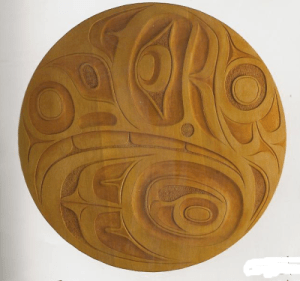
Several leading Haida artists featured prominently. Master carver Don Yeomans was represented by several circular panels and a mask well over a meter high –examples of what I think of as corporate art, since you need a large lobby, or at least an extremely long room with a high ceiling to display it in a setting that does it justice.

don-yeomans

April White, who paints in styles varying from traditional Haida designs on cedar bark to contemporary landscapes:

april-white

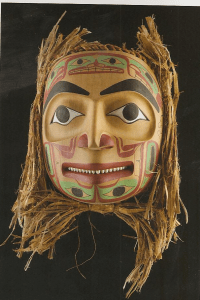
Also prominently displayed was the better part of two years work by Reg Davidson, who is probably the leading carver of masks that can be used for dances and ceremonies. This emphasis gives his masks a simplicity of line and color that is rarely seen, as well as a unique dramatic quality. I am sure, for instance, that the large eye-sockets that characterize his masks increase their theatrical effect when seen in the firelight of a night-time ceremony.

reg-davidson

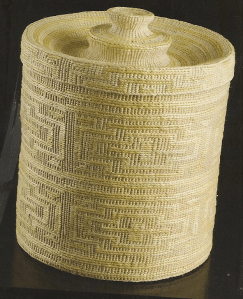
Yet another master artist who is well-represented is Isabel Rorick, a weaver who works largely with spruce roots and natural designs in traditional patterns collected from up and down the coast. I admit that I know little of basket weaving, and ordinarily think less of it. Yet even I could see that Rorick’s work was intricate and uniform. Despite the muted colors, the designs are clearly visible from ten meters away, and, up close, the evenness of her work make clear that she must spend hours upon hours in her craft.

isobel-rorick

Among such works by well-known artists, I almost missed some wood-carvings by newer artists. However, on my second or third round of the gallery, I took time to appreciate some panels by Kyran Yeoman, Don Yeoman’s son, and a mask by Robin Rorick. Also on display was one of the first masks I’ve seen by goldsmith Jesse Brillon.

Contemplating these works was a pleasant way to spend an evening. However, for me, the highlights of the show were the jewelry and small sculptures in the display cases. Jesse Brillon and Gwaai Edenshaw – so far as I’m concerned, the leading goldsmiths in Northwest Coast art – were unfortunately represented by only one work apiece, although both were standouts:

edenshaw-brillion

However, small displays of works by Derek White, Rick Adkins, and Gerry Marks were more than compensation.

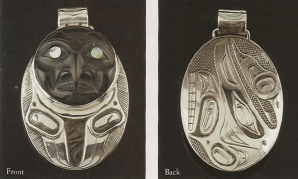
I also took the time to appreciate the two-sided silver and argillite pendants by young artist Ernest Swanson. I had not given much attention to his work before the show, but I plan to correct that mistake in the future because of the fineness of detail in his engraving.

ernest-swanson

But for me, the highlight of the show was the work in argillite by cousins Christian and Darrell White. Christian White, of course, is one of the most-skilled argillite carvers working today, and pieces like “Raven’s Children and “Eagle and Salmon” are typical of the strong lines and sense of restraint that I associate with his work.

christian-white

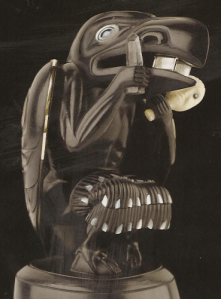
By contrast, Darrell White has only been working seven years to his cousin’s three or four decades, but he is rapidly perfecting his work. His style is less serene than Christian’s White, reminding me a little of Ron Telek’s, and having the same attention to detail. Pieces like “Thunderbird Captures Killerwhale” and “Raven Dancer” (below) show an originality of design that leave me looking forward to what he will do next.

darrell-white

As usual at such events, appreciating the art was repeatedly sidetracked by the interesting conversations flowing around the gallery. Although I had only expected to stay an hour or so, I suddenly found that three hours had passed and I still hadn’t looked as closely as some works as I had wanted. But that just gives me an excuse to return, so I’m not complaining.

Read Full Post »

Our washing machine started leaking this week, like a puppy relieving itself in a corner, so we’ve been spending our spare time looking for a new washer/dryer combo. It’s a good thing that appliances last over a decade, because it will take at least that long to ease the horror from my mind. Part of the problem is that we have very precise space constraints, but most of the problem is the way that appliances are sold.

Most of the time when I’m looking for hardware, it’s a computer or a computer peripheral. Because the competition is so fierce for computer hardware, manufacturers and vendors document everything about what they’re selling on their websites. Speed, physical dimensions – you name the spec, and you can find it on every site. Consequently, you can spend a hour or two in front of your computer and arrive at the store armed with an exact idea of what you want, and get out fast.

By contrast, household appliances aren’t sold that way. For several local appliance vendors, having a web site is simply a means of announcing their existence. In one case, their site is a single page. In another, you can can learn what brands they carry, but not which models or what the prices might be, because most of their site is simply links to manufacturers. Another one doesn’t bother to give dimensions. None of them update their site with any regularity.

Consequently, if you are trying to be a conscientious consumer and shop around, you have to do a lot of old-fashioned legwork. I’m no stranger to exercise, so ordinarily I wouldn’t mind, except that the trudging around was in the service of a necessity that doesn’t interest me in the slightest. Frankly, reading washing machine stats and peering inside their drums is so mind-numbingly boring that a mentally sub-normal yak would be bored by it. Personally, boredom set in after the second or third examination – and we’ve looked at dozens in the last few days.

Then, just to make matters worse, the sellers of appliances seem strangely reluctant to take your money. Our first stop had only a couple of models on the floor. We could ask about other models, we were told, but how would we know about them if we didn’t see them? We would have to jot down the brands the store sold, then go home and do research.

Our next stop was the Sears store in Metrotown, a complex that has long had my vote for the most hideous shopping complex in the whole of Greater Vancouver. I can’t confirm that minotaurs roam its corridors freely, but if I hear any bull-like rumblings as I pass the service hallways, I’m not investigating.

But the Sears store has its own special horror, because its staff is apparently competing with each other for the fewest times they have to talk to a customer. You can see the staff scuttling low down the aisles a few over, but, by the time you learn how to get one’s attention, you would have the experience to track big game anywhere in the world. About the only thing you can say for this attitude is that it is marginally better than having the clerks dance attendance on you with unrequested information.

At Future Shop, the pricse were good, but each time we were ready to buy, we were told that the warehouse was currently out of stock and was likely to remain so for the next couple of weeks. I strongly suspect (although I cannot prove) that this was a variation on bait and switch. To be fair, we did receive a phone call saying that one of our choices was available, but, by then we had already bought.

The next stop was Home Depot. I realize that the company has built its business on do-it-yourselfers, but the staff didn’t seem to understand that plumbing is a bit beyond the average home owner. The company didn’t even a list of suggested contractors that customers might hire to get their new appliances connected. Nor did the staff see anything ridiculous in the attitude.

Finally, with madness nibbling at our brains like a glimpse of Cthulhu and the Elder Gods, we stumbled into Trail Appliances in Coquitlam. There, we were left to browse for a few minutes before an employee approached us. He was helpful, even giving us some advice we probably wouldn’t have thought of. And, wonder of wonders, the floor model that was our first choice was actually available. Within minutes, we were paying and arranging delivery.

What the other companies didn’t seem to understand was that washers and dryers are not the most glamorous of appliances. While some conscientious but anal souls might conscientiously remember to have them serviced every year, I suspect that many people are like us, and don’t think of them until they need servicing or replacement.

The result is that, when people go shopping for washers and dryers, they are usually in urgent need of a replacement. They can’t afford to spin out the process, because, if they do, they will have to find a laundromat or an obliging neighbor who will let them have the use of the machine.

What Trail Appliances offered was simply efficient service. The result? We’ve decided to replace our fridge at the same time, since it is running on borrowed time, and we’ll do so by returning to Trail again. Trail’s website is no better than any of the others – in fact it is one of the worst ones – but at least its staff understands how to treat customers. So, naturally enough, it gets our other business, too.

Read Full Post »

When I wandered into the Alcheringa Gallery in Victoria on a day off, I really wasn’t planning to buy another piece of art. My official excuse was to see the gallery’s “More Than Meets the Eye” show, which included a recent piece by John Wilson, and a twenty-five year old piece by Ron Telek. But when I saw an artist’s proof of Wayne Young’s “Wolf Clan,” a purchase was more or less inevitable.

For one thing, Wayne Young is an artist on my short list. Having learned his craft under Dempsey Bob and his uncles Robert and Norman Tait, like his cousin Ron Telek, Young displays in his work all the characteristics you would expect – imagination, a strong sense of line, and careful attention to finishing – while still managing to display a distinctive style of his own. One of his prints at the Alcheringa Gallery was one of the few renditions of Dogfish Woman that didn’t descend from Charles Edenshaw’s sketch via Bill Reid. Another print that I saw at the same time showed Raven and the First People without being dependent on Bill Reid’s monumental work; in fact, unless I miss my guess, it shows a mussel or a chiton rather than a clam shell.

Just as importantly, something that always fascinates me about Northwest Coast art is how the design is rearranged and constrained by the surface it is on. A flat design can be wrapped around the handle of a ladle, for instance, or rearranged to fit into a round panel. The challenge to the eye is to pick out the details of the design and identify it while enjoying the intricacy.

In the case of “Wolf Clan,” the shape of the design is reminiscent of an argillite pipe. The compressed space contains three wolves, two full sized and one small one, perhaps a cub. Of the small one, only the head can be identified for sure, although perhaps its body and legs are to the right of it or to the left across the two central S-curves. Possibly, it is a killer whale, representing a clan related to the wolves. The wolves on the end show few clear signs of their bodies, with most of the space given to their heads and tails, and, on the left, a single paw.

What is mildly unusual for Northwest Coast art is that it is asymmetrical, with all three heads both facing the same way, and the right side of the share by two of the heads. The two S-shaped areas in the middle – at least one of which is a tail, and possibly both – also create the optical illusion that one side is shorter than the other. However, which one seems shorter depends on which S-shaped area you focus on, and measurement proves that the two halves are about the same length.

Notice, too, the variation of repeated elements, such as the eyes and pupils of the heads, and the secondary elements that surround the head and eye. Even the teeth vary, with the wolf on the left sporting an incisor and the one on the right none. The small head, by contrast, actually seems to have incisors that curl up In much the same way, the stripes on the tail vary as well. Since contemporary design is asymmetrical, the overall impression is of a modern sensibility, even though all the elements, taken one at a time, are traditional.

Even more unusual is the extraordinary variation in the thickness of the formline, ranging from the thick lines of the wolf snouts and heads to the pen-thickness of the outline of the tail in the middle, and the extreme tapering of some of the secondary elements where they join another line. This variation gives “Wolf Clan” a certain angularity, despite the roundness and the sweeping curves throughout the design. The variety also makes a sense of constrained motion in the design, moving the eye along one line until it catches the next one.

“Wolf Clan” is a small piece but it shows all the strengths of Wayne Young’s work. I have noticed recently that we have a disproportionate amount of Nisga’a works among our purchases, probably because of the bold simplicity that features in that nation’s traditional designs. To that tradition, “Wolf Clan” adds an intricacy that I’m sure will intrigue me for years to come.

wolf-clan-lo-res

Read Full Post »

I ride the buses at least as often as I do a private car, so I’m as pleased as anyone with the opening of the new Canada Line on the Skytrain system. But I do wish that when the media or casual conversation mentions the new rapid transit line, they would focus on what matters.

To start with, before anyone praises the fact that the line was opened three months early, let’s remember how that was done. It was done by ruthlessly ignoring the effects of construction on small businesses along the route. Dozens have closed as a result, and some may yet manage to get the compensation they deserve through the courts. And let’s not forget the hiring of foreign workers at sub-standard wages, or the farming of the management of the new line to private industry. If such things are the only way to finish a construction project early, then I think I might prefer delays.

For another, just as when the Millennium Line opened a few years ago, the commentators are babbling about the wonderful view on parts of the line. And it’s true that running seven meters off the ground, Vancouver’s transit lines can offer a better than usual view of the scenery. But, for those of us who will actually be using the line, the wonder of the view will last no more than a few trips. Soon, people will be reading, talking on the phone or fiddling with their music players, just as they always do on a routine trip.

The same is true of the comments made by the would-be architectural critics. What matters for daily travelers is not aesthetics, but practicalities. Are the stations well-lit? Are there enough signs so that people know where they are going? Are the stations safe? Can they accommodate the thousands of people passing through them during rush hour? The answers to all these questions seem mostly positive, although I’m willing to bet that the above ground platforms act like a wind tunnel, just as they do on the other lines. But what everyone seems to be commenting on is how the glass and metal and terra-cotta colored walls make an aesthetic experience.

To someone on transit as often as I am, the scenery and aesthetics soon fade into the background, except in unusual circumstances, such as an unusually vivid sunset. What regular riders like me want to know is something far simpler: Does the new line save us time?

I didn’t ride the line on the first day, when the fares were free. But I did ride it on the second day as I went about my business. So, I’m happy to report that, yes, the new line did save me time – some five to ten minutes compared to the bus when traveling across False Creek from Yaletown to Cambie and Broadway, and maybe twenty minutes total on my entire trip. Better yet, the connections were better than on my old route.

Obviously, how much time you save depends on where you’re going. But, for regulars, that is the real story in the new line – the time saved, and the relative convenience compared to the bus or the car. Most of the rest is background, at least for those who will actually be using the new line. I suppose the new line makes a change from the usual stories straight from the police’s media departments, but, as happens all too often nowadays, in this story the media is missing the point.

Read Full Post »

Yesterday, I was talking with the owner of a Northwest Coast gallery when an artist entered carrying an unprotected mask. I instinctively moved away, partly because I could see that the artist was going to try to sell the mask and business needs privacy, but mainly because I knew that he wasn’t going to succeed, and probably wouldn’t want obvious witnesses to his failure.

He was far from the first artist I’ve seen arriving unannounced to sell work. If you hang around galleries as often as I do, you’re bound to see a similar scene sooner or later. It’s frequently a painful scene, because few artists know how to sell their own work. They are nervous and embarrassed, but determined to plunge ahead with the effort.

Their uneasiness reminds me of a singer whose concerts I used to attend, who would grimace to himself if his singing was the least bit off true; in the same way that I used to sympathize deeply with the singer, I sympathize with the artists and their deep discomfort as they try to do something for which they have no talent.

Another reason I sympathize with the artists is that they are almost certainly preparing for failure. While I can’t pretend to understand all the details about how business is done in the Northwest Coast art world, I do know enough to know that only well-established artists can drop by unannounced and have any hope of selling their work or placing it on consignment. Most artists need to make an appointment – and, these days, spend some time exchanging emails and photos of their work, as often as not. Someone who arrives unannounced will have no idea whether the gallery is buying, or even whether a buyer for the gallery is available. For these reasons, they may very likely have wasted their time.

But yesterday’s artist had the odds more stacked against him than most. I could see his mask, and even from a five or six meters away, I could see that its quality was too low for any gallery to buy it. He might be able to sell it on the street, the way that one artist has been selling similar masks this summer outside the Vancouver Art Gallery, but the mask simply wasn’t good enough. All too clearly, the artist didn’t have the proper tools, or else didn’t know how to use them. The mask was roughly finished, front and back, and no amount of paint could hide the fact.

Under the circumstances, the gallery owner was gentle. Perhaps, being an artist himself, he could sympathize with the visitor. Instead of commenting on the quality of the mask, he made a non-committal comment, and simply said that he was not buying right now. Then he talked with the artist awhile, joking that, because of his Hawaiian shirt, he must be a Kanaka, then – when the artist was apparently too lost in his own anxieties to get the joke – exchanging nations. I could guess from the look at the artist’s face that this was not his first rejection of the day, but he responded to the gallery owner’s efforts to draw him almost against his will. Meanwhile, I watch while pretending not to watch, and found identifying with the artist all too easy.

The encounter was over in less than five minutes. But I found it hard to forget. I came away with respect for the gallery owner’s courtesy, and a profound gratitude that I hadn’t been the one to turn the artist down. I probably would have agonized over rejecting the artist, or even bought the mask – unsellable as it was – out of sympathy. In the end, I was very glad that I was just a spectator.

Read Full Post »

I have two great weakness when buying Northwest Coast art: I love to see artists trying out new media, and I love work that shows the lesser-known figures of mythology. With these preferences, it seems inevitable that I would have bought Morgan Green’s Mouse Woman platter.

Morgan Green is a twenty-five year old artist who seems to be in the middle of deciding what art she wants to do. She is represented in the galleries mostly by her painted leather cuffs, but she has also done fashion design, carved masks and poles, and assisted older artists with painting and metal casting. Add an art teacher and potter for a mother and master carver Henry Green for a father, and it is no wonder that she always seems to be galloping off in all directions (in fact, every time I’ve met or contacted her, she seems about to be preparing for a journey or just returned from one).

The Mouse Woman platter is one of several pieces of ceramics that Green is exhibiting at the Edzerza Gallery. Made from clay that Green recently brought back from Arizona, it is as untraditional as a Northwest Coast piece can be. Ceramics were not a part of the northern coast first nation cultures, and, unlike argillite a century ago or glass in recent decades, have never really caught on, although you can find occasional pieces – usually not very skilled and mostly for the tourist trade.

As for Mouse Woman herself, she remains a bit of a mystery. Few, if any renditions of her survive. But the stories make her a powerful, although minor character. She generally appears as a helper of a hero in a quest. In several tales, for instance, a hero helps a mouse over a log, and then, that evening, comes to a long-house where he is greeted by a noble woman who feasts him and gives him good advice. In other tales, she whispers practical advice about everyday concerns that the hero passes on to his people. In many ways, she is all that Raven is not: domestic where he is a wanderer, a maintainer and restorer of order where he is a bringer of chaos and change, and a representative of civilization where he is the eternal outsider. Where Raven is often a child, she is more often described as a grandmother, perhaps an elder.

Since no one is quite sure what Mouse Woman is supposed to look like, in depicting her, Green is free to let her imagination run wild. She chooses a simple design that goes well the rough, terra-cotta background – a combination that vaguely suggests petroglyphs, an art form that flourished several centuries before the northern formline became codified. Most of the lines are thin, except for those associated with what Green presumably intends as Mouse Woman’s distinguishing characteristics: her incisors, round eyes and ears. For these features, the lines are heavy, giving them added prominence, and elevating them to the equivalent of the orca’s fin or the eagle’s hooked beak – the features that tell you what creature is intended even if the complete shape is not depicted.

The result is a fragile but alert-looking creature, with ovoids that suggest cheeks stuffed with food. The result is a surprisingly naturalistic figure of a mouse, that, at the same time, also suggests a tiny but alert and active grandmother. How artists of a century and a half ago might have depicted Mouse Woman remains unknown, but I’m sure that they would recognize instantly the subject of Green’s depiction.

I don’t know whether Green will continue working with ceramics. Considering her restlessness, my guess is that she won’t for the time being, although she may return to them eventually. But I suspect that her recent YVR scholarship couldn’t have come at a better time. The Mouse Woman platter is a minor piece (in scope, I mean; at twenty-five centimeters it is definitely not so in size), but it suggests to me an artist who is starting to find the themes that interest her.

morgan-green-mouse-woman-plate

Read Full Post »

(Note: Because the staff was unsure which exhibits the artists had given permission to photograph, I was unable to take pictures)

When I go to an art gallery, I come prepared to be pleased. Just as when I go to a movie or go to a book, I generally arrive with few expectations. I try to practice the concept that I should understand a work in its own terms, and not through the filter of expectations that I bring with me. Over the years, I have found that this approach has allowed me to appreciate things that I might otherwise have dismissed.

I mention my perspective because I have to report, very much against my wishes, that the new exhibit at the Bill Reid Gallery, “Continuum: Vision and Creativity on the Northwest Coast” is a disappointment. The fact that it comes after the gallery’s first successful show that highlighted Bill Reid’s career, and shares space with the dazzling permanent collection of Reid’s jewelry only makes the show’s failure all the greater.

For the most part, the problem is not with the artists. True, a few of the artists chose to submit the physical equivalent of one-liners. For instance, Shawn Hunt’s “Trickster,” which shows Raven perched atop a can of clam chowder is amusing at first glance, with its reference to Andy Warhol’s famous silkscreen (and also an indication of how Bill Reid’s “Raven and First Men” has altered the traditional story in modern minds, since the recorded historical versions mention a different type of shell). But, on second glance, what the incongruity means remains elusive. It seems only a poke at the commercialization of Northwest Coast art in a way that has already been done before. Personally, given the design ability displayed in Hunt’s Raven, with the grinning faces as part of the body and wing, I would far rather see what he does with less derivative work, especially since he is a relatively new artist.

A similarly limited work is Moy Sutherland’s “The Negotiator.” Sutherland, whose work I have often admired elsewhere, is not the first artist to add First Nations politics into his work. But where Charles Heit (Ya’Ya) rarely lost sight of his art and his comments had an angry wit to them. Sutherland’s use of Canadian flags, five dollar bills, and a dangling carrot is simply angry. It can be reduced to a single short sentence: He is angry with the people negotiating land claims on behalf of his nation. Any work that can be reduced to fourteen words, I submit, is not art at all, regardless of whether I sympathize with the sentiment, as I do with Sutherland’s.

However, the majority of the work exhibit present an interesting variety. In contrast to Sutherland’s work, Mike Dangeli’s “’Redemption’ Ridicule Mask” presents a much more complex reaction to the situation of the First Nations, using an old tradition to comment on contemporary politics.

Similarly, Ian Reid creates a new effect by placing Chilkat patterns and colors on a raven mask. He did so, he explained as an acknowledgement of Tlingit and Tsimshian women who introduced the Chilkat patterns into Heiltsuk society. At a time when many First Nations people are descended from multiple nations or are half European in ethnicity, he said, this acknowledgement seems particularly appropriate. The juxtapostion of two different traditional media more than justified Reid’s motivation, resulting in an arresting and original effect.

Dan Wallace also placed Chilkat patterns in a new medium by engraving them on his silver bracelet, “Remembering our Royalty.” Like Reid, Wallace emphasizes the importance of looking back at history while reflecting on the current situation, and, like Reid, produces a new artistic effect as he does so.

Other pieces worth seeing included a traditional Tsimshian mask and a stop-action video of its carving by Phil Gray, Sonny Assu’s graffiti-like canvas with its reds and pinks and grays, Dean Hunt’s traditional-looking mask “Pk’vs: Wild Man of the Woods,” and Aaron Nelson-Moody’s red cedar and copper panel “Copper Man.” Nor should I forget to mention the wealth textile works, such as Marianne Nicolson’s “Tunic for a Noblewoman,” done in memory of her grandmother; Krista Point’s untitled Salish blanket; Teri Rofkar’s “Tlingit Robe,” and Carrie Anne Vanderhoop’s “Dream of Dragonflies.” Individually, all these works were well-worth lingering over and returning for second and third and fourth looks.

The problem is, while most of the works in the exhibit stand on their own merits, they seem to add up to nothing as an exhibit. Part of the problem may be that the show seems to have changed directions, starting as an exhibit of young artists but transforming into an exhibit with the theme of the tensions between the contemporary and the traditional and adding older, more established artists. But, for whatever reason, the result is a seeming random collection of artists.

For all the obvious skill of individual artists, there seems no particular reason why these particular artists were chosen. Any of four or five dozen other artists could have been swapped in instead, and the impression left by the exhibit as a whole would not be significantly changed (As if in confirmation of this statement, after I left the exhibit, I saw Andrew Dexel, the graffiti artist, at one of the Aboriginal Days booths outside the Vancouver art gallery).

Another problem is that, with only one work allowed per artist at the most (one bracelet was the work of three), you have trouble appreciating anyone’s work. A quarter of the artists, and four or five works apiece would help visitors to gauge each artists’ range. Given the number of newer artists in the exhibit, that sort of context would have been welcome.

As things are, the result is that seeing “Continuum” is not much different from seeing the latest work at a commercial gallery. In fact, I have seen larger shows at commercial galleries, as well as chances to meet the artists that did not include a request for donations at the door.

Nothing is really wrong with such a show – I guess. But the Bill Reid Gallery is not a commercial gallery, and is obviously struggling to be something more. Its difficulty is that it is still struggling to define what that something else might be. In “Continuum,” I suspect it temporarily lost its way in academic critical jargon and posturing (if the catalog is any judge).

I can only hope that, with its next show, the Bill Reid Gallery returns to the success of its first show. If it does, then I will be happy to report the fact. Meanwhile, so far as “Continuum” is concerned, “disappointment” is the mildest word that I can honestly choose.

Read Full Post »

« Newer Posts - Older Posts »