Feeds:
Posts
Comments

Posts Tagged ‘Bruce Byfield’

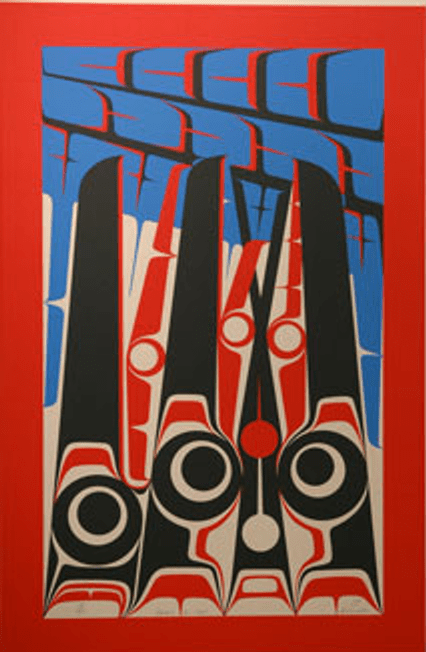
Northwest Coast art is semi-abstract to begin with, and continues to have a strong tradition. For these reasons, abstract or post-modern work in the field is rare. Perhaps the best-known movements in those directions come from Michael Nicoll Yahgulanaas’ Haida Manga or Andrew Dexel (Enpaauk)’s graffiti-inspired canvases. However, long before either of these efforts, Doug Cranmer was making his own movements towards abstraction or post-modernism. In the mid-1970s, he did a series of abstract paintings, several of which were turned into limited edition prints in 2005, and some of which have been released to a handful of galleries in the last month. Recently, we were privileged to take home a print of “Ravens in Nest,” which is compositionally the most interesting of the recently released prints.

At first, the idea of abstracts coming from someone like Doug Cranmer seems unlikely. After all , Cranmer comes from the first generation of artists in the Northwest Coast Renaissance, have learned carving from Mungo Martin. Later, he worked with Bill Reid on poles and houses that were commissioned by the University of British Columbia.

And in the mid-Seventies, who else was doing abstracts? Back then, even Bill Reid had just completed his mastery of traditional form and had yet to edge towards the free-form works of his last period. It would be almost two decades, too, before Robert Davidson would become one of the best known artists to move towards abstraction and post-modernism.

However, in an interview excerpted on the Museum of Anthropology web page, Cranmer explains that he was reacting against the orthodoxy created by Bill Holm’s book Analysis of Form, the first to codify the basic elements in Northwest Coast art.

“After the book came out, all of a sudden there was a right and a wrong way of doing things. We never had that before,” Cranmer said. “The book has served its purpose in explaining Indian designs and elements, but a lot of people followed the book to the letter: as a result, their work has come out all looking the same.”

Apparently in reaction to this tendency, in 1974-5, Cranmer began a series of 48 paintings. “I was doing them differently for the sake of being different.” he said. “I was doing things in Northwest Coast-type design elements that didn’t look like a bird, a fish, an animal, a man or a woman. It worked for a while, but then I noticed that they [the paintings] were starting to look like something again.”

If you look at “Ravens in Nest,” you can see this anarchistic outburst very clearly. The classic formline of Northwest Coat art barely puts in an appearance in the print. Instead, that flexible container of design elements which is generally black, is replaced by a thick red border. Perfect circles replace ovoids. U-shapes, unusually colored blue, float freely across the top, changing direction on each line, and change shapes along the bottom. Blue and red are the main colors, not black. The expected curve of the young ravens’ beaks – an identifying element of a raven in the traditional art — is reduced to the slightest tip possible Instead of the classic symmetry, everything is decidedly unbalanced.

You might almost say that “Ravens in Nest” is a Northwest Coast print because of all the things that it does not do. Like early post-modern works, the print works to the degree that you know the tradition that it is reacting against.

Furthermore, the more you do know, the more what Cranmer has done makes you think about traditional Northwest Coast forms. In fact, while Cranmer may have been reacting against orthodoxy, what he has produced is just as dependent on tradition as any piece that carefully follows the norms outlined by Holm. The only difference is that “Ravens in Nest” is dependent on tradition as its polar opposite, rather than as a key to its technique.

At the same time, while you can easily intellectualize about the piece, its subject remains clear: four hungry and clamoring young ravens. I don’t know if Cranmer intended the effect, but the floating U-shapes seem a graphical representation of the sound they are making, chaotic and clashing.

Such paintings were only a momentary experiment with Cranmer, but they had few if any imitators. The result is that the prints still offer a unique and challenging perspective thirty years after the original paintings. I am not fond of the average abstract, but in Cranmer’s I see a bold and innovative exception that I am proud to hang on our wall.
doug-cranmer-ravens-in-nest

Read Full Post »

Last week, as I took the last of the Christmas decorations down, I found myself singing a mummer’s song I learned long ago from a Steeleye Span record:

“Christmas is past
Twelfth Night is the last,
And I bid you adieu
Pray joy to the new.”

I also found myself thinking of the one and only major Twelfth Night celebration I attended while in the Society for Creative Anachronism (SCA), and how it turned into one of those trips from hell.

At that time, the local SCA was part of a much larger group centered in Seattle. That year, a local had won the tourney to become the next prince of the region, so more people than usual were determined to attend the coronation ceremony at Twelfth Night in Seattle. Personally, I didn’t care who was prince, but rumor made the celebrations worth attending, so we decided to go.

When carpools were organized, our driver turned out to be a new member we didn’t know very well: A hulking teenager who towered over me, and carried at least fifty extra pounds around his middle.

The first omens should have tipped us off: He proposed riding down to Seattle in his jeep. There was barely enough room for everyone, and, while Trish got the front passenger seat, our friend Niall and I had to perch on our gear in the back. And did I mention that the jeep was unheated, and only a thin plastic top separated us from the elements? Still, we wanted to go, and this was our only transport.

Except our driver (whose name I no longer recall through the dim mists of time) didn’t seem to want to get started. He delayed for trivial reason after trivial reason, and we started three hours later than we had planned.

By the time we drove the ten miles or so to the border, regret was already hanging around us like a cloud of smoke. Our driver was a self-centered, non-stop talker, with nothing to say that a bunch of medievalists might want to hear. Like sandpaper, he was coarse and abrasive – and proved it by arguing at the border, so that the US customs guard almost had us haul our bags out and open them on the pavement.

Somehow, we missed that, but the journey was just beginning. Despite our protests that we were already late, our driver insisted on stopping to eat in Bellingham, a few minutes south of the border. That was bad enough, but he insisted on strapping an outsized replica of a horse pistol to his hip when we walked in. Alarmed patrons called the police, and our driver lost us more time as he demonstrated to a local law officer that the gun was incapable of firing. Our driver seemed puzzled that anyone might be made nervous by the sight of it.

For the rest of the trip, the driver monopolized the conversation. The rest of us soon went numb, partly from the cold, but also from the utter banality of his conversation. He had the hoarse intonations you sometimes hear in Canadian taverns, the one that echoes generations of hockey commentators while making the “eh” at the end of every sentence an assumption of agreement. Before long, Niall was visibly cringing when our driver spoke. I spent a lot of time rolling my eyes. I don’t know about anyone else, but I was feeling vaguely complicit because I was too polite to tell our driver to shut up.

We had hoped to drop our luggage at the house where we were staying, but we arrived much too late for that. We went directly to the event, which was held at some church hall. We had to drag our luggage in with us, and find a corner to stow it, the neighborhood not being of the best and the jeep providing no security. When the three of us had a chance to confer, we all agreed that we would find another driver for the trip home. Almost anyone would do.

After all our expectations, we were too busy trying to find another driver to enjoy the event – or, for me, to remember it after all the intervening years. But, at 3AM, we headed out to the house where we were going to crash. The drive was enlivened by him asking me to take the wheel so he could do something unnecessary – a request that almost caused us to go into the ditch, because I was so focused on the sketch map of directions that I took a moment to respond.

We knew our driver was going to be an embarrassment to our friends who owned the house – and he was, from the moment we arrived. I wanted to cringe, and to apologize for bringing the driver into the house, which was new and our friends’ pride.
Before we slept, we pleaded desperately with another guest to let us drive home with him. We would wake early, and leave our driver to find his own way back. The way he talked, we figured he wouldn’t miss having an audience.

Satisfied with the promise of escape, we slept soundly – awaking to find that our new ride had left without us. So had Niall.

With only two of us to bear the brunt of our driver’s conversation, the return trip was far worse than the outbound one. Besides, we knew what to expect.

The mileage signs were starting to show the distance to the border, and we were anticipating finally being free of our driver when he insisted on stopping at a smorgasbord. Why? Because he always stopped there. For ten miles before and after, he kept explaining what a good deal the place was.

Somehow, neither of us screamed, and we finally came to the parting of ways. We never saw our driver again, and never quite forgave our alternative driver or Niall for cutting and running, either. We’ve had our share of nightmarish trips – driving down to Portland in a gray Maverick with one rear light and repeatedly just missing being run over by truckers trying to make up time in the middle of the night comes to mind – but none came close to this Twelfth Night trip for mind-numbing boredom and banality. And now, every time I hear mention of Twelfth Night, I remember our ordeal and wonder whether to laugh or shake uncontrollably.

Read Full Post »

Northwest Coast jewelry can easily cost thousands of dollars, especially if you are buying a gold piece. But, fortunately for those with neither the cash nor commitment to spend that sort of money, you can easily find quality designs –usually in silver — for under $300. Naturally, for that price, you don’t get an exclusive design, but you will find intriguing ones.

Here are several random examples I get from looking around the bedroom:

  • Like much of Alano Edzerza’s work in any medium, this ring of a frog head is bold and dramatic, with simple but effective lines. It is also one of the heaviest rings I’ve owned, with a band nearly three-quarters of a centimeter wide at the back. I’ve joked that I’m going to get another four, and I’ll have an effective set of brass – or silver — knuckles.

    gwaai-edenshaw-silver-frog

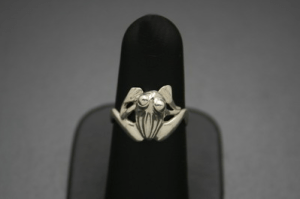
  • By contrast, this frog ring by Haida jeweler Gwaii Edenshaw is altogether more delicate, although suitable for either a man or a woman. This one is unusual for Edenshaw, in that it is silver, rather than the gold he usually works in (although a more expensive version has gold eyes, and an even more expensive one is cast in 18 karat gold, which is about as impure as he generally goes). It is also not particularly Haida in design, except for the ridges down the frog’s back. But it is a whimsical piece, with the frog resting its head on its front flippers and its back flippers locked together on the band on the back.
  • gwaai-edenshaw-silver-frog

  • These earrings are another commercial design by Gwaii Edenshaw, light, with the design just barely visible. They’re suggestive of worn petroglyphs, or perhaps a hand-inscribed design.
  • gwaai-edenshaw-small-earrings

  • Marcel Russ did this unusual design based on the myth of Raven stealing the light. This topic is a common one in many media in Northwest Coast art, and to pull it off, the artist really needs to come up with a different design. Russ’ approach is to show only the Raven’s head and the sun or moon in his beak. The result is a contemporary piece that retains strong roots in tradition.
  • marcel-russ-raven-steals-the-light-earrings1

All these pieces are highly affordable, and the last two are available for $100 or less. In all cases, you would be lucky to find comparable sophistication in a mainstream jewelry store. For the same price, you’d probably get an abstract design, or a mounted semi-precious stone with next to no design at all, and probably with a lower silver content besides.

Of course, Northwest Coast jewelry does have its share of what I think of as touristjunk (all one word), but for the same price as the touristjunk, without much effort you can find superior works like these ones.

Read Full Post »

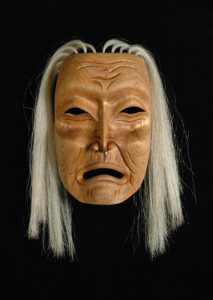
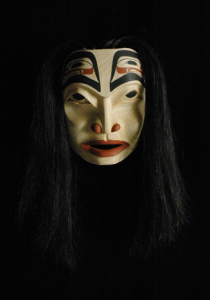
One reason why Northwest Coast art thrives is the strong tradition of teaching among the artists. Artists regularly take on apprentices, and many regularly assist younger artists in their struggles to establish themselves. One of the newer artists who has benefited from the tradition of teaching and plans to teach others himself one day is John Paul Wilson, a member of the Blackfish clan of the Haisla nation for whom carving masks is both personally satisfying and a means of rediscovering his culture.

john-wilson1
Wilson was born in Kitimat in 1973, but grew up and lives in Terrace, and is currently learning northern carving styles. “I have been taught little things about my culture as I was growing up,” he says, “But I didn’t go to my village. I am now really trying to find my culture as an artist.”

After what he describes as a hard-living youth, Wilson worked in a variety of jobs, including carpentry, forestry, and sales. “Now that I look back on my life,” he says, “I see that what I was doing was training myself to be an artist, whether I knew it or not.” All his work, he believes, helped him to prepare for both the techniques and business of being a carver.

john-wilson2

Although Wilson says that “I have always been doing art,” he only began focusing on carving in 2002, when he began studying under Tsimshian artist Heber Reece. After he “took some time away” from Reece, Wilson continued to return to him for help, and later took a course Reece taught at the local college in 2004. “He always had his doors open for me,” Wilson says of Reece.

More recently, Wilson has been receiving informal advice from Nisga’a carver Ron Telek, especially on the finer points of finishing, and attending the Freda Diesing School of Northwest Coast Art at Northwest Community College, where he is being taught by Stan Bevan, Dempsey Bob and Ken McNeill. In fact, this is the second time he has enrolled in the Freda Diesing School, after a burglary of his home forced him to withdraw the first time for lack of funds.

john-wilson3

Other artists whose work Wilson admires include Robert Davidson, Norman Tait, Klatle-Bhi, and Henry Green.

“The senior artists have given me the drive to to get to where I am as an artist,” Wilson says. He is particularly enthusiastic about the Freda Diesing School, which, although he has only just started the second semester, he describes as having “helped so much that I advise anybody to take the course if they want to get serious about being an artist as a living.”

Rediscovering culture

At first, Wilson admits, his interest about carving was as much about making a living as about art. However, under the influences of his teachers and education, he finds his motivations shifting. “I now realize that it is our culture,” he says. “That means a lot to me, knowing that I am going to help keep our culture alive.”

john-wilson4

As Wilson reconnects with his culture, one of his most personally meaningful discoveries was that his great-great-grandfather was also an artist. The discovery, he says, has made him realize that “without knowing the history, I don’t think I could go forward as an artist.”

He now plans to return to his village to familiarize himself with his culture, and dreams of one day teaching there. “Our culture is our way of telling stories to hand down to the next generation,” he says. “And art is a big part of our culture. It is something we were so close to losing, but I did not find that out until I talked to senior artists at the Fred Diesing School.”

john-wilson5

Learning the life and passing it on

At the same time, Wilson finds his carving, which he describes as “contemporary Haisla,” becoming central to his life. “The art is very important,” he says. “It has changed my life for the better. I have a strong feeling that [art] is the right path, like it is what I was brought on earth to do.”

Besides the technique of carving and his reconnection to his history, one of the things that bemuses Wilson about his chosen career is the need to market himself. “When you finish a piece it’s like creating a kid of your own. Sending a piece out for sale is one of the hardest things to get used to. And I’m still learning how to market myself. A lot of people think that when you’re done your piece that it’s time to rest, but they forget the time and effort it takes to sell the piece. You have to really study the way to market yourself as an artist if you want to make a living doing the arts.”

john-wilson6

Now selling regularly to galleries, Wilson is currently able to support himself as an artist. “Some times are better than most,” he observes, “but it still gets me by comfortably.”

All in all, art has become so central to Wilson’s identity and life that he is now starting to pass on the encouragement he received from senior artists to others. “Just try it,” he advises. “You never know what will happen. Look at Freda Diesing – she didn’t start until she was in her forties, and she won a lifetime achievement award for her efforts at learning and teaching the arts.”

(John Wilson’s work is available in the Black Tusk and Path Gallery in Whistler, The Edzerza Gallery in Vancouver, The Art of Man in Victoria, The Stonington and Steinbrueck galleries in Seattle, the Arctic Raven Gallery in the San Juan Islands, and Neo Concept in White Rock).

john-wilson71

Read Full Post »

Six weeks ago, I wrote that freelancers were better equipped than full-timers to survive a recession, because they were more accustomed to looking for work. At the time, I had only the vaguest suspicions that I would be putting my confident words to the test less than ten days later. Linux.com, which was buying most of my articles, was going along much the same as usual, and, and, because SourceForge, its parent company, is publicly traded, I knew it had money in the bank. If anyone were recession-proof, then surely I was. And, in the end, I was right, although not in the way that I had expected.

By freelancing standards, I had grown complacent. Ordinarily, I try to diversify my sources of income. But I was already writing the maximum number of stories that I could write per month without increasing my work hours, so I hadn’t done so as much as I might. Instead, I had allowed myself to become heavily dependent on a single buyer.

Imagine my surprise, then, when my main buyer suddenly stopped buying stories – just in time for Christmas.

After I picked myself up out of the bomb crater, my first reaction was relief that I had at least diversified enough that I could cover my monthly expenses. But I wouldn’t have much left over, and I didn’t feel like giving up my newly acquired art habit, even if it is a luxury.

As I exchanged a flurry of emails and IRC conversations with my fellow writers, I realized that I had to move at once. Quickly putting together a mental list of the most likely buyers for articles on free and open source software, I sent out some queries – not detailing what was happening, but simply saying that some slots in my writing schedule had opened up.

The results, to say the least, were gratifying. Five hours later, I had replaced 85% of the income I had obtained each month from my main buyer. Within three days, I had not only replaced it all, but had done so with a reduced work load. I didn’t even have to go through half my list of potential buyers, although I still might.

Of course, for the past month, I’ve been kept busy getting to know new editors and their ways of doing things. Also, there was paper work — all the more so because I’m a Canadian writing for American-based sites. But all that’s a small price to pay for self-preservation.

Am I lucky? I am painfully aware that I am, especially when I had let myself become so comfortable. But, to some extent, I made my own luck. I still had enough of a freelancer’s instinct to know what I had to do, and that I had to do it fast before anyone else did. And, apparently, despite the vocal minority that like to badmouth me, I seem to have developed a reasonably good reputation – in fact, some of that reputation seems founded on the grounds that anyone badmouthed by certain people must be all right.

Still, my escape was far too close for me to be self-congratulatory. To some extent, I’m still in panic mode.

I don’t know if Linux.com will still be a market for me when the dust clears. But, just now, I doubt that I will return to becoming so dependent on it – or any other single outlet. More than anything else, I am coming out of the last month with my belief intact: As a freelancer, I really was equipped to handle recession.

Read Full Post »

I’ve never seen an episode of “That Was the Week That Was,” the British comedy series from the early 1960s often referred to as “TW3.” However, I’ve read that each episode always started with a song whose first lines were, “That was the week that was; it’s over – let it go.” Sitting here six hours before New Years’, trying to resist the temptation to reflect back and look ahead, that would be the most honest expression of my reaction to the change of year. It’s over – let it go.” I feel much the same about every year, which is why I don’t plan on any resolutions, either.

It’s not that 2008 was a kind of wild ride of horrors sweeping across my horizon, although it did have its share of moments I’d just as soon forget. And it’s not that there weren’t high points that have left me a partly different person from whom I was a year ago.

But I don’t see much point in dwelling on either horror or highlights simply because the calendar has reached an arbitrary point. Long ago, the year used to start on March 25, and other cultures celebrate the change of year by a different, fluctuating count, so there is nothing special about January 1st.

Nor is there any point in making resolutions – a custom, I suspect that is more often joked about and talked about than actually observed these days. I imagine that, for companies that benefit from what is left of the custom are hustling right now – companies that offer fitness coaching, for instance, or job advice – but I don’t happen to be one of them.

The closest I came to making money off the change of the year was to write an article a couple of weeks ago about what several prominent people thought about the outlook for free and open source software in 2009 – and, even then, I felt like I was pandering to popular prejudice.

Besides, the cynical part of me that stands to one side of my brain making flippant remarks can’t help point out how commercialized the whole idea of resolutions has become. Instead of being a time for renewal of purpose, the new year has become, in its way, as commercialized as Valentine’s Day or Christmas – and that’s I trend with which I have little sympathy or patience.

I do have plans, of course. I always have plans. But, just as I have long observed that people who talk about the books they are going to write rarely finish them, so I have noticed that people who talk about their plans never seem to carry them out. Last year, for instance, I noticed a rise in the people going to the local gym for the first few weeks of January – and a drop by the end of the month, as most of the newcomers disappeared. I have a half-superstitious belief that making a talking about my plans is a sure way to guarantee that I don’t follow my plans, so you won’t hear anything about resolutions from me.

Besides, they’re kind of private, you know? I don’t feel like telling everyone about the domestic changes I’d like to see, or the quarrels I plan to end, or the places I hope to sell my writing. Like charity – like prayer, according to the parable in Luke about the Pharisee and the publican – plans and resolutions are private concerns that you don’t parade in public if you sincerely mean to follow them.

For these reasons, I plan on starting the next year neither nostalgic or full of resolves I am incapable of keeping. Instead, I’ll plod along one step and one day at a time, the same as I always do. And, if you think that sounds Grinchish or just plain unimaginative, I’ll tell you what: I bet I reach my personal goals before you reach yours.

Read Full Post »

You don’t have to dig very deeply into Northwest Coast art to stumble across a representation of Raven stealing the light from the chest where its owner has cached it. Whether you’re looking at a print, a piece of jewelry or a sculpture, in any gallery, you have an almost certain chance of finding a representation of the myth. In many ways, the story is to modern Northwest Coast art what the crucifixion or a Madonna and child were to the Italian Renaissance – a standard subject that most artists tackle sooner or later. That’s why Bill Hudson’s “Raven Opens the Box of Daylight” tickled our sense of humor so much that an artist’s proof of the cartoon was under our Christmas tree this year.

Bill Hudson is the spouse of Clarissa Hudson, the Tlingit weaver and painter. From what I’ve seen, much of his own work is more mainstream and includes a good deal of commercial and theatrical design. However, some of his work shows a Northwest Coast influence, including a poster he did for the twentieth anniversary of the Alaska Folk Festival that shows Raven, human with a mask for a head, wrapped in a robe of his own feathers and strumming a balalaika.

What I like about Hudson’s cartoon is the way that he has reduced a myth from the dawn of creation to a modern, mundane scene around a breakfast table, complete with orange juice and toaster. Far from being a great treasure, the light is contained in a commercial cereal box. It’s a good-natured but hilarious comment on just how common the story is; I’ve described the piece to several Northwest Coast artists, and all of them have understood the point immediately.

At the same time, Hudson has paid close attention to detail. Outside the window, you’ll notice, the stars and moon are visible, since in any form, the story predates the sun. Also, the raven’s feathers are not just black, as ninety-nine out of a hundred people would describe them, but tinted with a dark blue, as a raven’s feathers actually are. I appreciate such close attention to detail in what, for all its satire, is essentially a slight piece – so much so, that I have started paying closer attention to the rest of Hudson’s work, on the grounds that anyone who takes such pains is (at the very least) a thorough-going professional.
box-of-daylight-small

Read Full Post »

This year, I have no serious work and nothing more pressing than the wrapping of a few gifts for Christmas Eve. I don’t even have to go outside, except for exercise, which is a relief, because what passes for a blizzard here is pelting down on the other side of the window. I’m glad to be able to cocoon, and I’m not missing in the slightest those office Christmas Eves in which everyone pretends to work and keeps waiting for the executive officers to set a holiday example and leave early. And, as I smugly settle to loaf, I’m especially thankful that I haven’t spent the past few weeks working in a mall store.

Between my university degrees, I spent three Christmases in a mall book store, and they were the worst so far in my life. It didn’t help that, one Christmas, the mall had only two albums, which the management played incessantly from November 15 – nor that one of them was a Smurf Christmas special. To this day, I retain an aversion to squeaky voices and blue-colored midgets.

Pre-Christmas shopping means longer hours of operation for a store, and more money for the part-time staff, of which I was one. But the extra money did not compensate for the stress of that month. The crowds would always pin two staff to the cash register – the most boring part of the job – and random questions would keep everyone else from housekeeping work like stock checking or re-stocking the shelves. A few minutes snatched in the back room would be a relief, just to get away from the crowd. After a week or so, things were so bad that no one wanted to venture into the mall to eat – although, if you stayed in the back, you would probably be called to help with an emergency on the floor.

The uncomfortable truth is, pre-Christmas shopping in a mall reveals middle-class North Americans at their worst: Impatient, cranky, rude, and self-centered. Everyone wanted the staff’s attention at the same time, and a vocal minority did not believe in taking turns. For many, pre-Christmas marked their only foray into a book store all year, and many were uncomfortable there. Some would try to haggle on already discounted books. Others insisted on special attention that no one had time to give them, such as running their purchases to the post office and sending them off to relatives in Europe. A few always seemed to mistake the book store for the daycare center, and would drop their pre-school kids off to rummage through the children’s section, where only constant policing kept the books in saleable condition, and screaming children running through the aisles added to the chaos of hundreds of people doing something they hated. The situation wasn’t helped by the fact that most of the customers were dressed for winter, and quickly became over-heated in the mall.

Then, just to make matters worse, most of the customers were only interested in only a handful of books that were making headlines just then. That meant that, if you weren’t trapped at a cash register, as a staff member you were bombarded with the same questions several dozen times in a shift. I still think that a white board with the most common questions and answers would have helped. Not that many people will read anything unless prompted, but it might have helped the temper of the staff.

Closing time was almost impossible. Some people didn’t want to leave, and had to be told outright that they had to go. Others would dash in at the last minute, if a staff member wasn’t posted at the door, denying them entry. Even then, the staff was lucky if its members didn’t put in forty minutes of unpaid overtime before limping home, tired and irritated to collapse into bed – where they faced nightmares of endless hordes of customers, and tried not to think that they would be having another extended shift in twelve hours.

The pre-Christmas season was so stressful that I didn’t enjoy any of the Christmases I spent in the book store – not least because, after Christmas, the return season was almost as bad, its only improvement being a return to regular hours.

The only good that came out of the experience was that the third Christmas in the book store gave me the incentive to go back to school for another degree. I had no idea of what I would do with it, but, for a few years, I figured, I would have sources of income that didn’t involve fending off a mob.

But the experience had some long-lasting effects. Even now, years later, I avoid shopping malls whenever possible, but particularly from mid-November to mid-January. If I have to go to a mall around Christmas, I go on a commando raid, at a quiet time, and getting in and out as quickly as possible. My Christmas shopping, I do mostly elsewhere. And, at this time of year, I look back with a shudder, glad that period of my life is over, and only relived in stories.

Read Full Post »

Last month, a friend phoned to ask my advice about the price of a Northwest Coast mask that he had commissioned. The price the artist had quoted seemed high to him, but he was still interested in the mask. Thanks to my frequent gallery browsing – both in person and online — I was able to reassure him that, for a piece of that size by an artist of that reputation, he was getting a reasonable price.

More recently, I saw a piece by a new artist and instantly recognized the price as too high for this moment in the artist’s career.

From these two experiences, I realized that, not only is the price of Northwest Coast masks is determined by a couple of factors – the artist’s reputation and the size and finish of the mask – but that there is a rough consensus about how those factors affect the price. This consensus exists throughout British Columbia, so, contrary to what you might expect, you are unlikely to find many bargains outside of Victoria or the Lower Mainland regions. It is undoubtedly due to the fact that galleries and artists are always comparing notes and the fact that a handful of artists are widely viewed as a guide to pricing. In particular, Beau Dick, although widely recognized as a leading carver, has never priced his works as high as he probably could, but varies his prices according to the complexity and size of his work.

As near as I can construct it, here is a list of what you can expect at each price range when you buy a Northwest Coast mask. All prices are in Canadian dollars:

  • Under $2000: The largest group in this category are masks for the tourist trade, generally by artists who have few chances of selling to upscale galleries such as Douglas Reynolds. New artistically-oriented carvers and minis (masks 7×7 inches or smaller) – also fall into this category.
  • $2000-$3000: In this category, you can find average-sized masks (roughly 12-14 inches high) by artists who are starting to gain a solid reputation, or simple or experimental masks by established artists. Most artists’ work does not stay in this price range for very long, except for some long-established carvers for tourists.
  • $3000-$6000: This category is by far the largest. Most masks in most galleries usually fall within it. Here, you find works of average size and complexity by artists who have a modest reputation for their carving. You also occasionally, large works by lesser-known artists in this range, but the restrictions on beginning or relatively unknown artists are tight enough that such works appear only rarely.
  • $6000-$10,000:This price range seems reserved for large or intricate works by artists whose work usually falls within the previous category. One of the signs of consensus is that you find relatively few artists whose prices fall consistently within this category.
  • $10,000 and above: Only large and elaborate masks or normal sized ones by master carvers fall into this category. Very few masks sell above $18,000, although I have seen a Beau Dick mask over four feet tall selling for $28,000.

These ranges are only generalities. A lesser-known carver making a bid for more recognition may temporarily or permanently raise their prices, while a more established artist may lower the price on a specific piece that they feel does not represent their best work. Similarly, a smaller or larger size may bump a specific mask from the artist’s norm. Almost always, reputation trumps size: for instance, I recently saw a mini by Dempsey Bob selling for just under $5,000, a price that reflects both his fame and the fact that these days he does little non-monumental work in wood.

I should also mention that artists do not necessarily view this consensus as fair. They argue that, especially in the lower categories, it hardly pays to take the time to finish the mask – and no doubt they are right.

However, other artists figure that selling in the lower categories is a part of their career that they simply have to endure – and they are right, to. Unless an artist is lucky enough to live on commissions or has another means of exhibiting work to the public, they have little choice except to participate in a market in which both they and their work are evaluated in detail by the market.

Read Full Post »

During today’s Christmas shopping expedition, I witnessed a short scene that taught me something about my concepts of artistry.

I was in a local gallery dedicated to Inuit and Northwest Coast art. A well-known First Nations artist was working in the back, refurbishing the cedar braid on one of his works in the gallery, and doing the same for the work of his son, who is an artist in his own right, and has been for some years now.

While he was working, he looked at one of his son’s carvings. “I don’t know why he finished that with a rope,” he muttered in disgust, seeing that the rope was nylon. A few minutes later, he muttered, “And why did he use such big nails to hold it in?” As he complained to himself, he was stripping off the rope and replacing it with bundles of cedar branches.

The artist was unquestionably right in his aesthetic judgment: His son’s carving was greatly improved by the removal of the rope and its replacement with cedar bundles. Still, I found myself reacting simultaneously in two different ways.

One part of me was reflecting ruefully and with some amusement how hard it must be to study under your father, and to have him improving your work even after you are recognized as a artist yourself.

At the same time, another part of me was shocked. Like most people in modern industrial culture, I tend to view art as an individual form of expression. From this perspective, correcting another artist’s work is unacceptable, a form of aesthetic hostility and violation that seems even worse than physical harm. It is also lying to the audience, who pay expecting a work by one author, but actually get a pastiche. The fact that most audience members will never realize the switch doesn’t matter; they are still not getting what they paid for.

But, when I reflect more deeply, it’s really nothing new. I remember having the same reaction when I learned that various members of a group of writers I once knew would happily pitch in and finish each others’ work to help meet a deadline or to add a level of expertise that the person whose name would be on the cover couldn’t provide. For them, it was a sensible thing to do, especially since some of them shared a house. By volunteering their anonymous services, they were helping to ensure that the taxes and utilities would be paid.

Moreover, similar helping hands have been extended for centuries by masters to apprentices. I know, too, that many of the carvings attributed to Bill Reid were partly a collaboration, with Reid providing the design skills and other members of the team providing the carving skill. So my shock is hardly a valid reaction.

What matters, I keep telling myself, is the finished work of art. Could it really be considered a lesser piece if another artist than the accredited one contributed to it? Logically, that would be an absurd point to defend.

I suspect that my reaction shows that I am unlikely to enjoy collaboration on any of my own efforts – a fact that I might have also deduced from my uneasiness at being edited, even when the editing improves my work.

Read Full Post »

« Newer Posts - Older Posts »