Feeds:
Posts
Comments

Posts Tagged ‘Bruce Byfield’

If you’re one of the thousands who have been laid off in the last few months, you might be tempted to use a career coach to help you in your job search. But whether that’s a good idea depends on whom you hire as a coach, and what you expect to get out of the experience.

Hiring coaches is difficult, because in most places – and probably everywhere – anyone who wants to can set up as a career coach. No professional or regulatory body exists for the job. Nor does any recognized form of accreditation (having taken a course or two doesn’t count).

The only criterion you have for judging career coaches is their reputation. A good place to start is with an Internet search in which you keep an eye out for complaints to consumer organizations or better business bureaus. But even that may not tell the whole story if the coach is part of a larger organization or franchise, because a business record in one area may mean nothing in another area.

You may also want to arrange a preliminary meeting, and decide whether or not you trust the coach, but don’t imagine that you can necessarily tell someone who is fraudulent. After all, a fraud probably has more experience conning people than you have detecting them. Probably your best bet is to work with someone who comes recommended by a friend or family member who has been their client, and whose judgment you trust. However, if that isn’t possible, ask a potential coach for references — and check them.

As you screen a possible coach, be on the lookout for exaggerated claims. Does the coach claim to have methods no one else has? Do they guarantee results? Put you through a screening process, then tell you that you’ve made the cut? Use high pressure tactics? Any of these signs may indicate dishonesty or, at the very least, a greater interest in taking your money than in helping you.

Just as importantly, be very clear what a coach does for you. If you are expecting someone to do all the work for you, or to pull a genuine miracle out of the desk drawer for you, you are going to be disappointed in your association.

Basically, a coach can do two things for you. The first is to update your sense of the job market, and to help you prepare for your search. A coach can give you advice about how to arrange a resume to best effect, help you practice interviewing, critique your clothing and manner, and, if you have chosen well, give you a better sense of the job market in your areas of expertise than you have. In most cases, they will tell you about the effectiveness of networking and informational interviews, but the simple statistic that the average person needs 30-40 informational interviews to land a job is enough to tell you that the real work has to be done by you. A coach can prepare you, but if you don’t cooperate with their job search program, then you are wasting your money.

The second thing that a career coach can do for you is to serve as an advisor, answering the questions that arise during your job search, analyzing your account of your experiences, and suggesting ways that you can approve next time. Since they are constantly thinking about such matters with a number of people, they should be able to give you better advice than most people. In other words, they can help you focus your efforts and learn from them – but the effort is still up to you, and not the coach.

Hiring a coach is like taking a class; just as you can learn the subject matter of a class by yourself, you can learn what a coach can teach you through a library or experience. In both cases, entering into a formal agreement forces you to become organized, and can help you to learn more systematically.

But, if you are not ready to put in the effort, or imagine that the formal agreement is an end in itself rather than ongoing guidance, you are going to be disappointed in the result – and, because of the lack of formal qualifications for career coaches, quite possibly cheated.


Read Full Post »

For eight years, I made most of my income from technical writing. Not the relatively glamorous technical writing involved with writing articles about free and open source software (FOSS) – glamorous, that is, to those who haven’t done it (those of us who have done it are usually considerably less starry-eyed) — but basic how-tos and detailed instructions to accompany hardware and software. Looking back, I must have been reasonably good at the job, since I went from a beginner to a consultant with a sub-contractor in eight months, and kept myself steadily employed most of the time and well-employed much of the time.

Based on that experience, I would like to offer some advice for those who are trying to fill the gaps in FOSS documentation. It’s a thankless job, under-appreciated and laborious, but, if you’re going to attempt it despite all the disincentives, you might as well do it properly. After all, your satisfaction in doing the job properly might easily be your only reward:

  • You must become an expert in what you are writing about: Some professional technical writers pride themselves on being specialists in communication, and feel they don’t need to know the details of what they are writing about. You can always tell manuals done by them, because they are shallow and have large gaps in them. Likewise, you can always tell this type of technical writer, because they’re despised by any developer with whom they work. The truth is that, while you don’t need to be an expert when you start documenting, if you aren’t expert by the time you’re finished, you aren’t doing the job properly.
  • It all comes down to structure: Anybody with average intelligence or better can learn to write a coherent sentence or paragraph. However, structuring several hundred pages is hard work – much harder work than the actual writing. The need to structure is also why you need to become an expert in your subject; if you’re not, how can you know what information to put first, or what’s missing? Don’t be surprised if you spend 50-75% of your time in planning the structure, or if your first outline changes drastically as you work. Both are indications that your work is developing the way that it should.
  • In the majority of cases, the best structure will be a list of tasks, arranged from the most basic or earliest to the most complex or latest: It will almost never be a list of menu items and taskbar icons, except in brief introductions to the interface. This task-orientation is a major reason why you need to be an expert in what you are writing – if you’re not, you won’t have any idea of what users might want to accomplish.
  • Think of your audience as being attention-deficit: Knowing your material is necessary, but it can also make you forget what new users need to hear. The best way to write to the level you need is to project yourself imaginatively into the position of a new user, but, if you can’t manage that, imagine that you are writing for people with low attention spans who are easily bored. The result may spell out the obvious for some readers, but other readers will be glad that you are thorough. Always remember: What is obvious to you isn’t obvious to your readers.
  • Don’t worry about style: In fiction, writers often call attention to their style. By contrast, non-fiction like technical writing is not about you. Your job is to provide simple, clear prose in which you are invisible. And if that sounds boring or unchallenging, you might consider Isaac Asimov’s observation that stain glass windows have been made for over a millennium, while clear glass was a much later development. In many ways, writing simply and clearly is much harder than writing with flourishes and personality. Focus on clarity and content, and let other style considerations take care of themselves. You’ll be surprised how well they work out without you thinking consciously about them.
  • Use structured prose whenever possible:Bullet lists, numbered lists, tables, and callouts on diagrams – all these techniques are conciser and easier to understand than straight prose
  • Your first draft is probably going to be terrible: But that doesn’t matter, so long as it improves by the end. What matters in the first draft is getting something that you or others can analyze for gaps and make estimates about the finished documentation from. Probably, the physical act of writing will be no more than 25% of your time. Often, it will be much less. If you’re planned properly, and begin writing with a thorough understanding, it should almost feel like an afterthought.
  • Don’t mix writing and editing: Writing is a creative process, editing a critical one. If you try to mix the two, you will probably do both poorly. You may also find yourself freezing up and being unable to write because your self-criticism is interfering with your ability to write.
  • Make sure editing is part of your schedule: Editing should not be a last-minuted effort. Instead, accept it as an important part of your schedule. Expect it to fill 10-20% of your time.
  • Editing is about structure as well as words: Editing is not just about spelling or correcting grammar. It’s just as much about the structure of the work.
  • Get second and third opinions: When you have just finished writing, you are probably unable to judge your work effectively. Get other people to review your work in as much detail as possible. If you can’t get other people to review, put the manuscript aside for several days. If you can’t put it aside, print it out, or take a break before returning to it.
  • Expect revisions: Based on my experience teaching first year composition at university, I can say that the average person takes 3 to 4 drafts to produce their best work. You may be naturally talented or reduce that number with practice, but don’t count on either until you have some experience.Make sure you budget the time. You’ll know if your efforts are succeeding if the general trend is that each draft becomes quicker and quicker to write. If that doesn’t happen – especially if you have to keep reinventing the structure or making major additions – then something is probably seriously wrong.

With any given piece of writing, you may not be able to follow each of these pieces of advice. Deadlines in particular may keep you from giving each of these points the attention it needs. But keep all these points in mind, and you will be more likely to write documentation that people actually use, instead of an after-thought to the software that is never used.

Read Full Post »

I was at the Simon Fraser University book store downtown this afternoon when the cashier recognized me as the instructor for a class she had taken over a decade ago. That sort of recognition happens less often than you might expect, although I must have taught five or six thousand students overall. But it does happen once or twice a year, and never fails to make me edgy with the start of panic.

Partly, my panic is due to the fact that so much has happened since my instructor days that I hardly feel like the same person I was then. My ambitions, my career, and my whole outlook have changed dramatically since then – and not just once, but two or three times. I’m not much for nostalgia, thinking it a form of self-indulgent depression, so I don’t particularly welcome the unexpected reminders of the past.

For another, my interactions with a former student is necessarily very different from the one we once had. I am informal to a fault, but, in the past, the student-instructor relationship put us in an unequal relation. Now when we meet, the relationship is more equal. Or it should be. But the former inequality still colors what happens unless we are very careful. And the last thing I want to be is condescending, or assuming a superiority I no longer had nor wanted in the first place.

Even more to the point, one or two meetings with former students haven’t always gone particularly well. One former student lives in my neighborhood, and we often exchange a sentence or two when we encounter each other running, but, with other students, the encounters haven’t been so smooth. One student looked me up asking for a recommendation for graduate school at a difficult time in my life, and was put out when I told her – truthfully – that under the then-current English Department chair, my recommendation wouldn’t do her very good. Another met me coming out of the Canada Games Swimming Pool in New Westminster, and only my sense of my own ridiculousness kept me from sucking my gut in while we talked.

But the main reason these meetings make me feel uneasy is that I wonder how I am remember. By my own estimation, I was a committed instructor with scintillating lectures and a good rapport with students – but, by that same measure, who isn’t? The fact that my evaluations and frequent rehiring suggest that my self-estimation is not complete fantasy doesn’t help any, because (for all I know, at times), I could be meeting one of the handful of students who disliked me or complained about a grade.

Told that I once taught someone, my first impulse is to blurt out something like, “Well, I hope you have happy memories of the class.” But that would sound like I am angling for the very approval that I want, making it impossible for me to know if the reply was sincere or given out of pity. At the very least, it would put the ex-student on the spot. So, instead, I make small talk, hoping that I will gradually pick up the impression of what the student thought of me.

And, usually it is positive, as I would know if I used any sense in the matter. After all, why would someone reveal themselves to me if they had any animosity? They’d either ignore me or bop me on the head with the nearest blunt instrument the moment my back was turned. But logic has little to do with my reaction, so I am always disconcerted by these meetings, and probably always will be.

Read Full Post »

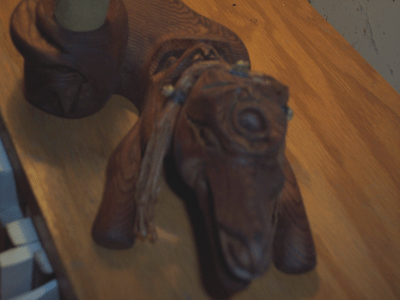
Ron Telek, the Nisga’a carver, can always be counted on for the unexpected – anything from the disturbingly haunting to the eerily beautiful, and in every form imaginable. I’ve even seen a shaman marionette by him. Our latest acquisition, “Transformation Rattle: Eagle to Wolf” is no exception. Only a handful of other Northwest Coast artists could take a utilitarian object like a rattle and turn it into a sculpture while keeping it functional.whole-small

One of the characteristics I’m starting to associate with Telek’s pieces is an unusual degree of three-dimensional awareness in the design. Like many of his pieces, “Transformation Rattle” is impossible to capture fully with a single photo. I took five pictures for our records, and I’m not sure that I shouldn’t have taken a sixth to cover it fully.

The rattle consists of two parts: The rattle, which is the eagle, and the rattle’s base, a lean-looking wolf with a curved tail and, around its neck, a garland of cedar boughs. The rattle rests inside the tail, and can be removed from it. At first glance, you are lucky to notice that it’s a functional rattle. Your first clue is the leather wrapped around the bird’s tail as a hand grip, but even that could simply be part of the surreal sculpture.

The rattle depicts the transformation perhaps two-thirds of the way through. On the right side, the bird’s features are depicted fully, but the left side of the body is mostly blank, with the features indicated by a few indentations, and the wing by the grain of the wood.

smooth-side-eagle-small

Its feet, too, are gone, absorbed into the wolf. Perhaps to indicate the transformation’s incompleteness, the bird’s wing is wrapped around its rounded stomach, as though it is pregnant with itself.

finished-side-eagle-small

The wolf is more complete, but its lack of claws and teeth or fully-formed rear legs shows that it, too, is an unfinished figure. wolf-small

Its thinness and slightly rough carving, especially in the comparison with the eagle further suggests the wolf’s incompleteness – and, perhaps, the energy expended to make the transformation.

The fact that the two figures are the same is suggested by the spirit in the middle of the eagle’s right wing and atop the wolf’s head. Furthermore, the wolf’s garland of cedar suggests that this is not a born wolf, but a human – no doubt a shaman – going through these transformations. Supporting this idea is the much larger, more human-looking spirit erupting from the wolf’s back, as well as the fact that, if you look closely, the rear legs are more human than wolf-like.wolf-front-small

All this complexity is heightened by Telek’s characteristic attention to the direction of the grain. An employee at the Art of Man Gallery in Victoria told me last week that Telek often carves down until he finds the grain he wants, and, looking at “Transformation Rattle,” I have no trouble believing it. Although both the rattle and its base is carved from a single piece of red cedar (and stop and think about the difficulty of that for a moment), the carving is literally never against the grain. Even on the wolf’s curving tail, the grain moves with the sculpture. And, on the eagle, the round pattern of the grain not only suggests the bird’s body, but creates a semi-abstract form as simple as it is beautiful.

The overall result is a contrast with the tall, rounded shape of the eagle, and the ground-hugging, angular shape of the wolf. It’s an accomplished piece of work, which I’ve place on top the shelves on my computer desk, where I can look up at it periodically, or even take the rattle out for a shake if I feel like it. We’re seriously thinking of mounting it on a lazy susan, so that it can be viewed in its entirety more easily. Meanwhile, I’ve already switched its position around several times in the day since we brought it home so I can admire another aspect of it.

Read Full Post »

Even if you’re an extrovert, meeting new people takes energy. To reduce the required energy, whenever I’m networking or at a business meeting, I like to come equipped with at least one conversational hook – a detail about me that make people curious and give them something to talk about when they approach me.

The term is borrowed from the writer’s idea of a hook, or first sentence that makes people want to read more. For example, when Charles Dickens started A Christmas Carol with, “Marley was dead to begin with,” he hoped that readers would be intrigued about why he would mention the fact. More subtly, when Jane Austen began Pride and Prejudice with “It is a truth universally acknowledged that a single man in possession of a good fortune must be in want of a wife,” she is announcing that her subject is courtship, hoping that it will interest them (and also, as you soon find out, being ironic, since the last thing that either Bingley or Darcy are thinking of at the start of the novel is getting married).

A conversational hook works the same way. Just as a literary hook lures you into reading, a conversational hook is designed to make others think that you are worth spending time with. It’s not as extreme as an eccentricity. Nor is it a pose, because, to be successful, a conversational hook needs to be backed up by the ability to talk about it. Rather, it is an expression of your individuality that attracts attention.

A conversational hook can be as simple as a T-shirt. When I am at a developers’ conference – and, sometimes, just on the street – My Linux Journal T-shirt, with the slogan, “In a world without fences, who needs gates?” (a reference, of course, to Bill Gates and Windows) is sure to evoke a laugh. And, once you have shared a laugh, talking with each other becomes easier.

More recently, I have found my three inch copper bracelet by Tsimshian artist Henry Green to be another conversational hook. Larger than usual, made of a metal that you rarely seen in jewelry, and featuring a stunning design, the bracelet offers all sorts of topics that people can use to approach me. First Nations people, especially artists, are especially interested in it, but the interest cuts across all sorts of demographics. One friendly acquaintance who has watched too much Doctor Who calls it my chronoplate, while others ask if I am wearing it because I believe that copper helps relieve arthritis. It helps that the bracelet is more suitable for formal occasions than a T-shirt, too.

You can use the same idea to make yourself stand out on a resume. Although I maintain several different resumes, I always include two or three lines under the heading of “Interests.” Currently, the section reads, “Running; parrots; punk folk music; Northwest Coast art; history, science fiction, and 19th century novels; Linux.” This summary not only says a lot about me and positions me – I hope – as a well-rounded individual who is worth interviewing.

In addition, when I am called into a job interview or consulting session, it gives other people a starting point. I have lost track of the number of times people have begun by asking me what punk folk music is, and many other meetings begin with an exchange of stories about running or science fiction. And I still remember the forty-five minute interview that consisted of five minutes of talk about the contract, and forty exchanging cute stories about our parrots.

Conversational hooks work because most people are nervous meeting new people. By giving them something to talk about, you set them at ease. In doing so, you generally create a favorable first impression – and first impressions, as you probably know, are frequently the basis for the impression that people take away from a meeting. Not only can you help yourself by creating hooks that draw other people in, but you can be on the lookout for hooks that others may be consciously or unconsciously offering.

Either way, you’ll find that conversational hooks are a great way to take the nervousness out of meeting people for everyone.

Read Full Post »

Not too many years ago, you only had to walk down Government Street in Victoria to find more shops selling Northwest Coast art than you could properly absorb in a day. Looking back, I’m not sure of the quality of some of the shops, but they were there. But times are harder, with many store fronts along Government empty, and now you have to search for galleries.

Descending on Victoria yesterday, these are the galleries we managed to find:

  • Art of Man: Located in the mall in the basis of the Empress Hotel, the Art of Man specializes in Inuit and First Nations masks and sculpture. The pieces for sale included four or five from Ron Telek, including a meter high blue shaman (this from an artist who rarely uses color), and a shaman marionette fending off a spirit attacking his foot with other spirits resting in his hand. Daryl Baker, the nephew of the LaFortune brothers Doug, Perry, and Aubrey, is also represented by highly-detailed designs that border on the surreal, and that are all marked by a close attention to finishing details. The Art of Man also seems to get first pick of Tim Paul’s work – so much so that I realize that only his lesser pieces reach Vancouver. Other artists whose work is available at this gallery are John and Luke Marston, whose work shows an awareness of history that I had never realized before that it possessed. In general, the quality of the work at the Art of Man is extremely high, making it by far the premier gallery of Northwest Coast art in downtown Victoria.
  • Hill’s Native Art: Like the Vancouver store, the Victoria Hills is mainly a tourist shop. However, the Victoria store seems to have a slightly better ratio of art to high-end tourist pieces, as though it gets first choice of all the locations. But perhaps this impression is due partly to the fact that it is less crowded and better lit.
  • Alcheringa Gallery: From the web site, I had the impression that this gallery was huge. The reality, though, is that this is a gallery with only a few of its pieces on display – and about half of those are given to works from Papua New Guinea, which is worth seeing, but doesn’t engage my interest the way that the Northwest Coast tradition does. Still, you can see some works by Tim Paul and John Marston there. I was also interested in seeing two works I had seen on the Internet, one by Ron Telek and another by Dean Heron.
  • Pacific Editions: Unfortunately, this story is closed on Mondays, which meant that we walked six blocks out of our way for nothing. But what we could see through the window confirmed the impression I had from the web site: Pacific Prints has a huge collection of limited editions prints. I look forward to spending a happy few hours there the next time I’m in Victoria.
  • Eagle Feather Gallery: A mixture of art and tourist pieces, this gallery is only a block from the Empress Hotel – but on a side street that you may have trouble finding. It specializes in the work of Doug, Perry, and Aubrey LaFortune, especially Doug (in fact, he was due to drop by the day that we visited, although we missed him). Daryl Baker and Pat Amos also have a couple of pieces, while Francis Dick has at least a dozen 2-D works from throughout his career at the gallery. Whether the gallery is worth a visit probably depends on your opinions of these artists, although its stock gives you a good opportunity of evaluating Doug LaFortune thoroughly.
  • Out of the Mist Gallery: This gallery specializes in antiques. Its modern selection is devoted largely to the Hunt family, and includes a few curios like a mask carved by Richard Hunt when he was a teenager, a formal, somewhat stiff print from the start of Beau Dick’s career, and a two meter-long eagle by Roy Henry Vickers. The quality of the antiques is completely indiscriminate, and includes some pieces from across North America. If your taste runs to antiques in Northwest Coast art, you could probably find something to your taste, but the somewhat dim lightning and the bored staff makes the effort hardly seem worthwhile.

As with previous lists I’ve made of galleries, this one makes no effort to be comprehensive. We did not, for instance, have to visit the Provincial Museum’s gift shop, which I seem to remember as having a few art pieces. So if you know of any other galleries in the Victoria area that might be worth a visit, please add a comment and let me know.

Read Full Post »

For as long as I can remember, I have always disliked those who correct other people’s grammar unasked. My dislike has little to do with being corrected myself, although I can be careless with proofreading my own work because I am in a hurry or simply because I dislike the task. However, having taught composition at university and sold hundreds of articles, I have reasonable confidence in my own literacy, and the most I can muster when my mistakes are pointed out is generally a mild embarrassment. Nor am I upset when people correct grammar when asked – that’s called editing. But those who decide that their mission is to correct other people’s writing or speech are rude, misguided, wrong (as often as not), and less interested in clear communication than in establishing their own superiority over someone else.

Working on the Internet as I do, I am used to all levels of literacy. Text messaging, lack of education, and efforts to write in a second language all mean that the English I read is often less than fluent. But unless someone asks my help, I refrain from pointing out errors and simply do the best I can to decipher. Under modern circumstances, zeroing in on someone’s errors is simply rude. It’s like telling someone with a large birthmark on their cheek that they have a blemish. If you have any claim to manners, you don’t mention the fact, and do your best not to stare or make the other person uncomfortable with your awareness.

At any rate, many of the grammar police seem to have little understanding about what language is about. Yes, consistency in language helps communication. But English can support a high number of transmission errors without being unintelligible. So why linger over the errors when you should be focusing on understanding?

More importantly, grammar-correcters seem under the impression that only one standard for communication exists. Perhaps this impression is the result of how reading and writing is taught in schools, but nothing could be more misguided. Any language has variations based on region, ethnicity, class, gender, politics, and just about every other factor that you can name. It changes over time and even over circumstance – for instance, my own sentence structure and vocabulary changes drastically depending on whether I am writing an academic paper or a blog entry, or talking to octogenarians or young adults. And when I follow the lead of Shakespeare and I use “they” as the impersonal pronoun (as in “Everybody is entitled to think what they want”), I am not committing an error but refusing to use “he” because of support for feminist language critiques I absorbed in university.

The grammar police, however, like to pretend that language has a single standard and never changes. A particularly popular ploy of their is lament the perfectly normal change in meaning of words; often, they can go on for thousands of words on the subject. But their diatribes are pointless – I have never heard of a single case in which a word reverted to a former meaning because the grammar police complained. In fact, I suspect that on some level they would be disappointed if their complaints had results, because then they would have less point to nag everyone with.

At other times, they show a singular lack of understanding of context. The much-dreaded double negative (“There ain’t no way”) is a common method of emphasis in Germanic languages for over a thousand years. So is repetition, although I recently saw “I personally” on the grammar police’s hit list.

The truth is, the grammar police often show a limited understanding of the language they claim to be defending. For example, you often hear them denouncing starting a sentence with “and” or “because,” although the practice is widespread among writers of all levels of expertise. Their argument is that “and” and “because” are conjunctions that join two clauses. And so they do – but the idea that the clauses can be in separate sentences never seems to occur to the grammar police.

But few of the grammar police are interested in accepting, much less appreciating the endless variations of English. What they are really interested in doing is establishing themselves as experts and their victims as less than themselves. Since this effort is often irrelevant to whatever is being discussed – that is, to the content – it amounts to what Roman orators described as an ad hominem attack – an effort to discredit an argument by attacking the person making it rather than disproving the argument itself. In other words, by making a writer or speaker appear illiterate, they hope to sway listeners against what is being said. Or, possibly, their goal is simply to demonstrate their superiority over the person they are attacking.

You can see these goals very clearly in the attacks on the syntax of George W. Bush – as though it were his syntax rather than his ideas that made him so alarming. Of course, you might argue that an incoherent politician is likely to have muddy thoughts, but the usual impression is that those who dwell on Bush’s syntax are more interested in establishing themselves as smarter than he is than on any more valid critique. They may very well be, but crowing about the fact is ugly and ignores the substance of what he is saying, which needs to be addressed far more than his illiteracy.

Being rude, ignorant, and elitist, the grammar police do little worth doing. They show only their own massive insecurities, and do nothing to advance communication or discussion. In the end, it is not just their lack of social graces or understanding that makes them irritating, but the way that they insist on thrusting their own need to prove themselves superior into every conversation. They are like a man who insists on adding irrelevant jokes into every conversation, only worse.

Read Full Post »

For the last couple of years of my bachelor’s degree and a few years after that, I was an avid Dungeons and Dragons player. Or, rather, I was an avid Dungeon Master – I was never an actual player more than once or twice. Somehow, with me ever thinking about why, I seemed naturally to fall into the role. Maybe anyone with ambitions to be a story-teller falls into that role, because the game is basically group story-telling, and the DM is the lead story-teller. But, at any rate, the experience taught me a thing or two I didn’t know about human nature – and that I still partly wish that I had never learned.

The regular group of players numbered six to a dozen, equally divided between men and women. All of them were people I knew from the Society for Creative Anachronism. Several were in the same SCA household, and three were sharing a townhouse in real life.

The result, to say the least, was scary. More than any of the adventures I sent them on (and I had them scampering across the wilderness between two cities, with a side trip to the nether world), what I recall best was how the usual Friday night sessions began to resemble a group therapy session, with me caught in the middle, trying to ignore the unpleasant undertones, smooth things over, and keep the game moving for everyone else.

At times, though, I might have saved myself the effort. When two of the room mates who were arguing in real life started trying to attack each other in the game, I knew that their housing arrangements couldn’t last. And, sure enough, one of the two moved out a couple of weeks later.

I was proud of my efforts to invent entertaining scenarios, and spent time that I should have used for study developing elaborate scenarios and maps. When many of the players decided that their characters were related, I came up with a plausible family tree. If someone wanted to bring a guest, I would develop a plausible scenario to explain how the guest joined the group and eventually left it. If someone missed a session, I would hold special sessions for them to catch up, so they wouldn’t be far behind in points. I was proud of my efforts, and prouder still of my efforts to weave an entertaining story.

Then I discovered that the group was holding another D & D session on another night – one to which neither Trish nor I were invited. Apparently, some of the players wanted a game where they could simply kill things. When confronted, they said that I was too intense to be invited along, and that they wanted a game without me.

Not so intense, apparently, that they weren’t willing to let me work to entertain them, I thought. Or eat our food and drink our juice and wine. Angrily, I told them that they could find another Dungeon Master for their Friday night game. They seemed honestly hurt and bewildered, which made me damn them as hypocrites and freeloaders, and cut off contact with them, even drifting away from the SCA.

The few times I’ve seen them since, they seemed genuinely unsure of what had happened – a reaction that only makes me think that I was sensible to stop hanging out with them.

A year or two later, we started another role-playing session with some friends who had moved down from the Sunshine Coast. This time, it was a post-holocaust setting, and I was Dungeon Master again. But that game died when our friends’ marriage started breaking up, and I haven’t played since.

Every now and again, I do wonder what it would be like to be just a player. But I don’t suppose I’ll ever find out now.

Read Full Post »

As I visit Northwest Coast Galleries in Vancouver, I’m starting to notice relations between certain galleries and certain artists. Out of friendship, enthusiasm, long-term business relations, or a combination of all three, some galleries simply carry a better selection of some artists than others.
Here are the specializations I’ve been able to detect so far:

  • Coastal People’s Gallery: This gallery has a good general selection of artists, although it seems to be buying less recently, possibly because it’s overstocked. However, it is the main exhibitor in town of Henry Green, especially for his carved and increasingly colorful panels. Coastal People’s also favors Chester Patrick, a less well-known artist who has done a number of acrylic paintings notable for the complex grouping of characters, as well as panel carving. Since the summer, the gallery’s Gastown store has had space set aside for Patrick to work. I’ve heard at least one patron refer to Patrick as the store’s artist-in-residence, although I don’t know whether the arrangement is formalized.
  • Douglas Reynolds Gallery: Douglas Reynolds seems to have first right of refusal on works by Beau Dick, the Kwaguilth mask-maker and Haida artist Don Yeomans, possibly because the artists have a long friendship with the owner. At any rate, the selection of works by both Dick and Yeomans tends to be larger and more varied than at any other gallery – so much so that, in Yeoman’s case, I tended to think that he was past his creative prime based on his work in other galleries. However, based on what I’ve seen at Douglas Reynolds, that’s far from true; I just wasn’t seeing his best work. This same gallery has also started carrying a good selection of jeweler Gwaii Edenshaw.
  • Edzerza Gallery: As you might expect, this new gallery is mainly a showcase for the work of owner Alano Edzerza. However, it has also had the work of newer artists like Ian Reid and John P. Wilson.
  • Inuit Gallery: The Inuit Gallery seems to have good connection with the North, including Alaska artists like Clarissa Hudson and Norman Jackson, whom many galleries neglect – even though importing First Nations art from the United States is supposed to be duty-free. Recently, it has also had a couple of new masks from Tlingit/ Northern Tutchone artist Eugene Alfred, and a number of playful masks from Kwaguilth carver Simon Dick. Other with whom the gallery seems to have a good relation include Salish artist Jordan Seward and Nuu Chan Nulth artist Les Paul.
  • Sun Spirit Gallery: Located in West Vancouver’s Dundarave strip, this small gallery currently has a strong selection of Klatle-Bhi’s work, particularly masks. Much of this work is in Klatle-Bhi’s apparently favorite white and light-blue palette.
  • Spirit Wrestler Gallery: Robert Davidson seems to offer new works to Spirit Wrestler first, and to have an arrangement with the gallery for prints as well. The gallery also gets the pick of new works by Norman Tait, and currently has more work by Dempsey Bob than any other gallery in town. In addition, the gallery seems to cultivate some of the best of up and coming artists, such as Dean Heron and Sean Hunt, making it more adventuresome that I originally thought from my first visit.

As I was making this list, I realized that it represents my own interests as much as each gallery’s specialization. Very likely, I have left out some specializations either because I am not interested in them or haven’t got around to them yet. Still, it’s useful to know which gallery to go to if you’re interested in a particular artist, so I’ll let the list stand, even while acknowledging that it is probably incomplete.

Read Full Post »

Earlier this week, The Globe and Mail ran an article about freelancers who were considering finding full-time work in response to the recession-cum-depression of the last couple of months. Being a long-time freelancer myself – and someone who has never been happier than when working for himself – I found some wry amusement in the assumption that freelancing is riskier than full-time employment. Not only do I believe that freelancing is generally safer than full-time employment, but I suggest that freelancers are better equipped to weather the uncertain economy.

Admittedly, a recession is a bad moment to begin a freelance career, if only because so many other people may be attempting the same change. Obviously, too, a freelancer’s ability to survive depends on what services they offer; for instance, if you offer web design services, in hard times people might be tempted to put off improvements and changes to their web pages as non-essential.

However, in general, freelancers have distinct advantages in troubled times:

  • Freelancers are already established: As full-timers are laid off and try to support themselves on freelancing, established freelancers already have the contracts and – most importantly – the reputations to keep themselves employed. Many of them have an established customer base, and they can focus on assignments rather than on marketing themselves – a process that usually takes a few months.
  • Freelancers are more versatile: Full-time employees are generally slotted into narrow specialties. By contrast, freelancers can offer new, related services as the opportunity or need arises. For example, if you are a technical writer who finds that clients are putting off updating their documentation, perhaps you can branch out into public relations or graphic design.
  • Freelancers are used to working on multiple contracts at the same time: While full-timers often have the luxury of concentrating on one project at a time, most freelancers juggle multiple projects at the same time. Part of the reason may be freelancers are so afraid of being without income that they often overbook themselves. However, an even larger part of the reason is that they don’t always find a single project that brings in enough income by itself. A recession simply makes this situation even more likely. So, in this sense, the habits of the average freelancer become a useful survival mechanism during a recession.
  • Freelancers have established social networks: In any sort of job-hunting, connections are important. But, while full-timers often neglect networking because of their false sense of security, freelancing is like constantly looking for work. The result is that freelancers may be prepared to replace work lost to the recession with other assignments.
  • Freelancers are better prepared psychologically for losing work: Many full-timers invest a lot of their self-image in their employment. When they lose their position, they are devastated. But freelancers do not nurse the full-timers’ dream of a job for life. They expect to work on many contracts during their careers. So, when one contract is canceled, it means very little to freelancers – unlike full-timers, they are not devastated. While they may regret the loss, freelancers know that some work will never materialize or be canceled, even in good times.
    In other words, a recession is only a freelancer’s regular situation intensified. They know how to deal with the situation, and don’t need to change their attitudes to survive – unlike full-timers.

I’m not surprised that The Globe and Mail could find freelancers who were considering full-time employment, but I suspect that they are in a minority. Although all the freelancers I know are alert to the economic situation, they seem reasonably confident of their ability to survive it. Unlike full-timers, they find little new in troubled times.

Read Full Post »

« Newer Posts - Older Posts »