Feeds:
Posts
Comments

Posts Tagged ‘Northwest Coast Art’

This weekend, I scouted the Northwest Coast galleries around the south end of the Granville Bridge. Here are my impressions:

  • Eagle Spirit Gallery: Located on the edge of Granville Island, this gallery is one of the pleasanter viewing areas that I’ve seen, with lots of natural light and indirect sun. It seems aimed at the corporate or public buyer rather than the individual, with many larger-than-life plaques, masks, and sculptures. Its selection includes some of Robert Davidson’s recent sculptures (which you don’t see much of), as well as works by Lyle Campbell, but, for me, Francis Horne, Sr.’s “Spirit Raven” was the only really exceptional piece. Even browsing casually, I saw a surprising lack of finishing detail on some pieces, including some by artists whose work is usually more polished. In general, the selection seemed a little too safe for my taste.
  • Edzerza Gallery: I discovered this gallery by accident, occupying the space that used to be occupied by the Bentbox Gallery, a block from Granville Island. Owned by the young artist Alano Edzerza, it displays mostly his prints and jewelry, but includes selected pieces from up and coming artists. For a young artist, running your own gallery seems a daring move, but, I’m proof that it pays off, since it means that I noticed Edzerza’s work for the first time, and he’s now on my list of artists whose work I want to buy. While I was there, I also met another artist whose work I admire. The selection is relatively small, but I am sure that I’ll be coming back, both to support the venture and to buy.
  • Latimer Gallery: A block from the Edzerza Gallery, the Latimer features moderately priced limited edition prints, masks, and jewelry I remember this gallery as being more touristy than it was today, so either my memory is faulty or else its stock has gone upscale a little. I had no trouble finding some small treasures, including some old Bill Reid prints, and some very affordable crayon sketches by Beau Dick. I don’t think I’ll be a frequent visitor at the Latimer Gallery, but I will be dropping by now and then to check what they have.
  • Douglas Reynolds Gallery: Located in gallery row a block up from the south end of the bridge, this shop is aimed at the high end of the market. Besides the inevitable Robert Davidson and Susan Point prints, it includes a number of masks by Beau Dick, and at least two striking wall plaques by Don Yeomans. It also includes a selection of gold and silver bracelets, rings, and earrings, including a few small pieces by Gwaai Edenshaw. The stock seemed a little safe to me, but was adventurous enough here and there to make me want to return occasionally.
  • There are still Northwest Coast galleries I haven’t visited in Vancouver, but these four, together with the ones I visited last week in Gastown, are some of the better known ones. Besides finding which galleries seemed right for my own art buying, visiting a number of them has helped me to understand the market a bit better, including such as who are the established and upcoming artists, and what are the going prices for each artists’ work. This knowledge makes my visits well worth the effort, especially since you can easily see a number of galleries in an afternoon without doing much travelling.
Read Full Post »

As part of my recently renewed interest in Northwest coast art, I’ve been making the rounds of the local galleries, trying to get a sense of their specialties and whether I want to deal with them. This afternoon, I made the rounds of the Gastown galleries, which are conveniently within a few blocks of each other.

Here are my impressions – partly for my own sake, but also for anyone else who might be interested in Northwest Coast art. I say nothing about the galleries’ Inuit collections, which I am even less qualified to judge:

  • Hill’s Native Art: Coming from the Skytrain, this was the first gallery I came to, and also the one I spent the least time in. It’s basically a high-end tourist shop, and so crowded that the main impression I took away was of art as a commodity. You could probably find some reasonably decent work if you searched, but, you would have to make an effort. Hill’s has a number of two or three meter high totem poles, but if you’re willing to spend over ten thousand, you would be better off spending a little more and buying one from a name artist elsewhere.
  • Spirit Wrestler Gallery: With over two decades of experience and a number of well-regarded shows and books behind it, Spirit Wrestler is at the opposite extreme from Hill’s, appealing to the serious collector with money to invest in art. Its selection of artists is small, but carefully chosen, and it has a varied selection of work from top artists such as Robert Davidson, Norman Tait, and Susan Point. Currently, it has more Tlingit work than any other gallery that I’ve seen, and a small but select collection of bracelets. The gallery also sells (but does not always display) pieces that have just come upon the market again, so a serious collector might want to keep in touch to hear what is available. The gallery also contains a few Maori works, which should interest many people who have a passion for Northwest Coast art, since the two cultures have a lot of similarities. It’s perhaps the premier gallery in the field in Vancouver, and deservedly so.
  • Inuit Gallery of Vancouver: This gallery has no more than a fifth of its space devoted to Northwest Coast art. It does not carry jewelry, but does include a collection of Northwest Coast masks and prints, as well as some other forms of carving mostly from the Nuu-chah-nulth and Salish nations. Although the selection of artists is comparatively small, you can find some interesting pieces without searching hard.
  • Coastal Peoples Gallery: In many ways, Coastal Peoples is the most interesting of the galleries in Vancouver. In both its Yaletown and Gastown locations, it carries everything from high-end tourist pieces to work that will appeal to museums and connoisseurs. To make things even more interesting, Coastal Peoples has by far the broadest range of artists of the four galleries mentioned here, with up-and-coming artists as well as established ones represented. The newer artists are especially interesting if you have any understanding of what you are buying, because their work is reasonably priced and some of it will undoubtedly rise rapidly in value. The jewelry on display is especially fine, especially in gold, and so is the sculpture, including everything from desktop pieces to bentwood boxes and three meter poles. The sheer variety at Coastal People’s is amazing, and is one of the reasons why the gallery is my current favorite.

There are, of course, other galleries that carry Northwest Coast art outside of Gastown in Vancouver. But they will be a subject for another day.

Read Full Post »

For many people, Bill Reid is the epitome of Northwest Coast art. The reputation is both deserved, given the quality and variety of his work and unfair, given the number of artists in the same tradition who are equally worthy of acclaim. But regardless of how you view his reputation, Reid has a strong claim to being the major Canadian artist of the late twentieth century, with one of his pieces both on display at the Canadian embassy in Washington, D. C. and on the back of the Canadian twenty dollar bill. And, like any admirer of Northwest art, for a long time, I’ve lusted to have one of his works but been unable to afford one – until now.

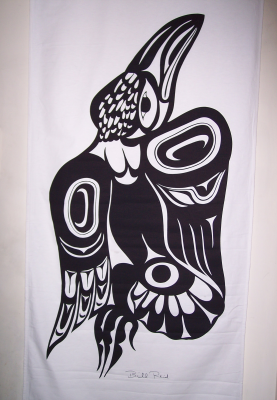
Even then, I only did so by getting into an area that the collectors haven’t discovered yet. I bought a canvas raven banner whose design is an expansion of the illustrations that Reid did for All the Gallant Beasts and Monsters, which was published in 1991. The banner was part of one of two complete sets of banners from the personal collection of Martine Reid, his widow, and was sold through the recently-opened Bill Reid Gallery in downtown Vancouver, so its provenance is unquestionable. In fact, I’ve left my email address with the gallery so that Martine Reid can give me more details about the banner.

The last stages of Reid’s development as an artist could be called his post-Haida era, in which Reid, while obviously basing his work on tradition, began incorporating more modern or personal elements into his work. The banner fits very clearly into this period.

While the ovoids and wings feathers are in the Northwest tradition, the torso, the foot at the bottom of the tail and head feathers are something else entirely. Similarly, while the twisting of the entire figure as though it is turning away from the viewer seems in keeping with the distortion of figures to fit a particular shape in classic works, Reid handles the distortion with high imagination, inverting shapes on one wing on the other, and presenting some shapes in full on one wing, but only hinting at them in another. It is as though Reid is inventing a new form of perspective that comes from neither Northwest nor modern art, although obviously drawing on both.

Raven Banner

Reid’s design is equally playful when it comes to symmetry, seeming to abandon it at first glance, but really playing some complex games with it. The body of the raven is defined by the triangle formed by the ovoids on the wings and at the base of the tail, an unusual shape in traditional art. At first, too, the body seems asymmetrical, with the left wing showing three flight feathers and the right wing four – but then you notice that the right wing’s four feathers matches the four toes on the foot and the neck feathers, and forms another triangle whose angles are an inversion of the first triangle.

Then, in contrast to this complexity, there’s the simplicity of the head, with its economical lines and the heavy beak that suggests both the classic depictions of the raven and their actual appearance.

Head Closeup

It’s a complex work, and one that could only come after decades of development, with clean lines that stand out all the more because the design is black on white.

I don’t know if I got a bargain or overpaid, or whether the purchase will prove a good investment. The price was acceptable to me, and, since I bought the work because I admired it, I don’t care if its value increases over time. But the work shows all the mastery of Reid’s last period, and I admire it hugely.

The only trouble is, I’ve hung it in our hallway, and the rest of the hallway cries out for a matching banner. So, I suspect this won’t be the only Reid banner I’ll be buying this year. But if I can get one that intrigues me as much as this one, I’ll be extremely well satisfied.

Read Full Post »

Northwest coast art is one of the healthiest schools of modern art, because it starts from a tradition yet still welcomes innovation. A juxtaposition of local First Nations mythology and the rain forest environment on one hand and advanced industrial techniques on the other, it also seems to reflect the experience of anyone who lives in the area where the artists work. For these reasons, yesterday I fought down the ‘flu that had taken root in my stomach to attend the public opening of the Bill Reid Gallery in downtown Vancouver.

Bill Reid was one of the founders of modern Northwest coast art, and his work from the late 1940s to his death in 1998 is broadly reflexive of the school’s history, starting with imitations of the past and gradually gaining originality as his confidence and knowledge of technique increased. With copies of his monumental Spirit of Haida Gwaii at the Canadian embassy in Washington D.C. and the Vancouver airport – as well as on the Canadian $20 bill – he is perhaps the best-known Canadian artist of the last forty years.

The gallery that carries his name features Reid, but, in recognition of his influence, does not confine itself to his work alone. A tribute pole by Jim Hart dominates the main gallery, and the gift shop has a large room where other Northwest artists are highlighted. Right now, the gift shop features April White, but I understand that the plan is to change the exhibit regularly.

The gallery windows are covered in semi-transparent blowups of Reid’s design, but still let in the natural light. With its high ceiling and dais for speakers, the main gallery suggests a modern version of a Northwest longhouse, the only jarring touches being the carvings around the archway and the computer screens and holograms that stand-in for pieces of Reid’s work that are not in the gallery A mezzanine allows visitors a chance to see close up the top of Hart’s pole, as well as “Mythic Messengers,” a bronze sculpture that is one of Reid’s best-known works.

Although today was the official opening, finishing touches at the gallery are still lacking. Several display cases are empty, and many are unlabeled. Nor does a guidebook or recorded tour exist. For yesterday, little of that mattered, because one or two people were giving tours, but I worry a little that the context may be lost on casual visitors.

Knowing that context is important, because otherwise the gallery might be mildly disappointing. Several of the pieces are smaller versions of Reid’s monumental works, and the change of scale makes it easy to under-estimate them. In particular, a palm-sized version of “Raven and the First Men” looks cramped and intricate where the original at the University of British Columbia’s Anthropology Museum looks spacious and simple.

Still, that is a quibble that seems ungracious when such a gift has been given to the area. With Reid’s preference for deep-carving and, in the last stages of his development, his trust of blank spaces – to say nothing of his consummate knowledge of technique and his frequent experimentation – his work consistently breathtaking. And to see so much of it in one space remains an overwhelming experience, even if his best work is not always represented. I found that I had to wander in and out of the gallery several times, just so I could appreciate all the exhibits properly. Otherwise, I would tend to wander in a sort of daze of admiration.

While I was there, I was also lucky enough to catch Martine Reid, the artist’s widow, talking about the jewelry displays. Although her French-accented English was easy to lose in the crowd, her reminisces helped to bring her husband’s development as an artist into perspective while also revealing something of his human side.

I particularly remember her story of how she bought a silver box he had made several decades previously and gave it to him as a birthday gift; he stared at it, she says, like a parent who had not seen his child for decades – then took a napkin and started polishing it.

Martine Reid also recalled that her husband used to carry a coil of wire and a pair of pliers in his pocket, and would twist the wire into shapes as he sat and talked. His “knitting,” he called it. Apparently, the habit was so ingrained that, even in his final illness, he was moving his hands as though twisting wire.

The Bill Reid Gallery is small — at least, to display an artist with such a long and varied career — but, if yesterday is any indication, I expect it will become an important center in Vancouver, not just for tourists, but for the First Nations community and art-lovers. Lingering for several hours, I completely forgot my ‘flu, swept away by the convictin that a species that can create such an artist obviously has redeeming qualities despite what you read in the newspapers.

Read Full Post »

« Newer Posts