Feeds:
Posts
Comments

Posts Tagged ‘Uncategorized’

(The following is a handout from my days of teaching first year composition at university. It is meant to be a very basic introduction to the complicated study of logical fallacies. Anyone who finds it useful can reproduce it, so long as they give me credit for it)

For thousands of years, people have been cataloging invalid arguments. These are arguments are invalid largely because they are illogical. That does not mean that they cannot be extremely effective; the associational fallacy, for example, is the basis of a good deal of advertising. But the illogic does mean that they should not be accepted in an essay, which is meant to be the construction of a logical structure of ideas.

Over-Generalization:
Too large a conclusion is drawn from too specific evidence.
Example: Three regional airlines have just gone bankrupt, and many of the larger lines have discontinued flights on certain routes. The North American commercial transporta­tion system is in chaos.
Airlines are not the only form of commercial transportation, and bankruptcies and discontinued routes might not be enough to justify calling the result “chaos.”

Over-Simplification:
Too many considerations are left out for the conclusion to be valid.
Example: Getting a good grade in English is easy. All you have to do is write essays of the required length and repeat the teacher’s opinion.
Grammar and punctuation, structure, and even original thought are also factors in getting a good grade.

Either/Or:
Only two extreme positions are acknowledged, and no alternatives or mixed positions. Sometimes called “the excluded middle.”
Examples:
a.) America: love it or leave it (a statement made by political conservatives in the 1960s)
b.)What do you want: good grammar or good taste? (a slogan once used by Winston cigarettes)

You can criticize your country and still want to live there, and good grammar has no relation to good taste, so it can hardly be its opposite.

Post hoc ergo procter hoc (Latin, “after this, therefore that”)
Because one event occurs after another, it must be caused by the second event.
Example: I carry a gun so I won’t be robbed. It must work. After I was robbed a year ago, I started carrying a gun, and I haven’t been robbed since.
From this statement alone, you can’t be sure of any cause or effect. The speaker may not be going to the same parts of town as before, or maybe they have just been lucky.

Non sequitur (Latin, “it does not follow”)
No logic exists between two parts of an argument
Examples:
a.) “I made the decision myself, because if we listened to experts, we’d have a tyranny of expertise, and then where would we be?” (John Fraser, former Minister of Fisheries)
b.) “I couldn’t have kicked that girl to death. I wear soft shoes” (a murder’s explanation of why he was innocent)

Why should Fraser insist on making the decision when the whole point of experts is to have someone with advice worth listening to? Similarly, you can still kick with soft shoes – or even when you’re barefoot.

False Analogy
A poor choice of metaphors or of similar situations.
Examples:
a.) Some people cannot be educated. You can’t make a silk purse out of a sow’s ear.
b.) A well-run office is like a machine. You should be able to replace people without disturbing the office’s efficiency, just as you can replace a bolt or a gear in a machine.

You can’t make a silk purse out of a sow’s ear, because silk isn’t made of pigskin, but it’s not clear that people are that inflexible.
As for an office being like a machine, every organization has an informal organization that compensates for problems with the official organization. For instance, a receptionist may compensate for a company officer’s inability to keep to deadlines. Replace that receptionist, and the office may become disorganized.

Ad Hominem (Latin, “to the person”)
Attacking the person who holds the argument, not the argument itself.
Examples:
a.) People who complain about the conduct of Cabinet Ministers have a vested interest in attacking the government.
b.) Ignore what teachers tell you about writing. They’re all frustrated journalists and novelists who aren’t good enough to compete in the commercial market.

Both these statements may be true or false. But, either way, they do no mean that the attack isn’t valid or that their advice isn’t worth following.

Ad Populum (Latin, “to the population”)
An argument that appeals to popular prejudice or belief.
Examples:
a.) Canadians have worked too hard to see their jobs stolen by recent immigrants, or, even worse, to support them when they go on welfare or unemployment.
b.) Everyone is entitled to an opinion.

The first example tries to appeal to anti-immigration prejudice, the second to the popular wisdom of a cliché. Neither replaces a reasoned argument.

Associational Fallacy
A position is made attractive by who holds it – either a famous person, or people with desirable qualities.
Example: I have no crystal ball. But based on our previous mailings, I’m willing to go out on a limb and make a prediction –
Of all the people who receive this invitation, only a very special group will select accept.
You can easily spot them in any crowd. The young in mind, no matter what their age. Eternally curious. Open to new ideas. Alert to future possibilities. Those fortunate few who didn’t stop growing – intellectually – the day they left school. (a magazine subscription offer in the mail)

The implication is that, if you subscribe, you will prove yourself open-minded and curious, too.

Appeal to Authority
A position must be correct because of who holds it. Alternatively, some greater force such as God or a natural order may be mentioned. Note that this has nothing to do with citing who you got an idea from.
Examples:
a.) Biology is destiny. Women must be dependent on men.
b.) It is historically inevitable that capitalism give way to socialism.

Here, “biology” and “historical inevitability” are represented as greater than human forces with which no one can argue.

Circular Argument
An argument in which the first statement depends on the second, and the second on the first.
Example: There are no drafts of the last half of the poem because Shelley never finished it. If he had finished it, we would have had the drafts.
Besides being faulty reasoning in other ways (the drafts could have been lost), this argument simply goes round and round.

Dormitive Explanation
Similar to a circular argument, the second statement simply repeats the first one – bu tthe repetition is disguised because of a change in wording.
Examples:
a.) Opium puts people to sleep because it contains a dormitive principle.
b.) Ted Bundy killed young girls without remorse because he was a sociopath with a disturbed libido.

“Dormitive” is an adjective that refers to sleep, and a sociopath does things without remorse.

Value Judgment
A position is attacked or defended because of its moral or ethical qualities.
Examples:
a.) That is an evil position to hold.
b.) My plan is simply common sense.

Arguments are supposed to be about logic. The morality or ethics of them are irrelevant.

Equivocation
A word or phrase is repeated, but with a different meaning each time.
Examples:
a.) The law is clear on this point. You can’t argue against it any more than you can argue against the law of gravity.
b.) Since evolution is just a theory, my theory about the origins of life are just as good as any biologist’s.

You can’t argue against gravity because it is a description of how the universe works, but the laws of a country are made by humans and regularly argued. Similarly, a theory is just below a law in science – a position that best explains the evidence – while a “theory” in ordinary conversation is just an opinion.

Confusion of Logical Types
A logical type is a level of organization. For example, a body is of a higher logical type than an organ like the liver, and an organ is of a higher logical type than a cell. You cannot compare or contrast different logical types because they create the absurdity of the parts of something being discussed as equal to the thing itself.
Example:
a.) The needs of the individual are more important than the needs of society.
b.) Ignore the details and concentrate on the larger picture.

Give too much priority to either the individual’s or society’s needs, and you are likely to have trouble. In much the same way, the larger picture is composed of details, so you cannot ignore them.


Read Full Post »

I’m not looking forward to the 2010 Winter Olympics in Vancouver. I never watch sports, and I’m concerned about the costs, traffic, and the virtual declaration of martial law during the games. The fact that I once dreamed of being in the Olympics myself only makes me angrier at the travesty that they have become.

Still, I could almost reconcile myself to the games for the sake of all the First Nations art commissioned for them. Some of that art was on display this weekend at the Aboriginal Art Exhibition at Canada Place this weekend, and I thoroughly enjoyed it – even if the lack of organization at the event seems ominous if it is a foretaste of how the games themselves will be run.

Being appreciative of the commissioned art is something you can file under No-Brainer. I mean, what’s not to like about the art? There’re medals with Corrine Hunt designs, commemorative coins by Jody Broomfield. The snowboarding pavilion at Cypress Bowl will have a wall graced with a new work by Dean Heron. GM Place will have a new work by Alano Edzerza, Nat Bailey Stadium a new work by Aaron Nelson-Moody, and the list goes on and on.

After fumbling badly by making the symbol of the game the inukshuk – a symbol that has nothing to do with British Columbia, much less Vancouver – the games organizers have had the sense to commission locally, focusing on less established artists and on members of the Salish nation, whose territory the Vancouver venues are on. I understand that some 45 works of public art will be added to the Lower Mainland as a result of the games, and I consider that an unalloyed good.

Sadly, though, the Olympic organizers fumbled again in their first efforts to bring most of these works to the public. The display was almost completely unpublicized except for newspaper stories just before the event and some Internet transmission. Even then, it was called an exhibition, so that most people arrived unaware that most of the work on display was for sale – an oversight that bitterly disappointed the artists who had taken tables and paid the exorbitant prices charged for parking at Canada Place.

Even worse, the management of the event was haphazard. I heard artists complain that they were unable to set up for credit or debit cards, and the rumor was that the one bank machine in the exhibit hall required a substantial surcharge to use.

And perhaps the worst thing was that, in order to fill up the hall, the organizers seem to have let anyone exhibit who cared to pay for the table. As a result, many tables displayed tourist junk that did not belong in the same exhibit as the commissioned artists.

For me, the incompetence of the organizing was summed up by the sight of two singers on the stage gamely belting out songs to rows of empty chairs, and a snack bar that had closed down at least two hours before the end of the show. Meanwhile, the exhibitors were strolling around talking to each other.

Such poor planning undermines the celebration of the artists. My impression is that the exhibition organizers couldn’t have cared less if the artists were treated with respect.

Perhaps the organizers can learn, but if this is how they put on such a relatively small event, then we should expect chaos during the games themselves. I might be lured downtown to see the aboriginal market at the Queen Elizabeth Theatre, but I, for one, plan to spend the three weeks of the games bunkered down safely in Burnaby, far away from the insanity.

Read Full Post »

This Facebook meme sounded interesting, so I decided to take the time to answer it:

***********FOODOLOGY******
What is your salad dressing of choice?
Oil and vinegar. They not only enhance the taste without smothering it, but they are low-fat.

What is your favorite sit-down restaurant?
Well, it has to be a sit-down restaurant, because I don’t touch fast food. I like Rasputin’s (although I have to be careful not to have too many different types of dumplings and ignore all the other choices), and the Afghan Horseman. When I’m in Dunbar, I like to treat myself to vegetable pakora and buttered chicken at Handi. And give me any Greek restaurant and I’ll be happy.

What food could you eat every day for two weeks and not get sick of?
I have a bagel from Solly’s every morning for breakfast. They are real bagels, not pieces of bread shaped like bagels, and they have enough variations that I never tire of them.

What are your pizza toppings of choice?
Spinach, capicolla (provided it’s the real thing and not just ham covered with pepper), Gorgonzola and any cheese besides mozzarella. But the crust is just as important; give me a dry oven-baked one or I’ll pass.

What do you like to put on your toast?
Butter, and nothing else.

***********TECHNOLOGY*****
How many televisions are in your house?
One – and I feel a little ashamed of that, so it’s hidden in a cabinet. But I’m not going to sit at my computer desk to watch DVDs. I spend too much time there already.

What color is your cellphone?
I don’t carry a cell phone. If I’m out doing errands or wandering, that’s my own time, and I don’t care to be disturbed. I figure that very few things will be so important that they can’t wait for a few hours.

Do you have an iPod?
No. iPods don’t support the free (and superior) Ogg Vorbis format. Besides, the Sansa players have more features and better sound quality for a much lower price.

***************BIOLOGY****
Are you right-handed or left-handed?
Left. I figure that this simple fact gave me a head start at independent thinking. When you’re left-handed, you learn early to translate physical instructions so that you can do them.

What is the last heavy item you lifted?
The new stacked washer and dryer – although I suppose it was more of a drag than a lift.

Have you ever been knocked unconscious?
No, although I felt as though my whole skeleton shook a couple of times when I was tackled while playing high school rugby.

********BULLOLOGY******
If it were possible, would you want to know the day you were going to die?
Not really. I probably wouldn’t believe the prediction anyway. Or, if I did, it would become a self-fulfilling prophecy, because I’d be defiant and get careless.

If you could change your name, what would you change it to?
I’m used to the name I have, for better or worse, and couldn’t be bothered. But, if I did change it, I would find something that allowed for lots of variations so I would have a choice.

Would you drink an entire bottle of hot sauce for $1000?
Yes, diluted 2:1 in water.

**************FAVORITOLOGY****************
Season?
Mid-spring and early autumn. The temperatures are decent without being uncomfortable, and I like the signs of change.

Holiday?
My birthday or my partner’s, because we try to do some thing interesting and go out to dinner.

Day of the week?
No favorites. Since I freelance, I work irregular hours and often work weekends or into the evening, so the days of the week don’t mean much to me.

Month?
May and September.

***********CURRENTOLOGY*****************
Missing someone?
I work from home. At times, I would even appreciate seeing anyone, just for a change.

Mood?
Pleasantly busy.

What are you listening to?
Ray Wylie Hubbard’s “Snake Farm” (it just sounds nasty).

Current worry?
What have you got? I have a well-developed imagination, so I can find half a dozen things to worry about before breakfast. I usually don’t let any of them get to me, though.

***************RANDOMOLOGY*****************
First place you went this morning?
To the bathroom to shave.

What was the last movie you saw?
I can’t remember (it’s been a slow year). But it probably would have been science fiction or fantasy.

Do you smile often?
Yes, if grinning counts. I grin when I’m enjoying myself, when I hear or see something I appreciate, when I’m nervous, and even when I’m angry. I have a different grin for each of these occasions.

***************OTHER-OLOGY*****************
How many pairs of flip flops do you own?
None.

Last time you had a run-in with the cops?
I keep away from cops. They’re like F. Scott Fitzgerald’s rich: they’re different from you and I, and I don’t approve of the difference.

Last person you talked to?
My partner, as she came in the door from doing errands.

Last person you hugged?
My partner.

Do you always answer your phone?
Yes, although I often hang up quickly if it’s someone trying to sell me something. I get calls from around the world, and I wouldn’t want to miss them.

It’s four in the morning and you get a phone call (or text message), who is it?
A wrong number, or someone with an emergency.

If you could change your eye color what would it be?
I would want my eyes to be greener than they are.

Do you own a digital camera?
Yes. I use it most often to take pictures of art for insurance purposes.

Have you ever had a pet fish?
No. I’m a parrot person.

Favorite Christmas song
I admire Sileas’ version of “Thomas the Rhymer” on “File Under Christmas.” If that doesn’t count, then something medieval and not often heard. I could list far more Christmas songs that I hope never to hear again.

What’s on your wish list for your birthday?
A new piece of Northwest Coast art.

Can you do push ups?
Yes, I do fifty every day unless I’m sick.

Are you excited or nervous about the future?
Neither. I can only do so much to influence it, so I cultivate a stoicness about the uncertainty.

Do you have any saved texts?
No.

Have you ever been in a car accident?
No.

Do you have an accent?
Yes. It’s a western Canadian accent with the vowels, combined with a mid-Atlantic accent picked up second hand from my father’s Yorkshire. The combination makes people very unclear where I come from; over the years, they’ve guessed Ireland, Iceland, and Jamaica.

What is the last movie to make you cry?
Can’t remember. I could tell you what music did, though.


Plans tonight?

I’ll do some more writing, eat, then watch one episode of “Primeval” and another of “Tru Calling.”

Have you ever felt like you hit rock bottom?
Yes, but I won’t talk about it here.

Name three things you bought yesterday?
Two 18 karat gold rings by Gwaai Edenshaw, spinach, and a tamale dinner special at a Mexican restaurant.

Have you ever been given roses?
Yes, by my partner on my 21st birthday.

Met someone who changed your life?
Dozens of people have introduced me to things I might never have discovered on my own. But I won’t mention the people who have changed my life for the worst because I won’t give them the satisfaction, and I won’t mention those who have changed my life for the better because I wouldn’t want to embarrass them.

Name two people who might complete this.
Who knows?

Would you go back in time if you were given the chance?
Without hesitation. The chance to see different periods would be irresistible to me. I wouldn’t want to see wars or great social upheavals so much as daily life. I’d like to do things like hear Samuel Taylor Coleridge deliver a lecture, or see the first performance of Shakespeare’s plays, or attend an Althing in early Iceland and the coronation of Charles II.

Do you have any tattoos/piercings?
No. Both are very permanent, and I would quickly get bored with them and regret them.

Does anyone love you?
I hope so, but that’s private.

Would you be a pirate?
Only if I could be one like William Dampier, the subject of “A Pirate of Exquisite Mind.” Dampier was a pirate who was also a naturalist, and a writer, and introduced a number of words into the English language.

What songs do you sing in the shower?
Well, it would be in the bath, and it would be whatever song I woke up with in my mind (I wake up with some song at least one day out of three, if not more often)

Ever had someone sing to you?
Only if “Happy Birthday” counts.

Have you held hands with anyone today?
No, although a parrot put two toes around my finger and held it there for a time.

Who was the last person you took a picture of?
Can’t remember, which tells you how rarely I do so.

Are most of the friends in your life new or old?
New.

What is one thing that scares you?
Not knowing what is happening, and being misunderstood. But both have happened often enough that I can live with them, even if I dislike them.

Read Full Post »

The other night, I woke in the early hours to the sound of coyotes howling. The howling is a thin quaver that seems to rise slowly through the sky then disappear, and I can think of others sounds that I would prefer to awaken me. But, once awake, I lay on my back with my hands behind my head enjoying the eeriness and the thrill that fluttered through me. I hadn’t heard them in months, and I was starting to think that the local pack had moved on.

Probably, I am a minority in my enjoyment of coyotes. Many people call them vermin. Others are convinced that coyotes will drag young children away, although that has only happened once or twice. Still more are angry because their cats or lapdogs have become the snack for a pack – although the real blame lies with their own irresponsible treatment of their pets.
But I figure that you have to expect that the wilderness is going to creep in one way or the other in an urban area, especially one so full of parks and trees as greater Vancouver. And when you live hard against a green belt as we do, then inevitably the occasional cougar or bear is going to stumble into someone’s back yard. Compared to such visitors, coyotes make good neighbors, going about their business while causing a minimum of fuss.

I used to hear them frequently at night, answering the sirens trailing from the nearby fire station. Sadly, that ended when a patch of woods a couple of blocks away was replaced by condos. However, they are frequent in the daylight. Once or twice, I’ve seen half-grown ones partly concealed by the bushes, but the adults put on a bold front, making so little fuss about walking down the street that at first you think they are stray dogs. Once, I even saw one passing through the middle of our townhouse development, ignoring the people and mostly unnoticed.

Several times, too, I’ve seen them on the sidewalk, sitting waiting for the flow of vehicles to change with the traffic light. I suppose they are watching the vehicles, not the light, but sometimes I am not so sure. The few times I’ve made eye contact with a coyote – from a safe distance, let me assure you – I’ve wondered afterwards if it was a sentient creature evaluating the level of threat I represented. After those experiences, I’m not quite prepared to rule out the possibility that some of them know which light it is safe to cross the street on, even though they are presumably as color-blind as dogs.

Coyotes are not creatures of beauty. If anything, they are scrawny things, living lives of desperation. Still, I admire them for being a part of the wilderness that can adopt to the city. I sometimes think that urban life is an isolated one that leads everyone to imagine that they can control everything about their lives. As the coyotes slip from park to park throughout the urban sprawl, eating our garbage and denning in greenbelts in the ravines of creeks, they disprove such ideas with a quiet disdain.

Their continued experience shows that, no matter how we try to isolate ourselves, we cannot deny nature. Despite all the radical changes to their environment, despite the way they are hunted, coyotes still survive. And I, for one, appreciate their casual upsetting of all our assumptions about ourselves and our cities.

Read Full Post »

My revived interest in Northwest Coast art dates to nearly two years ago, when I commissioned a copper bracelet from Henry Green. So, naturally, I’ve kept an ongoing interest in what Green was doing – an interest that has been further reinforced by mutual acquaintances and by meeting Green when I was in Terrace for the Freda Diesing School graduation show last April. But, until this last week, I hadn’t bought anything else by Green.

The lack of purchases was definitely not a lack of interest. Although I didn’t realize the fact when I commissioned the bracelet, Green is one of the two leading Tsimshian artists working today (the other is Robert A. Boxley), and probably the premier jeweler. His engraving is exceptionally fine, and his invention is high, although it rarely strays far from tradition.

Moreover, his jewelry is exceptionally well-priced, perhaps because he doesn’t want to set too high a pricing standard for other artists, or perhaps because his income comes largely from poles and large commissions. He could easily get two or three times what he charges, which makes a silver pendant from him one of the best buys you can find in Northwest Coast art. The only real reason for not buying another of his pieces until now was simply that the artists whose work I want to buy far outstrip my income, especially in this last year of recession.

Several months ago at Alano Edzerza’s Gift of the Raven opening, I had seen and appreciated casts of combined pendants and broaches by Green representing some of the Tsimshian house crests. As is inescapable with casts, the pendants suffered from an obvious loss of detail, but I appreciated them all the same. When Morgan Green, Henry’s daughter, sold some to help finance her way through art school (presumably with permission, although I keep have visions of her sneaking into the family workshop at night), we bought a cast of the mosquito pendant from her.

But the cast we really wanted was the devilfish. Consequently, when I stumbled across the engraved original at Coastal People’s, I bought it as soon as I could afford it.

What first struck me about the pendant is its irregular shape. Distorting the design to fit its surface is common in Northwest Coast art, but, in this case (and several of the pendants from the same set), Green has chosen to distort the surface to fit the design. Rather than squeezing the devilfish into an oval or some other pendant shape, he decided instead to let the pendant take the shape of the devilfish instead.

At the same time, within the shape, Green has distorted the shape even though the shape does not require him to. I have seen a number of Northwest Coast designs for a squid or octopus, and almost always they are depicted in a flat, semi-realistic style. However, Green’s tangle of body and tentacles (which are reduced to three, just enough to give a suggestion), although more abstract, captures more of the feel of a devilfish’s irregular movements than a realistic portrayal.

Since the irregular movement is probably what most people see first when they encounter a live octopus or squid (even in a tide pool), the paradox is that Green’s abstraction is emotionally truer than a literal design. Moreover, because the irregular movements are apt to create uneasiness and fear, by capturing the movements, Green’s pendant suggests why a devilfish might become a household crest. With its outsized, eagle-like beak, Green’s devilfish seems a savage predator, powerful and potentially dangerous.

The large areas of cross-hatching and the parallel lines of dots or brief lines are straight from the traditional Tsimshian repertoire. However, in this pendant, Green adapts these elements for practical purposes, using an unusual filling around the eye to give it an unearthly look and turning the parallel lines into suckers on the tentacles.

At the same time, the placement of the tentacles seems to owe more to Celtic knotwork than traditional Tsimshian work. And, in fact, according to Morgan Green, this resemblance is deliberate, reflecting the fact that his first wife was Scottish, and his children are half-Scottish. However, while Don Yeoman and others have tried to combine Northwest Coast and Scottish design in the same piece, this pendant is one of the few that does so successfully. It does so, I think, by balancing the knotwork with the Tsimshian parallel lines and cross-hatched background, blending the two traditions so they work together.

This blending is worth noticing because I think it points to how Green can innovate within his main tradition. Unlike a beginning artist, Green is not restrained by the tradition, forced to alter his design to fit the tradition and therefore chafing at its limitations. Instead, Green is so utterly familiar with the tradition that he can use its elements for his own purposes. In this pendant, the result of his knowledge is a miniature masterpiece in silver.

henry-green-octopus-pendant

Read Full Post »

“I am not altogether on anybody’s side, because nobody is altogether on my side.”
– Treebeard in The Lord of the Rings

I despise over-simplification, so I’m often in a state of ambiguity. In fact, I’m there so often that I’m considering applying for citizenship and a passport. But I find myself saddened to be in that state where the new site Boycott Boycott Novell (BBN) is concerned.

As you probably know, Boycott Novell is a site that is notorious in free software and open source circles for its hatred of Microsoft and Novell, the ability of its writers to jump to pre-determined conclusions at the expense of logic or grammar, and the viciousness of its personal attacks. Some people find it entertaining, but I prefer to avoid it because of these characteristics.

Also, I am semi-regularly attacked on the site. A few times, I’ve answered back, but mostly I can’t be bothered.

Under these circumstances, I was amused when David “Lefty” Schlesinger’s Boycott Boycott Novell was suddenly revealed last week. Schlesinger was one of the few other men who shared my opinions about the sexism in the community, and for the first few days I enjoyed the site’s skewering of Boycott Novell and Sam Varghese, a journalist who is, if anything, even nastier than Boycott Novell – and is even fonder of attacking me.

I was not altogether comfortable that BBN is dedicated to attacking people, but I thought its targets could only blame themselves for receiving some of their own back. Besides, BBN is better written and has a higher regard for logic and evidence than its targets.

If BBN had stopped there, it might have proved a real service to the community. Too often, such voices go uncountered, possibly because everyone hopes they will go away if ignored. But BBN didn’t stop there.

Instead, Schlesinger posted an article reviving the old discussions about using “GNU/Linux” rather than “Linux.” When I suggested (as politely as I knew how) that digging up old grievances was not the best use of the site, Schlesinger replied with comments about the Free Software Foundation that suggested that he saw it as little different from the Boycott Novell crowd. The free software movement, he suggested, was fully of zealots at all levels.

These remarks were followed by a guest post about the negativity of the Free Software Foundation and an anonymous picture of Richard Stallman as Ivan the Terrible. Looking at that picture and thinking disparaging thoughts about its artist, who refused to sign it, I realized that BNN had quickly developed an obsessional tone that contained too many echoes of its namesake.

Instead of being the debunking site I had hoped, BNN was revealing itself as sharing something of the obsessional tendencies of Boycott Novell. Boycott Novell almost certainly had jumped to conclusions to suggest that Schlesinger and his supporters were motivated by their support of Mono and other Microsoft-inspired technology, but it does seem reasonable to conclude that the site was a place where people who self-identified themselves as open source advocates were attacking and ridiculing free software and the Free Software Foundation.

Since I am a free software supporter myself, I find this tendency distasteful. More importantly, though, BNN seems inconsistent to decry personal attacks and obsession while showing similar tendencies.

But what really disturbed me was the apparent willingness of BBN to operate on spite. If half what I hear is true, then Schlesinger can hardly be expected to be fond of Stallman. Yet I fail to see what yet another a site at least partly dedicated to venting spite can achieve.

The community of free and open source software is too divided already. Too many are increasing those divisions instead of trying to find common ground. It is as though more than the names of the two sites suggested an infinite regression, as though Boycott Novell and Boycott Boycott Novell were mirror images of each other, reflecting each others’ spitefulness. BBN’s writers, so fact as I can see, have yet to understand that stooping to the same level as its enemy robs the site’s writers of any claim to moral superiority.

Perhaps I expected too much after BBN’s promising start. After all, it is a new site, and could still manage to settle down into a kind of Snopes.com for free and open source software. But it looks like another occasion for ambiguity, with me enjoying the skewering of those who deserve it and disliking the anti-free software rants.

I can’t deny that both are part of BBN, so I suppose I’ll have to accept the fact. But I think I can appreciate it more if I delete the site’s bookmark and stop visiting it regularly. Already, I regret the few comments I made on the site, knowing that some people will take them as a sign of approval. As things are, they’d only be half-right.

Read Full Post »

A recent Facebook app offers to tell you how you’re going to die. Unfortunately, it is nothing more than a fortune-telling application. That seems a wasted opportunity to me – not that I expect any predictive accuracy from such a thing, but more personalized answers might tell you a bit about your character and habits.

So, in that spirit, here’s a list of the ways I might expect to die:

I will die at 64, after going on a long jog on a cold and rainy day in late October. Like I always do, I failed to notice that summer was ending and I went out dressed in only shorts and a singlet. Needless to say, I was soaked and shivering when I returned three hours later, but I no longer had the physical strength to fight the fever that sent me immediately to bed.

I will die at 78, senile and in a nursing home. The nurses thought I was cheerful enough, even if I talked too fast and was ungodly energetic for a person of my age.

I will die at 92 while on an exercise bike. I might have been all right if I had stopped when the first pains hit my chest, or called the gym attendant over. But I always was stubborn about finishing my intervals when exercising, and I still had another ninety seconds to go.

At 57, I am out for a late night walk when a couple of teenagers pull a gun on me and demand my money. Unfortunately, I am not carrying any money, and my determination not to be a victim makes me try to stand up to them verbally. The trouble is, what I really needed to do was to stand up to them physically and keep my mouth shut.

I will die at 81, of no particular cause except that every organ in my body is worn out. Since I maintained a remarkably heavy exercise program for a person of my age, I was deeply asleep at the time, dreaming of high school, and felt no pain whatsoever.

I will die in bed at the age of 109. I was smiling, because I had filled the promise I had made to myself when I was 9 of living to see Canada’s bi-centennial. Of course, there wasn’t much left of the environment by then, and the country had long ago proved ungovernable, but I was pleased all the same.

I will die at 61, choking on a piece of meat that I tried to swallow too fast. My last thought is how Earl Godwin died the same way in 11th century England, and of how at least nobody can draw a moral from my death the way they tried to do with his.

When I am 86, I am found at the keyboard of my computer, finishing my sixth novel. I was very late in publishing, but my small output of fiction enjoys minor cult status for a few decades before being forgotten then rediscovered a couple of centuries later.

I die at the age of 4,365 due to a clerical error that delayed the transfer of my consciousness to its newest artificial brain. It would have been my 134th transfer, counting clone bodies and temporary holding tanks. My last words are, “What’s next?”

Okay, maybe I am whistling past the graveyard with these scenarios. The truth is, like many people, I don’t really believe in a world without me. So, regardless of whether Death is Terry Pratchett’s skeleton or Neil Gaiman’s Goth chick, I’m going to be surprised when we finally meet.

But, should Death try to schedule an appointment, I plan on being busy with something else, no matter how old I am. And that, I think, tells more about me than any scenario I can imagine.

(With an acknowledgement to Harlan Ellison)

Read Full Post »

The Bill Reid Gallery kicked off a series of talks about artists from its Continuum exhibit with a slide show by Michael Dangeli, a Nisga’a artist who has started to receive recognition in the last few years. The choice was lucky or inspired, because Dangeli is more articulate about his work than most artists, and has clearly thought carefully about what he is doing.

The Continuum show is supposed to be about the conflict between traditional and contemporary influences in Northwest Coast art. And, in fact, Dangeli was introduced in terms of this conflict. However, he immediately made clear that he rejects such a dichotomy in his own work. Calling his work “traditionally contemporary,” Dangeli made clear that he considers his work a continuity of the past, both an attempt to reclaim it and to expand and to adopt it.

One reason why Dangeli is comfortable with the paradox of living with opposites is that he sees the rest of his life in such terms. Nisga’a by birth, he has lived in the United States and Vancouver, far from his nation’s territory. Deeply interested in his cultural past, he is also aware that he is a modern urbanite in his day to day life. Spiritually inclined, he is also a veteran of two tours of duty abroad in the American military. With such tensions, those between the traditional and contemporary must seem like just one more.

Another reason that Dangeli can have the attitudes he does is probably the fact that he is actively involved in the cultural revival of his people – something that seems especially unusual for an urbanite. During his discussion, Dangeli talked of pieces of art being given as payment for services, and at potlatches, as well as important events such as a betrothal. He talked, too, of being groomed to take over a chieftainship, and of his hesitation about taking on an even larger chieftainship recently. He talked about his dancing, and of acquiring songs and dances and inventing new ones, and of exploring the distinctions between male and female powers and responsibility with his finacee.

Unlike many First Nations artists, Dangeli seems either fortunate enough or determined enough to have lived with a sense of tradition from an early age. Consequently, it is easier for him than many artists to see a continuity rather than an opposition.

This continuity seems to affect his art very strongly. He talked of preferring that his gallery pieces not have eyes that would make them danceable, and of his relief when he managed to buy back an early exception to this preference. He talked, too, of making one of the first stone masks for well over a century, and having it danced.

But the strongest evidence of his artistic continuity came at the end of his talked, when he uncovered three pieces of his work that are reserved for ceremonial purposes: The mask he bought back and modified with a pieced of Ainu cloth; the stone mask, and a frontlet worn by his fiancee. He explained that he generally kept them covered, and treated them as living spirits, requesting that people look them over a few at a time so as not to overwhelm them. It was unclear to me whether any power in the objects was innate or resided in the respect shown to them, but his attitude was curiously moving.

Even if you didn’t share his cultural background or beliefs, they were obviously alive for him – either never having died or after being carefully revived, or some combination of the two. Clearly, he had fought hard to make them meaningful to himself and those around him, and I believe that he has largely succeeded. At the very least, he demonstrated to the audience that his cultures were still ongoing and hadn’t stopped developing with the European conquest.

All this says nothing directly about his work, which ranges from the traditional to the modern, with a variety of color palettes and a frequent emphasis on collaborations with other artists – or “brothers,” as he called them.

I have liked what I’ve seen of Dangeli’s work in the past, and, by the time he had finished talking, I had a much clearer sense of why, and an increased interest in what he might do in the future. And, really, what more can you ask of an artist’s talk? With several dozen slides and intelligent commentary, Dangeli sets a high standard for the next speakers in the series to match.

Read Full Post »

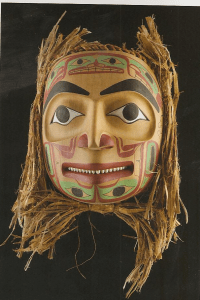
Haida art occupies a privileged place in Northwest Coast art. Because the revival of the art is associated closely with Bill Reid, who began with the Haida tradition, to many people, all Northwest Coast art is Haida, and Tsimshian, Nisga’a, Kwaguilth, Nu-chu-nualth, Salish and the others are not even names. Still, no one can deny that the Haida include many brilliant artists in every medium, so last night I went to the opening of Coastal People’s show, “Haida Masterworks” expecting to enjoy myself. Nor was I disappointed.

In fact, the show exceeded my expectations. Since it had been only lightly advertised, I expected a small show. Instead, what I saw was a showcase of leading Haida artists, with works ranging from the classic to the contemporary.

Several leading Haida artists featured prominently. Master carver Don Yeomans was represented by several circular panels and a mask well over a meter high –examples of what I think of as corporate art, since you need a large lobby, or at least an extremely long room with a high ceiling to display it in a setting that does it justice.

don-yeomans

April White, who paints in styles varying from traditional Haida designs on cedar bark to contemporary landscapes:

april-white

Also prominently displayed was the better part of two years work by Reg Davidson, who is probably the leading carver of masks that can be used for dances and ceremonies. This emphasis gives his masks a simplicity of line and color that is rarely seen, as well as a unique dramatic quality. I am sure, for instance, that the large eye-sockets that characterize his masks increase their theatrical effect when seen in the firelight of a night-time ceremony.

reg-davidson

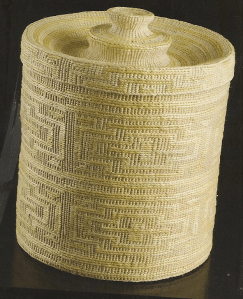
Yet another master artist who is well-represented is Isabel Rorick, a weaver who works largely with spruce roots and natural designs in traditional patterns collected from up and down the coast. I admit that I know little of basket weaving, and ordinarily think less of it. Yet even I could see that Rorick’s work was intricate and uniform. Despite the muted colors, the designs are clearly visible from ten meters away, and, up close, the evenness of her work make clear that she must spend hours upon hours in her craft.

isobel-rorick

Among such works by well-known artists, I almost missed some wood-carvings by newer artists. However, on my second or third round of the gallery, I took time to appreciate some panels by Kyran Yeoman, Don Yeoman’s son, and a mask by Robin Rorick. Also on display was one of the first masks I’ve seen by goldsmith Jesse Brillon.

Contemplating these works was a pleasant way to spend an evening. However, for me, the highlights of the show were the jewelry and small sculptures in the display cases. Jesse Brillon and Gwaai Edenshaw – so far as I’m concerned, the leading goldsmiths in Northwest Coast art – were unfortunately represented by only one work apiece, although both were standouts:

edenshaw-brillion

However, small displays of works by Derek White, Rick Adkins, and Gerry Marks were more than compensation.

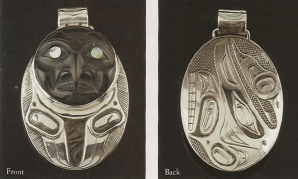
I also took the time to appreciate the two-sided silver and argillite pendants by young artist Ernest Swanson. I had not given much attention to his work before the show, but I plan to correct that mistake in the future because of the fineness of detail in his engraving.

ernest-swanson

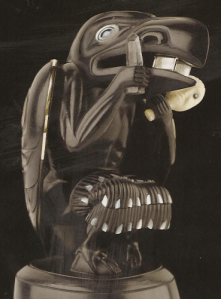
But for me, the highlight of the show was the work in argillite by cousins Christian and Darrell White. Christian White, of course, is one of the most-skilled argillite carvers working today, and pieces like “Raven’s Children and “Eagle and Salmon” are typical of the strong lines and sense of restraint that I associate with his work.

christian-white

By contrast, Darrell White has only been working seven years to his cousin’s three or four decades, but he is rapidly perfecting his work. His style is less serene than Christian’s White, reminding me a little of Ron Telek’s, and having the same attention to detail. Pieces like “Thunderbird Captures Killerwhale” and “Raven Dancer” (below) show an originality of design that leave me looking forward to what he will do next.

darrell-white

As usual at such events, appreciating the art was repeatedly sidetracked by the interesting conversations flowing around the gallery. Although I had only expected to stay an hour or so, I suddenly found that three hours had passed and I still hadn’t looked as closely as some works as I had wanted. But that just gives me an excuse to return, so I’m not complaining.

Read Full Post »

Life has been interesting since I wrote a piece called ”Sexism: Open Source Software’s Dirty Little Secret” for Datamation a couple of weeks ago. I won’t go into details, but, since then, replies pros and cons have occupied a disproportionate amount of my time. The supportive replies are gratifying, if embarrassing, but what really disheartens me is the dreary sameness of the hostile responses. Free software, I like to think, attracts intelligent and rational people. So why are so many of the hostile responses so supremely illogical?

Let’s start with Sam Varghese’s reply to my article. After making some sensible points about the current background to the issue, such as the upcoming mini-summit on women in free software Varghese misrepresents me by saying that I have already concluded that sexism exists in FOSS. In fact, I have simply looked at a set of figures that shows a surprisingly low proportion of women in free software – a figure far too low to be the result of margin of error or in any way ambiguous – and concluded a systemic bias. Correlation, of course, is not the same as causation, but when a trend is so pronounced, causation does become a leading hypothesis.

Varghese is on better logical ground when he examines the figures I cited. However, while he validly suggests that the higher figures of female involvement for proprietary development might include women who are not directly involved with coding, he neglects to consider that many roles in FOSS are also not directly involved with coding, such as documentation or user assistance.

However, Varghese’s article seems a model of reason besides one written by Hans Bezemer. What is especially fascinating about Bezemer’s piece is how many logical fallacies and inconsistencies it squeezes into such a small space.

Bezemer gets off to a false start by framing the debate in terms of either-or: Either we have free will and can change our behavior, or we don’t. In such complex questions, coming down entirely on one side is an over-simplification that creates distortion. In particular, he classifies all feminist thought as having the same basic underpinning of assumptions about free will — something that nobody who had actually read any feminists could possibly believe, and that renders anything else he says untrustworthy.

Bezemer continues by making a biological appeal to authority. We can’t do anything about sexism, he declares, because gender differences are innate. I am not sure whether he also lacks knowledge of biology or hopes that his opponents do, but, once again, matters are nowhere near as simple as he suggests. But, by pretending that they are, he tries to close off discussion.

Bezemer then stoops to ad hominem arguments — attacks on the people holding views he disagrees with, rather than on their arguments. He does so by implying that they are attempting to impose “political correctness,” a label that is meant to be both dismissive and demeaning, and leave the impression that the views of his opponents are valueless. Yet what is being asked? Only the same basic level of professionalism that is required in any modern workplace. Or, to put things another way, common decency.

But perhaps Bezemer doesn’t want to oppose common decency in public. So, instead he weakens his argument still further by implying that his opponents hold views that they have never expressed. “Unless a huge number of males quit making FOSS software,” he says, “that ratio is not going to change – no matter what.”

Of course, this comment ignores that the ratio has changed in several projects that have attracted seven or eight times more women than free software as a whole. But the real point is, where has anyone suggested that men should quit projects? The idea is entirely Bezemer’s. Apparently, either the idea of feminism in free software raises the specter of affirmative action in his mind, or else he wants to raise the specter in other people’s minds. Either way, the suggestion is not the highest-minded part of his argument.

Bezemer winds down by saying that “only coding matters,” and that women who want to contribute to free software should simply do so. Unfortunately, his generosity is belied by his apparent need to write an anti-feminist piece. If only coding matters to him, then why does he ignore the issue? Why would he try so hard to debunk an issue that could be preventing more code contributions? If code contributions are really that important to him, then why is he not doing everything in his power to encourage more?

Bezemer then concludes with two classic bits of evasion. First, he insists that he is not sexist, although his eagerness to see gender differences where the evidence is spotty and contradictory suggests otherwise. Then, he reverses himself and says that people can call him sexist if they want, but should let people like him do their own thing. “We’re people, too, you know,” he says, neatly turning himself into the victim.

In the end, while both Varghese and Bezemer claim some sympathy with the aspirations of female contributors to free software, in both cases their articles amount to a plea to leave things as they are. Both are defending the status quo and any sexism that might be involved in it.

But, just to complicate things, I suspect that both are moved to write at least in part because of their dislike for me. As a quick search on our names can quickly prove, both Bezemer and Varghese dislike me, and criticize me whenever possible, sometimes even to the extent of contradicting or reversing a previous stand. I have no idea what Varghese’s motivation is, and I will spare Bezemer the embarrassment of explaining his possible motivations, but I strongly suspect that both partly oppose efforts to combat sexism simply because I support them.

Still, I urge everyone to read these two bits of anti-feminism. If you don’t already recognize the classic counter-arguments when anyone objects to sexism, you can learn them very quickly from these two articles.

Read Full Post »

« Newer Posts - Older Posts »