Feeds:
Posts
Comments

Posts Tagged ‘Vancouver’

Twenty-years ago, I happened to be in a gallery when a First Nations man was talking to the owner. He was selling copies of a relative’s work – his father, I believe he said. They were loosely rendered works in a style I had never seen before, and I was immediately intrigued. I bought two as birthday presents for my partner, although I had never heard of the artist, Henry Speck. Nor could I find any information about him aside from the fact that he was Kwakwaka’wakw. I concluded that he was a minor figure and that his relative had exaggerated his importance.

Last week, I finally learned more by visiting The Satellite Gallery’s small show, “Projections: The Paintings of Henry Speck, Udzi’stalis”. It turns out that Henry Speck was a Kwakwaka’wakw hereditary chief, fisherman, and artist. While he had been painting since the 1930s, his moment of greatest recognition came in 1964 when the New Design Gallery held an exhibition of his work – an exhibition that was almost unheard of for any First Nations artist at the time. Even Bill Reid, who could be scathingly scornful of anything non-Haida, acknowledged his work as “far beyond anything attempted before in Kwakiutl art” (although, strangely, Reid did not include Speck’s work in his seminal “Art of the Raven” exhibit in 1967).

In other words, Speck is one of the bridges between the decline in traditional First Nations culture and art in the early 1900s and the renaissance that began midway through the same century.

This current show hints more than once that Speck might be considered a modernist, and it is easy to see why. Surrealists and modern artists like Jackson Pollack have been fascinated by the masks and paintings of the Northwest Coast and their obvious sophistication, and have tried to give their impressions of what they saw – usually very poorly, since they had almost no understanding of the artistic traditions they were seeing.

To a degree, Speck’s work is equally impressionistic, obviously sketched in ink or paint, and without the close attention to exact lines and curves that you see in traditional artists today such as Richard Hunt. His work also has individual idiosyncrasies, such as using short parallel lines or rows of irregular circles to fill empty space that – so far as I know – have no antecedent in Kwakwaka’wakw art.

However, the difference between Speck and the mainstream surrealists and moderns is that Speck had at least some understanding of the traditions he was depicting. Consequently, while his art seems less disciplined than that of modern traditional artists, his work does not seem glaringly wrong or poorly-observed so much as individualistic. Like many recent First Nations artists, his work does not fall neatly into either the modern or traditionalist categories, but seems to contain elements of both.

The “Projections” show is disappointingly small, with no more than a dozen original pieces, none of which is larger than 16×20 inches. However, taking the lead from Bill Reid’s observation that Speck’s work seems unnaturally confined at these sizes, and would benefit from being much larger, “Projections” includes a large slide show based on the Speck collection at the Glenbow Museum in Calgary that partly compensates for the lack of originals. Not only was Reid quite right in his observation, but seeing Speck’s work on slides restores the often-faded colors of the originals.

Behind the screen for the slides is a loop of archival footage of Speck and his work. by modern standards, the film clips are often gratingly patronizing, as journalists try to adjust to the idea of a First Nations artist. Is it hard to work in the traditional art, they ask Speck, when as a modern man he can’t believe in what he is depicting, the way he might have a century ago? Does he see a conflict between his subject matter and his own Christianity? But Speck, although unassuming, is far from the naïve native that the journalists assume, and answers with more graciousness than his questioners had any right to expect.

“Projections” is a show that can be easily absorbed in seventy minutes, and I wish it was larger. Yet, even as it is, the show goes some ways towards to restoring Speck to the position he deserves in the history of local First Nations art. And, finally, I have the context for the copies I bought so many years ago.

Read Full Post »

I know it’s rained at the Vancouver Folk Music Festival. I’ve stood in the mud many times, worrying what I would do when my last dry layer was soaked. I know, too, that at least twice rainy weekends have almost drowned the Festival in debt. Yet somehow in my mind, when I think of the Festival, the sun is always shining.

But to be exact, I need to expand the image. In my mind, it is early afternoon. A mild breeze is coming off the water. It makes Jericho Park, the home of the Festival for most of the last thirty-five years, looks deeply green, and makes the temperature in the shade several degrees Celsius cooler than in the sun. The young crows are picking at the garbage, so surprised by their luck that they forget to be afraid of humans. Everywhere you look, blankets and elaborate fortifications of chairs, tents, and banners are spread in front of the main stage, reserving spaces for the evening concert.

Overhead are a few wisps of cloud, just enough to keep the worst of the heat away for most of the days. But as the day continues, an increasing number of the crowd are opting for the three stages in the shade, where the risk of sunstroke is lower.

From wherever you are, you can tilt your head in a different direction and catch the strains of whatever is playing at another stage – sometimes, two or three. Very occasionally, you can hear applause or a roar of approval, but not often. The problem isn’t the quality of the musicians, which varies wildly, but has included dozens of superb acts over the year. The problem is that, after the first set or two, most of the crowd are too drowsy in the sun to get excited by anything except the very best.

And everywhere, there are people – people sitting cross-legged on the grass, or stretched out staring up at the sky, people dancing to one side of the stage, and people trudging in long lines along the increasingly dusty footpaths to the next stage, or to grab something to eat in the food corner.

Mostly, the crowd is couples and of European descent, but there are always families and cliques of teenagers, and a scattering of other ethnics as well. Recently, women and men in their late sixties and seventies have also started to become more common — some of them with enough tattoos to forever put to rest the idea that people will regret their tattoos when they’re young. A few of every age are in scooters and wheelchairs – including ex-Vancouver city council radical Tim Louis – because both the site and the Festival are more accessible than almost any other event that claims to be. And weaving through this crowd are volunteers, driving performers and drum sets and bass fiddles to distant stages, or picking up garbage or selling raffle tickets (the ticket sellers, by tradition, in costumes).

Most of the crowd, though, are in T-shirts and shorts, or tank tops and halters and long cotton skirts. A few are in bathing suits (and looking increasingly red and pained as the day continues), and women in elaborate and expensive fantasies of what they imagine the counter-culture must have been – fantasies that seem to owe more than a bit to ElfQuest. Some wear costumes. A few women go bare-breasted, believing themselves in a safe place, and a few men who want to show off the results of their weightlifting do so as well. However, far more have hats, either carried with them or improvised from programs or whatever else is at hand. Many have bare feet, despite the warnings in the program that shoes are advisable.

Or so the gestalt image appears in my mind. In reality, I know that that the Festival is not always The Peaceable Kingdom that its organizers sometimes like to pretend. In the early days, drugs were often obvious (and spot the narc one of the informal games that everyone played). More recently, the addition of a beer garden has created an increased need for security (or so I’m told). There are complaints, too, about the high prices charged for tickets and food, the selection of acts, and just about any other aspect of the Festival that you might name.

But I’m talking about my imagination, and not trying to give a balanced assessment. In my mind’s eye, at the Festival my brain is always slightly sodden with the heat, and the rest of me mildly dehydrated and seeking more fluids. The next day, or maybe the day after, I will be back at work, but that time seems centuries away. For the coming hours, I am relaxed and doing nothing but listening in a way that I rarely manage at any other time, even when on holiday.

Last year, I didn’t feel that way. As I said, it was raining. More importantly, the trip was a pilgrimage in which I remembered being there with my deceased partner. “It’s the nearest thing we have to religion,” she used to say, and, it’s true: although we missed the first two, and one for a vacation and one for a wedding, the years in which we missed the Festival altogether were rare.

But this year, I went alone, not expecting to do more than strike up a few casual conversations, and the magic was back. This year, it was the Festival of my dreams once again, and I know that next year I will be back and it will be a blazing hot summer day.

After all, isn’t it always?

Read Full Post »

I live near the greenbelt surrounding Simon Fraser University’s Burnaby Mountain campus. As a result, I see more wildlife than most suburbanites in my daily routine.

The neighborhood is full of coyotes who have learned not to cross the roads against the traffic flow, and red-tailed hawks who perch on lamp posts, waiting endlessly for road-kill. Every year or two, a mountain lion or bear swims across the inlet and causes a panic, and the mountain used to support a pair of ravens (and possibly still does). And all of this is in addition to the usual squirrels, song birds and seagulls that you can find anywhere in the urban sprawl.

However, by far the most dramatic manifestation of living on the border between the city and the wilderness is when a bald eagle comes hunting in my townhouse complex, and the crows counter-attack in defense of their nests.

It usually happens in late June or July, when this years’ offspring are just leaving the nest. The first sign that a predator is in the area is the suddenly silence outside. If I go to the window, all the smaller birds are flying within ten meters of the ground, darting into the thicker, lower branches of the trees.

From the directions they are coming from, I usually have no trouble locating the eagle, sitting on some high perch, always looking larger than seems possible, and with the mad gleam of a single-minded predator in its eye. Even though eagles rarely attack humans, it’s a sight that’s as frightening as it is magnificent.

The crows take part in the general exodus. But, as soon as they have found shelter – or perhaps checked that their fledglings are safe – they start calling to each other.

Apart from being louder and more alarmed, their calls sound no different than usual to me. Yet the calls obviously mean something to the crows, because, after a few minutes, they rise to confront the eagle, like Spitfire pilots during the Battle of Britain.

The crows, of course, lack the talons and beaks of the eagle, and are fighting well above their weight. However, they fight as a team – and that makes all the difference.

The crows attack from all sides, never staying still, flying at the eagle but always veering away at the last moment. The eagle no sooner focuses attention on one or two crows than they have moved out of the way, taking temporary shelter in the lower, thicker branches that the eagle has trouble squeezing between. Meanwhile, more crows are dive-bombing it from another direction, and the eagle has to whirl about to keep an eye on them. No sooner has it done so than more crows have moved in from yet another side. There are always dozens of crows, so they have no trouble keeping up their attacks indefinitely.

Usually, though, they don’t have to. Within moments, the eagle has been reduced from predator to fugitive. Abandoning its efforts to attack, it looks for a refuge in the trees, never finding one, since crows can maneuver anywhere it can. Within twenty minutes, it is crashing from tree to tree, trying to escape. Meanwhile, behind it, crows keep rising to meet it, then returning to shelter for a temporary rest while other crows take up the fight.

Once, when walking up to the corner store, I saw one of these attacks about twenty meters above me. From the way its feathers were plastered tight against its body, I could tell that the eagle was not only bewildered, but actually terrified as it was driven from shelter after shelter, never getting enough of a respite to counter-attack.

I half-wondered if the eagle might be so confused that it would attack me, or if the crows in their anger would see me as another intruder and deal with me the same way, but neither of these things happened. Instead, the eagle continued careening from tree to tree, disappearing into the distance while from every tree around me, crows were calling in anger. I tried not to think of Hitchcock’s The Birds, and continued on my errand as the fight moved gradually further away.

Read Full Post »

Gwaai Edenshaw was long overdue for a solo exhibit. Both a goldsmith and a traditional carver, he is an artist’s artist, and his work is in popular demand. However, for his first exhibit, he has chosen to emphasize another aspect of his work: his graphite and ink drawings, and their role in his artistic process. “Sounds Good on Paper,” currently at the Petley Jones Gallery, does include some his work in gold, but largely to illustrate the importance of his preliminary drawing in his jewellry.

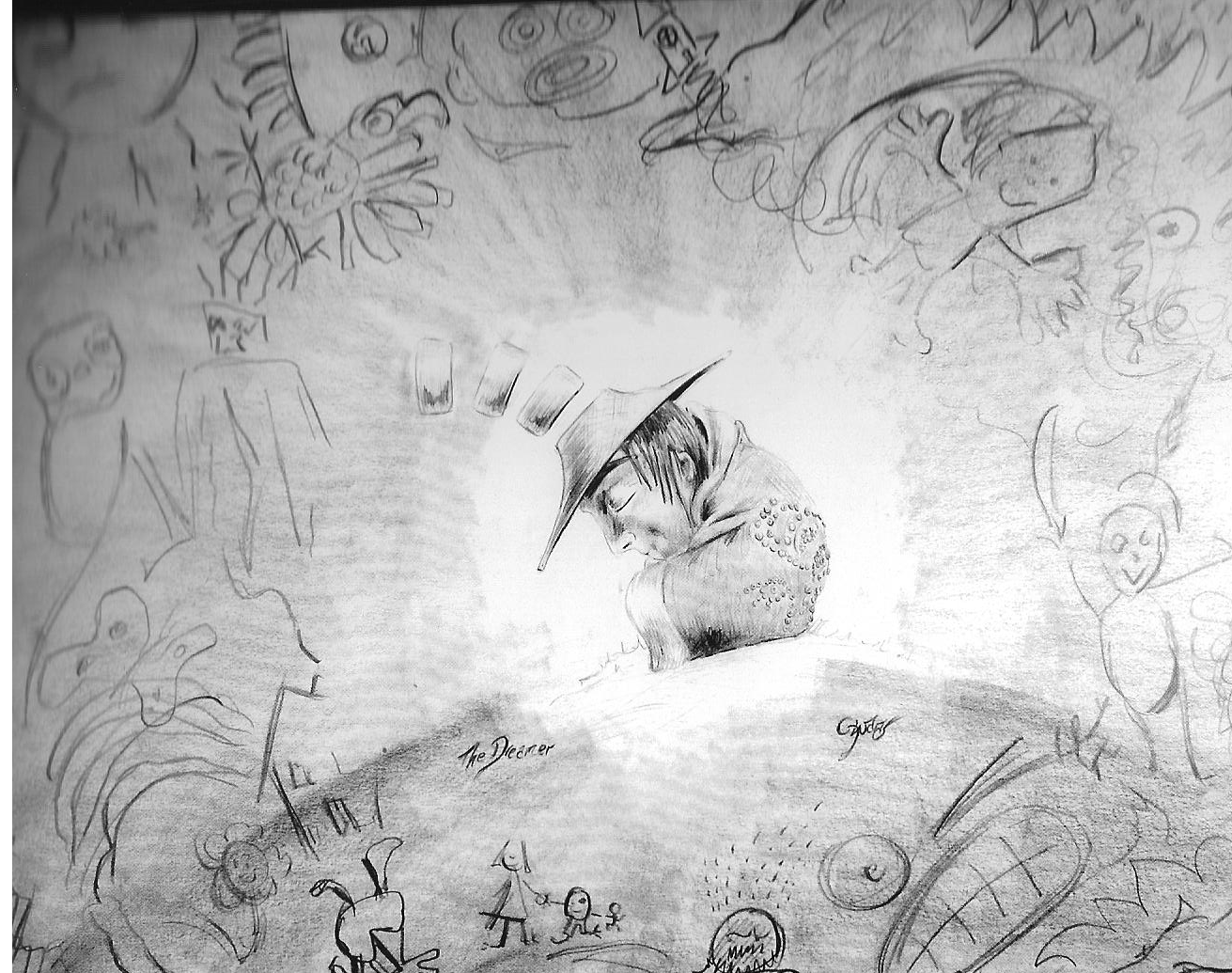
With this theme, the show’s catalog inevitably chooses “The Dreamer” as the piece on the cover. The piece is not only an obvious choice for the theme of the artistic process, but for Gwaai himself (to use the name with which he signs his work). The cartoon style is a reminder of his animation prototypes for teaching the Haida language, and the rings on the hat, a sign of high status in traditional culture an indication of the importance of art among the Haida today. At the same time, the doodles around the margin, as rough as they are, have a non-traditional look. Also, to anyone who has sat down with Gwaai for any length of time, they are a reminder of his constant doodling.

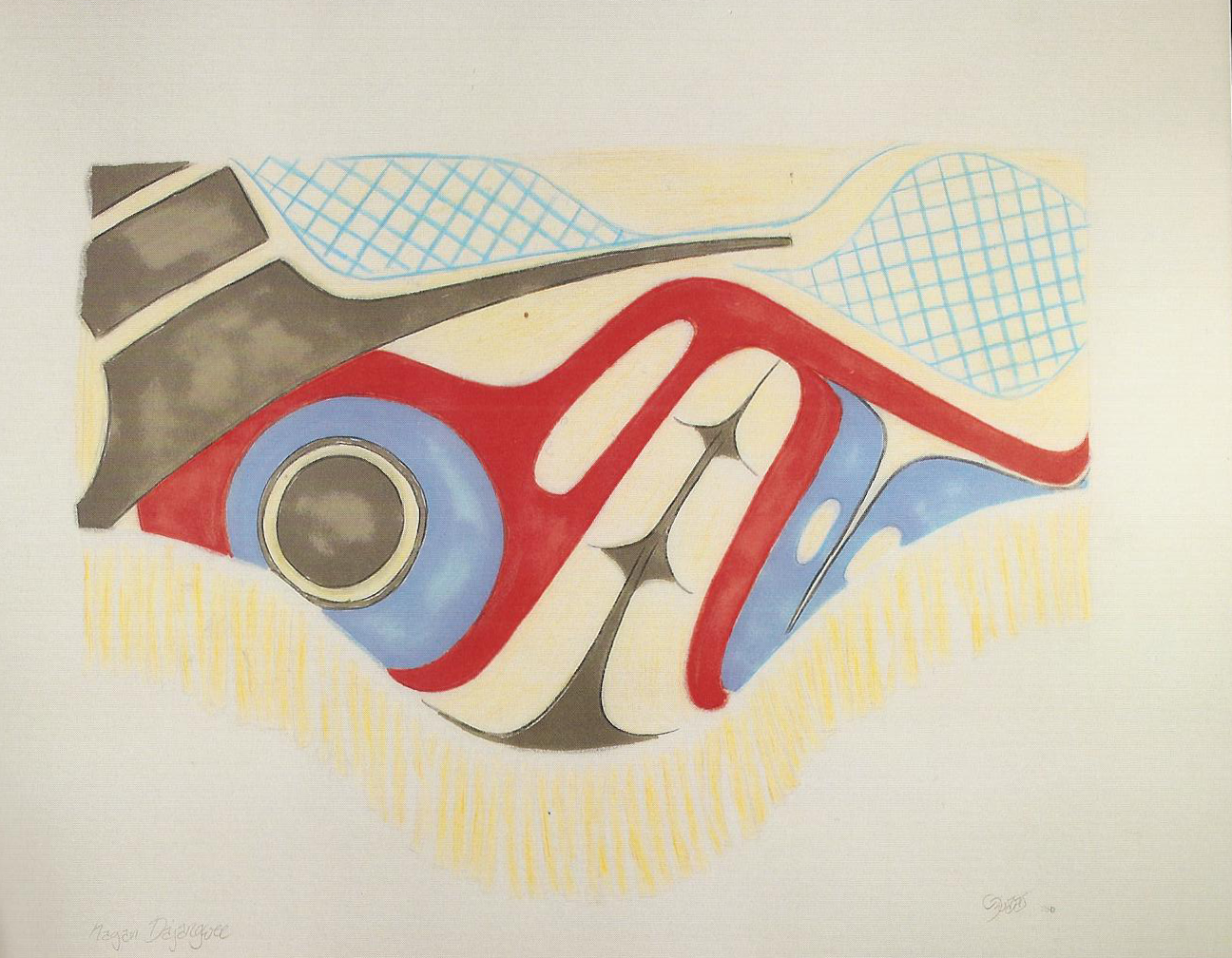
Other pieces in the show emphasize Gwaai’s different traditions and influences. Some, like “Kagan Dajangwee,” are slightly stiff exercises in the northern First Nations style, with their formline and cross hatching:

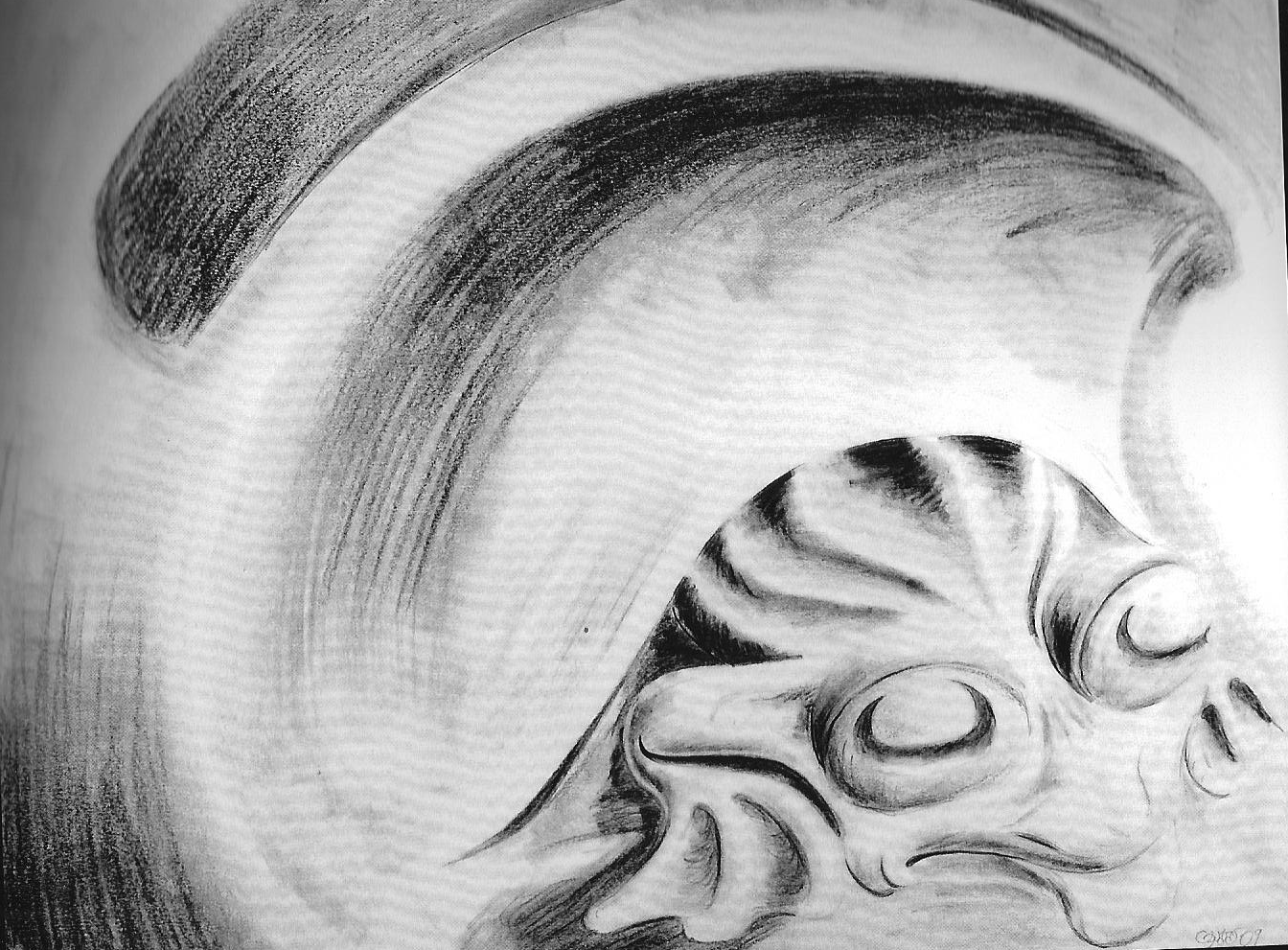
Others, like “Nanasimget,” a depiction of an Orpheus-like figure in Haida mythology, look like a two-dimensional rendering of a metal casting (and, perhaps not coincidentally, are reminiscent of some of the sketches of Bill Reid, Gwaai’s mentor when he was a teenager):

At the opposite extreme are more mainstream pieces. “Ts’aahl Girl” (Eagle Girl), for instance, combines realism with a touch of whimsy:


Similarly, the two studies of Gagiid, the Haida wildman whose lower face is pierced by the spines of the sea-urchins he is forced to eat after being castaway, bear a distinct resemblance to Gollum as portrayed by Andy Sirkis in The Lord of the Rings:

This movement between traditional Haida culture and urban industrial life – so effortless that it includes analogies – suggest the position of the modern First Nations artist. For those of us who have met him, it also seems very typical of Gwaai’s wide-ranging mind.

Some of the most interesting pieces in the show offer a glimpse of the creative process.For example, “Detail: The Two Brothers Pole” shows the precision-drafted plans for a pole that Gwaai recently completed with his brother Jaalen, and a view of the raised pole. The pole is located in Jasper National Park, and was a replacement for a repatriated pole that was appropriated from the Haida in 1907 and that is often attributed to Charles Edenshaw:

A more personal glimpse of the relation between sketches and other media is provided by “Sons of Djillaquon” and the gold pendant “Sons of Djillaquons:”

Both the sketch and the pendant are powerful works in their own right, but together they illustrate what is gained and lost in the transfer between media, as well as the limitations of each. It is this relationship that makes the oxymoron title of “Sounds Good on Paper” a suitable title for the exhibit.

Casual observers might be tempted to to describe “Sounds Good on Paper” as a minor show. And, in one sense, they would be right: most of what is displayed are not the pieces for which Gwaai has rightfully gained his growing reputation.

Yet such a view would also be short-sighted. More than anything else, “Sounds Good on Paper” is a very personal show. It displays many different aspects of Gwaai’s personality – probably not all –and offers a tantalizing hint or two of his creative process and his interest in different media.

My only regret is that the show couldn’t include some examples of Gwaai’s argillite prototypes for his jewellry. Placed beside the finished jewellry, these prototypes could have provided yet another perspective on the concerns of the show.

However, even without this touch, “Sounds Good on Paper” remains interesting both aesthetically and psychologically. It’s been a long time since I’ve seen an exhibit that shows so much of the artist without a hint of arrogance.

Asked the day after the opening what I thought of the exhibit, my first response was, “It’s very Gwaai.” Having had a few more days to think, I still that response the most accurate I could have given.

Read Full Post »

For academics, their thesis defense is often a highlight of their lives. Not for me. My defense was over so quickly that I almost felt disappointed. In fact, it was so quick that sometimes I almost wonder if I’m really entitled to the Master’s degree that the diploma says that I earned.

Probably every grad student sweats over their oral, and, nine times out of ten, I’m told, it’s wasted anxiety. A successful grad student is a form of prestige in academia, and few supervising committees will let a candidate defend unless they are likely to succeed. A failing student makes their committee look bad, so, while committee members may harrow a student who’s preparing, and ask a few tough questions at the defense, they’re generally not out to cause problems.

However, as a grad student I didn’t know the situation. It didn’t help that the one defense that I witnessed so I would know what to expect was a last ditch effort to squeeze the student out the door before she used up her time in graduate school. Unlike most defenses, that one was testy, especially since the candidate obviously had trouble thinking on her feet and several inadequate answers resulted in extended cross-examinations. When she was finally told that she had passed, you could see the tension draining out of her. Watching her, I got the idea that a defense was an ordeal, and success was by no means as pre-ordained as it usually is.

In addition, I had my own reasons to be nervous. I was writing about science fiction – and not science fiction old enough to be of historical interest, like the H. G. Wells thesis that had been successfully defended a few years earlier. My subject, the fantasist Fritz Leiber, was new material, and, in many department members’ eyes, somewhat dubious. I had heard enough remarks to realize that, were I to fail, several tenured faculty members would not be unbearably disappointed, and never mind that my thesis was original work and almost guaranteed publication.

As if that wasn’t precarious enough, my thesis supervisor was the department’s token humanist. By working with him, I had announced to the entire department that I was not in any of the popular critical camps, such as the feminists or the post-colonials. It wasn’t that I disagreed with these camps politically or socially, you understand – quite the contrary. But, unlike members of these camps, I had been heard to express a number of heresies. Books were to be enjoyed, I had insisted at departmental meetings, and not simply studied. Moreover, I had often said that conscientious critics should fit the theory to the work, not the work to the theory. Such ideas amounted to a questioning not only of critical method, but of how most members of the department worked. Under these circumstances, I didn’t feel I could take my defense for granted.

My particular worry was my second reader. The thesis supervisor wasn’t a problem, or he wouldn’t have been working with me in the first place, and all his objections had already been handled while I was struggling with the drafts. Similarly, the external examiner was a minor fantasy writer, so he was unlikely to be hostile, even though he would probably ask some questions to determine the extent of my knowledge.

However, the second reader was a problem. He had made the odd comment that suggested that he disapproved of my subject matter, and he hadn’t had time to read my thesis until just before the defense, so I didn’t know what points he was likely to bring up. About all I could do was prepare some explanations of why my subject was worthy of attention, readying a defense in depth that guarded against every attack which I could anticipate. And, being imaginative, I could anticipate a lot of possible attacks.

With these worries, I spent a fitful night the day before the defense. The morning was worse; tap me on my shoulder from behind, and I would have exploded like a Prince Rupert’s drop. Mercifully, the defense was early in the morning, or I might have collapsed in fetal position in the nearest corner.

I sauntered into the room with all the nonchalance of a condemned prisoner being taken for execution. But to my amazement, my own defense was nothing like the one I had witnessed. My supervisor and the external examiner asked a few questions to probe my knowledge, and I found I could not only speak but summon some eloquence as well.

However, all the time, I waited for the second reader to pounce. To my eye, he looked abstracted, a little impatient, as if just waiting for his chance to shoot me down. Yet, apart from a comment that Leiber hadn’t done anything in forty years as effective as his story “Coming Attraction,” the second reader took no part in the discussion, although my supervisor turned to him several times.

I couldn’t understand it. But, finally, my supervisor asked the second reader if he had any questions. The second reader muttered something, and my defense was over, fifteen minutes after it began. I followed tradition by leaving the room while the merits of my work were discussed, and, anxiously fretted to Trish about what the second reader might be saying without me in the room.

But I needn’t have worried. Less than twenty minutes after my defense began, I was called back and told that, apart from a few exceptionally minor corrections, my thesis was accepted and I had my second post-secondary degree.

The second reader disappeared almost immediately, and the supervisor explained his strange behavior. The second reader was subject to petit mal, moments of mental blackout in which he could barely function, and an attack had hit him during the defense. However, rather than plead illness and ask for a rescheduling, the second reader preferred to act as though nothing was wrong and nobody had noticed the lapse.

To this day, I still don’t know if the second reader planned to give me a tough time. Possibly not; he had a reputation for being exacting and a bit grumpy, but also fair. But after all my uncertainty leading up the defense, his reaction was so much of an anti-climax as to be ironic. More relieved than I could possibly explain, I went off to treat my supervisor and external examiner to an afternoon-long lunch, at which I polished off a bottle of retsina by myself, and barely noticed the effects.

Later, I started wondering if I had missed something. I wondered if I could have been better prepared for life as an academic if I had faced a withering and ruthless quizzing and managed to stand my ground. It all seemed too easy somehow, and, although no one complained, to this day I often feel like I obtained my Master’s under false or irregular circumstances.

Read Full Post »

YVR, Vancouver’s airport, is noted for its collection of local First Nations art. I’ve wanted a tour for over a year, but they aren’t always easy to come by, since they involve weaving in and out of security areas. However, today my chance came at last. Together with Ann Cameron, the editor of Coastal Art Beat and my colleague on the YVR Art Foundation board, we followed Rita Beiks, the airport’s art consultant, back and forth through the terminal until I was throughly lost, but marveling at the airport’s collection.

We met at the foot of Don Yeoman’s “Celebrating Flight,” a four-story pole that mixes Haida mythology with Celtic knotwork and a greeting in Chinese. The knotwork and Chineese characters, Rita said, replaced the originally planned figures because of some knots in the wood that made the figures impossible. By itself, the pole is impossible to photograph without a crane and bucket, but when you realize (as I had not) that everything from the panels representing the northern lights at the top to the mosaic on the floor and the moon some distance away are all part of the installation, then taking a complete picture becomes even more impossible.

From the pole, we walked to the terminal’s best-known installation: Bill Reid’s “Jade Canoe,” version of “The Spirit of Haida Gwaii.” The “Jade Canoe” is a copy of the “Black Canoe” at the Canadian embassy in Washington, D.C. However, while the “Black Canoe” is barely visible for security reasons, the “Jade Canoe” is so accessible that people have rubbed the bronze patina off the paddles and some of the other reachable parts of the sculpture. A sign telling people not to climb the sculpture is necessary, and the tradition has grown up that rubbing Mouse Woman’s nose is good luck.
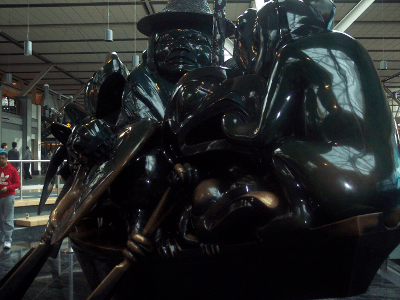
Rita gave a brief history of the negotiations for the piece, which cost three million – an unheard of figure for an airport to spend on art in the early 1990s, and mentioned that the piece was orginally intended to have a copper patina, and changed to bronze only after a phone call from airport official Frank O’Neil to Reid, who at the time was in intensive care. She also pointed out that Lutz Haufschild’s “The Great Wave Wall,” which replaces the nearby windows on the terminal, was chosen as a suitable backdrop to Reid’s iconic piece.

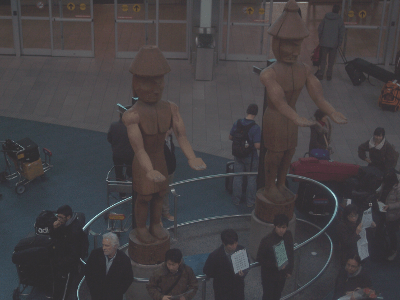
Leaning over the railing, we looked down at the arrival level to Nu-chu-nualth artist Joe David’s “Clayoquot Welcome Figures.” Originally carved for Expo 67, the figures are on permanent loan from the Vancouver museum. Their popularity is so great that they needed a railing to protect them; even so, money is still regularly found in their hands.
We then moved into the secure area for departure and arrivals. Strangely enough, Rita and Brenda Longland, the airport official with us, both had to submit to the usual inspection of their belongings, while Ann and I sailed through without any problems with our visitors’ badges.
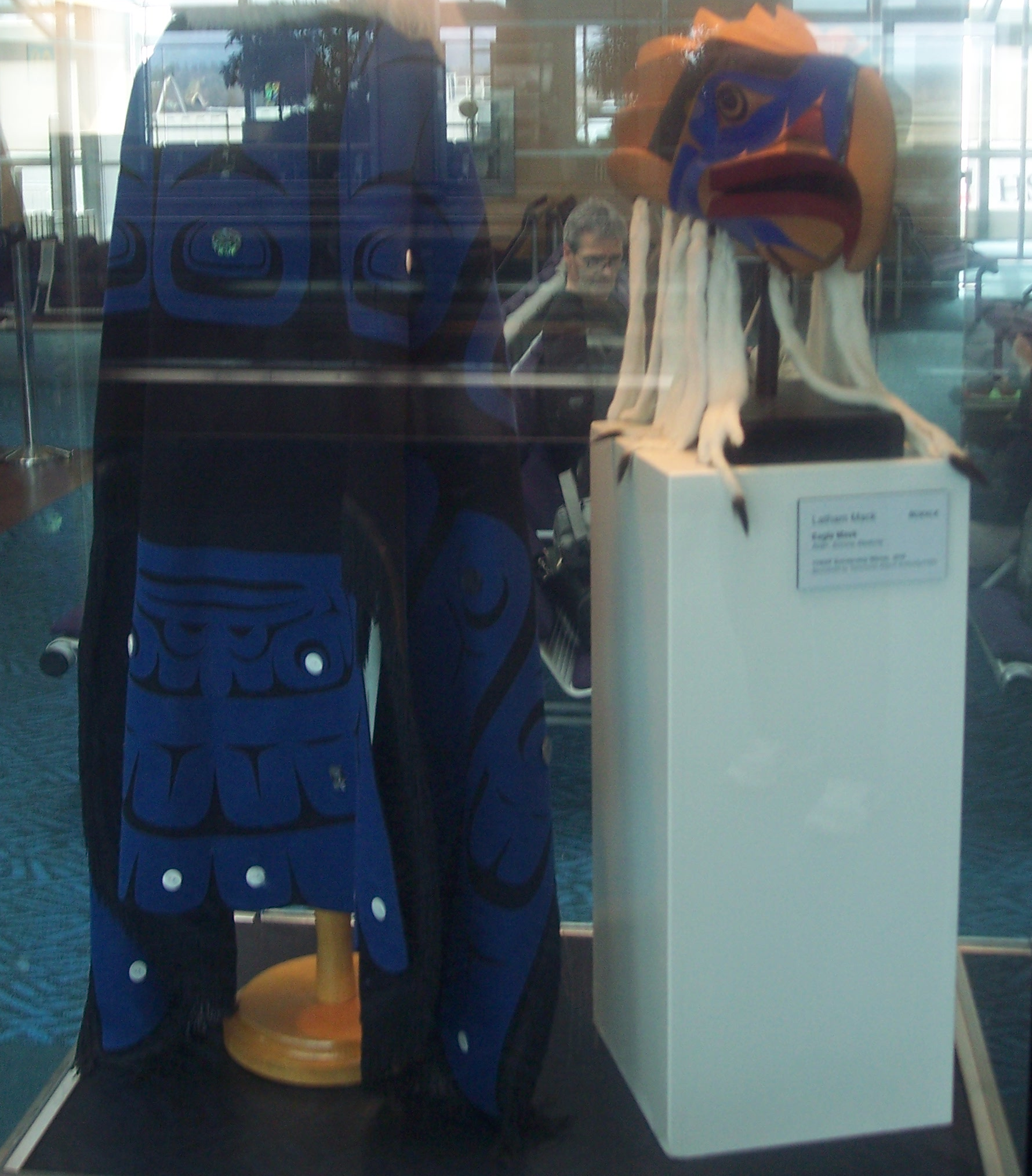
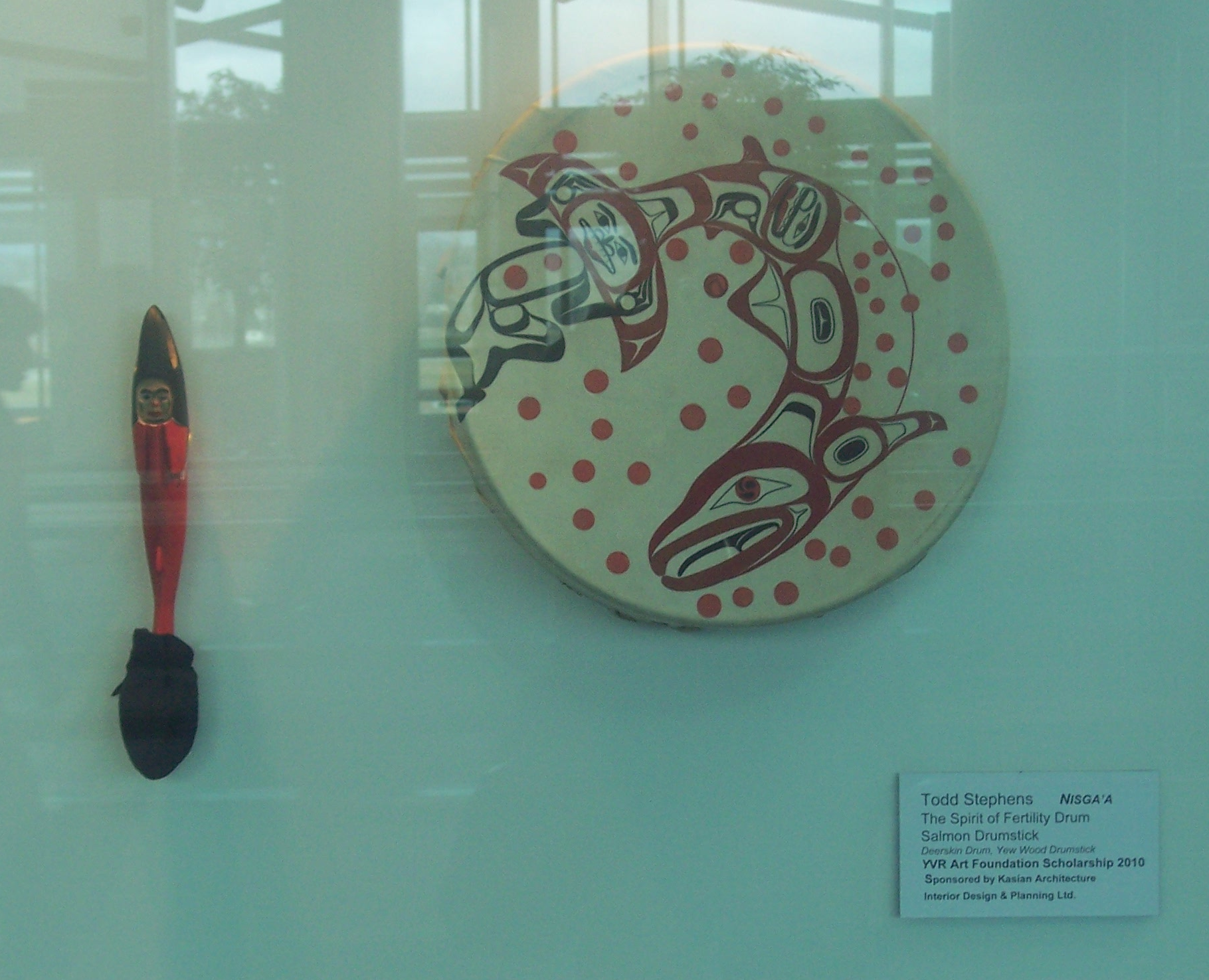
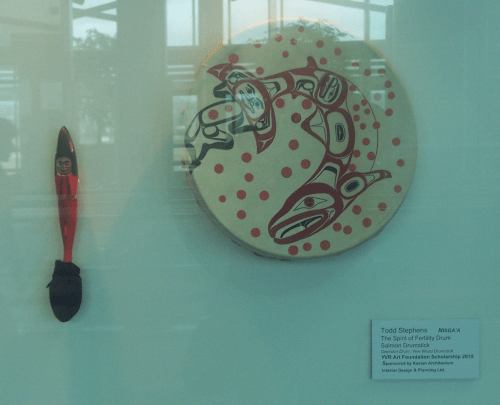
We passed display cases with the works of YVRAF scholarship winners from 2010, including Latham Mack’s Nuxalk mask and robe, and Todd Stephen’s drum. Like the other scholarship pieces scattered throughout the terminal, these pieces will be on display until June 2012, when they will be replaced by the work of the 2011 scholarship winners.

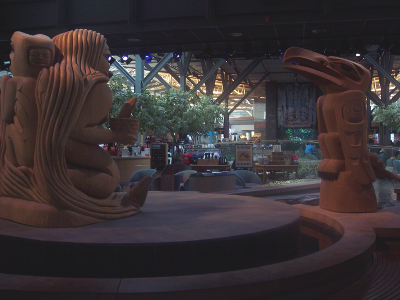
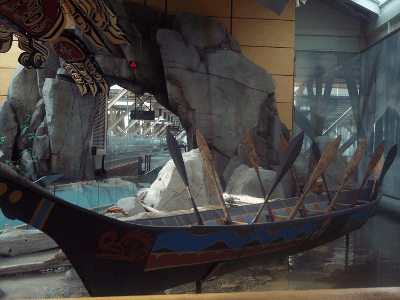
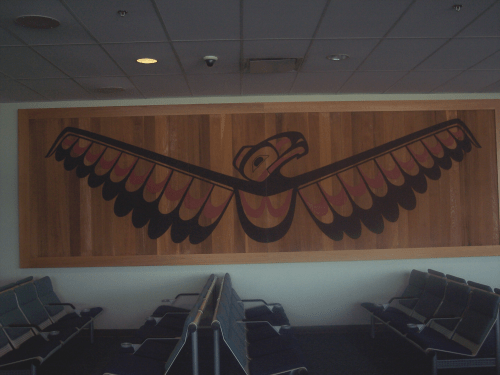
The next permanent display was the Pacific Passage in the arrivals area, a combination of diorama and original art.
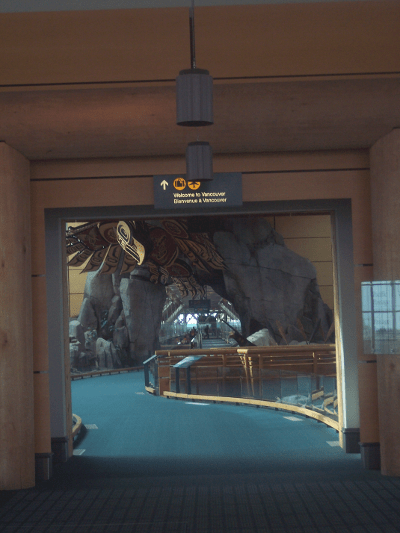
I had seen the Pacific Passage several times, but always after a long flight that left me rushing to the fresh air, and uninclined to give the art treasures on display more than a passing glance.
That was a mistake on my part, because the display is well worth lingering over. It is dominated by Connie Watt’s thunderbird.

Also in the area is an aluminium panel by Lyle Wilson and a canoe by Tim Paul, as well a number of smaller pieces. Bird sounds start as soon as you enter the area, and I was amused to see the swallows who live in the terminal sheltering in the empty eagle’s nest that was added to the dioramas for realism.
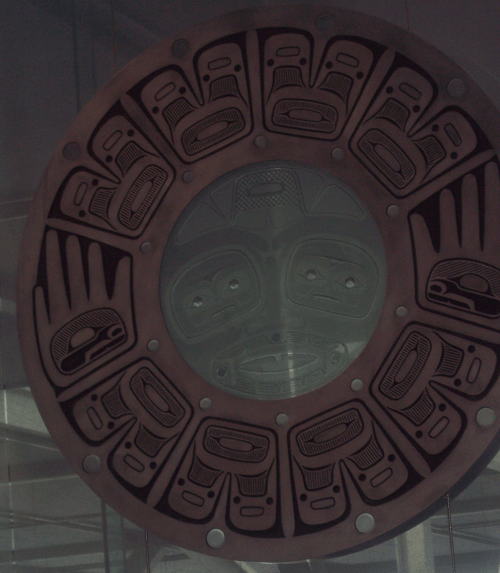
Walking down the overhead walkways, we stopped next at the Musqueam Welcome area, the contribution of the First Nations people on whose territory the airport stands. According to Rita, Frank O’Neill, the airport official responsible for the idea of the First Nations collection, was convinced of the need for the area when the Musqueam chief told him that not having the local nation included there would be like having a sign in Ireland saying, “Welcome to the United Kingdom.”

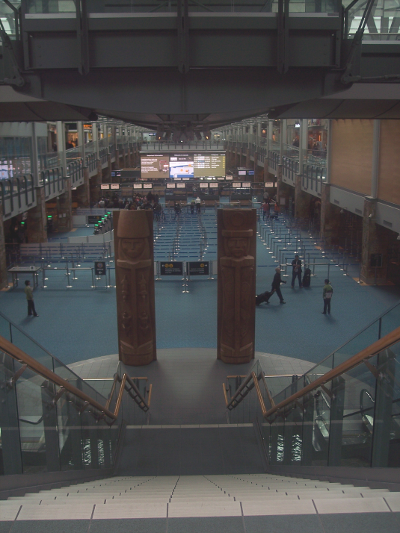
Accordingly, arrivals are greeted first by the Musqueam, and then by Canada. One of the first sites arrivals see is Susan Point’s giant spindle whorl set against a waterfall – an impressive site even if you have been flying all night (although the palms to each side are incongruous; can’t native plants be used instead?).
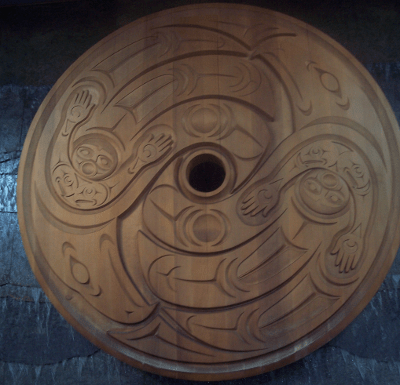
Turning to the stairs and escalators that lead down to the custom booths, the first thing arrivals see are free-hanging samples of Musqueam weaving.

Moving to the steps and escalators, below them arrivals see the Musqueam welcome figures. These were originally carved by Shane Point, but when Musqueam women complained about the sagging breasts on the female figure, it was replaced by the less controversial figure by Susan Point that stands there today.

Only as you descend do you appreciate the sheer size of the figures; by the time you are on the same level, you realize that they are enormous.

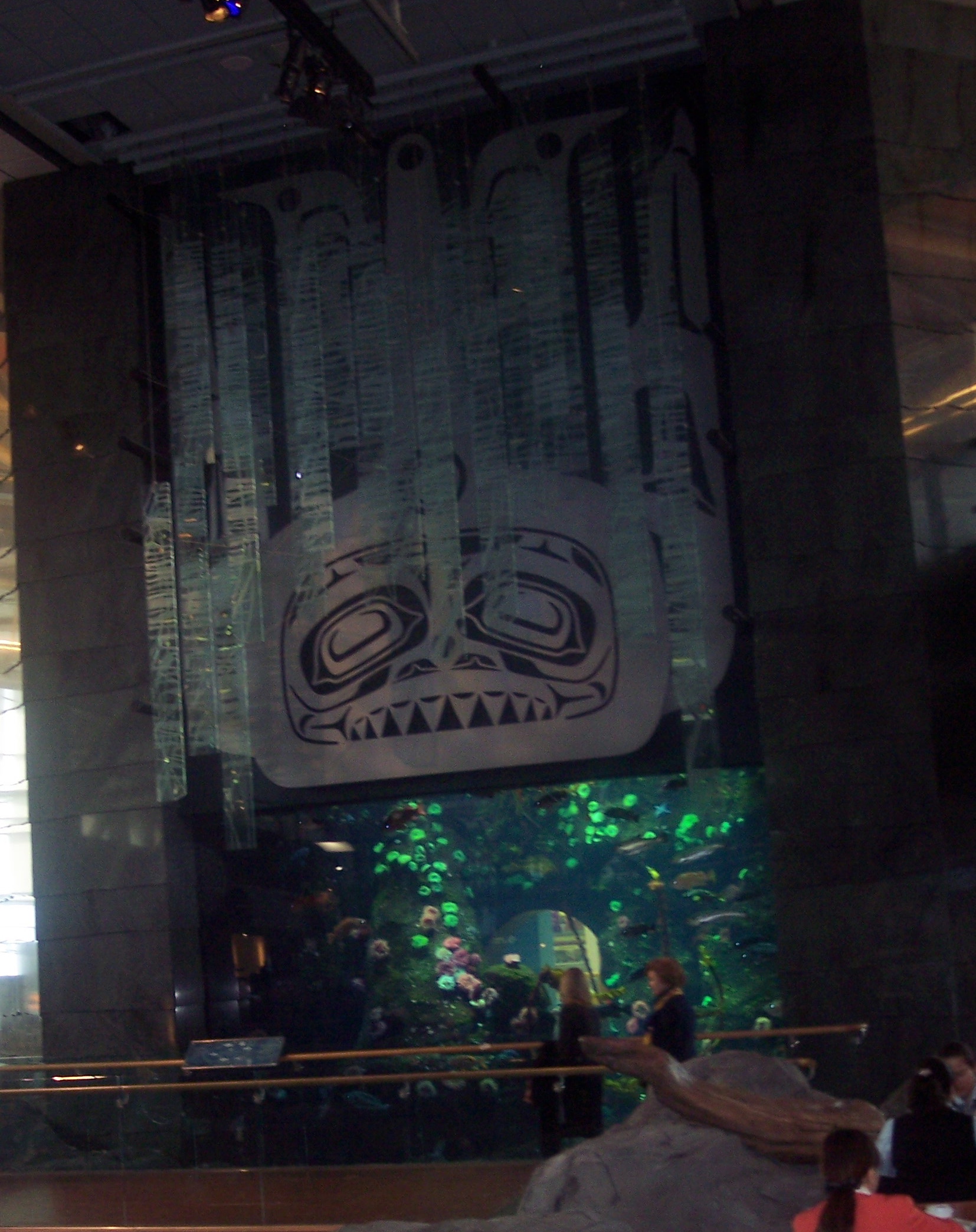
Our next stop was the artificial river that begins with an installation by Tahltan master carver Dempsey Bob, and winds down to an oceanic aquarium dominated by another piece by Haisla master Lyle Wilson.

Bob’s piece is “Fog Woman and Raven.” It is based on the tale of how Fog Woman, mistreated by her husband Raven, gathers up all the salmon from the streams and smoke houses, and prepares to depart the world with them. A little stiffer than many of Bob’s works, it is still a piece worth lingering over because of the details like the salmon caught in Fog Woman’s hair.

The figures are carved from laminated blocks of cedar – an expensive process that is rarely done because it involves shutting down a mill for the better part of a day. In fact, the first laminted block for Fog Woman was found to be punky inside, and had to be abandoned.

Bob’s tableau is surrounded by chairs, and would be a pleasant piece to linger beside, but, unfortunately no food vendors are nearby, so nobody does. Annoyingly, too, small merchandise displays are crowding the piece (we asked a cashier to move an obscuring sign, but it was back when we passed by again half an hour later)

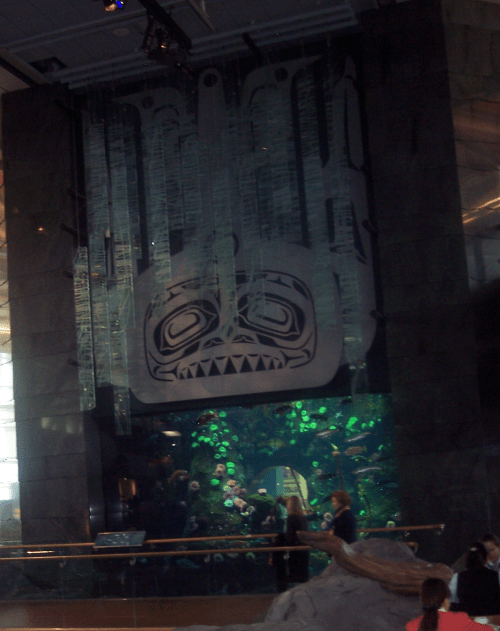
At the far end of the river, Lyle Wilson’s “Orca Chief and the Kelp Forest” rest on top of an aquarium of fish, so that the chief lies half hidden in the kelp made from glass and looks down at the subjects whom he protects. Rita says that few people look up, and reactions to Wilson’s piece proves her point, since most people looked at the fish moving back and forth, but few ever glanced up to see the art above them.
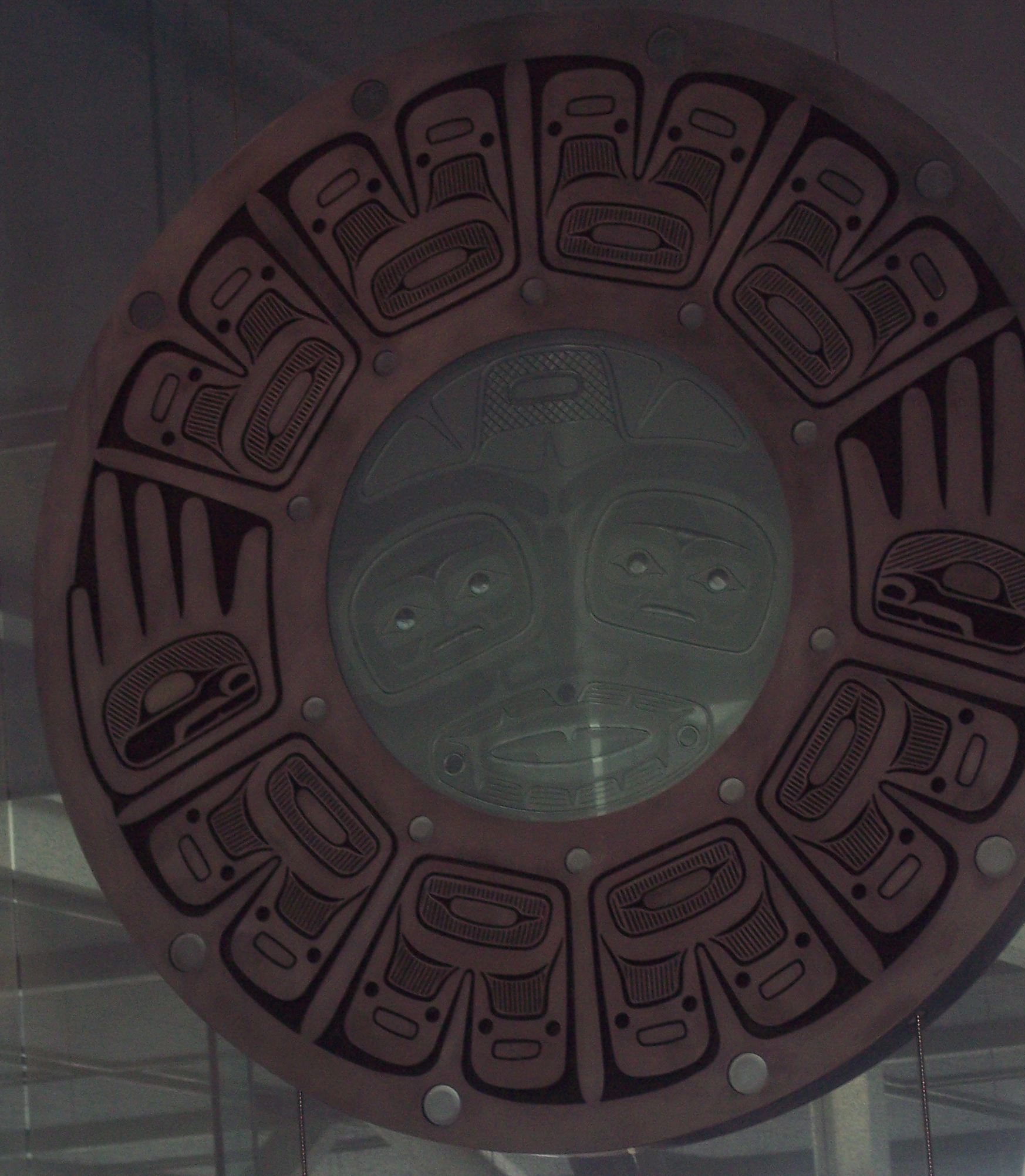
Our last major stops on the tour were two pieces by Steve Smith. The first, “Freedom to Move,” is a series of painted panels that are intended to slow people down in their hurry through the airport.

Unfortunately, the piece is squeezed into a space too small for it, and the pool that is supposed to surround it is dry, but Smith still managed to slow me down for an appreciative moment or two.

The second of Smith’s installations, “Sea to Sky,” named for the highway to Squamish and Whistler, is a series of drums hung beneath a sky light. What we saw was the second version of the piece, parts of the first having been damage by temperature problems, crumbling with a sound like artillery one winter day (fortunately without anyone being hurt. Smith took advantage of the incident to paint bolder designs, and sold what remained of the first version.

These are only some of the collection we saw today. There were also a number of pieces by Roy Henry Vickers that were originally part of a longhouse that has since been destroyed. The longhouse’s pillars and several other designs are now temporarily scattered throughout the airport, most of them unlabeled.
Display cases throughout the terminal also carried such treasures as Hazel Wilson’s famous “Golden Spruce” blanket, which commemorates the recent felling of a particular tree famous in Haida mythology, Tim Paul’s “ClearCut and Dressed,” and some outstanding non-native work by local artists such as Graham Smith. However, enumerating the entire collection would require a blog five times as long as this one.

For lack of time, we also didn’t get to the “Supernatural World” installation by Dempsey Bob, Robert Davidson, and Richard Hunt on the domestic arrivals level. And the only reason Susan Point’s “Cedar Connection” was included in the tour was that we passed it on the way to the Skytrain and the parking lot as we left.

Still, I didn’t feel cheated by any omissions. After four and a half hours, my brain was as numb as my kneecaps. I had taken in as much art as I could appreciate for the day, and rode the Skytrain home, full of the dazed content that comes from prolonged exposure to fine art.

Read Full Post »

Last year, I started the Northwest Coast Art Meetup Group. But the assistant organizer proved unreliable, and, I couldn’t afford renting meeting space in downtown Vancouver every month – a necessity, since I’m in the suburbs. Lacking support, I stepped down as organizer. But I regretted the failure, and was as pleased as I could possibly be when Stacey Jessiman. took over and announced a new meeting.

Last night, a half dozen of us met at Stacey’s house on the west side of Vancouver to hear Bill McClennan, a curator at the Museum of Anthropology, deliver a slide show on the recently-concluded Charles and Isabella Edenshaw exhibit. Meeting in her house helped to keep the atmosphere informal, and the expenses down.

Charles Edenshaw is generally considered the premier Nineteenthh Century Haida artist, and recently his wife Isabella has received the credit she deserves for spruce root weaving of baskets and hats, many of which were painted by her husband. The show at the Museum was an unprecedented bringing together of his silver work (although not, unfortunately, his argillite carving) and her surprisingly well-preserved weaving, and I had visited it twice in the last year.

Not that I objected to seeing slides of some of the pieces, many of which came from private collections or distant museums, and aren’t easy to see. Charles Edenshaw’s work, with its use of negative space, remains surprisingly modern, especially in its use of blank space – perhaps because he heavily influenced artists like Bill Reid and Robert Davidson. Similarly, I am intrigued by the thought that Isabella’s work has distinct knots and patterns that, to an expert, identifies it as hers.

In addition, Bill did a good job of putting the Edenshaws in context, showing surviving pictures of the houses where they lived, and even the general store on the banks of the Skeena where Charles Edenshaw sold his art while Isabella Edenshaw labored in the salmon canneries down the beach.

However, I was equally intrigued by Bill ‘s behind-the-scenes account of the exhibit. The Edenshaws’ descendants number in the hundreds, and perhaps a quarter attended a private viewing and celebration the night before the official opening.

For example, Bill relates that as the descendants entered the exhibit’s gallery, he was surprised to see that many left quickly. Apparently, some were concerned that the spirits connected to the pieces were upset by the chaos of the crowd, and only re-entered after elders performed a ceremony to calm the atmosphere.

Bill also explained that, at any exhibit, some pieces always receive more attention than others, and that he was curious to see what those pieces would be at this one. To his surprise, the main attraction was a blown-up photograph of Isabella Edenshaw. Although the Haida were forced to become patrilineal by English and Canadian society, matrilineal remnants are still strong among the Haida (so much so that some thought the patrilineal descendants shouldn’t be invited), so Isabella was of of more interest than Charles. Many, too, were interested in the Edenshaw’s four daughters for the same reason, and some had never seen pictures of their female ancestors.

In fact, interest was so strong that the pictures were carried out of the gallery into the main hall for the celebration. In the slides Bill showed, the pictures stand in the background, almost, as he said, as though Isabella and her daughters were waiting to speak or to enter the dance floor. For me, hearing about these personal touches helped me to recognize that the exhibit was not just an artistic event, but a cultural and familial one as well.

This information was delivered informally, with Bill propped against a cushion on the floor next to the projector, and the rest of us arranged on the furniture around the fire. It was an atmosphere that rented space could never have matched, even without the buffet of salad, bread, cheese, and drinks that Stacey prepared.

All in all, I’d call it a successful re-launch. I look forward to the next meetings (although I suggest they be potluck, so that everyone can enjoy them). Obviously, the meetup is now in much more capable hands than before.

Read Full Post »
First as a student then as an instructor, I spent three decades in class rooms. Even now, when I step into a class to speak, I am immediately comfortable with my surroundings. So when I attended my first Philosophers’ Cafe last night, I knew exactly what to expect: an informal discussion in informal surroundings by well-educated people. Nor were my expectations wrong.

Philosophers’ Cafes are events organized throughout the Vancouver area by Simon Fraser University, the institution where I earned two degrees and spent five years teaching. Events may take place on a campus, but are just as likely to take place in a library or a cafe. An academic is on hand to coordinate the discussion, and anybody who cares to can drop by to participate.
Topics are usually chosen for their broad appeal, but are diverse. For example, this month, participants could choose from such discussions as “Charity and Justice,” “Michael Blugakov’s Master and Margarita” (in Russian), “Does reason have limitations?”, “Intellectual vs. technological discoveries,” “Is nothing sacred? The ethics of television,” “Are traditional proofs for the existence of God still valid?” and a dozen other topics. The topics remind me very much of the sort of points that I used to argue earnestly in pubs and seminars as an undergraduate, and still occasionally enjoy with intellectual friends.

The session I attended last night was on the topic, “Should we teach religion in public schools?” Although as an agnostic, the topic is not of overwhelming importance to me, I foresaw that it could lead to a number of interesting points. Besides, the location, Nature Gardens’ Organic Deli on University High Street near the SFU Burnaby campus, was close enough to my townhouse that I wouldn’t have wasted much time if the discussion was less than I had hoped.

I arrived early so I could grab a bowl of soup to fortify me for the discussion. Jason Carreiro, the education doctoral student who was the evening’s coordinator, was already there, deep in discussion with one of the deli’s owners. However, I took out my book and kept to myself until the event started, remembering that, when I was teaching, I always preferred to have a few moments to myself before beginning.

About a dozen people participated. All had obvious academic backgrounds somewhere in their past. Besides the deli owner, they included two men who were strongly biased against religion and a third who was mildly so, two Moslem women who were Carreiro’s fellow grad students, a Christian art teacher in a wheelchair with her helper dog, and an education student from Belfast who professed herself to be a Catholic.

After everyone introduced themselves, the coordinator read part of a newspaper article on the topic, and made a few general remarks to get the discussion started. It was exactly as I had hoped – a free-ranging discussion in which maybe two-thirds of those in attendance participated without prodding, distinctions were made, interesting suggestions raised, and tempers only threatened to get out of hand once. But, if voices were occasionally raised, only beliefs and not people were attacked, and, although no consensus was reached during the two hours, people departed amiably enough.

To me, the experience was reminiscent of the round-robin bardic circles I’ve attended at various conferences and conventions over the year. Both are a non-threatening way to enjoy the company of strangers, and left me feeling stimulated and full of good natured espirit d’escalier. Even if other Philosophers’ Cafe sessions turn out to only half as interesting as last night’s, I recommend them as a civilized remedy for midweek boredom, and plan to attend others over the next few months.

Read Full Post »
Like those infinite monkeys who eventually replicate Shakespeare on their keyboards, so I become fashionable at random intervals in my life. This time, it’s with hoods, and, I presume, connected to the popularity of hip hop and hoodies, as well the fact that we’re currently slogging through a wet winter in Vancouver. But I find the situation alarming, just the same.

My own reasons for liking hoods are much more personal than fashion. To start with, hoods are often connected to cloaks — and, as I discovered when I was a medievalist, the only thing that’s more romantic or mysteriously dramatic than a cloak is a cloak with a hood.

Think Robin Hood going to the archery contest in disguise. Think Aragorn sitting in the dark corner of the tavern at Bree. Anyone can wear a hat, but only hawks and super heroes or mysterious strangers go hooded. Show me a person who doesn’t feel like a figure of mystery when they’re in a hood and peering out of its dark recesses, and I’ll show you a person whose imagination is either dead or mortally wounded. It’s like carrying your own piece of the night everywhere you go.

Just as importantly, a hood is more practical than any alternative. Unlike most of my fellow Vancouverites, I don’t deny that rain happens frequently around here. It happens a lot, and in winter we sometimes get wind storms full of damp air. But an umbrella or a hat is just one more thing to pack. As I rush for the bus, I’m likely to forget either. If I do remember an umbrella or hat, I either clutch it compulsively when I’m inside, or else put it down and forget it until I’m halfway home.

By contrast, a hood is connected to a coat. That means I’m less likely to forget it. And it definitely won’t fall under a chair and be lost.

However, the real reason I prefer a hood is my lifelong fear of baldness. I was six when I first worried about inheriting my father’s pattern of baldness. Probably, I won’t, because my hairline is inherited from my maternal grandfather, who had a full head of hair when he was eighty. But in my adolescence and young adulthood, I thought my father’s baldness had something to do with his wearing of a tight cap in the British army during World War II.

That was never going to happen to me, I resolved. Besides, wearing hats in public was something my father’s generation did, not mine. So I got into the habit of never wearing one, even to ward off sun stroke. No skull-fitting cap was going to erode my hair prematurely, thanks all the same.

By the time I figured that the issue was one of genetics, the habit had already been formed. Now, I can’t wear a hat or cap without feeling stupid and self-conscious. I don’t even need to reverse a cap to feel this way. Long ago, the feeling became automatic.

Finding myself unintentionally fashionable, I’m almost tempted to break my lifelong habits and start wearing a hat, or at least a toque until the weather improves. But I’m afraid it’s far too late to have a choice. All I can do is pull my hood down over my temples and glare from the depths of its folds at all the latecomers who are intruding on my scene for no better reason than fashion.

With luck, they’ll be so unsettled by the way my eyes glare out like coals at them that they will take their lack of originality and slink away, leaving me alone with my lonely but lordly splendor.

Read Full Post »

I spent several years of my university career hitchhiking to and from university For the first two years, I’d bus to work, then hitch from the campus to downtown Vancouver, or even home to the North Shore. Later, when I moved closer to campus, I’d regularly hitch while waiting for the bus at the foot of the hill, hoping someone would stop and save me a few minutes.

To many today, this hitchhiking must seem appallingly dangerous. At the time, though, it made me only slightly uneasy. I was an ultra-fit young male, so I was in minimal danger. Besides, I rationalized, I further minimized any danger by hitching only to and from campus – as though, just because someone was associated with the university, they wouldn’t be predators. Sometimes, too, I got such a good ride that I saved my bus fare.

People being what they are, I’m sure that hitchhikers, especially young women, must have been harassed and abused. But, if so, the university took care not to publicize these incidents. For many years, the university actually encouraged hitchhiking, setting by three hitching posts where people could wait for a ride. I was a grad student before the hitching posts were dismantled, and many people protested their removal, even though times had changed, and the campus women’s groups were complaining by then about such an irresponsible policy.

All that I can say is that I never had the slightest problem. The first few times I hitched, I was nervous, but in those days I was telling myself that I needed to be more adventuresome, so I overrode my apprehensions, and soon learned to take them for granted. For better or worse, hitching seemed an adventure. It allowed me to meet people I would never otherwise have met. Often, for a semester at a time, I had regular rides, although I rarely knew the names of my benefactors, for all the far-ranging conversations that we had.

Of the hundreds of rides I cadged, several stand out. One was from a battered pickup truck containing two long-haired musicians and their dog. They did a hilarious fire and brimstone preaching routine to a banjo accompaniment, and insisted on performing for me on the spot, the driver wedging his banjo between his stomach and the wheel, and taking his hands off the wheel to strum. They made me feel hopelessly straight, but I was proud that I could enjoy their company.

Another time, a ride let me out at Main and Hastings. Even then, the intersection was the heart of Vancouver’s skid row, although those were prosperous times and the area was much safer then than it is now. But to a sheltered kid like me, the intersection felt like dangerous territory. I walked eight or ten blocks until I got to the business section, and only relaxed when I boarded the bus for home.

Yet another time, in my second year, I got a ride to North Vancouver, a couple of miles from home, which was an easy jog to home. At the time, I was uncomfortably aware that I came from an affluent municipality – never mind that my family was no more than middle class – and went to great lengths to hide the fact.

Consequently, I lied to the driver about where I lived. When he went on to ask if I were interested in car-pooling, I lied again, saying I was about to move. After he dropped me off, I went half a mile out of my way to pretend that I was heading towards the area where I said I lived, and kept looking over my shoulder all the way home in case for some reason the driver might be following me. My nervousness was due to my discomfort at having lied so lightly, and was directly responsible for me resolving to eradicate or at least minimize my lying – not so much for moral reasons, so much as because of the complications that a lie could cause. Even then, I could see how ridiculous and unfounded my behavior was.

All these episodes were years ago, and I haven’t hitchhiked since. Probably I wouldn’t now, unless I was with at least one other person. But, although in retrospect, I think that I was lucky (perhaps my naivety protected me), I can’t help feeling nostalgic for a time when hitchhiking seemed a natural thing to do, and trusting yourself to strangers didn’t seem rash.

Read Full Post »

« Newer Posts - Older Posts »