Feeds:
Posts
Comments

Posts Tagged ‘Vancouver’

A week of riding a bicycle around Vancouver reminds me of the first time I took a boat up the Fraser River. Seeing the region from the water, I became aware of industries and activities that most people drive past every day, never imagining nor seeing. In the same way, riding a bike – often on trails and routes that run parallel to main roads, rather than on them – is making me discover corners of the city that I thought I knew. It’s as though I’m continually crossing over into an alternate universe from the one I’ve lived in most of my life.

The small revelations are all the more surprising because, as someone who until a few years ago did some serious daily running, I figured I already knew more than most about the hidden pockets of the city. Yet riding along the south side of Burnaby Lake, I discovered trails that I either never imagined, or had forgot years ago if I ever did know them. Half a kilometer away, traffic on the Trans Canada roared past, yet I was alone on trails through partly reclaimed marshland that gave a green and brackish impression of eternity.

Then, on Friday, I was on the first few kilometers of the Central Valley Greenway, where it crosses from New Westminster into Burnaby. The route passes through Hume Park, which I have been passing for years in cars and on the bus, but of which I’ve been only vaguely aware. To my surprise, the path through the park was surrounded by the tall and dripping green of secondary trees, and passes a semi-professional baseball diamond I never knew existed, and exits into a small urbane oasis of calm only a couple of blocks from the busy streets that made up my definition of New Westminster.

Coming back, I detoured from the Greenway up a steep hill to a path beside the small switching yard for the trains. I’ve run along this part of the Greenway for years, figuring I had a shrewd idea where the path up the hill must lead – but I was wrong by three or four blocks. In fact, the distance from the Greenway to the end of this detour was at least half a kilometer longer than I imagined. In the middle of the city, less than two kilometers from where I live, was a stretch of woodland where I was completely alone, except for the occasional dog walker.

Much the same discovery awaited me this afternoon, when I took the Skytrain to the Main Street station and rode to Granville Island. I was vaguely aware of the Olympic Village, Vancouver’s white elephant from the Winter Games, and the fact that the seawall wound along the south shore of False Creek, but both were far enough from my usual haunts that I had never seen them up close. But today I had a chance to see them up close – even if I did have to keep more than half an eye on the crowds of pedestrians and dawdling cyclists. The Olympic Village struck me as a piece of post-modern minimalism that would benefit from more trees and garden, and I much preferred the older condos closer to Granville Island, but the point is that I had seen neither. I even discovered pubs and restaurants that must cater to a severely local crowd, because I had never heard of them.

The illusion of a parallel world is all the stronger because I’ve met more people in a week than I have in all my years of riding in a car or among the anonymous, iPod-deafened crowds on public transit. Cyclists, I’ve discovered, actually talk to each other. Unlike most of the people you encounter in public, they have potential topics of conversation with each other – and their chosen means of transport actually makes conversation possible.

After all, as a cyclist, you know that any other cyclists is one of the few percent who have chosen a means of transport that depends on their own muscle power. And while the bike routes are mostly well marked, there is often the need to ask directions, or maybe the need to borrow a pump or repair kid.

But, whatever the reason, cyclists talk to each other as they cruise along or wait at lights. One couple even volunteered themselves as guides for several kilometers before we parted ways.

Possibly, my reaction is colored from the wild exuberance and nostalgia I still feel from being back on a bicycle. But I am tickled by the small discoveries I’m making – and more than a little smug that I am now part of a small minority that knows the city in a way that most of its inhabitants never will.

Read Full Post »

“I’m going back on the bicycle,
I just can’t pay the bills,
I’m going back on the bicycle,
And freewheel down the hill.”

–Tommy Sands

In my teens, I was welded to my bicycle. I used it to run errands in the village, and in the summer I would organize forty kilometer rides out to Horseshoe Bay or the University of British Columbia. But as an adult, I let my bicycle rust on the porch until it was beyond reclaiming, and walked or rode in a car – until today, when I spent the afternoon becoming a cyclist again.

I’d been contemplating the move for some time. For one thing, I only preserve my sanity when riding an exercise bike at the gym by doing interval workouts – and even then I have to grit my teeth against the sports and diet talk around me. For another, Burnaby, the city where I live, has kilometers of urban cycle trails, including the Central Valley Greenway, which goes all the way into Vancouver, as well as dozens of trails through the nearby green belt. Just as importantly, now that I’m by myself, I felt the need of doing something new, something just for me.

Still, for a while I thought I wasn’t fated to be a cyclist again. Twice when I planned to find a bike, the Skytrain broke down. Two other times, I had a swollen ankle that kept me near home. Another time, a friend arrived unexpectedly in town, causing me to cancel my plans. But today, the stars were finally aligned, and shortly after noon, I arrived at the shop and started trying bikes.

Supposedly, you never forget how to ride. But in my case, that’s a half truth: in my first effort, I managed to stay upright, but I wobbled like the backside of a duck.

Fortunately, my inner ear and muscles soon started half-remembering the skills I hadn’t used in years, and within twenty minutes I was no longer disgracing myself quite so badly and could almost look over my shoulder without veering out of control. If I couldn’t turn on a dime, I could just about manage the maneuver on a baseball diamond.

I did, though, need to go back and try the first bike again. The first time I tried it, I was too busy clinging to the handle bars and trying not to yelp with terror when the bike store employee gave me a push.

I had come with a definite idea of what I wanted – a refurbished bike, with racing handle bars, and a good gear ratio so I wouldn’t bang my chin with my knees when pedaling on the flat. But a slightly used hybrid (half mountain, half road) was almost the same price, gave a better ride with regular handle bars, and gave me more options for the kinds of riding I was likely to do. So that’s what I ended up buying, even though twenty-one gears seems a ridiculously large number.

Then it was time to accessorize. When I was a teenager, I just hopped on my bike and rode. In contrast, today the law requires a helmet and a bell at the very least (never mind that I would forget all about the bell and most likely shout on any occasion when it might be useful). If I ride at night, I need a rear reflector. A basket and lock were necessary for quick hops to the store. I also wanted fenders, since the idea of my back being spotted by mud didn’t appeal – and, living in the Lower Mainland, sooner or later, I knew I would be riding in the rain. Still, somehow I fought the madness and managed to keep my spending down to only ten dollars more than I had planned.

“How are you going to get home?” the store clerk asked.

I had planned to take my new purchase on the Skytrain and only ride a couple of kilometers home, but in a fit of bravado I said, “I’m going to ride it.”

“Good for you! Way to go!” The clerk enthused. But when he asked me where I lived, I couldn’t help imagining that he looked glad to think that he was unlikely to be on the road while I was. He’d seen me testing bikes.

Since home was ten kilometers away, I was already repenting my rashness. Yet I couldn’t back down without condemning myself as an empty boaster, even if nobody except me would know. So I set off, my hands a little uncertain on the gears, worrying that any moment I was going to end up curled in a ball, like the centipede who become uncoordinated when asked how he walked. So long as I didn’t think too much, I kept telling myself, I could trust my old reflexes to get me home – even if I took three hours to get there, and walked most of the way.

But you know what? Within a kilometer of leaving the store, I was having the most fun I had had in over a year. Like walking, cycling keeps me in touch with what’s happening around me, but it has the advantage of letting you travel reasonably quickly.

Moreover, unlike a car, a bicycle is a machine that enhances your muscular effort. Where a car simply carries you, a bike improves your efficiency, helping you to climb a hill more easily in lower gears, and to travel farther with each revolution of the pedal in higher gears.

The result was a wild joy in my heart, of a sort that only the best of runs can provide. I felt strong and unlimited, as though I wanted to sing but too many songs were clamoring to be sung for me to know which to voice first.

Thirty minutes later, I was regretting the end of the trip, and only the knowledge that I had to get other things done kept me from prolonging it.

I’m sure that my muscles will pay the price tomorrow. But I’m going out for a ride tomorrow, too, hoping to recapture more of that strenuous pleasure from my teen years that I’d forgotten.

Read Full Post »

Organizing a meetup group, I’ve discovered, is a good way to find new things to worry about.

When I first started the Northwest Coast Art Meetup Group in Vancouver, I worried that no one would show up to the first meeting. I tried to minimize the worry by asking artist and dancer Mike Dangeli to be the first speaker. Then Mike sent out an invitation to all his Facebook friends, and I worried whether the space I’d booked – the lobby of The Network Hub – would be large enough for everyone who said they planned to attend.

However, I shouldn’t have worried (although I did, of course, being the sort of person I am: About whether the third floor of a building without an elevator was too high for anybody, or too inaccessible; whether the food that co-organizer Nathan Bauman brought would be eaten, whether everybody enjoyed the talk; you name it, and I worried about it).

I counted eighteen at the meetup’s first event yesterday evening – fewer than I had expected or feared, but better than most first meetup events can manage from what several people told me. I suspect that predictions of snow kept the numbers down.

Mike had agreed to talk about “Art and the Potlatch.” It’s a subject that he is well-equipped to discuss, having given fifteen potlatches, and given away hundreds of thousands of dollars in art at them.

I knew in the abstract the importance of potlatches in First Nations cultures, and the importance that art played in them. However, it is one thing to understand something in theory and entirely another to see overwhelming proof of it. As Mike talked, I gained an appreciation of the wide variety of events covered by the term. Births, puberty, betrothal, marriage, the assumption of titles or responsibility – listening to the passing mentions of all the different occasions, I appreciated in a way that I hadn’t really before just how many rites of passage were contained within that simple word from the Chinook jargon. A single word didn’t seem enough to cover so many different occasions.

In fact, it occurs to me that this poverty of expression helped to hide just how devastating the banning of the potlatch from 1884 to 1951 actually was – and why they continued to be celebrated in secret. The same missionaries who urged the banning of the potlatch would have been outraged had anyone tried to ban their own baptisms, marriages and funerals. Yet either they didn’t notice or they didn’t care that that was what they were doing by passing the anti-potlatch legislation.


Another impression I took from Mike’s talk is how closely the art of the coastal First Nations is connected to these rites of passage. Not only the amount of art given, but the sheer variety – paintings, hats, masks, robes, jewelry, dancing regalia – on Mike’s slides impressed this point. Since that was what I hoped would come from his talk, I was glad to feel that realization sinking into me, and I hope that others at the meetup did as well. I didn’t want the group to be a bunch of dilettantes, but to provide a real understanding of the art’s roots and connections – and there’s no doubt that Mike started the meetings off the right way.

No one had any questions at the end, but few were in a hurry to leave, either. Most stood talking for the next forty minutes, and seemed enthused by what they had just heard. One or two, who were artists themselves, or the recent recipients of gifts, showed their own pieces of art. Many thanked me for starting the group.

I’d call the evening a moderately successful beginning. Now, I want to arrange the next event, and see if a bit of a community can’t be organized from the group.

Read Full Post »

Alano Edzerza is a thirty-year-old Tahltan artist whose work ranges from architectural commissions and uniforms for the Dutch Olympic team to T-shirts and hoodies. Although he sometimes duplicates the same design in different media a little too often, on the whole, his work is a good example of how you can find something for every budget in Northwest Coast art. So long as you’re not looking for one-of-a-kind pieces, you can often find pieces of work for $200-$500 in the gallery that carries his name.

For example, one of the pieces usually available at his shop is this Chilkat belt buckle:

Edzerza has often worked with Chilkat designs, but, because they originate in weaving patterns, seeing a single element like this is startling. More often, a Chilkat design will have a number of elements, often repeated, with the result that you rarely linger over a single element. Isolated here, the design gives you the chance to study the face at length. In fact, it wasn’t until seeing this belt buckle that I realized that Chilkat designs (of which I know very little) are structurally closer to the formline designs of paintings and carvings than I had realized.

Edzerza also occasionally sells castings of other artists’ work, like this one taken from a pendant by Mark Prescott, whose prints have been available in the Edzerza Gallery:

The pendant is non-traditional, of course – if anything, the crouching figure of the shaman reminds me of some Old Norse drawings I have seen of Woden. This (presumably) accidental resemblance seems appropriate, since, like the Old Norse god, this shaman with a rattle in his right hand and a knife in his left combines elements of both the magician and the warrior.

Edzerza has also done a casting of an eagle pendant by Marcel Russ. I believe the original is in argillite:

Unfortunately, this picture suffers from the limitations of my digital camera. As a result, you will have to take my word that this casting manages to capture the strong sense of line for which Russ is famous. That is not an easy thing to do, and many casts I have seen of original works are muddied versions of the original. But here, Edzerza – who also shows a love of a good line, both in the occasional borrowing and his own original ones – has managed to give a strong suggestion of what the original must look like.

Works like these do not increase in value like exclusive works. But, at their best – as in these three pieces – such commercial works make a bit of beauty accessible to any budget.

Read Full Post »

Over the last few years, I have spent more than my share of time visiting in hospitals. Visiting a patient in a private room has its advantages – I once marked several batches of essays in one – but can be lonely for the patient unless they have a constant stream of visitors. A semi-private room is better, depending on who the other patient is, but can turn into a nightmare, as happened once when the other patient was from a psychiatric ward and had to be strapped down because he was under the illusion that he was defending the west coast against a Chinese invasion. So, on the whole, a four-bed room is usually the best balance between privacy and company.

For instance, over the past three weeks, the four-bed room where I have been spending several hours every day has presented a variety of people coming and going, some pleasant, some eccentric, but all providing stimulation to one another with their differences.

One was a woman who in sixty years had been both a hairdresser and a prison guard. She was outspoken, and obviously restraining her language, but unfailingly polite to the nurses and everyone else. She quickly became friends with the person I was visiting, and the two of them soon started trading the contents of their meal trays like kids at recess, and watching out for each other.

At the start of my visits, another of the bed was occupied by a soft-spoken man who had recently retired from sales. His wife, a puppeteer, was another frequent visitor. He participated lightly in the conversation, and everyone knew he was a Christian fundamentalist, but it was only on his last night that he revealed his missionary instinct. In response to a few questions, he got out an oversized Bible and a stack of computer printouts and immediately started trying to convert the ex-hairdresser-prison guard. It was a mark of her restraint that she didn’t lose her temper with him, although she complained long and bitterly after he left.

The fundamentalist was followed by a man who kept the curtains drawn around his bed and said as little as possible. He, in turn, was followed by a male nurse who took some advantage of his conventional good looks, but also interceded with the ward nurses on behalf of other patients. After him came a folk singer from Prince Edward Island, hospitalized on the other side of the continent after he had come to sing at a family wedding and contracted laryngitis. He spoke little (unsurprisingly), but showed a strong streak of kindness when he did.

The other bed in the room was initially occupied by a young Vietnamese woman. She would talk, but she spent a lot of her time on her cell phone or watching videos on a portable player with her legs draped over her bed tray. Either her sister or her boyfriend would crawl into bed with her at night, a practice that disturbed the nurses, but seems to me a reasonable way to help lessen the strain of being in hospital.

When the Vietnamese woman left, her bed was taken by a homeless man who worked part time as a roofer. He had the most prehensile toes I had ever seen, and was absolutely filthy. Despite cracked ribs, he was always descending six floors to go for a smoke – and I suspect, to judge from his behavior, for his drug of choice as well. Talking to him, I got the impression that his brains and reality were not quite in sync. However, his brains worked well enough for him to realize that he had a good place to stay, and he only left when it was clear that the next step would be to have security escort him out.

None of these people were extraordinary. You could probably pick half a dozen strangers at random on the street and find an equally interesting assortment. But on the street, of course, you would never learn much about them. In a hospital room, where little happens between doctors’ visits and being wheeled away for tests, people have to pass the time somehow, and while some opt for a portable TV, sooner or later most people talk. And, because they have so little to do, anyone who does talk invariably ends up saying more about themselves than they would in other settings. Probably, it helps that the first questions anyone is asked is why they are in a hospital – a private detail that makes giving more private details easy.

I’m not sure if I or the patient I was visiting will ever see these people again. Both of us took several people’s contact information, but a promise to keep in touch made when you are sharing the experience of being in the hospital is easy to break afterwards. You can’t help suspecting that you knew the other people only in special circumstances, and that in their ordinary lives they might be strangers – and strangers who are not at all eager to see anyone from a time when they were helpless, bored, and far from their best. Still, for the time of a hospital stay, the people in a four-bed room provide a variety and interest that any other form of hospital accommodation cannot hope to match.

Read Full Post »

I’ve been looking forward to the virtual gallery of Bill Reid’s works ever since I heard a first whisper of it over a year ago. However, perhaps I anticipated too much, because, now that The Raven’s Call is online, I find myself disappointed. I’ve bookmarked the site, and plan to return to it regularly, but, all the time I’m using it, I keep thinking that it could have been something much more.

The first problem with the site is the navigation. The home page offers four menu items – of which only two, Who was Bill Reid? and Bill Reid’s Art, actually deserve to be at the top of the menu. Of the other two, The Unfinished Story is amusing but slight, while In the Classroom appeals to a narrow group of visitors, and suggests possibly unjustified assumptions about the users of the site. Are visitors really elementary and high school classes, or are they mainly adult art lovers and students of First Nations culture?

The second problem is that while the site has an astonishing amount of material, both visual and aural, most of it is simply categorized and labeled as though it is a museum specimen. For instance, in Who Was Bill Reid? You can view a pictorial history of his life, and a series of aural clips by both Reid and others. Similarly, in Bill Reid’s Art, you can see slide shows labeled Sculptures and Containers; Paintings, Prints and Drawings, and Jewelery. However, because nothing is done to place any of this material in context, the effect is like browsing through the drawers of a museum archive.

The result is an experience is interesting but dry and minimally engaging – so much so that it fails to do justice to either Reid or his work. It is only in the biography Bill Reid’s Journey that any of this material is put into context. Rather than just the bare facts about where a photo was taken or when a piece of jewelry was created and what it is made of, I suspect that most users would prefer to have a few hundred words giving anecdotes and explanations of how each item fits into Reid’s life or development of an artist.

Still another problem is that site designers show more interest in fitting graphics into the viewing page that displaying them at a size where they can be studied in detail. This tendency is especially obvious in larger pieces like “Mythic Messengers,” where the insistence on presenting the work as a whole results in a view that is only marginally better than the thumbnail. Some details of these larger pieces would go a long way towards helping viewers appreciate Reid’s work.

I would like to say that The Raven’s Call is the online monument that Reid’s genius deserves. If nothing else, I would prefer to offer praise commensurate with the three years that the site took to assemble. However, in all honesty, I cannot. The Raven’s Call might almost be a remnant from the mid-1990s, rather than a modern site.

Even its terms of use, which tries to limit borrowing from the site to fair use, seems archaic in web terms. After all, Reid’s work is well known, so there can be no question of anyone claiming it as their own. For another, the pictures are low resolution, so any use of them is going to be extremely limited anyway. Had the site designers contented themselves with a Creative Commons Attribution license, asking only that borrowers acknowledge the source of the material they were using, there might be some chance of the license being respected. Instead, the site simply looks old-fashioned in opting for terms of use that cannot possibly be enforced.

I’d like to think that the present version of the site is only the beginning – that, slowly, it will evolve the context that is currently lacking. But, for now, the main impression I take away (aside from the awe that Reid’s work always leaves me with) is of good intentions and results that were far less than should have been.

Read Full Post »

Most people are probably unaware that the South Terminal of the Vancouver airport even exists. Decades ago, it was the main terminal, but now it is reserved for small local airlines, and the occasional celebrity hoping to slip into town unobserved. A ten minute shuttle ride from the main terminal will take you there, but the effect is like stepping back in time. Looking at the two-story, yellow brick building and the small, aging Dash-8s on the tarmac, you half expect to see Humphrey Bogart and Claude Rains standing around in trench-coats talking about what they will do next over a bottle of Vichy water.

Okay, that might be an exaggeration, but the scale and the pace are very different from what you find at the main terminal. For one thing, the building is no more than seventy meters long. Inside, it looks more like a shopping mall than an airport terminal. Counters for half a dozen companies line one side, and the center of the building is dominated by a cafe. At one end is a gift shop, full of the inevitable smoked salmon and vaguely Northwest Coast designs. You have to search to find the security checkpoint, which opens on to the single waiting area, which might manage to hold a hundred people, if it were ever full (which, in my experience, it never is).

The crowds are smaller, too, and their members more casually dressed. You don’t get many executives flying out of the South Terminal – or, if they do, they are flying upcountry to small towns where blue jeans and a T-shirt are acceptable as business casual. Who you do see are many men and women in middle age, heavy set and looking as if they might have fished or cut timber thirty years ago. A few music players and netbooks are visible if you look, but not many. You can count them on the fingers of one hand, if you choose, because, there’s rarely forty people waiting at any given time.

This setting makes traveling far more casual than at the main terminal. If you have to wait in line at the counter, it’s only for a couple of people at the most. The counter staff are relaxed and chatty. So are the security staff; while they are by no means slack, they are the only security staff I’ve ever encountered who could be described as friendly and forthcoming. When I forgot my keys in a tray after my belongings were scanned, one even hurried after me with them. They almost make an annoying and pointless procedure bearable, apparently well aware that the chances of suicide bombers targeting a flight to Campbell River or Terrace are remote. Of course, they don’t have to hurry, since there are almost never two planes taking off at the same time, but I appreciate the general atmosphere all the same.
When you line up and are led to your plane along the pedestrian walkways painted on the tarmac, you find the same casual efficiency is found on board the aircraft that fly from the South Terminal – or at least you do on Hawkair, which I’ve flown twice now. When was the last time you remember that WestJet or Air Canada held an in-flight raffle? Or handed out complementary newspapers (even if it was just The Vancouver Province)? Or invited you to take advantage of the empty seats to give yourself more room? Admittedly, once on a SouthWest flight into Phoenix, the pilot announced that we were ahead of schedule and detoured so we could see the sunrise over the Grand Canyon, but I can’t remember the same atmosphere anywhere else.
If you can’t guess, I love flying out of the South Terminal. If the airlines attached to it flew every place I wanted to go, I would use it exclusively and never come near the main terminal (except to view its display of Northwest Coast Art). Given that my parents didn’t have the decency to let me born independently wealthy, it’s probably the closest I’m ever going to get to flying in a private charter.

Read Full Post »

Tracing one warm line through a land so wild and savage,
And make a Northwest Passage to the sea.

– Stan Rogers

I maintain that you can never know a city until you walk around it and use its sidewalks and public transit. Last year, I didn’t get to see much of Calgary outside of the conference hotel for COSSFest (the Calgary Open Source Solutions Festival), so I was determined to correct my oversight this year, at least a bit. I arrived the day before the conference, and no sooner checked in to the hotel and dropped my luggage than I headed off to catch the C-Train.

The first thing I learned was that Calgary takes a different view of rapid transit than the Vancouver region. In Vancouver, space is scarce, so elevated transit lines, which are both more expensive and environmentally less sound are favored. By contrast, Calgary opted for a mostly ground level system. It It seems to work at least as well as Vancouver’s. And while the highways were crowded enough at rush hour, so were the C-Train cars.

Moreover, Calgary is more systematic about rapid transit. Instead of Vancouver’s confusing system of zones, which can challenge even experienced riders (okay, I mean it can challenge me), Calgary has a flat rate of $2.75 for the entire system. Similarly, where the Vancouver region has designed many of its recent stages as modern art that leaves passengers on the platform in the middle of a wind-tunnel, Calgary provides an area where people can huddle inside until the train comes. The difference, I suppose, is that Vancouver rarely gets truly cold, while Calgary does so regularly. Having been caught in a snow storm on the C-Train, I can testify that shelter is a necessity, not a frill.

The trip downtown was quick and non-eventful, although I noted that my hotel was not far from the zoo. I also observed that Calgary seems to have a thorough system of urban trails, and that people use them. The rivers the C-Train crossed were still frozen along sheltered shore lines, and every now and then the currents would flash an icy green whose like I have never quite seen anywhere else.

Getting off at the Olympic Plaza station, I quickly found my way to the Glenbow Museum for a whirlwind tour (which I plan to write about in the near future). Then, with the station as my anchor, I started looping further away in one block intervals in all directions.

My impression is that Calgary is a brasher city than Vancouver, more entrepreneurial where Vancouver is more activist and artistic. The Olympic advertising excess that left half of Vancouver disgusted (including me) would hardly rate a notice in Calgary; the casual ads I saw on the C-Train and on the streets were blaring by Vancouver standards. Perhaps that is why their Winter Olympics had more support than ours, although the difference in the times is probably responsible as well.

Another difference is that, while Vancouver sometimes seems cursed to be a forest of skyscrapers covered in blue-green glass, Calgary is more adventurous (or insecure) architecturally. Every 20th and 21st Century school of architecture seems represented in Calgary’s downtown. The result could be called a high-rise version of strip malls, with all the different styles tending to cancel each other out, and only an impression of disorder remaining.

This impression is strengthened by the fact that Calgary preserves relative low rises far more often than Vancouver does. I suppose it can afford to preserve its history because space is not at premium, whereas, in Vancouver, the fact that development is squeezed into a couple of peninsulas means that preservation is only practical in limited areas.

But, whatever the reason, the establishing shots you see of Calgary as just another high-rise business center are real only at a distance. When you are actually walking the streets, the difference in building heights is very noticeable. On some streets, you almost get the impression when looking up that Calgary is a much smaller city than it really is, despite the crowds on the sidewalks

I reasoned – correctly – that Calgary would have a rush hour, so I kept an eye out for a place to eat. In Vancouver, in the distance I walked, I could have found a dozen ethnic restaurants, each of which would offer a superb meal in a mellow setting. As a former Calgarian said to me, “Vancouver is one big restaurant.”

In Calgary, though, the ethnic restaurants downtown were less upscale in Vancouver (at least the ones I saw). Most upscale restaurants seem to offer some variant of modern cuisine, and to be overpriced by Vancouver standards. Or such was my impression – I’ll have to verify it on later trips. On this trip, wanting more than deVille Luxury Coffee and Pastries could provide, I settled on the Deli at Art Center, which had a casual atmosphere and reasonable food not that much more expensive than its equivalent would have been in Vancouver.

True to my regional conditioning, I scurried back to the hotel at the first signs of a snow flurry, and unfortunately, I am unlikely to have more time to explore this trip. So I still cannot claim with any accuracy that I know Calgary. All I can really say is that I’ve traced a few paths through it. Most of greater Calgary remains unknown to me.

Read Full Post »

Aboriginal artists in British Columbia have been combining traditions for some years now. Preston Singletary, for example, has collaborated with Maori artist Lewis Gardiner, while Terrance Campbell is strongly influenced by the jewelry of the American Southwest. But I admit I was skeptical about the collaborations of Mike Dangeli and Don McIntyre. Maybe the problem was my own ignorance, but I wondered how much artists like Dangeli in the Northwest style and McIntyre in the Woodlands style could exchange, beyond good will.

Don McIntyre (left) and Mike Dangeli (right)

However, in practice, the mingling of traditions works much better than I expected in “East Meets West: Throwing Power,” Dangeli and McIntyre’s combined show currently at the art gallery in the Student Union Building at the University of British Columbia.

The main reason, I suspect, is the obvious closeness of the two artists. Dangeli and McIntyre share studio space and are adoptive brothers. They share such a sympathy that at times, they say, they have trouble remembering who painted which line when they collaborate.

The mixture of their style may be sometimes jarring, but it succeeds because, while both Dangeli and McIntyre show a firm understanding of their respective traditions, they are also concerned with adopting those traditions to contemporary urban life, often with a sense of humor that begins with the titles of their works and continues with their choice of subject matter. Despite the large differences in traditions, this similarity of outlook allows them to meet in the middle, as their paintings do literally in the galley.

If you look at a selection of Dangeli’s work with any knowledge of the northern formline style, it immediately becomes obvious that he is intimately familiar with the tradition. And some of his work does not stray very far from that tradition, apart from the selection of colors.

However, in many of his pieces in this show, Dangeli’s rendering of that tradition is a departure from the norm. In the classical northern tradition, ovoids and U-shapes are rendered as though from a template – in fact, in large scale projects like house-fronts, artists often work from stencils.

Dangeli does work in this tradition. However, just as often – and perhaps increasingly – he favors a looser, hand-drawn rendering of classical shapes – a sketch as opposed to a smoothly finished work. Often, too, he combines shapes in non-classical ways. The result is that, where in his tradition, formlines tend to flow together, dragging the eye through a work, Dangeli’s looser renderings sometimes seem fragmentary and disjointed.

Perhaps the effect is a stylistic commentary on the survival of the northern tradition in industrial urban life. If so, the style is well-suited to Dangeli’s habit of commenting on this lifestyle.

The titles alone indicate his on-going commentary on the modern relations between First Nations people and this lifestyle, for instance, “Bright Shining Lie,” “For Those Who Had to Hide,” and “We Will Not Be Boxed In. Often, the titles are referenced by the techniques in each work, so that “Surviving the White Wash” literally has a wash of white over everything, while “We’re Not Open for Business,” an anti-Olympic statement,” has the shape of a Closed sign.

Don McIntyre’s relation to his tradition closely resembles Dangeli’s. Like Dangeli, McIntyre sometimes produces a piece that fits comfortably within his tradition, as in “A Place to Come Back To.”

"A Place to Come Back To"

Yet even when McIntyre appears to be working in the tradition, first impressions can be deceptive. His apparently innocuous drum (shown above), if you look closely, shows the union of sky and earth as an act of sex, and his title for this depiction of creation is “The Big Bang.”

Yet, where many Woodlands artists continue to depict natural scenes that have little in common with the cities in which they live, McIntyre tries to advance his school of painting by transferring its traditions to what he sees around him.

At times, the difference is subtle. As he pointed out to me at the exhibit’s opening, “Natural Urbanity” could easily be a classical work, if the streetlights were replaced by trees. At other times, as in “New Counsel,” nature creeps into the cityscape only in small oases, like the log that the birds in the canvas cling to.

"Natural Urbanity"

"New Counsel"

And, as in Dangeli’s work, McIntyre often turns his extension of his tradition into social commentary. In “(Dis) Placed Illusions,” for example, McIntyre combines an inukshuk, the symbol of the Vancouver 2010 Olympic Winter Games, with a sleeping polar bear, drawing a line between cultural appropriation and global warming .

"(Dis) Placed Illusions"

Combined with their friendship, such similarities make Dangeli and McIntyre’s collaborations exactly what collaborations should be: not just a juxtaposition, but something that neither could achieve by themselves.

For me, the most successful of the several collaborations on display was “Ben Couver: Olympic Gluttony.” The central figure, with its extended belly, fits in well with McIntyre’s style, in a way that it would not into Dangeli’s.

Yet, at the same time, Dangeli’s image of broken coppers being thrown into the water adds its own dimension. Moreover, the combination of Dangeli’s self-consuming two-headed serpent and McIntyre’s Wendigo provide two complementary images of destruction.

“East Meets West” is a small show, but it is an ambitious one. To its credit, though, it convincingly draws parallels between the two traditions in the show, and produces intriguing art in the process. While the gallery may be obscure for many people, it is well worth searching out just to see this show.

Read Full Post »

For many modern Northwest Coast artists, improving their skills means discovering their culture. Kaska/Tlingit artist Dean Heron is no different, except that he came to his art and culture later than most of his peers – and, that, in pursuit of both, last year he moved north to Terrace, instead of staying in the south where many NorthWest Coast artists now spend at least part of the year.

“I was adopted as a child,” Dean explains, “and grew up in a non-First Nations family,” mostly in Whitehorse, Kitimat, and Powell River. “I had grandparents who lived in Victoria, so we’d often go down to Victoria in the summer time. My parents always used to drag me to the Royal British Columbian Museum to look into my culture, but at that point I was six or seven, and I was more interested in riding my bike, playing street hockey – being a kid.”

Creating the Watchmen

Then, when Heron grew up, he worked as an assistant manager at a Milestones restaurant, and later in the IT department of the British Columbia Ministry of Health in Victoria.

Heron did have a general interest in art of all sorts, and he remembers a two-week survey of First Nations art when he was in Grade Seven in Kitimat. However, it was only after he met his wife Therese that his interest in his ancestral culture and art began to take shape.

“She was very inquisitive, always asking me questions about Tlingit culture,” Heron recalls. “We’d go down to the Royal BC Museum and she’d ask me all sorts of questions. And I was just blank. I didn’t really have any idea.”

Then, one Christmas in the early 1990s, when they were both students and short of money, Heron was pondering how he could give presents. “I had no idea. So Therese said, ‘Why don’t you create something?’ I think I laughed out loud, actually. I didn’t think I had an artistic bone in my body. But she went out and bought a book on First Nations art, and that was the beginning.”

Returning Sockeye

Making the artistic connections

Even then, for years art was more a hobby than anything else. Heron know no artists, but he received encouragement from Victoria gallery directors such as John Black and Elaine Monds. “I would take my early paintings down to Elaine or John Black, and get criticisms on them and come back and produce something else.”

At the time, Monds’ Alcheringa Gallery was displaying the works of master carver Dempsey Bob and his star pupils Stan Bevan and Ken McNeil, although most of them sold quickly. Heron also remembers visiting Vancouver to see the Inuit Gallery.

“But what really did it for me was a book that Dempsey Bob had produced with the Grace Gallery called Dempsey Bob Tahltan Tlingit – Carver of the Wolf Clan. It was this little catalog, way out of print now – I don’t know if you could even find it. There was a picture of a wolf forehead mask, and I had never seen anything like it. It was distinctly Dempsey Bob’s style – it was brilliant. And I just went, ‘Wow! That’s exactly what I want to be doing’ – although at that time I didn’t really know how I was going to do it.”

Moon Mask

Then, somehow, “it all just sort of fell into place for me.” A few weeks after his family moved into a house in Victoria, he met Dempsey Bob’s son and his family at a children’s birthday barbecue. A couple of weeks later, he met Bob himself, “and it changed everything.”

Bob invited Heron to Manawa – Pacific Heartbeat, an event sponsored by the Spirit Wrestler Gallery in Vancouver featuring Maori and First Nations artists from British Columbia. There, Heron says, “I realized just how rich the culture was, and just how much I’d been missing.” Near the end of the event, Bob mentioned that the Freda Diesing School was about to open at the Terrace campus of Northwest Community College, and invited him to enroll and learn to carve.

Finding roots in the north

Deciding to accept Bob’s offers “was a giant leap of faith for me,” Heron recalls. His children were six and one, and both Heron and his wife had jobs in the provincial Ministry of Health. “But I never looked back. I think it was the best decision I ever made.”

Killer Whale Comb

After Victoria, life in Terrace “was a huge culture shock. We had everything in Victoria. That’s probably what I miss the most – having a good theater and good restaurants to choose from,” Heron says.
However, the adjustments in daily life soon seemed unimportant compared to what Heron was learning about his ancestral culture and art. Suddenly, Heron was being taught by Dempsey Bob, Stan Bevan, and Ken McNeil – three artists he had admired for years.

Today, Heron praises them for their commitment towards art, their professionalism and work ethic, and their dedication. “Although established artists, they are always learning and pushing themselves forward – and thus pushing the art forward,” Heron says. “As well, they share all their knowledge with their students. Dempsey always says, ‘Why wouldn’t I share it? If I did not, we could lose all that we have gained in a generation – it is why I am here.’”

In the new environment, Heron found his relationship to traditional culture and art changing.

“Back when I was working on art on my own, I didn’t know the rules completely. Working with Stan and Ken and Dempsey, the whole idea is that you learn the rules and make them your own. Then, you can star innovating. But you have to work from a base of tradition, which the school does.

“The first eight weeks of school, all we did was draw ovoids and U forms and secondary figures. And they break down the components of the design, so they do wing design one week and they do head designs another week. Then they’ll do feet designs and tail designs, and then you put the pieces together. The first year, there were only seven [students], so it was a really tight group of friends.

SmallTlingit Portrait Mask

“Another thing that Stan and Dempsey have really convinced me of is [the value of] collecting books. At the time I was working on my own, I was looking at galleries and contemporary works of artists like Robert Davidson, Joe David, and Art Thompson, and I never really gave any validity to the old works that are in museums and collections. That was my mentality – that’s a long time ago, that’s history. But I think everybody’s who’s doing the art and is a professional will look at the old art. [The old artists] are still pertinent today. Their advantage was they lived the art. The art was around them all the time. They used the spoons, they used the bowls, and they saw the regalia all the time.”

The result of this discipline and re-evaluation, according to Heron, is that “I’m starting to realize that there’s a lot more rules involved in creating pieces. You can’t just go out and create a frog headdress without getting permission from chiefs or elders. I’m starting to learn a lot more of those rules, where before I just drew and painted what I wanted without any thought of the culture itself. Now, I’m more careful with what I’m creating.”

Killer Whale Plaque

This new attitude created a crisis of faith when Heron, perhaps motivated by his new sense of traditional culture, looked for his birth family. Although his biological mother declined to contact him, Heron did learn that he was part Kaska, not completely Tlingit, as he had assumed.

“I remember the day I found out, my first thought was, ‘I can’t practice the art. I’m tied to those Kaska roots.’ But I found digging into my family history that there was more of a Tlingit side. So I paint particularly in the Tlingit style.”

Today and Onwards

Now, Heron thinks he might explore the Kaska side of his heritage. “I’m starting to think that as a person I have the right to know where I’m from,” he says. “So I’m looking more into the Kaska side.” In the summer of 2010, he hopes to take his family to Watson Lake for Kaska Days.

However, whether he will explore Kaska art remains uncertain. “It’s much different from the coastal art. A lot of it is beading, and moose antler carving, drumming and singing. I think they were a more nomadic people [than the Tlingit]. There’s not a lot of information out there.”

Meanwhile, Heron is keeping busy. In the fall of 2009, he completed a mural for the Snowboard Pavilion at Cypress Mountain for the Vancouver 2010 Olympic Games. “I’ve had lots of people comment on it, via email and letters,” he says.

Snowboarding Mural, Cypress Mountain

.
In addition, for much of the last year, he has been painting designs for a longhouse on the grounds of the Terrace campus of Northwest Community College. Stan Bevan is doing the formlines, and Heron and student Shawn Aster are doing the secondary elements. Currently, the interior screens are done, and the house front is being completed. The longhouse is scheduled to be completed in early May.
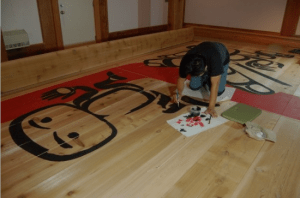
Dean Heron at work in the longhouse

When the longhouse is complete, Heron plans to continue carving his own work. In addition, “I have lots of images that I’d like to get printed.” He would also like to begin doing clothing designs, and learning jewelry-making.

Dedicating himself to art and moving into a community that was strange to him was a huge gamble, but Heron clearly feels that it has paid off for him.

“Growing up, I always felt that I was at the front door, but not right inside – always looking through the window and looking at these sculptures and not understanding the whole of them. I mean, I still don’t. And I think that’s part of the experience of being adopted and being First Nations. I’m at the point now where I’m straddling two different cultures, really. I have a non-first Nations family, so I’m getting an outsider’s point of view, but now I’m living in the community and understanding a lot more of it.”

Read Full Post »

« Newer Posts - Older Posts »