Feeds:
Posts
Comments

Posts Tagged ‘Vancouver’

Well, that was unexpected.

Passing through downtown Vancouver yesterday on my last errands until the end of the Winter Olympics, I imagined I’d be affected by the games preparations in any number of ways. Not being a sports fan, I thought I might be offended by the waste. I might flee the crowds and the traffic prepared to be a hermit. I might be angry for the sake of the business owners who had to close down because the traffic restrictions mean that their staff can’t get in and they can’t get deliveries. I might even have been blown away by the spectacle and find myself looking forward to the games after all.

What I didn’t expect was to look around and feel that I had been dipped in tacky excess. Everything I saw was so over the top that it might have been orchestrated by Albert Speer.

The first thing that caught my eye were the banners covering a few of the buildings. Do we really need blowups of athletes six stories high? A Canadian flag ditto, covering most of two sides of a building? Boasts that the corporate owner of a building was an Olympic sponsor? Endless urgings to “Go, Canada, Go?”

Descend to the Skytrain stations, and the excess continued. So far as I can figure, three advertisers had each won the privilege of monopolizing a transit station, and responded by covering as much of their station as possible. At Granville, it was Coca Cola, at Burrard, Macdonald’s, and Acer Computers at Waterfront.

Junk food and cheap computers? How does Vanoc square these with the Olympic ideals of athleticism and excellence? And I wonder who first imagined that repeated the same half dozen ads fifty or sixty times in a confined space was effective advertising, instead of an annoyance.

And everywhere, there were the officials and athletes from out of town, wearing their team uniforms that were not only gaudy but usually with the manufacturers’ names as large as the names of the country. Again, the connection to the Olympics eluded me. The out of towners were so gaudy that they might almost have been wearing Hawaiian shirts.

Yet the out of towners were restrained compared to some of the locals. Well over three-quarters were simply going about their Sunday business, but a minority were as gaudy as the out of towners and jingoistic as well, with Canadian flags flying from their cars and the marquees on their buses giving us a “Countdown to Gold” and urging Canadian athletes on. It was like the hockey playoffs, only on a larger scale.

A two year old might be fascinated by all the bright colors and larger-than-life consumerism, but it’s been a while since I was a child. Surrounded by such general tackiness, I could only complete my errands as fast as possible, and get out of the downtown. Except, perhaps, to see the Aboriginal Pavilion, I don’t plan on coming back until after the Olympics, when the city is back to itself.

Read Full Post »

When the news came that Vancouver would be hosting the 2010 Winter Olympics, I was jogging down from the Stadium-Chinatown Skytrain station to the Yaletown office where I was working. I didn’t hear the announcement, but I heard a cheer go up from the offices on all sounds of me.

Personally, I was surprised. At that point, I had no strong feelings about the Olympics one way or the other. But I had thought that the logistical problems of keeping people moving along the road between Vancouver and Whistler would prevent the bid from being successful. Even more importantly, my own contact with the bid committee hadn’t impressed me much.

About six months earlier, I had applied for a job as a writer on the bid. It wasn’t a position that strongly interested me, but I thought it worth a hour or two of my time to satisfy my curiosity. So, I duly strapped myself into my interview suit, stripped any obvious signs of eccentricity from my person, and presented myself at the Gastown office of the bid committee.

I was interviewed by two women who I quickly classified as marketing and communication workers. That isn’t prejudice; I’ve done similar work myself, after all. But, after a while, you get to know the signs. The two women talked in generalities, and displayed an artificial optimism and enthusiasm at all times. Somehow, I couldn’t imagine them taking part in a casual Friday.

Mostly, the conversation went well enough, so far as conversations during a job interview can ever be said to go well. But when I asked about how the logistical problems might be overcome, the women’s reply boiled down to, “Somehow, everything will work out..” I could also see that, in their minds (and probably on their clipboards), I had set a black mark against my name. That was all right; their replies had cost them points with me, too.

However, two other points were what really disturbed me. First, they said that working on the bid committee would be no guarantee of a continued job if the bid was successful. Since I was sure that the leaders of the committee would land jobs in Vanoc, that seems a lack of loyalty to staff members.

Secondly, as part of the interview, they asked me to go home and write seven or eight pages on how I would promote the Olympics. That is a considerable effort to ask someone to do on spec. Combined with the lack of a guarantee of continuation, I concluded that the request showed a cavalier attitude towards employees. I thought for a couple of days, then phoned the interviewers to say that I would not be responding to their request and that the job no longer interested me.

I have no idea whether those particular women found work with Vanoc. I no longer even remember their names. But it seems to me that their attitudes are echoed in everything I’ve heard from Vanoc ever since, from the feeling that problems would work themselves out to the assumption that local residents will put their lives on hold for the duration of the games next month.

It is not an echo that promotes happy thoughts about how the games will be organized and what the after-effects will be. Frankly, it has kept me from supporting the games ever since. I might talk about the financial and social costs, but behind them is an emotional core of distrust based on this one brief encounter.

This attitude puzzles people from outside the Vancouver area. When I was in Calgary last spring, people were surprised by my lack of enthusiasm. Remembering the Calgary games twenty years and the very different social attitudes in which they took place, everyone assumed that I must be looking forward to the occasion. They were surprised by my lack of enthusiasm, even when I explained my reasons. I’m not sure they ever did understand.

However, I don’t think my attitude is unique in anything other than its origins. No doubt it’s the company I keep, but I’ve found that only one in four – or thereabouts – actually supports the upcoming games. The intial cheering at the news of the bid just doesn’t seem to have lasted.

In fact, I’ve only found one person who defended the games with any passion, and her criticisms were bizarre – she argued that nobody who objected or even questioned the games should use the newly improved highway to Whistler (never mind that she also insisted on the official line that such improvements were not part of the costs of the games). But of eight or nine people in the store, nobody felt like taking her side in the discussion.

Maybe more people will show enthusiasm as the games approach, but, I don’t expect that most people will. The average person in the Vancouver region seems resigned to the games, largely indifferent and if anything mildly hostile, although you wouldn’t know that from the media.

You might say that, for most of us, 2010 will be divided into two parts: enduring the preparations and the games themselves, and the rest of the year. And, like most people, I find myself looking forward to the rest of the year far more than the preparations and the games. If I became dubious earlier than others, it is because I was exposed to the spirit of the games earlier than others.

Read Full Post »

Northwest Coast art has a new medium. It’s called forton, and it’s a mixture of gypsum, fiberglass and plastics, and has the advantages of being non-toxic, lightweight, weather resistant, and capable of imitating anything from marble to plaster or bronze. So far, you can see the largest collection of sculptures in forton in Vancouver at the Douglas Reynolds Gallery, including one cast from James Hart’s Celebration of Bill Reid pole that was officially presented to the public on December 5.

The Celebration of Bill Reid pole is a permanent fixture at the Bill Reid Gallery in downtown Vancouver. Carved by James Hart with the help of Ernest Swanson, Tyson Brown, Carl Hart, and GwaLiga Hart, the pole is topped by a raven whose chest is a stylized version of Bill Reid’s face. Through the Douglas Reynolds Gallery, eighteen copies of the raven are being made in forton – six imitating plaster, and 12 bronze, including three artist proofs.

Hart spoke briefly at the launch, arriving after the crowd had already gathered and was well into the buffet and wine. A tall man with long gray hair, he wore a bright Guatemalan jacket and carried a string of trade beads in his hands that someone gave him as he came in the door. He walked with a stoop and a slight hesitation. As he stood halfway up the stairs in the gallery, he was surprisingly soft-spoken for a well-known artist who is also a chief.

Hart spoke briefly about the pole and its intent to honor Bill Reid. He explained that he not only learned carving from Reid, but how to survive in the city, including such details as how to use an elevator, something he had rarely encountered in his rural youth. Turning to the plaster raven in the corner, he emphasized that it was a white raven, a representation of the trickster before he stole the moon and was singed black in his effort to escape with it through the smoke hole.

Afterwards, I managed to talk briefly to him as he mingled with the crowd. He said that the project was his first effort to work in forton, and that he liked the way it could be carved and was resistant to weather. He also expressed his enthusiasm for the new medium and designs that younger artists from all the local first nations were developing the traditional art forms.

Until the new raven cast, most of the works in forton that I’ve seen were done by Don Yeoman at the Douglas Reynolds Gallery. However, Reynolds mentioned the side of a house in Whistler that recently had several dozen forton panels added to one side, and I suspect that any artists who encounter it are likely to be as interested in it as Hart seemed to be.

One look at the cast and you can understand why. Made from a mold of the cedar original, the pseudo-plaster cast picks up so much detail that you can actually see the wood grain and tool marks in it. With forton offering so many benefits and no drawbacks so far as I can discover, I strongly suspect that, just as local first nations artists adopted to argillite a century and half ago and glass in the last few decades, many are going to seize on forton as yet another medium for their work.

Read Full Post »

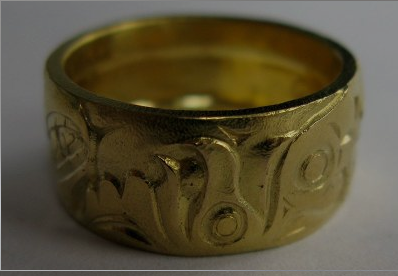
One way that you know an artist is talented is when other artists are eager for their work. Gwaai Edenshaw is in that enviable position among the Northwest Coast artists who live in Vancouver. A some-time botanist and Bill Reid’s last apprentice, he works largely in gold, although he has been known to sketch, carve wood, and even experiment with animation. Having admired his work since we first saw it, Trish and I recently celebrated our anniversary by buying two of his rings.

Mine is based on an episode in “Raven Traveling,” the Haida narrative of the Trickster’s wanderings near the beginning of time. On the beach, the raven encounters a group of crows. They begin to cook a salmon. The raven falls asleep, but the crows can’t wait for him to wake, and devour the salmon. Belatedly, they realize that the raven will be angry when he rouses, so they take the remaining crumbs of salmon, and wedge them between his teeth. When the raven wakes, hungry for his meal, they point out the crumbs and ask, “Don’t you remember? You ate it before you went to sleep.” Angry at the deception, Raven throws the crows into the fire, turning them forever from white to black.

I appreciate the story for its broad humor, as well as its extrapolation from nature; crows really do mob ravens, especially when their young are in the nest. If crows could play practical jokes on ravens, they undoubtedly would. Also, the story is not one of the ones that is generally depicted, like raven’s stealing of the light, or even his theft of the salmon from the beavers.

I suggested the subject to Edenshaw, and waited with all the patience that anticipation would allow for six months until he had time to get to it.

The result was more than worth the wait. Edenshaw chose a style that fits the humor of the story, showing the raven with his beak open and crows rollicking around him, pushing the crumbs of salmon into his mouth and their beaks open in excitement, no doubt chortling with glee at the thought of putting one over on their rival.

Since the raven has teeth in the story, and the Haida storytellers must have had plenty of chances to notice that birds have none, I assume that he must have been in human form when he met the crows. However, the fact that Edenshaw chose to show the raven as a bird with teeth in his beak does not detract, any more than the teeth in the beak of the parrot in Aladdin. It is a comic touch, and the result is reminiscent of the lively cartoons that you see in the margins of medieval manuscripts. I especially like the mischievous crow that is pushing a piece of salmon along the raven’s back (You can see the crow’s beak just behind the top of the raven’s head).

At the same time, I appreciate the economy and skill with which Edenshaw rendered the story. Like a business card (only more so), a ring provides a very limited space for depicting anything, yet Edenshaw manages to focus on the main event of the story, while selectively choosing details so that, while the feathers on raven’s head are not visible, the pieces of salmon clearly are. The detail is all the more amazing when you consider that the ring is cast, not engraved.

So far as I am concerned, Edenshaw produced a ring that is utterly unique, and wonderfully rich in humor and detail. After wearing it for several weeks, and having appreciated the small extra touches with which it was delivered (in a small wooden box, with the promise that the mold would be kept, in case the original was lost), I fully intend to buy more of Gwaai Edenshaw’s work. But if, as I suspect, his prices rise as he receives the recognition he deserves, at least we have a couple of samples of his work to console ourselves.

lm

Read Full Post »

One thing you can say about public transit: It may not be cheap or convenient, and you learn more about people’s personal hygiene than you ever wanted to know, but there’s nothing like it for people watching.

Sometimes, the people are just outlandish – and I say that as card-carrying eccentric myself. For instance, last weekend, a couple boarded the Skytrain walking very close together. He was tall, with a near beard and long hair and sun glasses. She was shabbily dressed, in kneeless jeans that only stayed up when she held a belt loop, and bobbing her head in a stoned sort of way to the tracks on her iPod. She also had an odor of at least two types of smoke and unwashed body trailing her like a shadow. Close inspection showed she was wearing a dog collar that was chained to his belt. Every now and again, he would give a little proprietary tug, not hard, but enough so that she would try to fix her eyes on him. I try to be broadminded, but if ever a couple needed to be told to rent a room, this one did. That’s not the sort of role-playing you expect to see in the middle of a Sunday afternoon.

But people on transit frequently reveal so much about themselves that they seem to be under the illusion that nobody around them can see or hear them. I remember one time when a young man got on at Metrotown looking distinctly lumpish. He was carrying a dozen coat hangers, and seemed to be wearing as many shirts and sweaters. I’d say he got on casually, if there wasn’t such a nervous edge to his casualness.

That attitude is especially common with people on cell phones. They talk as loudly as possible, until I’m tempted to clap at the end of their calls. One man even broke up with his lover in the middle of a crowded car I was riding in. “But I love you!” he keep saying, while embarrassment spread around him like a stain. After he left, I could see people relax, and several looked at each other and shook their heads.

It’s encounters like these that generated my first dictum about riding transit: Whatever you do, don’t make eye contact. The risk of having to make conversation with some of your fellow passengers is simply too high.

Read Full Post »

I appreciate Northwest Coast art for many reasons. It is semi-abstract, which always captures my imagination. It has a historical and sociological aspect, so I can combine intellectual and aesthetic interests. It is the art of my home, although not of my culture. But, sometimes, I think that my main reason for buying Northwest Coast art is that it is one of the few modern forms that remains largely unaffected by scholasticism.

By “scholasticism,” I refer to the modern trend in many of the arts for artists to be more interested in theories or concepts than in craft or any general audience. It is a trend that has occupied most of the twentieth century, and continues to prevail in the 21st. I’ve seen it first hand in poetry and literature, and it seems equally prevalent in music, painting, and dance. It is the approach that Tom Wolfe slammed, outrageously and a little unfairly in architecture when he wrote From Bauhaus to Our House.

Under scholasticism, what matters is the theory behind it. Before anything else, what interests the artists of scholasticism is demonstrating that they can put the theory into practice. Their work tends to be crammed with obscure references and in-jokes, and their talk is usually more about the theory than the work itself. It creates a vicious circle, with artists losing audiences because of their obscure practices, then retreating into even obscurer theory in reaction to the lack of audience.

While exceptions exist, Northwest Coast art seems largely free of such attitude. Beginners may be told to read Bill Holm to understand the mysteries of formline, but nobody reacts when someone breaks the alleged rules, or strikes out in a new direction, as the Salish artists have in the last few decades. Similarly, while many artists have experimented with the forms of modern art, few seem to become obsessed with the theories behind the forms.

Why Northwest Coast art has been spared this obsession is probably complex. But it is not because the art is in any way primitive, any more than Celtic knotwork is primitive. Such forms can be dismissed as primitive or romantic only to those who have not bothered to learn about them.

Nor is it naive. Many Northwest Coast artists are just as prone to in-jokes as any mainstream artists, but the difference is that the jokes are an extra layer of meaning, not the only one, nor even the most important one most of the time.

Nor does the reason has anything to do with the rigidity of change, or even the marketplace. For the last century and a half, Northwest Coast artists have seized on new media whenever they have had the chance. Argillite, glass, aluminum, canvas – each of these has been eagerly adopted as soon as it became available. The same is true of tools, from steel engraving tools to power tools. And, as often as not, the artists have begun work with new media and tools with only a few denouncements from their peers, people, or clients.

If anything, this versatility may have helped Northwest Coast artists take scholastic art in their stride. Although scholasticism is all about breaks with the past – often, the nosier the better – few Northwest Coast artists seem to consider new media, tools, or techniques a radical departure. This attitude has become very apparent in the Bill Reid Gallery’s current Continuum show, in which the curators’ efforts to start a dialog about the differences between traditional and contemporary first nations art has met with very limited success. Almost all the artists in the show make clear that they don’t see such an opposition.

Another reason for the freedom from scholasticism may be that, unlike modern mainstream artists, Northwest Coast artists tend not feel deracinated. Their art is not only an expression of their cultures, but a statement that their cultures are alive and thriving. Even those who did not grow up in their cultures generally feel an urge to know more about their origins as their art develops, and, for many in their communities, the success of Northwest Coast art is an obvious source of pride. Rediscovering and proclaiming their cultures, perhaps, is more than enough of an agenda to be going on with.
Not only that, but Northwest Coast art has genuine popularity, both among the first nations cultures of the coast and a small segment of the general art-buying public.

Admittedly, this popularity is not an unalloyed good. I have heard artists complain about being limited in their subject matter because something too esoteric won’t sell. Some artists, too, are tempted by the tourist trade, and start producing cheap curios rather than art. In addition, the popularity of the art form ties too many artists to the gallery system, and allows a handful of gallery owners far too much influence on what the public sees.

However, this popularity still gives Northwest Coast artists a huge advantage over their mainstream counterparts. Unlike mainstream artists, Northwest Coast artists know their work is appreciated – sometimes for the wrong reason, sometimes condescendingly, but appreciated all the same. Much of the public art in British Columbia is from the first nations, and, internationally, probably only art from the American Southwest is more eager sought after. In their own cultures, art is increasingly wanted for potlatches and ceremonial purposes.

Unlike many mainstream artists, Northwest Coast artists – even the most reclusive ones – have a dialogue with their audiences. They may not always like what they hear or agree with it, but they can still count on a degree of interest that mainstream artists can hardly imagine. So long as that interest remains, I suspect, it is hard to imagine scholasticism ever getting much of a hold in Northwest Coast art.

Why disengage and retreat into the cloisters when you have people who want to talk about your art? After all, that is what most artists want, even those who are most deeply into scholasticism – an audience that engages their work.

I used to wonder why mainstream art events so rarely included first nations artists in Vancouver. The communities seem very separate, even though a few people like Andrew Dexel or Sonny Assu seem to cross between them. The answer, I now believe, is that the two communities are so different that communication is difficult. Their approaches, attitudes, and perspectives are so much opposed to one another that the surprising thing is not that some Northwest Coast artists are exploring the mainstream. The surprising thing is that any have managed to do so at all. But, apparently, Northwest Coast Arti is in such a healthy state that it can even absorb attitudes that are opposite to its core assumptions without any real difficulty.

Read Full Post »

This afternoon, I heard Tlingit artist Nicholas Galanin speak at the Bill Reid Gallery. His talk was my first prolonged exposure to concept art applied to Northwest Coast art. I came away stimulated, but not particularly sympathetic to the effort.

Galanin is the latest of several generations of artists, and has done some jewelry in the traditional style. However, at least for the time being, he is not especially interested in traditional art or culture. He talked about traditional art as being confined by the stereotypes imposed by a romantic view of first nations, and – rather tellingly – could not tell where he obtained a traditional song he used in a video, even though in coast cultures, rights in songs and their performance can be important pieces of property. [Note: Both Galanin and Sonny Assu tell me that it was not the traditional song whose source Galanin didn’t know, but a hiphop song that was part of the same work. See the comments below. I apologize for the error].

Instead, Galanin is more interested in exploring the First Nations as another ethnic minority within the dominant culture – in particular, how coastal images are bastardized and exploited by cheap imitations made in Asia for the tourist trade in the Northwest Coast. He discussed, for example, a series of masks he made out of pages of the Bible, talking about how he found it appropriate that the holy book of Christians, who suppressed shamanism, should be converted into a shaman mask. Galanin also talked other paper masks he had made and how they were masks by a first nations person that showed no signs of first nations culture.

Other projects he discussed involved embedding tourist-trade masks in a wall covered with wallpaper that depicted idealized pictures of 19th century life and another in which the same type of masks were covered in Chinoserie. In a pair of videos, he had a traditional dancer (or an approximation of one) and a modern dancer moving to the same traditional song. In yet another series of work, he gave his version of the highly idealized photos of Edward Curtis: naked women with masks added in a graphics editor.

Meanwhile, ten meters from the podium where he stood was his contribution to the Bill Reid Gallery’s Continuum show: A version of Bill Reid’s “Raven and First Men” rendered by a chainsaw. Galanin was seeing his version of the famous sculpture for the first time, because he had outsourced the work – as he does much of his work.

The outsourcing is a commentary on commercialism, but I also had the sense that for Galanin what matters is not the actual work so much as the concept. Apparently, he sees his role as that of impresario, rather than as an artist who necessarily creates works with his own hand.

Having been a grad student in an English department of a major university, I am tolerably well-versed in such approaches to art. Nor do I find anything in Galanin’s social commentary with which I disagree.

But I wonder if I am missing something, because I have never found this kind of concept art very compelling.

For one thing, it seems to have little room for something that is central to my own appreciation of art – the enjoyment of craft, of sheer artistic excellence. Part of this lack may be that it does not delve deeply into tradition, so it has no standards to judge skill by. But the major reason for the lack seems to be that, when you are making a comment, craft becomes unimportant or perhaps a distraction.

Moreover, when you are commenting on commercialism, too much craft is probably out of place. If anything, your message is stronger if an object shows a lack of craft.

This situation helps create another problem: most concept art, including Galanin’s, is like a symphony of a single note. If your ideal is the “well-made object” of Bill Reid’s aesthetics, then viewers can return to it many times, and even discover something new after the first viewing. In comparison, concept art seems simple and to offer few reasons to return to it. Once you have grasped the message – which is often simple enough that you can reduce it to a single sentence, or at least a rather short paragraph – nothing is left to appreciate. Concept art seems to be unambiguous and unsubtle by nature, and, consequently, not very interesting.

In this respect, it is interesting to compare Galanin’s chainsaw Bill Reid knockoff with Mike Dangeli’s ridicule mask, which is also in the Continuum show. Where Galanin’s “Raven and the First Immigrants” seems one-dimensional, Dangeli has reached into his cultural history to bring an old concept into the future: just as the ridicule masks of the past were public announcements of a wrong, so Dangeli’s is a declaration of the wrongs suffered from the first nations. Dangeli’s mask is every bit as social or political as Galanin’s sculpture, but where Galanin’s sculpture seems facile, Dangeli’s mask is ambiguous and complex. And I doubt it is a coincidence that Dangeli is throughly involved in preserving and reviving his culture while Galanin sounds like a typical deracinated intellectual.

But such issues are a matter of taste. Regardless of what I think of Galanin’s work, I have to admit that the very fact that it takes the form that it does illustrates the diversity of Northwest Coast art and proves it a living tradition. And that by itself, I suspect, is something of value.

Read Full Post »

I’m not looking forward to the 2010 Winter Olympics in Vancouver. I never watch sports, and I’m concerned about the costs, traffic, and the virtual declaration of martial law during the games. The fact that I once dreamed of being in the Olympics myself only makes me angrier at the travesty that they have become.

Still, I could almost reconcile myself to the games for the sake of all the First Nations art commissioned for them. Some of that art was on display this weekend at the Aboriginal Art Exhibition at Canada Place this weekend, and I thoroughly enjoyed it – even if the lack of organization at the event seems ominous if it is a foretaste of how the games themselves will be run.

Being appreciative of the commissioned art is something you can file under No-Brainer. I mean, what’s not to like about the art? There’re medals with Corrine Hunt designs, commemorative coins by Jody Broomfield. The snowboarding pavilion at Cypress Bowl will have a wall graced with a new work by Dean Heron. GM Place will have a new work by Alano Edzerza, Nat Bailey Stadium a new work by Aaron Nelson-Moody, and the list goes on and on.

After fumbling badly by making the symbol of the game the inukshuk – a symbol that has nothing to do with British Columbia, much less Vancouver – the games organizers have had the sense to commission locally, focusing on less established artists and on members of the Salish nation, whose territory the Vancouver venues are on. I understand that some 45 works of public art will be added to the Lower Mainland as a result of the games, and I consider that an unalloyed good.

Sadly, though, the Olympic organizers fumbled again in their first efforts to bring most of these works to the public. The display was almost completely unpublicized except for newspaper stories just before the event and some Internet transmission. Even then, it was called an exhibition, so that most people arrived unaware that most of the work on display was for sale – an oversight that bitterly disappointed the artists who had taken tables and paid the exorbitant prices charged for parking at Canada Place.

Even worse, the management of the event was haphazard. I heard artists complain that they were unable to set up for credit or debit cards, and the rumor was that the one bank machine in the exhibit hall required a substantial surcharge to use.

And perhaps the worst thing was that, in order to fill up the hall, the organizers seem to have let anyone exhibit who cared to pay for the table. As a result, many tables displayed tourist junk that did not belong in the same exhibit as the commissioned artists.

For me, the incompetence of the organizing was summed up by the sight of two singers on the stage gamely belting out songs to rows of empty chairs, and a snack bar that had closed down at least two hours before the end of the show. Meanwhile, the exhibitors were strolling around talking to each other.

Such poor planning undermines the celebration of the artists. My impression is that the exhibition organizers couldn’t have cared less if the artists were treated with respect.

Perhaps the organizers can learn, but if this is how they put on such a relatively small event, then we should expect chaos during the games themselves. I might be lured downtown to see the aboriginal market at the Queen Elizabeth Theatre, but I, for one, plan to spend the three weeks of the games bunkered down safely in Burnaby, far away from the insanity.

Read Full Post »

The other night, I woke in the early hours to the sound of coyotes howling. The howling is a thin quaver that seems to rise slowly through the sky then disappear, and I can think of others sounds that I would prefer to awaken me. But, once awake, I lay on my back with my hands behind my head enjoying the eeriness and the thrill that fluttered through me. I hadn’t heard them in months, and I was starting to think that the local pack had moved on.

Probably, I am a minority in my enjoyment of coyotes. Many people call them vermin. Others are convinced that coyotes will drag young children away, although that has only happened once or twice. Still more are angry because their cats or lapdogs have become the snack for a pack – although the real blame lies with their own irresponsible treatment of their pets.
But I figure that you have to expect that the wilderness is going to creep in one way or the other in an urban area, especially one so full of parks and trees as greater Vancouver. And when you live hard against a green belt as we do, then inevitably the occasional cougar or bear is going to stumble into someone’s back yard. Compared to such visitors, coyotes make good neighbors, going about their business while causing a minimum of fuss.

I used to hear them frequently at night, answering the sirens trailing from the nearby fire station. Sadly, that ended when a patch of woods a couple of blocks away was replaced by condos. However, they are frequent in the daylight. Once or twice, I’ve seen half-grown ones partly concealed by the bushes, but the adults put on a bold front, making so little fuss about walking down the street that at first you think they are stray dogs. Once, I even saw one passing through the middle of our townhouse development, ignoring the people and mostly unnoticed.

Several times, too, I’ve seen them on the sidewalk, sitting waiting for the flow of vehicles to change with the traffic light. I suppose they are watching the vehicles, not the light, but sometimes I am not so sure. The few times I’ve made eye contact with a coyote – from a safe distance, let me assure you – I’ve wondered afterwards if it was a sentient creature evaluating the level of threat I represented. After those experiences, I’m not quite prepared to rule out the possibility that some of them know which light it is safe to cross the street on, even though they are presumably as color-blind as dogs.

Coyotes are not creatures of beauty. If anything, they are scrawny things, living lives of desperation. Still, I admire them for being a part of the wilderness that can adopt to the city. I sometimes think that urban life is an isolated one that leads everyone to imagine that they can control everything about their lives. As the coyotes slip from park to park throughout the urban sprawl, eating our garbage and denning in greenbelts in the ravines of creeks, they disprove such ideas with a quiet disdain.

Their continued experience shows that, no matter how we try to isolate ourselves, we cannot deny nature. Despite all the radical changes to their environment, despite the way they are hunted, coyotes still survive. And I, for one, appreciate their casual upsetting of all our assumptions about ourselves and our cities.

Read Full Post »

The Bill Reid Gallery kicked off a series of talks about artists from its Continuum exhibit with a slide show by Michael Dangeli, a Nisga’a artist who has started to receive recognition in the last few years. The choice was lucky or inspired, because Dangeli is more articulate about his work than most artists, and has clearly thought carefully about what he is doing.

The Continuum show is supposed to be about the conflict between traditional and contemporary influences in Northwest Coast art. And, in fact, Dangeli was introduced in terms of this conflict. However, he immediately made clear that he rejects such a dichotomy in his own work. Calling his work “traditionally contemporary,” Dangeli made clear that he considers his work a continuity of the past, both an attempt to reclaim it and to expand and to adopt it.

One reason why Dangeli is comfortable with the paradox of living with opposites is that he sees the rest of his life in such terms. Nisga’a by birth, he has lived in the United States and Vancouver, far from his nation’s territory. Deeply interested in his cultural past, he is also aware that he is a modern urbanite in his day to day life. Spiritually inclined, he is also a veteran of two tours of duty abroad in the American military. With such tensions, those between the traditional and contemporary must seem like just one more.

Another reason that Dangeli can have the attitudes he does is probably the fact that he is actively involved in the cultural revival of his people – something that seems especially unusual for an urbanite. During his discussion, Dangeli talked of pieces of art being given as payment for services, and at potlatches, as well as important events such as a betrothal. He talked, too, of being groomed to take over a chieftainship, and of his hesitation about taking on an even larger chieftainship recently. He talked about his dancing, and of acquiring songs and dances and inventing new ones, and of exploring the distinctions between male and female powers and responsibility with his finacee.

Unlike many First Nations artists, Dangeli seems either fortunate enough or determined enough to have lived with a sense of tradition from an early age. Consequently, it is easier for him than many artists to see a continuity rather than an opposition.

This continuity seems to affect his art very strongly. He talked of preferring that his gallery pieces not have eyes that would make them danceable, and of his relief when he managed to buy back an early exception to this preference. He talked, too, of making one of the first stone masks for well over a century, and having it danced.

But the strongest evidence of his artistic continuity came at the end of his talked, when he uncovered three pieces of his work that are reserved for ceremonial purposes: The mask he bought back and modified with a pieced of Ainu cloth; the stone mask, and a frontlet worn by his fiancee. He explained that he generally kept them covered, and treated them as living spirits, requesting that people look them over a few at a time so as not to overwhelm them. It was unclear to me whether any power in the objects was innate or resided in the respect shown to them, but his attitude was curiously moving.

Even if you didn’t share his cultural background or beliefs, they were obviously alive for him – either never having died or after being carefully revived, or some combination of the two. Clearly, he had fought hard to make them meaningful to himself and those around him, and I believe that he has largely succeeded. At the very least, he demonstrated to the audience that his cultures were still ongoing and hadn’t stopped developing with the European conquest.

All this says nothing directly about his work, which ranges from the traditional to the modern, with a variety of color palettes and a frequent emphasis on collaborations with other artists – or “brothers,” as he called them.

I have liked what I’ve seen of Dangeli’s work in the past, and, by the time he had finished talking, I had a much clearer sense of why, and an increased interest in what he might do in the future. And, really, what more can you ask of an artist’s talk? With several dozen slides and intelligent commentary, Dangeli sets a high standard for the next speakers in the series to match.

Read Full Post »

« Newer Posts - Older Posts »