Feeds:
Posts
Comments

Archive for the ‘art appreciation’ Category

You don’t have to dig very deeply into Northwest Coast art to stumble across a representation of Raven stealing the light from the chest where its owner has cached it. Whether you’re looking at a print, a piece of jewelry or a sculpture, in any gallery, you have an almost certain chance of finding a representation of the myth. In many ways, the story is to modern Northwest Coast art what the crucifixion or a Madonna and child were to the Italian Renaissance – a standard subject that most artists tackle sooner or later. That’s why Bill Hudson’s “Raven Opens the Box of Daylight” tickled our sense of humor so much that an artist’s proof of the cartoon was under our Christmas tree this year.

Bill Hudson is the spouse of Clarissa Hudson, the Tlingit weaver and painter. From what I’ve seen, much of his own work is more mainstream and includes a good deal of commercial and theatrical design. However, some of his work shows a Northwest Coast influence, including a poster he did for the twentieth anniversary of the Alaska Folk Festival that shows Raven, human with a mask for a head, wrapped in a robe of his own feathers and strumming a balalaika.

What I like about Hudson’s cartoon is the way that he has reduced a myth from the dawn of creation to a modern, mundane scene around a breakfast table, complete with orange juice and toaster. Far from being a great treasure, the light is contained in a commercial cereal box. It’s a good-natured but hilarious comment on just how common the story is; I’ve described the piece to several Northwest Coast artists, and all of them have understood the point immediately.

At the same time, Hudson has paid close attention to detail. Outside the window, you’ll notice, the stars and moon are visible, since in any form, the story predates the sun. Also, the raven’s feathers are not just black, as ninety-nine out of a hundred people would describe them, but tinted with a dark blue, as a raven’s feathers actually are. I appreciate such close attention to detail in what, for all its satire, is essentially a slight piece – so much so, that I have started paying closer attention to the rest of Hudson’s work, on the grounds that anyone who takes such pains is (at the very least) a thorough-going professional.
box-of-daylight-small

Read Full Post »

During today’s Christmas shopping expedition, I witnessed a short scene that taught me something about my concepts of artistry.

I was in a local gallery dedicated to Inuit and Northwest Coast art. A well-known First Nations artist was working in the back, refurbishing the cedar braid on one of his works in the gallery, and doing the same for the work of his son, who is an artist in his own right, and has been for some years now.

While he was working, he looked at one of his son’s carvings. “I don’t know why he finished that with a rope,” he muttered in disgust, seeing that the rope was nylon. A few minutes later, he muttered, “And why did he use such big nails to hold it in?” As he complained to himself, he was stripping off the rope and replacing it with bundles of cedar branches.

The artist was unquestionably right in his aesthetic judgment: His son’s carving was greatly improved by the removal of the rope and its replacement with cedar bundles. Still, I found myself reacting simultaneously in two different ways.

One part of me was reflecting ruefully and with some amusement how hard it must be to study under your father, and to have him improving your work even after you are recognized as a artist yourself.

At the same time, another part of me was shocked. Like most people in modern industrial culture, I tend to view art as an individual form of expression. From this perspective, correcting another artist’s work is unacceptable, a form of aesthetic hostility and violation that seems even worse than physical harm. It is also lying to the audience, who pay expecting a work by one author, but actually get a pastiche. The fact that most audience members will never realize the switch doesn’t matter; they are still not getting what they paid for.

But, when I reflect more deeply, it’s really nothing new. I remember having the same reaction when I learned that various members of a group of writers I once knew would happily pitch in and finish each others’ work to help meet a deadline or to add a level of expertise that the person whose name would be on the cover couldn’t provide. For them, it was a sensible thing to do, especially since some of them shared a house. By volunteering their anonymous services, they were helping to ensure that the taxes and utilities would be paid.

Moreover, similar helping hands have been extended for centuries by masters to apprentices. I know, too, that many of the carvings attributed to Bill Reid were partly a collaboration, with Reid providing the design skills and other members of the team providing the carving skill. So my shock is hardly a valid reaction.

What matters, I keep telling myself, is the finished work of art. Could it really be considered a lesser piece if another artist than the accredited one contributed to it? Logically, that would be an absurd point to defend.

I suspect that my reaction shows that I am unlikely to enjoy collaboration on any of my own efforts – a fact that I might have also deduced from my uneasiness at being edited, even when the editing improves my work.

Read Full Post »

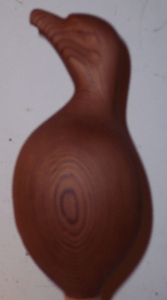
Ron Telek, the Nisga’a carver, can always be counted on for the unexpected – anything from the disturbingly haunting to the eerily beautiful, and in every form imaginable. I’ve even seen a shaman marionette by him. Our latest acquisition, “Transformation Rattle: Eagle to Wolf” is no exception. Only a handful of other Northwest Coast artists could take a utilitarian object like a rattle and turn it into a sculpture while keeping it functional.whole-small

One of the characteristics I’m starting to associate with Telek’s pieces is an unusual degree of three-dimensional awareness in the design. Like many of his pieces, “Transformation Rattle” is impossible to capture fully with a single photo. I took five pictures for our records, and I’m not sure that I shouldn’t have taken a sixth to cover it fully.

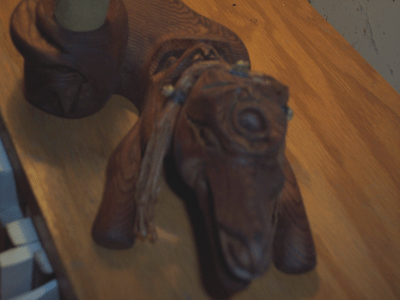
The rattle consists of two parts: The rattle, which is the eagle, and the rattle’s base, a lean-looking wolf with a curved tail and, around its neck, a garland of cedar boughs. The rattle rests inside the tail, and can be removed from it. At first glance, you are lucky to notice that it’s a functional rattle. Your first clue is the leather wrapped around the bird’s tail as a hand grip, but even that could simply be part of the surreal sculpture.

The rattle depicts the transformation perhaps two-thirds of the way through. On the right side, the bird’s features are depicted fully, but the left side of the body is mostly blank, with the features indicated by a few indentations, and the wing by the grain of the wood.

smooth-side-eagle-small

Its feet, too, are gone, absorbed into the wolf. Perhaps to indicate the transformation’s incompleteness, the bird’s wing is wrapped around its rounded stomach, as though it is pregnant with itself.

finished-side-eagle-small

The wolf is more complete, but its lack of claws and teeth or fully-formed rear legs shows that it, too, is an unfinished figure. wolf-small

Its thinness and slightly rough carving, especially in the comparison with the eagle further suggests the wolf’s incompleteness – and, perhaps, the energy expended to make the transformation.

The fact that the two figures are the same is suggested by the spirit in the middle of the eagle’s right wing and atop the wolf’s head. Furthermore, the wolf’s garland of cedar suggests that this is not a born wolf, but a human – no doubt a shaman – going through these transformations. Supporting this idea is the much larger, more human-looking spirit erupting from the wolf’s back, as well as the fact that, if you look closely, the rear legs are more human than wolf-like.wolf-front-small

All this complexity is heightened by Telek’s characteristic attention to the direction of the grain. An employee at the Art of Man Gallery in Victoria told me last week that Telek often carves down until he finds the grain he wants, and, looking at “Transformation Rattle,” I have no trouble believing it. Although both the rattle and its base is carved from a single piece of red cedar (and stop and think about the difficulty of that for a moment), the carving is literally never against the grain. Even on the wolf’s curving tail, the grain moves with the sculpture. And, on the eagle, the round pattern of the grain not only suggests the bird’s body, but creates a semi-abstract form as simple as it is beautiful.

The overall result is a contrast with the tall, rounded shape of the eagle, and the ground-hugging, angular shape of the wolf. It’s an accomplished piece of work, which I’ve place on top the shelves on my computer desk, where I can look up at it periodically, or even take the rattle out for a shake if I feel like it. We’re seriously thinking of mounting it on a lazy susan, so that it can be viewed in its entirety more easily. Meanwhile, I’ve already switched its position around several times in the day since we brought it home so I can admire another aspect of it.

Read Full Post »

Not too many years ago, you only had to walk down Government Street in Victoria to find more shops selling Northwest Coast art than you could properly absorb in a day. Looking back, I’m not sure of the quality of some of the shops, but they were there. But times are harder, with many store fronts along Government empty, and now you have to search for galleries.

Descending on Victoria yesterday, these are the galleries we managed to find:

  • Art of Man: Located in the mall in the basis of the Empress Hotel, the Art of Man specializes in Inuit and First Nations masks and sculpture. The pieces for sale included four or five from Ron Telek, including a meter high blue shaman (this from an artist who rarely uses color), and a shaman marionette fending off a spirit attacking his foot with other spirits resting in his hand. Daryl Baker, the nephew of the LaFortune brothers Doug, Perry, and Aubrey, is also represented by highly-detailed designs that border on the surreal, and that are all marked by a close attention to finishing details. The Art of Man also seems to get first pick of Tim Paul’s work – so much so that I realize that only his lesser pieces reach Vancouver. Other artists whose work is available at this gallery are John and Luke Marston, whose work shows an awareness of history that I had never realized before that it possessed. In general, the quality of the work at the Art of Man is extremely high, making it by far the premier gallery of Northwest Coast art in downtown Victoria.
  • Hill’s Native Art: Like the Vancouver store, the Victoria Hills is mainly a tourist shop. However, the Victoria store seems to have a slightly better ratio of art to high-end tourist pieces, as though it gets first choice of all the locations. But perhaps this impression is due partly to the fact that it is less crowded and better lit.
  • Alcheringa Gallery: From the web site, I had the impression that this gallery was huge. The reality, though, is that this is a gallery with only a few of its pieces on display – and about half of those are given to works from Papua New Guinea, which is worth seeing, but doesn’t engage my interest the way that the Northwest Coast tradition does. Still, you can see some works by Tim Paul and John Marston there. I was also interested in seeing two works I had seen on the Internet, one by Ron Telek and another by Dean Heron.
  • Pacific Editions: Unfortunately, this story is closed on Mondays, which meant that we walked six blocks out of our way for nothing. But what we could see through the window confirmed the impression I had from the web site: Pacific Prints has a huge collection of limited editions prints. I look forward to spending a happy few hours there the next time I’m in Victoria.
  • Eagle Feather Gallery: A mixture of art and tourist pieces, this gallery is only a block from the Empress Hotel – but on a side street that you may have trouble finding. It specializes in the work of Doug, Perry, and Aubrey LaFortune, especially Doug (in fact, he was due to drop by the day that we visited, although we missed him). Daryl Baker and Pat Amos also have a couple of pieces, while Francis Dick has at least a dozen 2-D works from throughout his career at the gallery. Whether the gallery is worth a visit probably depends on your opinions of these artists, although its stock gives you a good opportunity of evaluating Doug LaFortune thoroughly.
  • Out of the Mist Gallery: This gallery specializes in antiques. Its modern selection is devoted largely to the Hunt family, and includes a few curios like a mask carved by Richard Hunt when he was a teenager, a formal, somewhat stiff print from the start of Beau Dick’s career, and a two meter-long eagle by Roy Henry Vickers. The quality of the antiques is completely indiscriminate, and includes some pieces from across North America. If your taste runs to antiques in Northwest Coast art, you could probably find something to your taste, but the somewhat dim lightning and the bored staff makes the effort hardly seem worthwhile.

As with previous lists I’ve made of galleries, this one makes no effort to be comprehensive. We did not, for instance, have to visit the Provincial Museum’s gift shop, which I seem to remember as having a few art pieces. So if you know of any other galleries in the Victoria area that might be worth a visit, please add a comment and let me know.

Read Full Post »

Around the turn of the millennium, the Haida clothes designer Dorothy Grant had a shop in the Sinclair Center in downtown Vancouver. When she moved, we lost track of her. But I noticed her at a lecture a few days ago at the Bill Reid Gallery, where she was flashing a pair of earring by Gwaai Edenshaw, and yesterday we made a point of dropping by her new store and studio just off Broadway and Main.

Grant’s downtown store felt like a small clothing boutique, differing from countless of others only in her designs and impeccable tailoring. Her new location feels more like a work space; you go down a hall into a retail space, but the activity seems to be taking place either in the studio and meeting place up the stairs or the work area on the other side of it. The entire area is dedicated with art from Grant’s personal collection: A mask by Beau Dick, a print by Robert Davidson, a glass box by Alano Edzerza, and some recent glass plaques by Grant herself (which leaves no doubt that she could have become a gallery artist rather than an applied artist, had she chosen).

The location is open to the public, but you have to ring for entry, perhaps a reflection of the fact that the space is in the middle of an industrial area that, while not seedy, has probably seen better days.

Or perhaps the locked door reflects that this is more a work space than a retail outlet. It certainly seemed so during our visit, with Grant planning with a couple of other people (for a photo shoot, I think), and only stopping briefly to greet us in the friendly and energetic way that, from the little that I’ve seen, appears to be her most common public persona.

Whether you are female or male, you could easily drop a few thousand dollars going through Grants’ racks. But that few thousand would be exceptionally well-spent, especially compared to what you would get elsewhere for the same price in terms of cut and sturdiness of material, let alone the designs. And if you can’t afford that sort of money, you can still find blouses, shirts and jackets for a few hundred dollars, some of which will be heavily discounted if you arrive at the right time of year.

Even as an old-married, I can’t really speak to Grant’s line for women, although nine years ago I bought several blouses and vests as presents. But, from a male perspective, Grant’s line is a relief from mediocrity. Most men’s clothing is drab and unimaginative, and the most you can hope from more upscale offerings is better tailoring. But Northwest Coast designs are one of the few options for men who want a bit of flamboyance without being inappropriately dressed or having to fend off taunts about their sexuality (the sort that are supposed to be jokes but aren’t, if you know what I mean). And Grant’s simple, but bold designs are works of art in themselves that lend an elegance that nobody would dare to question.

Personally, I have arranged my life so that I only need a suit – much less a tuxedo – only for marriages and funeral. However, if I ever did, Grant’s versions of either, with designs on the lapels on one side would reconcile me to the uncomfortable garments. I might still feel uncomfortable wearing them, but at least I would know that I was artistically and well-dressed, and perhaps signaling to the world that I was indvidualistic, if not outright eccentric.

My life being as it is, I will settle for buying two or three buttoned shirts or polo shirts from the store – and I don’t especially like polo shirts.

I did succumb to a light black jacket with an eagle design on the back and a raven wing design on the left arm. Julie, the store manager insisted that I could carry off the look, and a survey of my image in the mirror suggested she was right. A look at the price tag reinforced her view, so I left with a different jacket than the one that was on me when I came in.

“That will bring all the ladies to you,” she said as we were leaving. I started to mutter about how little good that would be for me as a married man when an old customer arrived wearing a similar jacket.

She turned to him for reinforcement of her claim. He agreed, and called after me, “Better stay away from my part of town, man!”

I’ve looked in a mirror. Given the human material that the jacket has to work with, I remain dubious of Julie’s claims. All the same, I’m sure that I’ll return to Dorothy Grants’ the next time that I want well-made clothes with a bit of flare. When we have so much Northwest Coast art on our walls, why shouldn’t I be wearing some as well?

Read Full Post »

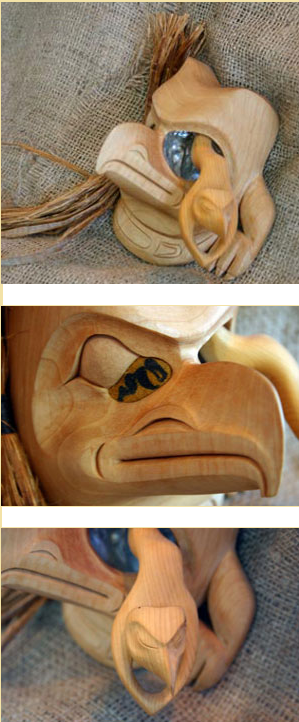
As I go through Northwest Coast galleries and web sites, one of the things I am always looking for are miniatures masks – ones under about eight inches in height. We have several wall areas – mostly above doors – that are too small for anything else. Even more importantly, a miniature is a sign of a carvers’ skill. Yet I don’t see many worth buying, perhaps because miniatures tend to be either student pieces or ones designed for the tourist trade, and experienced carvers cannot charge enough for their time to produce many. As a result, I was especially pleased when I noticed that Ron Telek’s “Transformation Mask: Human to Eagle” had come back on to the market. It’s an unusually fine miniature that shows his customary skill and imagination.

How the mask came from Terrace to Vancouver and I picked it up at the South Terminal of the Vancouver airport (which was not, to my disappointment a foggy runway used by single prop planes like something out of Casablanca) doesn’t matter. Enough to say that it did, and I did, and the mask now resides at the busiest crossroads in the hallway of our townhouse.

What makes the mask so haunting is its ambiguity. Although a human is turning into an eagle, the dominant face is more of an eagle’s. From the left eye, whose socket is lined with abalone, a human shape with a bird’s head seems to diving. Or so it appears; if you look at how the spirit’s head and arms are arranged, you’ll notice that they suggest another beak. You have to wonder, too, if the shape is the departing human soul or, given the deepness of the eye socket, if the transformation is being achieved by the plucking out of an eye.

Then, if you look at the right eye, you’ll notice that it is bare wood. However, in the eye’s lower third, like a cataract, is a piece of leather with a small shape that resembles the one leaving the left eye. Does that mean that the transformation is all in the eye of the imagination and not literal? That the transformation, or the need for it is based on faulty vision and understanding? Or is it a supreme act of will?

Also, despite the title of the mask, what dominates is a largely bird-like face with a full beak and one taloned foot where its left ear should be. So who is transforming into what? Perhaps the transformation is of the human into the form of his helper spirit or true self. Certainly, the bird face seems serene, perhaps even amused to judge by the line of its mouth on the beak. It is the human spirit that seems in pain or exaltation. By contrast, the eagle seems more stoic and less affected by the transformation. Perhaps for the eagle’s nature, transformation is natural, and it is the human spirit that finds passing from one form to the other uncomfortable.

These ambiguities make for an asymmetrical design – something that is relatively common in Northwest Coast art, but which is part of the foundation of modern mainstream design. By showing elements of both, the mask increases its ambiguity even further. To a certain extent, the asymmetry is reduced by the long cedar braid on the right, but the mask remains, like the figure it represents, halfway between two different states.

In the end, you can say so little about the mask that the uncertainty adds to its fascination. The only thing that you can say for sure about the mask is that it is finished with Telek’s usual attention to detail.

I don’t know why the previous owner decided to sell the mask, but I’m glad he did. Unlike the previous owner, we don’t plan to let it out of our hands. We wonder, though, where we will find other miniatures to match its complexity.

telek-human-eagle

Read Full Post »

In the last few weeks, I’ve realized that my fascination with Northwest Coast art goes back further than I originally thought.

When I was seven or eight, I was mad for mythology. I started with Greek and Roman mythology, and, before I was ten, I’d worked steadily through Egyptian, Norse and every other coherent set of tales that I could get my hands on.

Part of that mix was various North American First Nation tales, and, most of all, stories from the Northwest Coast. All myth fascinated me indiscriminately, but Northwest Coast myth was special, even in the fragmented retellings for children that were – and still are – the most common form of presentation. Unlike the other mythologies, they were about places I had seen, or at least could travel to in a day or two.

That gave them a special interest and grounding in reality that even the Greek and Norse myths – my other two favorites – could never hope to match.

One off-shoot of this interest was that, while at four I was dressing up as a cowboy with chaps and cap guns, four years later I was pleased at souvenirs that included a bamboo spear with a rubber point, and a Plains-style headdress that draped my face with artificial raccoon tails. Watching westerns, I started cheering for the Indians. They had imaginative mythologies, and the cowboys had none.

At about ten, I also started buying my first pieces of art: souvenir totem poles made in Japan and China. Even then, I knew that their straight lines and garish colors showed no real knowledge of what they were representing, and that they shouldn’t be sold alongside tipis, but, so far as I knew, they were all that were available. Better, to my childish mind, an inadequate souvenir than none at all.

My aesthetic sense took a slight turn upward when my father brought home a raven graphic he had designed at work to go on the panels of a phone booth for some special event. It was a simple design, black and white, with the raven’s head turned to the right and the wings and feet symmetrical. I suspect now that it was copied from some other design, since so far as I know, my father had no interest in Northwest design. Probably, it showed no more understanding of form than another special booth he did for Vancouver Chinatown, in which his efforts to improve the characters ended up making them illegible, but it did include authentic U-shapes and ovoids, however unimaginatively they were depicted. I loved it, displaying first a version on cardboard then one on plastic for years in my bedroom.

Enough interest remained that when Trish and I went shopping for engagement rings, we quickly dubbed the conventional ones tacky and unimaginative and went shopping for Northwest Coast designs. People laugh now when we tell them that we bought our engagement rings at the Vancouver Museum and Planetarium, but, back then, the first Northwest Coast art galleries hadn’t appeared, and you could buy Bill Reid and Roy Vickers limited edition prints in the gift shop, as well as high quality silver jewelry.

Unfortunately, in those days, we weren’t much interested in the names of the artists, and now, years of daily wear have effaced the signatures inside – to say nothing of much of the detail of the designs.

Over the next few years, we bought a few limited edition prints, including one by Clarence Wells and several by Richard Hunt, and always we were thrilled to afford some real art (the memory of those souvenir totem poles were haunting me with embarrassment). But our purchases became fewer and fewer over the years, partly because of periods of poverty and partly because other interests and priorities intervened.

Then, well-sunk in middle-age, I realized that I could finally afford the bracelet I had always wanted – and did so. Within a few months, my old interest came rushing back. I started frequenting galleries. Looking at the prints on our walls, I found many of them formal and fussy compared to what was being done today. I began reading the available information about the myths, finding it hard to track down and almost as incomplete as the retellings I had read as a child, but tantalized all the same.

Now, as I write, the art-fever is on my more fiercely than ever. I suppose that the interest will taper off eventually, but maybe not — no sooner can we afford a modest piece than it seems that two or three others worth having hove into our attention. But, far from being a recent whim or interest, it’s really an interest that goes back to the days of my earliest literacy and imaginative awakening.

Read Full Post »

After several months of down payments, we’ve added the first mask to our collection of Northwest Coast art: “Spirit Moon Mask” by Ron Joseph Telek.

Telek is a great original – perhaps the great original in Northwest Coast art today. Inspired, they say, by a car accident in which he was legally dead for a few minutes, his work is largely concerned with images of transformation and shamanism. While his work obviously comes out of the northern tradition in British Columbia, it breaks with the tradition as much as it keeps it.

His work is quirky, asymmetrical, and fully of little details, and often more than a little disturbing. I’d call it the carved or sculpted equivalent of a Gothic novel – a dark, romantic, and highly individualistic style. Others have called him the first surrealist of the Northwest Coast, and likened some of his more disturbing images to Edvard Munch’s “The Scream.”

His imagination alone would make him one of the top carvers and sculptors on the coast today, but Telek is also a painstaking craftsman, much like his uncle Norman Tait, whom he once studied under. Like Tait, Telek is a master of using the grain of the wood to enhance his subject matter.

The same is true when he turns to other materials – there is a walrus tusk he did a couple of years back languishing in a Vancouver gallery which is so eeriely beautiful that it had to be moved further away from another piece of ivory so as not to outshine it.

Another characteristic of Telek’s work is that, in contrast to what might almost seem his imaginative excess, his finishing details are always meticulous and restrained – you won’t find any tarting up of a mask with rings of unmatched abalone or endless cascades of horse hair in Telek’s work, the way you do in less talented artists. And you never do see paint, which other artists sometimes cake on to hide defects. Like Tait, if Telek adds a finishing detail, it’s for effect.

And if all this wasn’t enough, Telek’s imagination seems endless. Other artists may have periods in their development, in which work after work resembles each other, but Telek’s periods don’t seem to last for more than a piece or two before he moves on to something new. Possibly, this restlessness works against him in the galleries, where many buyers want something familiar, but, I prefer to think of it as one more sign of an inventive and agile mind.

“Spirit Moon Mask” is one of Telek’s smaller, tamer pieces, but it strikes an interesting balance between tradition and the west coast contemporary style of architecture. But the type of odd details that make his other work so lively are there. The wall-eye, the bit of abalone that could either be a nose-piercing or a wound, the strained-looking cheekbones, the arms of the spirit rising from the moon that look like tentacles, the spirit’s arched back and round-mouthed scream — for such a simple piece, the number of unusual touches crammed into the mask is overwhelming.

Since our townhouse is small, we had been thinking of limiting ourselves to one work by each artist who attracted our attention. But, already, we are talking about making an exception in Telek’s case. Perhaps, too, we’ll save for eight or nine months and buy one of his really big works, even if we have to rent the townhouse next door to display it properly. Frankly, we’re hooked.

Read Full Post »

At times, I’m not sure whether I’m a romantic or a skeptic. On the one hand, I love popular legends and mythology. On the other hand, I love efforts at debunking. Was Richard III the victim of propaganda after his death? Did Benjamin Franklin pass information to the British? Was Bonnie Prince Charlie a semi-literate sot who guzzled his way through the 1745 Rebellion? Topics like this always fascinate me, even when they fail to convince. For that reason, I find Maria Tippett’s Bill Reid: The Making of an Indian endlessly fascinating, even when it seems dubious or exaggerated.

If you don’t live in Canada, particularly in British Columbia, you might not know why Bill Reid is a subject for debunking. Briefly, Bill Reid was a jeweler and a sculptor working in the Northwest Coast tradition. He is generally considered the chief figure in the renaissance of Northwest Coast art, and the major Canadian artist of the late 20th Century, with his work on the back of the Canadian $20 bill and one of his sculptures on display at the Canadian embassy in Washington. Ten years after his death, he remains so admired that if an artist, gallery owner or collector of Northwest Coast art refers to “Bill” with no surname, they are referring to Bill Reid — a touching and clear indication of his ongoing importance.

Tippett clearly admires Reid’s work, and its fusion of European and First Nations sensibilities. However, she also states that Reid was bipolar, and – on very little evidence – that he was sexually promiscuous and adulterous. More importantly, she suggests that it is wrong to see him as the sole instigator of the Northwest Coast art revival, and that, especially in the last years of his life, he carefully crafted his own image as an Indian to further his career (hence the title).

These claims were greeted with outrage by a number of reviewers when the book was first published four years ago; a review in the Georgia Straight, for example, referred to the book’s “slash-and-burn” approach to its subject. In the end, though, it is surprising how little her claims actually matter. Regardless of their truth or falsehood, even Tippett cannot deny Reid’s importance as an artist.

Personally, however, I wish that Tippett had balanced her claims more, and, in places, elaborated on them. A man struggling with mixed European and First Nations ancestry in the mid-20th century, and later with Parkinson’s disease has every right to depression and moodiness. As for her claims about his sex life, they are based to a large extent on hearsay, and, not really the concern of anyone except Reid and his wives. I suppose the claims have to be there for the sake of completeness, but they have little to do with his art, which is almost completely void of the sexual elements in 19th Century Northwest Coast art.

Similarly, it is true that other artists were keeping the tradition alive when Bill Reid began his career. However, to imply as Tippett seems to that the tradition would have its present popularity without him seems absurd. True, artists like Ellen Neel and Mungo Martin were active in the 1950s, but to suggest that they could have sparked the current interest without Reid seems questionable; he developed into a first-rate talent who influenced dozens, and Neel and Martin were second-rate at best. Might-have-beens are endless, but, without Reid, the tradition would probably not be nearly as popular as it is today. Even artists of the excellence of Robert Davidson and Norman Tait might not have been able to promote it, not because they are any less talented than Reid – they’re not – but because they lack Reid’s flare for self-promotion.

But self-promotion, of course, is something that artists are not supposed to engage in, according to many outsiders. Apparently, they are somehow truer to their craft if they live in poverty. And Tippett seems to share this self-righteous puritanism in full measure – if anything, she seems more shocked that Reid should cleverly promote himself than that he should sleep around. She reacts with a cynical naivety, using anti-Indian statements by Reid from earlier years to create the impression that his political activism in his last active years was a calculated marketing decision. She does not consider the possibility that marketing can be based on honesty, much less than Reid’s adoption of a First Nations identity may have been a resolution to his life-long conflict about who he was.

Still, better a debunking book that lacks generosity than a hagiography that ignores its subjects’ faults. Tippett could argue her case better, but, even if her interpretation is faulty she at least presents a portrayal of a human being – and one whose faults, real or imagined, don’t change his importance in the least.

Read Full Post »

As I wrote a few months ago, how a building is used can create an atmosphere. A hospital, for instance, nearly always make you uncomfortable, even if you are not involved in anything going on there. After thinking for a couple of weeks, I can think this same truism helps to explain the appeal of buying art.

For me, buying art is not an investment. Nor is it a hobby like collecting coins or stamps, in which you try to collect a complete set. Still less is it a sense of ownership; I firmly believe, for instance, that you should not buy art that you have no room to display properly, which is why we wouldn’t buy a Northwest Coast button blanket – even if we could afford it. We simply don’t have the fifty square feet of wall space to display one properly.
Instead, buying art is an effort – a slow, piece by piece one, in our case – to transform the atmosphere of our living space. Consciously or unconsciously, everyone does something similar if they live in one place long enough.

But, in most cases, furnishings are chosen because they are comforting or show an awareness of the latest trend. You find very few people, even interior designers, who create rooms that are a bold statement of personality or aspirations.

About the closest you usually get to such a declaration are the people who buy an antique house and spend years living with sawdust and the noise of construction until they have refurbished it into as close a replica of the original as modern tastes can stand. In effect, such people make the house itself a work of art.

Living in a townhouse, I’m not in a position to do that. Nor do I have the tolerance for breathing dust and living with table saws and lathes for years on end. But, what I can do is decorate my living space with what I think is the most inspirational or provocative art that I can afford.

Some of the art that we have bought or hoped to buy is not comfortable – some of it makes people whose idea of decorating is pretty pictures very uneasy. But what it all has in common is that it is the product of the human mind at its best, If some of it is challenging, that is all the better, so far as I am concerned. I want to be challenged and inspired by the best as I go about my daily business. I don’t want merely pretty pictures.

In fact, I am convinced that you are better for surrounding yourself by art. Where a prison or a hospital upsets, art soothes and relaxes. It makes you more observant as, living with a piece day by day, you slowly unravel the secret of why it is a triumph of design. It also, I find, inspires you to live up to it, not only in little ways, like trying to keep the place neater so it is a suitable environment for the art, but also in large ways by challenging you to do your best in your work or pastimes, to make yourself worthy of your surroundings.

That is why those who think that art is only the concern of a small elite, as well as those who mistake art for fashion are both wrong. Art, like exercise, is good for everybody, and you can’t replace excellence with conformity. Really, it’s as simple as that.

Read Full Post »

« Newer Posts - Older Posts »