Feeds:
Posts
Comments

Archive for the ‘art’ Category

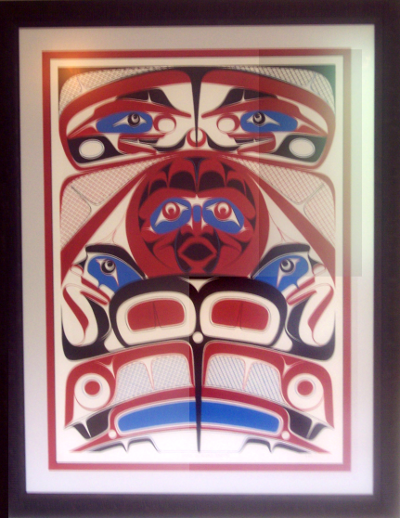
Six weeks ago, Haida/Tsimshian artist Mitch Adams and his wife Diana were in Vancouver on a selling expedition. We sat on the shaded porch of a Starbucks, and Mitch unwrapped the pieces he hoped to sell to one of the galleries. They included a variety of pipes (“They’ll make you look taller! Cooler!” Mitch claimed), several miniature masks carved from ebony, and a couple of sculptures I would have bought on the spot if I’d had the money. Then Mitch brought out a framed painting from the back of the car.

I remembered the painting. I’d seen it when I was in Terrace the previous April, sitting at the back of Mitch’s workshop. It was a design that he had done while a student at the Freda Diesing School. An injury had left him temporarily unable to carve, so, rather than sit idle (or more like, kibbitzing with the other students, if I know anything), he began to do designs on paper.

At the time, I asked him if he would sell it, but he was unsure of the price, and I had enough to carry back on the plane already. “Throw it in the trunk next time you come to Vancouver,” I said, but, to be honest, I’d forgot all about the piece until I saw it again. However, once I got over my surprise, I was happy to buy it.

As you might guess from the story about its origin, “Haida Box Design” is a formal exercise, but no less interesting for that. Like Celtic knotwork, abstract Northwest Coast designs fascinate me in their intricacy. When you know a bit about the artistic tradition, you can appreciate the breakdown of the figures in a series of basic shapes, each of which is varied by such details as how the thickening of the formlines where they meet is minimized, or the designs inside the U-shapes. At its best, the result is a strong sense of individualism within a detailed tradition – which is certainly the case here.

Adams’ individual touches are numerous. To start with, rather than designing primarily in black, he balances red and black almost perfectly. The design puts round shapes, rather than the more common ovoids, in the center where they can hardly be missed. Many of the lines are straight, rather than curved, as you would expect in most designs on paper, although that would make them ideal for carving. Tapering of the lines is minimal, and Adams makes wider use of thin lines than most artists would.

However, what fascinates me most about the design is how, despite being symmetrical, it manages to avoid some of the stiffness usually associated with symmetry – especially to a modern eye, trained to consider asymmetry of design the norm. Day after day as I’ve done my morning stretching exercises, I’ve watched the piece and considered the elements that undermine the potential symmetry.

First, there’s the easy interchange of figure and ground between the black and red that changes depending on what you focus on. Then there’s the mild variation of rounded shapes in the center of the design. Most of all, however, what really offsets the symmetry are the shapes positioned on an angle.

All things considered, I’m tempted to say that I’d appreciate seeing “Haida Box” design carved in yellow cedar and painted. The only thing that keeps me from doing so is the fear that, the next time we meet, Mitch will present me with exactly that, and I won’t be able to resist pulling out the cash to buy.

Read Full Post »

Twice in the last few weeks, I have been asked for advice about picture framing. Each time, the requests surprised me, because matching a frame to a picture is such an exacting exercise that I don’t think of myself as an expert. However, I have framed nearly three dozen prints and canvases in the last four years, so on second thoughts I must have picked up a few basic ideas.

My first advice to anyone framing a picture is: keep it simple. Anything you like well enough to frame is probably going to be around much longer than your current furniture – plenty of time for you to get bored with something elaborate, and for anything trendy to date itself. So, unless you are decorating a room like an 18th century boudoir, forget the gilt frames that are half as thick as the picture. You are far less likely to grow tired of a plain black frame or one of stained wood.

After all, the whole point of a frame is to accent the picture, not to call attention to itself. If you notice the frame as much the picture, you’ve made the wrong choice.

In choosing the frame, try to match a dominant color in the picture. If, for example, the picture has a blue background, consider a blue frame. If there is a hint of metal in the picture, then consider a metal frame rather than a wood one. When the picture is colorful, either go with a plain frame, or, at the most, a frame with a barely noticeable line of color that picks up on a common color in the picture.

In general, the smaller the picture, the thinner the frame should be. A canvas that is “museum-finished” – that is, painted on the sides (a reference to the times when artists were expected to provide their own frames and wanted to save the expense) – need not be framed at all, although it will usually look more finished if you do. Other canvases often have a deep frame, with the canvas resting about halfway from the bottom.

For a print or a painting on paper, you will often want a matting, or even a double matting between the frame and the picture. The matting needs to complement both, and choosing between the dozens of shades of an appropriate color for exactly the right one can be demanding. You need to consider the width of each matting, as well as which is on top of which, and, occasionally, if the matting should be some other shape than square. Usually, part of the picture is concealed by the matting, which is why white space is so important, but a picture with a ragged edge may float on top of the matting instead. Canvases generally do not use matting, although paintings on paper do.

The next consideration is the glass, unless the picture is on canvas. In some cases, you can save money by the glass you choose, but I generally prefer glass with ultra-violet protection. This glass is expensive, and usually mutes the picture’s colors, but if you think that you may ever change its position, you’ll be glad that you took the time to protect your painting from sunlight.

The combination of frames and matting are numerous, so expect to spend some time finding the exact ones. Twenty minutes or half an hour are not unusual for the decision, especially when you are not used to it, so don’t expect framing to be something you rush in and do in a few minutes. Take the time to do it right, and you’ll enjoy your picture more over the years.

Oh, and one final piece of advice: Don’t attempt to frame a picture yourself. For one thing, if you’re like most people, you don’t have the tools to do so. For another, hobby stores and do-it-yourself framing stores (which mercifully are far less common than they used to be) generally don’t have the selection of frames and matting to help you make the most suitable choice. Going to a professional framer won’t cost you that much more, and you’ll likely be more satisfied with the results.

In Vancouver, I use either Framagraphics or Kent Picture Framing. In other cities, ask the gallery or store where you bought who they use for their framing. – if professionals employ a framer, chances are you can safely use them, too.

Read Full Post »

When I was in Terrace last April, I returned with two artist proofs from Jared “Citizen” Kane, a young First Nations artist who affects hip-hop clothes and attitudes. Both these works – one entitled simply “Moon” and the other “Love Birds” – interested me as examples of what computer-assisted art does easily and what it struggles with in Northwest Coast art.

Both these pieces are based on popular images. Neither image is claimed by a particular family, so artists can use them without being accused of appropriating someone else’s property. “Moon” is a successful blending of the traditional crescent of the moon with a more modern sketch of a face, while “Love Birds” combines a traditional split image with lightly concealed heart-shapes of European origin. “Moon” is striking for its simplicity, “Love Bird” for its intricacy, as well as for the placement of a central T-shape with foreshortened arms that could be interpreted as either male or female genitals, but both are identifiable at a glance as being designed on the computer.

I spend far too much time on a computer myself to see anything wrong with making art on the computer. The days are long past when people objected to pole makers rough-shaping the wood with chainsaws, and computers seem to me nothing more than another way that artists can make their work easier.

However, the idea of computer-assisted art remains far from generally accepted in Northwest Coast Art. In the case of several established artists who dislike the very idea, part of the reaction may be due to their own lack of computer literacy. However, they will add that they consider computer-assisted art lacking in warmth and individualism. But artists like Alano Edzerza have shown the possibility of bold, original works designed on the computer. And, really, the idea is no different from the manual templates used by some artists on the coast for over two centuries.

Still, computer-assisted art generally leaves its mark. Like many of the pieces created since Bill Holm in the 1960s codified the conventions of the northern formline tradition, it emphasizes geometry and symmetry in a way that traditional art did only part of the time. It is not so much that a piece like Kane’s “Moon” adds an unnecessary line to create a complete circle instead of a crescent, but that each of the ovoids, U-forms, and other shapes has a single template. Graphics software allows these templates to be scaled and rotated, or even distorted, but they remain obviously based on the same source.

In addition, because the templates are available, computer-generated designs tend to be less varied in general. In formline design, part of the craft is how the thickness of the formlilne changes according to the need of the design. Look, for example, at the work of Todd Stephens, a Terrace-based Nisga’a artist, and you will see that the broadest formline can be up to ten times that of the thinnest, which is often as thin as single brushstroke can make it. By contrast, in Kane’s “Love Bird,” the difference is may be four times.

Another place for variation in formline design is the variety of techniques for avoiding too much thickening of the line where two formlines meet. These techniques can include thinning the tips of one or both lines, or adding a T-shape or some other element in the middle of the two lines to thin out the filled space between them. Kane uses both techniques, but the thinning is minimal in both pieces, and he uses fewer varieties of techniques than many manual artists.

Although I suppose that in theory there is no reason that artists working on a computer could not make asymmetrical designs (which were a much larger part of the local traditions than is sometimes credited in these post-Holm days), or vary technique more, in practice they seldom do. The natural tendency is against both asymmetry and variation and for consistency. There is nothing wrong with this tendency, but it means that computer-assisted design is more likely to be bold rather than nuanced and varied. Even the relative intricacy of “Love Birds” looks far less detailed and more striking than a hand-drawn similar design, like Shawn Aster‘s “Raven Heart,”) another piece on display in my townhouse.

In general, though, Kane makes the computer work for him rather than against him, producing designs that almost insist on being enlarged, and, in “Love Birds,” adding more variation than many artists who have attempted to work on the computer. In the future, I’m going to keep my eye out for what he is designing – manually as well as on the computer.

Read Full Post »

As a current director of the YVR Art Foundation, I first saw the work of Coast Salish artist Cody LeCoy as part of his successful scholarship applications in 2011 and 2012. I was immediately struck by his impressionistic technique and surreal composition, as well as the thickness of the acrylic paint on his canvases. Buying one of his works was only a matter of waiting for the right canvas. The canvas turned out to be “Ridicule Mask,” which was hanging in the Lattimer Gallery.

Like the potlatch, the ridicule mask is one of the unique customs of many First Nations in the Pacific Northwest. When someone of high rank behaved improperly – for instance, by destroying goods in a display of pride and greed instead of distributing them – a ridicule mask would be displayed until they made retribution.

Often, ridicule masks show a half-ruined face, referring to a story of one chieftain who, in destroying oolichan grease – a form of wealth – in an effort to outdo rivals, badly burned himself. His injuries are considered a just punishment for his boastfulness and pride.

Modern first nations artists have often used the concept of the ridicule mask creatively. For example, several years ago in the Continuum exhibit at the Bill Reid Gallery, Mike Dangeli presented a ridicule mask whose subject was the treatment of the first nations by modern society.

However, LeCoy’s painting is more personal. Asked to comment on the painting, he emailed back that the painting was about “the idea of wealth coming from what is given away rather than what is hoarded. The main theme of the painting is awareness of one’s self to know the value of gifting, and to recognize thoughts and behaviors within – hopefully before others catch on – where greed can lurk around the corner.”

In other words, LeCoy makes the ridicule mask a private warning to avoid greed, instead of the traditional public shaming – a re-interpretation, perhaps, that highlights one of the differences between traditional and modern ways of life.

The split between ideal and incorrect behavior is seen throughout “Ridicule Mask.” On the left are unbalanced faces, divided vertically and horizontally. But where on a traditional mask, the division would be clearly defined, on canvas LeCoy can have them overlap, which makes their relationship even more psychologically ominous. In the middle are images of traditional ceremonies – specifically, the potlatch – which was the traditional mechanism for spreading wealth among the community and preventing hoarding by offering status and respect in return for generosity. The canvas ends on the right with an old growth tree that towers above the other figures, contrasting with the ridicule mask faces on the left and suggesting that the sharing of talents is what is natural.

These figures are reinforced by the mixed palette, which LeCoy describes as a mixture of “stagnancy and rejuvenation.” The stagnant colors, he writes, “represent the decay of something that is hoarded for one’s self. The original vitality of something (an object, an idea) goes stale if [it is only used] as a means of personal gain.” By contrast, the images of the potlatch are more brightly colored, and sky beside the tree is blue. However, in all sections of the painting, the colors are mixed, the bright colors highlighting the stagnant colors on the left, and darker colors creeping in between the color images in the rest of the canvas, as though to suggest that the two opposites are never far apart and, perhaps, only exist in relation to each other.

At twenty-three, LeCoy is still a young artist. For this reason, it is possible to see the influences of other artists in his work. Several people with whom I have discussed “Ridicule Mask” suggest that its surrealism is the influence of Lawrence Paul Yuxweluptun, LeCoy’s mentor for his YVR Art Foundation Scholarships. Similarly, the tree on the right is strongly reminiscent of Emily Carr.

Yet if such influences are visible, they are combined with elements that are LeCoy’s own. The crowded canvas is saved from chaos by solid composition; mentally subtract the raven mask in the top center, for example, and the entire painting falls apart. Similarly, in the brush work with its mixture of colors and thickness of paint, LeCoy creates a sense of restlessness and variety that gives his work an originality that proves that he is an artist to watch.

I look forward to watching LeCoy’s talents develop. I suspect that, while “Ridicule Mask” is the first painting of his that I’ve bought, it won’t be the last.

Read Full Post »

Twenty-years ago, I happened to be in a gallery when a First Nations man was talking to the owner. He was selling copies of a relative’s work – his father, I believe he said. They were loosely rendered works in a style I had never seen before, and I was immediately intrigued. I bought two as birthday presents for my partner, although I had never heard of the artist, Henry Speck. Nor could I find any information about him aside from the fact that he was Kwakwaka’wakw. I concluded that he was a minor figure and that his relative had exaggerated his importance.

Last week, I finally learned more by visiting The Satellite Gallery’s small show, “Projections: The Paintings of Henry Speck, Udzi’stalis”. It turns out that Henry Speck was a Kwakwaka’wakw hereditary chief, fisherman, and artist. While he had been painting since the 1930s, his moment of greatest recognition came in 1964 when the New Design Gallery held an exhibition of his work – an exhibition that was almost unheard of for any First Nations artist at the time. Even Bill Reid, who could be scathingly scornful of anything non-Haida, acknowledged his work as “far beyond anything attempted before in Kwakiutl art” (although, strangely, Reid did not include Speck’s work in his seminal “Art of the Raven” exhibit in 1967).

In other words, Speck is one of the bridges between the decline in traditional First Nations culture and art in the early 1900s and the renaissance that began midway through the same century.

This current show hints more than once that Speck might be considered a modernist, and it is easy to see why. Surrealists and modern artists like Jackson Pollack have been fascinated by the masks and paintings of the Northwest Coast and their obvious sophistication, and have tried to give their impressions of what they saw – usually very poorly, since they had almost no understanding of the artistic traditions they were seeing.

To a degree, Speck’s work is equally impressionistic, obviously sketched in ink or paint, and without the close attention to exact lines and curves that you see in traditional artists today such as Richard Hunt. His work also has individual idiosyncrasies, such as using short parallel lines or rows of irregular circles to fill empty space that – so far as I know – have no antecedent in Kwakwaka’wakw art.

However, the difference between Speck and the mainstream surrealists and moderns is that Speck had at least some understanding of the traditions he was depicting. Consequently, while his art seems less disciplined than that of modern traditional artists, his work does not seem glaringly wrong or poorly-observed so much as individualistic. Like many recent First Nations artists, his work does not fall neatly into either the modern or traditionalist categories, but seems to contain elements of both.

The “Projections” show is disappointingly small, with no more than a dozen original pieces, none of which is larger than 16×20 inches. However, taking the lead from Bill Reid’s observation that Speck’s work seems unnaturally confined at these sizes, and would benefit from being much larger, “Projections” includes a large slide show based on the Speck collection at the Glenbow Museum in Calgary that partly compensates for the lack of originals. Not only was Reid quite right in his observation, but seeing Speck’s work on slides restores the often-faded colors of the originals.

Behind the screen for the slides is a loop of archival footage of Speck and his work. by modern standards, the film clips are often gratingly patronizing, as journalists try to adjust to the idea of a First Nations artist. Is it hard to work in the traditional art, they ask Speck, when as a modern man he can’t believe in what he is depicting, the way he might have a century ago? Does he see a conflict between his subject matter and his own Christianity? But Speck, although unassuming, is far from the naïve native that the journalists assume, and answers with more graciousness than his questioners had any right to expect.

“Projections” is a show that can be easily absorbed in seventy minutes, and I wish it was larger. Yet, even as it is, the show goes some ways towards to restoring Speck to the position he deserves in the history of local First Nations art. And, finally, I have the context for the copies I bought so many years ago.

Read Full Post »

I don’t know quite how it happened, but I was born into a Christian culture that has transformed into a post-Christian one. This change is a basic fact of my time, regardless of what I or anyone else thinks about it.

I am too young to remember fully Christian times. However, from what those a few years older than me say, when I was born, Christianity – or Protestantism, to be exact – was considered the default. Shortly before I was old enough to take an interest in such matters, the expectation was that any respectable man or woman would go to church on Sunday. If anyone wanted to succeed in business in a recognizable community, they made sure they attended regularly, and, if they were really ambitious, they became involved in their local church. Naturally, too, everybody was married in a church. Everybody knew the bible, too, or at least the stories in it.

These norms were so pervasive that I attended Sunday School at the United Church until I was about twelve, even though my mother was only moderately religious and my father an agnostic or atheist, who probably only attended holiday church services as a family outing

By the time I quit attending, I had absorbed that Catholics were an odd, barely tolerated sort of Christian, no better than the Christian Scientists that I passed on my way to Sunday School. I had encountered only one family of Jews, but I often wondered what made them so different. As for Sikhs or Hindus or Muslims, they were mostly a distant rumor to my young ears, but I understood that any I encountered were to be trusted only to the extent that they acted like good Protestants.

Even my grandfather, who I rarely saw be impolite to anyone, belonged to the Orange Lodge. Admittedly, in British Columbia, this was a much watered-down version of the organization that had been involved with religious violence in Ontario and was still in the middle of the chaos in Ireland. Yet my kind and gentle grandfather apparently believed that the mostly theoretical Catholics of the neighborhood needed opposing, because their loyalty to the Pope meant that they were denied religious freedom.

Looking back, I realize that things were already changing when I was a child. The minister, a pale man who always did his best to sound earnest, talked about social service and good causes as much as about Jesus – and never about hell. But the remnants of a Christian culture were still strong enough that few questioned them openly.

And now? When polled, a majority still will say they still believe in God. In the United States, people are still reluctant to vote for anyone who is an open atheist. Yet despite such hypocrisy, church attendance has sinking for over two decades. When morality is discussed, it is rarely in terms of the bible or Christianity, or any other religion. Asked on a census, many still call themselves Christians, but by their actions and attitudes, clearly Christianity does not steer their actions, and very few would be considered Christians by the standards of fifty years ago.

But probably the greatest sign that we are in a post-Christian world is that religious festivals such as Christmas and Easter have become secular holidays, and governments are careful not to endorse even a generic Christianity over any other religion. A few of the remaining devout Christians complain about these changes, citing the occasional excessive zeal of non-denominationalists as proof, but what they really seem to object to is the loss of any special status in the culture.

My own beliefs parallel these changes, since I have been agnostic since I was a young teen and drifting towards atheism ever since. If anything, I am more at home in the culture of my middle-age than I was in that of my youth. Generations younger than me seem to have caught up with my thinking as a young man.

At the same time, while decidedly a non-Christian, I am glad that I was lucky enough to be educated in its basic tenets. After all, no matter what I think of Christianity today, at one time it was an undeniable creative force.

How, I wonder, do those brought up entirely non-Christian appreciate the cathedrals of Europe without the understanding that they were physical prayers to God? How can they listen to Handel’s Messiah and understand how it develops? Or read the works of Christina Rossetti or Gerald Manley Hopkins, whose styles and phrasings were where they worked out their relationships with their deity?: Even great agnostics like George Eliot or Thomas Hardy make little sense without a thorough knowledge of Christianity, because their passing references and analogies draw upon the common Christian mythology. I would only be short-sighted and false if I attempted to deny that Christianity was a major influence on much of our cultural history.

Knowing Christianity, I have a sense of the continuity in my culture that most people no longer have. But, as for the decline of Christianity as the foundation of the culture – for that, I feel nothing except relief, tempered by only a mild ambiguity stirred by the cultural accomplishments of the past.

Read Full Post »

In April, I flew up to Terrace for the Freda Diesing School’s graduation show. I entered from one end of the modern longhouse where the exhibit was set up, and wound my way through the display panels and cases to the opposite end. As I rounded the last panel, Kelly Robinson’s “Nuxalk Box Design: Four Carpenters” caught my eye.
Immediately, I knew two things:

First, from the amount of red and the particular shade of blue, and the looseness (or non-existence) of formline, it was a Nuxalk piece.

Second, it was such an eye-catching piece that, if I could, I was taking it home with me. At the time, I already owned Robinson’s canvas, “Mother of Mischief,” but this was a contemporary piece that was, if anything, even more striking.

As things turned out, I didn’t take the painting home with me that weekend. I bought it, but both Robinson and I were worried that the glass might not survive the flight home, and that the painting might be damaged. As things were, it was only six weeks later, when a somewhat different version of the show was displayed by the Spirit Wrestler Gallery in Vancouver as Northern Exposure that I finally took delivery.

The Nuxalk, sometimes known as the Bella Coola (although not by them) are a nation about midway up the coast of British Columbia. Like the neighboring Heiltsuk and Haisla, their art shows hints of both the northern formline style and that of the Kwakwaka’wakw to the south, but with bold lines and colors that make it unique.

Unfortunately, Nuxalk art has not been extensively studied in comparison to, for instance, that of the Haida or Tsimshian. However, in the last half century of the local First Nations revival, the Nuxalk have never lacked for artists. My own familiarity with the style – such as it is – comes mainly from the Nuxalk who have graduated in the last few years from the Freda Diesing School, such as Latham Mack, Chaz Mack, and Lyle Mack, all of whom are related to Robinson.

Nuxalk mythology has been neglected by academics almost as much as the art. So far as we know, we have no transcriptions of how Nuxalk stories might have been told a hundred and fifty years ago. Nor has anyone collected the stories. But, from the little I know, the Nation has some unique traditions.

Foremost among these traditions are the Four Carpenters. These are the supernatural beings charged by Atquhtam the Creator to prepare the world for the Nuxalk. Sometimes, the Four Carpenters are loosely glossed as being arch-angels, but a better analogy is probably heroes like Prometheus, who are responsible for the foundations of culture.

If I have the stories correct, the Four Carpenters created the Sun, which is often depicted as a canoe, as a vehicle for the Atquhtam. By some accounts, the Four Carpenters created the Raven specifically to steal the light, as he does in other first nation cultures. But the Four Carpenters also designed the Nuxalk language, as well as the ceremonies and dances of each of the Nuxalk clan; each of the Carpenters may also be the founder of a clan. When they left Atquhtam’s house, they descended to earth on the sun’s eyelashes.

“Nuxalk Box Design: Four Carpenters” shows the subject surrounding the sun, with the bottom two, perhaps, starting to descend to the earth. As the name suggests, Robinson’s painting is a study for a design that might be painted or carved on a box. That description sounds like a formal, academic study, the kind of rigidly traditional work that might be done by a student artist, and there are, in face, objects in the painting such as the faces that remind me of other Nuxalk work I have seen. There is also a regular layout that suggests the careful measurement that might be expected in such an exercise.

At the same time, a strong sense of style is obvious at a glance. “Bold” was the first word that came to my mind when I first saw the painting, and it remains the best description I can think of. With the thickness of the red lines, it could almost be intended for a housefront ten metres long, and not just a box. And, while the painting may be generally symmetrical, the difference in positioning between the upper two and lower two Carpenters strikes me as a touch that a modern artist would be more likely to add than a traditional one, or one just learning the style.

Still another individual or modern element is the large amount of cross-hatching in the design. So much cross-hatching might appear in metal or wood, but from my limited knowledge seems rarer in Nuxalk painting. Perhaps, like many local First Nations artists today, Robinson has been influenced by other traditions of painting, such as the Tsimshian’s, which sometimes uses cross-hatching heavily.

I rate the painting as Robinson’s best to date, and have hung it in the living room, facing “Mother of Mischief” on the opposite the wall. I suspect that, on that fast-approaching day when I have so many paintings and prints that I need to rotate them on my wall, “Nuxalk Box Design: Four Carpenters” will be one of the few than hangs permanently.

Read Full Post »

The Nu-chu-nulth (formerly known as the Nootka and West Coast) were among the earliest First Nations to have contact with European explorers. Yet today, very few Nu-chu-nulth artists are well-known. I can think of Patrick Amos, Joe David, and Tim Paul, and have to do a web search to come up with any other names. This lack is unfortunate, because, while the Nu-chu-nulth sometimes work in the northern formline tradition, their art also includes at least one other – possibly two — schools of design that are unparallelled anywhere on the Northwest Coast.

For that reason alone, a few months ago when Kelly Robinson recently offered his “West Coast Wild Man” mask for sale, I was happy to add it to the works on the walls of my townhouse. But I was also glad to buy because the mask was not like anything I had ever seen before.

A 2012 graduate of the Freda Diesing School, Robinson has been selling his jewelry to galleries for several years. More recently, at the Northern Exposure show at the Spirit Wrestler Gallery, three of his four pieces sold within the first three hours of the show. He is also a skilled painter, and one of his canvases, “Mother of Mischief,” already hangs on my wall.

However, most of Robinson’s work is in the Nuxalk style. He has only occasionally explored the other side of his heritage and worked in the Nu-chu-nulth style, but if “West Coast Wild Man” is any indication, he could have a significant contribution to make to that tradition as well.

There are few references for Nu-chu-nulth stories, no matter what name you search under. I assume that the Nu-chu-nulth wild man has some similarities to the Bukwus of the neighboring Kwakwaka’wakw or possibly the Gagiid of the Haida. All three are often depicted with large hook noses and grimaces, and probably their symbolic taming was a feature of the midwinter dances in all three cultures.

Probably, though, the parallel is not exact. The Bukwus is a dwarf, often conceived as being dead, who tries to tempt the living into eating its ghost food so that he can carry them away. Often,  like the Gagiid, he is said to originate as a shipwrecked voyager.  The Nu-chu-nulth wild man seems to share these characteristics, since the culture often raised memorials of skulls to shipwrecked sailors, but almost certainly some of the other context is missing.

To even a casual observer, Robinson’s mask shows obvious signs of the Nu-chu-nulth style, with the inverted skull dangling below the chin, the straggling hair, and the unusually large eye sockets and relatively small eyes. Whether the hair, which resembles dreadlocks, is also traditional or Robinson’s own innovation, I am uncertain, but either way, the general influence is obvious when you compare the mask to the work of carvers like David or Paul.

However, if you continue the comparison, you will notice something else. If you search on the Internet, you will soon notice that David’s or Paul’s work has an air of historical re-creation. Both artists reach a high level of quality, but their work is little different from that done a century and a half ago in the same tradition.

There is nothing even mildly wrong with this choice, and I look forward someday to having works by both David or Paul around the house to enjoy. But, having trained with some of the leading woodworkers on the coast today at the Freda Diesing School – artists like Dempsey Bob, Stan Bevan, and Ken McNeil – Robinson is trying to do something more.

Consciously or unconsciously, Robinson is following his teachers, and thinking of his work as fine art. His use of both paint and abalone is restrained, and his wood is finished to modern standards. He also takes full advantage of the grain, shaping it to fit his carving. While obviously based on past Nu-chu-nulth tradition, the result is something that – so far as I am aware – no other Nu-chu-nulth artist has attempted. And what is even more important, Robinson succeeds, producing a work that is both contemporary and not quite like that of any other artist.

This originality – admirable in anyone, but especially so in such a comparatively young artist – is sensed almost immediately by anyone who views the mask. Robinson delivered the mask to me at the opening of the Northern Exposure show, and the first response of each of the half dozen people I showed the mask to responded was a sigh of wonder. “West Coast Wild Man” is an original work of unexpected power, and if Robinson can continue to meet the same high standards in other works, his future as a major artist on the coast seems assured.

Read Full Post »

Paintings have never been a large part of modern Northwest Coast Art. Since the 1960s, artists have preferred to release limited edition prints instead. Recently, though, this trend has shown signs of changing.

Ever since the 1960s, limited prints have been far more common than paintings. The reason is simple economics: A limited print costs the buyer anywhere from half to one-tenth the price of a painting, which pleases buyers not interested in an investment. If a run of a hundred can be sold, the artist makes much more than they would from a painting – enough, with luck, to allow them to earn a living from their art.

As a result, limited prints have long been the norm in Northwest Coast Art, despite the forgeries that have been periodically discovered. By contrast, artists interested in painting have often found selling their work to galleries difficult. A few exceptions exist, such as Robert Davidson in the last decade, but they are exceptions because of their fame.

A better indication of the status of paintings in Northwest Coast art is the fact that even an artist as accomplished as Lyle Wilson could only manage a show consisting entirely of paintings this year – and at least two-thirds of the pieces were completed decades ago and had never sold. Meanwhile, an artist’s first limited print is still seen as an important step in their career.

However, the days when prints could be counted on to fund an artist’s career are rapidly coming to an end. Hundreds are entering a market that once sustained dozens, thanks in part to the relative cheapness of producing a print from a computer compared to traditional silk screening.

Perhaps as a result, the average price of a print has declined or remained static, with many prints available for well under a hundred dollars unless the artist is well-known. Moreover, where, thirty-five years ago, so-called limited prints could have a release of five or six hundred copies, now releases of a hundred, or fifty, or even twenty have become common, partly to reduce forgery and partly to ensure that artists are not left with a large inventory of unsellable prints.

At the same time, Northwest Coast artists are more closely connected to other schools of art than they have been at any time in the last sixty years. Artists like Dean and Shawn Hunt have succeeded to some extent in selling canvases outside the usual Northwest Coast markets, and new artists – an increasing number of whom have attended art school – are becoming more interested in painting as well. In fact, I know several young artists who began working on canvas and only learned carving and metalwork later.

Whether on wood, paper, or canvas, painting has suddenly become semi-respectable. The Douglas Reynolds Gallery has been showing an increasing number of high-end paintings over the last couple years. Similarly, Lyle Wilson may have had to go to the suburb of Maple Ridge rather than downtown Vancouver to mount his recent Paint show, but the point is he managed to have the exhibit. And, as I write, I have just returned from the Lattimer Gallery’s opening reception for “medium: Painting on Canvas,” an exhibit of over fifteen canvases by both new and leading artists.

Slowly, painting is becoming acceptable in Northwest Coast art. It still has a ways to go – according to Peter Lattimer, for many of the artists in his exhibit, working on canvas was a new and not wholly comfortable experience. But the change is coming, all the same.

Most likely, painting will not replace limited prints. A handful of top artists are still doing well with limited prints, and will probably continue to do so for years. However, a day might come within the next decade when most limited prints are viewed as tourist wares and no longer as fine art.

Read Full Post »

When I travel to Terrace every April, I spend three days submerged in art. Not only is the Freda Diesing School’s graduation and year end exhibit my official excuse for the trip, but I meet other artists and view their works in progress. This year, one of those artists was Ivan Adams, a Haida carver doing some unique work in argillite.

Ivan Adams is the father of Mitch Adams, a middle-aged artist from whom I’ve bought half a dozen pieces in the last three years. Last year, I met Ivan over Sunday brunch, and several times Mitch has mentioned his father as an artist, but until this year, I had never seen any of his work.

This year, Mitch drove me up to his parent’s house, and we sat in their kitchen while his father showed what he was working on. The three or four pieces I saw were literally like nothing I had ever seen before.

They were not in the argillite style of the nineteenth century, nor were they the inlaid and embellished pieces that most modern argillite carvers favor. As Mitch said, Ivan’s work is a little reminiscent of some Inuit work, but the resemblance is mostly in the scenes of everyday life he favors, rather than the carving style.

What Ivan Adams is doing is a naturalistic, detailed style all his own. One piece is a bear with silver teeth rearing on two legs while a much small hunter attacks with a spear; the base comes apart so you can position each figure separately. Another is a legendary strong man straddling a bull sea-lion and tearing it apart with his bare hands, with the exposed muscle suggested by artfully positioned catlinite (reddish brown argillite). A smaller piece is an eagle, so ungainly that it suggests an archeopteryx. All the pieces I saw were obviously mature pieces, done by an artist with a strongly developed style of his own.

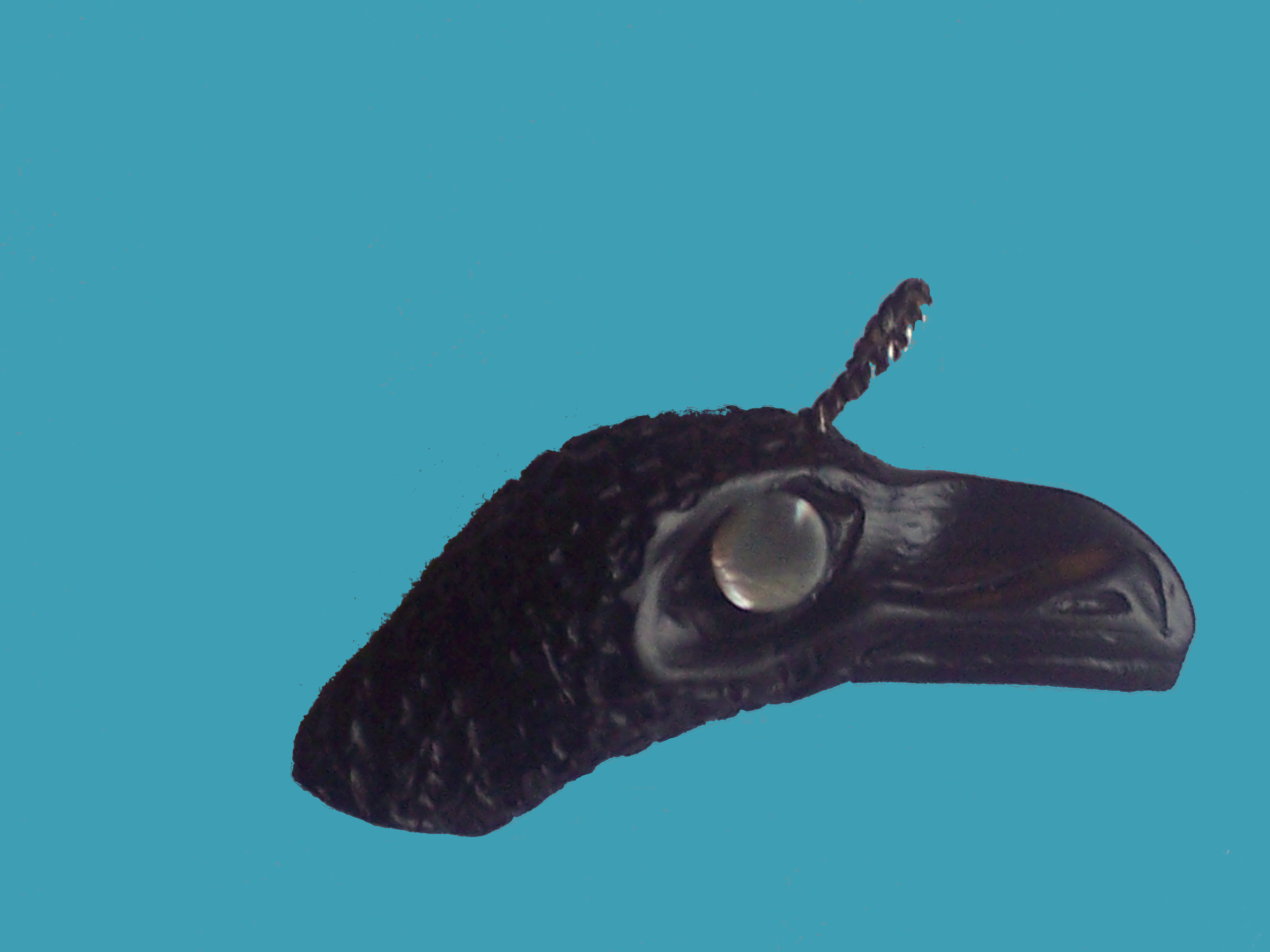
Unfortunately, I couldn’t afford one of Ivan Adams’ larger pieces. However, he also had a raven pendant about the size and thickness of my thumb, which I was pleased to take home with me as consolation.

I suspect the pendant was a left over piece of argillite whose shape suggested its subject. But, like Adams’ larger pieces,what makes the piece standout is the attention to detail. The shape of the beak and how the upper and lower beak fit together are absolutely accurate. Adams has even included the striations that make every raven’s beak as individual as human finger prints, and suggested the soft tissue that connects the lower beak to the body – even though that part of the carving is not seen when the pendant is hanging from a chain. Similarly, the off-white of the inlaid eyes is a close approximation of the natural color of some raven’s eyes.

Yet as if that were not enough, on the head and neck, Adams has indicated individual feathers. Most of these feathers are aligned in rows, but only roughly, with some out of alignment and skewed from the rest, and most of them not quite the same shape. On the top the head, too, the feathers grown smaller as they approach the beak. I have no idea whether Adams has observed live ravens or worked from pictures in a book or on the Internet, but the only way that the pendant does not closely reflect a living raven is that the argillite lacks the blue oil-like highlights of actual feathers.

Ivan Adams is not well-known, and you won’t find his work in any Vancouver or Victoria galleries – at least, not yet. But anyone who takes the pains he obviously does is an artist worth paying attention to. Perhaps one day I will be able to afford one of his larger pieces, but meanwhile the pendant is a very satisfactory consolation.

Read Full Post »

« Newer Posts - Older Posts »