Feeds:
Posts
Comments

Archive for the ‘British Columbia’ Category

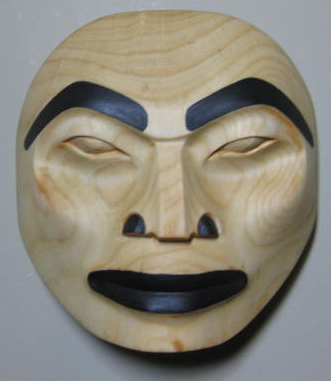
I first crossed paths with John Paul Wilson a year ago. Another artist wanted to send me pictures, and John agreed to take and send them. Since then, we have been in touch once or twice a week, and I have enjoyed watching his art move from promising to a first maturity. It is hardly surprising, then, that “Summer Moon Maskette” was under our Christmas tree this year.

The moon is a popular subject in Northwest Coast art. So far as I know, the moon is nobody’s crest, so the question of having permission to use it never arises. Perhaps just as importantly, it is a subject that requires no special knowledge of mythology to appreciate. Wilson himself describes the moon as one of his favorite subjects, and, if you look at his Flickr site, you can see several different ways that he has approached it.

What makes “Summer Moon Maskette” stand out is its simplicity. It has no complicated design, and no red, the second most important color in the northern style. Even the black paint is applied sparingly, being confined to the mouth, nostrils, and eyebrows, and not to the pupils.

This simplicity means that the piece’s carving stands out more than usual. Wilson has responded to this situation by carving with more realism than usual. He has shaped the mouth more, and made the nose fuller than usual on the sides. He has also given close attention to the cheekbones and the area where the nose, eyes, and eyebrows meet.

However, what really makes “Summer Moon Maskette” stand out is the eyes. Slanted, with an inner fold and no pupils, they are very different from most eyes in the northern style – so much so that I almost wonder if they are a portrait. They seem to be closed, suggesting a sleepiness that is appropriate to a hot summer night.

Another result of the simplicity is that, after the paint, most of what catches your eyes is the grain. Wilson has always excelled in sanding the grain until it conforms with the contours of his carving, but “Summer Moon Maskette” is an especially fine example of this practice. For example, if you look, you can see how the grain conforms to the line of the cheekbones and the forehead, or the hollow beneath the eyes. The effect is almost hypnotic in itself, relieved only by a small imperfection which is confined to the chin – and which is also a relief after your eye has been following the apparently billowing lines of the grain.

This simplicity is an indication of how far Wilson has advanced in his art. A less experienced artist would be tempted to tart up the mask with abalone or copper. By contrast, Wilson lets the maskette speak for itself, which makes it all the more powerful. That is a risky approach, but the fact Wilson succeeds is a measure of his advancing skill and confidence.

Read Full Post »

When the news came that Vancouver would be hosting the 2010 Winter Olympics, I was jogging down from the Stadium-Chinatown Skytrain station to the Yaletown office where I was working. I didn’t hear the announcement, but I heard a cheer go up from the offices on all sounds of me.

Personally, I was surprised. At that point, I had no strong feelings about the Olympics one way or the other. But I had thought that the logistical problems of keeping people moving along the road between Vancouver and Whistler would prevent the bid from being successful. Even more importantly, my own contact with the bid committee hadn’t impressed me much.

About six months earlier, I had applied for a job as a writer on the bid. It wasn’t a position that strongly interested me, but I thought it worth a hour or two of my time to satisfy my curiosity. So, I duly strapped myself into my interview suit, stripped any obvious signs of eccentricity from my person, and presented myself at the Gastown office of the bid committee.

I was interviewed by two women who I quickly classified as marketing and communication workers. That isn’t prejudice; I’ve done similar work myself, after all. But, after a while, you get to know the signs. The two women talked in generalities, and displayed an artificial optimism and enthusiasm at all times. Somehow, I couldn’t imagine them taking part in a casual Friday.

Mostly, the conversation went well enough, so far as conversations during a job interview can ever be said to go well. But when I asked about how the logistical problems might be overcome, the women’s reply boiled down to, “Somehow, everything will work out..” I could also see that, in their minds (and probably on their clipboards), I had set a black mark against my name. That was all right; their replies had cost them points with me, too.

However, two other points were what really disturbed me. First, they said that working on the bid committee would be no guarantee of a continued job if the bid was successful. Since I was sure that the leaders of the committee would land jobs in Vanoc, that seems a lack of loyalty to staff members.

Secondly, as part of the interview, they asked me to go home and write seven or eight pages on how I would promote the Olympics. That is a considerable effort to ask someone to do on spec. Combined with the lack of a guarantee of continuation, I concluded that the request showed a cavalier attitude towards employees. I thought for a couple of days, then phoned the interviewers to say that I would not be responding to their request and that the job no longer interested me.

I have no idea whether those particular women found work with Vanoc. I no longer even remember their names. But it seems to me that their attitudes are echoed in everything I’ve heard from Vanoc ever since, from the feeling that problems would work themselves out to the assumption that local residents will put their lives on hold for the duration of the games next month.

It is not an echo that promotes happy thoughts about how the games will be organized and what the after-effects will be. Frankly, it has kept me from supporting the games ever since. I might talk about the financial and social costs, but behind them is an emotional core of distrust based on this one brief encounter.

This attitude puzzles people from outside the Vancouver area. When I was in Calgary last spring, people were surprised by my lack of enthusiasm. Remembering the Calgary games twenty years and the very different social attitudes in which they took place, everyone assumed that I must be looking forward to the occasion. They were surprised by my lack of enthusiasm, even when I explained my reasons. I’m not sure they ever did understand.

However, I don’t think my attitude is unique in anything other than its origins. No doubt it’s the company I keep, but I’ve found that only one in four – or thereabouts – actually supports the upcoming games. The intial cheering at the news of the bid just doesn’t seem to have lasted.

In fact, I’ve only found one person who defended the games with any passion, and her criticisms were bizarre – she argued that nobody who objected or even questioned the games should use the newly improved highway to Whistler (never mind that she also insisted on the official line that such improvements were not part of the costs of the games). But of eight or nine people in the store, nobody felt like taking her side in the discussion.

Maybe more people will show enthusiasm as the games approach, but, I don’t expect that most people will. The average person in the Vancouver region seems resigned to the games, largely indifferent and if anything mildly hostile, although you wouldn’t know that from the media.

You might say that, for most of us, 2010 will be divided into two parts: enduring the preparations and the games themselves, and the rest of the year. And, like most people, I find myself looking forward to the rest of the year far more than the preparations and the games. If I became dubious earlier than others, it is because I was exposed to the spirit of the games earlier than others.

Read Full Post »

A couple of months ago, Haisla artist John Wilson told me about a promising first year student at the Freda Diesing School named Colin Morrison. After seeing some minor pieces by him, I commissioned a painting. It turned out to be his first professional sale.

I am absolutely confident that it won’t be his last – and not just because I would like to boast ten years from now that I had the foresight to see his potential before he became well-known. “The Spirit of the Wolf” is an accomplished piece that illustrates Morrison’s potential better than anything I can say. It is all the more remarkable because it comes from a man in his mid-twenties.

On the surface, “The Spirit of the Wolf” is a traditional piece, reminiscent of Roy Henry Vickers’ work. It shows a strong interest in style, with a variety of ovoids and U-shapes used throughout and a variety of tactics used to control the thickness and joints of the formlines. The sheer number of tactics could easily result in a mishmash, but Morrison controls it by having shapes mirror and contrast each other in disciplined way. The mirroring is especially obvious when the primary and secondary formlines are adjacent to one another.

At the same time, you do not have to look very long before you realize that “The Spirit of the Wolf” has a playfulness that suggests a very contemporary outlook as well. The design is basically a play on the various interpretations of the title, with wolves spread throughout the design – everything from the physical wolf to the Wolf as a clan crest. This dichotomy is suggested by the vaguely yin-yang shape of the overall design.

There is even, Morrison says, several spirits in the metallic paint of the design. So far, I have to admit, I have been unable to detect what kind of spirits they might be, or if anything specific is intended, but I find the idea immensely appealing all the same.

You could even go one step further and say that, since Morrison himself is a member of the Tsimshian Wolf Clan, that the painting itself is a manifestation of a wolf’s spirit.

You might call the painting a kind of Northwest Coast “Where’s Waldo?” If you wanted to say the same thing more seriously, you could say that the content is as inventive as the style.

Asked to say something about himself, Morrison replied, “I’m Tsimshian, Ginadoiks tribe, Wolf Clan. I’ve been an artist since I was young; I started painting when I was 18, and didn’t take it seriously till I was 23 years old. I’ve been painting off and on since that time, trying to figure out what I was going to do with my life.

“Then, one day last year, my Mom started going to a carving class in school. She wanted me to go and dragged me there. I started painting again, and liked what I was doing. My instructor (Harvy Ressel) saw the raw talent and asked me if I wanted to go to the Freda Diesing School. I said yes. Since then, I have found my calling.”

Since doing “The Spirit of the Wolf,” Morrison has completed his first mask and is in the process of finishing his second. I expect that the world of Northwest Coast art will be hearing more from him, but remember (I said, with a certain pride) – you heard of him first from me.

Read Full Post »

Last Friday, the Queen Charlotte Islands in British Columbia were officially renamed Haida Gwaii, the name preferred by the First Nations people who live there. I suppose I should have a twinge of uneasiness about the fact that part of the geography I learned so painfully in elementary school has disappeared into the recycle bin with Czechoslovakia and Yugoslavia, but my main feeling is that the change was long overdue.

In fact, in the last couple of decades, I’ve hardly heard anyone refer to the Queen Charlotte Islands. The only exceptions I can recall are The Globe and Mail, which I often think of a newspaper written by seventy-year-olds for seventy-years-old (and as too Eastern to know better), and members of the Monarchist League, who blindly defend anything with the remotest connection to royalty. The people who live on the islands call them Haida Gwaii, and that is enough for most people, either because they’re polite or out a vague sense that the people who live there should have a right to determine the name.

I mean, it’s not as though one person in ten knows who Queen Charlotte was. I know, but, then I read history. Yet although in theory I have a good deal of sympathy for Queen Charlotte, who had to endure George III’s madness, in which he sometimes yearned for a woman other than her, in practice she doesn’t have much to do with British Columbia. Her sole association is that a ship on George Dixon’s voyage of discovery in 1786 was named for her. She probably would have hard-pressed to locate the islands without help.

At any rate, the 18th century explorers of the Pacific, Cook and Vancouver included, may have been fine surveyors, but I don’t see why we should regard their poverty of imagination as unchangeable. When they came to naming landmarks, their resources were painfully limited: First, their officers, then their ships, then all the members of the English royal family they could remember, then start all over again. If you read about their voyages of discovery, you soon sense an air of desperation about their names. Sometimes, I’m surprised that we don’t have coast lines full of No Name Bays, Capes #42, and Mounts Whatyoumacallit.

By contrast to the arbitrary names of the European explorers, Haida Gwaii is deeply meaningful to those who live there. Translated as something like “Islands of the People,” the new name acknowledges the people who have lived there for a minimum of ten thousand years, developed and still practice some of the most genuinely moving art that I have seen, and who are now moving rapidly towards self-determination. All this seem far more worth acknowledging in a name than a half-forgotten royal consort. Besides, if anyone wants to remember Charlotte of Mecklenburg-Strelitz, the islands still include a Queen Charlotte City.

But when you think of it, the name change isn’t really radical at all. It’s just a recognition of how things are – and have been for some time.

Read Full Post »

Last year, when I attended the Freda Diesing School Student Art Exhibition in Terrace, I noticed that most of the awards were for students 25 years old or younger. The school has some fine younger artists, but I thought that the older students deserved some recognition, too. To fill the gap, Trish and I decided to sponsor a Mature Student Award of $1000 per year, and to work towards making the award self-funding.

The official description of the award reads:

This award is given annually to a mature student (25 and over) from the
Freda Diesing School of Northwest Coast Art who has demonstrated
leadership and mentoring qualities in the classroom. Faculty from the
School of Northwest Coast Art will select a student after confirmation of
enrollment in the second semester of the certificate or diploma program.

The award recipient must; be a First Nations Freda Diesing School of
Northwest Coast Art student; identify and work with a mentor to facilitate
the ongoing learning process; reside in British Columbia; demonstrate
potential in visual arts in the Northwest Coast style; and display
mentoring and leadership qualities in their relationships with other
students in the school both inside and outside class.

The award will be given for the first time in January 2010.

I have two main reasons for starting the award. First, as a late bloomer in my own craft of writing, I sympathize with the mature students. Being a student is hard enough when you are twenty, but when you are thirty-five or fifty, returning to school is even harder, because you probably have a family, and you are more set in your ways. Often, it means giving up a steady income when you’ve been used to one for years.

At the same time, I know from years as a university English instructor that older students are worth encouraging. They add a maturity to the discussion, and often serve as role-models and mentors to younger students.

Second, I am a buyer and lover of northwest coast art, especially art in the northern style taught at the school. I am not one of those people descended from Europeans who feel personally responsible for the wrongs against the First Nations that began before I was born, but I do believe in paying my debts and in doing the little I can to alleviate current problems. Northwest Coast art has given me hours of pleasure and learning, and I want to repay those hours with more than simple payment for each piece. I’d like to think that the award would help a student a little in the short term and in the long term maybe help them to launch their careers.

Compared to the other awards that the school gives, the Mature Student Award is starting off slowly. But I hope that it will eventually match the other awards, and become self-perpetuating.

If you are an artist, an art dealer, or someone who appreciates Northwest Coast art, please consider donating to the Mature Student Award. But don’t contact me. Instead, please contact Jill Girodat, the Associate Registrar at the Terrace campus of Northwest Community College at 250-638-5477 or jgirodat AT nwcc DOT bc DOT ca.

Read Full Post »

“I’ve been doing art all my life,” Mike Dangeli, the up and coming Northwest Coast artist says. But although he identifies himself mainly as an artist, you cannot talk to him for very long before realizing that he is also many other things — a member of the Git Hayetsk Dancers, the heir to a chieftainship, and a man passionately committed to living in the culture of his Nisga’a, Tlingit, and Tsimshian ancestors within the context of modern technological society. Nor can you separate any of these things from the others, because Dangeli is at least as well known for his artistic work for ceremonies and regalia as for his commercial offerings.
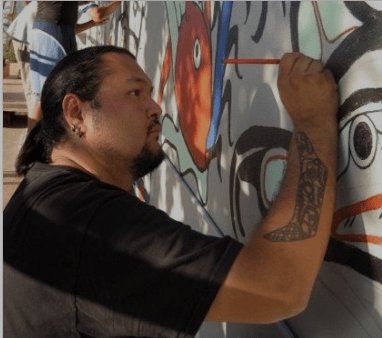
Mike Dangeli

The interconnections go a long way back, although Dangeli took some time to bring them all together. He got his start in art early, making his own dance regalia when he was four or five with his grandmother, artist Louise Barton-Dangeli. He went on to learn acrylics, water colors and oils from her, as well cedar pouches, bags, and beaded necklaces.

At the same time, he learned “everything from weaving to painting to beadwork” from his mother, Arlene Roberts, both individually and as part of the yearly programs at the Chilkoot Cultural Camp in southeast Alaska.

At the camp, he learned from its organizers, Richard and Julie Folta and Tlingit artist Austin Hammond . From an old couple he only remembers as Mr. and Mrs. King, he also learned how to make drums — “that’s everything from taking a deer skin and scraping off the fat to making your own rawhide to string the drum,” Dangeli explains. He enjoyed the process so much that he estimates that by the time he became a professional artist at the age of 27, he had made “over five hundred drums.”
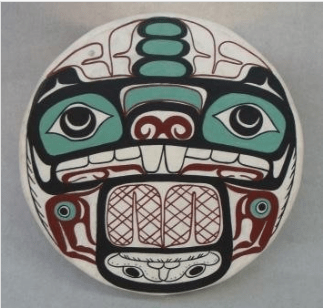
Beaver Drum

Another important early experience was spending the summer travelling on the Alaska ferries with his mother and grandmother, stopping at each port to sell what they made. Dangeli recalls that they did well enough to pay for their fares and his clothes for the coming school year. Through this experience, he also learned from his guardians “how to talk to galleries, to tourist shops, and cultural centers.”

Dangeli’s first training in carving came from his uncle in Prince George. “I spent a summer with him learning basic design and carving bowls and helping him with his work,” Dangeli says. “It was a lot harder than it looked, and I was a teenybopper with a lot of different interests.”

The road to an artist’s life

As a young man, Dangeli staged his own form of rebellion by joining the American army as an Air Ranger. He explains, “I’ve heard all my life that I’m in line to take a chief’s name. When you hear something like that all your life and you have to be good because of it, you decide you’re missing out and think, ‘I’m going to do my own thing.'”

The army seemed a natural choice, because he was thinking of going into law enforcement. “I didn’t see myself as an artist and living that kind of of lifestyle.”

Dangeli spent ten years in the military, rising to Staff Sergeant, but continued carving and designing in his spare time, and visiting family members when possible. It was on these visits that he started gaining a more deliberate understanding of his nation’s Angiosk –traditional territory — and Ayaawx — customs.
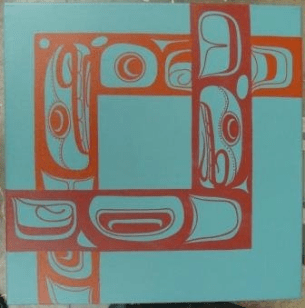
Adjusting our frame of reference

When he became a reservist, he attended the University of Alaska and working with his uncle Reggie Dangeli, a historian with the Alaska State Historical Commission. Eventually, he transferred to Washington state.

Matters came to a crisis when he got into a fight with another Staff Sergeant. “He said, ‘That’s the problem with you Indians,’ and of course he said effing Indians, so I smacked him up one side of his head.” At least partly because of the experience, Dangeli decided to leave the military, a move that cost him his university funding.

Finding himself in a well-paying but dead end job, Dangeli drifted towards Robert Boxley’s Seattle dance troupe and eventually apprenticed to him. He went through “a nasty divorce” due to his change of lifestyle, and headed “home to the Nass Valley to lick my wounds.”

The trip got sidetracked in Vancouver when he was asked to finish a pole in Woodland Park.

“I didn’t want to do it,” he says. “It wasn’t a very nice chunk of wood, and I didn’t want to do someone else’s work. So I said, ‘If I do it, it won’t be mine. It will be a community project.'” Hiring ten youths, he finished the pole and celebrated its completion with a potlatch — and, in the process, discovered that he had found himself a community.

“It was such a sad little pole,” he says. “It had been stolen twice, spray painted and a chunk was taken off the side, and someone took a Louisville [baseball bat] to it. It was horrible. But I look at it in retrospect as a physical manifestation of where I was in that moment in time — just beat up and kind of sad. It ended up being something very beautiful — not necessarily the totem pole itself, although it’s still up there and humbling to look at, but because it represents a massive amount of growth. What I created was a community here in Vancouver.”
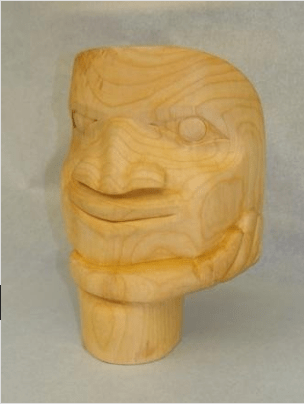
Lifting up my god-son mask

While carving the pole, Dangeli found studio space at the Aboriginal Friendship Centre at Hastings and Commercial. He remains there to his day, running a program called The House of Culture. At first, the program was a cooperative, through which artists passed like Robert Davidson, Reg Davidson, Henry Green, Simon Dick, and Lyle Campbell, as well as younger artists such as Ian Reid and Phil Gray.

More recently, The House of Culture has become a rental space, because “there were a couple of people who had abused the space because they were abusing themselves in their addiction,” as Dangeli explains the situation. Dangeli now shares the space with Woodlands artist Don McIntyre, and Mari Torizane, a Japanese master painter who works as Dangeli’s assistant. Space is also found from time to time for other artists, such as Ian Reid, whom Dangeli regards as a brother.

Such experiences have left him with a strong interest in collaboration. One such result can be seen on the west side of the Friendship Centre, where Dangeli recently painted a mural with Don McIntyre.

Dangeli now works in a variety of media, including stone carving, wood carving, jewelry making, painting, and sculpture. He works twelve to fourteen hours a day and completes 10-30 pieces per month.

“I love a bit of everything,” he says. “You get lost in what you’re working in, so there is no favorite medium. It’s whatever I’m working on. but I always have five of six projects on the go in various stages. You get bored with one and you want to pick up something else. but then the clock’s ticking on a couple of pieces, and you’ve got to get going on them.”

Ceremonial, commissioned, and commercial art

“What’s become really important to me is the performance and ceremonial part of our art,” Dangeli says. “You can ask every Northwest Coast artist, and they’ll tell you that some of the best carvers and west coast artists are the ones who have an understanding of ceremony. It’s a lot different than creating something for the galleries.”

Part of the difference is that a mask intended to be danced “needs the inside to be functional. It needs to be carved to the dimensions of the face of the person who’s wearing the mask.”

Another part is the “responsibility and rights and privileges that you learn by attending ceremonies and understanding them.”

However, the largest difference, Dangeli says, is the spirituality. “In our languages, masks were naxnox— ‘beyond human power.’ These naxnox embodied the wind, they embodied the spirits, and were able to connect us to that spirit world. There’s an understanding that if you don’t treat these naxnox right, they’ll bite you.

“And I’ve seen that happen. I’ve seen a guy who played around too much with a mask and he was dancing on stage at this one event, and he fell right off the stage. It was a good five foot drop. That was part of the mask saying, ‘I didn’t appreciate that.’ I’ve seen it happen in our own dance group. I’ve even had it happen to me.”

Another consideration is the stories that are told in ceremonial and commercial art. “With a lot of our naxnox, there’s an oral history that’s owned by families that I don’t have the right to go and use. There’s even traditions that belong to my family that I would never go and openly sell. When I do art for potlatching or for individuals who ask me for things that display their clan crest, there’s always a different price. I don’t ever charge the full price in these cases, because the best payment is having one of your pieces used. It’s more of an exchange” of services or goods or artwork.

By contrast, “when I’m doing things for a gallery, there are certain stories that are universal to everybody” that can be used instead. Dangeli suggests that this is not a limitation, so much as a situation that calls upon his ingenuity as an artist. He likens the distinction to his experience of dancing, where there are some dances that are not recorded and others that are brought out for public performance.
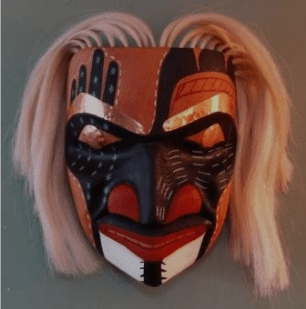
Dangeli acknowledges that other artists do not observe the same distinctions, but seems to feel that their choices are not his business. “I find it really sad when I see artists breaking those laws [about what can be publicly displayed], but it’s up to their elders, their chiefs and their matriarchs to put them back into line, not us as artists. Although there are some things you look at and think, ‘Gosh, I can’t believe they did that.'”

These distinctions are increasingly easy for Dangeli to observe because, while he has had work in galleries, today, commissions and ceremonial work mean that he does not rely on the commercial art market to make his living. While he praises some galleries like the Eagle Spirit and the Leora Lattimer Gallery, and speaks of their owners with respect, he is concerned that meeting the galleries’ needs can be restrictive for artists.

In fact, in some cases, dealing with galleries can be “abusive,” he says. He recalls selling a drum and a mask to one gallery, and being told by the owner, “‘Now, don’t go drinking this all up in one spot.’ So I looked at him and said, ‘I don’t need this,’ and I ripped up the cheque and handed it back, and took my pieces.”

This experience was reinforced a few years ago by an incident online in which his building and launching of a canoe received condescending criticism from an academic, and others rallied around him.

“It was really wonderful having support from my own people, indigenous people, and people from museums from all over the place, and I let go of that final fear about what people think of my art. It’s none of my business. If you like it, you like it. If you don’t, that’s fine. I think [this attitude] has made me a better artist, and that taking on more commissions has helped me to focus on more personal items and concentrating more on things for potlatches. It’s wonderful to have that freedom, and I would wish it for every artist.”

Art and the community

Dangeli takes his role as an interpreter of his culture seriously. “There is a responsibility, because artists are our historians. They are people who are able to act as a conduit between our culture and our people to the outside world. They’re historians, they’re writers, they’re creators of things that will be used inside those ceremonies. So, yeah, there’s a lot of importance in being a leader and an artist.”

For Dangeli in particular, this responsibility and importance is augmented because he is heir to two chieftainships, one of which he grew up expecting to inherit and one which he has only recently become heir to. This situation, he says, “has affected me in wanting to convey more of my messages. And taking on that larger chieftainship means that I have more responsibilities, both financially and culturally. Financially in the way of making sure that I can get home to attend feasts and potlatches, culturally by being able to create things for my people. It has affected some of what I create and definitely the responsibility not to do anything embarrassing as well.”

Sunset

However, asked if artists help to restore pride to First Nations communities, Dangeli characterizes the idea as an outsider’s view. “I think that, as an outsider looking in, yeah, it could be construed that way. But are you being made aware of it because individual artists are opening your eyes to what’s going on inside those communities? Because, growing up and witnessing all these wonderful things happening within my community, there’s always been pride. There’s always been this sense of beauty and right and wrong and putting your best foot forward. A lot of artists, especially in the generation before mine, have all grown up with that responsibility.

“There’s a huge responsibility being an artists and growing up in that culture, which is why some artists choose not to be part of it. It is too much responsibility. Everyone always wants you to create things for some sort of giveaway or to do this or that. So there has to be a balance.” For instance, Dangeli will often repurpose a piece, or ask permission to make a print of an original painting, so that he can respond to a request without taking too much of his time. He cites Joe David and Beau Dick as two of the older artists who are models of how to find this sort of balance.

“We have a responsibility because we’re able to function in so many worlds, whether it be the white world, within the art world — and it’s not just the art world, it’s the First Nation’s art world as well — within our communities, culturally, and academically and with art historians. I’ve been able to walk in all these worlds, and been intimidated in all of them.

“I remember when Mique’l [his financee] had moved up here. I was looking through some of the readings she had to do for her Master’s in Art History, and I became worried because art historians analyze everything. And I was like, ‘Look, I was poor this month, and people will say, this is Mike Dangeli’s blue period because I didn’t have anything else but blue paint. That was part of my fear: Is what I’m doing now going to be analyzed and picked apart twenty, forty years down the line?. And that was something else I had to let go.”

But, for all the fears, the responsibilities, the obligations and the need for balance, Dangeli clearly remains committed to all that he has taken on. “I love what I do. It’s not a job, and it’s not a career –although it is both — it’s a passion. I absolutely love it. So to be able to have that opportunity to take what’s inside me, to make my thoughts tangible –”

He trails off for a second, then starts in a new direction.

“I’m able only to put out so much in thirty or forty years. That’s a short time in a person’s life. And I started this when I was a little older than most artists. I was 27 when I decided to become a professional artist. so I have a lot of catching up to do. And, at the same time, I’m grateful to be able to create art and to have people see value in it.”

Read Full Post »
Northwest Coast art has a new medium. It’s called forton, and it’s a mixture of gypsum, fiberglass and plastics, and has the advantages of being non-toxic, lightweight, weather resistant, and capable of imitating anything from marble to plaster or bronze. So far, you can see the largest collection of sculptures in forton in Vancouver at the Douglas Reynolds Gallery, including one cast from James Hart’s Celebration of Bill Reid pole that was officially presented to the public on December 5.

The Celebration of Bill Reid pole is a permanent fixture at the Bill Reid Gallery in downtown Vancouver. Carved by James Hart with the help of Ernest Swanson, Tyson Brown, Carl Hart, and GwaLiga Hart, the pole is topped by a raven whose chest is a stylized version of Bill Reid’s face. Through the Douglas Reynolds Gallery, eighteen copies of the raven are being made in forton – six imitating plaster, and 12 bronze, including three artist proofs.

Hart spoke briefly at the launch, arriving after the crowd had already gathered and was well into the buffet and wine. A tall man with long gray hair, he wore a bright Guatemalan jacket and carried a string of trade beads in his hands that someone gave him as he came in the door. He walked with a stoop and a slight hesitation. As he stood halfway up the stairs in the gallery, he was surprisingly soft-spoken for a well-known artist who is also a chief.

Hart spoke briefly about the pole and its intent to honor Bill Reid. He explained that he not only learned carving from Reid, but how to survive in the city, including such details as how to use an elevator, something he had rarely encountered in his rural youth. Turning to the plaster raven in the corner, he emphasized that it was a white raven, a representation of the trickster before he stole the moon and was singed black in his effort to escape with it through the smoke hole.

Afterwards, I managed to talk briefly to him as he mingled with the crowd. He said that the project was his first effort to work in forton, and that he liked the way it could be carved and was resistant to weather. He also expressed his enthusiasm for the new medium and designs that younger artists from all the local first nations were developing the traditional art forms.

Until the new raven cast, most of the works in forton that I’ve seen were done by Don Yeoman at the Douglas Reynolds Gallery. However, Reynolds mentioned the side of a house in Whistler that recently had several dozen forton panels added to one side, and I suspect that any artists who encounter it are likely to be as interested in it as Hart seemed to be.

One look at the cast and you can understand why. Made from a mold of the cedar original, the pseudo-plaster cast picks up so much detail that you can actually see the wood grain and tool marks in it. With forton offering so many benefits and no drawbacks so far as I can discover, I strongly suspect that, just as local first nations artists adopted to argillite a century and half ago and glass in the last few decades, many are going to seize on forton as yet another medium for their work.

Read Full Post »

The stories of Raven stealing the light or Raven prying open a shell that contains the first people continue to inspire great art, and have the advantage of being no single family’s property. But they are only a fraction of the stories and themes that could be told in Northwest Coast art. That is why, when I buy art, I am always interested in less often heard subjects – the change is interesting to me, and, I hope, a change of pace for the artists as well.

A case in point: “Healing Ring,” the second of the rings made for us by up and coming artist Gwaai Edenshaw (the other ring was “Raven and Crows,” which I blogged about earlier).

Here’s how Gwaai Edenshaw himself describes the ring. He was talking with us as he wrote and using a soft pencil, so I have had to guess here and there as I transcribed:

[The] centre of the ring is Fungus Man, made famous in the story of Raven and the First People. The only [one] of Raven’s helpers that was strong enough to face the feminine energy/sprit, and bring it to humanity. This character was likely Fomitopsis Officinalis. This is a shelf fungus that is analogous to a Chinese medicine (in fact one of Chinese Medicine’s most prized medicines). It was almost definitely used by Haida shamans. Samples of it have been found among shaman’s effects (this was thought to be wooden carvings until a recent test of the wood revealed it to be Fornitopsis. Fungus Man appears out of a bush of K’waay K’ia (Indian Hellebore), a very important medicine to us. Like many medicines it has potential for toxicity, but in the hands of the right practitioner it is a true marvel.

Also called Laricifomes officinalis, the fungus is almost extinct in Europe, but is found in old growth forests in the Pacific Northwest. In various locales, it has been used to treat tuberculosis, pneumonia, asthma, rheumatoid arthritis, infection, and smallpox, and to ensure long life.

I believe that the appearance of the fungus on the ring is one of the first instances in which Edenshaw has combined his interests in Haida botany and art. In fact, aside from what appears to be tobacco leaves and European-influenced floral designs in some argillite work, flora of any sort is rare in Haida art, although some mainland nations have floral crests, such as the Gitksan Fireweed clan.

Edenshaw continues:

On the reverse side is a pair of herons. These are the helper in a number of stories, notably the Gunarsiargit story where they play a small but critical role in the story’s namesake fulfilling his destiny.

More specifically, a heron often dwells on the edge of the village, some distance away from the inhabited houses. This locale reflects the heron’s often lone habits, but might also suggest a shaman, since shamans often lived and certainly were buried separately from everyone else.

For me, these are the kind of details that, when combined with artistic skill, can make Northwest Coast art so satisfying to me. They offer not only aesthetic pleasure, but, for a European ethnic like me a small window into the cultures that produce them. And Edenshaw, besides being a gold smith with a genuine feel for the metal, is also clearly someone deeply knowledgable about his culture as well.

Read Full Post »

One thing you can say about public transit: It may not be cheap or convenient, and you learn more about people’s personal hygiene than you ever wanted to know, but there’s nothing like it for people watching.

Sometimes, the people are just outlandish – and I say that as card-carrying eccentric myself. For instance, last weekend, a couple boarded the Skytrain walking very close together. He was tall, with a near beard and long hair and sun glasses. She was shabbily dressed, in kneeless jeans that only stayed up when she held a belt loop, and bobbing her head in a stoned sort of way to the tracks on her iPod. She also had an odor of at least two types of smoke and unwashed body trailing her like a shadow. Close inspection showed she was wearing a dog collar that was chained to his belt. Every now and again, he would give a little proprietary tug, not hard, but enough so that she would try to fix her eyes on him. I try to be broadminded, but if ever a couple needed to be told to rent a room, this one did. That’s not the sort of role-playing you expect to see in the middle of a Sunday afternoon.

But people on transit frequently reveal so much about themselves that they seem to be under the illusion that nobody around them can see or hear them. I remember one time when a young man got on at Metrotown looking distinctly lumpish. He was carrying a dozen coat hangers, and seemed to be wearing as many shirts and sweaters. I’d say he got on casually, if there wasn’t such a nervous edge to his casualness.

That attitude is especially common with people on cell phones. They talk as loudly as possible, until I’m tempted to clap at the end of their calls. One man even broke up with his lover in the middle of a crowded car I was riding in. “But I love you!” he keep saying, while embarrassment spread around him like a stain. After he left, I could see people relax, and several looked at each other and shook their heads.

It’s encounters like these that generated my first dictum about riding transit: Whatever you do, don’t make eye contact. The risk of having to make conversation with some of your fellow passengers is simply too high.

Read Full Post »

I appreciate Northwest Coast art for many reasons. It is semi-abstract, which always captures my imagination. It has a historical and sociological aspect, so I can combine intellectual and aesthetic interests. It is the art of my home, although not of my culture. But, sometimes, I think that my main reason for buying Northwest Coast art is that it is one of the few modern forms that remains largely unaffected by scholasticism.

By “scholasticism,” I refer to the modern trend in many of the arts for artists to be more interested in theories or concepts than in craft or any general audience. It is a trend that has occupied most of the twentieth century, and continues to prevail in the 21st. I’ve seen it first hand in poetry and literature, and it seems equally prevalent in music, painting, and dance. It is the approach that Tom Wolfe slammed, outrageously and a little unfairly in architecture when he wrote From Bauhaus to Our House.

Under scholasticism, what matters is the theory behind it. Before anything else, what interests the artists of scholasticism is demonstrating that they can put the theory into practice. Their work tends to be crammed with obscure references and in-jokes, and their talk is usually more about the theory than the work itself. It creates a vicious circle, with artists losing audiences because of their obscure practices, then retreating into even obscurer theory in reaction to the lack of audience.

While exceptions exist, Northwest Coast art seems largely free of such attitude. Beginners may be told to read Bill Holm to understand the mysteries of formline, but nobody reacts when someone breaks the alleged rules, or strikes out in a new direction, as the Salish artists have in the last few decades. Similarly, while many artists have experimented with the forms of modern art, few seem to become obsessed with the theories behind the forms.

Why Northwest Coast art has been spared this obsession is probably complex. But it is not because the art is in any way primitive, any more than Celtic knotwork is primitive. Such forms can be dismissed as primitive or romantic only to those who have not bothered to learn about them.

Nor is it naive. Many Northwest Coast artists are just as prone to in-jokes as any mainstream artists, but the difference is that the jokes are an extra layer of meaning, not the only one, nor even the most important one most of the time.

Nor does the reason has anything to do with the rigidity of change, or even the marketplace. For the last century and a half, Northwest Coast artists have seized on new media whenever they have had the chance. Argillite, glass, aluminum, canvas – each of these has been eagerly adopted as soon as it became available. The same is true of tools, from steel engraving tools to power tools. And, as often as not, the artists have begun work with new media and tools with only a few denouncements from their peers, people, or clients.

If anything, this versatility may have helped Northwest Coast artists take scholastic art in their stride. Although scholasticism is all about breaks with the past – often, the nosier the better – few Northwest Coast artists seem to consider new media, tools, or techniques a radical departure. This attitude has become very apparent in the Bill Reid Gallery’s current Continuum show, in which the curators’ efforts to start a dialog about the differences between traditional and contemporary first nations art has met with very limited success. Almost all the artists in the show make clear that they don’t see such an opposition.

Another reason for the freedom from scholasticism may be that, unlike modern mainstream artists, Northwest Coast artists tend not feel deracinated. Their art is not only an expression of their cultures, but a statement that their cultures are alive and thriving. Even those who did not grow up in their cultures generally feel an urge to know more about their origins as their art develops, and, for many in their communities, the success of Northwest Coast art is an obvious source of pride. Rediscovering and proclaiming their cultures, perhaps, is more than enough of an agenda to be going on with.
Not only that, but Northwest Coast art has genuine popularity, both among the first nations cultures of the coast and a small segment of the general art-buying public.

Admittedly, this popularity is not an unalloyed good. I have heard artists complain about being limited in their subject matter because something too esoteric won’t sell. Some artists, too, are tempted by the tourist trade, and start producing cheap curios rather than art. In addition, the popularity of the art form ties too many artists to the gallery system, and allows a handful of gallery owners far too much influence on what the public sees.

However, this popularity still gives Northwest Coast artists a huge advantage over their mainstream counterparts. Unlike mainstream artists, Northwest Coast artists know their work is appreciated – sometimes for the wrong reason, sometimes condescendingly, but appreciated all the same. Much of the public art in British Columbia is from the first nations, and, internationally, probably only art from the American Southwest is more eager sought after. In their own cultures, art is increasingly wanted for potlatches and ceremonial purposes.

Unlike many mainstream artists, Northwest Coast artists – even the most reclusive ones – have a dialogue with their audiences. They may not always like what they hear or agree with it, but they can still count on a degree of interest that mainstream artists can hardly imagine. So long as that interest remains, I suspect, it is hard to imagine scholasticism ever getting much of a hold in Northwest Coast art.

Why disengage and retreat into the cloisters when you have people who want to talk about your art? After all, that is what most artists want, even those who are most deeply into scholasticism – an audience that engages their work.

I used to wonder why mainstream art events so rarely included first nations artists in Vancouver. The communities seem very separate, even though a few people like Andrew Dexel or Sonny Assu seem to cross between them. The answer, I now believe, is that the two communities are so different that communication is difficult. Their approaches, attitudes, and perspectives are so much opposed to one another that the surprising thing is not that some Northwest Coast artists are exploring the mainstream. The surprising thing is that any have managed to do so at all. But, apparently, Northwest Coast Arti is in such a healthy state that it can even absorb attitudes that are opposite to its core assumptions without any real difficulty.

Read Full Post »

« Newer Posts - Older Posts »