Feeds:
Posts
Comments

Archive for the ‘British Columbia’ Category

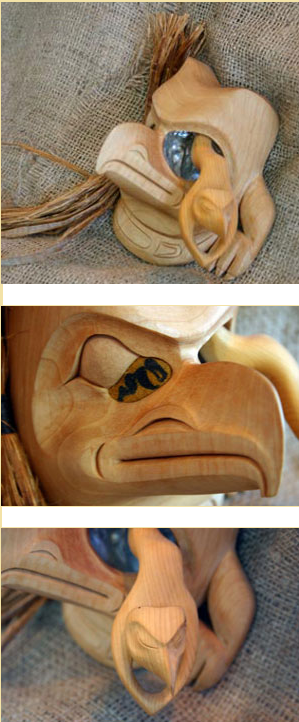
As I go through Northwest Coast galleries and web sites, one of the things I am always looking for are miniatures masks – ones under about eight inches in height. We have several wall areas – mostly above doors – that are too small for anything else. Even more importantly, a miniature is a sign of a carvers’ skill. Yet I don’t see many worth buying, perhaps because miniatures tend to be either student pieces or ones designed for the tourist trade, and experienced carvers cannot charge enough for their time to produce many. As a result, I was especially pleased when I noticed that Ron Telek’s “Transformation Mask: Human to Eagle” had come back on to the market. It’s an unusually fine miniature that shows his customary skill and imagination.

How the mask came from Terrace to Vancouver and I picked it up at the South Terminal of the Vancouver airport (which was not, to my disappointment a foggy runway used by single prop planes like something out of Casablanca) doesn’t matter. Enough to say that it did, and I did, and the mask now resides at the busiest crossroads in the hallway of our townhouse.

What makes the mask so haunting is its ambiguity. Although a human is turning into an eagle, the dominant face is more of an eagle’s. From the left eye, whose socket is lined with abalone, a human shape with a bird’s head seems to diving. Or so it appears; if you look at how the spirit’s head and arms are arranged, you’ll notice that they suggest another beak. You have to wonder, too, if the shape is the departing human soul or, given the deepness of the eye socket, if the transformation is being achieved by the plucking out of an eye.

Then, if you look at the right eye, you’ll notice that it is bare wood. However, in the eye’s lower third, like a cataract, is a piece of leather with a small shape that resembles the one leaving the left eye. Does that mean that the transformation is all in the eye of the imagination and not literal? That the transformation, or the need for it is based on faulty vision and understanding? Or is it a supreme act of will?

Also, despite the title of the mask, what dominates is a largely bird-like face with a full beak and one taloned foot where its left ear should be. So who is transforming into what? Perhaps the transformation is of the human into the form of his helper spirit or true self. Certainly, the bird face seems serene, perhaps even amused to judge by the line of its mouth on the beak. It is the human spirit that seems in pain or exaltation. By contrast, the eagle seems more stoic and less affected by the transformation. Perhaps for the eagle’s nature, transformation is natural, and it is the human spirit that finds passing from one form to the other uncomfortable.

These ambiguities make for an asymmetrical design – something that is relatively common in Northwest Coast art, but which is part of the foundation of modern mainstream design. By showing elements of both, the mask increases its ambiguity even further. To a certain extent, the asymmetry is reduced by the long cedar braid on the right, but the mask remains, like the figure it represents, halfway between two different states.

In the end, you can say so little about the mask that the uncertainty adds to its fascination. The only thing that you can say for sure about the mask is that it is finished with Telek’s usual attention to detail.

I don’t know why the previous owner decided to sell the mask, but I’m glad he did. Unlike the previous owner, we don’t plan to let it out of our hands. We wonder, though, where we will find other miniatures to match its complexity.
telek-human-eagle

Read Full Post »

One of the pleasures of buying art is the thought that you might recognize a young artist before anyone else. The pleasure is not in the fact that the piece increases in value, but in the knowledge that you recognized excellence before anyone else. Currently, buying a print in Northwest Coast art by Robert Davidson or Susan Point requires no special insight – the excellence of both has been well-established for years. By contrast, when Trish and I purchased an acrylic copy of Alano Edzerza’s “The Thief” today, we were taking a gamble.

However, it’s a gamble that we are sure will prove our foresight as Edzerza’s career continues to flourish.

Under thirty, Edzerza is an artist who is beginning to make himself known, especially in glass, graphics, and large scale installations in businesses and offices. Unlike most artists, he also knows the business side of art, and few other artists are in so many galleries, or can boast so many shows so early in their careers.

Last summer, he also became owner of the Edzerza Gallery, which showcases both his work and pieces by other up and coming actions, making him one of the only First Nations artists to run a commercial gallery. I know of several young artists who hope that he will provide a fairer deal than other galleries, and at least one who believes that he does.

I have heard one person denigrate Edzerza for producing giclee prints, as though running off prints from the computer was an abomination rather than a convenience.

More tellingly, I have seen lines in several other people’s artwork pointed out to me that Edzerza might have copied. However, if that is so, the practice is common enough among young artists. Even such an icon as Bill Reid borrowed and imitated at the start of his career, and nothing is wrong with the practice so long as an artist eventually outgrows it.

A more valid criticism is that Edzerza’s imagination is still more two-dimensional than three-dimensional, to judge by his jewelry; not that anything is wrong with his jewelry except that it is not at the same level as his graphics or glass work. Just as importantly, he is also still mastering color, tending to use only one per work.

But, at the same time, Edzerza already shows an exceptional sense of design and a strength of line in his works. Not only are his works effective compositions, but, at least twice, he has found new pieces in closeups of existing works. He simply has an eye for design, and, with this trait, I have few doubts that his limitations will cease to exist in the next few years.

It helps that he seems to have a curiosity and memory for design. The one time I met him, he seemed very current about what other artists were doing, and the way he studied the Henry Green bracelet I was wearing when I passed it to him suggests a capacity to learn.

Just as importantly, Edzerza has an eye for drama, tending to show figures in motions rather than static ones. For instance, in depicting the over-used story of how Raven stole the light, in “Smoke Hole,” he focuses on Raven erupting from the smoke hole, charred and on fire. The result is one of the most arresting retellings of that myth that I have ever seen, because he has chosen a dramatic moment to represent.

Although I find graphics like “Smoke Hole” and “Think Like a Raven” powerful, we chose to buy the acrylic of “The Thief” because we believe that it has the potential to be a breakthrough piece for Edzerza. Even if it is not, it is still one of the most effective piece that he has done in a career that already does not lack for highlights.

“The Thief” is another depiction of the Raven engaged in stealing the light. However, unusually in Edzerza’s work, it is a still and formal piece. Almost a mask, it shows the child that the Raven has transformed himself into in order to accomplish the theft, surrounded by the body of the bird that he really is. But a hint of Edzerza’s characteristic drama rests in the enigmatic smile of the child, which – unlike the sleepy eyes — is not only decidedly not innocent, but mirrored by the raven’s beak above it. The disturbing smile suggests the theft that is about to happen or is in the process of happening.

Like much of Edzerza’s latest work, “The Thief” is in grayscale. However, there are more shades within “The Thief” than in any other of Edzerza’s works that I have seen. I strongly suspect that “The Thief” is a study in chromatic complexity, and (whether he knows it or not), one of the first steps that may eventually lead to a richer use of color in his future works.

Even if it doesn’t, grayscale is a fascinating world of its own, as anyone who has ever worked in black and white photography can tell you. In “The Thief”’s case, the color palette suggests the moon, which, depending on the version of the myth, is either what Raven steals, or else soon results from his theft. Especially in the acrylic version, the composition has something of the rich sheen of argillite – and, although argillite is generally worked by the Haida, rather than by a Tahltan like Edzerza, the resemblance suggests a carving as much as a graphic. This impression is heightened by the position of the raven’s head over the child’s forehead, an arrangement often seen with transformation figures on masks. Could Edzerza also be using grayscale and the illusion of depth it creates as an exercise to improve his three-dimensional imagination?

Whatever exactly Edzerza was intending, “The Thief” remains the best northwest coast composition I’ve seen this year. It’s a contemporary piece, while remaining firmly rooted in tradition. I am proud to be one of its custodians, and look forward to ferreting out its secrets in the coming years. And if Edzerza becomes as well known as I suspect he might, I will be just as proud to loan it for the inevitable retrospective on his career, when it is recognized as a pivotal moment in his career.
cropped1

Read Full Post »

I could be wrong, but I’m starting to see a darker side to art galleries – at least, the ones that specialize in Northwest Coast art. If you are a potential customer, you are unlikely to see this side. Most of those who work in a gallery are as passionate about the art as the customers, and – especially if you are a returning customer – will happily talk for hours. I wish, though, that I could be sure that the artists receive the same courtesy. I’m starting to wonder.

This doubt began to flicker when I first became aware of a common figure in the galleries: A first nations person – almost always a man – hovering around a gallery, looking as though he feels out of place. Sometimes, such a man has a knapsack or even a large duffel bag that he lays very carefully on the floor. If he doesn’t, at some point he will take out a carefully wrapped bracelet or other piece of jewelry from his pocket. Typically, he waits until the gallery is mostly deserted, and then gingerly approaches the nearest gallery employee. He is, of course, an artist hoping to make a sale, and his manner is very much that of a supplicant, nervous if not outright afraid.

Then, yesterday, a gallery owner regaled me with stories of how artists used to be lined up outside his door in the morning. Sometimes, he said, there would half a dozen in line, including many famous ones. The first one or two might make a sale, or even the first three, but, after that, the owner said, he usually lacked the money and was suffering from too much sensory overload to buy anything else. So, at least half the line would have waited hours for nothing.

At the same time, I’ve heard grumbling from several artists. Sometimes, they’re talking about how they feel that a particular gallery has cheated them. But, just as often, it’s grumbling against the gallery system in general. They complain that the galleries sell their work for three times what they were paid for them. And the younger ones especially complain that no major gallery for Northwest Coast art in the province is owned by a member of a first nation (although perhaps Alano Edzerza’s new gallery will change that).

I don’t want to be dramatic, but such scenes make me uncomfortable. Not only are the artists at the hub of the system, but Northwest Coast art is an assertion of identity — both personal and cultural — for many artists. It’s an assertion that, despite everything, they and their culture are still here, and being respected. Yet the scenes are not so different from those associated with day-laboring farm workers. Not that people doing piecemeal work aren’t entitled to dignity – they obviously are – but it seems an added injustice that people who are the main producers, people of real talent and sometimes genius should be subjected to this kind of treatment. Yet some don’t even feel at home in the places where their work is being displayed.

Not all, of course have this reaction. Some artists are capable of handling the gallery system with skill and finesse. Others hire someone who can do the business of selling for which they personally have no aptitude. Still others either have enough talent or reputation that a gallery will adopt them and do everything in its power to promote them. But many aren’t so lucky, and they resent the situation without feeling that they can do much about it.

I don’t know what the solution is. Maybe galleries can be justified as a form of promotion that ultimately helps artists’ careers. But I’m starting to think that more artists need to learn more about business so that they can hold their own. Or maybe more Northwest Coast artists need to become gallery owners themselves. Others might group together to form an online co-operative and create a market for their work that bypasses the gallery system.

Personally, I am listening to the artists, trying to separate out individual animosities from trends in the hopes of finding which galleries, if any, are the most ethical. I am also starting to wonder if I should be dealing more with the artists directly – although I’m not much for negotiations myself, even if I have some experience with them. It’s not a situation that has clear answers, but I won’t be easy about my art-buying until I have some.

Read Full Post »

After several months of down payments, we’ve added the first mask to our collection of Northwest Coast art: “Spirit Moon Mask” by Ron Joseph Telek.

Telek is a great original – perhaps the great original in Northwest Coast art today. Inspired, they say, by a car accident in which he was legally dead for a few minutes, his work is largely concerned with images of transformation and shamanism. While his work obviously comes out of the northern tradition in British Columbia, it breaks with the tradition as much as it keeps it.

His work is quirky, asymmetrical, and fully of little details, and often more than a little disturbing. I’d call it the carved or sculpted equivalent of a Gothic novel – a dark, romantic, and highly individualistic style. Others have called him the first surrealist of the Northwest Coast, and likened some of his more disturbing images to Edvard Munch’s “The Scream.”

His imagination alone would make him one of the top carvers and sculptors on the coast today, but Telek is also a painstaking craftsman, much like his uncle Norman Tait, whom he once studied under. Like Tait, Telek is a master of using the grain of the wood to enhance his subject matter.

The same is true when he turns to other materials – there is a walrus tusk he did a couple of years back languishing in a Vancouver gallery which is so eeriely beautiful that it had to be moved further away from another piece of ivory so as not to outshine it.

Another characteristic of Telek’s work is that, in contrast to what might almost seem his imaginative excess, his finishing details are always meticulous and restrained – you won’t find any tarting up of a mask with rings of unmatched abalone or endless cascades of horse hair in Telek’s work, the way you do in less talented artists. And you never do see paint, which other artists sometimes cake on to hide defects. Like Tait, if Telek adds a finishing detail, it’s for effect.

And if all this wasn’t enough, Telek’s imagination seems endless. Other artists may have periods in their development, in which work after work resembles each other, but Telek’s periods don’t seem to last for more than a piece or two before he moves on to something new. Possibly, this restlessness works against him in the galleries, where many buyers want something familiar, but, I prefer to think of it as one more sign of an inventive and agile mind.

“Spirit Moon Mask” is one of Telek’s smaller, tamer pieces, but it strikes an interesting balance between tradition and the west coast contemporary style of architecture. But the type of odd details that make his other work so lively are there. The wall-eye, the bit of abalone that could either be a nose-piercing or a wound, the strained-looking cheekbones, the arms of the spirit rising from the moon that look like tentacles, the spirit’s arched back and round-mouthed scream — for such a simple piece, the number of unusual touches crammed into the mask is overwhelming.

Since our townhouse is small, we had been thinking of limiting ourselves to one work by each artist who attracted our attention. But, already, we are talking about making an exception in Telek’s case. Perhaps, too, we’ll save for eight or nine months and buy one of his really big works, even if we have to rent the townhouse next door to display it properly. Frankly, we’re hooked.

Read Full Post »

At times, I’m not sure whether I’m a romantic or a skeptic. On the one hand, I love popular legends and mythology. On the other hand, I love efforts at debunking. Was Richard III the victim of propaganda after his death? Did Benjamin Franklin pass information to the British? Was Bonnie Prince Charlie a semi-literate sot who guzzled his way through the 1745 Rebellion? Topics like this always fascinate me, even when they fail to convince. For that reason, I find Maria Tippett’s Bill Reid: The Making of an Indian endlessly fascinating, even when it seems dubious or exaggerated.

If you don’t live in Canada, particularly in British Columbia, you might not know why Bill Reid is a subject for debunking. Briefly, Bill Reid was a jeweler and a sculptor working in the Northwest Coast tradition. He is generally considered the chief figure in the renaissance of Northwest Coast art, and the major Canadian artist of the late 20th Century, with his work on the back of the Canadian $20 bill and one of his sculptures on display at the Canadian embassy in Washington. Ten years after his death, he remains so admired that if an artist, gallery owner or collector of Northwest Coast art refers to “Bill” with no surname, they are referring to Bill Reid — a touching and clear indication of his ongoing importance.

Tippett clearly admires Reid’s work, and its fusion of European and First Nations sensibilities. However, she also states that Reid was bipolar, and – on very little evidence – that he was sexually promiscuous and adulterous. More importantly, she suggests that it is wrong to see him as the sole instigator of the Northwest Coast art revival, and that, especially in the last years of his life, he carefully crafted his own image as an Indian to further his career (hence the title).

These claims were greeted with outrage by a number of reviewers when the book was first published four years ago; a review in the Georgia Straight, for example, referred to the book’s “slash-and-burn” approach to its subject. In the end, though, it is surprising how little her claims actually matter. Regardless of their truth or falsehood, even Tippett cannot deny Reid’s importance as an artist.

Personally, however, I wish that Tippett had balanced her claims more, and, in places, elaborated on them. A man struggling with mixed European and First Nations ancestry in the mid-20th century, and later with Parkinson’s disease has every right to depression and moodiness. As for her claims about his sex life, they are based to a large extent on hearsay, and, not really the concern of anyone except Reid and his wives. I suppose the claims have to be there for the sake of completeness, but they have little to do with his art, which is almost completely void of the sexual elements in 19th Century Northwest Coast art.

Similarly, it is true that other artists were keeping the tradition alive when Bill Reid began his career. However, to imply as Tippett seems to that the tradition would have its present popularity without him seems absurd. True, artists like Ellen Neel and Mungo Martin were active in the 1950s, but to suggest that they could have sparked the current interest without Reid seems questionable; he developed into a first-rate talent who influenced dozens, and Neel and Martin were second-rate at best. Might-have-beens are endless, but, without Reid, the tradition would probably not be nearly as popular as it is today. Even artists of the excellence of Robert Davidson and Norman Tait might not have been able to promote it, not because they are any less talented than Reid – they’re not – but because they lack Reid’s flare for self-promotion.

But self-promotion, of course, is something that artists are not supposed to engage in, according to many outsiders. Apparently, they are somehow truer to their craft if they live in poverty. And Tippett seems to share this self-righteous puritanism in full measure – if anything, she seems more shocked that Reid should cleverly promote himself than that he should sleep around. She reacts with a cynical naivety, using anti-Indian statements by Reid from earlier years to create the impression that his political activism in his last active years was a calculated marketing decision. She does not consider the possibility that marketing can be based on honesty, much less than Reid’s adoption of a First Nations identity may have been a resolution to his life-long conflict about who he was.

Still, better a debunking book that lacks generosity than a hagiography that ignores its subjects’ faults. Tippett could argue her case better, but, even if her interpretation is faulty she at least presents a portrayal of a human being – and one whose faults, real or imagined, don’t change his importance in the least.

Read Full Post »

Kwakwaka’wakw carver Beau Dick is one of the names on my short list of people from whom I would one day like to buy a mask (for the record, the others are master carver Norman Tait, Nishga’a surrealist Ron Telek, and Tlingit carver Stan Bevan). Not only does Dick have a subtle sense of color that is rare in Northwest Coast mask-makers, but he manages to find endless creative possibilities in two main figures — Bukwus, the wild man of the woods, and Tsonoqua (also called Dzunuk’wa), the wild woman – producing countless masks of both without repeating himself very much. And, like the others on my list, he is meticulous about finishing details, although he often chooses a rougher look than Tait, Telek, or Bevan. So, last month, when I came across a few sketches by Dick for about the price of a quality limited edition print, I was instantly tempted to buy.

The first Dick sketches I saw were at the Inuit Gallery in Gastown. One was a colored pencil sketch of a mask with a quick gradient background, one was a mask done in charcoal, and the third was a colored sketch of a dancer. At first I thought them unique, but a week later at the Latimer Gallery, I saw some similar works, as well as some colored pencil sketches of dancers that I suspected were done from photos. The Latimer Gallery pieces were dated about four years later than the Inuit Gallery mask sketch, and were about two-thirds the price, although I judged them not quite so interesting.

From what I was told at the Latimer Gallery, the mask sketches were the result of a period in which Dick had sketched his designs before carving them. He had tried this experiment at least twice, once in 1999 and again in 2003. I don’t know, but I surmise that he either was not especially satisfied with the results, or found the exercise not useful for his carving since (so far as I know), he only tried the experiment a few times with masks. I hope one day to learn more.

Meanwhile, I was disappointed to find that the sketches weren’t as unique as I had imagined. Instead of coming down the next week to buy the mask sketch at the Inuit Gallery, I went to other galleries instead.

But, last Saturday, Trish was well enough to take a brief tour of some of the downtown galleries. When we reached the Inuit Gallery, she was as intrigued by the sketch as I had been, and we bought it on the spot, bearing it home in a mailing tube sealed with tape at both ends to keep out the rain and wrapped in a plastic bag. Tomorrow, it goes to the framer.

What interests me in the sketch is partly the subject matter. If you have ever been in the northern rainforest alone, especially near nightfall, you have no trouble understanding how Tsonoqua entered the local myths; she’s the sense of something terrifying moving just behind the trees.

But, just as importantly, the sketch is interesting for the way it is rendered. If you examine the lines of the face, you’ll see that they are not lines so much as surfaces. Even a single line, like the ones on either site of the mouth are not so much lines as areas, and their shadows are likewise. In other words, Dick is sketching with a carver’s eye.

The only exception to this approach is the hair of both the head and the shaggy eyebrows (although even the individual hairs tend to be thick). The mixture of the two different approaches only adds to the oddness of the face. So does the red patch on just one of the cheeks.

The sketch is rough, but not so rough that Dick didn’t give it a bit of a finishing touch with the gradient background. I suppose that some people would consider the roughness a fault, but, really, what else do you expect in a sketch?

Anyway, a calculated roughness is a common characteristic in a lot of Dick’s work, and seems to suit a character that has been living rough.

One day, I might be lucky enough to find the mask that matches the sketch. But, for now, the sketch is a small and slightly curious addition to our small art collection.

B

Tsonoqua Mask by Beau Dick

Read Full Post »

This weekend, I scouted the Northwest Coast galleries around the south end of the Granville Bridge. Here are my impressions:

  • Eagle Spirit Gallery: Located on the edge of Granville Island, this gallery is one of the pleasanter viewing areas that I’ve seen, with lots of natural light and indirect sun. It seems aimed at the corporate or public buyer rather than the individual, with many larger-than-life plaques, masks, and sculptures. Its selection includes some of Robert Davidson’s recent sculptures (which you don’t see much of), as well as works by Lyle Campbell, but, for me, Francis Horne, Sr.’s “Spirit Raven” was the only really exceptional piece. Even browsing casually, I saw a surprising lack of finishing detail on some pieces, including some by artists whose work is usually more polished. In general, the selection seemed a little too safe for my taste.
  • Edzerza Gallery: I discovered this gallery by accident, occupying the space that used to be occupied by the Bentbox Gallery, a block from Granville Island. Owned by the young artist Alano Edzerza, it displays mostly his prints and jewelry, but includes selected pieces from up and coming artists. For a young artist, running your own gallery seems a daring move, but, I’m proof that it pays off, since it means that I noticed Edzerza’s work for the first time, and he’s now on my list of artists whose work I want to buy. While I was there, I also met another artist whose work I admire. The selection is relatively small, but I am sure that I’ll be coming back, both to support the venture and to buy.
  • Latimer Gallery: A block from the Edzerza Gallery, the Latimer features moderately priced limited edition prints, masks, and jewelry I remember this gallery as being more touristy than it was today, so either my memory is faulty or else its stock has gone upscale a little. I had no trouble finding some small treasures, including some old Bill Reid prints, and some very affordable crayon sketches by Beau Dick. I don’t think I’ll be a frequent visitor at the Latimer Gallery, but I will be dropping by now and then to check what they have.
  • Douglas Reynolds Gallery: Located in gallery row a block up from the south end of the bridge, this shop is aimed at the high end of the market. Besides the inevitable Robert Davidson and Susan Point prints, it includes a number of masks by Beau Dick, and at least two striking wall plaques by Don Yeomans. It also includes a selection of gold and silver bracelets, rings, and earrings, including a few small pieces by Gwaai Edenshaw. The stock seemed a little safe to me, but was adventurous enough here and there to make me want to return occasionally.
  • There are still Northwest Coast galleries I haven’t visited in Vancouver, but these four, together with the ones I visited last week in Gastown, are some of the better known ones. Besides finding which galleries seemed right for my own art buying, visiting a number of them has helped me to understand the market a bit better, including such as who are the established and upcoming artists, and what are the going prices for each artists’ work. This knowledge makes my visits well worth the effort, especially since you can easily see a number of galleries in an afternoon without doing much travelling.

Read Full Post »

As part of my recently renewed interest in Northwest coast art, I’ve been making the rounds of the local galleries, trying to get a sense of their specialties and whether I want to deal with them. This afternoon, I made the rounds of the Gastown galleries, which are conveniently within a few blocks of each other.

Here are my impressions – partly for my own sake, but also for anyone else who might be interested in Northwest Coast art. I say nothing about the galleries’ Inuit collections, which I am even less qualified to judge:

  • Hill’s Native Art: Coming from the Skytrain, this was the first gallery I came to, and also the one I spent the least time in. It’s basically a high-end tourist shop, and so crowded that the main impression I took away was of art as a commodity. You could probably find some reasonably decent work if you searched, but, you would have to make an effort. Hill’s has a number of two or three meter high totem poles, but if you’re willing to spend over ten thousand, you would be better off spending a little more and buying one from a name artist elsewhere.
  • Spirit Wrestler Gallery: With over two decades of experience and a number of well-regarded shows and books behind it, Spirit Wrestler is at the opposite extreme from Hill’s, appealing to the serious collector with money to invest in art. Its selection of artists is small, but carefully chosen, and it has a varied selection of work from top artists such as Robert Davidson, Norman Tait, and Susan Point. Currently, it has more Tlingit work than any other gallery that I’ve seen, and a small but select collection of bracelets. The gallery also sells (but does not always display) pieces that have just come upon the market again, so a serious collector might want to keep in touch to hear what is available. The gallery also contains a few Maori works, which should interest many people who have a passion for Northwest Coast art, since the two cultures have a lot of similarities. It’s perhaps the premier gallery in the field in Vancouver, and deservedly so.
  • Inuit Gallery of Vancouver: This gallery has no more than a fifth of its space devoted to Northwest Coast art. It does not carry jewelry, but does include a collection of Northwest Coast masks and prints, as well as some other forms of carving mostly from the Nuu-chah-nulth and Salish nations. Although the selection of artists is comparatively small, you can find some interesting pieces without searching hard.
  • Coastal Peoples Gallery: In many ways, Coastal Peoples is the most interesting of the galleries in Vancouver. In both its Yaletown and Gastown locations, it carries everything from high-end tourist pieces to work that will appeal to museums and connoisseurs. To make things even more interesting, Coastal Peoples has by far the broadest range of artists of the four galleries mentioned here, with up-and-coming artists as well as established ones represented. The newer artists are especially interesting if you have any understanding of what you are buying, because their work is reasonably priced and some of it will undoubtedly rise rapidly in value. The jewelry on display is especially fine, especially in gold, and so is the sculpture, including everything from desktop pieces to bentwood boxes and three meter poles. The sheer variety at Coastal People’s is amazing, and is one of the reasons why the gallery is my current favorite.

There are, of course, other galleries that carry Northwest Coast art outside of Gastown in Vancouver. But they will be a subject for another day.

Read Full Post »

Having finished my quota of articles for July early, I took yesterday to run errands and browse a couple of book stores downtown. I took most of the afternoon, and had worked out most of the kinks from spending too much time in front of the keyboard when the relaxation was undone in a moment by seeing someone beaten up by three members of the transit police. In fact, until I read the first comment (see below), I thought I had witnessed a tasering. I’m still not sure that I didn’t, considering the source of the comment. But what I did see was bad enough, whether a taser was involved or not.

Understand that I have little use for cops of any kind. The small-c conservatism of the average person in the police fits poorly with my anarchistic tendencies, and I have seen and heard enough that I view the seige mentality of the typical cop with a skeptical eye. While I have known some decent cops, too often they seem a kind of of government-sponsored street gang. And the transit cops are worse than most. One or two in particular seem to take far too much pleasure in picking on Asian teenagers for my liking. But what I saw yesterday was even worse than I had come to expect.

As I got off at my stop, I saw three transit cops taking aside a man for questioning. The cops were typical of the transit forces: each was a few years past his prime, and a little paunchy. The man they were surrounding was much smaller and thinner, and possibly Vietnamese. He had a glazed look about his eyes that suggested that he was stoned on something.

“You poor bastard,” I thought, and continued on my way.

A few minutes later, I was at my bus stop when a scream caused me to look up to the Skytrain platform. Now, the small man was trying to run from the three cops, dodging behind a pillar without much success. As I watched from twenty meters away, two of the cops wrestled him to the ground. I could hear him pleading with the cops as they tried to handcuff him, promising at the top of his lungs that he would cooperate with them if only they left him unrestrained.

They didn’t listen. Clumsily, they continued to wrestle with him. Suddenly, I saw a flash. (naturally, I thought it a taser). The man screamed even louder than before, and went limp. After some effort, they pulled him to his feet. He was crying and cursing, but in a lower voice than before. I heard another scream, which was probably his arms being twisted behind him as a cop put him in handcuffs, but could possibly have been a taser being applied directly to his skin.

I’ve just seen someone tasered, I thought dumbfounded. Even at the time, I supposed that I could have been wrong, but what I saw certainly resembled the videos I’ve seen of tasers being used. The only difference was that watching a video has a distancing effect. This was all too real.

As I watched, I told myself that I should go back on to the platform and see what I should do. I knew that could be unpleasant for me – to say the least – but I hated to think I was the kind of person who would watch such a thing and do nothing. Nor was I the only one; about half a dozen others gathered around the scene on the platform, being held back by a couple of other cops who had suddenly appeared from somewhere. I imagine that most of the other spectators were having as much trouble believing what they saw as I was, but I like to think that, like me, some might be bearing witness to what was happening.

To my own self-criticism, I was still deciding what to do when the police dragged the man away and my bus arrived. But my day of leisure had already been spoiled, partly by my own internal debate about what to do, but mainly because of the unexpected brutality I had seen.

Ever since Robert Dziekanski was tasered to death at the Vancouver airport last fall, I have been against the use of tasers by police. I have been angry, too, that the various investigations into other recent taser deaths were obvious white-washes that exonerated the police involved and never even considered the possibility of banning tasers, calling instead for better training and guidelines. It seems obvious to me that tasers kill, and that they are especially likely to kill precisely the sort of people on whom cops tend to use them.

However, what I hadn’t really absorbed before was that tasers are being used to torture people in public. Can anything be so contrary to the alleged purpose of the piece, or more humiliating for the victim and horrifying for both him and passers-by?

I may have been wrong about what I saw, but the insight is not wrong for all of that. Even if no taser was used, what I saw was brutal and shocking, even from a distance.

And what was the man’s alleged crime? Probably nothing worse than fare evasion and failing to show the proper respect for the cops when questioned, then trying to run. These are hardly acts that deserve such a reaction from people who are supposed to be in authority.

I wish now that I had shouted something, or run to the platform and urged others to act with me – although what we could do, I’m not entirely sure. Chant, “The whole world is watching” in hopes of shaming the cops? Probably, that would have only resulted in us being arrested or assaulted ourselves, assuming that I could have found anyone else who shared my outrage. As things were, all I am left with is – once again – the melancholy conclusion that the civil society on which we pride ourselves is a lie.

Read Full Post »

Hospitals are not my favorite places at the best of times. They are such concentrations of pain, stress and raw emotion that I barely need twenty minutes before I start feeling emotionally overloaded in them. But, after last week, I have reason to like them even less.

Thanks to the overcrowding that has become the norm, Trish had to share a semi-private ward with a man having psychotic episodes. This circumstance is not (I say with understatement) recommended for someone who has just had major surgery.

At first, he seemed normal enough. Possibly, I thought on my visits, he was a little simple, not being able to distinguish his current hospital stay with past ones or give his doctors and nurses much information about himself, but I could hardly blame him for that. Even when he insisted on giving a half-incoherent, half-rambling reply to every comment made in the room, I dismissed his behavior as annoying but harmless.

Then, last Friday night, he went off like a bomb, trying to tear out his IV and catheter and other connections and struggling to get out of bed (which, fortunately, he was unable to manage). At first, he seemed to think he was in a war movie – and, before long, the movie became real. He seemed to believe that the Chinese had landed troops in British Columbia, and that he was on a boat that was shelling their positions. A little later, after nurses and security swarmed around him and tied him to his gurney, he seemed to believe that he was in a town called Dawson, where he had been taken prisoner and was being tortured for information.

Between swearing and shouting abuse, he made his plans out loud. He would pretend compliance, he said, so he could escape. He would even eat the food provided – although it was undoubtedly poisoned – but just enough to stay alive.

And Trish? In her room mate’s delusion, she was pretending to be his mother to trick him. She came in for a share of the swearing and abuse. She managed to get some sleep after the nurses brought her some ear plugs, but trying to sleep less than two meters from such events is not exactly restful.

Nor could she help thinking what might happen if her room mate got loose – he may have been too weak to walk far, but he still might get as far as her.

The next day, the hospital found a nurse to sit with the man, and Trish finally managed to get a few hours’ sleep. She also spent as much time as she could manage outside the room. Her room mate was mostly sedated, but he was still rude and angry when awake.

By the time Trish came home on Monday, she was more than a little tense. We weren’t sure she was healed enough to go home, but she wanted out of that room badly.

I don’t blame the nurses for what happened. They do the best job they can in trying circumstances, and, anyway, surgical nurses aren’t experienced in dealing with psychiatric patients. I’ve often thought that the medical system would be more equitable if doctors’ pay was halved and nurses’ pay was doubled. They do a job that I would flee screaming after half a shift.

But I do blame the organization and budget cuts to the medical system that such a patient was put in with another one who could only be traumatized by his behavior. The next time someone claims that the British Columbia health system is fine, I’m going to reply with this anecdote. It’s one that would be compelling as a Stephen King short story – but even King would have trouble convincing readers that such a real-life incident could happen in fiction.

Read Full Post »

« Newer Posts - Older Posts »