Feeds:
Posts
Comments

Archive for the ‘Bruce Byfield’ Category

We never told our families, but Trish and I had three weddings. After proposing to each other, we jumped a broom. Then there was the civic wedding and our medieval wedding – or, rather, the marriage of Ullr Eriksunu and Morag Nic Fingon, to use our medieval names. Of the three, the medieval wedding is the one we enjoyed the most and spent the most money on.

The festivities were at Coyote Creek Campground in Surrey, in the height of the summer heat. We had worked for weeks beforehand to prepare, sewing new costumes for ourselves and planning bits of theater to enliven the proceedings.

Shortly after sunset, we started the event with the bride barter. As a Hebridean widow, Morag claimed the right to barter for herself. She sat in her high seat by the fire, surrounded by female attendants, while I marched up with my attendants to announce my attentions and my gifts.
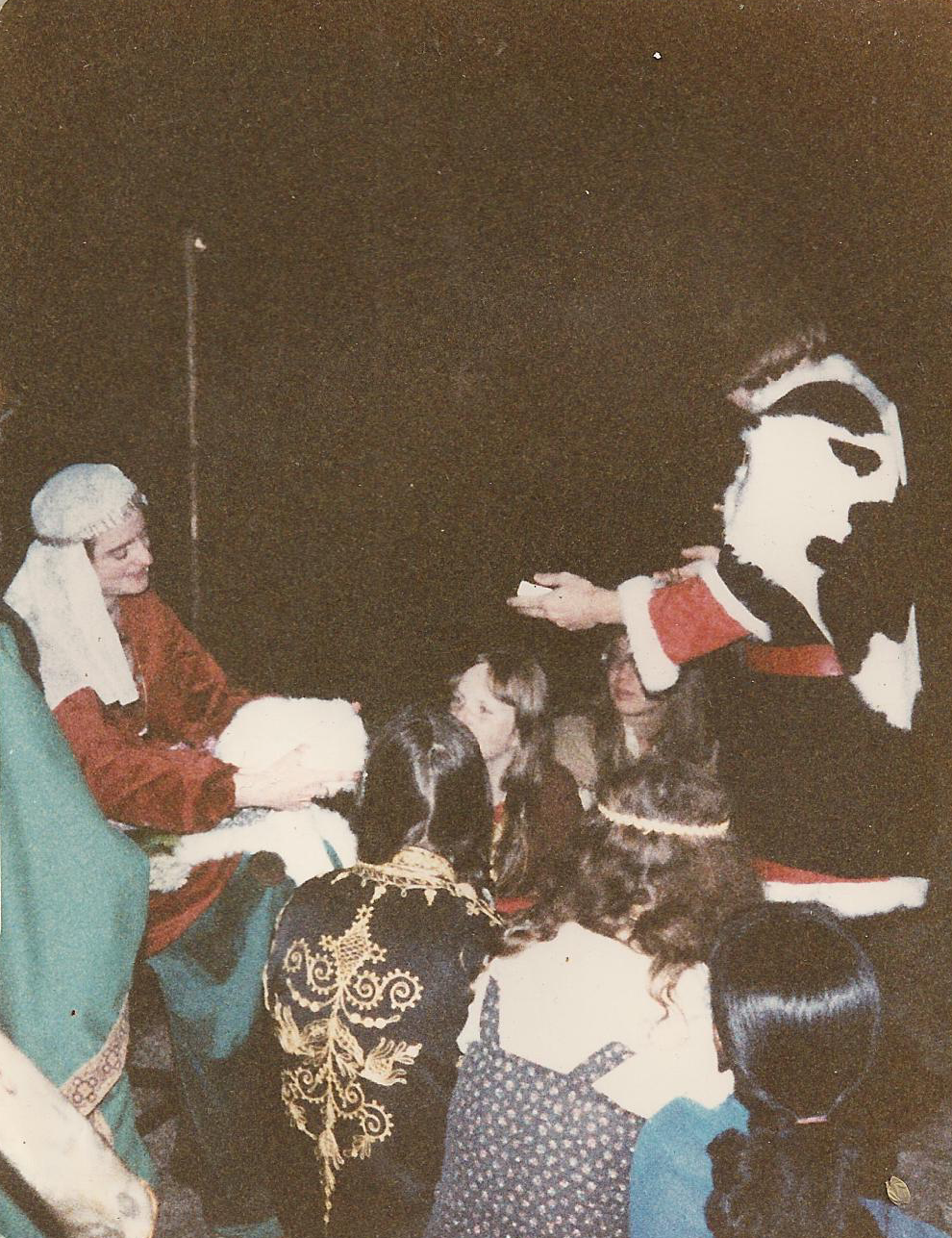
I had gone to some effort to keep the gifts secrets while I was making some of them. But, on presenting them, I downplayed them in a mimicry of modesty designed to draw laughs. For her part, Morag examined the goblets and rabbit skin purse, checking their construction and passing them to her attendants, many of whom made risque remarks. The final gift was what swayed her: phials of saffron, a luxury spice of fabulous price in our medieval period.  After consulting with her attendants, Morag rose and formally handsealed the agreement, making it a formal contract.

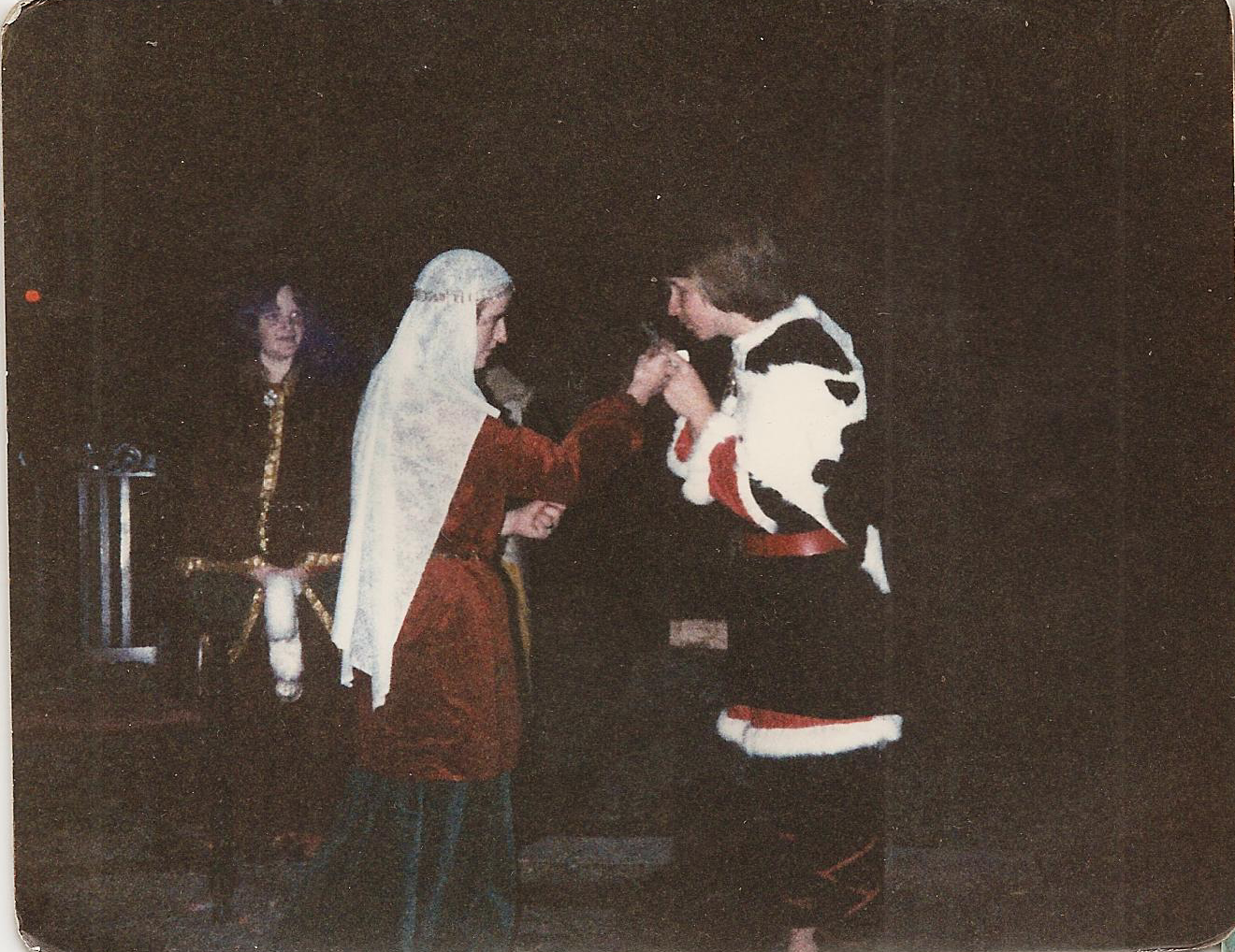
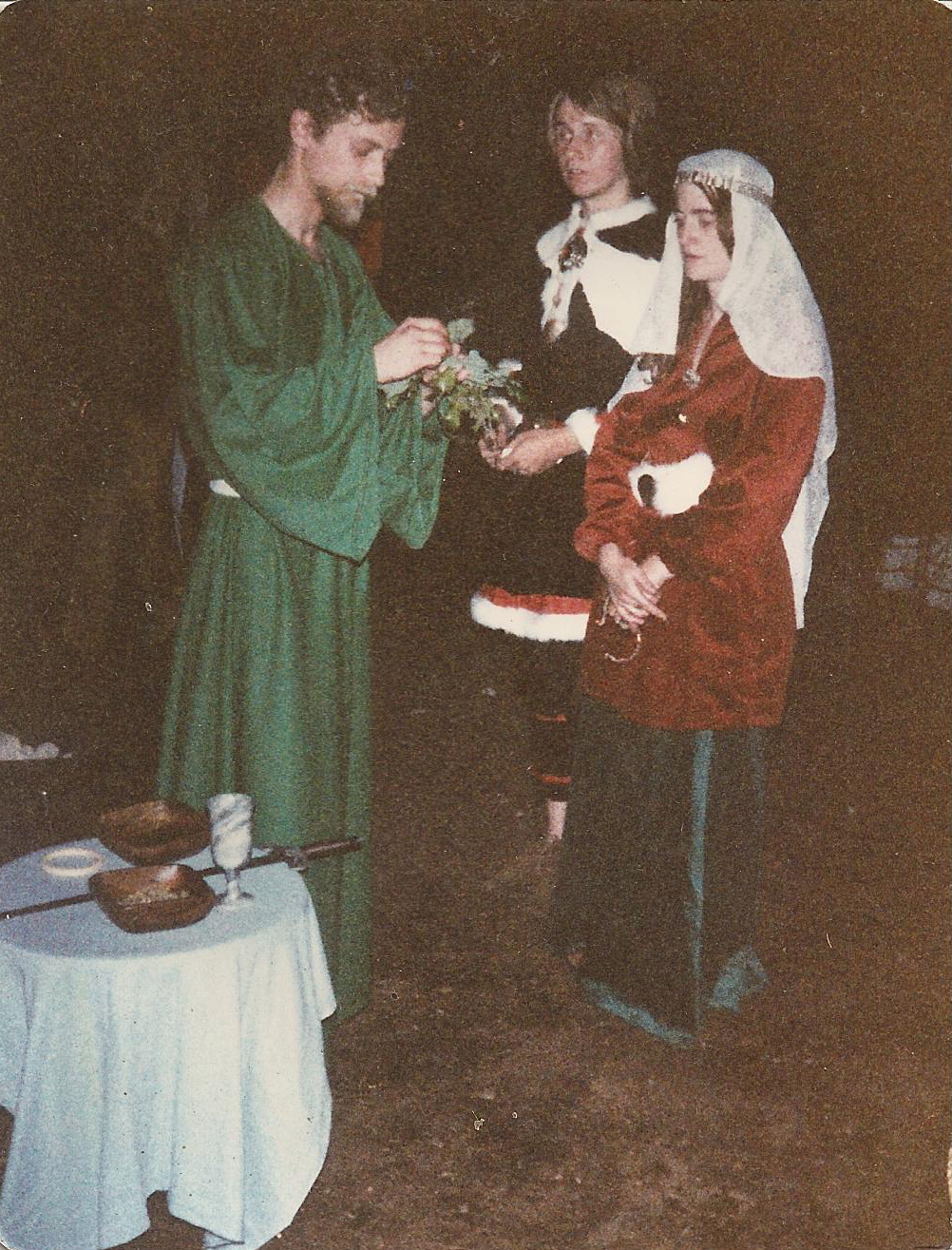
Surrounded by torches (and more remarks), we moved in procession to where the local bard, Daffyd ap Moran (aka Gary Wadham) was waiting in his green Druidical robes. Although not a practicing pagan, Daffyd took his role seriously, fasting for a day before the ceremony. We had a literal handfasting, with our hands tied loosely together by a leather chord, and a ceremony that included us grasping a wooden ring while exchanging vows and copper bracelets made by our friend Jaqueline and drinking at the same time from a marble cup full of mead.
After the mead came the gifts from friends, and singing late into the night. Finally, we retired, with our attendants guarding the tent to prevent the otherwise inevitable chivaree.

Then, just as everyone was falling asleep, a muttering cry of, “Grendel, grendel, grendel,.grendel!” went through the camp. It was Bolverk of Momchilavich, the foremost women fighter of the local medievalists, playing the monster from Beowulf.

Our attendants refused to let us stir from the tent, but we were told that she had wrapped some old furs around her, and had trundled through the camp bent nearly double. She was met at the pavilion by her husband Sir Seamus, who was playing the role of hero. I suspect that the actual Beowulf never greeted his victory with, “I got the mother!” but the next morning there was a giant arm pinned to the pavilion to mark his victory.

The next day, we slept late, and oversaw the final cleanup of the site.. At home, we seemed to require endless trips from the parking garage to our apartment. Most of the boxes we left in the spare room for later storage.

“So that’s marrying done with,” I said as we collapsed on our bed.

“It had better be,” Trish said, and before we fell asleep, I remember thinking that the last twenty four hours were a good memory to have.

And they still are, although the pictures are grainy and damaged, and  we haven’t seen most of the people who  were there for years.

Read Full Post »

Last Sunday, Trish and I would have celebrated our anniversary as a couple. As I have done the previous two years since she died, I observed the day (“celebrate” is hardly the correct word) by taking myself out to dinner. And, as I sat at the restaurant, I had a small moment of personal insight.

I was given a table in the bay window at the front of the restaurant. The table would have been ideal for two people who wanted to focus on each other, but for a person eating alone, it gave two choices: to sit either staring at the wall, or staring out at the dark and rainy street. Both choices meant my back was to the rest of the restaurant.

As I stared out at the cold and damp people hurrying along the street, I reflected that I was lucky I hadn’t been given a seat by the kitchen or the washroom. But I told myself I had better get used to unusual tables, because they were likely to be my lot for the rest of my life.

I sipped a cider and nibbled some bread, considering this prospect. The waiter took my order, and I kept on considering. Slowly, I realized that I was not embittered by the prospect. Nor was I anticipating it, nor resigned to it. I simply knew that was how things would be.

The realization, I discovered, was a profound relief.

Ever since I was widowed, friends have urged me to look for a relationship. At their urging, I have tried to join activities where I might meet someone. Not very seriously, I have tried online dating sites. Once or twice, I have gone out with a woman.

None of this activity led to anything serious. Perhaps it might have if I had tried harder. But the truth is, I never cared enough to do so. I was lucky once – far luckier than the majority of men who marry. Why should I expect to be equally lucky a second time? The odds seemed against me, and, although I’ve been lonely in the last thirty-two months, I don’t mind loneliness so much that I would automatically exchange it for any other alternative.

The truth is, a self-declared eccentric like me is not going to be much attracted to many women. I’m a romantic whose experience of relationship-hunting is decades in the past. Even worse, I’m a feminist, who had a feminist spouse, and I have little patience with the games I’m still supposed to play. Effectively, I’m an innocent with an exaggerated sense of idealism, which means that I would be unrealistic to pretend that these traits don’t substantially reduce my second chances.

No doubt this realization has an element of self-defense. Middle-age is supposed to be a time of settling in to your life. To have your routine routed and your expectations extinguished is enough to make anyone wary of trying a second time. After all, I barely avoided being broken on the facts of my life the first time.

But what I mostly realized while eating dinner on Sunday was that my life over the last two and a half years had fallen into a rhythm. I have meaningful work, and friends and pets. Although I can hardly call myself supremely happy, I am content, and disinclined to search for alternatives.

After all, my maternal grandfather lived alone for nearly twenty years, and seemed to manage a full life. My sister-in-law divorced over a decade ago, and her time has been full of accomplishment. And, clearly, there are some advantages to living alone, like keeping irregular hours when necessary and not being answerable to anyone  So who knows what other ones I might find by accepting my situation instead of resisting it?

For that matter, who knows if I’ll meet someone? I’m not prescient.

Meanwhile, though, please, don’t tell me to hang in there, or that I’ll never know unless I try, or offer any of the other cheerily meaningless cliches that people offer when someone has reached a conclusion that they shy from themselves.

I’m not asking for sympathy, much less direction. I’m describing the place I’ve reached so far, and while the description may appall you if you’ve never been here, let me assure you: for the time being, it suits me just fine.

I’ve things to do and places to see. And right now, doing these things matters to me far more than changing my relationship status on Facebook.

Read Full Post »

On Friday, I was harassed in the local mall. By any standards, it was a trivial incident, but I believe that the encounter gave me, if not insight to what women endure regularly from men, then at least something from which I could emotionally extrapolate how they must feel.

I was walking through the local mall at the end of a long day. I had just come from the gym, and I was unwashed and limping from a minor injury. I was tired, and had just discovered my bank card was missing, and that I needed to add canceling it to my list of errands to do. I wanted nothing so much as to drag myself home and collapse in a hot bath, but I knew that I had at least another hour’s worth of errands. All in all, I was feeling about as attractive as the sweaty towel in my gym bag.

As I neared a kiosk selling spa products, I saw one man holding a tray of hand lotion samples break into a little dance. By the time I reached the kiosk, he had moved to its other side, and a woman in black blocked my path, holding out a tray.

I tried to step around her, and she moved to block me again. Ordinarily, I would have just kept walking, but, as I said, I was tired. Taking the path of least resistance, I reached out for a sample, and rubbed it on my hand.

“Do you have a special woman in your life?” she asked.

Since I’m a widower, that is a bit of a tender point with me. “No,” I said shortly.

“No sister? No friends? No mother? No aunt?”

I replied “no” to each question, becoming increasingly annoyed at a stranger asking me personal questions.

“Let me show you something,” she said. Not thinking, but relieved that the questions had stopped, I let myself to be steered over to the kiosk.

Without asking, the woman grabbed my hand and started demonstrating a nail buffer on my right thumb. She was standing close to me, and her breasts kept rubbing against my arm as she worked. When I took a step away, she followed, talking continually about how attractive regular the products she was selling would make me.

“Younger women just love men who use them,” she told, stroking my hand.

I was more embarrassed than enticed, and I more or less tuned her out. So far as I was thinking at all, I was hoping that the demo would be over soon and I could move on without being polite.

“You’re not listening to me,” she said. “You’re looking at my breasts.” I wasn’t, but she plucked at her top, an action that not only drew my eyes, but exposed more cleavage rather than less.

Abruptly, I pulled myself together and decided that, single as I was, I wasn’t so desperate as to prolong this encounter. “Sorry, I have to go now.”

“No you don’t,” she said with a knowing smile, trying to grab my hand again.

“Yes I do.”

We repeated the same sentences several times apiece. Then I realized that I didn’t even owe her even politeness, and simply turned and left, shaking my head.

The next day, I was in the mall again. I seriously considered taking a roundabout route so I wouldn’t have to pass the kiosk. But I told myself I wasn’t going to inconvenience myself to avoid embarrassment, and made myself walk by.

“Oh, you’ve come back,” she said, smiling. “I knew you would.”

This time, I was rested enough to know that the last thing I wanted was to stop and listen to her.

I held up a hand without slowing. “No, I haven’t.”

I felt better for walking on. But I admit that I was glad that she was helping another customer when I walked by twenty minutes later.

If you’re a man, especially a young one, you might wonder why I didn’t play along, enjoying the contact and the innuendo as long as they lasted. But such things were far from my mind. All through the encounter, I kept thinking that I might be desperate for female contact, but I would never be that desperate. Besides, as irresistible as I might sometimes imagine myself to be, I knew the whole thing was about selling products. I was disgusted with her tactics, and not much pleased with myself for going along with them, however briefly.

In fact, as I retell the story, I find my lip curling in distaste, and I have had to stop several times to calm myself before I could go on. What, I keep wondering, did she see in me that she would imagine that I would be open to these sales tactics? Did she think that, as an older man, I would buy for the pleasure of having a younger woman come on to me? Or was I supposed to buy because I was embarrassed?

I’m not going to be scarred for life by what happened. I am not even going to report the woman, although I’m sure that I’m not the only one she has used such tactics on. But the experience does leave me with a more immediate understanding of a situation that I ordinarily understand only intellectually, or with an imaginative effort.

All the reactions I felt are similar to those I’ve heard hundreds of times from women recounting petty harassment. My annoyance at being imposed upon, going along with what was happening out of a misguided sense of politeness, the sense of being impersonally manipulated by sexuality, the wondering whether I was somehow to blame, the temptation to avoid the place where it happened – despite my gender, I was reacting much the same as many women do in a similar situation.

So, if anyone thinks that I should have enjoyed it, let me assure you that what happened wasn’t flattering and wasn’t a compliment. It was intrusive and annoying, and an over-obvious attempt to manipulate me that is still making me uneasy several days later.

Admittedly, it was only one encounter. For many women, such encounters are a daily occurrence. Quite justifiably, some women may wonder why I imagine my experience worth recording, or how I imagine that I can extrapolate from my experience to theirs.

All I can say is that, if their reactions are anything like mine, I wonder how they endure such incidents – and why. And you can be sure I am going to be monitoring my behavior very carefully from now on, to make sure that I don’t – even accidentally – leave a woman feeling the way that I am feeling now.

Read Full Post »

Six weeks ago, Haida/Tsimshian artist Mitch Adams and his wife Diana were in Vancouver on a selling expedition. We sat on the shaded porch of a Starbucks, and Mitch unwrapped the pieces he hoped to sell to one of the galleries. They included a variety of pipes (“They’ll make you look taller! Cooler!” Mitch claimed), several miniature masks carved from ebony, and a couple of sculptures I would have bought on the spot if I’d had the money. Then Mitch brought out a framed painting from the back of the car.

I remembered the painting. I’d seen it when I was in Terrace the previous April, sitting at the back of Mitch’s workshop. It was a design that he had done while a student at the Freda Diesing School. An injury had left him temporarily unable to carve, so, rather than sit idle (or more like, kibbitzing with the other students, if I know anything), he began to do designs on paper.

At the time, I asked him if he would sell it, but he was unsure of the price, and I had enough to carry back on the plane already. “Throw it in the trunk next time you come to Vancouver,” I said, but, to be honest, I’d forgot all about the piece until I saw it again. However, once I got over my surprise, I was happy to buy it.

As you might guess from the story about its origin, “Haida Box Design” is a formal exercise, but no less interesting for that. Like Celtic knotwork, abstract Northwest Coast designs fascinate me in their intricacy. When you know a bit about the artistic tradition, you can appreciate the breakdown of the figures in a series of basic shapes, each of which is varied by such details as how the thickening of the formlines where they meet is minimized, or the designs inside the U-shapes. At its best, the result is a strong sense of individualism within a detailed tradition – which is certainly the case here.

Adams’ individual touches are numerous. To start with, rather than designing primarily in black, he balances red and black almost perfectly. The design puts round shapes, rather than the more common ovoids, in the center where they can hardly be missed. Many of the lines are straight, rather than curved, as you would expect in most designs on paper, although that would make them ideal for carving. Tapering of the lines is minimal, and Adams makes wider use of thin lines than most artists would.

However, what fascinates me most about the design is how, despite being symmetrical, it manages to avoid some of the stiffness usually associated with symmetry – especially to a modern eye, trained to consider asymmetry of design the norm. Day after day as I’ve done my morning stretching exercises, I’ve watched the piece and considered the elements that undermine the potential symmetry.

First, there’s the easy interchange of figure and ground between the black and red that changes depending on what you focus on. Then there’s the mild variation of rounded shapes in the center of the design. Most of all, however, what really offsets the symmetry are the shapes positioned on an angle.

All things considered, I’m tempted to say that I’d appreciate seeing “Haida Box” design carved in yellow cedar and painted. The only thing that keeps me from doing so is the fear that, the next time we meet, Mitch will present me with exactly that, and I won’t be able to resist pulling out the cash to buy.

Read Full Post »

This early in the month, I have no pressing deadlines, so I took the afternoon off to wander the Circle Craft Christmas Fair. There, I wandered the endless aisles of crafts, a little nostalgic for the years Trish and I browsed similar fairs, vaguely looking for one or two things and, as usual, spending most of my money of food (two tins of carmels, coated nuts, and three types of feta). Many of the wares, I noticed, were poor quality – and I was being scornful when I suddenly realized that the lack of quality was probably deliberate.

I was in the mood to notice quality, because I had recently discovered a source of hand-made shoes. Wearing these shoes not only solved most of the problems I’ve been having with my feet for the past eight years, but made me notice how the shoddiness of most of the shoes people are wearing. I’m like that: when cramming to buy a car, I notice all the cars on the road, and, when I was learning design, part of me critiqued every sign on the street. Periodically, I have these small bursts of obsession for a week or two before reverting to what passes with me for normal.

Yet even without this fading obsession, I would have noticed anyway. I grew up with a father who brought do-it-yourself to new heights. Trained as a painter, in the process of building two houses and customizing a trailer and two vans, he had to teach himself everything from electricity to plumbing. Since he had a limited education, learning these trades couldn’t have been easy, but he managed a rough competence in all of them except cabinet-making, and even then he managed to figure out enough work-arounds to substitute for not having years of apprenticeship. Consequently, although I usually can’t produce competent work, I know it when I see it.

This afternoon, I couldn’t help but notice that as many as one in three or four of the vendors were selling clothes or handicrafts simply weren’t that good. If they sold jewelry, they were cutting the metal to shape, not casting. If they were weaving, the result was loose and slightly irregular. If they were working in metal, you could still see the marks of the tools, particularly the hammer. If they had cut something from wood – even a square cutting board – they had apparently not measured or bothered to square the corners. And so it went, all too often, no matter what the craft, with merchandise being offered for sale at premium prices that was often crude and unfinished.

Yet, strangely, the low quality didn’t affect their business. Often, I thought the reverse was true, and that they were doing a brisk business because of the low quality.

I suppose, however, that this reaction is inevitable in the days of automation. To moderns, perfectly regular, perfectly fitted merchandise is the norm. Without irregularities, even crudity, we would never know that something was handmade.
It didn’t used to be that way. Two centuries ago, artisans prided themselves on the quality of their work, producing a perfect curve in a china teapot, or finishing a piece of jewelry to mirror-like brightness.

But today, an artisan with that level of skill would only be reproducing what a machine could do much more easily, what we see every day. And what would be special about that? The perception that buyers were getting something unique would be lost if a craft vendor sold something that looked no different from what you could find in a shopping mall.

You might say that craft vendors today are not just selling their skill, but that illusion of uniqueness. They are leaving flaws, not because only their deity is perfect but because, by today’s standard, only machines are perfect.

The exceptions are very few. Often, too, they require a trained eye to appreciate them. Several times, I have seen people who balked at paying several thousand dollars in a Northwest Coast gallery in Gastown, walk out on Water Street and pay ninety dollars to someone on the street to someone with a single knife for a tool and no understanding whatsoever of the tradition they were vaguely imitating.

The buyers seemed satisfied with the street vendor’s carving, and not just because of the price. Judging from what I overheard them saying, they seemed to feel that what they were buying was somehow more genuine than work done by artists who had spent decades perfecting their skills.

Such attitudes may be unavoidable, but they annoy me profoundly. So long as these attitudes exist, what incentive do artists have to perfect their crafts? In some cases, artists must even hold back deliberately. Perhaps they even add errors if they want to sell. All these possibilities amount to a cheapening of the artistic process, yet, if artisans want to make a living, what choice do they really have?

Read Full Post »

The mother of a friend of mine once said that he had raised himself to be a knight. She didn’t take any credit for the fact – she simply observed it, which it made it the best compliment of a child by a parent that I have ever heard. I knew instantly what she meant, because I had done much the same with Robin Hood, or at least Roger Lancelyn Greene’s version of him.

To this day, I happily devour any retelling of the stories. Robin McKinley’s The Outlaws of Sherwood, Parke Godwin’s Sherwood and Robin and the King, the Child Ballads, the Robin of Sherwood series that made him a mystical figure associated with Herne the Hunter, Robin and Marian featuring Sean Connery as the aging hero, the recent BBC series, the Errol Flynn version with Claude Raines as the Sheriff – all are part of my mental baggage, with what for me is an unusual lack of concern for quality. I’ll even watch Kevin Costner’s Robin Hood: Prince of Thieves, an admission that shows just how indiscriminate my obsession really is.

You see, for better or worse, a good part of my ethical standards was consciously modeled on Robin Hood, to say nothing of my politics as well. Only King Arthur and the Knights of the Round Table came anywhere close to be as influential, and Robin Hood – despite being the Earl of Huntington – had the same ethics without the sense of class and privilege. He wasn’t even much of a sexist, loving a woman who shared his dangers, rather than languishing at home like Queen Guinevre.

So what did I learn as a child from Robin Hood? Far more than the manly virtue of courage. I learned that I was supposed to be polite to everyone. That I was supposed to be a good sport, even if I had just been thwacked on the head by Little John or dumped into the stream by Friar Tuck. That I was to value honesty and abhor hypocrisy. That I was supposed to help people, even at inconvenience to myself. That I was supposed to face danger cheerfully – and this, and a hundred other things besides.

However, none of this would have impressed me by itself. I could learn the same values from Baden-Powell’s Scouting for Boys – never mind that I later learned that Baden-Powell was a traitor to his own standards, having starved the local Africans to keep his British troops alive during the siege of Mafeking during the Boer Wars.

What really impressed me was that, unlike the propaganda of the Scouts, or even the followers of King Arthur, Robin Hood decided for himself. Rather than acquiesce to things that were legal but immoral, he became an outlaw, and he enforced his own sense of right and wrong while he was in Sherwood no matter how anyone else condemned him. Greene never used the phrase, but his Robin Hood lived by a higher morality, deciding for himself where right and wrong lay.

Of course, the anarchy of Sherwood cannot last, and Robin Hood ends by being pardoned by King Richard. But even as a boy I understood that end as more symbolic than anything else: King Richard is the source of the law, and his approval amounts to a public acknowledgment that Robin Hood’s code of behavior was correct, no matter how eccentric it happened to be. The idea that he was substantially changed by his reintegration into society is quashed by his last moments, when he forgives the Prioress for poisoning her and tells his followers not to avenge themselves upon her.

Part of me wants to laugh at this set of ethics, but I can never manage to be quite so flippant. Robin Hood’s example helped me through the worst stage of my life, when only a handful of people believed in me.

At other times, his example is difficult. For example, while I believe in acknowledging when an opponent has done something ethical, I often suspect that belief only serves as a handicap. Certainly few of my enemies have ever reciprocated in kind.

However, at his best, Greene’s Robin Hood embodies a generosity of spirit that I can’t help but admire. I have often fallen short of imitating this generosity, but the idea that I should try to is lodged too firmly into me to ever root out. No matter how cynical or disillusioned I might become, the lessons I learned from reading Greene’s book into oblivion are likely to remain with me for the rest of my life, even if spend my last few years senile.

Read Full Post »

Of all the concepts I discovered at university, few had greater impact on me than type theory – not Betrand Russell’s mathematical application of it so much as Gregory Bateson’s application of it to psychology. I picked it up as part of my study of General Systems Theory, a popular intellectual fad of the times, and was lucky enough to have several classes with Anthony Wilden, one of the leading theorists in the field. Probably, Wilden’s originality and passion would have been enough to imprint the idea on my mind, but the main reason that type theory became a part of my thinking was that it explained in a satisfyingly complex way matters that would otherwise be inexplicable.

For Bateson, logical types were useful as a description of how information was organized. In a simple example, an organ like the heart and liver is of a higher logical type than a cell, while the body is of a higher logical type than an organ – higher, not in the sense of being superior, but of being composed of elements at a lower level.

For understanding how a body functioned, levels are useful because each one shows different characteristics and behavior. For example, consciousness is characteristic of the body as a whole, while a variety of chemical reactions such as the exchange of oxygen, take place at a cellular level.

Right away, this distinction has the advantage of reformulating apparent paradoxes. For instance, using type theory, “I am a Cretan. All Cretans are liars” can be quickly dissected to make sense. These statements are meta-statement, a statement about statements,” and is therefore of a higher logical type. As such, their truth needs to be evaluated separately from statements made at the usual level of discourse, and no paradox exists.

Similarly, philosophical discussion about individuals vs. society turn out to be in need of reformulation. Being at different logical levels, individuals and societies cannot be said to be at odds with each other, any more than your heart can be said to be at odds with your body. But if you say instead, “how can individuals and society interact for the benefit of both,” you have gone some ways towards focusing the subject and of increasing your chance of saying something meaningful.

Bateson used this set of intellectual tools to develop double-bind theory, the study of the psychological problem poised by a hidden meta-statement. For example, “Be spontaneous” contains two statements: first, a command to act naturally, and, second, a meta-statement to obey the speaker. The recipient of these commands cannot obey one without disobeying the other. Instead, they can only oscillate between the two. Bateson called such a situation a double-bind, using it to suggest that schizophrenia was the result of trying to live with a situation – an idea that R. D. Laing was to take to such flamboyant and extreme lengths as to discredit it in many people’s minds.

Later theorists went on to suggest that double-binds explained a great deal of human behavior. They suggested that it was a key form of social control, on both a political and a family level – present someone with a double-bind, they suggested, and they are kept too confused to question or rebel. Only if someone recognizes the structure of the double-bind – or, better yet, removes themselves from the situation in which they have to deal with it – can they hope to accurately assess their situation.

However, even in less pathological situations, those who came after Bateson found type theory useful. The idea that unclear communication exists because people are unable to separate statement from meta-statements suggests that any interaction is far more complex than it first appears.

For instance, a couple that bickers should not be explained just by the ostensible subject of the current argument, which is often petty. Rather, the argument should be read as having a level in which the couple are disputing their relationship. However, because neither realizes what they are really arguing about, the petty subject can be discussed almost endlessly.

I am well aware that type theory and double-binds have been criticized. But, as soon as I first read about them, they struck me in much the same way as Orwell’s analysis of how language can be used to corrupt communication instead of encourage it: both were concerned with opposing pathology and trying to describe what was really happening, rather than what appeared to be happening.

My conviction about the usefulness of type theory in dealing with people has never faltered since. Countless times, it has allowed me to de-rail an argument by suggesting that I and the others involved were really talking about something else rather than whatever had started us snapping.

It doesn’t always work, because, sometimes people would rather argue than reduce their differences. But, even then, it leaves me with an understanding of what is happening, which I far prefer to be mystified about what is going on.

Read Full Post »

“You can trust in the power of music,
You can trust in the power of prayer,
But it’s only the white of your knuckles
That’s keeping this plane in the air.”

– Oysterband, “Dancing as Fast as I Can”

Probably, it is no accident that, as North American culture has grown less religious that affirmations have become increasingly popular. Today, affirmations have become a form of secular prayer, used by New Agers, athletes, and many religious groups – yet the only evidence that they work is anecdotal.

Affirmations are verbal or written statements whose repetition is believed to help people accomplish their goals. A classic example is Émile Coué’s “Every day in every way, I am getting better and better,” but there must be millions in use, some of them long and specific.

So far as I know, no one has traced the history of affirmations. However, I suspected they have multiple sources. Besides the secularization of society, they may also reflect the rise of the middle class, and a standard of living that gives people the illusion of having far more control over their lives than they actually do, so the idea that a magical chant can help them influence the workings of society or the universe actually seems plausible to large numbers of people. Perhaps, too, affirmations are a kind of watered-down form of behavioral theory.

But, whatever their origins, affirmations were first popularized by early business writers such as Napoleon Hill and Norman Vincent Peale in the 1930s and 1940s. They received a boost in the New Age belief structures that emerged in the aftermath of the counterculture of the 1960s, spreading until, today, most North Americans must have tried them at least once for everything from quitting smoking to getting a job promotion.

My own experiments with affirmations came while I was a long-distance racer in my teens. Encouraged by coaches and some older runners, I did my best to make them part of my training regime for about six months. They had no noticeable effect on my speed or times, or on my efforts to train regularly, but they did some use on focusing my attention on a simple, immediate goal.

For example, during one Chandler Memorial race from West Vancouver to Kitsilano, I was determined to beat a rival from Burnaby with the last name Reid. As the runners snaked over the narrow sidewalk on the Lions Gate Bridge, he was ahead of me, but I could do little to pass him. However, as I wound through Stanley Park, I began thinking over and over, “I fly, Reid dies.” By the time I had left the park, I had passed him, and repeating the simply rhyme helped me maintain the steady pace I needed to pull far ahead and finish the race.
For more complex, more abstract goals, however, I never saw any evidence that affirmations helped any more than simple determination.

Searching the web suggests more or less what I concluded independently. There’s no shortage of testimonies to the power of affirmations, nor of cheery assumptions that they can improve any aspect of your life (and that, if they don’t, you must be using them incorrectly).

But scientific evidence? If many attempts to study affirmations have been done, most of them have apparently never found their way on to the web. Possibly, researchers are embarrassed to investigate such a central part of pop culture, or wary of the unwelcome attention from true believers they might receive.

Such studies that exist give little reason to believe in them. One study mentioned briefly online suggests that affirmations can actually make people with low self-esteem feel worse. The news item is to brief to give any detail, but I suspect that when the gap between reality and the goal is too great, repeating the affirmation makes the discrepancy harder to ignore.

Otherwise, hard evidence is practically non-existent. Probably the closest to any study of affirmations are the various studies of prayers. At best, these studies suggest that praying may temporarily improve a person’s mood. No correlation between prayer and any external effect such as healing or influencing events has ever been found, aside from one poorly designed experiment that was quickly discredited – although it continues to be cited by those who wish to believe in the power of prayer.

Not that this lack of evidence is likely to convince those who have made affirmations part of their daily routine. As Garry Trudeau, the writer of Doonesbury, once said, the beauty of pseudo-science is that you can always find an explanation why a belief doesn’t work. Affirmations are part of the superstitions of our times, and few people care to question them. Instead, if affirmations fail them, they will decide they need to try harder, or that something else went wrong, and continue with their belief systems unchallenged.

Read Full Post »

The older I get, the more I become convinced that most debates are a clash of half-truths. Instead of one point of view being right and the other wrong, almost always each has a limited validity. Necessity or pragmatism may mean that I need to choose a side, but my support is increasingly nuanced and qualified by context.

One of the latest examples of this perspective is my reaction to a discussion on the Geek Feminism Wiki. In response to a guest post, one commenter mentioned that they were put off by the amount of swearing in the post. A second commenter immediately said that the first was using a tone argument, and others quickly joined in.

A tone argument, for those who have never heard the phrase, is one that, rather than addressing what is said, focuses on how it is said. Feminists, for example, are frequently told that they might convince more people if they used a politer tone. Logically speaking, such an argument is irrelevant to a discussion, which means that, by invoking a tone argument, the second commenter was discrediting the first, condemning the objection to swearing as invalid.
.
What nobody in the ensuing discussion seemed to consider is that both positions might be true depending on context. Yes, by the highest standards of logic, a tone argument is a fallacy. How an idea is expressed does not alter how convincing or accurate it is, and complaining about the tone is basically an emotional appeal – often effective enough at swaying an audience, but unfair in any attempt to have a rational discussion of the issues.

Yet, at the same time, when you consider rhetoric as an art, the way the classical Greeks and Romans did, you would be rash to deny that tone is completely irrelevant. A writer or speaker who prides themselves on being ethical would avoid relying only on a tone argument, but no writer or speaker of any skill would refuse to think of tone as a useful support for whatever they were arguing. If nothing else, the chosen tone would vary depending on the audience. Usually, too, it would vary depending on exactly what response the writer hoped to encourage in the audience.

However, this does not mean you have to practice double-think and believe that both are simultaneously true. Instead, it means that you have a Schrodinger’s cat sort of situation, in which both perspectives are true, but only until you consider the context.

In the case of the argument about swearing and tone argument, the context depends on the motivation of the original comment. Was the disapproval of swearing meant to derail the discussion? Then it was a tone argument, and deserves not to be tolerated. But, if it was a meta-discussion, a discussion about the discussion, then it becomes a valid commentary, and bringing up tone arguments becomes an effort at derailment in itself.

What complicates this example is that, within the context, which is happening is difficult to determine. The written word is generally less subtle than the spoken word, and, unless I am mistaken, the first commenter is not well-known on the Geek Feminism Wiki, so anyone likely to read the exchange probably has no idea what their opinions might be.

Since the commenter writes that, “anyone with a strong point should be able to make it without swearing,” I suspect it is a meta-comment about technique. However, the comment is too short for me to have any strong confidence in that verdict.

Personally, that lack of certainty would have been enough for me to hesitate to mention tone arguments. However, choosing a side is always quicker than considering the possibilities of all sides.

The trouble is, once you support the idea that tone arguments are a fallacy that is particularly used against women, then your position can quickly degenerate in an either-or position in which any mention of tone is something to avoid, regardless of the circumstances. In the same way, insisting that mentioning tone is no more than a matter of technique, you can just as easily condemn the idea of a tone argument as being overly punctilious.

Even worse, taking either position as your own means that you can descend into an endless argument in which there is no right or wrong, not because they don’t exist, but because you are ignoring the circumstances that would determine them.

Increasingly, that is what I notice about many arguments – not just the utter impossibility of ever reaching a conclusion that might satisfy everyone, but, beyond that, the crushing futility of exchanging half-truths. After all, a half-truth is also half a lie.

Read Full Post »

My partner Trish loved miniature roses. At one point, she had over forty plants on the balcony of our townhouse and on the courtyard outside. On weekends, she would spend several hours in the morning caring for them. Then, when we did errands in the afternoon, she would take the flowers, wrap them in moist paper towels if it happened to be a hot day, and distribute them to the staff of the stores and services we visited. If any were left over, we put them on display in vases about as high as my thumb, mostly around the computer.

They were very much her concern. I appreciated them as little points of symmetry and color, as well as for their names – Pinstripe, Pandemonium, Cartwheel, Carousel, and Black Jade – but had little to do with them except when buying one occasionally for her.

At one point, Trish had over forty plants. However, by the time she died, the numbers had dwindled to half a dozen, partly through normal attrition, but largely because her final illness kept us busy with more basic concerns.

By the time I had steeled myself to clean out the remains, they were down to four, two of which were not looking overly healthy. Never having been a gardener, I didn’t mind too much. I had more basic things on my mind, and I gave them minimal care only because I associated them with Trish.

But about a month ago, I bought some basil, which I use in spanakopita and lasagna. Somehow, the splash of green made the living room more home-like.

Inspired by that realization, I decided to bring the surviving Black Jade inside. Far from its former glory, it is now a sprig barely twelve centimeters long, clinging to the original root structure, and I thought it needed some shelter in order to survive the winter. Like the basil, it seemed to make my surroundings more comfortable.

Then, last week, I was walking through New Westminster when I saw a half dozen miniature roses on a rack outside a dollar store. One, I was sure, was a Black Jade. On impulse, I picked it up as well as two more.

At home, I put the white and peach flowered plants on the television cabinet, and the Black Jade on the tea tray that I use for a coffee table. They seemed to crowd the living room a bit, but, considering their effect, I decided they belonged there.

They’re not a shrine to Trish. Thirty months after her death, that would be desperate, and more than a little pathetic. But they are a memory of happy times, and they relax my eye as much as the art on the walls.

Read Full Post »

« Newer Posts - Older Posts »