Feeds:
Posts
Comments

Archive for the ‘Bruce Byfield’ Category

Last week, I flew into Terrace to attend the end exhibit at the Freda Diesing School of Northwest Coast Art.

Of the four year end exhibits I’ve attended, this years’ was the weakest, with the fewest number of pieces on display and the lowest quality, but there were compensations. The show was partly a reunion of alumni, with former students such as Mitch Adams, Latham Mack, John Wilson, and Carol Young in attendance. And, as always, Waap Galts’ap, the longhouse on the campuse of Northwest Community College in Terrace, made for a setting that was both aesthetic and relaxing.

Nor was the show entirely lacking in pieces worth lingering over.

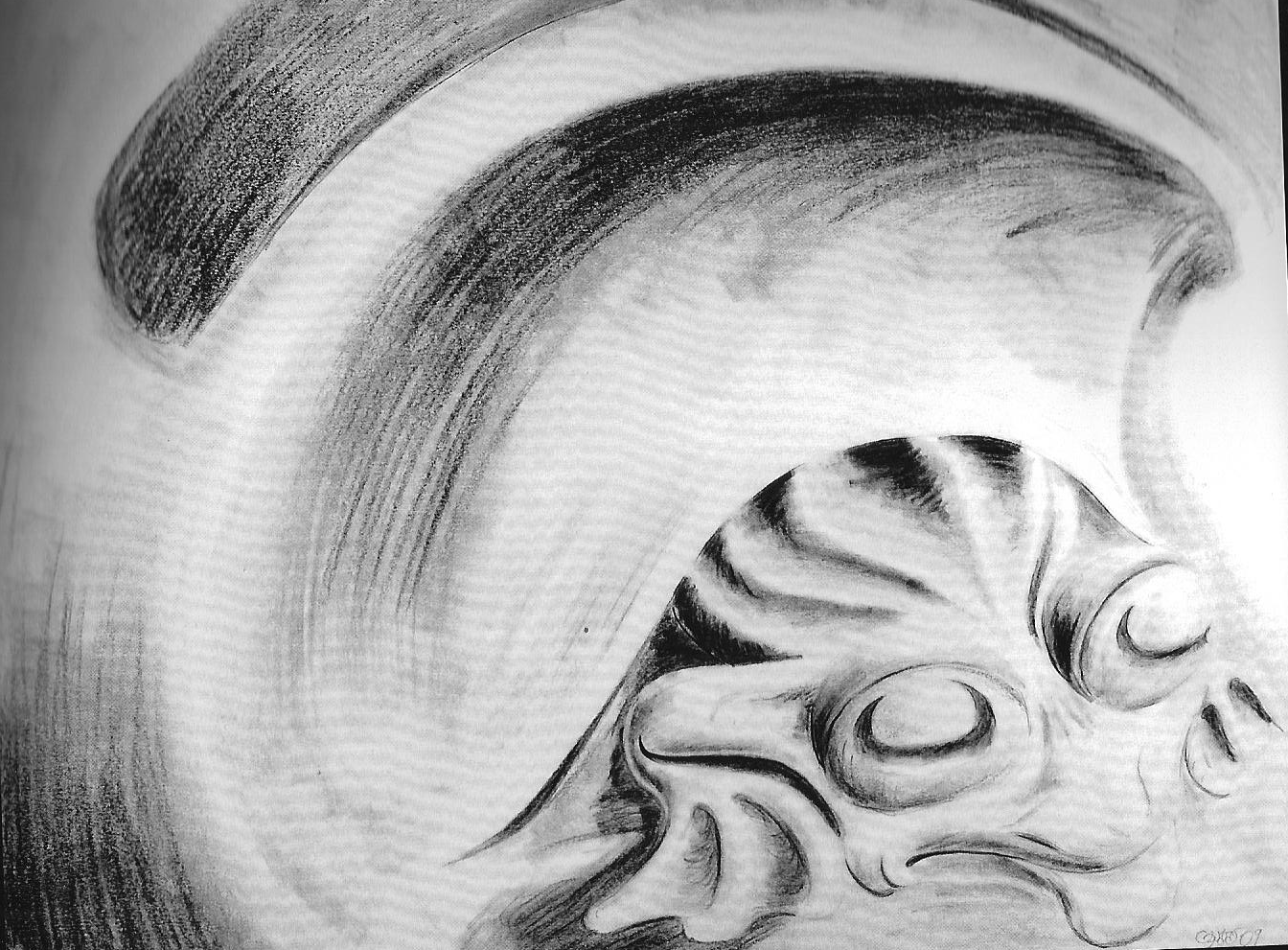
Larry Darrick displayed an abstract panel design that was all the more striking for being in black and white:

Darrick’s “Boogie Mask- Myth of Hairy Man, Bigfoot & Boogie Mask” was also worth a second look for its use of woven cedar for its mess of hair, although its copper nostrils and eyebrows seemed more elaborate than the simplicity of the carving would justify:

Among the spoons and bowls, the painting and lines of Lyle Mack’s “Transformation Spoon” was noticeable, so much so that I found myself wishing he had finished a mask or a painting for the show:

I was especially pleased to see that some of the high-quality work was done by last years’ winners of the Mature Student Award, which I sponsor. Barry Sampare, last years’ winner, showed more attention to detail and finish than most students:

Similarly, Evan Aster, who last year received an Honorable Mention for the Mature Student Award, displayed the same attention to the painted design as in last year’s exhibit to produce a mask of mildly eerie paleness:

Last year’s other Honorable Mention, Moses White, produced the strongest work of his that I’ve seen to date in “Oil Stained Warrior – Blood will spill before oil.” White’s mask had one side slightly higher than the other, but managed to be eye-catching just the same.

One of the standouts of the show was Nathan Wilson, who has already had some commercial success in the galleries. His “Defend the Village: Warrior Mask” seemed to show traces of the influence of John Wilson, with whom he worked privately in the past, but the boldness of design, as well as the mixture of materials (alder, horse hair, abalone, cedar bark, acrylic) was a a rare example of embellishments not overwhelming the design:

My only regret was that Wilson was not displaying more in the show.

First year student Jared “Citizen” Kane was another standout, with prints that were somewhat lacking in detail, but intricate enough that I bought both of them:

Still another standout was Paula Wesley, who plans to continue her art studies at Emily Carr next September. Although Wesley’s carvings looked a little rushed, and were not her best work, her two-dimensional pieces showed a pleasing discipline of line and a complexity of design, as in her “Releasing the Light”:

Wesley also created one of the strongest pieces in the show, a family box design that, had it been for sale, I would happily have bought:

However, pride of place in the show literally went to Kelly Robinson. Already a professional jeweler and painter, Robinson showed that he is equally promising as a carver. The central area of the exhibit was dominated by a display case with a spoon by Robinson, while two of his masks hung facing each other on either side:

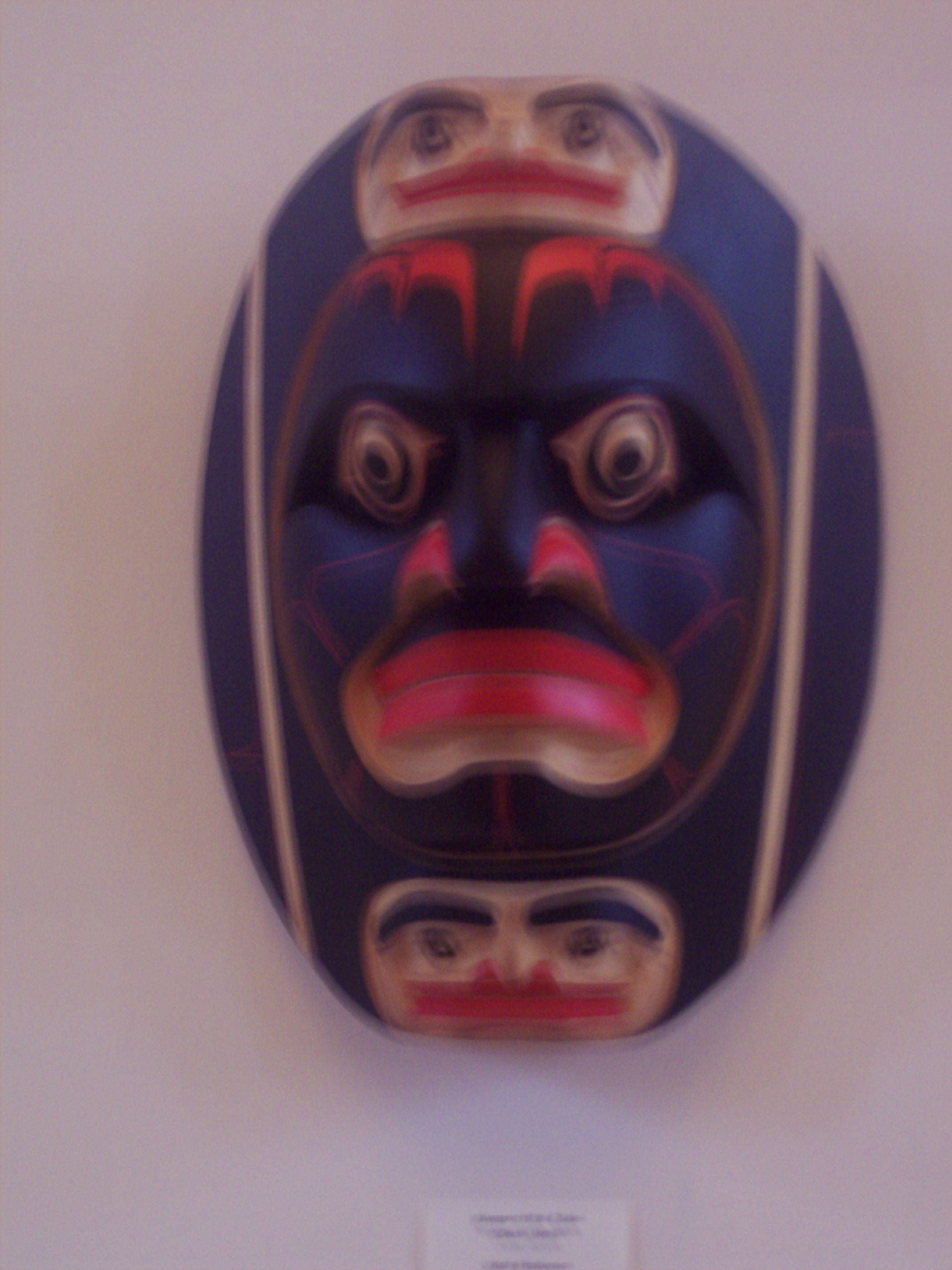
In addition, Robinson’s painting, “Box Design (The 4 Carpenters)” hung at the main entrance of the longhouse, and was the most accomplished piece of the entire show:

The title refers to what might be called the celestial contractors in Nuxalk mythology who were charged with making the sun and other aspects of the world. The painting has a boldness and a mixture of traditional and contemporary that many visitors to the show admired, and I am proud to say that it will soon be on my living room wall.

With such artists as Kane, Robinson, Wilson and Wesley, the show was still worth seeing, and, as in past years, both the students and instructors couldn’t have been more welcoming. I look forward to seeing what the grads do next (and maybe buying more of their work), and how the first year students improve after another year of instruction.
Read Full Post »

List stories are one of the most heavily criticized forms of journalism. According to detractors, list stories show a lack of thought, and are simply a lazy way to produce an article. However, I believe that, with a little planning, list stories can be as legitimate a form as any other. They simply have different considerations from most types of journalism.

Not that the criticisms aren’t justified. The structure and logic of list stories are different from the typical story. Instead of offering an obvious path of development of the central idea, list stories are constantly starting over again.

It’s also perfectly true that list stories often feel easier to write than an in-depth story that builds on a single point. Instead, list stories rarely have room to go beyond the general. As a writer, you just start to get into the discussion when it’s time to move on to the next item in the list. Rightly or wrongly, this can feel much less demanding than sticking to one topic throughout the article.

Still, I like list stories – maybe because one of my strengths or weaknesses as a writer is that I’m always tempted to make lists. Instead of squeezing the lists into conventional paragraphs, sometimes it just seems easier to give in and acknowledge the point by putting list items into a bullet list or using sub-headings.

If nothing else, a story divided by bullet lists or sub-headings looks more approachable online. Its blocks of text look smaller because they are divided. There are fewer formidably long paragraphs, and readers have more natural places to pause and return to the article later. Particularly on-line, you have more chance of being read if you organize your thoughts in a list than a conventional story.

Besides, list stories are a good place to use random thoughts and observations that are too short to make stories in themselves. All you have to do is generate some related points to go along with them – which is easier than it sounds, because often one point suggests another.

Developing the story

The trick of writing a successful list story is the same as with any article. You need to find what William Goldman calls “the spine of the story:” The central, unifying idea that justifies talking about all the points in the same story. Without the spine, a list story is just as bad as critics contend that it always is. With the spine, a list story can be as meaningful as any other piece. State the central idea in the introduction, and you’re well on the way.

Then there’s the question of the points themselves. For the article to work, all the points in the story need to be as strong as possible. Since you don’t have much space for each point, any that are vague or obviously padding are going to stand out.

At the same time, for some reason — call it the unspoken numerology of popular culture – some numbers of list items seem to be more widely read than others, such as 7, 9, 11, or 12. Any fewer than seven items looks more like a teaser than a story, while some numbers, such as 6 or 8, simply look wrong somehow.

But, in reaching one of the magical numbers, you need to be careful to avoid padding. Instead, you need to think more deeply, or perhaps see if any of the existing list items is complex enough to be divided into more than one section. If so, as a bonus you have at least two items than can follow one another, the second maybe referring back to the first and thereby increasing the unity of the entire article.

Pay attention, too, to the order of the list items. I always think in terms of what I call “relay order,” based on the order of runners in a team race in track and field. Typically in a four-runner relay race, coaches would have the second fastest runner begin, followed by the third and the fourth and ending with the first. By approximating this order, you start off strongly and end strongest of all. The middle might sag a little, so you want to mix the stronger points with the weakest so that there isn’t a downward descent in interest.

By the time readers reach the end, the original statement of the unifying theme may have grown vague with the details, especially with a longer article. For this reason, a list item needs to end like any other story, with a re-emphasis of what you want readers to take away. Nor does it hurt to explain why what readers have just read is interesting or worthwhile.

 More than a list

Done thoughtfully, a list item is more than a collection of random thoughts. It may look simple and unassuming, but, behind the scenes, a conscientious writer needs to have a good idea of what the points add up to, and be ready to experiment with the order of items as they write. Often, you’re only know the most effective order after you write.

But that’s another part of what makes list items so suitable for online articles. Text editors and word processors are all about rearranging blocks of text – and, with list stories, you’ll have plenty of opportunities and needs for rearranging before you’re done.

Read Full Post »

I’ve never been a supporter of proprietary formats. So far as I’m concerned, they’re an imposition on the rights I acquire when I buy. But knowing something intellectually is one thing, and knowing something deep-in-the-gut, blind-raging and foaming at the mouth is quite another, as I discovered recently when I bought an audio book.

The fact that I eventually managed to access my property is entirely besides the point. The access was all of my doing, and none of the manufacturer’s. In fact, if I wasn’t so bloody-minded, I would have given up entirely. As things were, I ended by spending half the price of the purchase again just so I could do what I have a right to do.

OK, part of the blame is mine. I should have known that the promise that I could freely play the ebook I purchased on any of my devices was too good to be true. The manufacturer wasn’t proclaiming its dedication to open standards with that statement, which is how I interpreted its statements in my eagerness – it meant that I could play my purchase on any devices so long as was willing to load the manufacturer’s codec on the devices just so I could play that one purchase.

(Actually, from accounts on the Internet, the promise didn’t even mean that it. It meant any device that the manufacturer had arranged for a hardware manufacturer to pay for for support.)

After I downloaded my purchase, I quickly discovered how I had been misled – or misled myself, perhaps, through excitement. My purchase wouldn’t play on GNU/Linux, like any decently open or semi-public format. I found a seldom-used netbook computer that still had a Windows partition on it, and discovered I could play the proprietary format in iTunes. So at least I could listen.

However, I didn’t want to start up another computer whenever I wanted to listen. Nor did I want to use Windows, or to carry the netbook around, nor to have seven hours-long files. Why? Because I didn’t want to, that’s why, and I shouldn’t have to give any other reason.

All I had in mind was to listen on the operating system of my choice or maybe a music player, with files in a format I could play and divided neatly into individual stories for my private use – all modest and completely sensible goals, I think you’ll agree.

Trusting that where there’s a proprietary format there’s a way, I searched the Internet. A few pieces of software from companies of which I never heard promised to do the conversion for me, but I was dubious.

Then I discovered that iTunes included a loophole that the proprietary manufacturers hadn’t considered: the ability to burn playlists to audio CDs in .wav format.

However, as part of the plot to drive me mad, the function is a feeble ghost of what it should be. For one thing, it doesn’t burn to DVDs. For another, while it supports using multiple CDs on large files, with each new CD, it has to scan the source all over. As a result, each 80 minute CD takes some 12 minutes to burn. When you’re dealing with files seven hours long, that’s a lot of delay. It’s as though iTunes executives rationalize that, just because making a backup copy for personal use is a right in many countries (including my own), that doesn’t mean that anyone has to make creating that backup easy.

My conviction that the manufacturer wasn’t going to make things easy took another giant leap when I discovered that the files were all in ten minute segments, each labeled with another writer’s name — a mistake so amateurish that it seems designed mainly to add to the confusion. At times, too, the last minute or so of one CD would overlap with the start of another CD, so I had to listen carefully when the breaks came.

But the resulting files would at least play on my computer of choice, and I used the free software sound editor Audacity to splice them together, tantalized by the few seconds I heard while working.

Of course, it takes time to copy seventeen full CDs over to the hard drive, and still more time to reassemble the 170 files and to manually rip them into stories. Let’s call it a long evening’s project that was only slightly less fun than washing dishes for five hours. Only a fanatic would have bothered, I’m sure.

But now I’m done, and finally I can sit back and enjoy the stories.

Still, my enjoyment is tempered by the extraordinary efforts I required to do such very ordinary things when, by any sane standard I have absolutely no criminal intent. There’s a basic lack of respect for customers in such practices, no matter how widespread they are — and, after going through this experience, all I can say is that I return it. I’m forewarned now, and I’m going to think twice or three times before buying again from the manufacturer. But if I do, I think it’s only fair to return disrespect for disrespect and to assert the basic rights that the manufacturer has decided to take away.

Read Full Post »

Gwaai Edenshaw was long overdue for a solo exhibit. Both a goldsmith and a traditional carver, he is an artist’s artist, and his work is in popular demand. However, for his first exhibit, he has chosen to emphasize another aspect of his work: his graphite and ink drawings, and their role in his artistic process. “Sounds Good on Paper,” currently at the Petley Jones Gallery, does include some his work in gold, but largely to illustrate the importance of his preliminary drawing in his jewellry.

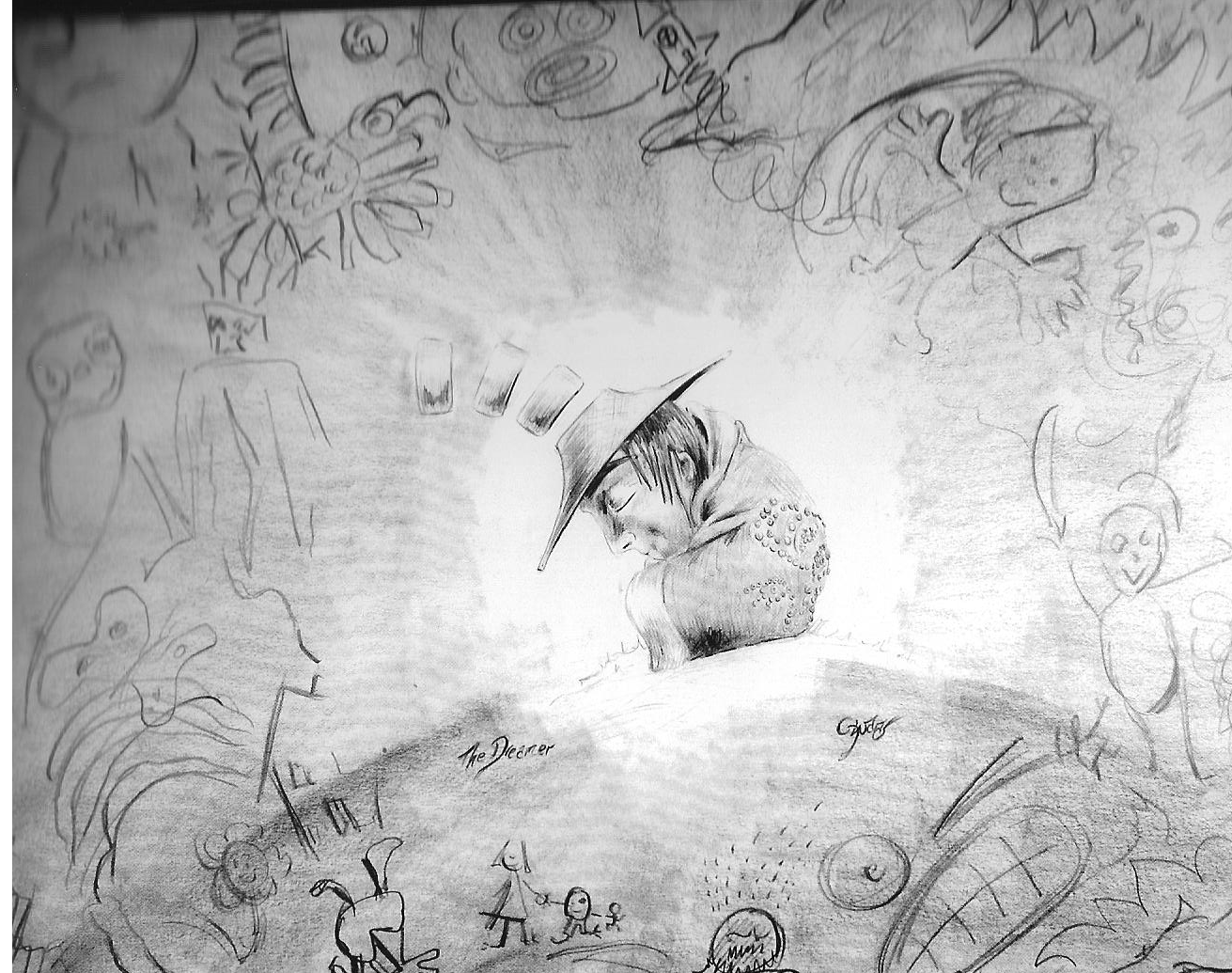
With this theme, the show’s catalog inevitably chooses “The Dreamer” as the piece on the cover. The piece is not only an obvious choice for the theme of the artistic process, but for Gwaai himself (to use the name with which he signs his work). The cartoon style is a reminder of his animation prototypes for teaching the Haida language, and the rings on the hat, a sign of high status in traditional culture an indication of the importance of art among the Haida today. At the same time, the doodles around the margin, as rough as they are, have a non-traditional look. Also, to anyone who has sat down with Gwaai for any length of time, they are a reminder of his constant doodling.

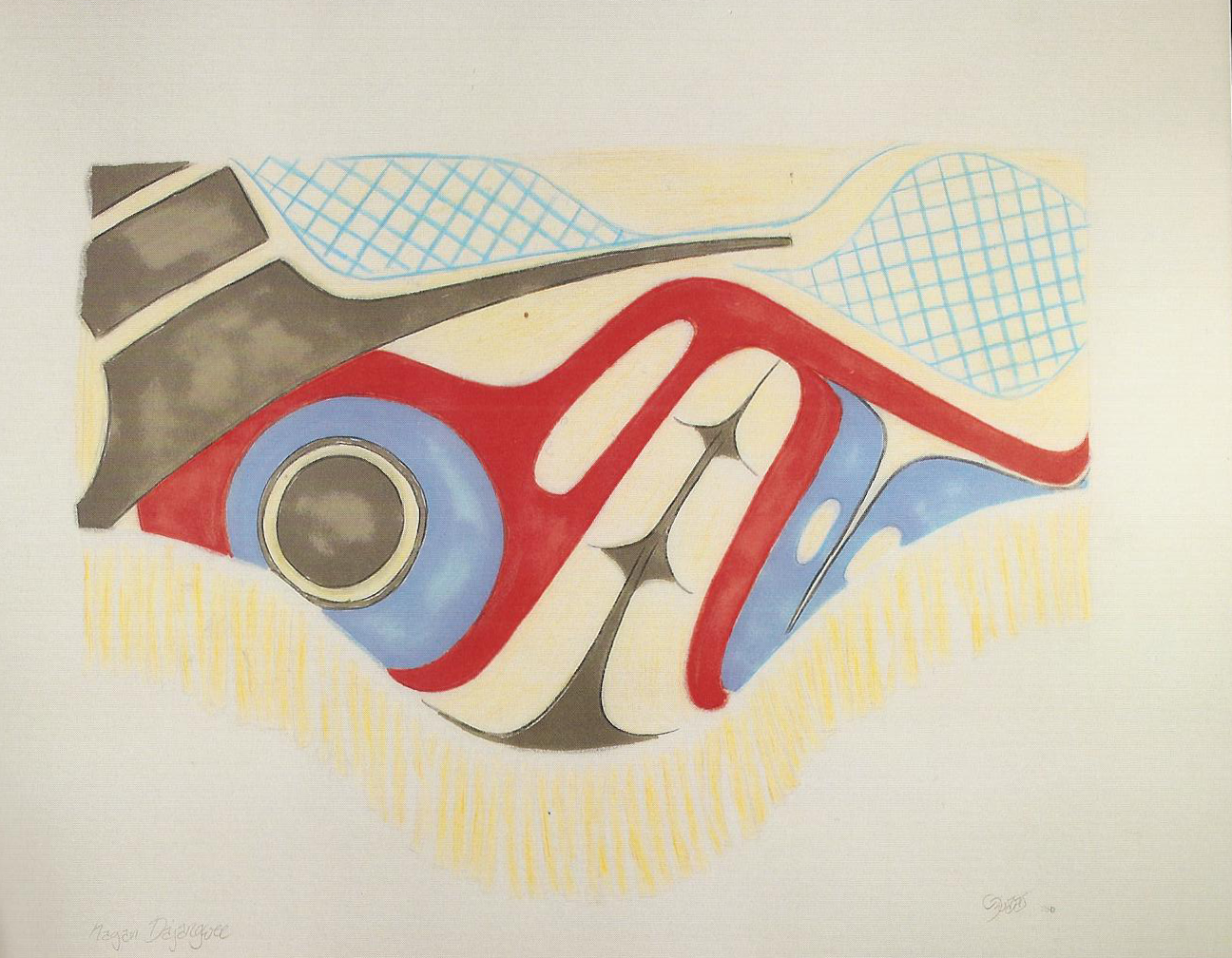
Other pieces in the show emphasize Gwaai’s different traditions and influences. Some, like “Kagan Dajangwee,” are slightly stiff exercises in the northern First Nations style, with their formline and cross hatching:

Others, like “Nanasimget,” a depiction of an Orpheus-like figure in Haida mythology, look like a two-dimensional rendering of a metal casting (and, perhaps not coincidentally, are reminiscent of some of the sketches of Bill Reid, Gwaai’s mentor when he was a teenager):

At the opposite extreme are more mainstream pieces. “Ts’aahl Girl” (Eagle Girl), for instance, combines realism with a touch of whimsy:


Similarly, the two studies of Gagiid, the Haida wildman whose lower face is pierced by the spines of the sea-urchins he is forced to eat after being castaway, bear a distinct resemblance to Gollum as portrayed by Andy Sirkis in The Lord of the Rings:

This movement between traditional Haida culture and urban industrial life – so effortless that it includes analogies – suggest the position of the modern First Nations artist. For those of us who have met him, it also seems very typical of Gwaai’s wide-ranging mind.

Some of the most interesting pieces in the show offer a glimpse of the creative process.For example, “Detail: The Two Brothers Pole” shows the precision-drafted plans for a pole that Gwaai recently completed with his brother Jaalen, and a view of the raised pole. The pole is located in Jasper National Park, and was a replacement for a repatriated pole that was appropriated from the Haida in 1907 and that is often attributed to Charles Edenshaw:

A more personal glimpse of the relation between sketches and other media is provided by “Sons of Djillaquon” and the gold pendant “Sons of Djillaquons:”

Both the sketch and the pendant are powerful works in their own right, but together they illustrate what is gained and lost in the transfer between media, as well as the limitations of each. It is this relationship that makes the oxymoron title of “Sounds Good on Paper” a suitable title for the exhibit.

Casual observers might be tempted to to describe “Sounds Good on Paper” as a minor show. And, in one sense, they would be right: most of what is displayed are not the pieces for which Gwaai has rightfully gained his growing reputation.

Yet such a view would also be short-sighted. More than anything else, “Sounds Good on Paper” is a very personal show. It displays many different aspects of Gwaai’s personality – probably not all –and offers a tantalizing hint or two of his creative process and his interest in different media.

My only regret is that the show couldn’t include some examples of Gwaai’s argillite prototypes for his jewellry. Placed beside the finished jewellry, these prototypes could have provided yet another perspective on the concerns of the show.

However, even without this touch, “Sounds Good on Paper” remains interesting both aesthetically and psychologically. It’s been a long time since I’ve seen an exhibit that shows so much of the artist without a hint of arrogance.

Asked the day after the opening what I thought of the exhibit, my first response was, “It’s very Gwaai.” Having had a few more days to think, I still that response the most accurate I could have given.

Read Full Post »

If the cause is good, people tend to believe that the charity is, too. Without any investigation, we usually accept a charity at its word, glad to hand over our money in exchange for the feeling that we are making a difference.

In practice, though, some charities or non-profit organizations are less worthy of support than others. Few are outright criminal, but some are incompetent. Many, too, are less interested in achieving a specific goal than they are in keeping themselves going to provide careers and a sense of accomplishment for their executives and employees.

So how can you tell whether a charity deserves your support? There are no firm guidelines, but here are eleven indications that you might want to investigate further and reconsider where your donations go:

  • The charity lacks detailed views or policies: the charity has a general cause, but information about its exact positions or goals is unavailable. If the organization releases information that is supposed to explain its positions or statements, the information is so overly generalized that it tells nothing.
  • The organization lacks transparency: little information is available about what the organization is doing, and why. Reports on the group’s activities are either not made, or else full of generalizations and obviously selected specifics. When someone requests more details, they may be refused or delayed, or receive information that tells nothing.
  • The charity is always fund-raising: most charities gladly accept donations at any time. However, if a charity is always starting a campaign every few months, that may be a sign that its cause is not viable or that it is being inefficiently run, either because its basic expenses are too high or because its ambitions are too grandiose.
  • The lines of authority are blurred: a well-run non-profit follows standard business practices to help ensure that it is above-board. For instance, the treasurer should not be the same person who has the main responsibility for spending decisions or benefits from them. Similarly, the executive director is the senior employee, and should not control the board of directors or serve on the board.
  • Governing bodies seem to have little power: Either advisors and directors are not consulted at all, or else their input is confined to specific questions or trivial matters. For example, they might be asked what thank-you gifts will be given donors in a fund-raising campaign, but not for ideas about how the campaign will be run.
  • Achievements are slight or exaggerated: minor successes are exaggerated to create the impression of activity. Blogs, news releases, or year end reports are full of non-news, or the same news endlessly repackaged.
  • The creation of a community is ignored: a non-profit may rely on the public or target corporations for income. Either way, it needs a community to accomplish its goals. Indifference to the need of community-building might suggest that the group is more concerned with perpetuating itself than accomplishing anything.
  • The charity presents two different faces: to donors, the charity may be friendly and seemingly open. However, to employees, its executives may be dictatorial and overbearing. Such dichotomies suggest a charity that is not going away in a hurry, and that may have settled down to acting much like a corporation.
  • No opposition is tolerated: instead, opposing views are discouraged along with discussion. Rather than a group working towards a common goal, the organization’s lead employees and volunteers resemble corporate types engaged in a power struggle.
  • The charity is built around a cult of personality: One or two people, usually the founders, feature prominently in all publicity. If not generally famous, they are at least well-known in the circles in which the charity operates. They may talk a good talk about the cause. They may even declare themselves against cults of personality. Yet, somehow, publicity for the charity is all about them, and they expect deference from everyone else.
  • The charity’s expenses are excessive for their activities: How much a non-profit spends on salaries, office space, and travel is by far the most common way to evaluate a charity. A widely accepted general rule is that a well-run charity spends 20-35% of its income on these basics, and that a charity that spends over 60% should not be supported. Alternatively, compare the ratio of expenses to income to get a figure that shows how much a company spends to get $100, and read the results using the same percentages as for general expenses. Be sure to look over several years if possible to avoid making decisions based on a year with unusual, but justified expenses.

Except in the most obvious cases, one or even two or three of these signs is probably not enough to make you stop supporting a charity or non-profit. If nothing else, you need to judge by results. Even a group that spends 70% of its income on overhead might be worth supporting if it is hugely successful in accomplishing its aims. By contrast, a group whose overhead is 10% of its income might reduce costs by placing unrealistic demands on volunteers.

However, if a number of these signs occur – certainly over half – the odds are high that something is wrong and you need to reconsider your support.

Read Full Post »

One benefit of digitalizing my music is the rediscovery of artists. Thanks to the digitalizing, I’ve tracked down at least a dozen artists and found what they’ve been doing since I first heard their music, including The Men They Couldn’t Hang, Michelle Shocked, Kirsty McColl, and Mark Graham. My latest re-discovery is Sam Weis, a twelve-string guitar player and writer of original songs from Washington State.

I don’t remember the first time I heard Weis, but it must have been at a Rogue Folk concert at the WISE Hall in East Vancouver. Possibly, I’d run across her previously at regional science fiction conventions; if not, it was someone remarkably similar. She had a vaguely punk sensibility that appealed to the front-row lesbians who seemed to attend every local folk concert in those days, and a twelve-string guitar that seemed almost too big for her and with which she could do almost anything. I especially remember the audience joining on the “Ride, ride, ride” chorus of “Til We’ve Seen It All,” and many of those around me crying at the longing expressed in the song.

At some point, we bought her Restless album, and over the years I played it often. But the CD lost its cover, and Weis seemed to be performing less, perhaps concentrating on her painting, which she also does professionally. Occasionally, I searched the Internet for her, but never found anything.

It was only last week, as I searched through my digital collection, that I realized that I had been looking for “Weiss,” adding an erroneous “s” to the end of her name. Having grabbed a clue, I located and downloaded her other three albums, and have been enjoying them for the past six days.

Finding an analogy for Sam Weis’ work isn’t easy, because it appeals in a number of different ways. Listening to her cover of “Dancing Barefoot,” I might compare her to Patti Smith with a stronger voice and better guitar work. Listening to “’55 Ford,” you might mistake her for a rocker. Her instrumental “Helix” is reminiscent of the Scottish harp duo Sileas. Another instrumental, “Train to Blue Sky” sounds like something the Allman Brothers might have recorded in their heyday, while “Breakfast with Bob” has an acoustic quietness. Philosophical pieces like “Why Not Utopia?” are reminiscent of Tori Amos in expression, while “Seven Sisters Road” suggests Michelle Shocked feeling nostalgic. Some critics have compared her to Joan Armatrading because of her probing relationship songs.

All these comparisons have a grain of insight, and none is accurate by itself, if only because Weis’ versatility is always supported by her strong guitar skills and a voice that, while ordinary in range, has a husky vibrato that suggests ambiguity and repressed emotion, making it second to very few in expression.

At times, her lyrics teeter at the edge of triteness, often as she finds herself boxed in by a scarcity of non-cliched rhymes. Such low points are especially likely to happen when she waxes philosophical in songs like “Why Not Utopia?” or “Shape of Time.” Not that such songs aren’t redeemed by the arrangements, but tackling such topics in a three or four minute song is only slightly easier than doing so on Twitter.

By contrast, Weis’ lyrics are at their height when she deals with personal emotions, whose complexities and ambiguities she expresses better than almost anyone. For instance, in “Seven Sisters Road,” she talks about youthful sessions with friends “where we invented destiny / And traded rage for poetry.”

Her lyrics are at their best when describing the intricacies of love in plain language. In “Restless Heart,” for example, she pleads, “Open up and let me come in / My lessons have been learned and I want to try again” and invites her lover to “slow dance on the back porch.” Similarly, in “Moment to Moment,” she expresses the obsessiveness of love with:

I don’t want to spend one more night
With you on my mind,
I’m going to be so tough when I pretend
I can leave this love behind.

However, my personal favorite remains “Til We’ve Seen It All.” I suppose you might argue that, in modern times, a song about cruising the highways with a lover isn’t environmentally correct. All the same, the poignancy remains despite such quibbles:

This is how I see
The golden American Dream,
Three thousand miles of asphalt,
Four wheels and a holy machine;
I’ve been chasing the illusion
Like an astronaut running down a star,
The dream to go fast, go hard,
Go now and go far.

I’m sure that the only way that any listener can fail to be moved by the longing is if they’ve completely given up their own ambitions and dreams.

None of this is to dismiss Weis’ instrumentals – just to say that I’m more qualified to discuss her words. Instrumentals like “Cosmo and Peanut” and “Helix” from her just-released album Paradox have already kept me sane while riding public transit, and I plan on them doing the same many times in the future. The fact is, all Weis’ albums have a permanent place on my music player, and I”ll happily listen to whatever other music she releases.

The only question I have is: Why isn’t this artist better known?

Read Full Post »

To my distinct displeasure, I am now the owner of a credit card and a smart phone.

To anybody else, these possessions may seem trivial, such a regular part of daily life that they aren’t worth talking about. However, to me, they represent major compromises between how I would prefer to live and modern culture.

You see, all my adult life, I have been wary of manufactured needs. I never bothered with a mobile phone because I mostly work from home, where a landline is available. When I’m away from home, I’m on my own time, and didn’t want to be accessible to business colleagues. As for friends and family, they never had business so urgent that they couldn’t wait for a few hours to get in touch. By not carrying a phone, I removed unnecessary stress from my life.

Similarly, I didn’t carry a credit card because I worried about plunging into debt, and because I am scornful of demands for instant gratification. Instead, I used a debit card and PayPal, paying as I went and resting much easier as a result.

The trouble is, personal phones and credit cards are so convenient that modern life no longer leaves room for those like me who would prefer to be without them. Oh, I suppose I could live an Amish-like existence, but, for all my stubbornness, I’m not prepared to do that. In the last few years, the inconvenience of not using these artifacts of modern life have simply become too great.

I started carrying a phone because Trish’s illness meant that I needed to be accessible in case of an emergency. Ironically, I bought my first phone two weeks before her death, but I kept it because around the same time pay phones started to disappear. You can still find them at Skytrain stations, but elsewhere in greater Vancouver, they are almost extinct. When you do find them, they are in dark corners where nobody sensible ventures, and using them means standing knee-high in garbage and trying not to gag on the smell of urine that’s all around.

Also, many bus stops no longer post schedules. Schedules are usually a case of wishful thinking at the best of times, but if I want any indication of when the next bus might come, my only alternative is to use the phone.

In the same way, credit cards have become equally unavoidable. I can do without them from day to day, but the book and music stores that I used to frequent have slowly disappeared. For that matter, so has the large Virgin and later HMV store downtown. I can order in one or two stores, but have to wait three to six weeks for delivery, and then only if I don’t want an e-book. By contrast, an online order saves me money, and, in the case of music and ebooks, is often immediately downloadable. Usually, the sites I order from won’t take PayPal, or online debit from my credit union. Under the circumstances, I can be perversely stubborn and penalize myself or else get a credit card. I chose not to penalize myself.

I have to admit, the credit card is convenient and the smart phone I bought yesterday is a marvelous piece of technology (there was a sale on; otherwise, I’d have stuck with a basic phone). And I do keep within reason. The credit card has a low limit that’s paid off monthly, and I’m not going to be doing much searching of the web on the new phone.

But I still feel like I’ve lost my integrity. More importantly, I feel angry that I can’t live the way I prefer unless I do without and suffer inconvenience.

I didn’t ask much – just to pay as I go, and not be tied to a piece of technology that keeps me always accessible. To me, these seem both modest and sane goals, and I suppose that I could have denied myself a few things to have the satisfaction of standing on principle.

Yet after a while, such rearguard actions become futile. Peevishly, and with a good bit of grumbling, I’ve been dragged along with everybody else — and feel lesser because I’ve given in.

Read Full Post »

“There’re no atheists in foxholes,” religious people like to say. What they mean, of course, is that when you’re in trouble, the idea of a deity becomes more inviting. I’ve always thought the comment smug, to say nothing of beside the point, since belief does nothing to prove that a deity actually exists. So, while I can’t speak for atheists, I’m proud to say that I’m one agnostic who hasn’t found religion in the foxhole.

Mind you, I can see the attraction. Twenty months ago, I was abruptly widowed, and everything I expected about the rest of my life changed when I was still relatively young. Then, five months ago, just when I thought I found a group to identify with and maybe give me new direction, that was snatched from me, too. Under the circumstances, it would be reassuring to think that all the loneliness and existential angst had some purpose and that all had happened for the best.

The trouble is, I can’t reconcile these ideas with the senselessness of what I’ve lived through. If anything, my recent life seems evidence of randomness, of the stark fact that the only purpose is what I choose to adopt, and that even self-chosen purposes can be punctured by chance. To insist on an external purpose in the face of such evidence seems nothing more than wish-fulfillment.

Anyway, assuming that a deity exists, what would she/he/it/they think of my new-found belief? It wouldn’t be based on a sincere faith; it would be based on being frightened. Nor do I think much of a deity that used fear to gain followers.

The situation all comes down the familiar problem of pain. Endless pages have been written on this subject, but it amounts to one simple, unanswerable question: how can you reconcile the idea of a loving deity with all the hurt that’s in the world?

Suggesting everything is part of a larger plan doesn’t answer the question. Nor does the suggestion that, without suffering we could never appreciate happiness.

No matter what you answer, you’re still left with one of two situations, assuming that a deity exists. Either that deity has no control over how things operate, or that deity is amoral. In both cases, that deity is by definition unworthy of worship.

Instead of wrestling with such problems, it’s simpler – more logical, and more in accordance with my observations – to believe no one’s in charge. Far from encouraging me to find religion, if anything the last two years have nudged me from neutrality closer to outright atheism.

And if you suggest that the last two years were intended to teach me a lesson, all I can say is that I have more pride than to acquiesce to the machinations of a bully, no matter how powerful and no matter how badly I’ve been mugged.

You might call that perverse. Personally, I call it self-respect.

So, please, no smug talk about what happens in foxholes – especially if you’ve never been in one.

Read Full Post »

Slide shows have done more to reduce the quality of speeches than anything else. They encourage presenters to peak too soon by writing out their entire talk in detail. They chop logic into a series of small bullet points, none of which seem more important than the other. They tempt presenters to read their speech and ignore the audience. But probably their worst offense is that they encourage the tendency of presenters not to move, as though the soles of their shoes were crazy-glued to the spot.

Not that the average presenter needs much encouragement to be motionless. For as many as two-thirds, the purpose of a podium is to give them something to hide behind. For the other third, having found a spot to stand, they barely shift their weight from one leg to another, much less use the space around them effectively.

Why does being motionless matter? Because public speaking is performance. It’s not only performance – obviously, you need something worth saying, too. But unless you can entertain as well, what you have to say is going to be as flat as wine left uncorked in the back of the fridge of a couple of weeks. When you speak in front of an audience, you almost always have space to move, whether a stage or the front of the classroom, so you might as well use it to get your point across.

If you want proof of the importance of movement in speaking, go find a video of Bill Hicks on YouTube. Listen to him first without looking at the video. You’ll probably smile, maybe grin, and think he’s an okay comedian. Then listen while watching the video, and you’ll be wishing you spent more time building up your abs at the gym because you’re laughing so hard. The difference is the way he moves. As funny and as wise as his routines are, they’re not half as funny as the way he moves through the space around him, sometimes with exaggeration, and at others times with the economy of motion of a martial artist.

Very likely, your subject and tone are more serious than Bill Hicks’. But you still have opportunities to use your movement to bring your points across.

The trouble with standing still is that nothing changes. With you rooted on the spot, the audience relaxes, and sinks back in their seats, getting into the routine, and gradually – unless you have more animation in your gestures and voice than the whole of Hayao Miyazaki’s production studio – they stop listening.

By contrast, if you move from the podium to somewhere else, suddenly your audience shifts and pays attention. Chances are, that means they pay more attention to the point you start to make from your new position.

Similarly, when you are impersonal or logical, move to the back of the stage. When you want to connect with your audience on a personal level, move to the front, even down into the aisles (why do you think so many musicians do it?).

Or if there’s a table, sit on top of it when you want to be casual and intimate. When the time comes to be serious, or to emphasize your point, get up. If you are recounting a problem and how you solved it, pace and stop at random spots so that your movements mirror the confusion you are describing, then dart to the white board to jot down a keyword of the solution. You don’t have to move quickly – just move at all. So few speakers do that you’ll automatically have another way of connecting to the audience.

In fact, once you start being aware of the concept, you’ll soon find all sorts of ways you can use movement while you speak. Once, for example, I turned the fact that a college class wanted to be on the other side of the windows on a hot summer morning by moving up and down in front of the windows for much of my lesson, forcing the class to look at me as much as the window. Think a while, and you’ll find other impromptu possibilities.

In the same way, consider how a little choreography can discourage both you and your audience from spending the entire talk looking up at your slides. Leave the stage and face the screen, and you can read it without being obvious. You should also entice some of your audience to watch you instead of staring at your slides.

Sometimes, of course, you won’t have much space. Or, as happened to me when I spoke in Calgary a few years ago with a swollen foot, you might need the podium to keep yourself upright, and going across the stage just isn’t a possibility. Yet even when you can’t move very far, you can still suggest movement by shifts in your posture. In such cases, even a little movement is an improvement over the immobilization that reading your slides to the audience usually encourages.

Read Full Post »

Haida/Tsimshian artist Mitch Adams seems to be making a career out of smaller pieces. Not that he avoids larger pieces; his “Blue Moon Mask” is one of my favorite pieces on the walls of my townhouse. However, in the last year or so, he has done masks from laminated blocks of wood about the height of my finger, a brass magnifier, a couple of combs, and, most recently, a briarwood pipe, filling a niche shared by few other artists. With a length of ten centimeters, his “Raven Rattle” is another of his miniatures – and one of my favorites among his work.

Contrary to what you might think, rattles of this size are not a recent development. Although modern tools makes carving at smaller sizes much easier, rattles the size of this one appear in artifacts of a century and a half ago. Some might have been used, concealed, in the magic and theatrics of the winter ceremonies. More likely (since the sound doesn’t carry far), small rattles might have been used by shamans, working up close with sick patients.

Aside from the obviously modern paint, Adam’s main innovation is his material – boxwood. The stand is a piece of driftwood, or (as I like to think of it), two-thirds the price of a Special Platter at The Afghan Horseman, where I last had dinner with Mitch and his wife Diana and took the rattle home with me. Unpainted, the base provides a contrast with the largely painted rattle. The rattle can be left on the base, in a position in which it resembles a rocket, or else lifted free and used, in which case it gives a delicate, half-hissing sound.

Like the size, the subject and composition is also traditional. The rattle depicts Raven the trickster, the face in his belly representing the light that he has stolen from the chief who hoarded it. On his back is a red human figure facing a raven’s head, their tongues intertwining to suggest communication, and a reminder of Raven’s ability to change from human to bird shape. You might also take the quasi-sexual posture of the two figures, as well as the round belly containing the face in the light of some of the details of the story: Raven has impregnated the chief’s daughter with himself to be reborn as the chief’s grandson, so he might have a chance to get close to the light.

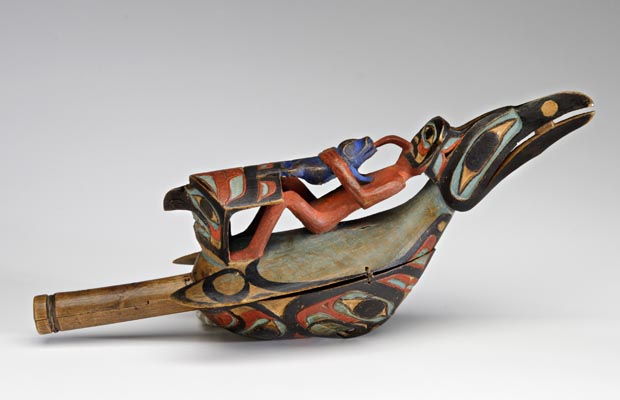
As for the composition, it, too, has a long tradition. For instance, just before writing this entry, I came across a picture of this two centuries-old Haida piece in the McCord Museum in Montreal:

The subject is different, but the composition similar, although Adam’s piece was never meant to rest on its bottom, and has a more streamlined look. With a few minutes’ research, I could easily turn up another two of three similarly arranged rattles.

None of these comments are meant to suggest in any way that Adams lacks originality. Rather, I’ve made them to point out that the rattle is a piece within a tradition. Its shape and intricate painting of details are more than enough to establish Adam’s ability – and to make me curious about what he will do next.

Read Full Post »

« Newer Posts - Older Posts »