Feeds:
Posts
Comments

Archive for the ‘Bruce Byfield’ Category

I know that many men are more obsessed with gender stereotypes than I am. However, I have a renewed appreciation of how crippling such obsessions can be after reading a comment left last week on my Linux Pro Magazine blog.

The comment was placed on a blog entry about the gap between Linux Fund’s intentions to produce an anti-harassment policy and its reputation and recent statements. It was not a direct response to any of the issues raised in the blog entry, but a reaction to the fact that I had written about such a topic at all.

“You are desperately in need of an intervention, Mr. Byfield,” the comment read. “Your self-hatred and conditioned sense of male-inferiority are obvious. I would suggest you spend some time reading _____, a site that exposes the fraud of ‘misogyny’ while exposing the very real sexism, misandry, that is poisoning and destroying Western Civilization.”

I’ve left out the site’s name and URL, since I have no wish to promote it.

I replied that, contrary to this statement, I was quite comfortable with myself, and had enough self-confidence not to find feminist goals a threat. I also said I would add this comment to the Abuse page of my personal web site. This dismissal produced a second message (which I did not post) denouncing me as a “neutered male” and denying any intention to abuse.

These comments were so mis-directed that my first response was a good, long laugh – and that’s something that I don’t do very often when I’m alone. But the only logical conclusion I could reach was that the name hurling was supposed to sting me into action. Apparently, male stereotypes are such a preoccupation for the sender that he could not conceive of a man who would not respond to them. The idea that his comments were so absurd that I refused to take them seriously never seems to have occurred to him – so much so that, in his second comment, he could only repeat himself in stronger terms, and not deal at all with the fact that I found his comments humorous.

Self-hating? Feelings of inferiority? Me? If the people who dislike me were to categorize my faults, I assure you that neither would be on the list.

But, then, anyone who could toss such adjectives around then deny that they were designed to insult shows such a lack of self-perspective that I could hardly expect them to understand that someone might think differently from them. However, no doubt he would claim that he was simply telling the truth.

Perhaps, too, like many fanatics, he imagined that I had never encountered his arguments. Once I went to the site he suggested, the truth of the comments on it would be so self-evident that I would immediately reverse my position. The fact that I had read male supremacists as well as feminists (just as I had theologians and atheists, anarchists and fascists) and found the male supremacists wanting in logic and powers of observation never seems to have occurred to him.

Possible proof of this perspective is that the sender described the essays on the site as well-argued and insightful. (The teacher in me longs to explain that, just because you agree with a statement does not make it well-expressed or well-argued, but, judging from his comments, this distinction would probably be too subtle for him.)

Still, curiosity and ingrained fairness made me look through the site. It was all that I had expected, and then some. Anger, hatred, paranoia, poorly-defined grievances, even worse-argued claims – it was all there. Sometimes, this mixture was subdued into a thin semblance of rational thought, and other times it approached incoherence, but it was never completely absent.

I came away marveling at the self-inflicted perversity of the writers, and an impression of baffled grievance that the degree of privilege they would like to have become accustomed to was not unquestioningly theirs (which brings up another point: why do modern reactionaries always claim to be victims – a point of view they profess to despise in their opponents?).

I also wanted to rinse my brain – repeatedly, with bleach. The degree of hatred expressed was so extreme and so unreasoning, so utterly lacking in any generosity of spirit that I was never even remotely tempted to alter my views. Instead, I was left with the belief that every term of abused hurled at me was a projection of male supremacists’ own insecurities. In fact, male supremacists themselves are by far the strongest argument against their own views.

I’m still not convinced that we need gender roles of any sort in modern industrial society. However, if we must have them, the best suggestion I’ve heard for men comes from Susan Faludi’s Stiffed!, which points out that all male groups from sailors to industrial workers have an unspoken tradition of older men teaching younger ones what they need to survive. That would be a role in which a man could take justified pride.

No doubt more is needed, but one thing is sure: we won’t find healthy male roles for those who need them by retreating into a fantasy of a past of privilege. In the end, my strongest impression was that those writing for the site were ineffectual losers, more ready to find scapegoats in feminism than to take control of their own lives – an attitude, I can’t help pointing out that, by their own standards, is as unmanly as they could get.
Read Full Post »

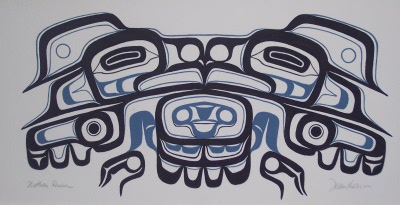
I’ve long admired the graphics work of Dean Heron, but a couple of months ago I realized that I didn’t have any in the townhouse. I quickly remedied that by buying “Northern Raven,” a small acrylic on paper painting that I’m sure will be the first of many purchases.

“Northern Raven” is a split design, with two views of the same figure connected to a central core. Historically, split designs were often used to fill a space, or to wrap the design around a curved surfaced like a handle or the bowl of a spoon. However, they were also frequently used, as here, on a flat surface. They have always struck me as one of the most pleasing forms of symmetrical design, because the fact that one side of the design mirrors the other reduces the static repetition of a perfectly balanced design.

In addition to this natural advantage, “Northern Raven” has several other qualities that make it stand out. To start with, split designs usually have the heads facing outward, leaving a space in the middle. Although reversals of this arrangement are not entirely unknown, they are still rare enough to be noticeable when you see them. By replacing what is usually blank space with design, here Heron creates a far busier design than he would otherwise have, which further helps to break down the staticness of the design.

Another departure from the norm is the use of blue as the secondary color in place of red. This is not an unheard-of innovation in contemporary art, but seeing it in what in other ways is a very traditional piece is somewhat unusual. Added to the pale blue of the paper itself, this choice of colors suggest a cool, icy quality that suggests the first half of the painting’s name (which I otherwise take as referring to the fact that Heron describes himself as a Kaska/Tlingit artist). It also has the advantage of being less arresting than any shade of red, which forces the eye to linger over the design and discover its details at leisure.

However, what really stands out for me is the hand-painted quality of the piece. In some modern First Nations art, the ovoids and u-shapes are geometrically precise, and often drawn by a template, with their curves created by a compass (or, at least, so it appears). If the design is split, the two sides are literally, not just figuratively mirrored, and often created by flipping one side over in a computer drawing application.

By contrast, “Northern Raven”has the appearance of being less geometrically oriented. Much of this sense is created by the thin blue lines outlining the heads. But there is also a suggestion of irregularity in some of the interior elements. Moreover, if you look closely, some of the mirrored elements, like the U and T shapes at the bottom left and right of the design are not completely identical. Such irregularities might easily give a sense of amateurishness, but in this design they add a more human quality, breaking down the symmetry and keeping the design from becoming an exercise in applied geometry.

My only criticism of “Northern Raven” is its scale. With its bold, regular formlines throughout much of the design, the piece deserves to twenty or thirty times its size, and serving as the house front to a longhouse. Otherwise, I consider it a fine place to begin my collection of Heron’s work.

Read Full Post »

When I was at university, I used to write essays from the beginning. I would ponder the title for hours, labor over the first paragraph almost as long, then gradually pick up speed as I realized what I had to say. People who contact me about my published articles often assume that I must still write that way, but teaching composition and more experience has taught me that these work habits are inefficient.

To start with, I can’t remember the last time that I approached a subject with a definite position in mind. As I’m researching, people often ask what my perspective is, and I can almost never tell them, because I honestly don’t know. I may have a predisposition towards a certain viewpoint, but as I research, that predisposition transforms, sometimes morphing out of all existence, and at the very least becoming more qualified and richer as I test it against facts. I’m sure that some people suspect me of equivocating when I tell them I don’t know what my perspective is, but all I can honestly say is that a topic interests me, either personally or because of its importance.

As I research, some ideas may start to emerge. But they are tentative, and usually change as I work, assuming they are there at all. It’s only when a deadline looms or sources start to get repetitive and I’m unlikely to pick up any additional nuances that my opinion start to take definite shape.

Just before I actually write, I start sorting my notes. At times, I print them out so that I can get a different perspective on them. I go through them, noting important points and quotes that I would like to use. Especially for a longer article, I may jot down a rough order that I think will present my opinion in the strongest way possible.

Then I begin to write. Perhaps one time in five, an opening sentence or two comes to me. But, even when I’m so lucky, I don’t spend much time on the first paragraph or section early in the process. I know that I will probably change it drastically before I’m done, and I prefer not to rewrite when I can wait for clarity instead.

The same is even truer for the title. Since I’m paranoid about losing material, I usually save whenever I pause in typing, but the file name is usually only the most general description of the topic.

Instead, I usually start with the second paragraph or section, which generally includes some background facts that don’t require much of an opinion and are therefore easy to write. However, if I’m really unclear about what I’m thinking, I scan my rough outline to find a part that I can develop easily. That’s one of the advantages of knowing the overall structure – I don’t have to start at the beginning and discover the structure through trial and error as I work.

As I start to work on my chosen starting point, I’m sometimes hoping that finishing it will help me discover another section I can write on. Without exception, it usually does, and I settle down to writing.

As I write, I stop sometimes to check a fact or the spelling of the name, thankful for how easy such checks are on the Internet. Almost always, I think of additional points that I have to add, or realize that a quote would be more effective some place else. But I almost never rearrange points in the first draft, and doing so is a sign that I’ve lost my way and need to stop and restructure. For the first draft, what matters is getting something into the file that is reasonably good.

After a five minute break, I start on the second draft. That’s where the serious restructuring and rewording happens, although, increasingly, as I gain experience, I find less and less is required. It’s here, too, that the first paragraph or section and the title take shape, since by this point my perspective is fully formed.

I leave my least favorite parts of writing – spelling and punctuation checking – for last. And, yes, that sometimes means that I skimp on them if time is short, I’m ashamed to say. But it helps that I know some of the things I need to look for, such as leaving two spaces instead of one, or the words or phrases I tend to overuse, which vary, but generally include too many unnecessary connectives.

By far the greatest part of this cycle is the research and initial organizing. It usually takes up nearly two-thirds of my time. The actual physical act of writing, when I finally begin it, is almost an epilogue to the process, taking less than fifteen percent of my time, with editing taking up the rest.

These allotments may seem counter-intuitive, but they allow me to work efficiently and produce salable copy, so I don’t think I’m likely to tinker with them much. I only wish I had discovered this work flow sooner, instead of spending so much time constantly writing and rewriting the same passage in the hopes that clarity and continuity would eventually strike and I could move on.

Read Full Post »

Even before adolescence, I knew I was an untypical male. By that, I do not mean that I was gay, transsexual, or anything else outside the statistical norm. Rather, I mean that I found – and find – very little appealing in the roles available to a straight male in modern industrial society. The times I grew up in, my childhood experiences, and my early sense of myself as an individual all made that impossible.

I can’t remember ever being taunted, much less abused because I happened to be unusual. I was tall for my age until I was fourteen and stopped growing, which meant that others tended to leave me alone. It helped, too, that I was a champion distance runner and a frequent scorer in soccer and rugby, because being good at sport buys respect in high school. And throughout my life, I’ve usually been fit, and moved with the unconscious confidence that brings. Had I ever made the effort, I might have forced a place in masculine society without any difficulty.

However, I never cared much cared to. Taking part in sports was one thing, but no amount of alcohol makes watching them interesting to me. Cars, for me, are merely transportation. Loud comments about women and jokes about them only seem rude.

And where was the place for art and intellect in this bundle of expectations? I refused to believe that such things were a consolation prize for nerds, because from an early age reading was as important to my sense of self as running faster than everybody else.

As for the idea that some tasks were masculine and others female, that seemed ridiculous to me. If work needed to be done, what difference did the gender of the one who did it make?

Part of the reason for my outlook was probably the times. Growing up during the second wave of feminism, I kept hearing that male stereotypes were not only outdated, but unjust. That meant that, since I had grown up on a steady diet of Robin Hood and King Arthur and of how Might didn’t make Right, I could not in good conscience imitate them.

Moreover, at an early age I had had the experience of not being taken seriously and dismissed by those in authority; I entered school with a speech impediment, and was sometimes regarded as mentally challenged by teachers and the parents of friends until it was corrected. At the time, I did not know why I was looked at askance, but I was old enough to resent the fact. Consequently, I had no trouble empathizing with the grievances of feminism. I’m not saying that I never benefited from male privilege (of course I did), but, unlike most boys and men, I could never take it for granted.

Later in life, trauma reinforced these reactions, but the point is that, once I realized that female gender assumptions needed to be questioned, questioning my own came naturally.

By contrast, I can’t remember many models of masculinity that were worth following. Yet that lack never bothered me much. Throughout my life, my tastes in practically everything – books, music, movies, food – have always been outside the norm. I was an individualist from an early age, so I never felt much need to identify with the male gender roles. Unlike most boys, I wasn’t used to a sense of belonging anyway.

Did I miss anything, growing up as an eccentric male? Very likely, but I can’t imagine what it might have been. Perhaps some romantic opportunities, because I wasn’t playing by the expected rules? But, if so, I can’t feel much regret. I doubt that such opportunities could have led to satisfactory or long-lived relationships.

Moreover, while the greatest of all male privileges is not to understand that you are privileged, I like to think that by generally regarding myself as human first and male second, I have been more than adequately compensated for missing any such opportunities by the conversations and friendships I have managed to have with women instead. There isn’t a traditional male who could say the same.

Read Full Post »

In print, I can rant with the best of them. In person, though, I am usually a broadly tolerant fellow to the point of mildness. My friends range from a Catholic cleric through various ministers to agnostics, and from neo-conservatives to anarchists and Marxist Leninists. My taste in books, music, movies, food, and art covers almost every genre you have heard about (and probably a few that you haven’t). When someone expresses an enthusiasm for the mediocre, I am polite and, if cornered into giving an opinion, I am diplomatic in my expression.

But there is one thing that leaves me feeling like my teeth have slid off tin-foil: the airhead optimism and superficiality of those who believe that all that anyone needs to achieve their goals is to think positively – the attitude, in short, that is peddled by pop-psychologists, psychics, and life coaches, borrowed from people like Dale Carnegie and Norman Vincent Peale, and promulgated in bits of New Age philosophy such as The Secret.

Why does this feel-good optimism annoy me so much? At first, you might expect it wouldn’t, because I’m a biological optimist, so wired to be upbeat that even trauma can’t keep me down for long. It probably doesn’t hurt, either, that daily heavy exercise keeps me pumped up with adrenalin and endorphins.

However, it is a sign of just how deeply such things irritate me that they can make me react so much against my natural inclinations.

I suppose that part of what irritates me is the methodology, which often seems to revolve around slogans and aphorisms intended to inspire you and reinforce the right attitudes. Being practical, I prefer to receive useful information rather than inspiration, and, as a lifelong student of Orwell, I am immediately suspicious at what looks like the techniques of mind-control – even if it is mind-control done with consent, or even self-inflicted.

But what irritates me most about the slogans is that, when they are based on quotes, they are frequently used out of context or inappropriately.

For instance, when Einstein said that God doesn’t play dice with the universe, he was not expressing a belief in a personal deity who influenced events, but a conviction that there was some principle beyond indeterminacy in subatomic theory – and, so far as we know today, he was wrong.

Similarly, when someone notes that Noah’s ark was built by an amateur and The Titanic by professionals, I can’t help thinking that as a carpenter Noah was a professional, too, and that The Titanic was sunk due to bad luck, not negligence on the part of the builders. I won’t even go into the fact that being mythical limits Noah’s usefulness as role model. But the point is that if you are going to quote or allude when an English major like me is around, you better do so appropriately.

Another reason I dislike this cant is that it is annoyingly over-simple. Yes, having a positive attitude can sometimes help you – but not always. Being cheerful and upbeat is not going to save you from your internal organs failing one day. If you get mugged, you are not going to hurt any less because you are optimistic.

It always seems to me that the positive speakers have either never had any serious trauma in their lives, or else have repressed the memory of any events that were painful or beyond their control. Furthermore, such an attitude is only possible if you are a middle-class member of a modern industrial society who has led a relatively uneventful life. It is the attitude of prolonged adolescence, not of experience, and requires more denial than I can muster or ever hope to maintain. Often, it seems dangerously close to solipsism. At best, it preaches a demonstrably false view of the world that can only leave believers less able to cope.

But the strongest reason why I despise this empty optimism is the hypocrisy behind it. Those who preach it cannot possibly feel it all the time, and there must be occasions when they long for a good mope. But melancholy or depression does not fit with the public image that they have worked so hard to establish, so they must falsify their feeling at least part of the time. Nor, having invested so much in their brand of optimism, can they honestly discuss it. Faced with such doubts, they can only be even more enthusiastically upbeat than before.

The result is that I can rarely relax among the positive thinkers, because it is impossible to be sure when they are genuine or when they are not. When they agree with me, do I really have a meeting of minds, or are they just being positive? I can never be sure.

Too often, everything they do seems exaggerated and false. Their smiles are too broad and last a little too long, and their enthusiasm always seems greater than the situation would justify. If they have any genuine reaction, it is well-hidden.

The uncertainty is greatest when I try to decide whether I have made a genuine connection or not. When they proclaim that they love everyone five minutes after meeting them, and applaude every suggestion as “fabulous,” what vocabulary is left for true enthusiasm? In one case, I thought for years that one of these airhead optimists thought of me as a special friend, only to find that they were simply being insincere.

Long ago, I learned that the people you can actually trust for help are not necessarily those with the strongest protests of friendship and understanding. In fact, one or two of the most supportive people I have known would be dismissed as uncaring and shallow rednecks if you judged them by their casual conversation. By contrast, I have known several positive thinkers whose actions never matched their words in a crisis.

With all this against the positive thinkers, no wonder that I sometimes feel like Don Marquis’ archy, the poet turned cockroach faced with the cheerful cricket – I want to tell them to groan just once before I throw a brick.

Of course, I never do, but the impulse is there. Usually, I simply leave them to their fantasy and walk away as quickly as possible, shaking my head, not at the power of positive thinking, but at the power of self-delusion.

Read Full Post »

Every January, hundreds of people descend upon their local gyms, determined that this is the year when they’ll become fit. A month later, nineteen out of twenty of them are gone – mostly because they had unrealistic expectations.
Getting fit requires determination, but it also helps if you know what you’re getting into. Before you hit the gym, here are seven things you should know:

Fitness Takes Time

You don’t get fit overnight, or even within a week. Most people take two or three weeks before they start to feel good from regular exercise, and two to three months before they can see the results in the mirror. Then figure on six months before the results really kick in.

Moreover, the longer since you were fit and the older you are, the longer getting fit will take. It’s not a pastime for those who want instant gratification.

Exercise Is Going to Hurt
You shouldn’t exercise to the point where you are crippled by sore muscles. But any time you try to get into shape or increase your fitness, you’re going to hurt a little, especially in the first week. Your muscles are being used in ways that you’re not used to, or else more than you’re used to, and they need time to adjust. If you don’t feel a little achy when you start a new fitness program, you are probably doing too little to do you much good.

Exercise Can Be Boring
Any exercise is basically a set of movements repeated over and over. That means that you are likely to get bored sooner rather than later. Some people combat the boredom with music players, but you might want to try varying your work out – for instance, doing intervals on the elliptical trainer one day, then a slower workout on the bike the next. Also, whenever possible, get out of the narrow confines of the gym and do part of your routine outside.

Exercise Is Not Really a Social Occasion
Going to the gym with friends may help you to workout regularly. However, once you’re in the gym, being with friends can be more of a handicap than a help. Talking while training usually means that you move more slowly, while talking between intervals or sets usually results in more talking than training. Either way, you also annoy those around you.

A word, too, about going to the gym with your significant other: if you’re accompanying them to be supportive, or to learn to share their interests, stay home and avoid the boredom. These reasons for going to the gym won’t do anything to keep you coming back in the long-run. They can also involve self-consciousness to say nothing of impatience as one of you waits for the other to finish their routine.

Cardiovascular Is Better Than Strength-Training
You might think that lifting weights or using machines is a less strenuous way to start getting fit than the treadmill or elliptical trainer. The trouble is, these exercises are not equivalent. Free or fixed weights are for building strength, the treadmill and elliptical trainer for cardiovascular development – and cv is what you mainly need to get fit. For all-round development, you want the right combination of both types of exercise, but, if you only have time for one, choose the cardiovascular exercises. They’ll do more for you.

Losing Fat Often Means Gaining Muscle
If you measure fitness by pounds lost, you may be disappointed to find that you are not losing weight as quickly as you’d hoped. To your horror, you may even be gaining a slight bit of weight. Usually, either of these events means that you are replacing fat with muscle mass. This is a good thing, and only avoidable by a very carefully designed routine.

But why would you want to avoid it? If you judge by how you feel and how you look, that new muscle is something you should want, regardless of whether you are male or female.

Exercise Alone Is Not Enough
Regularly scheduled exercise is only part of getting fit. To increase your chances of succeeding, you need to change other routine parts of your life. You need to walk instead of taking an elevator whenever possible, and to change both the amount that you eat and the quality of what you eat (in other words, cut out junk food). It means less caffeine, sugar, and salt as well.

Remember exercise is only part of the changes you need to make. Otherwise, you may actually sabotage your exercise by using it as an excuse to eat more.

Discouragement and Motivation
If any of these points discourage you or make you less inclined to start exercising, then very likely you are one of those who will drop out of their exercise program in a matter of weeks. Resolving to get fit is a commitment, and it can be an uncomfortable one, especially at first. Until you’re ready to face up to these facts, you’re not ready for the commitment.

By contrast, if you find yourself nodding at these points, or making notes, you may be ready to make the changes in your life that fitness implies. Why not hit the gym and find out?


Every January, hundreds of people descend upon their local gyms, determined that this is the year when they’ll become fit. A month later, nineteen out of twenty of them are gone – mostly because they had unrealistic expectations.

Getting fit requires determination, but it also helps if you know what you’re getting into. Before you hit the gym, here are seven things you should know:

Fitness Takes Time

You don’t get fit overnight, or even within a week. Most people take two or three weeks before they start to feel good from regular exercise, and two to three months before the results before they can see the results in the mirror. Then figure on six months before the results really kick in.

In other words, the longer since you were fit and the older you are, the longer getting fit will take. It’s not a pastime for those who want instant gratification.

Exercise Is Going to Hurt

You shouldn’t exercise to the point where you are crippled by sore muscles. But any time you try to get into shape or increase your fitness, you’re going to hurt a little, especially in the first week. Your muscles are being used in ways that you’re not used to, or else more than you’re used to, and they need time to adjust. If you don’t feel a little achy when you start a new fitness program, you are probably doing too little to do you much good.

Exercise Can Be Boring

Any exercise is basically a set of movements repeated any time. That means that you are likely to get bored sooner rather than later. Some people combat the boredom with music players, but you might also want to try varying your work out – for instance, doing intervals on the elliptical trainer one day, then a slower workout on the bike the next. Also, whenever possible, get out of the narrow confines of the gym and do part of your routine outside.

Exercise Is Not Really a Social Occasion

Going to the gym with friends may help you to workout regularly. However, once you’re in the gym, being with friends can be more of a handicap than a help. Talking while training usually means that you move more slowly, while talking between intervals or sets usually results in more talking than training. Either way, you also annoy those around you.

A word, too, about going to the gym with your significant other: if you’re accompanying them to be supportive, or to learn to share their interests, stay home and avoid the boredom. These reasons for going to the gym won’t do anything to keep you coming back in the long-run. They can also involve self-consciousness to say nothing of boredom as one of you waits for the other to finish their routine.

Cardiovascular Is Better Than Strength-Training

You might think that lifting weights or using machines is a less strenuous way to start getting fit than the treadmill or elliptical trainer. The trouble is, these exercises are not equivalent. Free or fixed weights are for building strength, the treadmill and elliptical trainer for cardiovascular development – and cv is what you mainly need to get fit. For all-round development, you want the right combination of both types of exercise, but, if you only have time for one, choose the cardiovascular exercises. They’ll do more for you.

Losing Fat Often Means Gaining Muscle

If you measure fitness by pounds lost, you may be disappointed to find that you are not losing weight as quickly as you’d hoped. To your horror, you may even be gaining a slight bit of weight. Usually, either of these events means that you are replacing fat with muscle mass. This is a good thing, and only avoidable by a very carefully designed routine.

But why would you want to avoid it? If you judge by how you feel and how you look, that new muscle is something you should want, regardless of whether you are male or female.

Exercise Alone Is Not Enough

Regularly scheduled exercise is only part of getting fit. To increase your chances of succeeding, you need to change other routine parts of your life. You need to walk instead of taking an elevator whenever possible, and to change both the amount that you eat and the quality of what you eat (in other words, cut out junk food). It means less caffeine, sugar, and salt as well.

Remember exercise is only part of the changes you need to make. Otherwise, you may actually sabotage your exercise by using it as an excuse to eat more.

Discouragement and Motivation

If any of these points discourage you or make you less inclined to start exercising, then very likely you are one of those who will drop out of their exercise program in a matter of weeks. Resolving to get fit is a commitment, and it can be an uncomfortable one, especially at first. Until you’re ready to face up to these facts, you’re not ready for the commitment.

By contrast, if you find yourself nodding at these points, or making notes, you may be ready to make the changes in your life that fitness implies. Why not hit the gym and find out?

Read Full Post »

Luke Marston is a Coast Salish artist whose work is much in demand. In the summer of 2009, he and his brother John had an exhibit at the Inuit Gallery that must have set records for the prices obtained by artists in their mid-careers. Since then, neither has sustained those prices, but each continues to be much sought-after (Luke, for the record, is the brother who does the astonishing masks and historical recreations). Never having had the money when I saw one of his works that I admired, I was glad to pick up a remarque of his print “Family.”

Released for his wedding, according to Elaine Monds of The Alcheringa Gallery, “Family” (I suppose) shows Marston’s eagle crest embracing the wolf crest of his bride. Because of its thick, dark lines, the wolf is the figure that stands out the most – the wing and leg of the eagle are noticeable only after your eye discerns the wolf, and the rest of the eagle only comes later.

However, as the eye takes in the complete design, the wolf – contrary to the ferocity you might expect – seems smaller and more fragile than the eagle, clinging for protection to the eagle. By contrast, the eagle seems more rigid and less emotional or vulnerable.

Given the occasion, it is tempting to speculate on whether this contrast suggests Marston’s view of his personality and his wife, or perhaps his feeling of protectiveness for her, although I have no idea whether that is true. However, the interpretation gains credibility when you consider that the eagle’s wing is raised as though sheltering the wolf, and that the wolf almost seems to be burrowing beneath it.

There is also a formalized sexuality in the design, with the eagle’s hock joint pointing towards the wolf’s mid-section suggesting a penis, although of course birds lack external sex organs. Similarly, while the interior design elements in the wolf’s thigh serve the practical purpose of reducing the thickness of the leg, the ovoid is almost positioned high enough to suggest an x-ray view of the uterus. This ovoid is echoed in the ovoid formed by the eagle’s claws, which are point at the wolf’s thigh.

Another contrast between the two figures is that the thinner lines of the eagle’s head and beak (and, to a lesser extent, the tail feathers) seem more realistically rendered than the rest of the design. Again, armchair psychology is tempting; in choosing to depict his crest in two different design styles, is Marston suggesting that he sees himself as belonging to two worlds or traditions? Or is the depiction merely a matter of design, created simply to balance the thicker lines of the rest of the design?

You can see comparable figures in most Northwest Coast traditions without having to search very far. However, despite that obvious fact, in some ways, this design hardly registers to my eye as a Northwest Coast design at all.

For one thing, few Northwest Coast designs leave the top and bottom of the design space undecorated except for a few simple lines.

Even more importantly, the all-black design and the sweeping curves remind me strongly of the work of Aubrey Beardsley. In fact, it is the curves that first draw my eye: The long line from the top of the eagle’s wing to the bottom of the design, the coat hanger-like design element at the top, and the curling line of the wolf’s tail. These three lines enclose most of the rest of the design in an off-centered oval, positioning the gaze of the viewer without being perfectly symmetrical itself. Supporting them are mirror-image angles such as those on the two heads, or the inversion of the two legs that is emphasized by the ovoid element in each. All these things give “Family” something approaching an Art Nouveau sensibility.

Last summer, I saw “Family” for sale without any additions. However, Marston has also chosen to release a number of the prints with a remarque in pencil in the blank space at the bottom of the design. The remarque shown here is frog. I have asked whether the frog is a family crest, but have not received any reply from Marston.

However, given the metamorphis in the frog’s life cycle and its amphibious habits, frogs are generally seen as figures of power throughout the Northwest Coast cultures. This background makes the frog a fitting symbol of a life transition such as marriage. But whether Marston himself chose it for that reason is uncertain; since other remarques include a raven or eagle, perhaps he doesn’t.

But whichever way you look at “Family,” it remains an elegant piece from an artist with an accomplished sense of design. I might even say that its simplicity and small size – about fifteen by forty centimeters – makes it more accessible than some of Marston’s larger pieces. I still hope to afford a major work by Marston one day, but, meanwhile, “Family” is a small sample of what he can do.

Read Full Post »

Since I was widowed, family and friends have made extra efforts to draw me out of myself. They make a point of inviting me over, and, at their parties, they are likely to ask me several times how I am doing. Socializing, they keep telling me, is better than “moping around at home.” Their efforts are well-meaning, and I appreciate the concern behind them, but I admit that I accept their invitations out of politeness more than any other reason.

To start with, I am not a person who easily accepts pity or help from others. When I’m sick, mostly I just want to be left alone to get better. I’m not surly with nurses, but I hate feeling helpless or putting people to any trouble for my sake, and twelve years of caring for a chronically ill spouse has only strengthened my preferences. I remain much more accustomed to caring than being cared for.

Just as importantly, what most of my acquaintances don’t realize is that I’m not exactly lacking social opportunities. Even without their special efforts, my social life is more active now than it has been for the last few years, when I was caring for an increasingly fragile partner. I’m now exploring all sorts of events for which I had no time a year ago.

In fact, recently, when someone sat down across from me and earnestly asked, “So, what have you been doing with yourself?” in a tone that suggested that I must have long, empty stretches to fill, I had to suppress a howl of laughter. Far from being eager to seize every opportunity to get out of the house, I have often found myself bowing out of events, just so I could have a quiet night for a change. But I have always moved in several different circles, none of which overlap, so probably few people appreciate how busy I actually am.

Not, you understand, that socializing comes easily to me just now. I usually test as someone balanced almost exactly between extrovert and introvert, but I am learning how to socialize as an individual, instead of half of a couple. Consequently, while I am glad to see people, being with more than two or three at once is a strain. I no longer know that someone automatically has my back. I find, too, that I automatically scan a group every few minutes to check how Trish is doing.

In other words, rather than helping me to forget my situation, being with other people accentuates it. I especially feel my changed situation when an event ends, and I return home, alone and unable to discuss what I’ve just seen with anybody. Sometimes, the better time I have with other people, the worse I feel because of a mixture of guilt at being still alive to enjoy myself and the contrast between my married life and now.

But there’s something else that most of those around me don’t seem to grasp: while I don’t want to cut myself off from people altogether, I don’t always mind being alone, either. Being alone with my memories is the closest I can get to Trish now. Moreover, I have a lot of things to process – not just the mechanics of probate and the winding down of Trish’s affairs, but assimilating the memories of our life together and figuring what I am going to do with the rest of my life. Although I sometimes talk over these matters, I also need to think about them, long and carefully by myself. I’m not going to adjust to the changed conditions of my life if I have no time to mull them over in my mind; right now, I need more time alone than most people do.

I can’t help thinking that, culturally-speaking, we’ve swung from one extreme to another when dealing with grief. Where once we accepted a period of mourning as a natural transition from one stage of life to another, we now view it as unhealthy wallowing in depressing subjects.

I’m sure that many people chafed at the culturally-designated periods of mourning in Victorian society, but our own attitude is no better. Depressing subjects don’t go away because you evade them – if anything, they often become worse if you don’t face them. All the well-meaning people who keep inviting me to places don’t seem to be aware that, for all their good intentions, in the long run they may actually be making me less able to cope instead of more.

But, to some extent, I suspect that all the invitations I receive are extended for the sake of those who make them as much as for me. In our death-denying culture, seeing someone in mourning is an uncomfortable reminder that there are somethings that you can’t escape and can’t mitigate with positive thinking or some other nostrum. If someone in mourning is seen socializing, acting more or less the same as everybody else, then everyone else can forget the unthinkable more easily.

Perhaps all these remarks are unfair to people who are only trying to do me a favor. Knowing exactly how to support someone in mourning is difficult, and I don’t want to suggest that I am ungrateful for the efforts being made on my behalf. Really, I’m not. But I do want to suggest that the situation is more complicated than most people imagine. There is such a thing as trying too hard, and even a well-meaning action can sometimes obstruct rather than help. Some problems, as I am finding, people have to work out in their own way and time.

Read Full Post »

Having worked freelance for most of my adult life, I’ve set up my desk in countless locales. It took me a while, though, to realize how to set up the desk in relation to the view. That’s not the kind of thing I was ever taught – I had to learn the hard way, through experience.

When I was a sessional instructor in the English Department of Simon Fraser University, my desk was mainly something to lean on while I talked with students about their essay preparation and results. I always counted myself lucky that I had entered grad school in English, because the Communications Department – my other choice was in the windowless maze of the Classroom Complex. By contrast, the English Department was on the north and west side of the sixth floor of the Academic Quadrangle. Each semester, I would have a variation on one of two views: The inner one, where I could see people passing through the quadrangle and, in summer, lounging on the grass, and the outer, which gave a spectacular view of the mountains to the north. I could, and did spend hours at my desk staring out at that semester’s view. But I never expected to get much work done anyway, because it would be sure of being interrupted just as I became absorbed.

When I became a technical writer, and later a marketing and communications consultant, the view became more important. At one long-term position, my window overlooked the top of the Hudson Bay parkade in downtown Vancouver. Looking down, I could see not only the people coming to and from their cars, but also the car thieves going systematically down the row of cars. I can’t have been the only one watching, because security guards would always come along a few moments before I thought to call them. But I was lucky that the project kept changing directions over the thirty months of its existence, or else I might have been too obsessed with the view below to keep up.

The same was true when I worked in Yaletown. The two storey building across the road had a flat roof that, over the decades, had accumulated enough top soil to support meter-high weeds. The weeds make the roof a perfect place for seagulls to nest out of sight of predators. Later, when the chicks came, they would scurry into the grasses to escape the detection of crows. Later still, they made their first stumbling efforts at flight across the roof, crash landing in the clumps of weeds. I was more fascinated by the progress of the fledglings than in the work I was doing, by far.

But my real downfall came when I worked on the twenty-third floor of Harbour Centre. I was the fourth person hired, so I more or less had my choice of locations for my desk. I placed it squarely facing the window, looking down at the harbor and beyond it to the mountains. The view was relaxing when I was negotiating ad space and bundling agreements on the phone, but a disaster when I was trying to write a manual or ad copy. I’d find myself staring out the window, and realize guiltily that I had left my thoughts to rove freely for the last ten minutes.

I wasn’t prepared to give up the view entirely, so I moved my desk at right angles to the window. That way, I could focus on my work without the distraction of a seaplane landing or a cruise ship docking, but, when I was on the phone or wanted to take a moment’s break, I only had to swivel in my chair.

I’ve followed the same arrangement ever since. Now, as I write in my townhouse, I am at right angle to a view of the trees beyond my third floor balcony. The view is not as breath-taking as some I’ve had away from home, but with the parliament of crows thirty meters away and its occasional visit by red-tailed hawks, there is still more than enough to distract me if I permitted it. But by not looking at it directly, I keep my productivity high, and can still enjoy the sight of the swaying tops of the evergreens when I stand, stiff and in need of a stretch after a long bout of work.

Read Full Post »

Mostly, I ignore the various memes that circulate on the Internet. However, every now and then one comes along that intrigues me. The latest of these is to name fifteen fictional characters who have influenced you.

My first impulse is to list only suitably literary and high culture characters. But the truth is, I’m an omnivorous reader, and a truthful list reflects that:

  • Odysseus (in both The Iliad and The Odyssey): Odysseus is hardly a consistent character between these two epics, but some points remain the same. In both, he is not the strongest of heroes nor the most powerful of kings, but he succeeds where Achilles and Agamemnon fail because there is more to him than macho or noble birth. I’ve always tried to combine the life of the mind with the life of the body, and Odysseus was the first character I discovered who did the same. Later, I learned to appreciate that he is also the only one of the major figures in the Trojan War who has a happy ending, even if it was delayed ten years.
  • Robin Hood (in Roger Lancelyn Green’s The Adventures of Robin Hood): Green’s Robin Hood is not only a hero who lives by his own code, but always up for an adventure and always a good sport, even when he loses. More than any of the other characters listed here, he sets the standard of behavior that I would like to live up to, and probably rarely manage to.
  • George Smiley (in John Le Carre’s The Spy Who Came in From the Cold and sequels): At first glance, this unassuming bureaucrat of espionage might seem unable to influence anyone. But from reading about him, I learned two important facts that were alien to my younger character: First, that it doesn’t matter if people under-estimated you and may work to your advantage, and, second, that you can often learn more by keeping quiet than by trying to dominate a conversation.
  • Emma Woodhouse (in Jane Austen’s Emma): Besides being Austen’s funniest novels, Emma is a wonderful portrayal of a precocious child growing up. Having been a precocious child myself, I empathize with Emma’s self-conceit at the same time that I wince at her gaucherie.
  • The Emperor Claudius (in Robert Grave’s I, Claudius and Claudius the God): As a child, I had a speech impediment and a mild stutter that made some people imagine that I was mentally impaired. For someone with this start in life, Robert Graves’ Claudius is the ultimate revenge fantasy. From a similar start, Claudius not only becomes emperor, but, until near the end of the second book, when he gives up, a very able one as well.
  • Conrad Nomikos (in Roger Zelazny’s This Immortal): Conrad is a secret immortal, living in a post-holocaust earth that is severely depopulated and dominated by extra-terrestrials. He is another of those heroes who is not immediately obvious as a hero, with a self-deprecating sense of humor. He is also one of the best portrayals of an immortal that I have read.
  • Lancelot (in T. H. White’s The Once and Future King): Heroes like Lancelot are usually bland. However, White injects life into Lancelot by making him someone who is not naturally good, but who must struggle to maintain his ideal. White also has the insight that, if Lancelot had not believed so earnestly in his code of conduct and was not genuinely fond of Arthur, the tragedy that tore Camelot apart would never have happened. As White points out, an amoral man would simply have run away with Guinevere, not stayed and tried to resist their mutual love for the sake of his personal code.
  • Rissa Kerguelen (in F. M. Busby’s Rissa Kerguelen): Rissa makes my list not so much for her portrayal – although her story is a lost classic of space opera – but because she is one of the best and most sustained portrayals of a woman by a man that I have ever read. Her story is the example I point to both when I see sexist portrayals of women and when I hear feminists claim that a man can’t write convincing female characters.
  • Aragorn (in J.R.R. Tolkien’s The Lord of the Rings): I’ve often thought that Tolkien has a hero for everyone. Aragorn has it all: competence, modesty, a life devoted to helping others, and the title to a throne no one has occupied for centuries. So far as I’m concerned, anyone who doesn’t admire Aragorn is imaginatively lacking, and probably has other nasty habits.
  • Dr. Who (all incarnations): For me, Dr. Who is the embodiment of creative chaos; he is the disruptive force that opposes and overthrows bureaucracy and other forms of sterility and replaces them with something better. He is the polar opposite of the military types in Star Trek and Battlestar Galactica.
  • The Wart (in T. H. White’s The Sword in the Stone): The Wart is the young King Arthur. He is ignorant of his parents, and his foster brother sometimes bullies him, but otherwise he has an ideal boyhood. He runs wild most of the time, and, when forced to study under Merlyn, most of his education consists of being transformed into different animals. It’s a brilliant portrayal, and when I was growing up, I envied The Wart a great deal.
  • Beauty (in Robin McKinley’s Beauty): Beauty is the original from which Disney borrowed heavily for its retelling of Beauty and the Beast. Reading it as a teenager reassured me that intellectual girls existed, and that I might meet one someday (I did).
  • John Constantine (in the Hellblazer graphic novels): John Constantine is a magician with a small bit of talent and a lot of attitude, opposed to Heaven and Hell and anyone else who seeks power, and loyal to his friends – and haunted by the fact that they tend to get killed at an alarming rate when they hang around him. Although his angst can be a little tiresome, the best of his adventures are strong evidence that graphic novels can be as serious as any other form of art.
  • Phillip Marlowe (in Raymond Chandler’s The Big Sleep and other novels): Marlowe’s appeal is that he is a man of ideals before he is anything else. Although he rarely talks about his code, he is willing to be beaten up and to live a life of poverty rather than give up those ideals. The utter cynicism of most people around him only makes him appear more plausible.
  • Fafhrd (in Fritz Leiber’s Fafhrd and the Gray Mouser Series): Fafhrd is a northern barbarian whose uncivilized exterior conceals a man of considerable intelligence and aesthetic sensibility. He is given to romantic imaginings, but he almost always chooses pragmatically when given a choice – a tendency I ruefully suspect I share.

I could add other characters to this list – for instance,Timothy Hunter from The Books of Magic graphic novels, Jack Aubrey from Patrick O’Brien’s novels, Jane Austen’s Elizabeth Bennet, Hamlet, or Sherlock Holmes – but none of these make the top fifteen.

Among those who do make the list, it isn’t hard to see common threads. Fantasy and mythology are the most prevalent genre. In addition, most of the characters are idealistic, intelligent, and/or individualistic. The men can hold their own in a fight, but are more than macho jocks, and, when they do fight, their beliefs are usually involved – which gives, I suppose, a clear picture of my concept of masculinity that I hadn’t really realized before.

Just as importantly, I am surprised by the number of books that I admire that don’t make the list. Where is Great Expectations? No Name? Wuthering Heights? Jude the Obscure? Any of several dozen other books that I regularly re-read or films that I re-watch? I suppose the answer is I appreciate some fiction for other reasons than the characters, or that some characters are so much a part of their settings that they lack the larger than life qualities of the ones that I list here.

Read Full Post »

« Newer Posts - Older Posts »