Feeds:
Posts
Comments

Archive for the ‘Bruce Byfield’ Category

For as long as I can remember, I have wanted to find the magic shop. You know the one I mean: the one heaped with treasures like a vial containing seven tears of an angel or a battered purse of gold coins that is never empty, the one that is there one day and gone the next. To my lasting disappointment, I have never found it, although I have found occasional intimations of it in occasional antique stores and book shops. But this fascination explains why this afternoon found me at the Circle Craft Christmas Market, treading every inch of the seemingly endless aisles of artists and artisians.over and over – even though, this year, the fascination was muted.

What I like about such events is the diversity. Usually, I spend very little – usually less than $100. But the diversions for the eyes seem endless. Jewelry, purses, saris, wooden game boards, rubber stamps, glasswork with streams of color running through it, woven Metis blankets, cedar hats, soup mixes, ,keychains, wallets, children’s songs, carved wooden bowls, clocks with slate faces, fudge from Calgary, soup mixes from Saltspring Island, vinegars as exotic as wine, CDs of children’s songs, lamps made from spirals of wood, Christmas cake, silk scarfs, birch bark bitings, canned salmon, chocolates, jellies, james, woven cedar roses, china flowers, table place settings – even with all the booths of women’s clothing, the variety seems impossible to summarize.

The fact that many of the items seem too unique for everyday use, if not outright useless and unnecessary only adds to the glamor. There is a kind of glorious excess to such displays, and some of the exhibitors seem to be present largely to share their delight in their own creations, although I know that others are counting on their sales at such markets for their winter income.

However, this was the first craft fair I had visited since I was widowed. As a result, my enjoyment was diminished by the fact that I no longer had someone to buy for. Several times, a set of earrings caught my eye, and I picked them up, weighing it in my hand as I studied its engraving, only to put it down again as I remembered I had no one to give them to. “Trish would like this,” I would think, fingering a purse, only to remember that she had no more need of one. I would imagine her describing a curve in a wood sculpture with her hand, or how she would have lingered over the racks of spice mixes or the gauzy scarfs hanging around a booth like a curtain, and suddenly, the enchantment would falter. Suddenly, I would find that I was not in the magic shop at all, but a cavernous convention center, where there were very few obscure corners in which I could sit and regain control of myself.

The enchantment never faded altogether. I came home with a vegan belt (so-called because it contains no leather) that fitted a silver buckle I bought months ago. And, remembering our habit in recent years of filling Christmas stockings with gourmet food, I also crowded my bag with bread dips and mustards and sauces and candied almonds.

But although a chance-met friend walked me to the station, it was a cold and dark ride home on the Skytrain, with an empty townhouse waiting at the end of the line.

A good thing the fair wasn’t the actual magic shop, I kept thinking, because now I had no one with whom to share the discovery.

And somewhere during the day, I had lost faith that I ever would find it now.

Read Full Post »

For five years, my living room has been a war zone, and I have been cast in a role midway between a UN observer and one of the gods of Olympus in the Iliad, mostly watching, but intervening now and then to spirit one hero or the other out of danger.

The combatants are two male Nandays, a type of small South American parrot. One side of the room houses Ning, an elderly bird little slowed by his age, and his mate Sophie. Ning was the first parrot we bought, and is under the impression that the fact that he was here first makes him top parrot (actually, he’s only top male, but Sophie allows him his illusions).

On the other side of the room is Beau, a much younger male, who is also much bigger than Ning. Having youth and size on his side, Beau is of the firm belief that he should be dominant male, and cannot understand why Ning should have a different opinion and not wish to abdicate in the face of the inevitable.

The household also has a third male, Ram, who lives in the kitchen. But because he has a damaged foot and leans forward in compensation so that he looks smaller than he is, he is not an active participant in the territorial dispute. Probably, too, his tendency to make baby sounds helps prevent the others from seeing him as a rival. At any rate, his sole role in the dispute is to bolster Beau’s sense of security; Beau tolerates Ram in his territory apparently on the basis of “the enemy of my enemy is my friend.”

From close observation, I could paint the boundary between Ning’s and Beau’s territories with an accuracy measured in millimeters. Should either bird cross the line, the other will dive-bomb or make other threatening gestures. Should one bird come close to the line when I carry him, he will quickly fly back from it.

Usually, the two combatants are content to scream abuse from their side of the living room. However, trouble arises because Ning is the master of psychological warfare. Like a kid in the back seat of the car who is told not to cross the invisible boundary that separates him or her from a sibling, Ning routinely sits a few centimeters over the line, daring Beau to respond.

In the past, Ning has been quite safe making this provocative gesture because the position of a tea trolley and some of Trish’s craft supplies ensured that the angle was too steep for Beau to dive bomb him. Ning would sit, just over the line, preening and making contented noises, while Beau screamed hysterically, unable to retaliate (Nandays being great cowards, whose wars consist almost entirely of feints and bluffs and almost never lead to actual contact between rivals). I don’t think I’m anthropomorphizing to say that Beau looks and sounds distinctly baffled. How could a young stud like him with everything in his favor be continually bested by that old fart across the way?:

However, after Trish died, my tidying altered the balance of power. Because of my alterations, Beau could now dive bomb Ning in the middle of the floor. During an attack, Ning shows a studied nonchalance, but his new vulnerability clearly disconcerted him, because he stopped sitting just over the boundary.

For a while, I felt guilty that my actions had overturned the established norm. Poor Ning, I thought, would have to spend his declining years subordinated to Beau in the place where he had been lord and master for so many years.

Then I noticed that Ning had discovered a new strategy. Instead of swaggering out into the middle of the floor, he now creeps along under the dining room table until he is right beneath Beau’s cage, where the angle is too steep for dive bombing. All on his own, Ning has evolved a new way to frustrate his rival.

I feel sorry for Beau, but the situation reminds me of that T-shirt that you used to see: “Old age and treachery will overcome youth and skill.” Ning has the psychological edge on Beau, and knows how to keep it, so all of Beau’s other advantages are meaningless. Beau considers the situation grossly unfair (if I am any judge of his attitude),but doesn’t know how to counter Ning’s taunting behavior. For his part, Ning, to judge from puffed-up feathers and happy chortling, enjoys keeping Beau off balance and upset. And why not? With next to no physical effort and no fighting, Ning manages to persuade Beau that he is still dominant male, and has no intention of giving up.

Read Full Post »

You’ve got to sing like you don’t need the money,

Love like you’ll never be hurt,

You’ve got to dance like nobody’s watching,

It’s got to come from the heart if you want it to work.

– Kathy Mattea

Sometimes, I find myself rediscovering the obvious. When that happens, I’ve learned to pay attention, because it always means that I’ve forgotten something to which I need to pay more attention. A few days ago, I made the thirtieth or fortieth of these rediscoveries in my lifetime – this one to do with networking.

Most of my income these days comes from journalism, but I do pick up the occasional tech-writing, communications, or graphical design work on the side – especially since the rise of the Canadian dollar has reduced the converted value of my pay cheques in American funds. Consequently, like any consultant, I am constantly networking to keep my name out there.

The only trouble is, most networking events are at the end of the day. After eight to twelve hours of work, going out is often the last thing on my mind. I often feel like I have to drag myself out to the events, when, instead of meeting a room full of strangers, what I really want to do is sprawl out on a futon with a parrot or two.

Then, when I get there, I have to get into persona. Regardless of how I feel, I have to look and sound outgoing, and bring out my best small talk. I never have been one of those who believes in speed-networking, counting the evening’s success by the number of cards I collect, but I have usually felt that I ought to circulate when I was really more in the mood to find a good conversation with two or three people in some quiet corner.

Yet over the last couple of years, I’ve been thinking more and more than the typical networking event was becoming less and less worth my while. Part of the reason was probably the tight economy, and another part that many of the same people keep attending the local events. But it was only this week that I accepted that most of the problem was my attitude.

The revelation came because I was out at an altogether different gathering. It had nothing to do with work, or even technology – it was just a group of people with a common leisure interest. And there, when I wasn’t even trying, I got the first piece of consulting work I had picked up at public event in over a year.

If that had just happened once, I would have attributed it to serendipity. But the next night, under the same casual conditions, it happened again, which makes coincidence seem less likely.

The difference, I think, lies in the image I project. I like to think that I talk a good line of piffle, and can make myself likable when I make an effort, and to judge by how people respond, that is not completely my imagination. But when I am going against my inclinations and maybe trying too hard, I suspect that I am projecting – not falseness, exactly, but an impression that is less than completely genuine. Even if most people are unable to explain why, something about me does not seem right.

Should I be in the position of needing work, this lack of authenticity is compounded by desperation. Most people, I find, are made uncomfortable by the slightest hint of desperation, and will avoid people who show signs of it. A few will even try to take advantage of it, although that’s another issue.

By contrast, at genuine social events, people are more likely to be relaxed and able to enjoy each other’s company. Our attitudes create an atmosphere in which actual connections can be made. Although the contacts we make may be fewer than those made at a networking event, the ones we do make are more likely to run deeper. Paradoxically, the less we try to connect, the more likely we actually are to connect.

I’m thinking now that much of how we’ve been told about how to network is inefficient, if not a waste of time. When I consider how I react to most of the people at networking events, I suspect that I’m not the only person with authenticity problems in attendance. Many, perhaps most, I suspect have the same problems as I do to a greater or less degree.

Under these circumstances, is it really so surprising that so few of us connect? We all want something from such events – a connection, a lad, a job – and we are all trying so hard that most of us are being less likable than we could be. Moreover, if some of us do have something in common, we may never realize the fact, because we are too busy with our false fronts.

To suggest that we stop worrying about making impressions or collecting business cards may sound counter-intuitive. To go out and simply enjoy ourselves, trusting that we will make connections without really trying might sound irresponsible, and trusting too much to luck. And almost surely it will result in far fewer connections than a networking event. Yet the connections we do make when not trying too hard are likely to be ones that are meaningful to us. Best of all, they don’t result in hundreds of business cards that we keep in drawer for a few years before we throw them away wondering who exactly all these people might be.

Read Full Post »

In my family, cheese came in two types: orange and sharp, (supposedly Cheddar) and white and bland (supposedly Swiss). Both were unpleasant, and mostly for sandwiches – although, very occasionally, on weekends, it would be placed in a grilled sandwich, which was the only way it was palatable. Considering this beginning, I am bemused to find that cheese now takes up a large chunk of my monthly grocery bill.

To tell the truth, the fact that I eat cheese at all is surprising. I remember choking down those sandwiches with cheese in the bleachers of my high school. Each bite was an act of will, and, more often than not, a good third of a sandwich would end in the garbage. I had no idea that cheese came in anything except slices. And to me, an aged cheese was one past its best-by date and probably turning moldy.

My ignorance might have remained at this stage, except that, shortly after I moved out on my own, the university Medieval Club held a potluck party. Although I was not buying cheese to eat regularly, I had a vague idea that bread and cheese would be appropriate to the Middle Ages, and, in my new independence, I was in the mood for experimentation. I bought a pepper cheese spread for the party, and, to my surprise, I liked it. In fact, I found it utterly delicious, and a culinary epiphany.

Before long, I was buying cheese and cooking with it several times a week. Since I started with a spread, I continued with soft cheeses like Brie and Camenbert. Then I found that Jarlsberg, Havarti, and Gouda made good workaday cheeses. I discovered the versatility of Feta in various incarnations, and started using it in salads and casseroles, and inside potatoes or on meat.

Cheese, I discovered with some of the wild surmise of stout Cortez, was an ideal way of spicing up otherwise bland meals with minimal effort. Fast-forward a few years, and I was known among friends for a killer lasagna made with as many as five different cheeses – usually, with at least one goat cheese, which for me has a flavor that cow and sheep cheese usually lacks.

Another major discovery for me was saganaki, Kefaloteri cheese breaded and fried, then served with lemon juice on top. Mouth-wateringly tangy, it goes well with a cold bottle of retsina, and is firmly imprinted on my mind as a fixture of celebration and general good times.

However, remembering the alleged cheese of my childhood, I generally avoided Cheddar and Swiss. Those, I assumed without investigating the matter, were cheezes for those who didn’t like cheeses. The best you could say about them was that they were better than Mozzarella, which to this day I suspect is a product of the petroleum industry.

Then, a couple of years ago, I discovered aged Cheddar. I especially discovered Red Dragon, a Cheddar aged in port and mustard seed. Branching out into other Cheddars, some merely aged, and others aged in Guinness, were discoveries that, to my taste bud, were as significant as splitting the atom was to physics.

Having recently discovered a specialty cheese shop, I am now happily sampling dozens of cheeses that are new to me, including a Derby Sage that is my current favorite.

Clearly, I have come a long way from the boy who used to shudder at the thought of his lunch. I now consider cheese one of the basics of civilized dining, and I look forward to eating my way through the cheese shop over the next few years.

Read Full Post »

The local real estate agent has always seemed a decent sort when I’ve talked to him. However, he has one annoying habit: he persists in filling my mail box with notepads and calendars that I will never use, because I don’t think the little things in my life should be converted into advertising. Today, he left a flier that included a quote that contained all the elements that I detest in Dale Carnegie and similar business gurus.

The quote was: “Did you ever see an unhappy horse? Did you ever see a bird that had the blues? One reason why birds and horses are not unhappy is because they are not trying to impress other birds and horses.”

Like much of what Carnegie had to say, the banality alone is enough to drive me screaming down the hall, banging my head against the walls in the hopes of driving the quote from my mind (perhaps I exaggerate). But such a quote passes for wisdom because it is short and makes a general statement, the way that aphorisms are expected to do. I suppose you could say that the quote is a triumph of style over substance; people sense the aphorism-like structure, then assume the profundity they expect, even though it isn’t there.

However, what really gets up my nostril about the quote (to use a wonderful Scots or Aussie expression I picked up from a live Eric Bogle album) is how sweepingly and utterly wrong it is on every possible level.

For the record, I have lived with four parrots for over two decades and I have seen my share of horses, considering that I’m a city-dweller. So I am in a position to confound Carnegie by saying that, yes, I have seen unhappy birds and horses. Many times.

I have also seen them trying to impress potential mates, sexual rivals, and the humans in their lives. They are social animals, and all social animals that I am aware of learn to do these things early. Many continue the attempts until their last moments.

Anybody who can assert that birds and horses are not unhappy and never try to impress simply hasn’t been paying attention. Both have enough sense of self that they have no trouble being unhappy (most often because they are being mistreated by humans) or worrying what others think of them. Moreover,they are in no way shy about revealing their feelings. It speaks volumes – if not flashdrives full of ASCII text – that Carnegie never noticed, and, this blindness alone disqualifies him from making any general statements about existence. I would sooner trust someone who had never noticed gravity, or was unable to judge an oncoming car’s speed well enough to cross the road safely.

Carnegie further reveals the shallowness of his own perceptions (or perhaps how sheltered a life he lived) in his implication that all unhappiness stems from the wish to impress. Hunger, poverty, violence, envy, unrequited love – you can’t begin to list all the causes of unhappiness without sounding banal yourself. But the point is: how could he have missed the falseness in what he said? Did he simply not care about the truth of what he said, so long as it sounded clever? Or was he so obsessed himself with impressing others that he was trying to elevate his own personality to the status of a universal truth? Either way, he reveals himself as an untrustworthy guide to any part of life, and unfit to dispense advice of any kind.

Personally, I work too hard to evolve a mental map of the complexities around me to accept over-siimplistic and inaccurate observations simply because their structure leads me to expect wisdom. Yet that describes every line of Carnegie that I have ever read. Next to him, Ayn Rand is a towering genius of literature; her prose may be tortured, and her world view is that of a failure dreaming of the esteem they would like to believe is their due, but at least her thoughts have some complexity and a relation – however distant – to observable truth. By contrast, Carnegie has only a superficial glibness that cannot hide his inability to say anything that is accurate, let alone profound. It says a lot about the business world (none of it good) that such a shallow thinker continues to be read and admired.

Read Full Post »

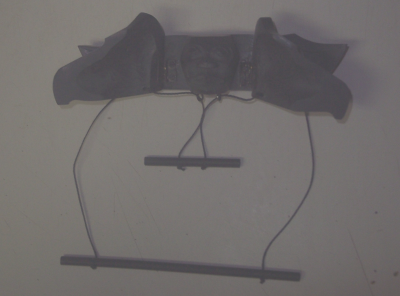
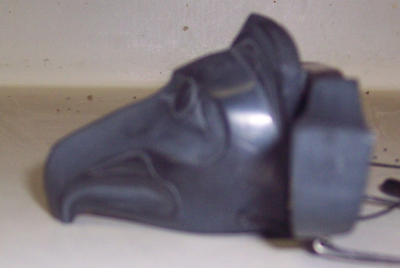
Ten years ago, Wayne Young was a promising journeyman in Northwest Coast art. Taught by such well-known figures as Dempsey Bob and Robert and Norman Tait, he had an enviable reputation for imaginative, often asymmetrical designs, and for fine finishing details on his carving. Now, however, illness keeps him from working. Since new works from him seem unlikely, when I first noticed this miniature argillite transformation mask of a raven and a human on the Alcheringa Gallery web site two years ago, I was immediately interested in buying it.

Not only was I interested in the artist, but I figured that the piece had to be one of a kind. I mean, a mask not only made of argillite, but with two faces? And one no more than fifteen centimeters long and six high? The thick hinges that the outer face swings upon and the fine screws drilled into the argillite are evidence of the difficulty in the construction – and also all the explanation necessary of why no one else is likely to try to imitate the piece.

However, obtaining the piece proved a challenge. When I visited the gallery fifteen months ago, none of the staff knew where it was. In fact, despite the fact it was still on the web site, they could never remember seeing it, and were sure it must be lost. However, three months ago, I queried again. This time, the gallery director answered, and could locate it.

Ordinarily, I don’t haggle over price. However, ten months previous, the mask had been part of an on-site auction, with a quick price that was two-thirds the listed price. Since the gallery had had the piece for seven years, I sensed it might be eager to sell it, so I offered the quick price. It was accepted, and I took a day trip to Victoria primarily to carry it safely home.

I declined the frame and beige and brown matting the gallery had added. I thought the frame did not do the mask justice; I am currently awaiting an argillite stand to display it properly.

Unfortunately, too, time has not been kind to the piece. Another artist who remembers seeing the piece when it was new remembers the outer mask closing evenly. Now, one hinge is slightly twisted, and one side of the mask is lower than the other when closed. A drop of glue on a couple of the screws might be useful, too, and perhaps a replacement of the black cord on the controls.

However, despite these imperfections, I consider the mask well worth having. The carving is simpler than most of Young’s work, but the lines need to be bold on a piece of such minute dimensions if they are to be discernible. Finer lines would be nearly invisible, and therefore wasted – nor would argillite lend itself to them. The fact that Young knew the restrictions of the size and the medium says a lot about his skill as an artist.

I could almost believe that Young deliberately set out to challenge himself by putting obstacles in his own path. If he didn’t, he must have soon discovered them. But, either way, he overcame the obstacles, not with inlays and other distractions, but with a well-designed, cleanly carved, understated bit of excellence. I consider myself lucky to have obtained it, and my only regret is that new pieces from Young are unlikely.

Read Full Post »

Yesterday, I had a date with a ghost.

You see, November 11 was the anniversary of Trish and I as a couple. It was not our wedding anniversary; that was for the public. November 11 was the private one, the day we kept for ourselves. Whenever we could, we took the day off, and at the very least we tried to go out to dinner, although once or twice in the last few years, she hadn’t been well enough for us to celebrate on the exact date.

This being the first anniversary since her death, I debated with myself all day if I would keep the date. Perhaps it was too sentimental? Too much giving in to grief? But in the end I decided I was observing the day in my own mind anyway, so I might as well indulge myself. I dressed in my best – a black Dorothy Grant shirt, my gold ring, my copper bracelet, and the Lyle Wilson pendant that Trish had won at a raffle at the West Vancouver Museum – and wore all black, one of the colors that Trish had liked best on me, and solemnly descended on the restaurant.

I had chosen La Rustica, an Italian restaurant we had known at its height when we were living in New Westminster. We hadn’t been there for years, but we had talked about returning there to see what it was like. Now, I would have to see for myself.

The restaurant had been extensively renovated at least once since we used to frequent it, so I couldn’t sit at the table in the back where a photographer had taken a picture of us on our fourth anniversary years ago. Instead, I was shown to a table for two on the edge of the vacant dance floor. On nights when the band played, I imagine it would have been a bad seat, the sort that single diners usually get unless they complain. But that night, I didn’t care; it was well away from the large party from the assisted living home who were the only other diners in the restaurant, so they wouldn’t notice my odd behavior.

My date, I imagined, was in a green turquoise dress with flowing sleeves, one of the few that I kept when I gave her clothes away. Her hair was long, and dyed auburn.

I ordered two glasses of white wine, and at first the server got it wrong, giving me two glasses of wine in a carafe. “If it’s not too odd, could I have another glass?” I asked. The server looked askance, but she did as I requested, not quite daring to ask what I was doing.

I poured our wine, then clinked the glasses together. Not daring to speak out loud because I knew I would end up sobbing in that horrible breathless way I have had during my mourning, I delivered the ritual Scottish toast and response that Trish had always loved since she first read it in George Macdonald Fraser’s The General Danced at Dawn:

“Here’s to us.”

“Wha’s like us?”

“Damn few, and they’re all deid.”

I followed that with the question that one or the other of us had always asked, “Has it really been __ years?”

“It doesn’t seem possible,” I whispered to myself, finishing the ritual. By then I was daubing at my eyes with the linen napkin.

My tastes have changed tremendously since I had last eaten at La Rustica, but I chose what had been my favorite meal: onion soup, followed by veal in a capers and wine sauce, and an amaretto gelato. The restaurant was dimly lit, but I knew my date was eating the shrimp, something I never prepare at home because it might trigger an allergic reaction for me, but which she always enjoyed when we ate out.

At the end of the meal, I asked if I could go into the back. But the years and the renovations defeated me, and I could not decide where our favorite table had been.

Maybe that was just as well. Wherever the table was, it would have sat hundreds since we had been at it, and we could have left no impression that would have remained.

The server was looking at me strangely, so I explained the occasion, and left a large tip before I left.

Ordinarily, I would have hardly felt two glasses of wine, but that night I did. I decided that I couldn’t bear the bus, so I walked down the hill to the Skytrain to sober myself up. By the time I boarded, the cold had cleared my head. I didn’t say goodbye to the ghost, of course; she followed me home.

People talk of melancholy although it were a form of depression, and should be avoided. If you believe that, you will never understand, but I enjoyed my company that night, although the encounter left me feeling drained.

I don’t know if I will be returning to La Rustica, which proved only adequate (the sauce had too much lemon, and the restaurant was no longer growing its own herbs on the roof). But I already know that my companion and I will be going out again on our wedding anniversary, as well as next next November 11th.

Read Full Post »

Remembrance Day is a holiday that always leaves me feeling ambiguous – to say nothing of slightly guilty about my ambiguity.

On the one hand, I have no trouble extending my respect to soldiers. They do a dirty and dangerous job that is often essential. The fact that, in Canada, they do it with inadequate equipment and wages that hover around the poverty line only makes them more worthy of recognition. For some, desperation might play a part in enlistment, but considering the conditions, I figure that a sense of obligation and loyalty must frequently play a large part in their career choices.

Nor do I have any trouble remembering history. If alternate worlds exist, there are a good many in which I am a historian, and, in this world, history forms a large chunk of my reading. I am constantly exasperated at how little sense of history the average person has, so an event that encourage people look back at the last ninety years seems worthwhile to me. I only wish more holidays encouraged such backward gazes.

On the other hand, the emphasis of Remembrance Day has changed greatly since I was a child. When I was growing up, the point of the holiday could have been summarized as “Never again!” I’m not sure of the intention of that message, but I took that to mean that we should do everything possible not only to avoid global conflicts like the one that originally inspired the holiday, but also to avoid wars altogether. I was proud that I lived in a country that focused on peace-keeping, because that seemed to be the enlightened, modern view.

However, in the last couple of decades, respect for soldiers seems too frequently to have become respect for the policies that send them abroad. The message I hear is that if you support the troops, you must also support the Canadian presence in Afghanistan, and that, if you don’t, you are some sort of hypocrite. That seems a false dichotomy to me, and I regret that the day has stopped being a reminder of what we want to avoid and has become instead an extension of government policy.

Along with this new propaganda has come the sort of rhetoric that I have always despised. The rhetoric uses words like “sacrifice” and “honor.” Soldiers do not die; they “fall.” To hear this new propaganda, you would think that soldiers did not simply accept the risk of death, but rush to it with the eagerness of Monty Python’s Kamikaze Scotsmen, eager to show their patriotism by making the supreme sacrifice. Personally, I suspect that they are just unlucky, and no matter how great their idealism, would probably prefer to still be alive.

Such rhetoric seems false at the best of times. Far from being a way to express respect, it seems a way to avoid really thinking about the gory details to which you are alluding. However, it seems even more false when applied to the subject of war

.Read the war poetry of Robert Graves, Siegfried Sassoon, or Wilfred Owen – people who had fought in the front lines, and knew what they were talking about – and you quickly find that this is exactly the sort of rhetoric that they railed against. It is the rhetoric that lured the generation of men who were young during World War One to be butchered by the incompetence of their generals. Now, though, “Lest We Forget” no longer seems to include remembering the danger of such rhetoric. But I do not forget, and I greatly resent the fact that it is creeping back into fashion.

I am sure that some readers will damn me for these sentiments, and doubt my sincerity. But, despite the tendency of mainstream media to reduce everything to an either-or question, I’d like to think that a mixed perception is still possible.

Respect for the average soldier is not synonymous with jingoism, and the sooner we separate them, the better. Until we do, Remembrance Day remains a holiday that I can only partly support.

Read Full Post »

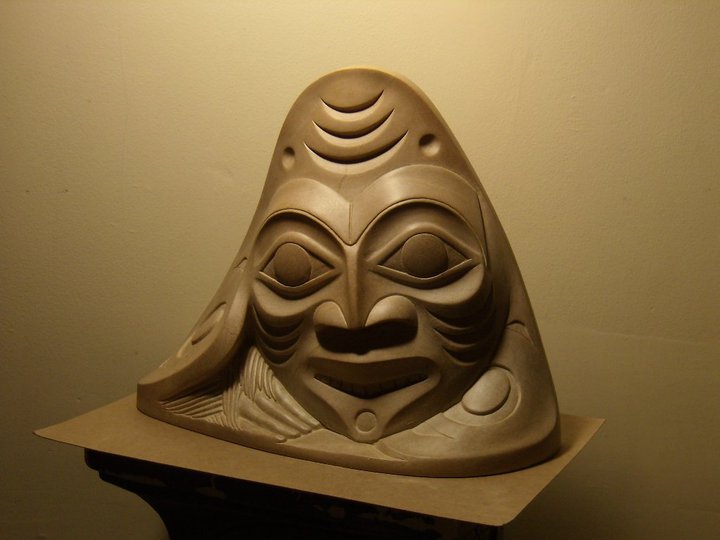
I never buy art unless it catches the eye or intrigues me in some other way. However, some purchases loom larger than others , and Gary Minaker Russ’ “Haida Sharkwoman” is one of them. I am not talking about price (although “Haida Sharkwoman” is one of the more expensive pieces that I’ve bought), nor size (although at fifty-three pounds, it is one of the heaviest), but about artistic integrity and excellence, both of which the piece has to spare.

Minaker is best-known as an argillite carver. Working with hand tools and preferring natural finishes, he has a tendency to go his his own way that some gallery owners think has hurt his career, but that keeps his work original. In the last few years, he has been resisting the pressure to carve for the market and produce copies of Bill Reid’s “Raven and First Men” or endless variations on Raven stealing the light. He has also been chafing at the growing tendency for inlays of precious and semi-precious stones and metals on argillite, which drives up the prices while rarely improving the actual lines of carvings.

Consequently, he has been branching out and trying to create a new market in Brazilian soapstone in the hopes of finding greater artistic freedom. He has had mixed success, he tells me: private collectors have no trouble accepting his new direction, but many galleries do. Still, he perseveres, partly because it is easier to find large pieces of soapstone than of argillite to produce such pieces as “Haida Sharkwoman.”

Forty-five centimeters long and thirty-five wide, “Haida Sharkwoman” is carved on one side and flat on the back. The asymmetrical curve on the right, Minaker says, was in the raw block, and only required refining.

Sharkwoman (not to be confused with Dogfish Woman, whom Charles Edenshaw and Bill Reid made famous) is a subject that Minaker has returned to many times in his work, just as Beau Dick keeps returning to the Bukwis and Tsonoqua. He suggests, only half-jokingly, that the subject reflects the difficulties he has had with the women in his life, adding that he tries to restrict himself to no more than one return to the subject each year.

The sculpture shows a woman half-way through a transformation into a shark. In modern northwest coast art, such a transformation is often depicted as a twisting of a person’s existing limbs, rather like the werewolf transformations seen in modern computer-generated special effects. That approach is unquestionably dramatic, but Minaker has chosen to depict the new shape as a blanket draped over the figure, as in the old stories. Here, you have the shark’s fins falling over the woman’s head like a hood, as her face, still showing her labret, is slowly transformed by the gills and flat snout of the shark.

The sculpture is dominated by the abstract carving style of the face and the fins. However, at the bottom right is a more realistic set of fingers half-covered by hair. This contrast emphasizes the transformation; it is only when your glance falls on the realistic hand that you realize that the transformation is taking place.

Notice, too, that the position of the hand suggests that the woman is propping herself up on her stomach against a rock, waiting for the transformation to complete so that she can begin to breathe the water.

The carving is further enhanced by one of the most sinuous and three-dimensional formlines that I have ever seen, beginning at the lower right of the fin, and twisting up to the eyebrows. From there, it continues around the face and jawbone to rejoin the right fin again, keeping the viewers’ eye in constant motion. And, should you detour down the nose or around the lip, the gills are on both cheeks to force your gaze back to the main formline. As a result, you soon tend to attribute the movement of your own eyes to the sculpture itself, and start imagining that its eyes are moving to watch you – not necessarily in a menacing way, but definitely an alert one.

I say “necessarily,” because the impression that “Haida Sharkwoman” makes can vary wildly. The combination of the formline and the reflective quality of the soapstone makes the sculpture look dramatically different in various lights. I have seen it a pale beige in bright sunlight, looking serene; golden in the reflected light of a flash, looking otherworldly, and dark in the shadows, looking sinister. The piece is so varied that I can get a different perspective on it simply by moving it to a different location.

One thing I’ve noticed, though, is that it tends to dominate a room, no matter where it’s put. After several experiments, I’ve given in and placed it on top of the TV cabinet, which most of the living room centers on anyway. As a major piece of art, it seems to belong there.

Read Full Post »

No Halloween costume for me this year. I’m still getting in character for my new everyday role as a widower. But my time will come around again, and meanwhile I’m thinking of the costumes I wore in the past.

The earliest costume I remember was a cowboy, put together when I was four or five., under the influence of Lone Ranger episodes, whose introduction I knew by heart. I was under the belief that the costume would actually disguise me, and was bitterly disappointed when people had no trouble recognizing me.

The next costume I remember was a monk’s habit, salvaged from a play in Grade Two that never happened. To my outrage, I had been cast as Friar Tuck when my destiny was clearly to play Robin Hood, or at the very least Little John. But, next Halloween, I added a skull mask to the costume. I remember in my juvenile cunning, I figured that, if I took off the mask, I would have a completely different costume, and could go around to the houses twice without anyone noticing. I was right, too, although my conscience kicked in after the fourth or fifth house and I stopped the deception while keeping the candy.

Treasure Island must have produced a pirate or two, because I remember a plywood cutlass that my father cut out for me and spray painted silver. But the next costume I remember clearly was the remnants of my Cowardly Lion costume from the Grade Five production of The Wizard of Oz. I had loved acting, and using the costume for Halloween was a way of hanging on to the excitement of the production a little longer.

Then came the age when I thought myself too old for trick or treating. It started in Grade Seven and lasted until my second year at university. By then, I was in the medieval club, and used to dressing in costume most weekends. But for medievalists, Samhain, the Celtic predecessor of Halloween, was always a major event. Once or twice, I simply went in my usual persona of Ullr Ericsunu, the Icelandic farmer sojourning at the court of Athelraed Unraed in England.

But for Samhain and other events, I also created a minor persona of Alain d’Alancote, a small-time Breton merchant living in York, so I would have an excuse to wear fourteenth century costumes with dagged hems and sleeves. Alain was born of the medievalist custom of coming to Samhain as an ancestor or descendant of your main persona – although how exactly Ullr and Alain were related, I never quite figured out.

However, Ullr and Alain disappeared when I left medievalist circles, and so, for the most part, did the costumes. I remember once pulling on a farmer’s smock that Trish made for me, and lugging along Ullr’s shepherd crook, which became a nuisance by the end of the evening.

Right now, I have no idea what my life will be like next Halloween. But, judging from my enjoyment of the costumes I’ve seen on the Skytrain in the last few days, I suspect I will be spending it in costume – and about time, part of me is muttering.

Read Full Post »

« Newer Posts - Older Posts »